Eye of the Cormorant

another odd bird who chases fish.

Category: Fishing Reports

  • Tarpon colors

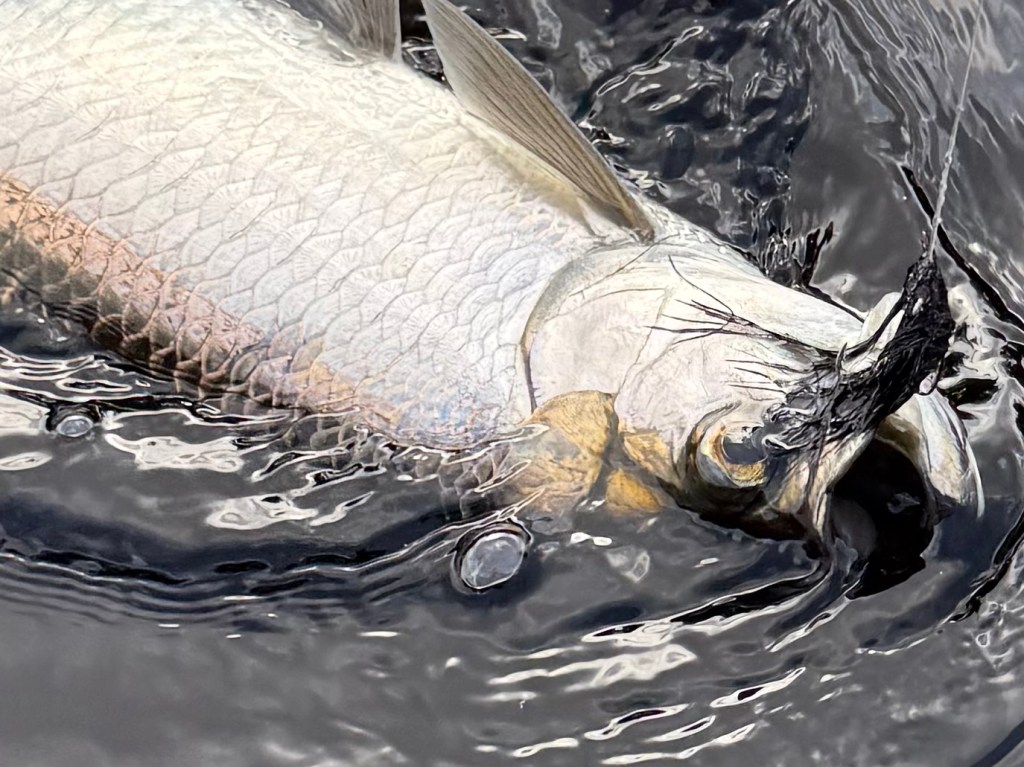
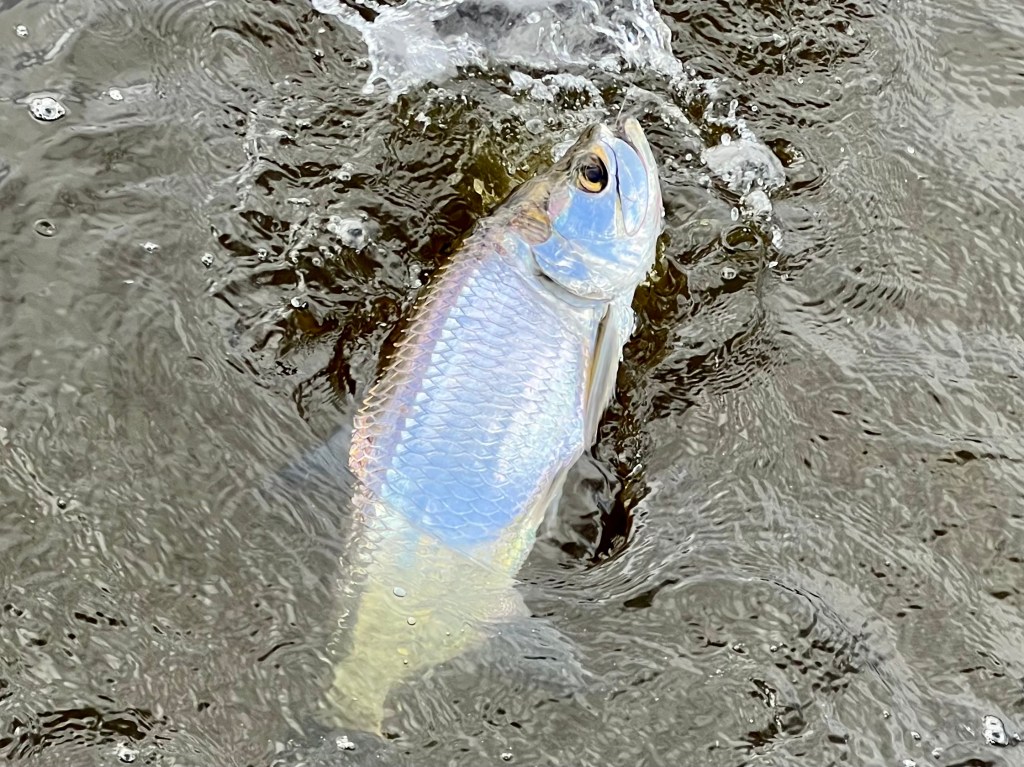
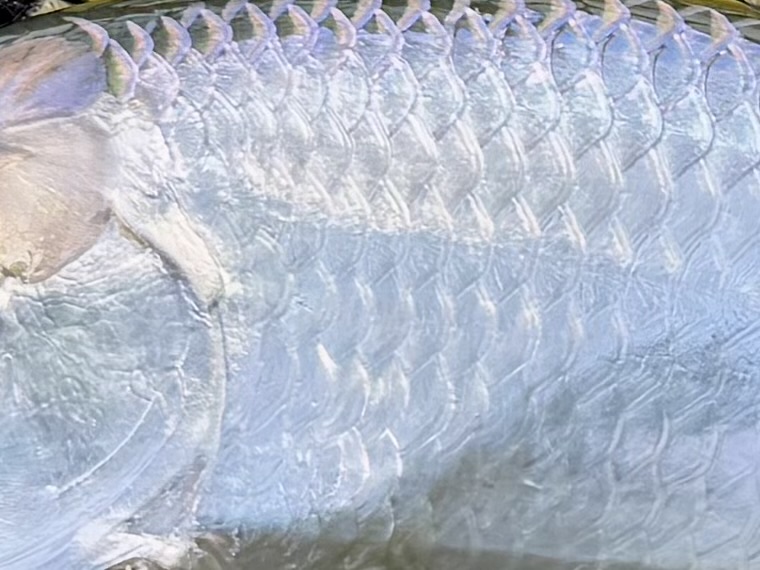
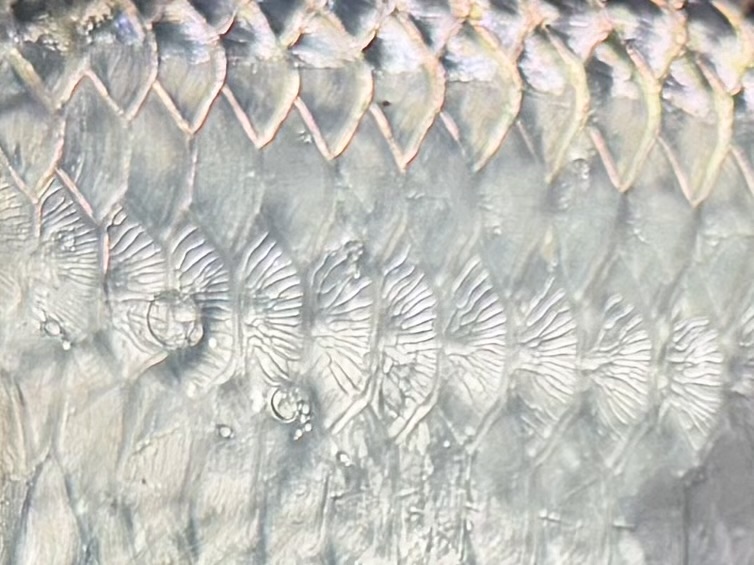
    Fish are often camouflaged, some by color and patterns that resemble their backgrounds, others by reflecting the light around them and thus matching any and every background. Tarpon do the latter with scales that work like mirrors.

    Juvenile tarpon are about my favorite fish to chase on the fly rod. I say “juvenile” because the adults weigh 70 to 200 pounds. I normally avoid disturbing the adults and fly fish instead for smaller juveniles weighing 3 to 20 pounds, reasonably common in the canals and tidal creeks of South Florida.

    Tarpon are smart and strong, and they are spirited jumpers. The mantra among tarpon fishers is “Bow to the King”, meaning when the tarpon jumps, you lower the rod to create slack and prevent it breaking off or throwing the fly.

    Instead, I lightly tension the fly line during a jump to help the tarpon toss the fly without breaking the line. My goal is to fool the tarpon into eating my fly, have it give me a showy jump or two, but spare it the exhaustion of a complete fight and spare me the guilt of exhausting a beautiful fish.

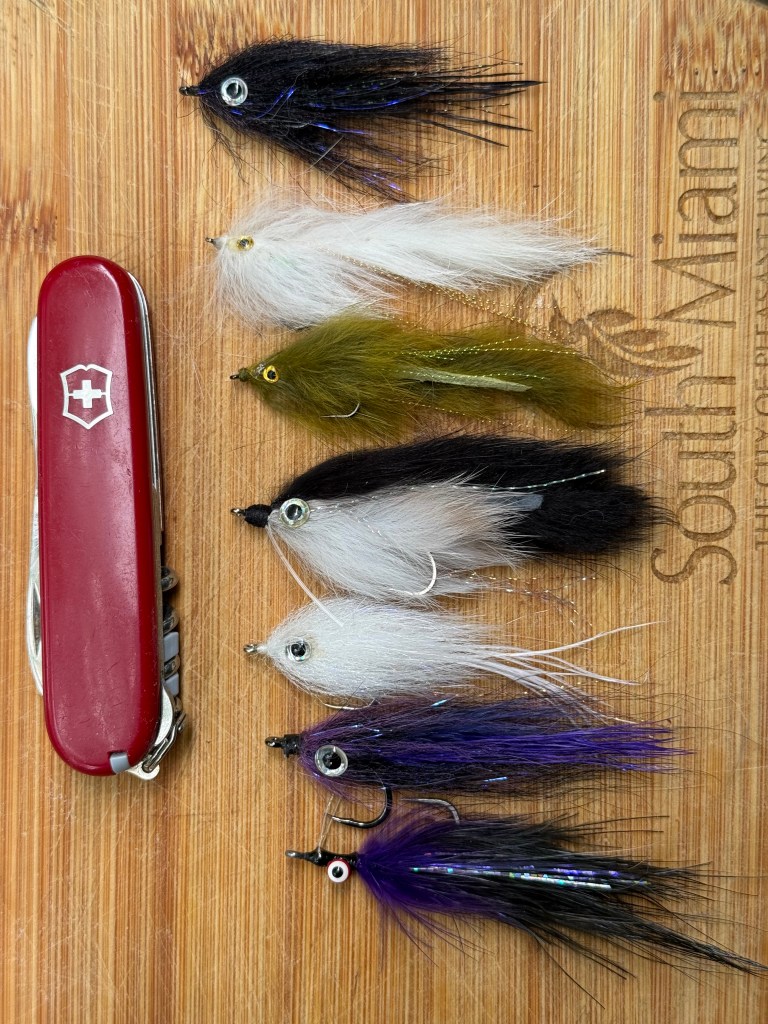
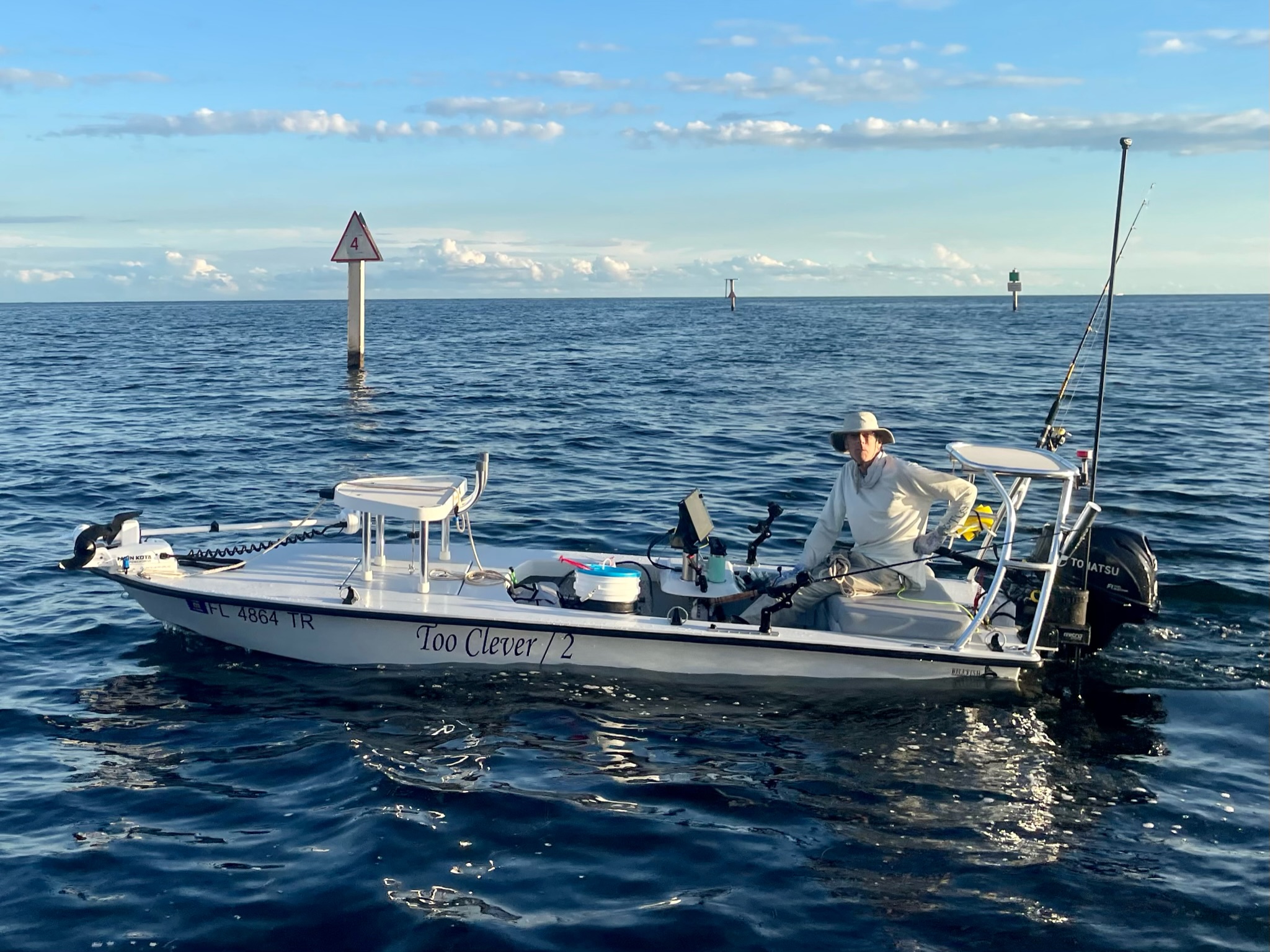
    Yesterday, while kayak-fishing a saltwater canal, three miles from home as the cormorant flies, I spotted a couple of big juvenile tarpon in the 40-60 pound range. I swapped up to a larger fly “the Devil’s Daughter”, a muted black pattern designed by Drew Chicone for catching tarpon that are wise to the fly fisher’s usual sparkly fare.

    Tarpon can breath air, “rolling” on the surface to gulp a bubble before descending into the murky water. Following a roll, I’d cast the fly 6-10 feet in front, let it sink a bit, and retrieve it steadily. Twice I felt “short strikes”, in which an unseen tarpon grabbed only the feathery tail of the fly. A couple of casts later the fly stopped mid-retrieve, like I’d hooked a log. I set the hook and the line began to pull. The fish was in no hurry.

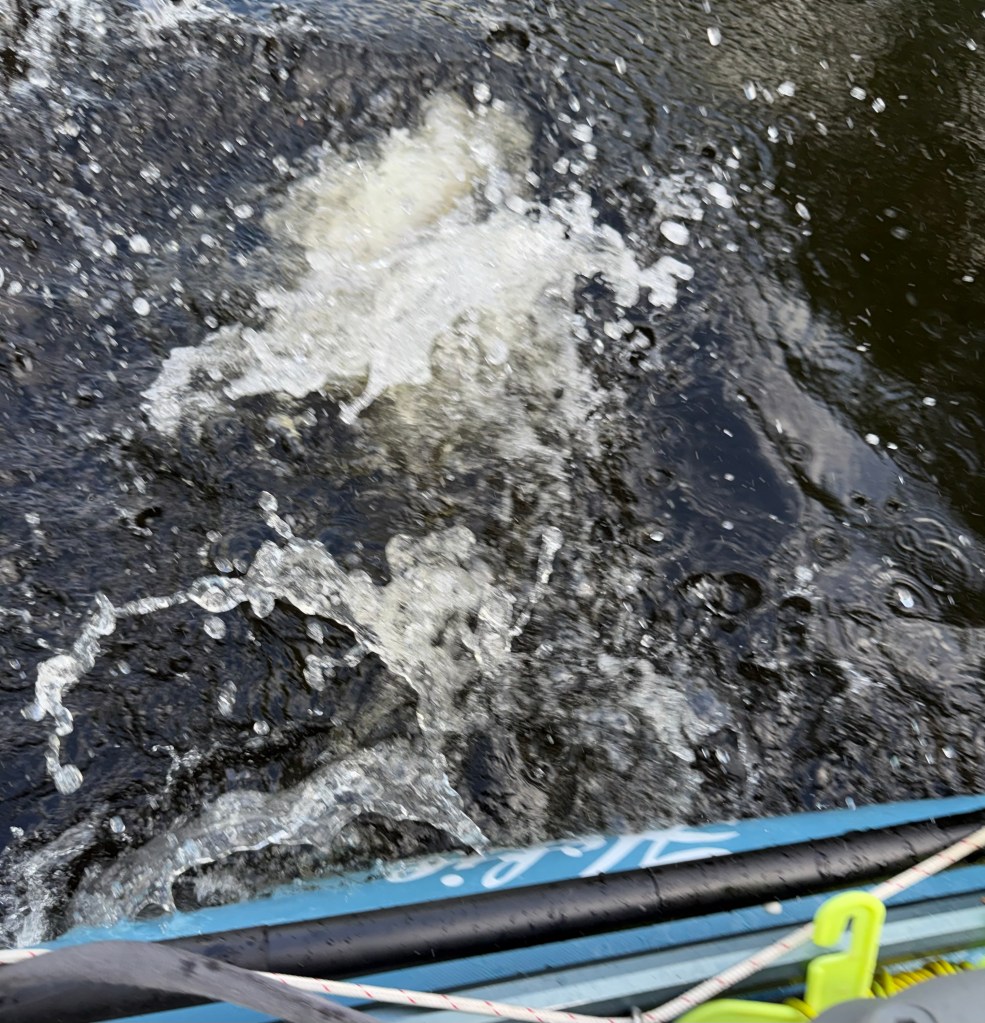
    Smaller tarpon jump immediately. Instead this tarpon went deep and swam away slowly. I took up the slack and kept reeling until my 7wt rod bent double and the leader touched the tip guide of the rod. The tarpon turned and made a dash under the kayak. I flattened the propulsion flippers to keep the line free as I worked it around the bow and the tarpon took off. Once in a while, I’m glad for the smooth drag on my fly reel.

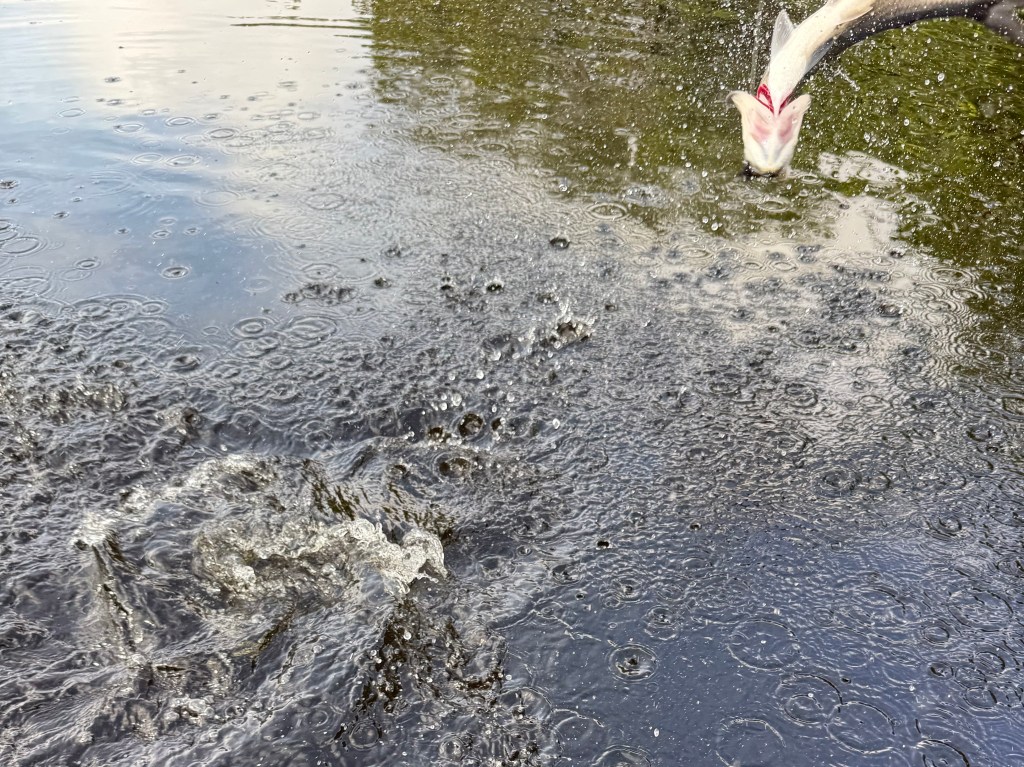
    We had been pulling back and forth on the fly line (intermediate clear tip) for a couple of minutes and the tarpon had enough. It took to the air, arcing its body in a fast reciprocating shake that tossed the fly. I got my fly back and the tarpon continued on its hunt for hapless baitfish. I was ecstatic – that’s about as good as it gets in my book.

    Sometimes the fly won’t shake loose and I must net the fish to release it. While I have it in the net, I usually take a photo to document the spectacular purples, pinks, blues, and greens reflected by the tarpon’s mirrored scales. Here are some photos from my collection.

    Thank you, tarpon.

  • Return to Mosquito Hell, with a most striking dawn

    Return to Mosquito Hell, with a most striking dawn

    My last few fishing trips onto the flats have been unproductive. The late summer water has been hot and low in oxygen. Maybe the fish are somewhere else, or maybe they’re just laying low. Tomorrow morning I’m venturing back into the mangrove lakes of Mosquito Hell, an area where I always find fish this time of year, assuming the Black Salt Marsh Mosquitoes (BSSMs) don’t drive me out first.

    Trip planning

    The moon is near full tonight, so the morning fishing activity is likely to be brief. I plan to arrive in the dark to maybe find a snook or two before the sun comes up. Then I’ll peddle-paddle my kayak to an area where the tarpon hang out and snook spend their day hiding in the mangroves. Occasionally, a snook wakes up for a mid-morning snack. If I find the juvenile tarpon rolling, I can see if they’ll play with me. Like snook, tarpon feed actively at night on a full moon, so they may be sated by the time I arrive.

    I’m preparing for the BSSMs the night before, putting into play a few improvements over my last trip to Mosquito Hell:

    I take my khaki fishing pants, outer shirt, and gloves to the driveway, spray them with DEET, and place them inside a 2-gallon zip-loc bag.  I lay out a towel to protect the car seat from the DEET. The rest of my special mosquito gear I place on the passenger seat: for my head, a Tilley hat and insect head net; for my feet, Simm’s neoprene wading gaiters and neoprene dive booties. Mosquitoes are not going to bite through 5 mm of neoprene.

    My scheme is to drive to the launch in the dark, and change into my stinky DEET-soaked clothes, then get out of the car to rig and launch my kayak. I will start fishing at 06:00, before the first dawn light. The nearly full moon sets at 05:49 and the sun rises at 07:06, with civil twilight starting at 06:36.

    It’s tricky fishing in total darkness, and tricker fly fishing. I only know that a snook is nearby if I hear it blow up the water while chasing mullet. Sometimes the water is silent. Other times I cast too far and hang the fly into a mangrove tree. Then I have to turn on my head lamp to untangle the line and of course the light attracts mosquitoes to my head. But other times I cast the fly near a snook and things get exciting in a much better way.  Hope springs eternal.

    My alarm is set for 3:50 am. Time for bed.

    Fishing report

    On the Mosquito Horror Scale (0-10) the morning ranks an 8, “Severe” but not “Extreme”. My mosquito gear system works perfectly. The only mosquitoes that try to bite me are 3 or 4 that go for the pads of my fingers where I have no repellant. That’s not a safe place for a mosquito to bite a human, and they are instantly dispatched with a pat of the finger. With my DEET-soaked outer clothes, mosquitoes don’t even follow me into the car.

    No mullet are splashing around the kayak launch area in the dark, so no predatory fish are there either. Too bad – sometimes the fishing is amazing right there. I light out for the far mangrove shore, about a mile’s paddle.

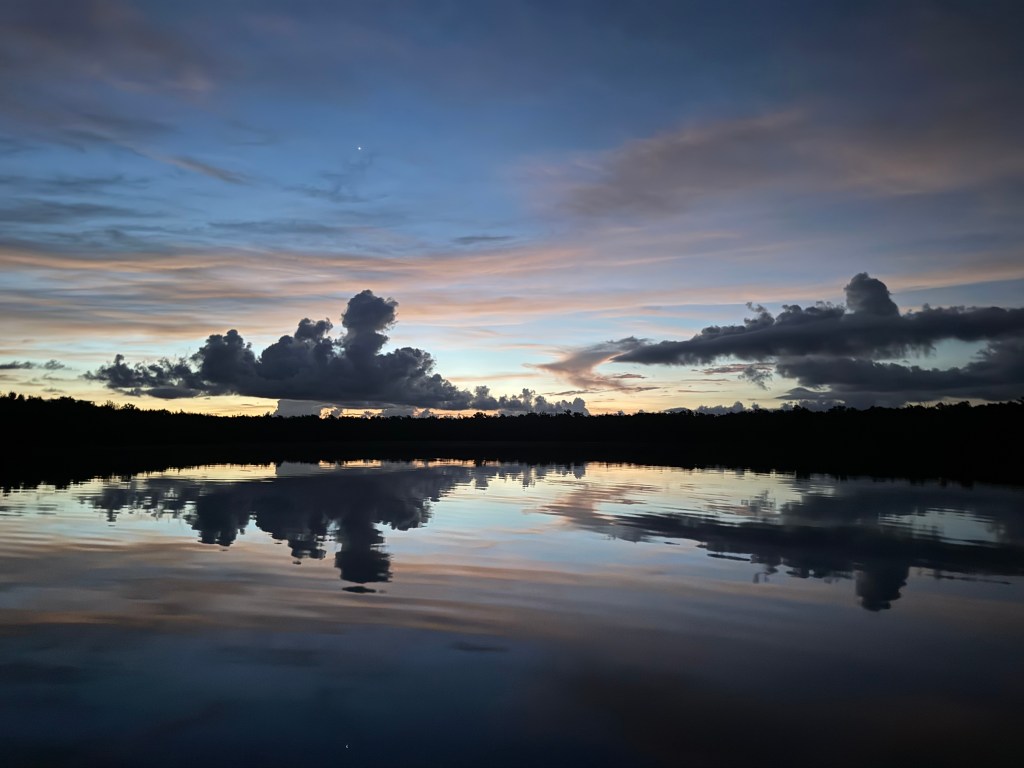
    The first traces of dawn light appear, with Venus still visible directly above the tallest thunderhead on the left.

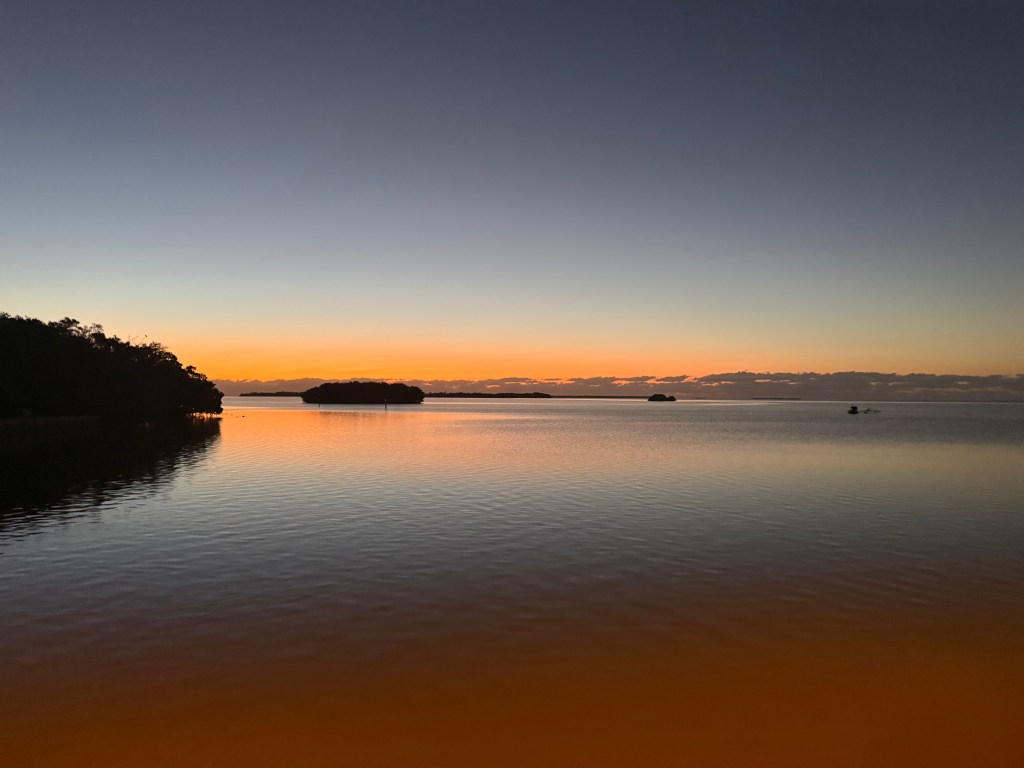
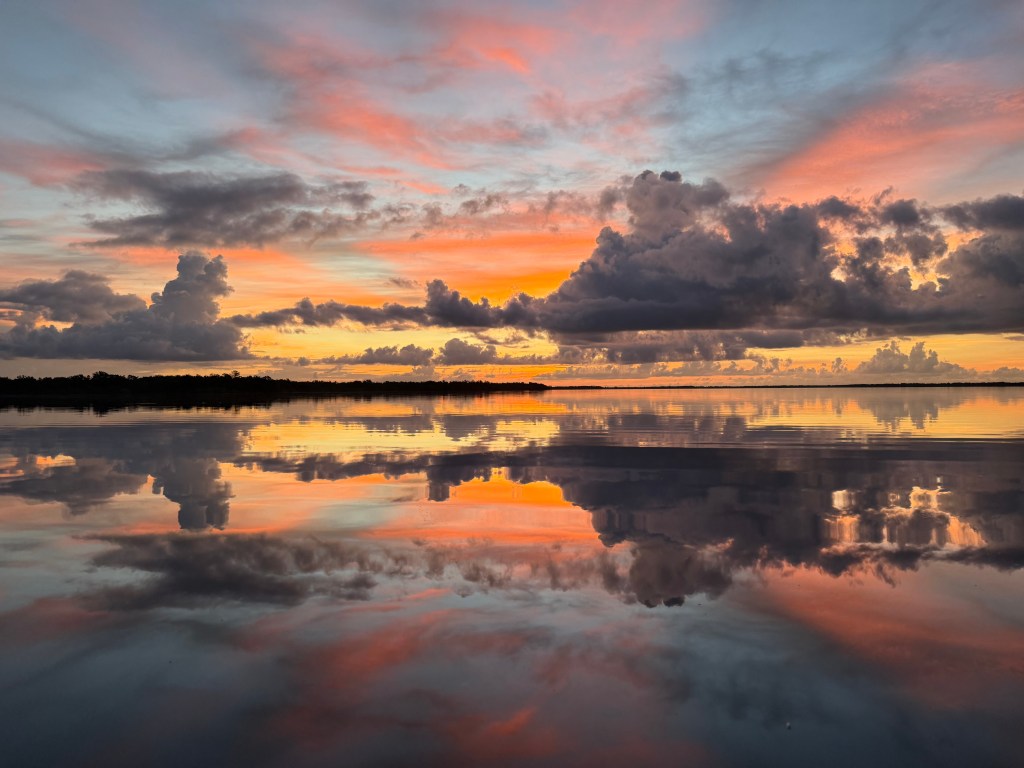
    Dawn explodes enroute. Yowza.

    I reach the other side eight minutes after sunrise. The water is extremely murky and tannic, like donut shop coffee with a tiny splash of horrid non-dairy creamer. I dip my finger in the water and taste it through the head net: slightly brackish.

    To find fish in water this opaque I need a “search bait” that’s dark, for maximum contrast when viewed from below against the sky, but with some sparkle and a lot of vibration to get a fish’s attention. I put away the fly rod and rig my spinning rod with a 4” paddletail in rootbeer & gold with a gold underspin jig – just the ticket.

    The paddletail, true to its name, wiggles its tail back and forth, and the underspin leaf twirls up a storm.

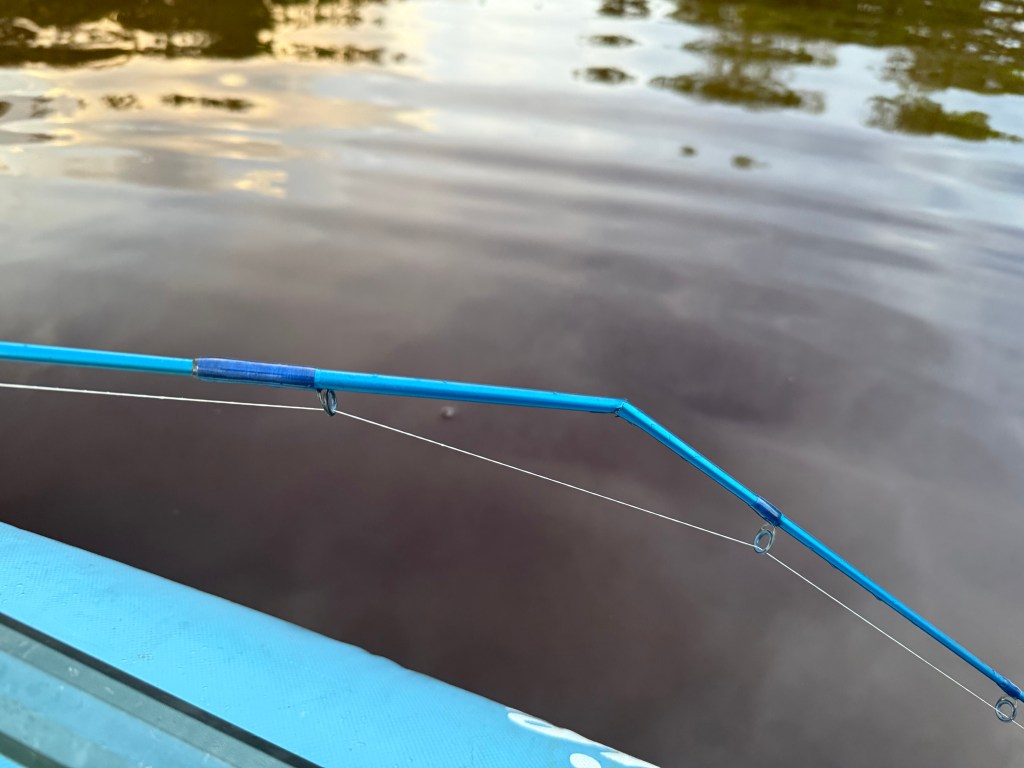
    At 7:15, my second cast is slammed by a snook in the 30″ range. It makes one jump, a brief lateral run pulling line off the reel, then runs straight for me as fast as I can take up line. It passing directly under the middle of the kayak, bending the rod hard. The  tip section of my three-piece TFO travel rod snaps, creating a brief moment of slack that pops the lure free of the fish’s mouth.

    This is the 4th time this spinning rod has broken, every time in exactly the same spot, 5″ above the ferule. Until now, I’ve blamed myself, but thinking on it, each break occurred under a different circumstance and stress geometry and I’ve never broken any other spinning rod. I’d wager the TFO Traveler is weak at the internal edge of a carbon fiber sheet wrap. I will write the company about this problem. I bought two replacement tip sections the last time one broke, so I still have one left, but I need a more reliable multi-piece spinning rod.

    Why even bring a travel rod on a local fishing trip? When kayak fishing tight to the mangroves, it helps to have the rods I am not using at the moment disassembled and stowed safely out of the way. That’s a key advantage of multi-piece rods, not to mention the obvious advantage when I travel.

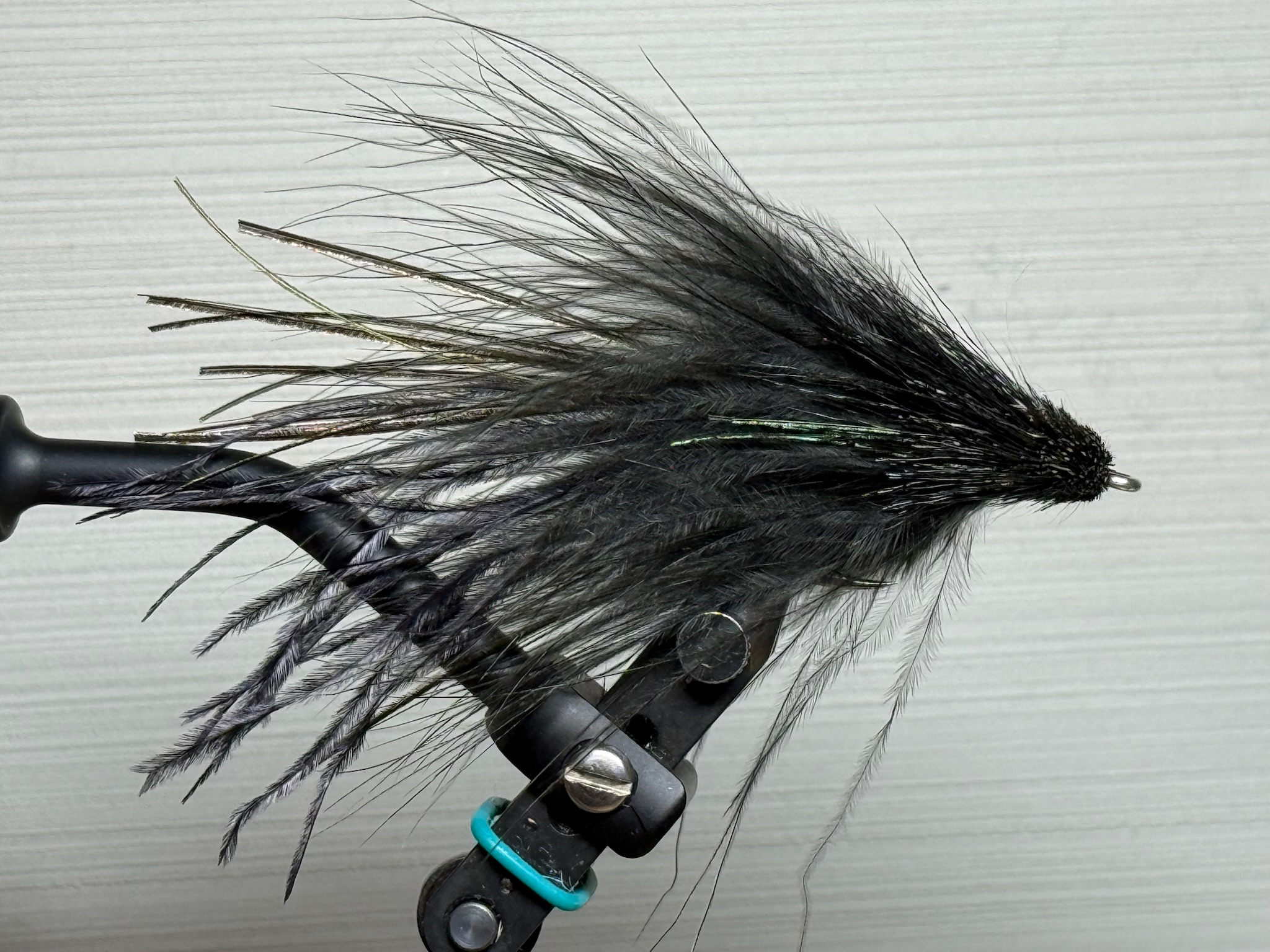
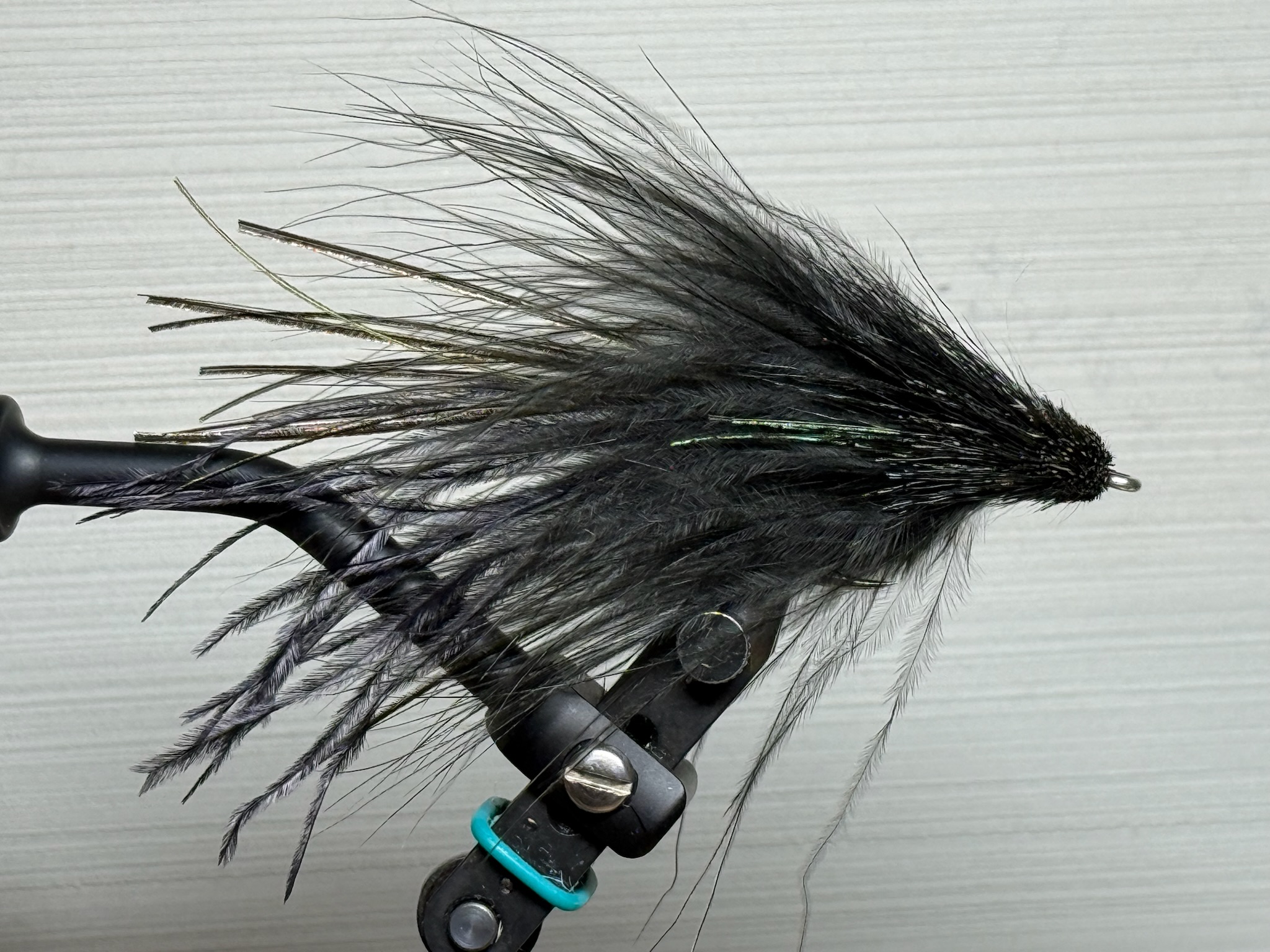
    Back to fishing. Having broken the spinning rod, it’s “fly or die”. I re-assemble the 8wt fly rod and choose a black dark-water fly, this one tied from Drew Chicone’s pattern, The Devil’s Daughter. The tail is ostrich and peacock herl, the body is fluffy marabou feathers, and the head is spun deer hair. Peacock herl gives It shimmer and the ostrich and marabou make it swish enticingly in the water.

    I start with the fly in the photo and immediately hang it in a mangrove. Impatiently, I shove my kayak into the mangroves to untangle the fly, leader, and line, then tie on another I’d made with a weed guard to keep it from hanging in trees and roots.

    Predatory fish that have spent the night foraging under a bright moon generally won’t be hungry again until the afternoon. This morning fits that typical pattern, with fish ending their feeding spree shortly after sunrise, shortly as in 9 minutes. In the next hour, I get rained on briefly (feels good) and catch a couple of small juvenile tarpon on fly (they’re always hungry), while their older cousins roll on the surface for air but won’t eat.

    Fishing is over until afternoon but the shoreline holds birds, orchids, and bromeliads. I can see for miles, the mosquitoes have let up, the rain shower has cooled things off, and I have yet to spot another human. It’s has turned into a pretty fine Sunday in the Everglades wilderness, but it’s time to get out. Bigger storm clouds are assembling and I don’t want to be crossing open water in an electric storm.

    On the way home I stop by Moreno’s Tortilla shop in Florida City to pick up hot tamales and a pack of corn tortillas. Josephine greets me and knows what I want without my asking. This little hole-in-the-wall makes the best Mexican tamales and you can’t buy all-corn tortillas this good in a supermarket.

    On the drive back, I divert 10 miles to check out a canal that friend Jay and I had identified from a YouTube video. In the video, a young kayak fisher from out of town was catching lots of fish while getting bitten on the eyelids and lips by something he called “yellow flies”. As soon as I step out of the car I am engulfed by a swarm of hungry deer flies. Uh oh.

    I consider deer flies even worse than mosquitoes because they are active midday when it’s too hot for protective bug clothes, they will find the the tiniest spot of skin on which you did not apply repellant (e.g. lips and eyelids), and their bites really hurt.

    Climbing over two metal gates, swat swat swat, I find the kayak put-in, swat swat. From the vague track through the vegetation, swat swat swat, I can tell it’s rarely used. I wonder why not, swat swat.

    I mash the deer flies that followed me into the car and photograph one that wasn’t too mangled.

    Serious rain slows the drive home but returns a few minutes by washing salt from the kayak and car.

    Unpacking my fishing gear, two stow-away mosquitos escape into the house. It’s still summer here in South Florida where if it’s not one nasty biting bug it’s another. I’ll bet the Wisconsin Driftless Area is getting really nice about now.

    © Philip Stoddard
  • Fishing with alligators

    Fishing with alligators

    As a rule, backcountry alligators avoid people, while those dwelling in human-infested waters learn that associating with humans can provide an easy meal.

    Feeding alligators is a very bad idea, though alligators in this second group believe that feeding alligators is a very good idea. They hold that the highest calling of human newcomers to the swamps is to catch big fish and feed them to deserving alligators. These alligators can be bold, aggressive, and very dangerous. If you toss a rock at one to scare it off, it assumes you are throwing food and comes closer.

    I fly fish tarpon in the tidal creeks and ponds along the Tamiami Trail, Florida Route 40 (“The Trail”), about 70 miles west of Miami.

    Last year, two human-adapted alligators ran me out of a productive pair of ponds. The smaller gator, an 8-footer, even came out of the water and chased me overland in a bid to snatch the tarpon I’d caught and had intended to release unharmed. Sprinting from a gator with a 10 pound tarpon in your arms is an effective cardio workout. I always think back on that morning when people tell me “I want to take up fly fishing – it looks so relaxing”.

    The ponds along the Trail do hold a lot of fish, but I cannot manage a big fish and fend off a bold alligator at the same time. I needed a way to convince the gators to leave me alone before I would fish there again. I needed a partner. A brave partner with experience in the ways of alligators.

    I met Gabriel Ross through an online fishing club. In time I learned that Gabriel knows a lot about freshwater fishing in South Florida. He fishes the Trail regularly and has both a sunny disposition and a high tolerance for mosquitoes. Importantly, Gabriel is not unhinged by alligators, which he has fished around all his life. Just the fellow I’d wanted to meet.

    On our first fishing trip together, I brought along two special items. The first was a new net with a long handle and silicone mesh, ideal for lifting big fish clear of the water quickly and gently. I don’t want to fall in the drink with a hungry and excited alligator moving in, and I don’t want to let a precious gamefish bounce around on the ground. Nothing annoys me like seeing video on YouTube featuring some proud, clueless asshole letting a tarpon flop around in the rocky dirt or on the pavement while he gropes around trying to unhook it. The second item was the 18’ carbon fiber push pole from my skiff, already proven useful for poking nosy sharks on the flats. Eighteen feet seemed like a good minimum distance to maintain between myself and a hungry alligator. I’d replaced the push pole’s sharp metal point with a flat-tipped cone 3D-printed of polyurethane, so a hard poke from the pointy end would not make a hole in the recipient. 

    Gabriel and I met up at dawn at the appointed pond on the Tamiami Trail. As Gabriel set up his minnow trap, an alligator began to move out of the mangroves. More and more of it. It was massive, 9’+, and it was coming towards us. 

    At 18 feet and closing I made my move.  Holding the push pole aloft with a firm grip on the broad shoe end, I let the other end fall two feet through the air onto the alligator’s head with an audible clunk.

    A gator this big is never challenged. He wheeled around and snapped at the push pole. I whipped the pole upwards in time to save it, and again dropped it on the alligator’s head – BONK!

    The gator wasn’t scared, he was pissed. He turned to face me, opened his mouth, and hissed. My next two strikes were a couple of sharp, well-placed pokes in the nose. Inspection of an alligator’s skull shows the nose is bony, not soft like a shark’s. Still, you’d think it would make an impression to have an 18’ pole thrust directly onto the tip of one’s nose, reinforced or not.

    I was preoccupied when the big gator was around, so here’s a photo of a smaller one later in the day.

    The alligator went underwater, but did not flee. Two sharp nudges in the ribs finally convinced him he was not going to be left alone, much less fed a snook or a tarpon, and he reluctantly departed.

    Cool as a cucumber, Gabriel never batted an eye throughout the commotion, quietly tending his minnow trap and bait bucket and re-rigging his spinning rod for bait-fishing. Only when he stood up did Gabriel mention that he carries a handgun to fire into the ground if a gator comes too close. Gators, he explained, are frightened off by the noise. Me too. Glad he told me before he had need to use it.

    With the big guy gone, the pond’s usual resident gator, a 6-footer, came out of the mangroves and swam up to us.

    “Feed me a fish?”

    It only took three pokes to send her to a far corner of the pond, where she found something else to eat (num num num). She stayed far away from the two-legged maniac with the push pole and from Gabriel’s minnow trap. Minnow traps are a favorite snack food of alligators.

    Oddly, the tarpon that are always common in the ponds north of the Trail were largely absent. I gave up pitching flies for missing tarpon, and got my first lesson in bait-fishing freshwater snook on the Trail.

    Bait

    The African Jewelfish (Hemichromis bimaculatus), also known as the Jewel Cichlid, is an invasive exotic from the pet trade.  My former doctoral student, Vanessa Trujillo, studied Jewelfish in the Everglades. Vanessa found that African Jewelfish beat up the small native fish species during the spring drydown, which they can do because they’re tough and mean. Jewelfish outbreed native fish in rainy summer floods because they have biparental care that ensures better survival of their offspring. 

    African Jewelfish, photo Gabriel Arenciba, The Art of Microfishing

    African Jewelfish are abundant in these ponds, so snook are already cued into looking for them. Because jewelfish are tough, they hold up well as bait until a snook eats them. Gabriel finds jewelfish easy to catch in a minnow trap baited with stale, week-old brioche. Bien sure.

    Gabe recommended connecting the jewelfish’s lower lip to a 4/0 circle hook. Circle hooks have the point concealed inside the hook gap, so when a predator fish swallows the bait (bye-bye jewelfish), the hook does not lodge in the predator’s stomach, but slips free until it encounters the jaw, yielding a clean hookset. An additional trick I learned from Chico Fernandez’s book on bonefish is to press down the very tip of the hook barb rather than pressing the whole barb flat or leaving the barb intact. The goal is to leave the barb shaped as a bit of a hump; it hooks up more reliably this way and makes it possible to remove the hook without tearing anything.

    Time to fish

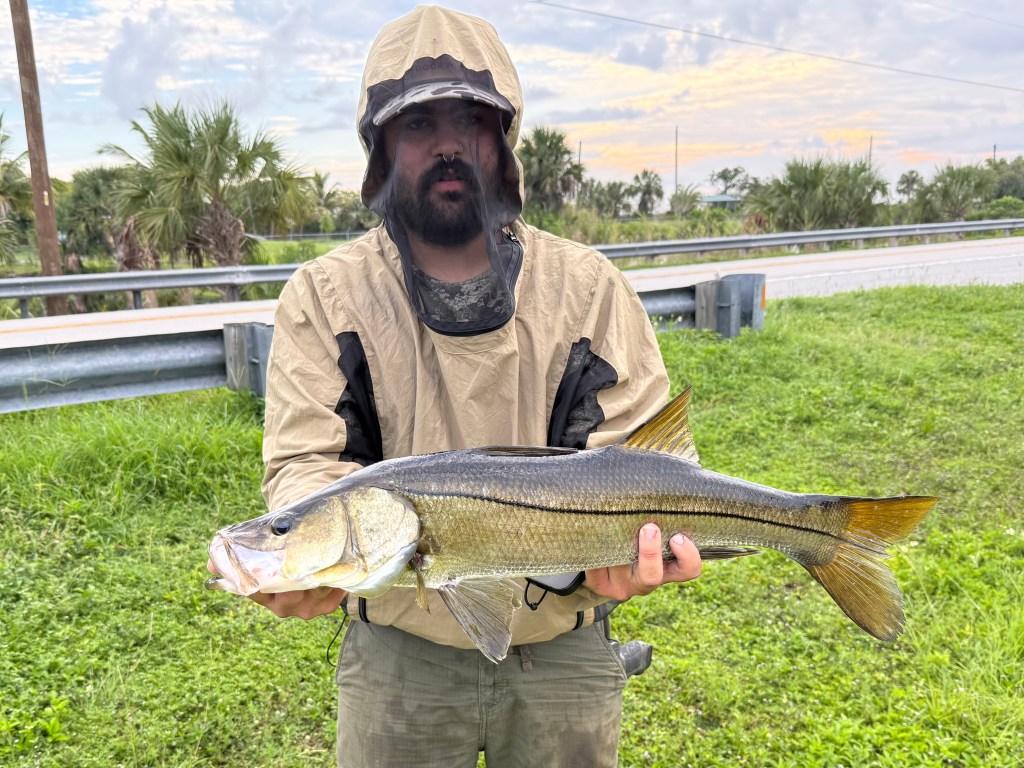
    Gabriel tossed his Jewelfish bait into the pond and quickly connected with a hefty snook. Gabe barely kept her out of the mangroves but finally got her in range of my spiffy new net. 

    Mrs. Snook measured out to 28.5”. She would be the biggest of the day. I took a quick photo then Gabe put her back in the water across the road so our alligator friends wouldn’t grab her before she regained full orientation and composure. It’s a short swim from there back to the pond.

    Snook are protandrous, meaning they start life as males and change to become female, transitioning when they reach 25-27 inches or so. Every badass snook is a trans female.

    I caught a couple of snooklets in the pond in quick succession before catching a Florida Soft-shelled Turtle. Ugh. Gabe caught a big Florida Gar. Lots of teeth and smelly slime – double ugh.  The slime left in my net attracted fire ants. One got inside my shirt and stung me. I hate fire ants – triple ugh.

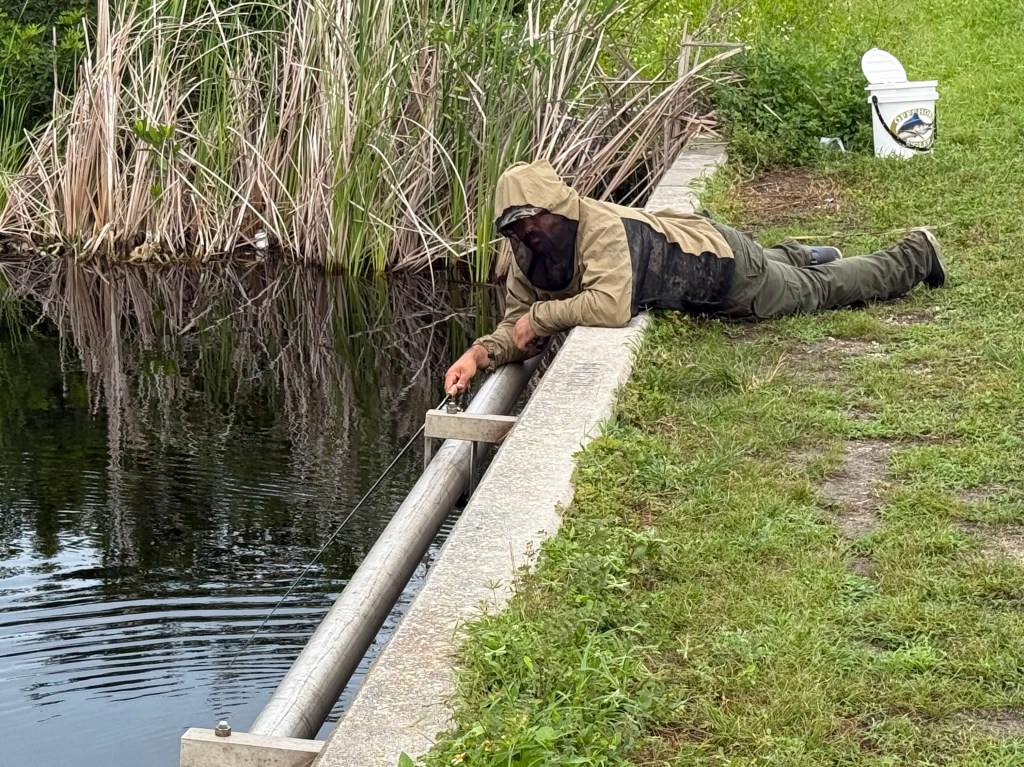
    We could hear snook under the bridge making audible pops as it or they snatched small fish from near the surface. Gabriel lay on his stomach and pitched jewelfish into the slim gap under the bridge. 

    We caught several more snook that way.

    In time the mosquitoes let up enough that we could take off the armor.

    At 10 am, a wall of white appeared in the East. We had just enough time to dive into our cars before the rain squall hit. As is typical in the Everglades, the rain passed in half an hour, cooling the moist air and leaving enough cloud cover to darken the sky a bit. Perfect conditions for Black Salt Marsh Mosquitoes to come back out.  

    We fished a few more creeks along the Trail. I’d never caught a fish at my favorite kayak put-in spot, but it always looked promising. Turns out the bridge there was stacked with snook eager to nosh on jewelfish.

    At another spot Gabriel knew about, I finally caught a sparkly young tarpon that took a jewelfish snack.

    I also caught a blue crab. Everything eats jewelfish.

    A second rain squall further improved conditions for mosquitoes.

    We returned to our starting point. There, without warning, the water erupted in an explosion of snook.  A mob of them had roared out from under the bridge all at once and raided a school of jewelfish or mollies – I couldn’t identify the prey in the mix of froth and silver.

    I don’t think I’ve done justice to the summer mosquito experience in the tidal mangrove swamps lining the western end of Tamiami Trail. As challenging as the alligators are to fish around, the summer mosquitoes in the mangrove ponds and creeks are just as bad, but in their own way. Alligators are finite while mosquitoes are infinite.

    Beyond sheer annoyance, the Black Salt Marsh Mosquito is a known carrier of Eastern Equine Encephalitis (EEE) and Venezuelan Equine Encephalitis (VEE). I lost a colleague to mosquito-borne encephalitis my first year at FIU. Because of the potential for contracting a lethal virus it’s best to minimize the number of bites one gets. Gabriel and I wore semi-breathable mosquito suits dosed with the repellant picaridin, a plant-derived product that doesn’t dissolve synthetic fabrics, fishing gear, or car seats. The bug suits work, but South Florida summers are hot enough as it is without adding a second layer to further restrict air circulation.

    I’d like to wear a GoPro camera to capture some of the action, but a camera mounted on my hat doesn’t work under a bug net and a chest strap mount would create constriction points in my clothes for mosquitoes to bite though.

    Am I trying to convince you to stay away from my fishing spots? Yes, but I’m not exaggerating about the contents of Pandora’s box you encounter on the Trail 9-10 months out of the year.

    I enjoyed fishing with Gabriel because he’s good company and is supercool around alligators. He liked fishing with me because I could handle the mosquitoes. It’s too beautiful out there to spend your day with someone who complains about nature.

    © Philip Stoddard

  • Fly fishing the Tetons

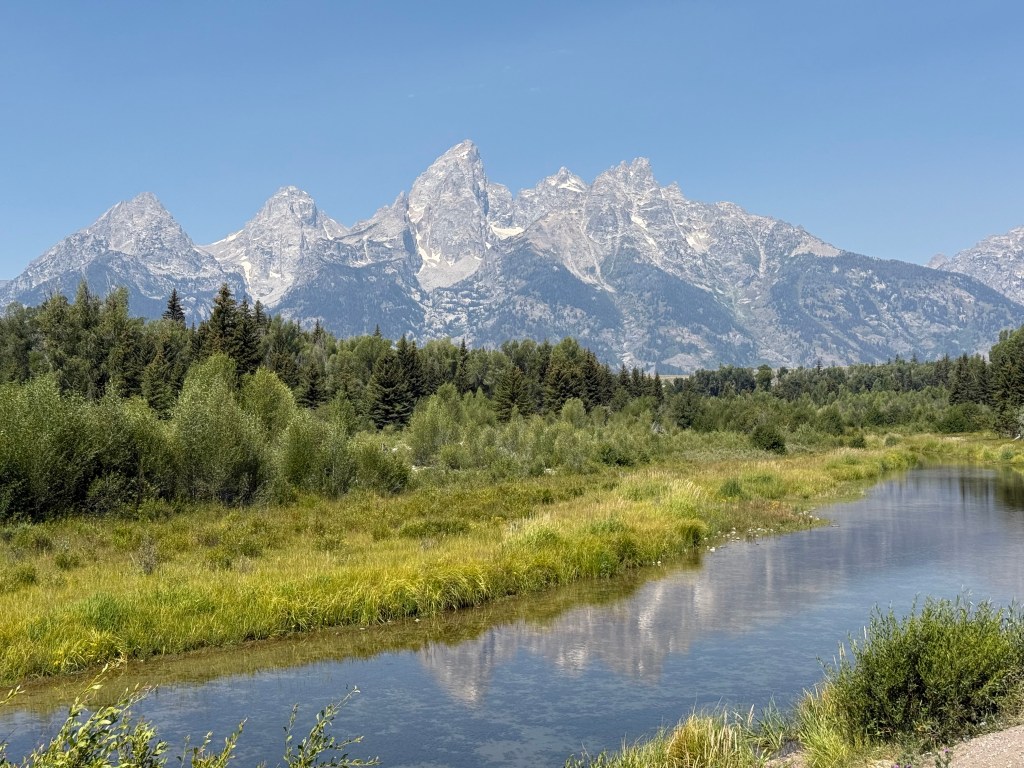
    I last visited Grand Teton National Park in August of 1980. Since then, the Tetons have moved about four feet due to fault slippage, not so noticeable for a mountain range 43 miles long. Indeed, most things seem about the same, but one thing that has changed noticeably is the tenfold increase in number of fly fishers.

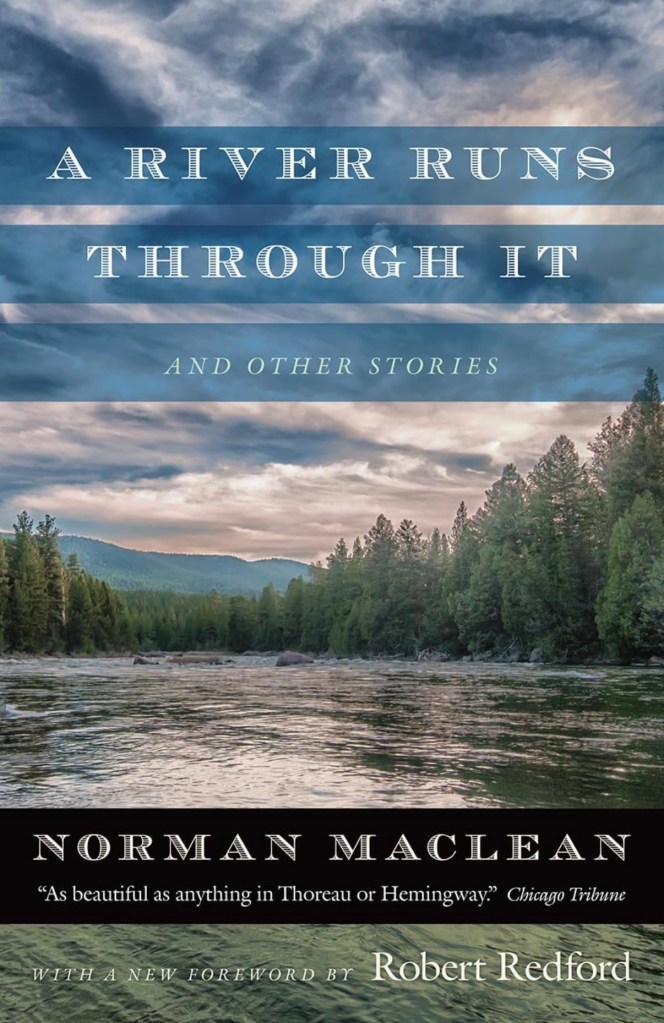
    The exponential rise in the popularity of trout fishing is widely attributed to the movie made from Norman Maclean’s wonderful novel.

    People tell me all the time “I LOVED that movie. It made me want to take up fly fishing. It looks so relaxing.”  Relaxing? They missed how seriously the menfolk in that family took the challenging and technical craft of trout fishing on a big western river. The narrator recalled his father’s sermon:

    “He told us about Christ’s disciples being fishermen, and we were left to assume, as my brother and I did, that all first-class fishermen on the Sea of Galilee were fly fishermen and that John, the favorite, was a dry-fly fisherman.”  

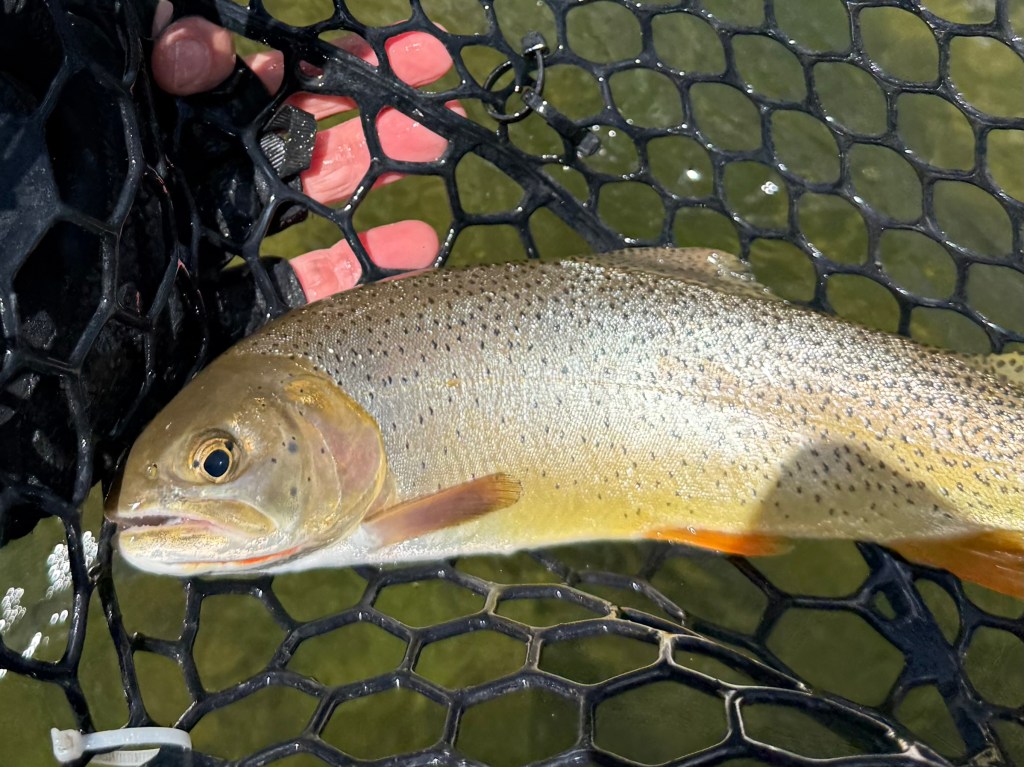
    The Snake River is the region’s big trout fishing draw, and even has its own race of fine-speckled Cutthroat Trout. Snake River Cutthroats are gorgeous creatures, silver and gold with little black dots, orange fins, and the trademark orange lines under the chin for which they are named. 

    Dozens of guided drift boats ply the river each day, and as many people fish from shore. Small trout are gullible but the medium and large ones have learned the mantra “look twice, bite once”.

    Our first day exploring Teton Park I spotted a distant, shallow creek below a splendid overlook. The Snake River was open for fishing, but creeks in the park were closed for one more day. Gray was painting, so I wandered down to the creek for a look. Descending through the dense brush I sang a little song: “Go away bears – go away moose”. 

    The creek was brimming with solid cutthroats, 12”-18” in length. Here they are:

    The next day we had our big splurge, a full-day float trip down the Snake in a drift boat manned by Larry Milton of Mangis Fishing Guides. In addition to a day of glorious scenery, an oared drift boat (shallow draft dory) provides a fly fisher access to many good trout holes inaccessible to those wading or fishing from shore. Even so, Larry, with his 30+ years of floating the Snake, kept saying “this hole SHOULD get you a bite”. 

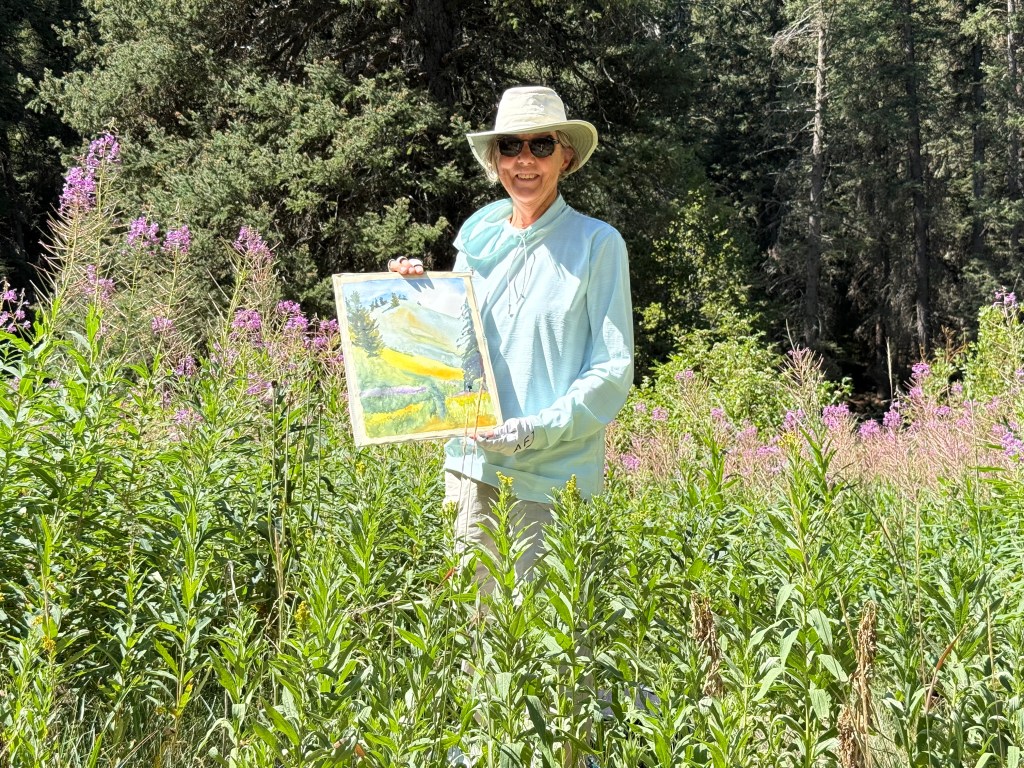
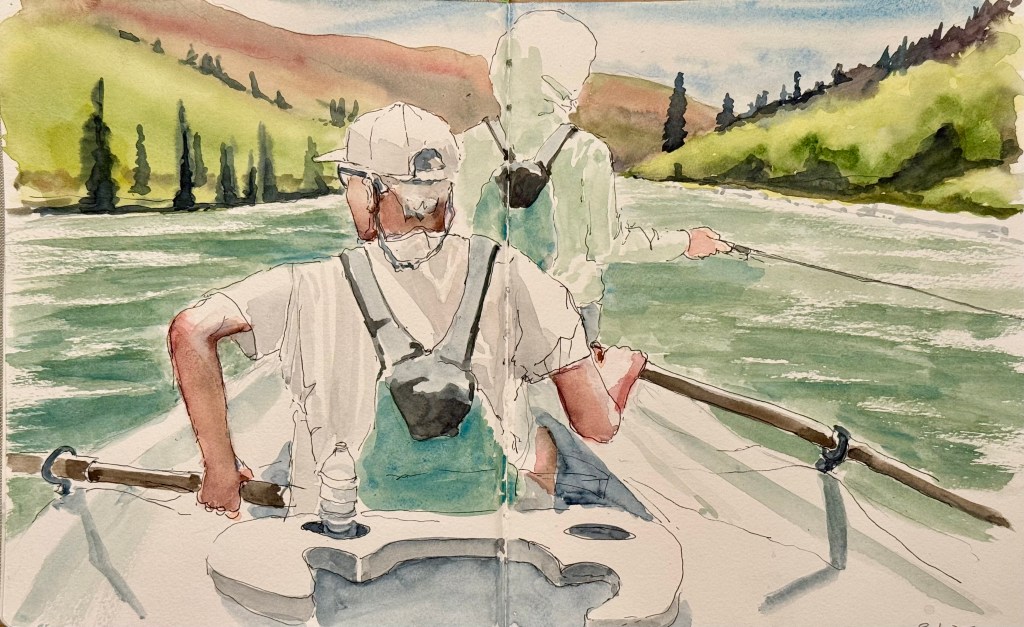
    Watercolor by Gray Read

    The “hatch” on the river that day was a random hoard of hapless spruce moths that either fell in the water or ventured close enough for a trout to leap up and grab one.

    I started out the day casting a “hopper-dropper” rig, a floating grasshopper dry fly with a small sparkly nymph fly dangling below. Usually 90% of bites come on the nymph, but this day 90% of the bites came on the dry fly. I snipped off the nymph to get a better drift of the dry and did a little better.

    Of ~20 cutthroat trout I caught and released, one was 16-17”, three were about 11”, and the rest were little pookers, 5-8”. Not a bad day. 

    The water was warming – better to get fish back in the river post haste than pose them for a pretty photo.

    The evening of the next day, we returned to that first creek, me with my fly rod, Gray with her watercolor kit. A fellow watching for moose from the overlook told me he’d seen a dozen fishermen trudge up the hill from the creek below. I went exploring anyway, expecting the lovely trout from before would be gone or hiding. To my surprise, every trout from two evenings prior was holding in exactly the same spot as before, lazily rising to pick the odd caddisfly off the surface. 

    Gray paints while I fish. Amid the scattered raindrops on the water, you can see the expanding ring where a trout has just picked a bug off the surface. Perfect dry fly conditions.

    Alas, these beauties showed exactly zero interest in the assorted flies I drifted past them on fine 6X tippet. They weren’t even disturbed by me casting at them. I could just as well have been a moose. 

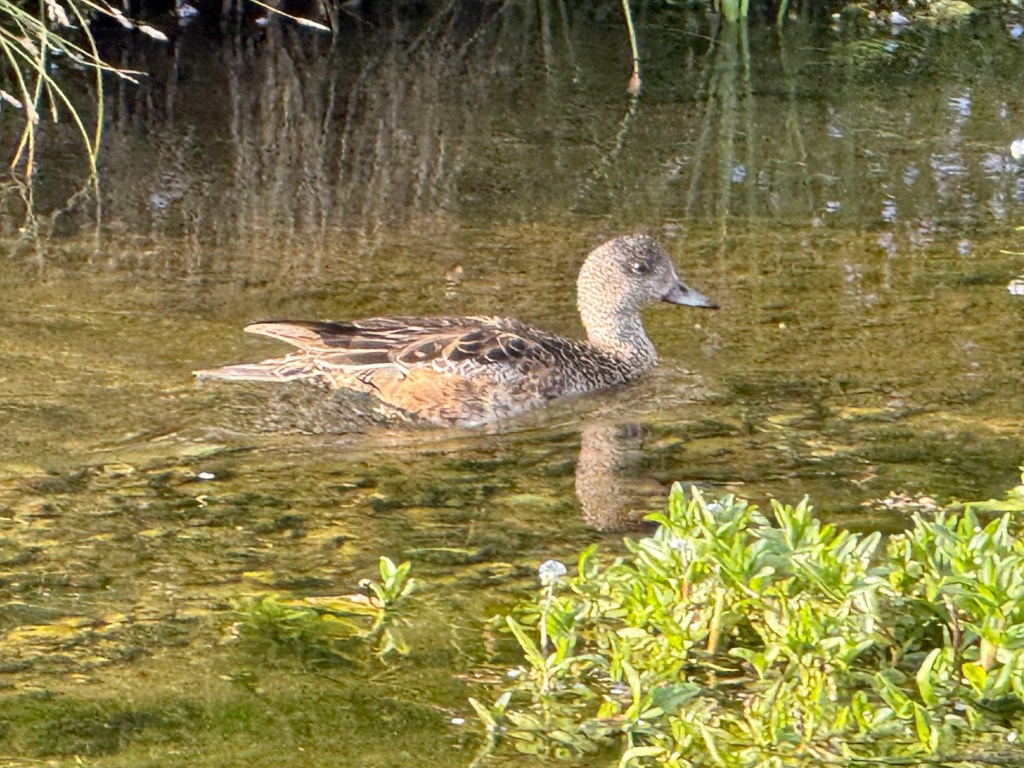
    I did get some attention, though. I was followed down the creek, then back up the creek, by a female Cinnamon Teal. She squawked at me the whole time. When I sat down to change flies she flew up into the air to spy on me from above.

    Between bouts of nibbling aquatic vegetation, Mrs. Teal had no compunction against splashing directly over a big trout to keep up with me. I saw no sign of ducklings and it was too late in the year for nesting. She was just a busybody. The extended mountain twilight was coming to an end, and moose were wandering in – time to leave.

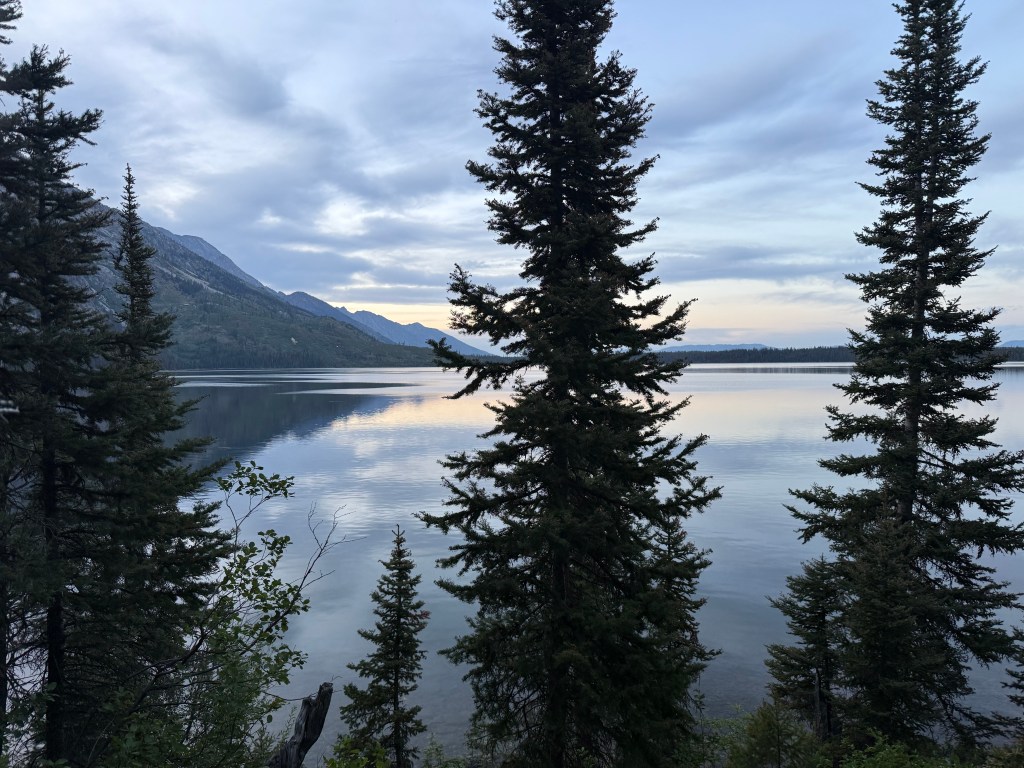
    Jenny Lake had opened to fishing, but we found the water was over 65° F, too warm to fish trout without stressing them.

    Same with Cottonwood Creek that flows from Jenny Lake.

    Instead, we hiked in to some beaver ponds to look for moose. Tiny trout dappled the surface or leapt into the air for flying insects, popping from the glassy water like slippery watermelon seeds squeezed between the fingers. Good dry fly fishing for naive 4-5” trout, but mind your backcast and keep an eye peeled for thirsty megafauna.

    Funny looking moose by the beaver pond.

    On our last morning we stopped by Flat Creek in the National Elk Refuge, a spot recommended for wade fishing by Larry the river guide. From the number of parked cars with single-purpose fly rod transport tubes clamped to their roof racks, I estimated 40 experienced and dedicated fly fishers were already stalking this narrow winding creek. Assuming I could even find a couple of bends to myself, I knew these fish would be highly over-educated.

    We left the crowded stream and drove over to the Gros Ventre River, which I’d also wanted to explore. We parked at a turnout away from the river and hiked to a section of water not visible from the road.

    I had this cold, braided river to myself as far in each direction as I cared to wander. Each bend offered promising trout spots. As I walked the banks, the air filled with small brown grasshoppers. Freshly expired stonefly nymphs littered the gravel bars. Easy to guess what these trout were eating. Indeed, I SAW lots of trout swim up and check out my flies: “Ooo, brown Morish Hopper, size 10” or “Golden Stone nymph, nicely tied.”  Indeed, I had a wonderful time picking my way along the game trails, fording the river to access the promising holes and seams, and seeing trout flash my flies in such a beautiful spot, even though I didn’t get a single bite.

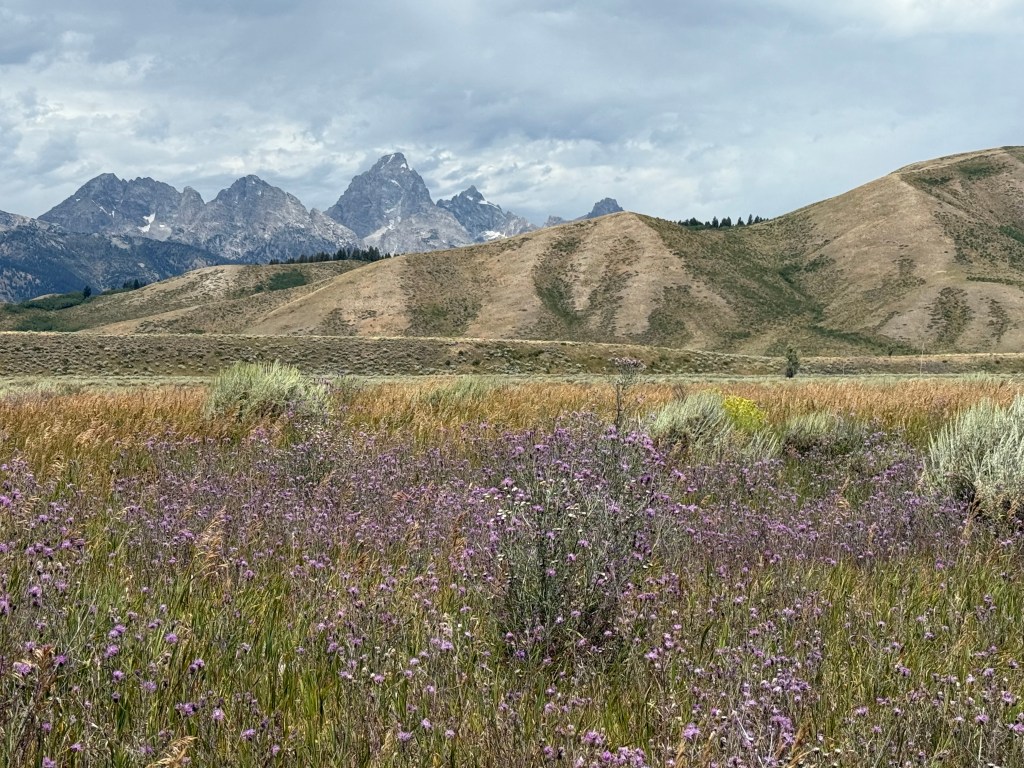
    As we hiked back to the car, the rangeland had every color on display. Hard to believe that’s a photograph.
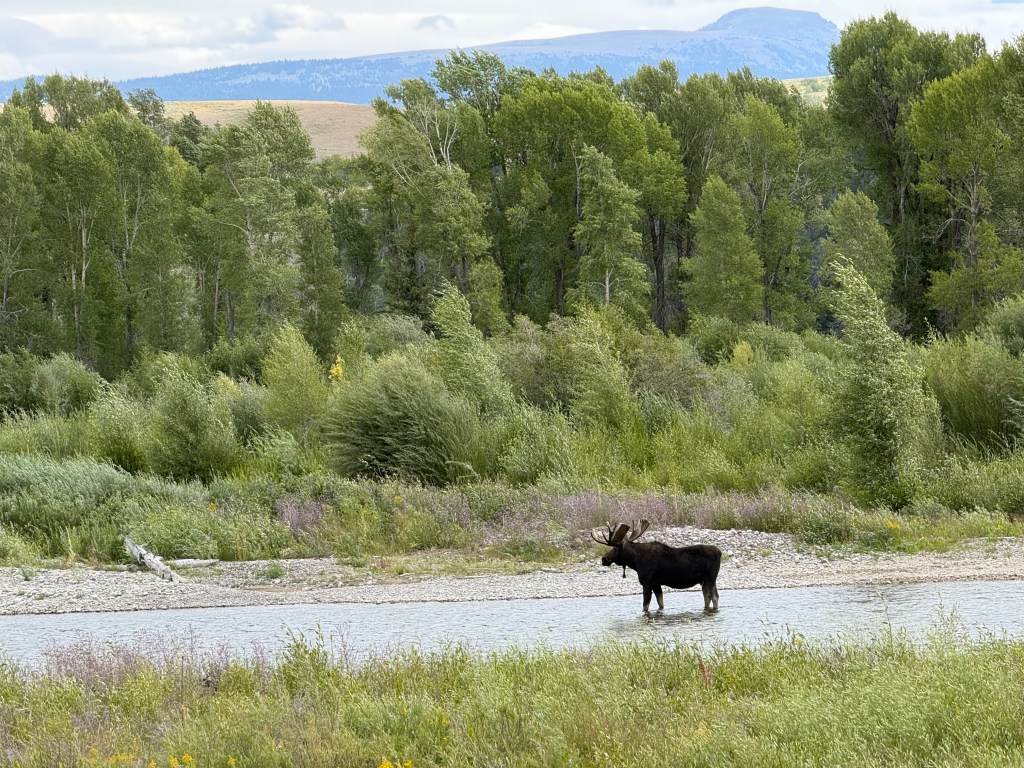
    Three bull moose grazed in the river as we too ate our lunch.

    In contrast to our day in the drift boat, I caught one trout and a whitefish while wade-fishing a couple of hours a day across the rest of the week.

    You can’t beat the Tetons for scenery, hiking, and critter-watching. I was delighted to spot my first Pine Marten and spent half an hour happily watching a Dipper bobbing and swimming in a mountain creek while Gray painted nearby, surrounded by a patch of fireweed and its attendant Rufus Hummingbird.

    But, if you thrill when a trout eats your fly, and again seeing it up close in your net, the Driftless Area of SW Wisconsin  draws far fewer people, and, as a result, offers much more productive trout-fishing.

  • Trout Fishing the Driftless Area

    “Phil, I get the draw of fly fishing in Wyoming, but Wisconsin?”
    email from friend in Miami

    Someday I want to go fly fishing in the Driftless.”
    overheard on train to car rental at Chicago O’Hare

    The Driftless area of Wisconsin was not glaciated, so it has some big rocks sticking up, topography conducive to springs and formation cool water trout streams. It’s pretty countryside, with cornfields in the flatter areas framed by woodlands in the dolomite and limestone ridges and valleys.

    The nearby town of Viroqua was described to us as a college town without a college. Many of its local businesses are named for the Driftless area, e.g., the Driftless Cafe, Driftless Books and Music, Driftless Angler, even the Driftless Humane Society. At the Viroqua Food Co-op you can buy Driftless Coffee.

    Brook Trout are native to the Driftless streams and Brown Trout are naturalized.

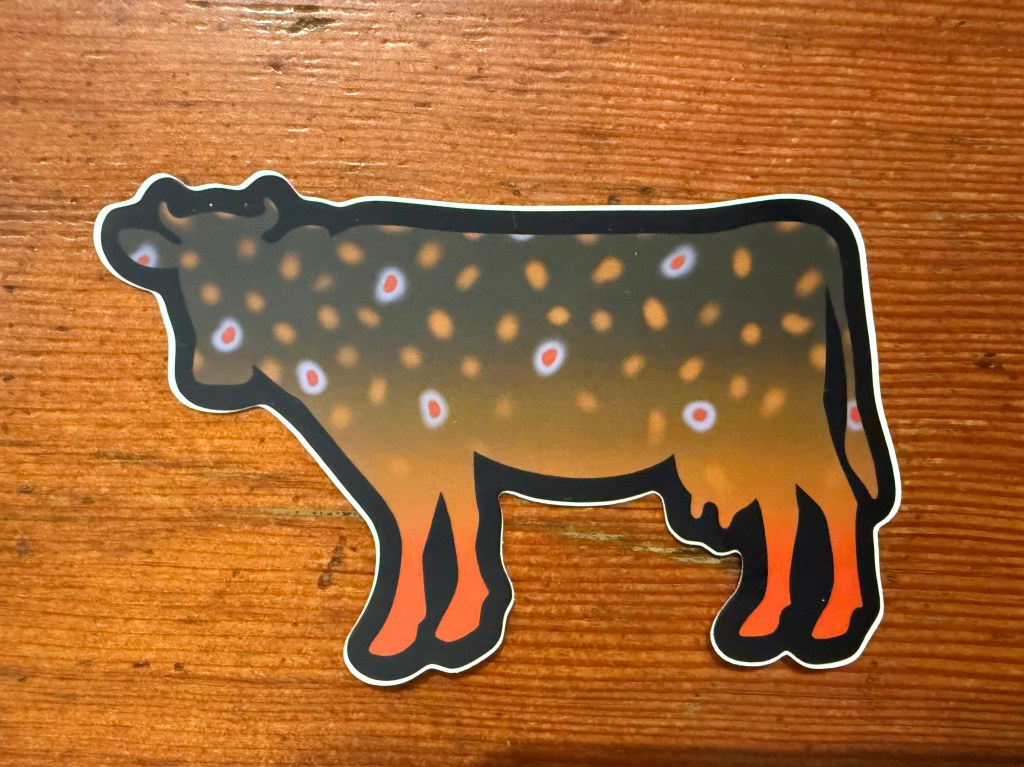
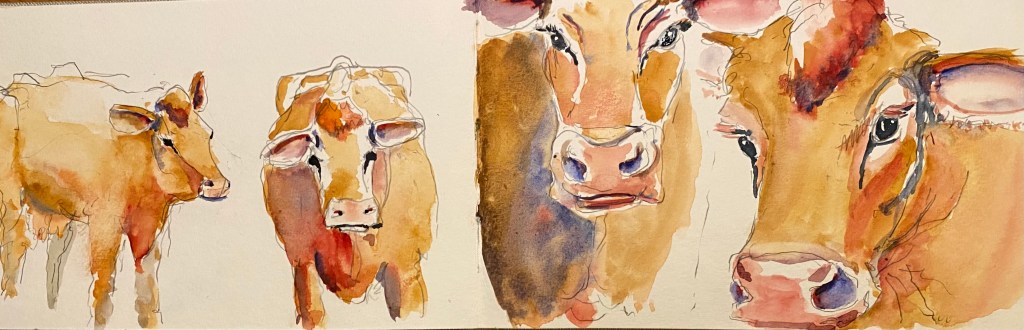
    In the Driftless, Brook Trout and cows come together.

    In addition to these self-sustaining trout populations, the Wisconsin DNR stocks streams with Rainbow Trout so the googans armed with spinning rods and barbed treble-hook spinners have something to catch on opening day. Any rainbows that survive that onslaught provide the big brown trout with something to snack on the other 364 days of the year, aside from their own offspring and hapless field mice. The Driftless streams grow some big browns, big like 30”. Fishing at night, when these leviathans are out feeding, is disallowed most of the year.

    In my week of fishing, I saw hundreds of brown trout and brookies, but not a single rainbow. No monster browns either – the largest was about 18”, a nice trout by my standards.

    Our first Drifltess afternoon we were joined by Adrian Livangood, a fishing guide from the outfitter Extreme Driftless. Adrian had spent five hours the day before scouting streams to find one with cool enough water, not higher than 65°F.

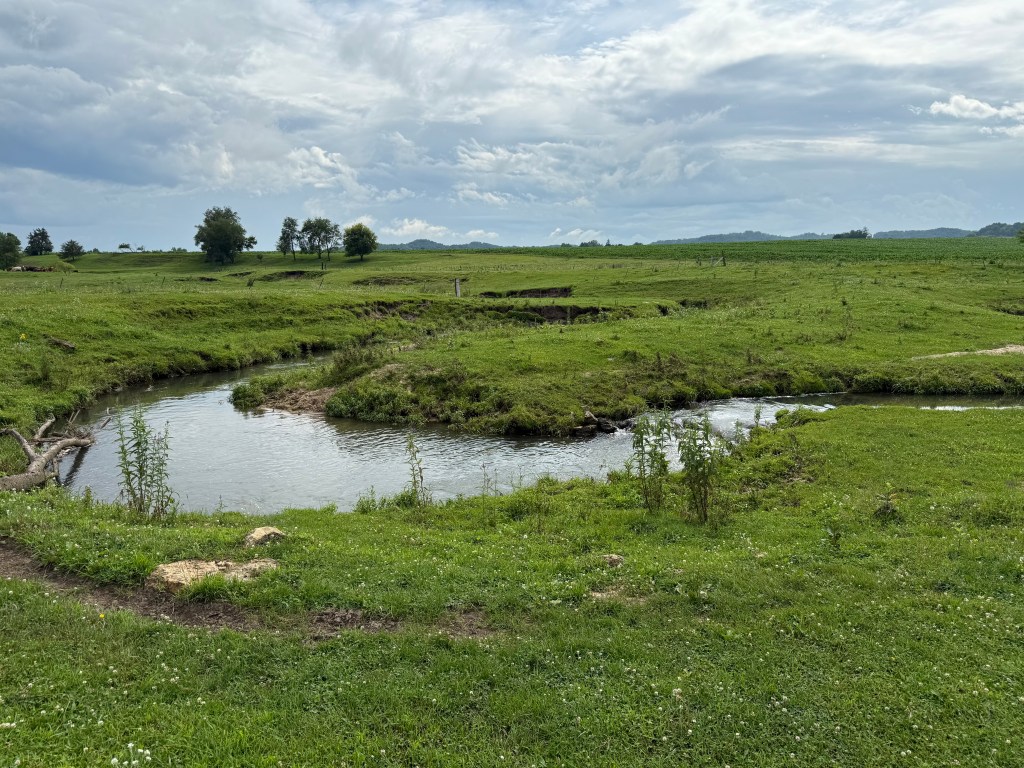
    Adrian finally chose his home stream, one he’d fished since he was a kid. Not surprisingly, he knows every ripple and sand ridge, and how they change with each rain storm.

    The stream, like many in the Driftless area, is accessed via a fishing easement, a strip of private land on which the owner has received a tax break for allowing access for trout fishing.

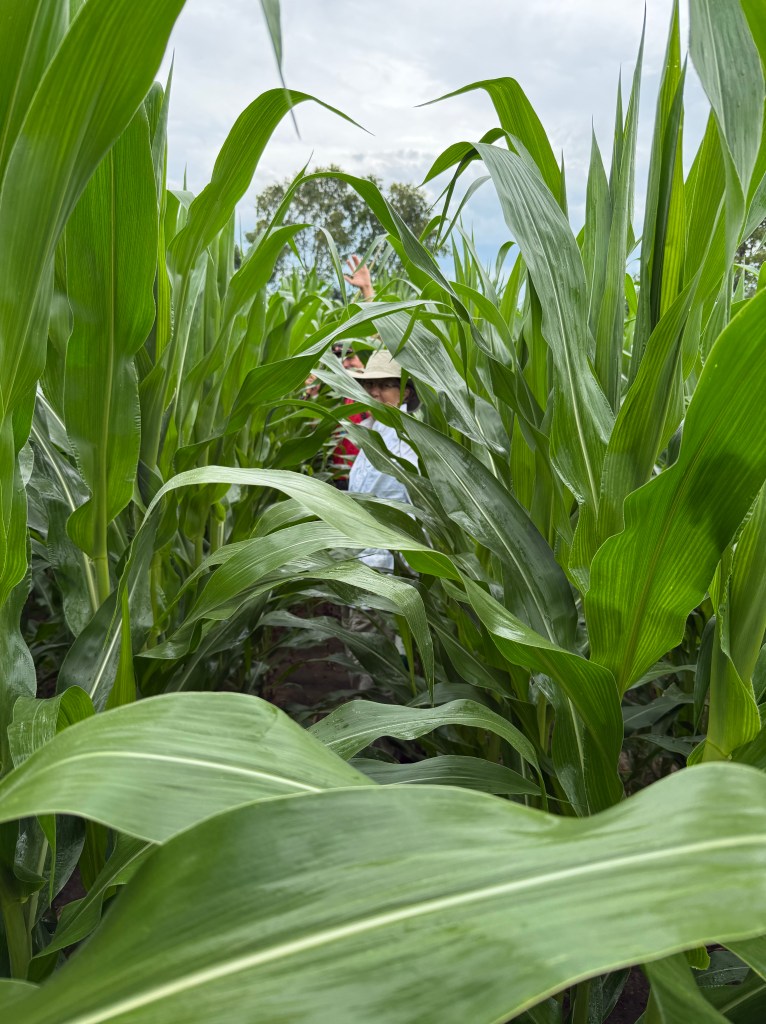
    Following Adrian, we tunneled through 100 yards of tall corn, crossed under a barbed wire fence, then stepped out onto a cow pasture through which flowed a beautiful cool stream.

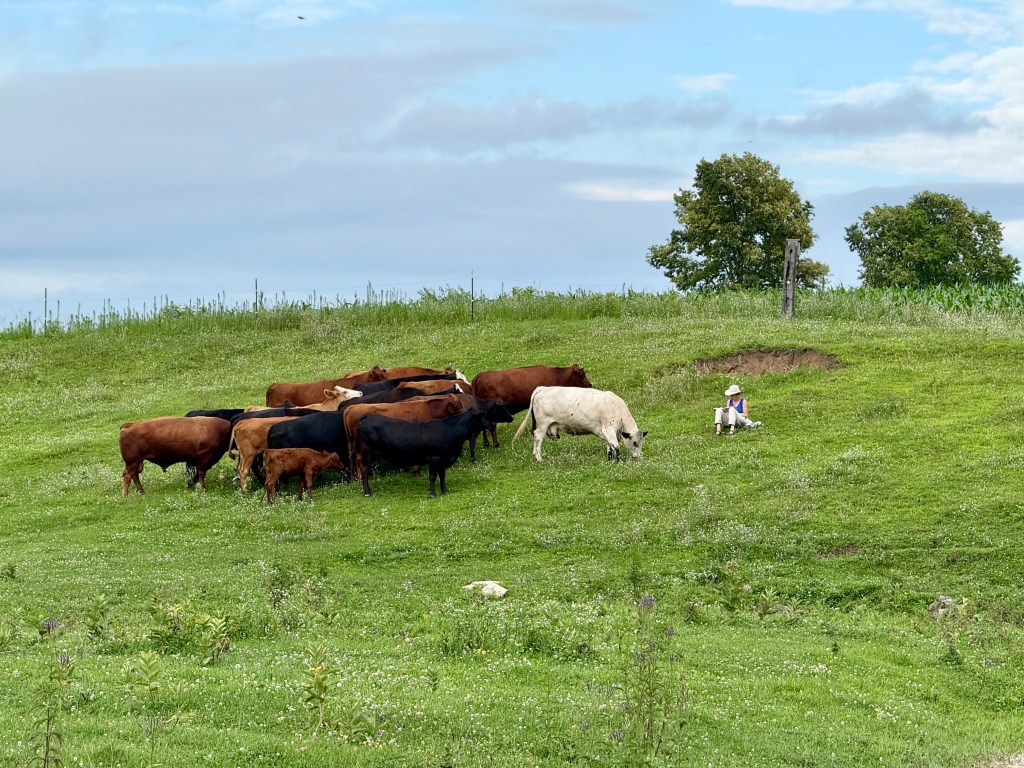
    As Adrian and I stalked the stream bank for trout, Gray sat in the pasture and drew. A herd of dairy cows and their attendant bull kept their distance from Gray at first, but grew increasingly curious. They hadn’t seen an artist before.

    One cow came close enough to drool on Gray’s notebook.

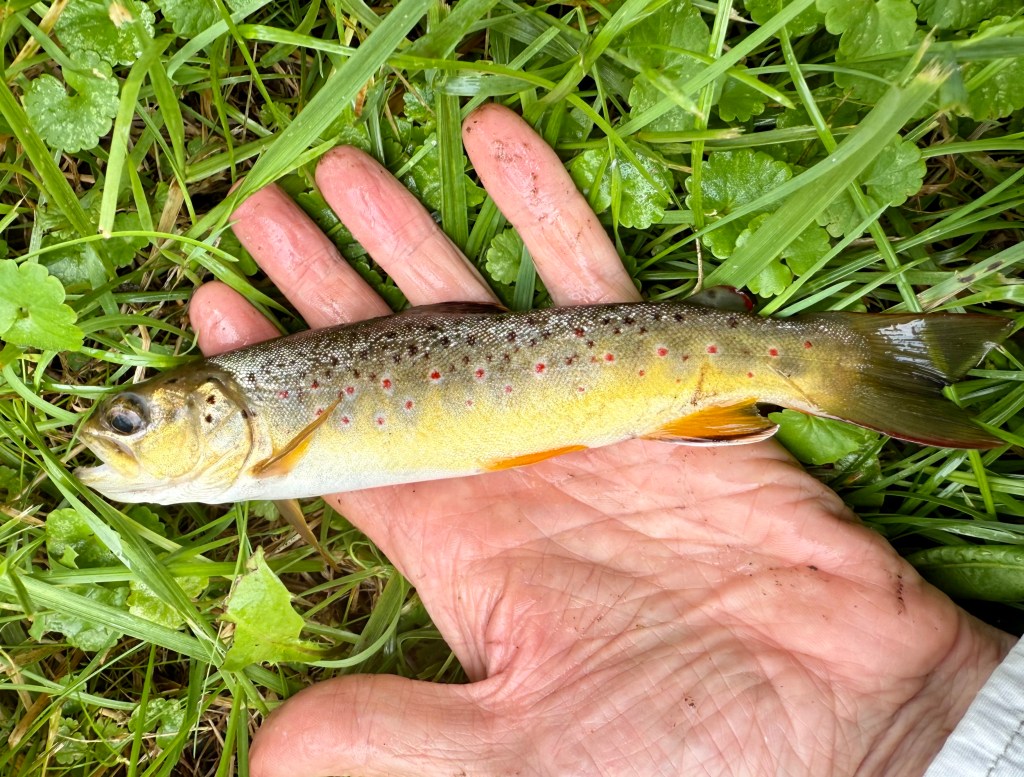
    The afternoon was not too fishy, as fishing goes, but I got the feel of where trout hang in the local streams, catching eight brown trout on dry flies, dropper nymphs, and streamers. 

    Brown Trout.

    Nothing I saw that afternoon was huge, but Adrian showed me three holes inhabited by “lunker” browns 29-30” in length. He hooked one as a kid when he was starting out, and of course it got away. He has seen them in that stream a few times since then but hasn’t caught one. In winter and spring Adrian catches at least one big brown (20-25”) daily on a nearby river. 

    Weekday mornings during our stay, I woke with the first song of the Indigo Bunting, and headed out to fish a different Class 1 trout stream each day. Weekends I left to the locals who work during the week, and who, by all rights, shouldn’t have to complete with visitors on their home creek.

    The streams I fished are designated catch-and-release, and all had cold water 58-64°F.  I caught lots of trout on dry flies, typically a Parachute Adams, but also terrestrial insect imitations: grasshoppers and ants.

    This 14” native Brook Trout was a prize catch on the size 12 Parachute Adams dry fly.

    After my introduction to the Driftless in a grazed pasture, I quickly came to understand why fly fishers like short rods for creeks. My 9-foot long, 5-weight rod was fine for fishing a stream with cow-mown banks, but proved ungainly in the more typical, heavily vegetated streams. There I lost multiple flies in tree branches and cow parsnips and spent hours unhooking flies from vegetation and tying up new hopper-dropper rigs.

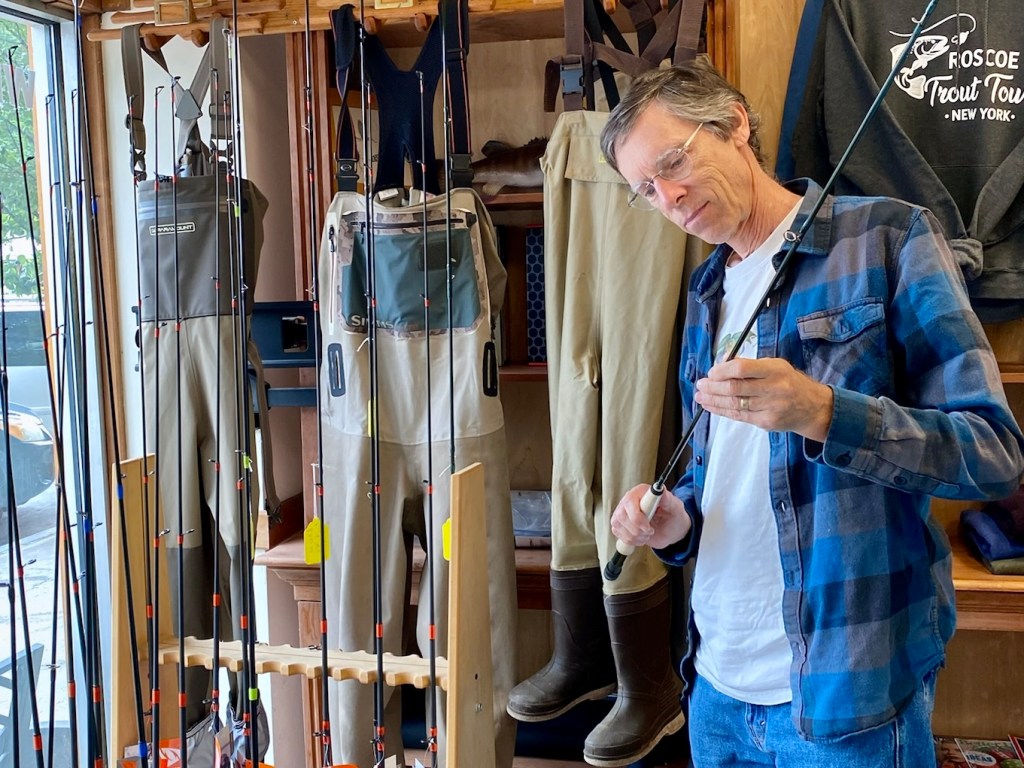
    I stopped by the Driftless Angler in Viroqua to replace my lost #12 Parachute Adams dry flies and made the mistake of wandering over to the rod rack to drool over their collection of short 3wt rods.

    Here I am fondling a nice 4wt fly rod at a shop in the Catskills. Substitute your favorite class of merchandise and you’ll get the picture.

    The St. Croix ($400) seemed like a good fit for these streams, but felt like a tent pole compared to the Sage Dart ($825). The urge to buy terrorizes me. Time to leave.

    Near our home exchange house, I fished a beautiful wooded stream, this one a particularly tight fit for a 9’ fly rod. 

    Good pool for trout, but tight for casting a 9’ fly rod.

    Once I did find a good use for the long rod, flipping the #12 Parachute Adams around a bush into an upstream pool that I could not see. Hearing the splash of a bite, I twitched the rod tip sideways and hooked a nice 11” brown.

    Brown that munched a Parachute Adams

    The next pool held a rising fish that repeatedly ignored the Adams. I noticed black ants marching along the bank, so I tied on a floating #16 black ant fly and flipped that into the pool. A small brook trout jumped into the air, did a back flip  and dove onto the ant fly.  It missed the fly, but earned top marks from the judges for difficulty and style.

    Floating ant fly.

    The adjacent pool upstream was wide open, so I tried the ant again. A second brookie came at the ant fly from below and connected.

    Easier pool to fish. A Brook trout waits unseen for bugs to appear at the back of the bend on the right.
    The Driftless Anteater.

    These two were the only trout I caught that morning before the rain set in, but their capture and release through fiddly persistence, the essence of fly fishing for trout, made the morning entirely successful in my view.

    The Driftless streams tend to be clear during the summer, which makes the trout more wary. Footpaths along the sides of many indicate the older trout are well-educated. But even on the most heavily fished stream I visited, the ancillary rewards are beyond words: picture rattling calls making you look up to see a pair of Sandhill Cranes flying low overhead, lit amber by the rising sun.

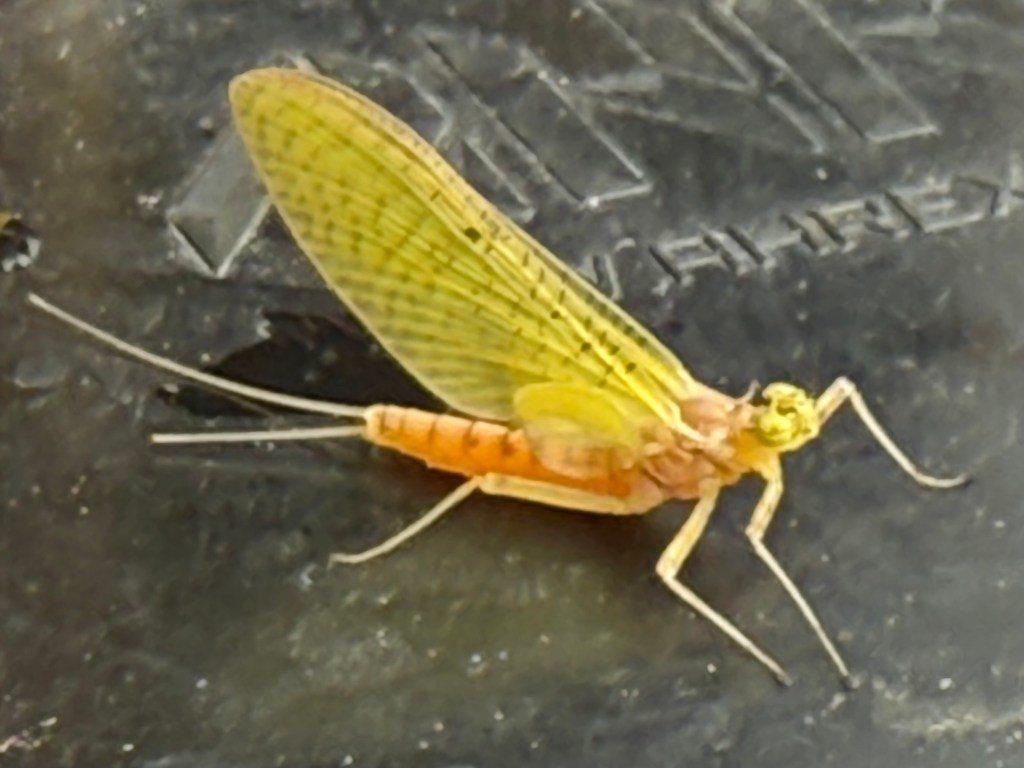
    Some days the trout were actively feeding on bugs that did not resemble the gray-bodied Adams flies. For instance, this big yellow mayfly held the trouts’ attention a couple of  morning on different streams, but my fly box lacked the size 8-12 Parachute Sulfur fly that would have “matched the hatch”.

    Stenacron canadense , sometimes referred to as a “Light Cahill”.

    Other mornings trout were taking small, unseen insects off the surface or jumping a foot in the air to snap at something they could see and I could not. At those times, I couldn’t get a bite on an Adams dry fly of any size. Looking around, I saw the odd caddis fly and some tiny gnats or blackflies buzzing around. The rising trout refused my size 18 Elk Hair Caddis. Maybe they’d have taken Griffith’s Gnat in size 20 or 22.

    If I’d had some.

    An article on the Orvis site says that fly anglers who fish clear, spring-fed streams carry multiple fly boxes. Oh. So I’ll need to wear a backpack too?

    Adrian wore a backpack…Click, grind, wheeze, the penny drops.

    I did make two other relevant discoveries: (1) coffee makes my left hand shake too much to thread thin tippet into the hook eyes of #18 & 20 dry flies, and (2) The smaller-sized dry flies I bought mail order from The Fly Shack had hook eyes blocked by hackle, tying thread, and/or head cement – I gave the company an earful.

    When surface feeding trout ignored my dry flies, a sinking nymph fly under an indicator (tiny foam float) or foam grasshopper fly sometimes did the trick. The best such nymph was the Jig Hot Butt Hare’s Ear that I’d bought last summer from Kelly Galloup’s fly shop on the Madison River in Montana. This nymph is said to be good where caddis flies are present. 

    Jig Hot Butt Hare’s Ear, in olive, size 16

    Last morning in the Driftless, after releasing ten brown trout caught on this cute little fly – including a nice 14-incher – plus another on the dry grasshopper, I lost both of my Jig Hot Butt Hare’s Ear flies to grabby overhead branches. A timely sign to wind in my line. Indeed, wiggling free of my waders back at the car, the sky opened up. If I lived near the Driftless area, I’d assemble the materials to tie this little fly myself, plus the Parachute Sulfur.  And I’d splurge on that Sage Dart stream rod.

  • Team Everglades won today

    Here is the summary in equation form:

    [moon + Monday + alligators + mosquitoes + heat + humidity] > Phil

    I had a day open to fish before we leave town for a vacation in the Wisconsin Driftless area.

    Moon is approaching full, allowing the fish to stay up all night feeding, which often makes for a poor morning fishing the flats. But the winds promised to be lowish which means I could go anywhere.

    So many possibilities. How to decide?

    One more wrinkle. I find Mondays are the worst day of the week for fishing in South Florida. I do have the water to myself, but the majority of my fellow fishers, who are not yet retired, have worked-over most of the good areas on the weekend. The worried fish often spend Mondays hiding under the bed.

    I figured it would be best to fish a spot off the beaten trail. How about off the Tamiami Trail?

    I headed out to fly fish for tarpon and snook in a favorite lake in the western Everglades / Big Cypress / Fakahatchee Strand ecosystem, arriving well before sunrise.  Perfect. I rigged my Spey rod with a good tarpon fly for this lake.

    I had dressed for effective mosquito protection: head net, two shirts, neoprene dive booties to protect my feet and ankles, gloves, and picaridin spray around the seams. Good thing too – the black salt marsh moskeeters (BSMMs) were thick. 

    Otherwise, it’s a nice lake. It has only two alligators: the South gator is afraid of humans and the North gator is easily avoided. If he shows, I just move down the lake to another opening in the mangroves. The lake holds lots of juvenile tarpon and some big snook and bass.

    This morning I saw an expanse of glassy water, with the occasional tip of a tarpon tail breaking the surface. Not many fish, not very active, and not too promising.

    Soon the sweat rolling down my forehead inside my head net began to condense on my glasses and I couldn’t make out as much detail, but I had the general picture: the tarpon did not appear to be feeding actively, which makes sense given they’d had 10 hours of moonlight in which to feed. I walked the perimeter, casting through openings in the mangroves in front of the odd disappearing tail. No takers. I startled the North gator and so moved on down the lake shore to avoid him.

    Just after I took this photo, something broke the surface, likely a snook or bass from the way it splashed. Though the Spey rod casts a long distance, I found that it needs a slightly wider opening in the trees than does a single-handed fly rod. I had to disentangle the fly line from the foliage of a Poisonwood tree. Mental note to self: wash fly line in soapy water when I get home.

    Poisonwood (Metopium toxiferum) is a common tree in the Everglades and coastal hammocks. Related to Poison Ivy and Poison Sumac, it produces the same irritant, urushiol. I once pointed out the Poisonwood to a visiting seismologist friend who said “It looks like everything else.” I replied “Yes, but don’t touch it.” Every time I looked at him, he had his camera up to his eye and one elbow or the other poked into a clump of Poisonwood foliage. By the end of the day, both his elbows were red and puffy.

    I left and drove to another good spot. The Mosquito Host Committee took a vote and decided to come along for the ride.

    By the next spot, the sun was high and the mosquitoes had begun retreating to the shade. I removed the stifling head net and extra shirt and downed a Yeti bottle of Liquid IV to replace what I’d lost. Whew! In the summer it’s warm and humid around the mangrove lakes, but you knew that.

    I could hear a school of snook feeding noisily under a bridge, loud smacks punctuating the silence. Anxious-looking Sail-finned Mollies shoaled tightly nearby. I could drift a mollie-sized baitfish fly under the bridge, but first, best take a quick scan for gators. Oops.

    Not far off a cheerful alligator waited, ready and hopeful. Might some thoughtful human catch a snook that would make a nice breakfast for some deserving alligator? It happens, you know.

    I don’t fish near a gator like that. Too easy to lose a snook and/or break a fly rod. Pass.

    At another lake I found a large school of feeding tarpon. I walked the edge, watching them roll. Periodically a feeding tarpon would crash the surface in an explosion of spray. So cool. The Spey rod could reach them easily. Full stop. I had previously lost an encounter with the 9-foot owner of that lake, breaking off a nice tarpon as the big gator moved in. Pass again.

    At the next spot feeding rings indicated tarpon, but another hopeful gator swam out and looked up at me. “Catch me a fish?” Pass.

    Final spot, two big gators sitting side-by-side and facing opposite directions. Nothing will get past that pair. But around the corner there were no gators (that I could see) and I could see the ripples left by a big fish that had broken the surface. I traipsed over towards the shore and was enveloped by a WALL of black salt marsh mosquitoes lying in wait under the shade of a Wild Tamarind tree. Holy shit!

    I ran for the car but couldn’t shake them.

    I ran away from the car and circled around a cluster of Cabbage Palms, but the hoard stayed with me.

    I ran past the car, dropping off my stuff so I could run faster, and did another lap around the neighborhood.  No use.

    I tossed my stuff in the car, hopped in, opened the windows, and drove for home, swatting mosquitoes the whole way.

    Florida’s new gulag at Mile 48 had fancy new signs reading: “Alligator Alcatraz”. No protest scheduled today, but two women were outside, holding their signs. I gave them a hearty thumbs up and they smiled and waived back.

    Some of the BSMMs that hitch-hiked home left the car as I unpacked and were waiting for me on the front porch where Gray had prepared us a lunch.  Swat swat swat. A few of those slipped in the front door and into the house. Swat swat.

    On the bright side, no sharks.

  • Dodging Keraunos on the flats at Flamingo

    Zeus used his lightning bolt “Keraunos”, a gift from Cyclops, to exercise divine authority over the sky and weather, wielding Keraunos in divine retribution as he saw fit (perhaps inspiration for you-know-who and his black Sharpie, only more final and definitive).

    I launched the skiff out of Flamingo before sunrise with the triple intent of (1) trying my new used Spey rod around actual fish, (2) seeing if small dark-colored paddletails, gifts from a friend, might pull a redfish out of the mangroves, and (3) not getting struck by lightning from any among the squadron of thunderheads coursing the flats.

    I fished wherever the storm cells were not, motoring away from every encroaching squall to the nearest patch of clear sky.

    Results:

    1. The two-handed Spey rod works. I caught four speckled seatrout, some ladyfish, and a catfish on assorted flies while Spey casting from the skiff’s poling platform.  Wind is not a serious problem.
    2. Throwing the tiny dark paddletail into the mangrove roots, I hooked a redfish, but it came off as I got it to the boat. That happens. But the tiny paddletail works as intended.
    3. I had to move around a lot, and could not fish where/when I wanted, but the outboard let me dodge the electric storms. One can’t do that in a kayak.
    This seatrout ate Tim Borski’s Mackerel Shrimp pattern.

    It turned out to be a pretty good day for bird- and fish-watching despite the ominous weather.

    I spotted this Mangrove Clapper Rail peering out from its secretive world.

    Mangrove Clapper Rail, Snake Bight ENP

    Roseate Spoonbills foraged on the adjacent flat. I counted 67 of them. When you find feeding spoonbills, the snook are usually close by, foraging on the same small fish and crustacea.

    The wind picked up, but no lightning, and then it rained. Between the wind, rain, and holding the boat steady in the tide coursing the shallow and narrow channel, the elemental chaos was too much for fly casting. With a spinning rod I still managed three snook in the low 20-something-inch range, just what the spoonbills had predicted.

    After the rain moved out, I paused to watch a Reddish Egret scampering after a shoal of baitfish. The one in this video I found at Key Biscayne, but it gives you a sense of their hyperactive hunting style.

    While I watched the antics of the egret, something to the right of it caught my eye. A snook was working its way below the surface, sneaking toward the same bait school as the egret, but from the other direction. They came closer and closer together until the snook made its move, charging the baitfish and showering the egret with spray. The surprised egret jumped into the air, flapping to land several feet back. Wish I’d gotten a video, but I was too mesmerized by the impending collision to reach for a camera.

    Three bull sharks formed a mullet-hunting party. After the trio dispersed around me, this six-footer came close enough to get a video.

    Keep your hands in the boat.

    With that many sharks hunting in the water, it’s time to wind it up.

    © Philip Stoddard

  • 2025-05-30 South Fork Shenandoah River

    Gray and I drove the EV north from Miami to check in on my parents in Northern Virginia, ages 98 & 91. We made a vacation of it, returning to a rental cottage on the South Fork of the Shenandoah, near the town of Shenandoah VA. The river teams with Smallmouth Bass and there’s paintable scenery everywhere you look.

    The river by the cottage was easily wadable when we stayed here two years ago. It was so much fun I stood around in the cold water in my nylon pants until hypothermia set in. I never appreciated a hot tub so much.

    Here I am two years ago, wade-fishing the middle of the river. Easy-peasy. (photo, Gray Read, 2023)

    This year I’d brought my new waders and wading boots. Arriving in the afternoon, I walk down the steep steps to the river and discover the small floating dock, despite being chained to a big sycamore, had washed away in a flood.

    As the sun falls behind the mountain to the west, the hour when the fishing was best two years ago, I don my gear and wade out. The river is a good 2’ higher than before, with a faster current to match. I can wade with care and two hiking staffs, but the prospect of wading all the way across, as I did readily two years ago (photo above), is intimidating. Further, fly casting in that strong a current, while my boot cleats cling tentatively to submerged rock ledges of different heights and angles, is nothing like the relaxing Zen-ish experience I remembered from before.

    Venturing forth in the waders towards deeper water. Clumps of leaves are still stuck in branches, leftover from the flood that took out the dock. (photo by Gray Read).

    “There he stands, draped in more equipment than a telephone lineman, trying to outwit an organism with a brain no bigger than a breadcrumb, and getting licked in the process.”   Paul O’Neil

    On the plus side, the waders keep me dry and warm. Fortunately the house comes with three simple kayaks, and I had chartered a guide with a drift boat for tomorrow, so I don’t push my skill or luck tonight.

    Day 1. Drift boat fishing with John Waller

    We spend the day floating the river with guide John Waller in his spiffy inflatable raft. Summer has started in Miami, so Gray and I, acclimated to the heat as we are, arrive at the boat ramp bedecked in multiple synthetic layers, while John arrives in a pair of shorts and a light, long-sleeved shirt.

    I stand in the bow, Gray sits in the back with her sketchbook, and John mans the oars in the middle, giving me welcome advice on where to cast and how to retrieve.

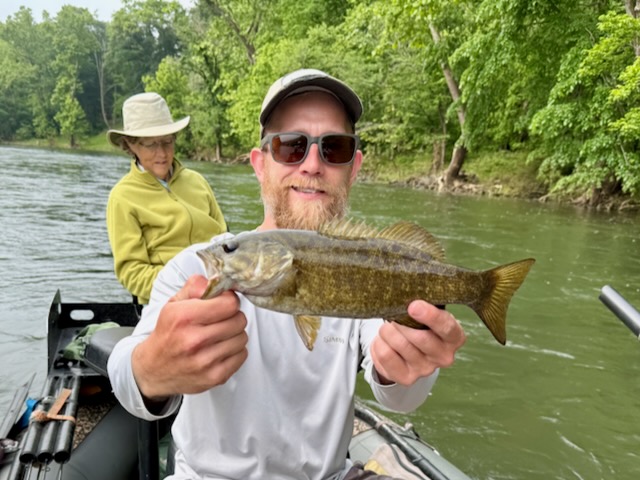
    John Waller, guide, holding one of the Smallmouth Bass I caught, Gray sketching in her fleece jacket. We tropical geezers are not unhappy with our extra clothing.

    Most of the day I happily cast a topwater frog fly (Umpqua Swimming Frog, 1/0) against the shoreline on John’s lovely Thomas & Thomas 8wt rod, strung with a 2x overweighted line (SA Titan Long).  To my delight, I don’t make a complete fool of myself. My experience casting flies under mangroves for snook comes in handy pitching the frog fly under sycamore bows for smallies.

    Umpqua Swimming Frog fly, size 1/0, a deer hair bass bug based on the Dahlberg Diver.

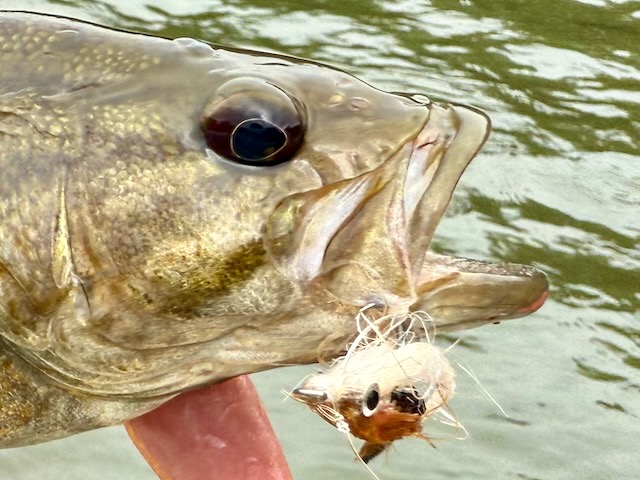
    We also mess around with poppers (let it drift, not much popping), streamers (2 hard strips, and a pause), and floating a wooly bugger under an indicator (cast, mend, wait). These setups catch fish, but without question the topwater frog is the most fun. As with dry fly fishing for trout, it’s a hoot seeing Smallmouth Bass rise to the big deer hair frog fly. I especially enjoy watching one that comes up, stares at the fly, then changes its mind… three times in succession.
    Around 3 pm, after seven hours of throwing that heavy fly line, my casting hand gives out, so I switch to the other hand. John looks at me and muses: “You waited all day to tell me you can cast left-handed.”

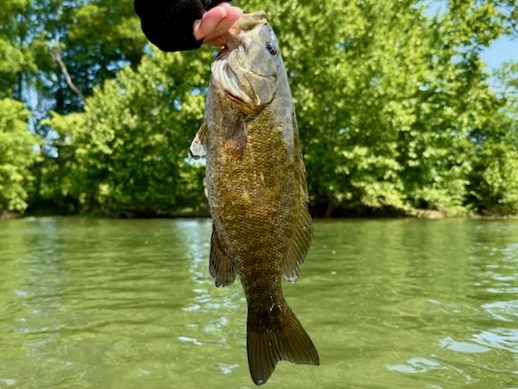
    In all, I catch 20 Smallmouth Bass (3 big ones) and three Largemouth Bass (all small). John says that Largemouth are becoming much more common. Warmer times.

    One of the big ones. (Photo by John Waller)

    Another plus, l learn how to fish the river, or imagine I do.

    Forty-five minutes after we get off the water, the weather explodes. Sheets of rain and gale force winds blow down the river. A tornado forms 20 miles north near Luray. Lucky timing for us.

    Day 2. more wind

    Today is also windy, gusting to 33 mph.  Plus my brother Andrew came by to visit.  Not a great day for fly fishing, much less from a kayak. Instead we fly Andrew’s stunt kite from a nearby field, fittingly situated on Kite Corner Road.

    Pretty cool kite, beyond my capability to handle, but Andrew has it mostly figured out. Check out the video:

    Looking the other direction toward Kite’s farm. (watercolor, Gray Read)
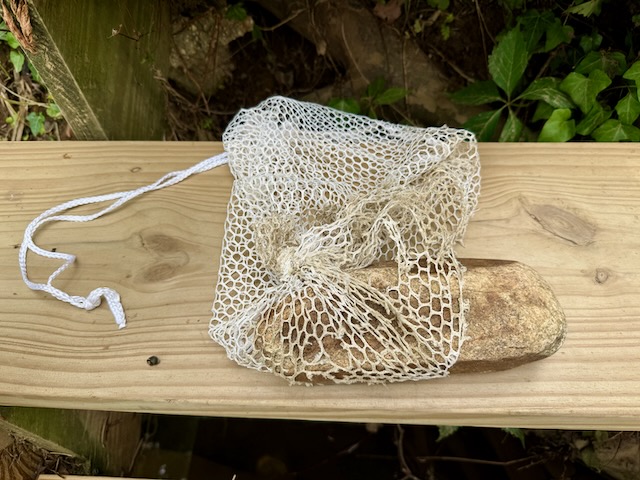
    Before sundown, I rig one of the kayaks at our rental with parachute cord and carabiners, lower it down the steep steps, and tie it in the river for tomorrow. I fashion a kayak anchor by putting smooth river stones in a nylon mesh bag that I’d brought along for that purpose. I’ll take the kayak out in the morning and see how I do on my own.

    Day 3. Kayak fishing

    The air temperature was 49° F when I rose this morning. After seeing my brother off, I put on multiple layers and head out in the kayak to fish the section of river around our rental cabin. Across the river, Wild Turkeys gobble as several deer eye me suspiciously from the bank.

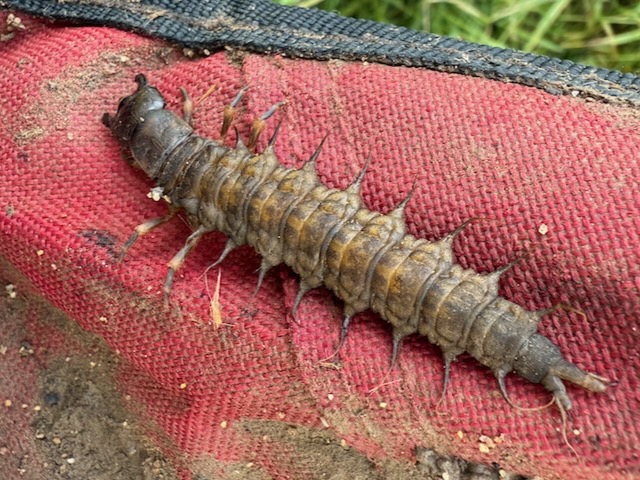
    My homemade kayak anchor (v1.0) works OK, but slips a bit in the current. I find more smooth stones on a bar and added them to the bag (v1.1). I also find a folding stool concealing a big hellgramite (Dobsonfly nymph) in between the muddy folds. It crawls into the river, taking its chances with bass unknown over the large creature that I am.

    I cast the swimming frog fly under and around every sycamore tree that overhands the river, but cannot get a bite. Ditto for the indicator/wooly bugger rig that John Waller showed me two days ago. This section of river by the house is shallower and faster than the places upstream and downstream where these methods caught fish: the topwater froggy drew bites in slack eddies and the wooly bugger dangling deep under the indicator (a light float) caught fish lurking in deeper holes.

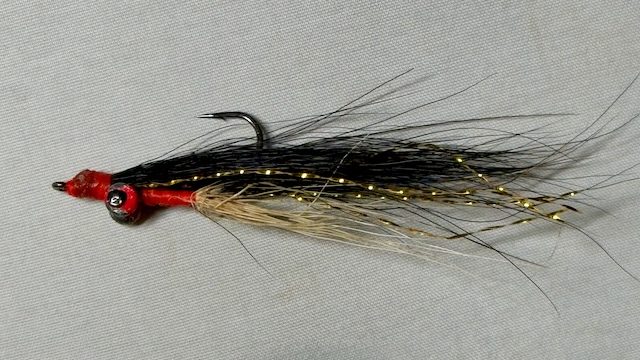
    In frustration, I tie on the old faithful black & ginger #6 Clouser Deep Minnow with red eyes and gold flash. That was the fly I used two years ago to catch dozens of small bass in the river. Doink! It hooks up on the first cast. Small fish, but one fish is infinitely better than zero. John Clouser invented this fly for fishing Smallmouth Bass before discovering that it catches everything.

    Black over ginger Clouser Deep Minnow with gold flash, tied on a #6 Gamakatsu B10S. The painted lead eyes on this one have seen their share of rocks and the bucktail has been chewed down by many Smallmouth Bass.

    Smallies strike the Clouser 30 feet from shore, retrieved from down current with little strips (strip-strip-pause). The third fish, a big one, comes partway out of the water to take the fly, fighting longer and harder than the one I was holding in the photo above. I switch hands when my right wrist tires, then switch back when my left wrist tires – what a great fish! I’d heard that among North American fish species Smallmouth Bass are the strongest fighters for their weight. Now I believe it. When the fish is close enough to see some flashes in the water, I reach for my landing net and – OH NO – slack line. The fish got off! Rats!

    If I’m not fishing for dinner I don’t need to lift a hooked fish from the water to be content, but I do want a good look at it before it takes off. Location noted. I will be back.

    Anchor v1.1  worked great this morning until the mesh wore out from dragging along the rocky river bottom, allowing the stones to escape.

    The last remaining river stone, caught in the act of escaping the mesh anchor bag.

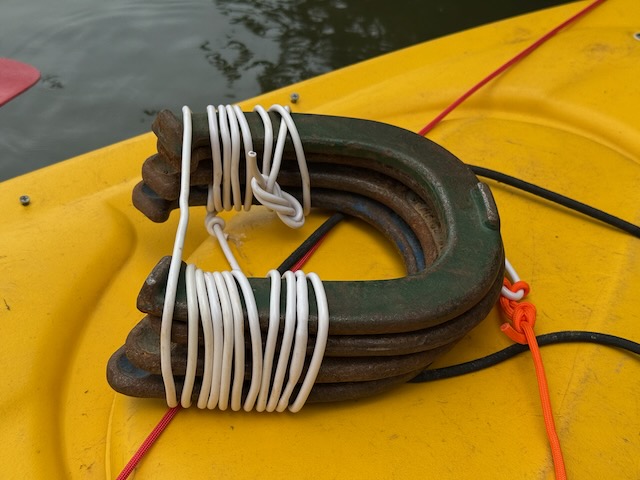
    Time for lunch. The owner of the house stops by to survey the storm damage we’d reported to her. She kindly unlocks the shed and invites me to scrounge for anything I could use to McGyver up another anchor. Digging around I find a stack of iron horse shoes, the kind you throw, and some plastic coated wire cable to bind them up. Kayak anchor v2.0.

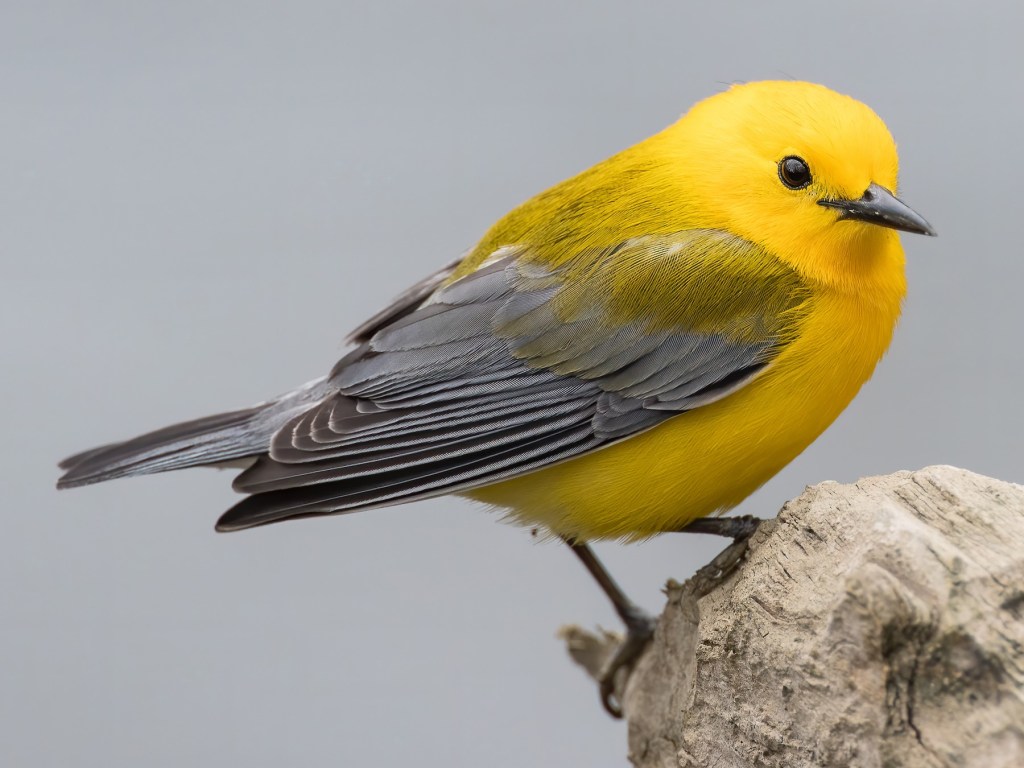
    Birding break: I hear a male Prothonotary Warbler singing from a tree near the porch. He cooperates as Gray and I get good views through the binoculars. Quite the looker, described by eBird thus:
    “Shockingly bright warbler of swamps and wet forest. Adult males have gorgeous yellow head and body with greenish back and blue-gray wings.”

    Prothonotary Warbler, photo © Ryan Sanderson, courtesy of eBird. https://ebird.org/species/prowar

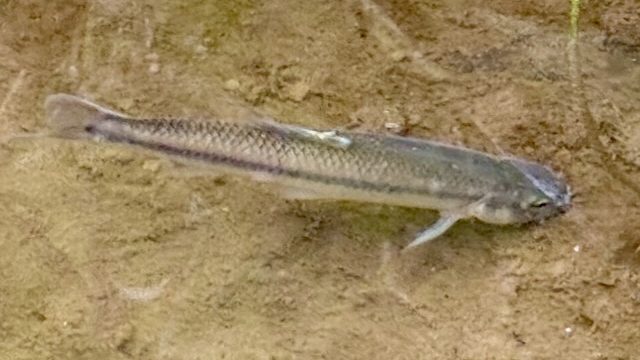
    I attach the horseshoe anchor to the kayak, photograph a Black-nosed Dace (minnow-type fish) in the shallows, and spy on the tame young woodchucks living under the porch.

    Young woodchuck savagely devours a hapless leaf.

    Two fishermen in a guided drift boat come by, working the shorelines below the house. We exchange the typically terse fishermen’s infochat: “a good morning, slow afternoon, subsurface streamers working best.”

    I will have to try casting my untested Black-nosed Dace subsurface streamer patterns against the shoreline.

    Late afternoon bird-fish report. Tree Swallows have a nest with babies in a sycamore snag and Baltimore Orioles have a nest in the living part. A Warbling Vireo sings nonstop, but I haven’t found his nest. My first cast of the Clouser catches a fish. A young Bald Eagle flies over in the middle of my next cast. I “Clouser” the kayak while gawking at the eagle instead of minding my backcast. A few more small bass, then a medium-sized one hooked so tight I destroy the fly taking it out with the hemostat.

    I needed an excuse to try out my new Black-nosed Dace imitations.

    Black-nosed Dace in the shallows.
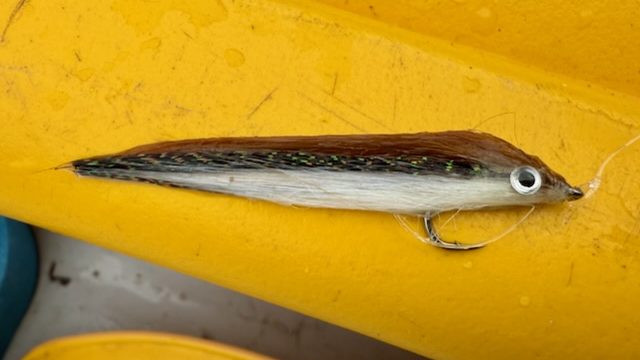
    My imitation dace streamer fly, tied with craft fur, black flash, and a mono weed-guard (more of a rock-guard in this river).

    No action on the shoreline but out in the middle, above the rapid line, my dace fly gets a hit every cast. Adding a stinger hook will catch the short-strikers.

    After dinner I go back out for the evening rise. Right on schedule the air over the river fills with big brown mayflies, but no fish rise to eat them as they had two years prior. Bobby, a neighbor spin fishing from his deck, tells me that in normal years smallmouth rise to mayflies at dusk, but this year the river is up 2-3’ from the rains and fish habits had changed.

    I cover the same sections that had been productive before dinner but cannot get a take. Hurrying back in at 8 pm to join Gray for cold watermelon in the hot tub, I pause to cast at the shoreline and hook up four times. Huh. Maybe river fish move around as much as flats fish do.

    Day 4. Working it.

    I catch that big smallmouth again, or at least one of similar size in the same spot, on the same fly, at the same time of day, and which puts up the same interminable fight. This time Fishy stays hooked until released.

    How about those stripes, huh? Back you go.

    All day, I only kayak-fish the 1/3 mile section of river in front of the cabin between the class 1 rapid upstream and the class 2 rapid downstream. The upstream rapid was a mere riffle two years ago through which I’d easily pulled the kayak on foot.

    I ponder running the lower rapid and think better of it. I am an experienced kayaker, skilled in low braces and competent to roll. I also know that no matter how adroit one is with a paddle, attempting to get over rocky drops in  a large-hatched kayak, with no flotation bags or sealed hatches, no spray skirt, no helmet, a heavy unsecured anchor, a floating backpack loosely fastened to the deck, an expensive fly rod between the knees, and no one to assist if something goes wrong, is the epitome of a bad idea. Possibly the anchor gets loose and jams between two  rocks, my kayak goes taught against the anchor line and turns crosswise to the current. Secured by the anchor line, the kayak does its very best to tip into the current, filling the open hatch with water and rolling it. Very hard not to break the fly rod. Worst case, I tangle in the paddle leash and/or hit my head on a rock and drown. John Geirach’s friend Archie “A.K.” Best put it this way:

    “I enjoy fishing too much to risk my life at it. 
    Death can really cut into your fishing time.”

    An inflatable raft is the way to go.

    The day’s final fish count when I quit at supper time is 34 smallies and one Pumpkinseed Sunfish, all caught in the safe span between the rough waters. (I counted the fish I caught in homage to my friend Jay Levine, who always counts his fish.)

    Pumpkinseed Sunfish caught on a red / white Clouser bendback.

    Day 5. Downstream

    Before we leave for home, I really want to catch another fish on the swimming frog topwater fly that John Waller gave me. I snuffle some more around the shed and find a couple of ratchet tie-down straps. The kayak thus secured on the car’s roof rack, I drive downstream 1.5 miles, bypassing a couple of sets of rapids, to the Grove Hill Boat Ramp (“Boat ramp” might be an Appalachian euphemism for a mudslick bulldozed out of the riverbank). My intent is to look for slack eddies where fish might feel sufficiently rested to attempt a frog.

    I spend an hour fishing an eddy shelf 2-4’ deep and 150 yards long. There I catch seven ambitious Pumpkinseed Sunfish and miss a dozen more strike attempts in which the sunfishes fail at stuffing that big fly into their tiny mouths.  I don’t see or catch a single Smallmouth – so different from the area near the cabin. I feel like there’s a lesson for me somewhere, but mainly I come away appreciating John Waller’s inflatable drift boat and his proficient oarsmanship.

    Good-bye, river. (watercolor, Gray Read)

    The next day we drive out, by way of Luray Cavern, which I’d been wanting to see for the past 58 years. Well worth the wait.

    © Philip Stoddard