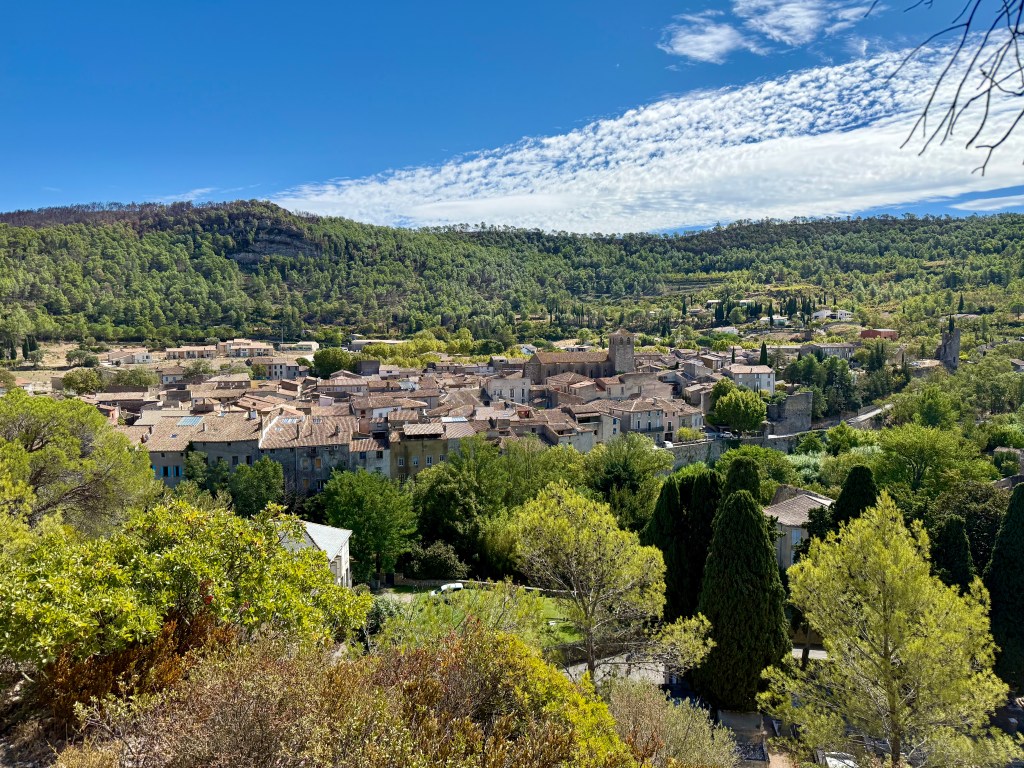
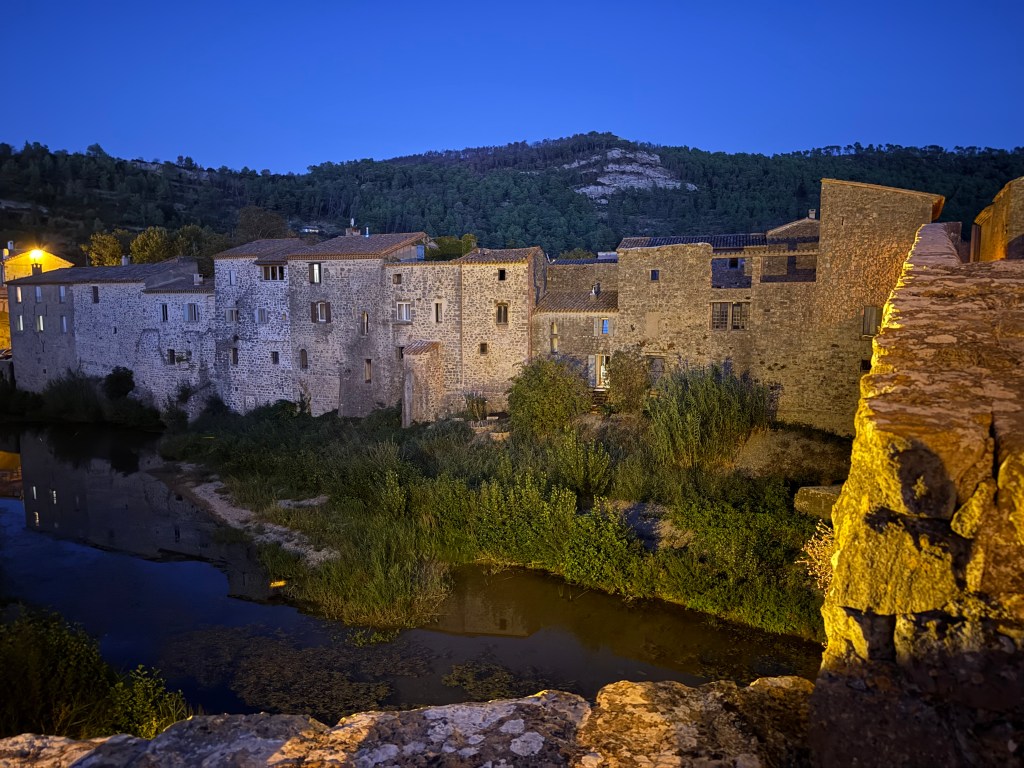
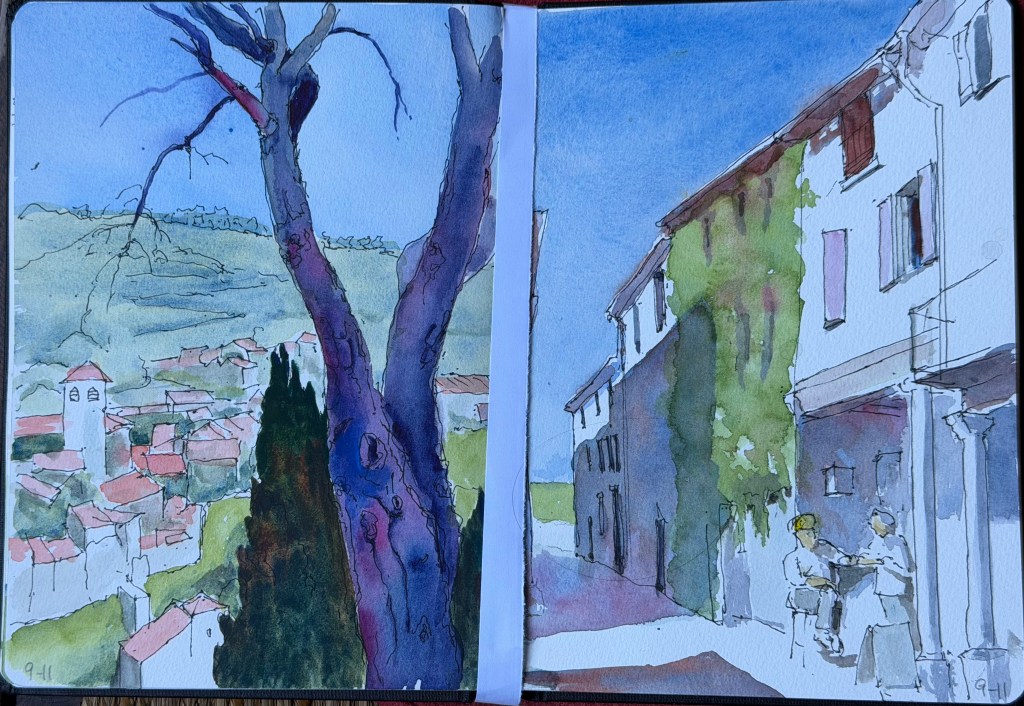
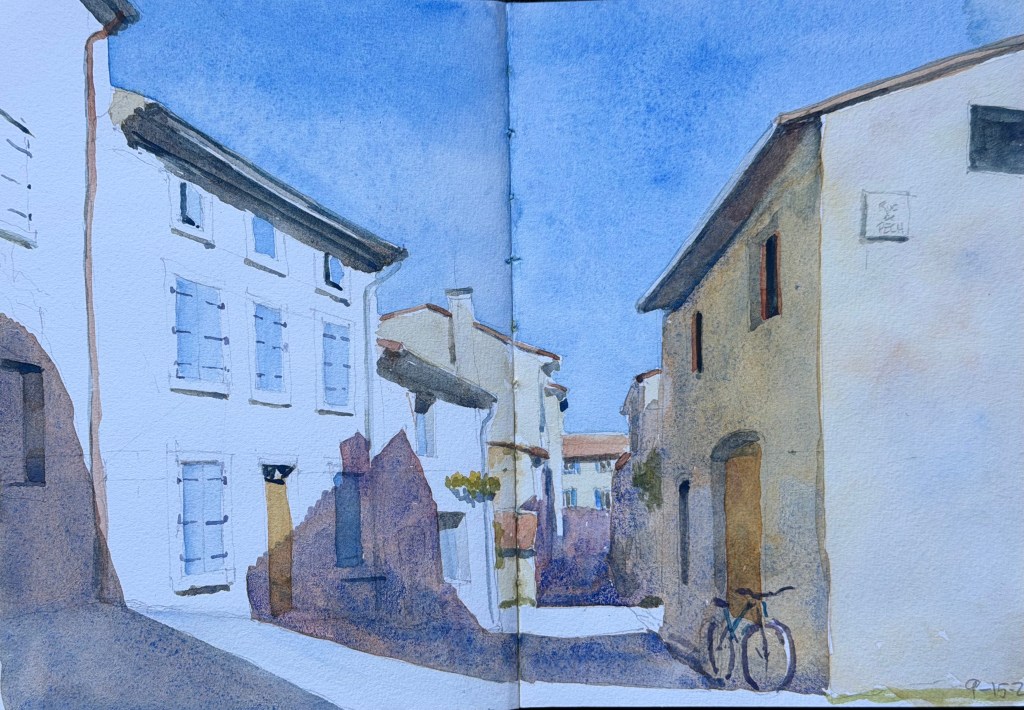
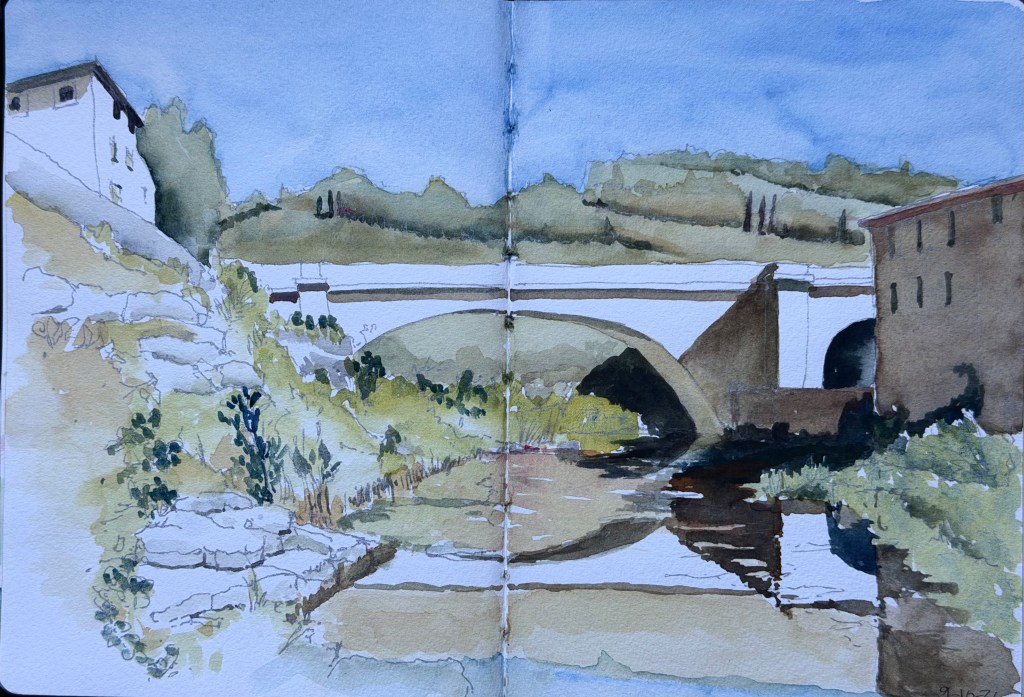
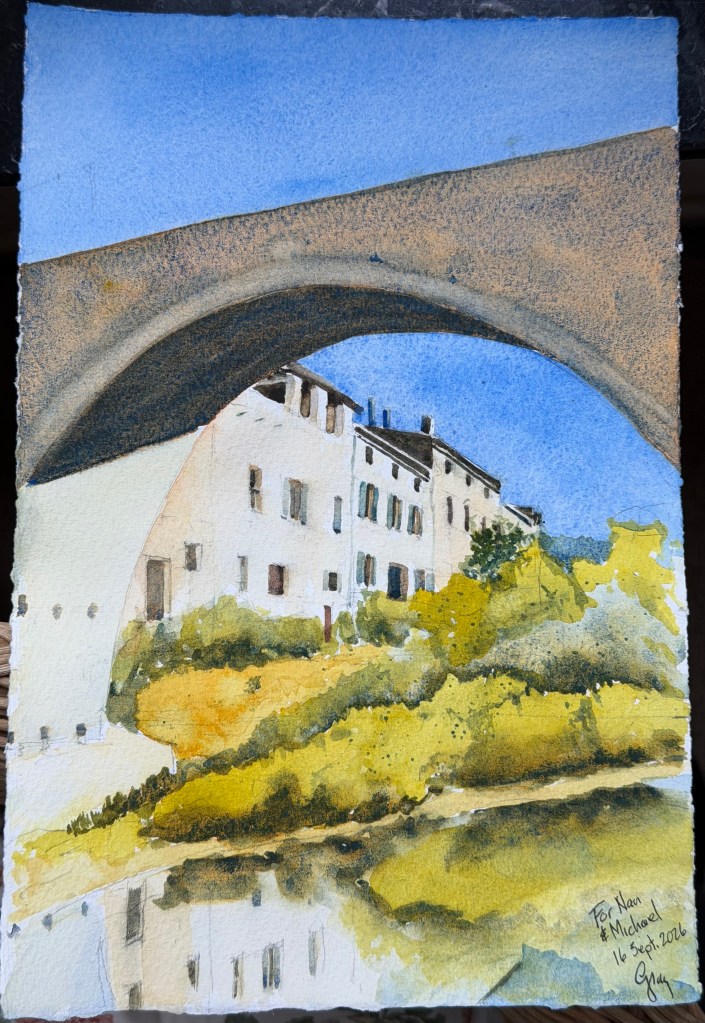
We have spent an enchanted week-plus in the medieval town of Lagrasse, in the south of France.
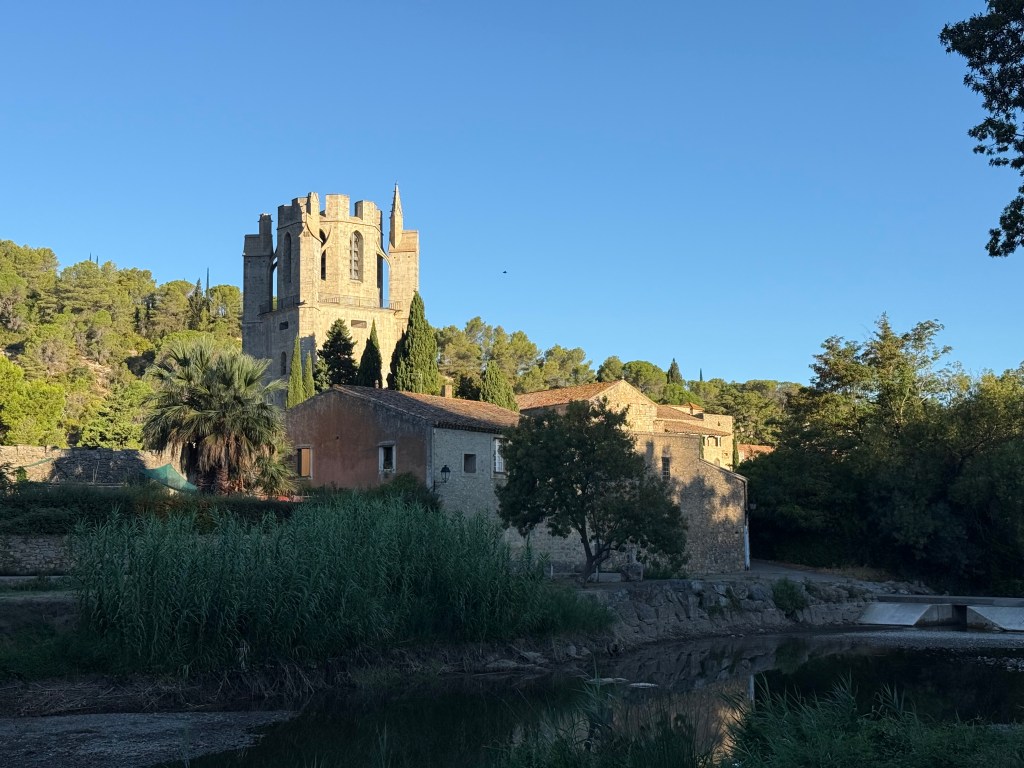
After the Catholic Church successfully eradicated the heretical Cathars in the 14th Century, they established an abbey to preserve the Church’s grip on the populace. The town of Lagrasse grew up beside the abbey.
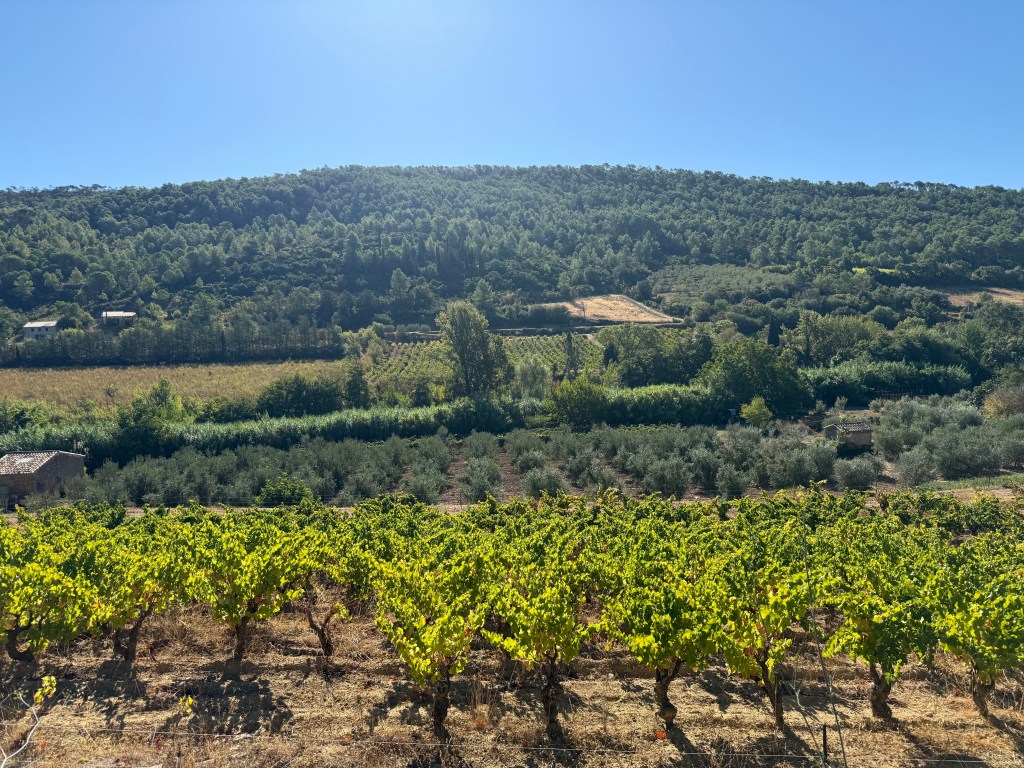
The abbey today is inhabited by Jesuits who grow olives and wine grapes. In their long brown robes they play soccer with the local kids.
The abbey’s bell rings on the half hour, followed exactly two minutes later by the bell of the local Catholic church.
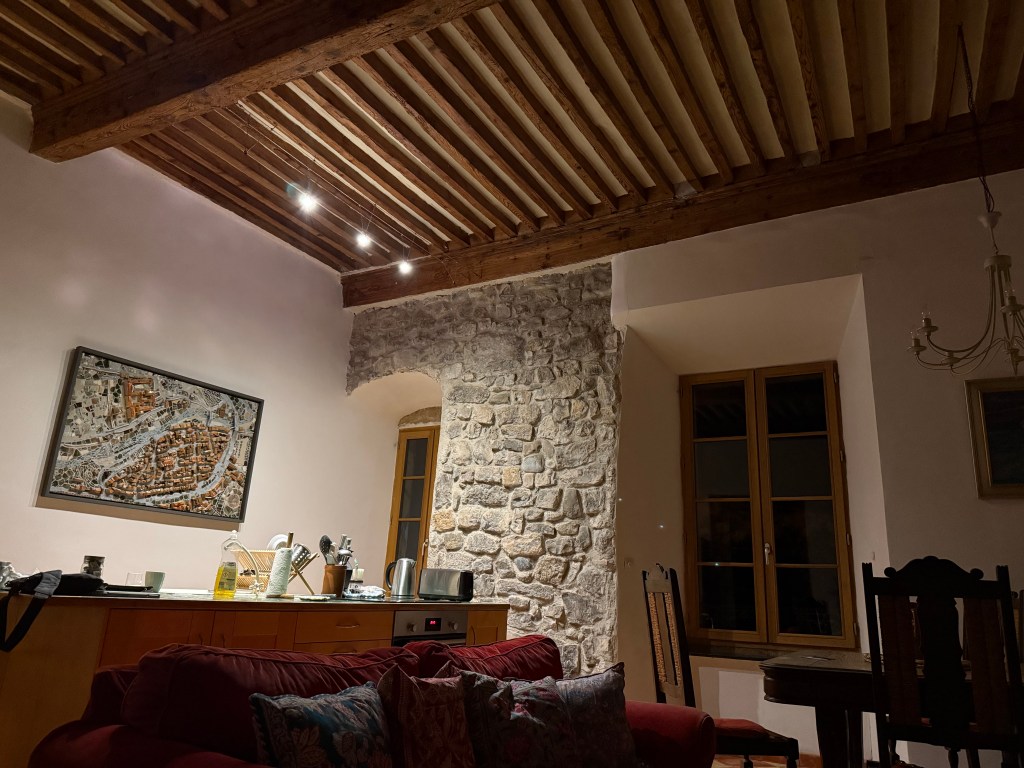
We stayed in the apartment of our old (but younger than us) friends Michael and Nan. A couple of days after we arrived, they drove the 12 hours from their residence in Delft, Netherlands, to join us for the week.
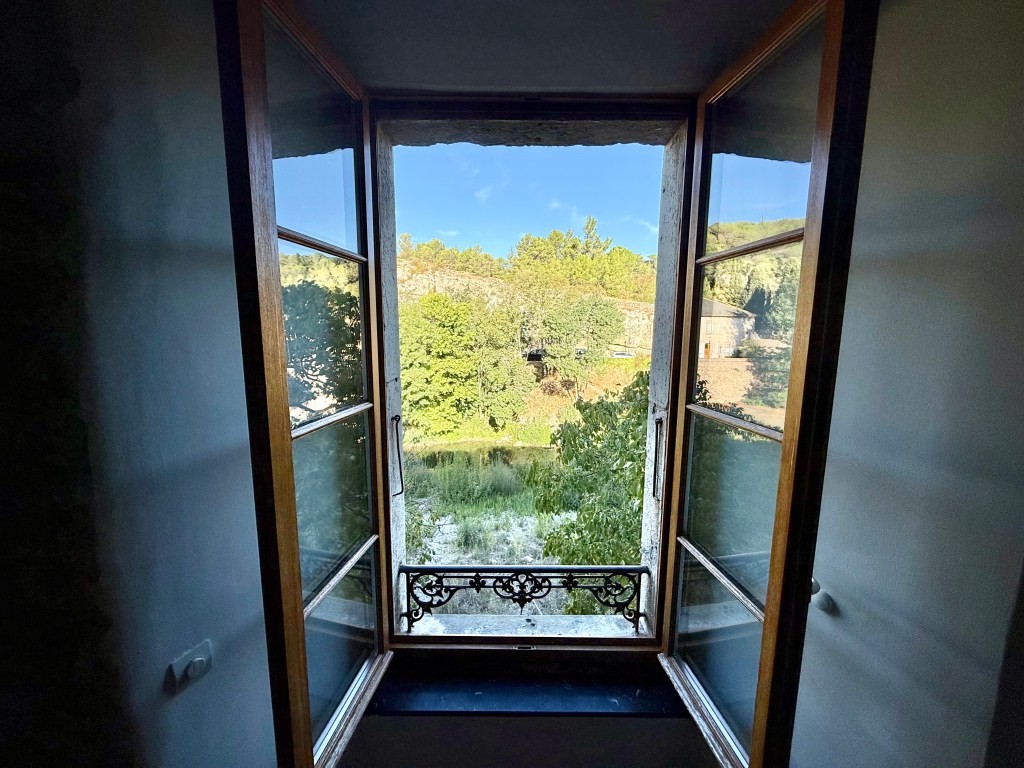
The outer wall of their apartment is stone, a full meter thick, forming part of the outer wall of the town, properly defensible from whoever might attempt to take by force the local resources: wine, olive oil, and violet ice cream.
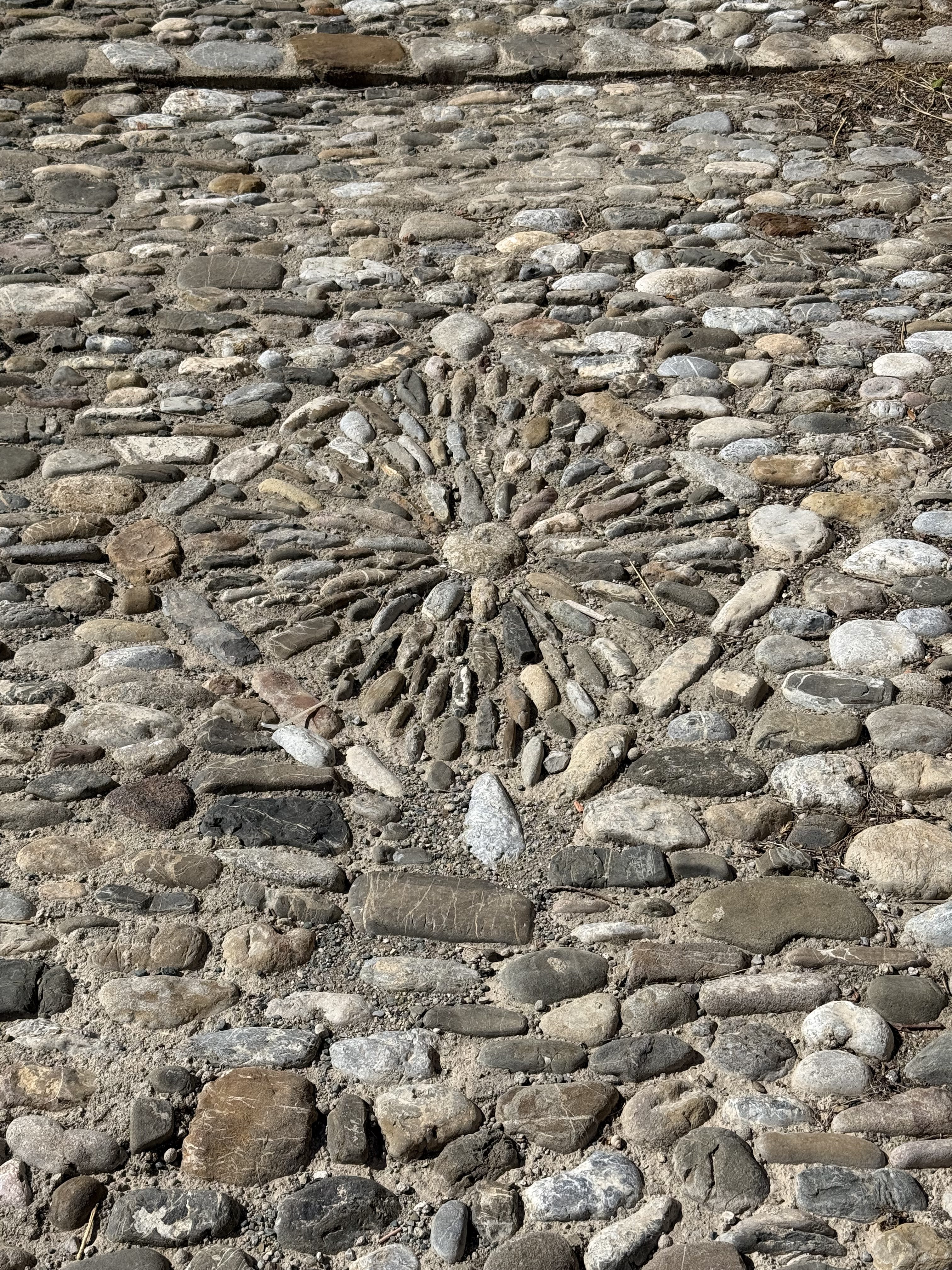
Just a random bit of the cobblestone street.
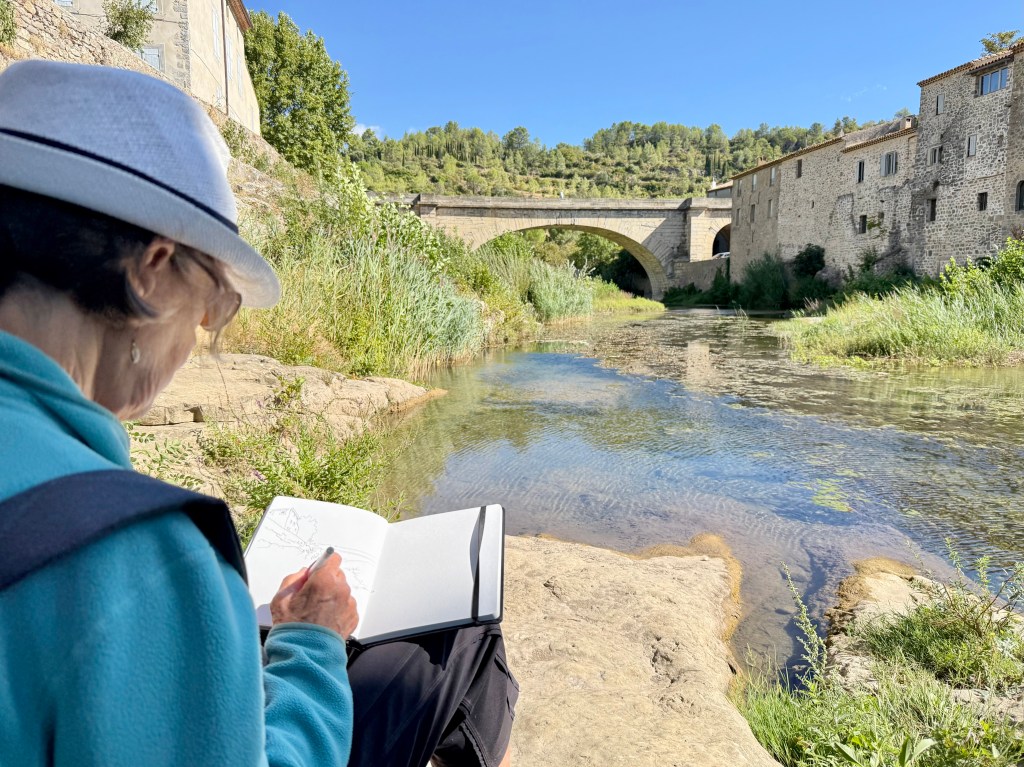
Every inch of the town begs for a watercolor painter. If only we knew one.
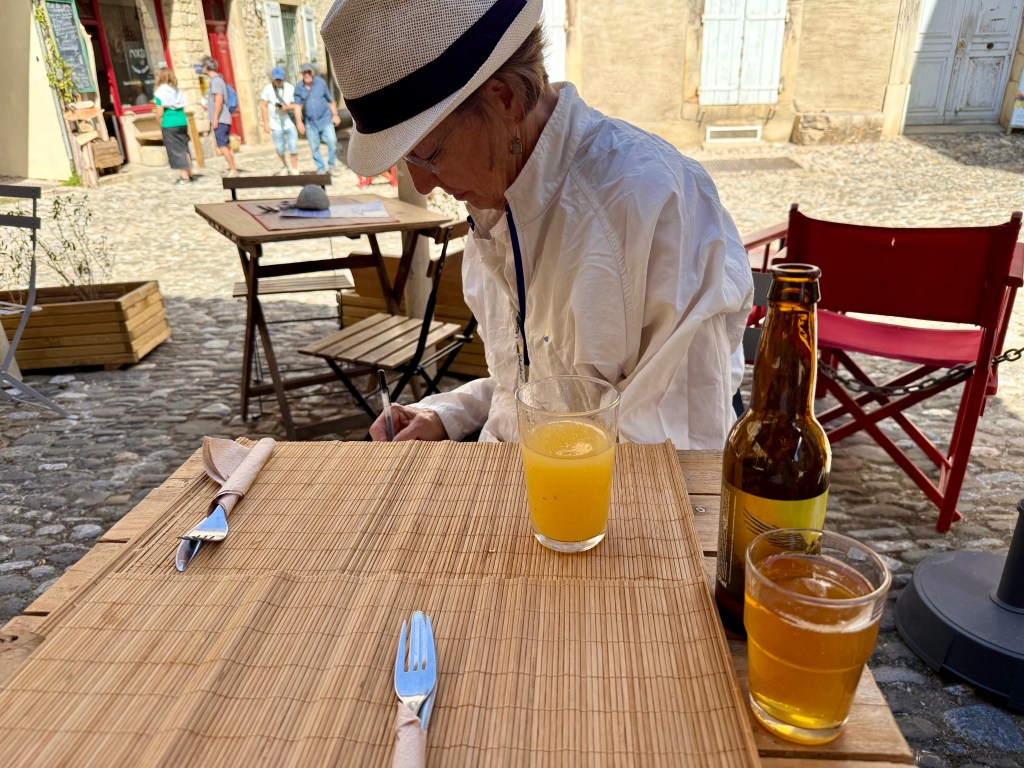
The only times Gray was without her sketchbook in hand were sleeping, swimming, and meals.
Ok, scratch “and meals”.
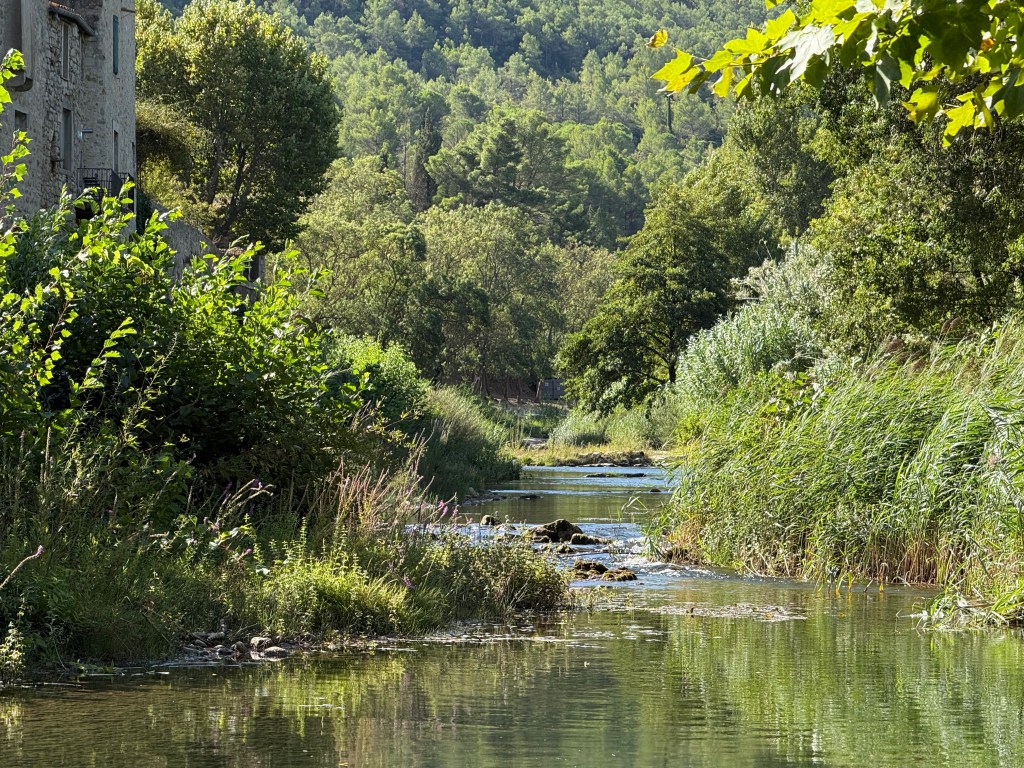
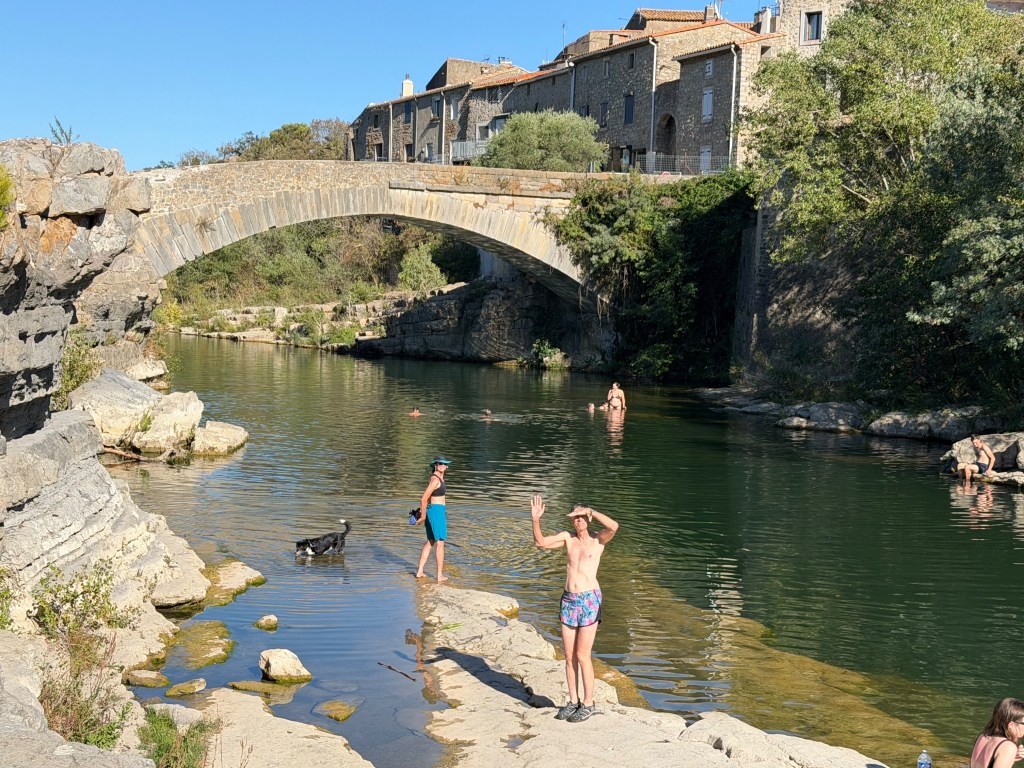
Lagrasse sits on the d’Orbieu River, a clear-running creek this time of year, which can rise 30 feet in flood, filling basements and first floors in the town. In late summer, it’s more of a creek.
The only grocer in town keeps random shop hours and stocks a random selection of wares to match.
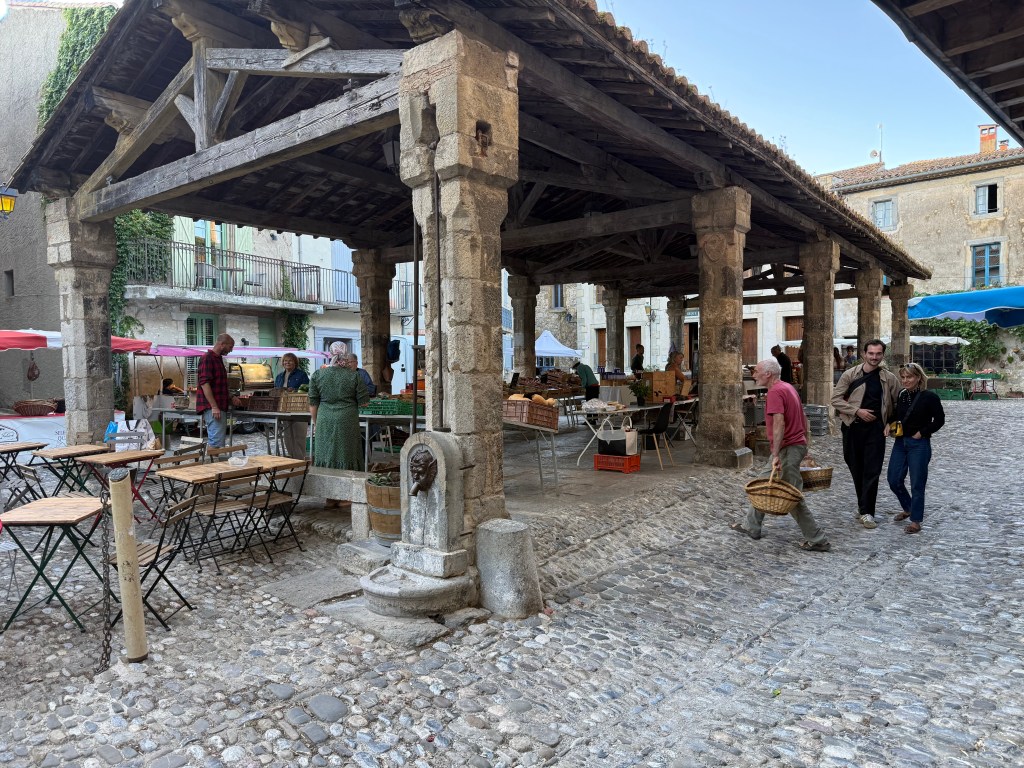
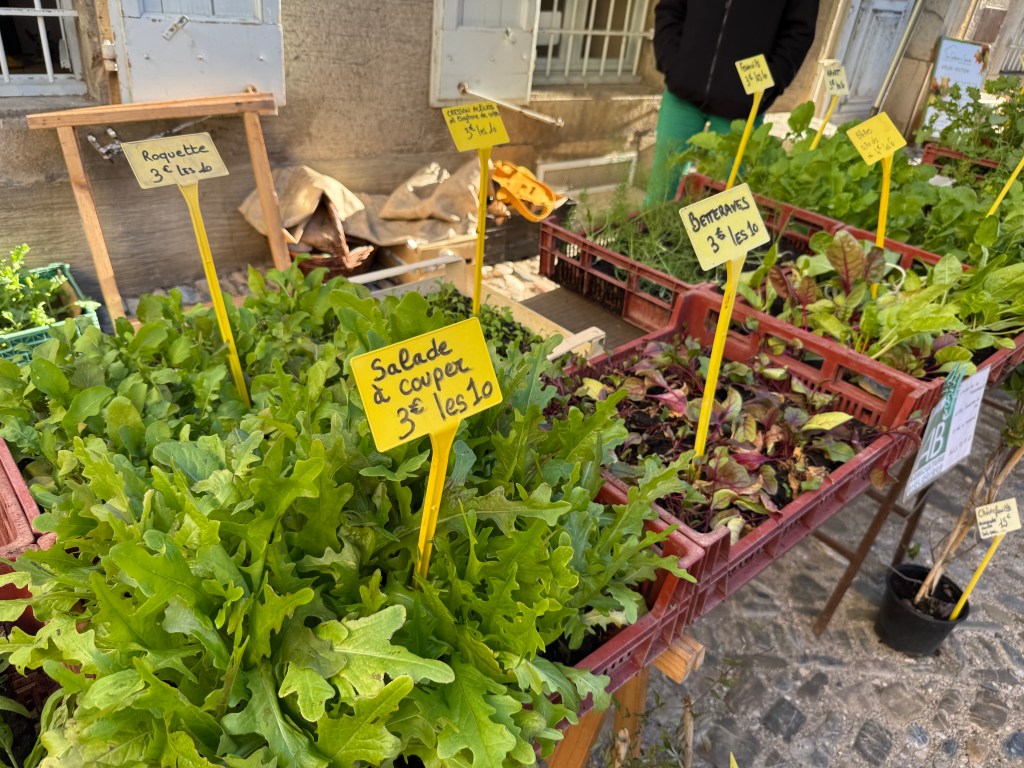
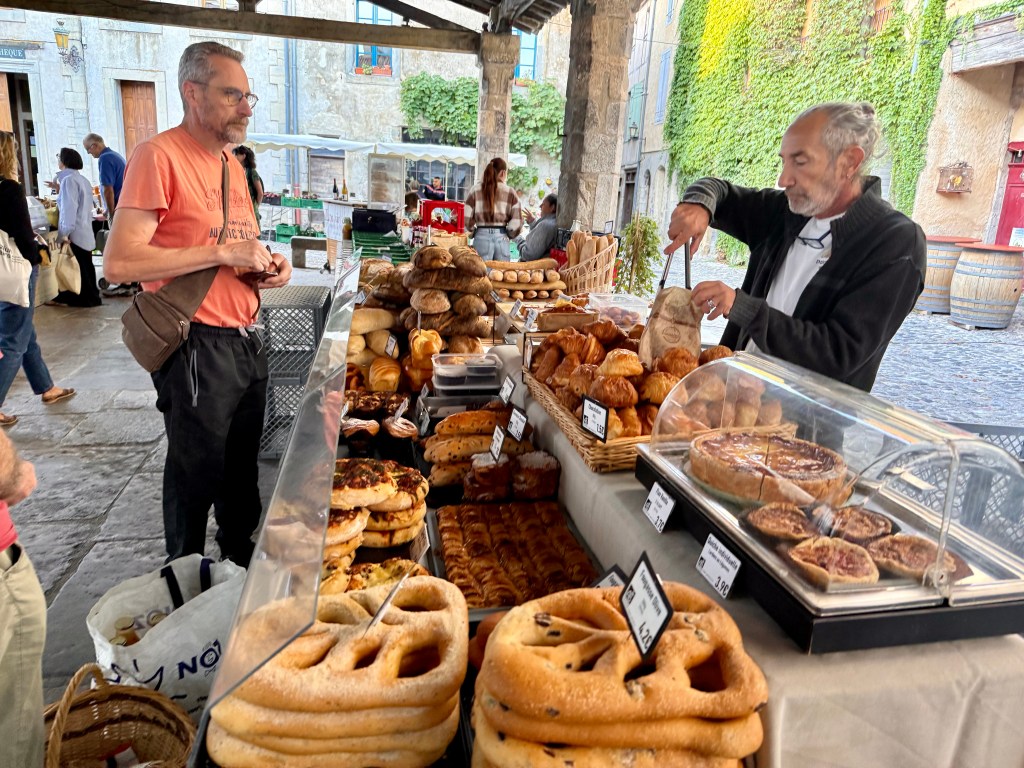
On Saturday morning, though, a market is held in the open square outside the apartment.
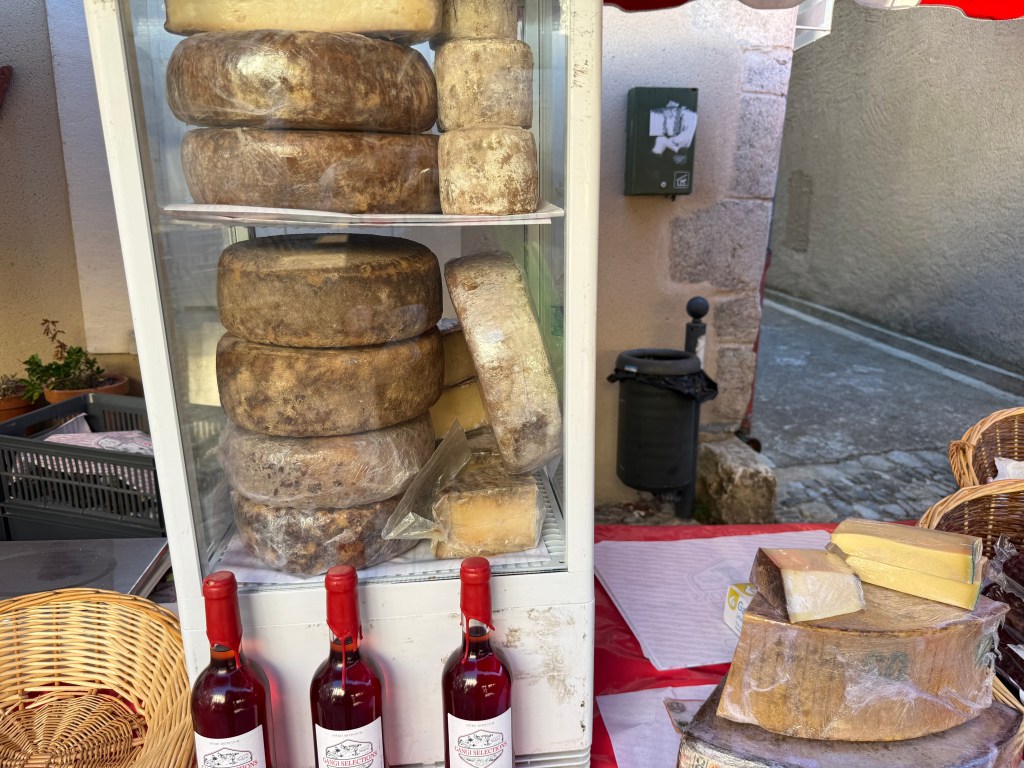
On first glance, it doesn’t look like much, but step inside and look again…
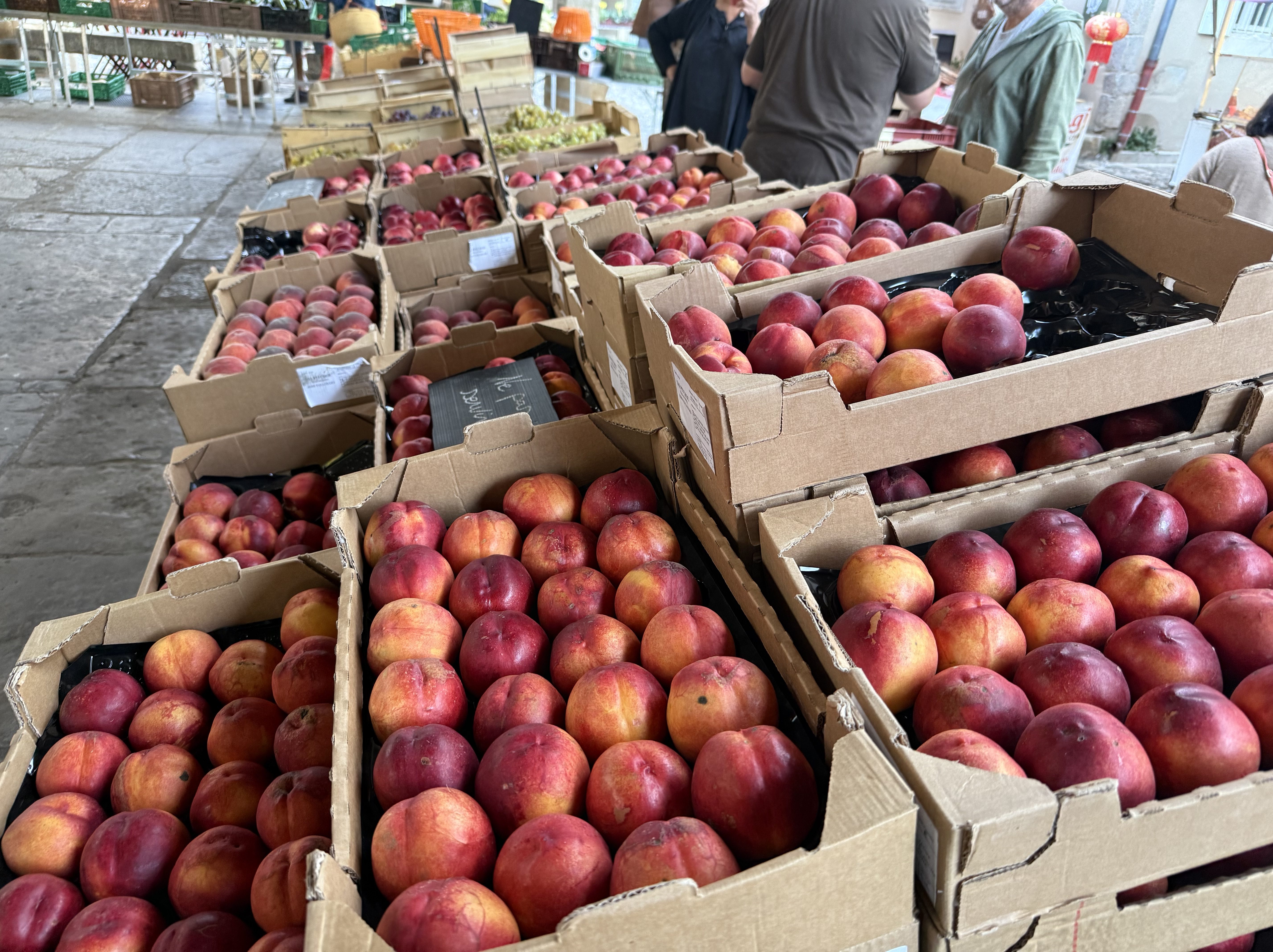
We stocked up on peaches, plums, vegetables, beef, poultry, sausage, salami, paté, cheeses, wine, and gluten-free bread. It’s France.
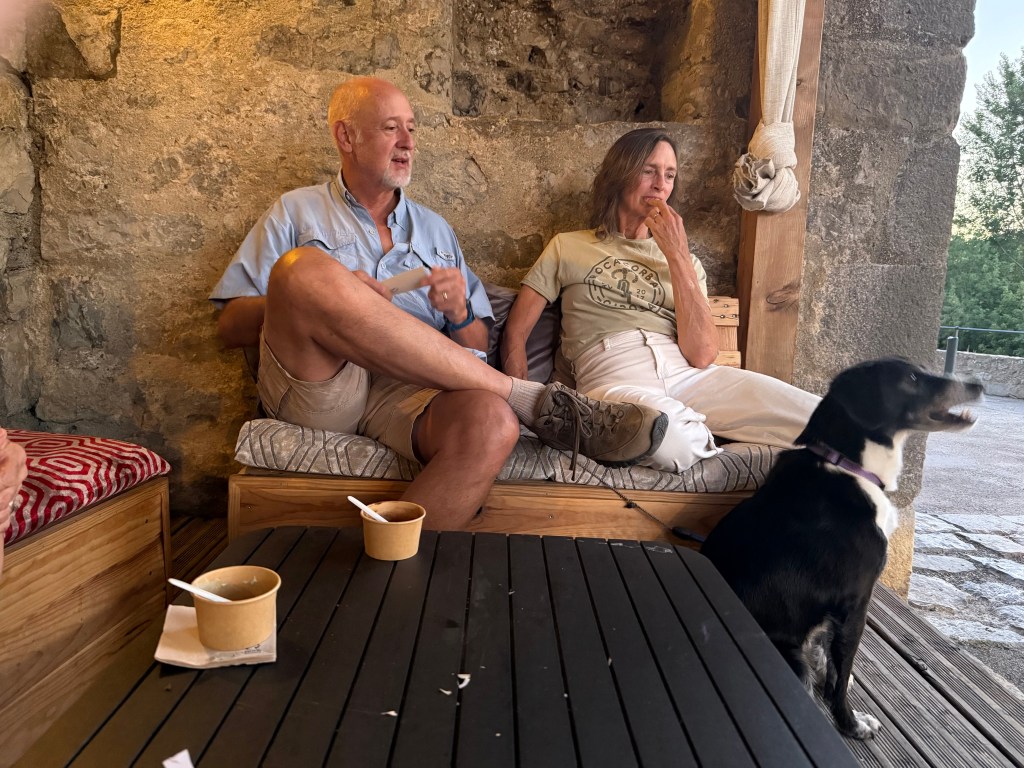
For dessert we could wander down the lane along the river to an ice cream shop. Gray had mint chip in a cup. I had violet ice cream in a cone. It’s a thing.
Michael and Nan, basking in the glow of ice cream.
The river is home to herons, ducks, wagtails, astoundingly beautiful kingfishers, and Great Gray Herons that look like our Great Blue Heron but say “snirk!” instead of “snork!”. And fish.
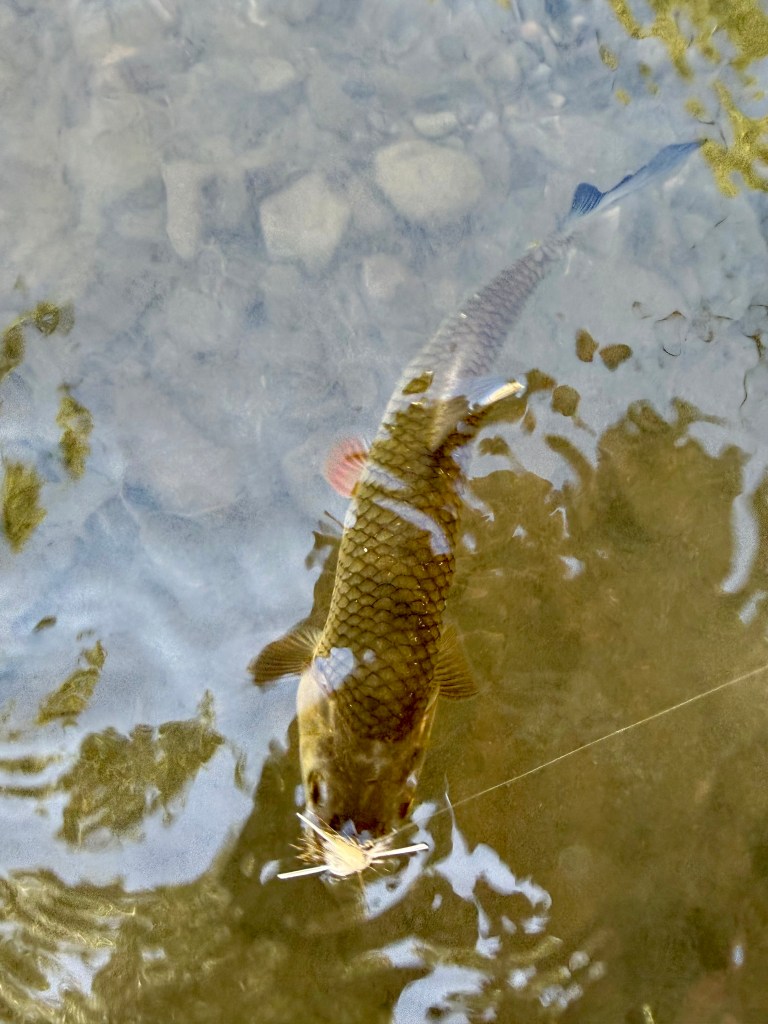
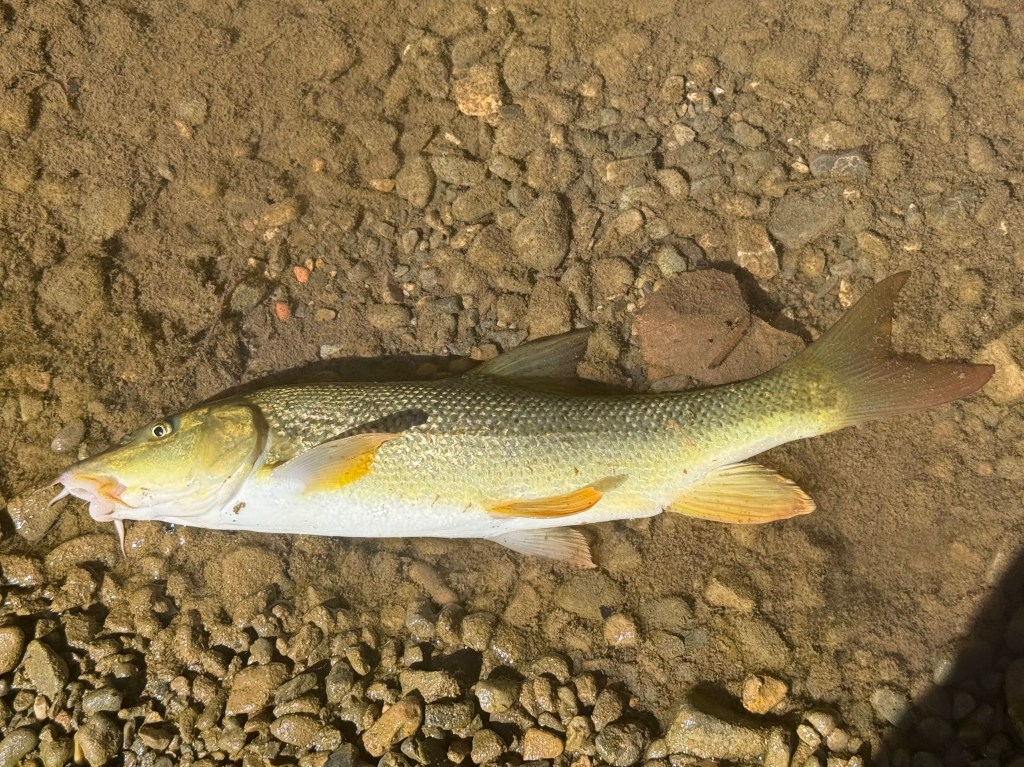
The d’Orbeau looks like a trout stream and is stocked with trout in the spring, but this time of year the visible fish are Chevesne aka Chevaine (Squalius cephalus) up to 18” in length and Mediterranean Barbel (Barbus meridionalis) up to 24”.
I had planned a fishing-free vacation for my right hand to recover after a summer of excessive fly casting. But Michael discovered that I fly fished, disappeared into their store room, and emerged with four fly rods, reels to match, and assorted fly tackle, left over from his days fishing trout in the Colorado Rockies.
The water was cool, but warm enough for me to wade in my sandals. I found the little Chevesne would pick at dry flies all day and the bigger ones would take a dry fly in the late afternoon.
Chevesne caught on dry fly
Barbels, however, preferred a slice of salami.
Mediterranean Barbel, caught on salami.
The Barbel looks like a bonefish and fights even harder than a wet rag. They try. I took a special liking to Barbels when I read they are considered a biological indicator of high water quality. Both species are eaten by the French, though the Barbel has poisonous roe. I let mine go back in the “river” to enjoy life and make more.
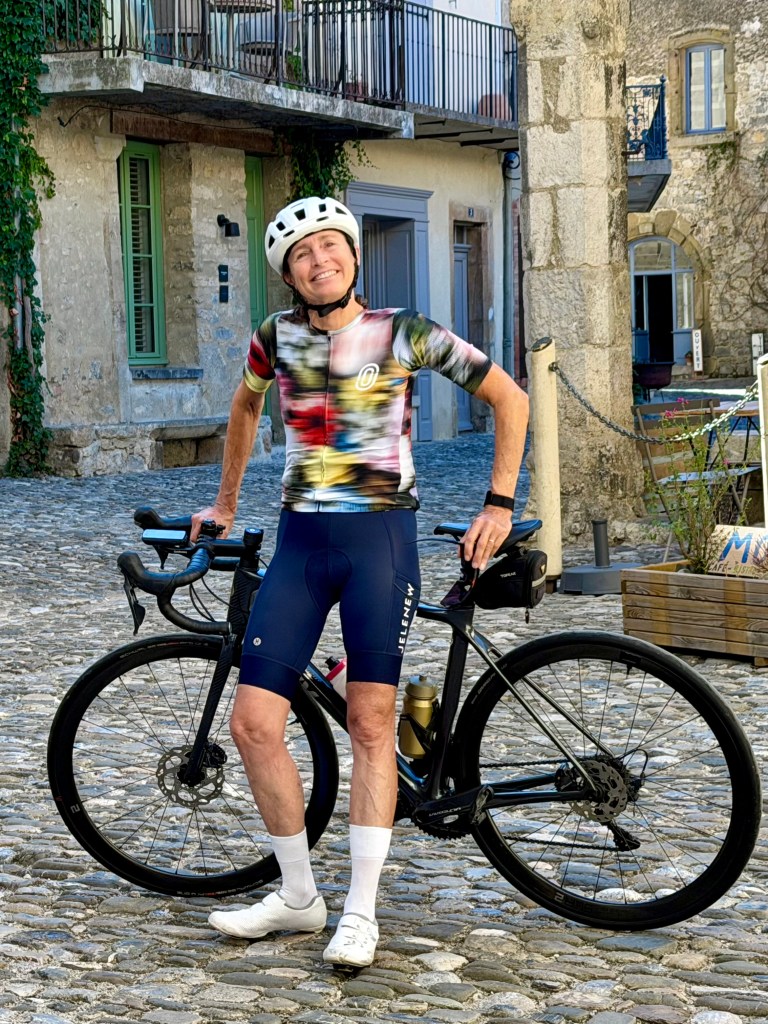
Michael and Nan are former bike racers, and took regular bike rides on their featherweight carbon fiber bicycles.
Nan, petite and svelte, remains a cycling beast, riding a fast 35 km through the foothills of the nearby Pyrenees one morning.
Their apartment was briefly visible to television viewers of the Tour de France. Michael watched the Tour de Spain at night on his computer.
Afternoons included a swim in the river.
At 1:30 am I woke to soft rustling and crunching noises. Had a rat had gotten in to nibble my chocolate bar? I slipped out of bed to investigate and found the sounds were coming from outside. I stood in the cool breeze of the open window and strained to see and hear in the moonless night.
From the rustling noises and footsteps I could localize two large beings roaming around in the dark directly below. The one on the left was concealed by the stirring bushes. My view of the one on the right was blocked by a balcony one floor below. That one was making loud hollow crunches, like bones being crushed in the teeth of a bear or large dog. CRACK! A Scops Owl tooted intermittently in the distance. CRUNCH!
My best guess was that I was listening to a pair wild boars that had descended from the forested hills above the abbey and waded across the river, but what was the crunching? In the morning, the ground by the patio was covered with large, cloven footprints, in the shade of a pair of bearing walnut trees.
The next evening we wandered up the street for dessert but found the ice cream shop had closed. The owner, who puts trout in the river every spring, was gone for a week of boar hunting. Filling the larder and making Lagrasse safer for walnuts.
Some pics from Gray’s sketchbook:
We are off to the town of Arles on the Rhône, close to the Mediterranean.
Fly fishing for Permit on the flats of Espiritu Santo Bay in the Sian Ka’an Biosphere Preserve
Day 2.
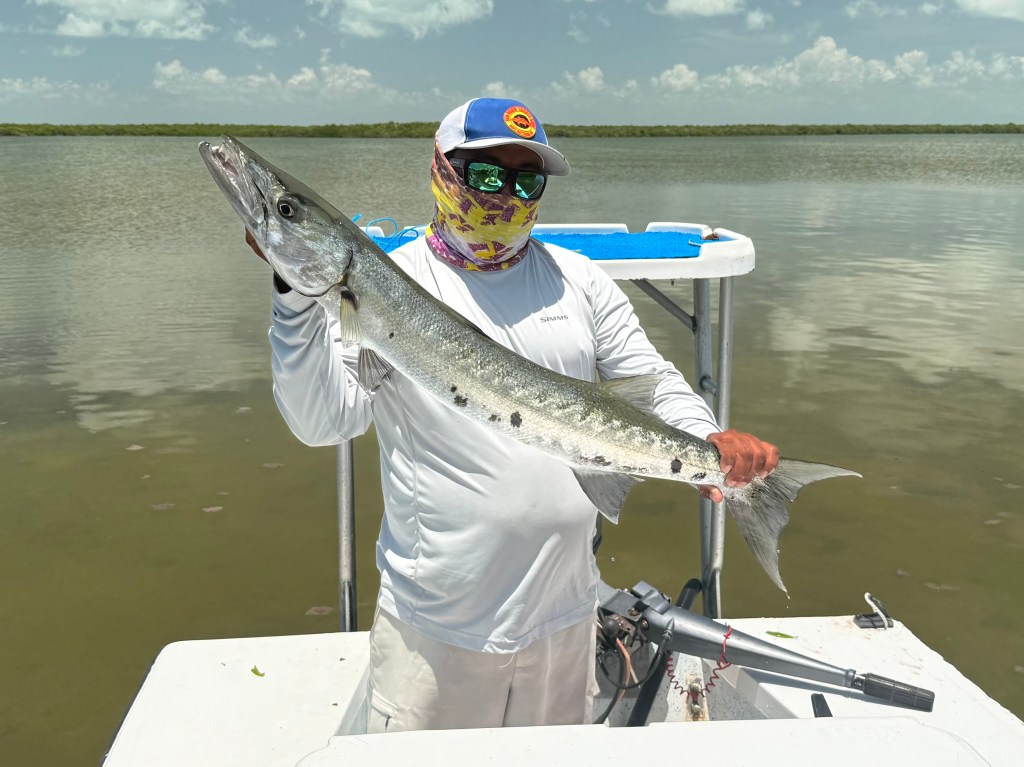
Today I am sharing a boat with another fisherman. Our morning is spent deep in a network of steamy mangrove creeks and coves where we see lots of juvenile tarpon and six hefty snook. The tarpon do not want to eat flies and the snook stay out of our way in the tight mangrove creeks. I catch one small tarpon and my partner refuses my offer to loan him a fly in the successful pattern. To his immense chagrin, he catches nothing but mangrove branches, usually on his backcast, each snag followed by a barrage of Spanish curses. Just outside the mangroves my partner hooks a hefty barracuda on one of the many tarpon flies that the tarpon had refused. Remarkably, the cuda does not sever the tarpon bite-tippet.
Guide Chepo with the barracuda.
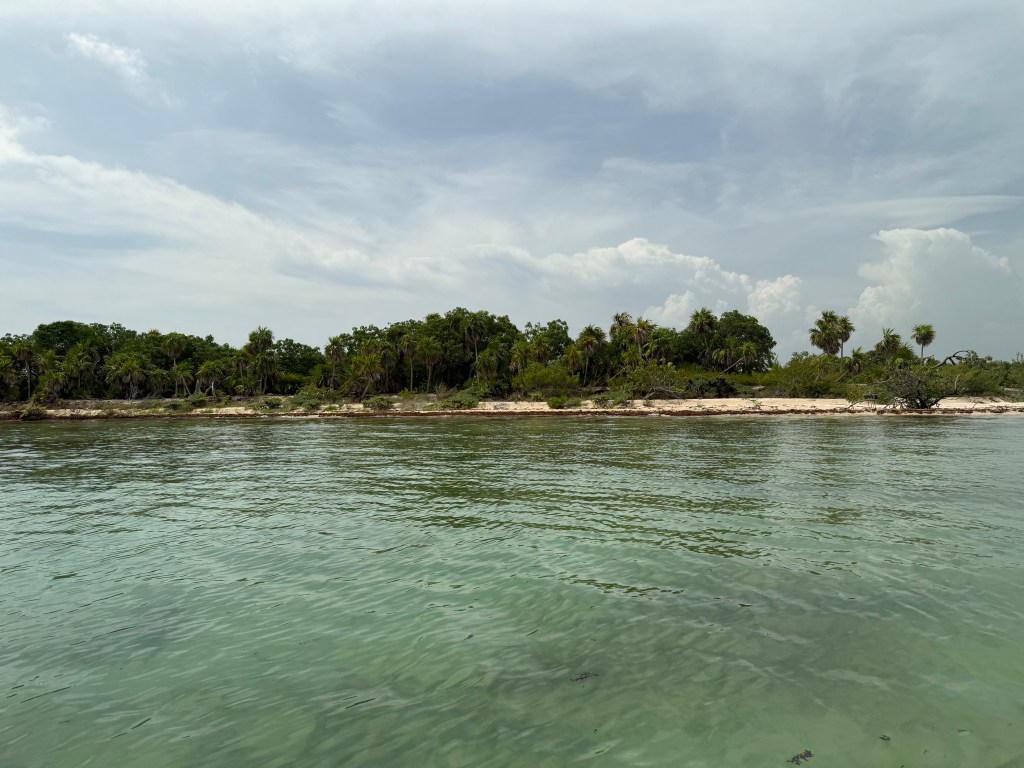
Back on the flats again after lunch, it’s my turn to be up front casting. Our guide Chepo takes us to a shallow stretch of green water edged by a beach. Just as we arrive, a school of ~20 Permit rips past us going the other direction. Chepo stows his push pole and fires up the outboard. We roar out a quarter mile from the shore then head back up the beach to get around the Permit school and wait for their approach.
Poling slowly off the beach we come upon the Permit school tailing in shallow water over a patch reef. Their black tails and dorsal fins extend from the water, swishing back and forth like so many knife blades.
Chepo suggests that rather than cast from the boat, I should hop out and wade to fish for them. I love wade fishing, but more importantly, a slow-wading human pushes less of a bow wave than a boat. Chepo and I work our way carefully forward and I began casting to the closest Permit. It follows the fly briefly two times but turns back each time.
As I prepare to cast again, the other fisherman, who will not be named, has worked his way up the beach. I assume he wants to watch, or maybe wait his turn to cast after I hook up. Instead he flanks me and starts casting into the middle of the Permit school. He lines a Permit (i.e., throws his fly line over a fish). That Permit spooks, and the whole school takes off for the middle of the bay. He does not apologize. Even though it was my turn to be on the bow and I was working the school first, he insists he’s allowed to wade fish the same school at the same time. A small black cloud settles in over my head.
While my boat partner is on the bow, I become aware of the inevitable, creeping dehydration and reach for my water bottle, which has rolled deep behind the seats. While retrieving the bottle, I accidentally scrape it lightly on the hull. Unbeknownst to me, my boat partner is working a group of permit and they turn away from his fly following the audible scrape. I apologize profusely. Despite my annoyance, I did not consciously scrape the hull with the bottle. After chewing me out, my boat partner says, “Well, I guess we’re even.”
* * *
DAY 3
Before getting back on the water here in the Yucatan, I’ll back up a month. Gearing up to fly fish for Permit, I went out every day to an open lake or salt flat near my home to practice casting heavy crab flies in the wind using my moderately fast Sage 9wt fly rod.
People usually fly fish for permit using a beefier 10wt fly rod because the heavier line penetrates the wind better. In fact, my friend Juan offered to loan me his ultra-fast 10wt rod for the trip.
Experience has taught me that my two enemies in a fly rod setup are fast and heavy. Even my moderately fast 9wt setup tends to overload my light bone structure and aggravate old injuries. That’s why I’d built a 8/9wt fly rod around a softer rod blank. My hand, wrist, and elbow get progressively grumpier with every step up in weight. My preferred flats rod is a 7wt – anything heavier is asking for trouble.
And trouble I got. Two weeks before the trip, I sprained my casting hand through the repetitive motion of a home carpentry project and daily casting practice with the 9wt. Ice reduced the pain, but healing was slow and I had to lay off casting practice to aid the recovery. The day I left for the Yucatan, my hand felt 95% better.
My wise spouse, who does not fish, nonetheless integrates information well and has a history of dispensing good fly fishing advice. She suggested I bring, as a backup, my two-handed “Spey” rod. Because it doesn’t load the same joints as a one-handed fly rod, if or when my right hand gives out again, I could continue to fish.
I’d never heard of anyone fishing for Permit with a two-handed rod, so I sought a second opinion from Anthropic’s “Claude” AI chatbot (Sonnet 5 medium LLM):
“Does anyone fly fish for Permit with a two-handed fly rod (Spey rod)?”
Claude returned a five paragraph treatise, the gist of which was that Spey rods are designed for distance, not accuracy, and that I’m a sacrilegious twit for considering such a crude instrument in the noble pursuit of Permit. Claude did throw me a small bone in the last paragraph:
That said, “almost never” isn’t “never” — some experimental or novelty anglers have tried switch rods or short two-handers for permit, mostly out of curiosity rather than because it offers any real advantage. It’s not a recognized or recommended technique in the permit-fishing community.
Being a scientist, I necessarily qualify as an experimental angler. My two-handed fly rod is 13 feet long, though, not a short two-hander or a switch rod. But what the heck, maybe I’ll be the first person to catch a Permit on a proper Spey rod.
OK, fat chance. Still, an extra checked item in my baggage would only cost $60 each way – not a bad price for trip insurance given the recent injury to my right hand.
Sure enough, after my first two days of fishing for fussy Permit with one-handed 9wt rods (“Cast again, same place!”), my right hand is trashed. I have four more days of fishing ahead of me here in the Yucatan. Casting left-handed, I’m quite accurate at close range but I can’t reach the full distance needed to hit every Permit shot the guide calls. So, on DAY 3, out comes the two-hander.
* * *
Yesterday’s boat partner has hired a guided boat all to himself for the rest of the week. Good idea. This day I share guide Chepo’s boat with Tim.
As Claude had explained, the two-handed fly rod won’t let me place a fly as precisely as I can with a single-handed rod, but contrary to Claude’s pronouncements, it excels at every other demand. Without hurting my hand, the two-hander tosses heavy permit flies 60 feet in a wind. Plenty of times a permit ignores a fly, so repeated casts are needed, even with a one-handed rod. When the guide calls out “Cast again, same distance, more left!” the two-handed rod can pick up 40-50 feet of fly line and recast it “more left” 60 or 70 feet with no time-wasting false casts.
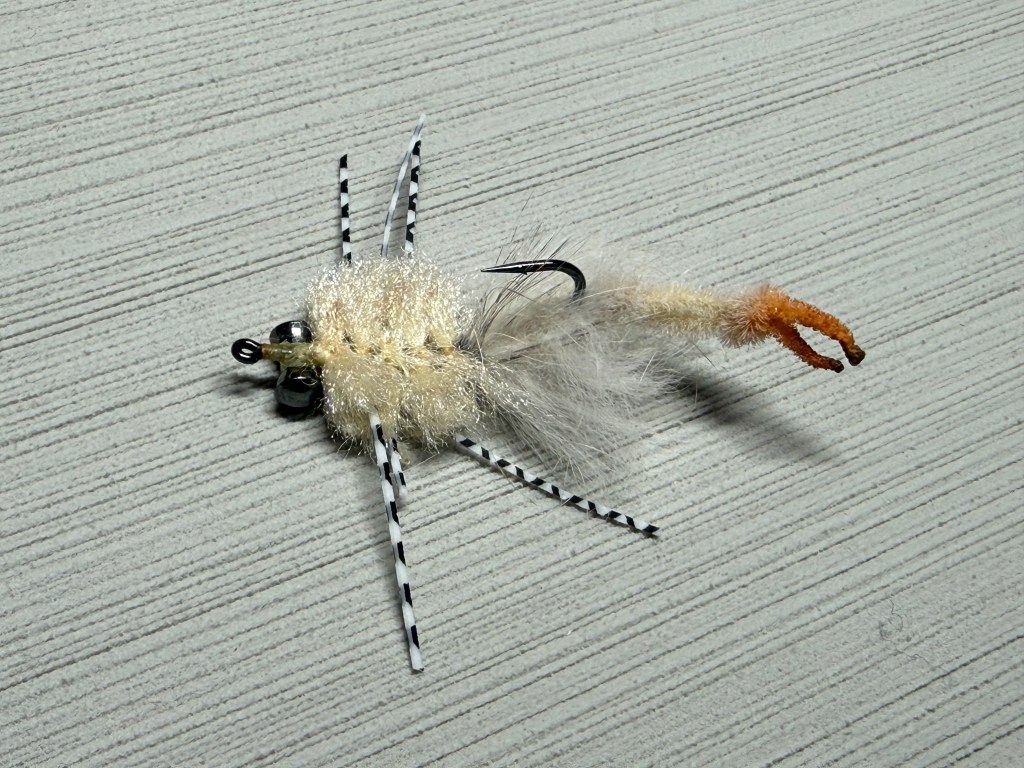
From my collection of Permit flies, Chepo selects a white tie of Dave Skok’s Strong Arm Merkin. I always fish with the tip of the hook barb depressed. Saltwater fly fishing pioneer, Chico Fernandez, insists that by pressing just the tip of the barb down to make a hump out of the barb, you get the best of both worlds: the hook penetrates better but also comes out when you want it to. That’s helpful when you hook your clothes, or worse, your cheek. If a precious fish breaks off with my fly in its mouth, I want it to shed the hook easily.
Back at the same spot mid-afternoon, a Permit follows my fly twenty feet before pouncing on it. I set the hook and the Permit takes off. That 20 foot follow has left me with a bit over twenty feet of loose fly line, piled in random curls on the deck behind me. As the fish starts its run, a strong gust blows a loop of that loose line up over my head and around my neck. Gripping the rod in one hand, I flail frantically with the other to get the line off my neck but in an instant it comes tight around the back of my head and the 16 pound tippet snaps. Rats!
Lesson learned: no matter the excitement of a permit chasing the fly, I must do what it takes to throw the retrieved line back and DOWN so the extra loops land inside the cockpit and not on the deck.
The break-off aside (beginner’s mistake), the two-handed rod had proven it could hook a permit. Even better, I have not been strangled nor my carotid artery severed by a fly line attached to a powerful fish.
But I have not spooked the school, so it’s Tim’s turn to try. He and Chepo hop out of the boat to wade, while I stay behind and make a point of not spooking his fish.
Tim lands a nice one.
A boy and his fish. I’m in the back, trying again. Photo by Chepo..
The Permit school is still there, so I climb out and try again. During my first retrieve, a big barracuda slashes through the school, probably in pursuit of Bonefish. The water explodes in a sparkle of silver flashes, Permit and Bonefish bound for deep water. The fishing day is over.
DAY 4
My partner today is Chris. I am heeding the lesson of yesterday’s error. After casting from the foredeck in the stiff wind, I bend down or kneel for the retrieve so I can carefully pitch each curl of loose fly line back and down into the cockpit behind me where the wind can’t make mischief of it. I am using a new fly of the same pattern as yesterday, but in cream instead of white.
Strong Arm Merkin, missing part of a leg, nipped off by a baby Blue Runner.
Chris gets out to wade fish our magic afternoon spot and casts repeatedly to a Permit, but each time a succession of small Bonefish zoom in to snatch away his fly. After a catching and releasing a bunch of little squirts, he hooks into a decent Bonefish.
Here Chris wrangles a pesky 4 lb Bonefish that snatched his fly from in front of the Permit.
It does not please him. Only a missed Permit could turn a nice Bonefish into a disappointment.
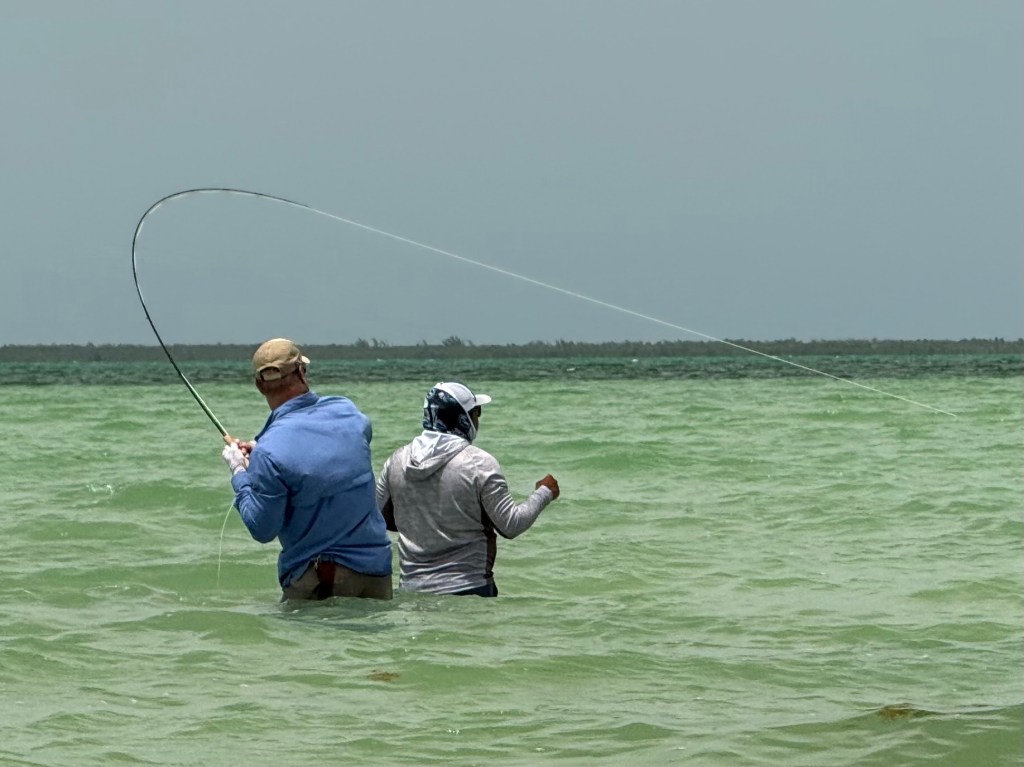
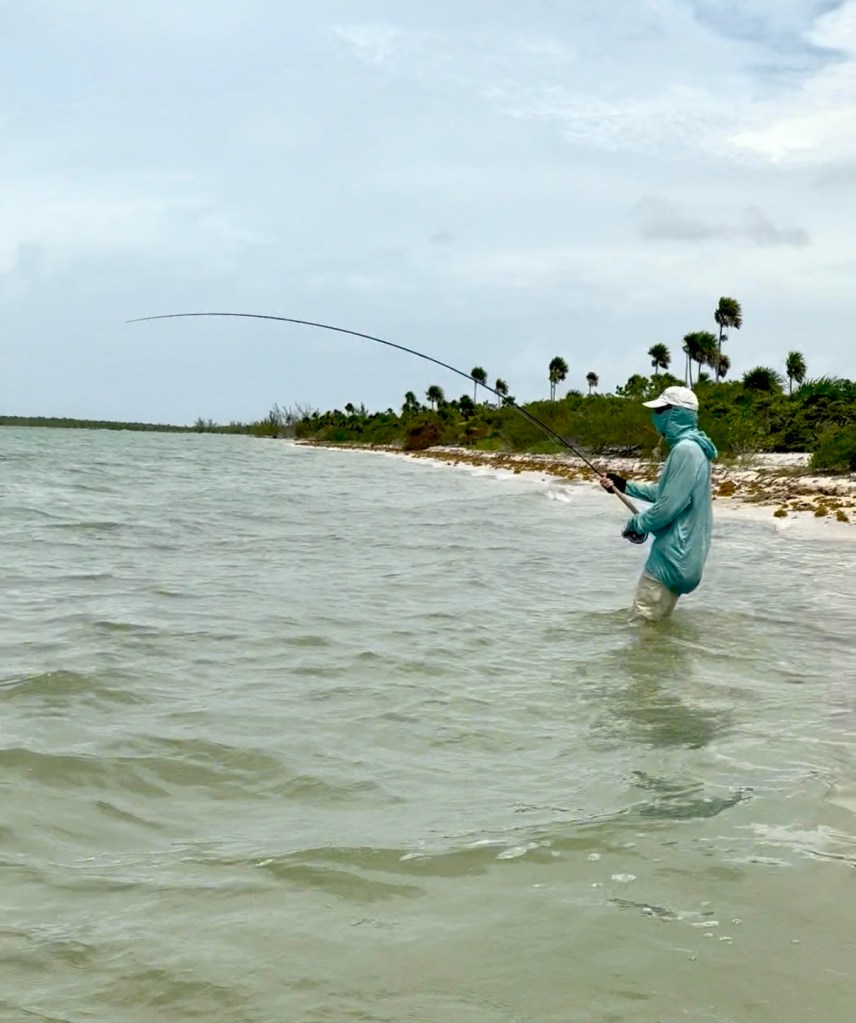
Using the two-hander, I hook up on another Permit and get it “on the reel”, meaning the line slack safely is taken up and the reel’s drag is engaged.
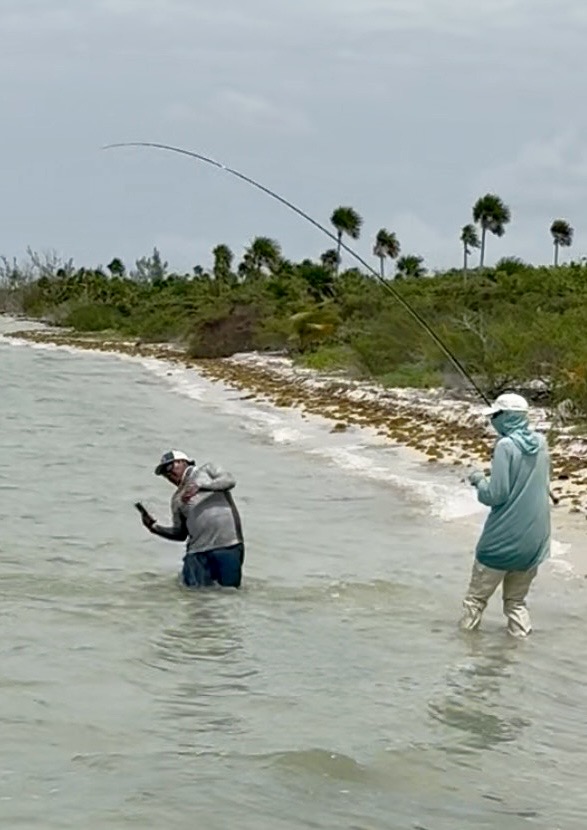
The fish runs down the beach, so I hop from the boat and wade after it to recover some line and make the fish quicker to land when it tires. Chepo wades in behind me while Chris stays with the boat and takes video.
Permit on the two-hander. Notice how little the two-hander bends compared to a single-handed rod. Photo by Chris Webb.
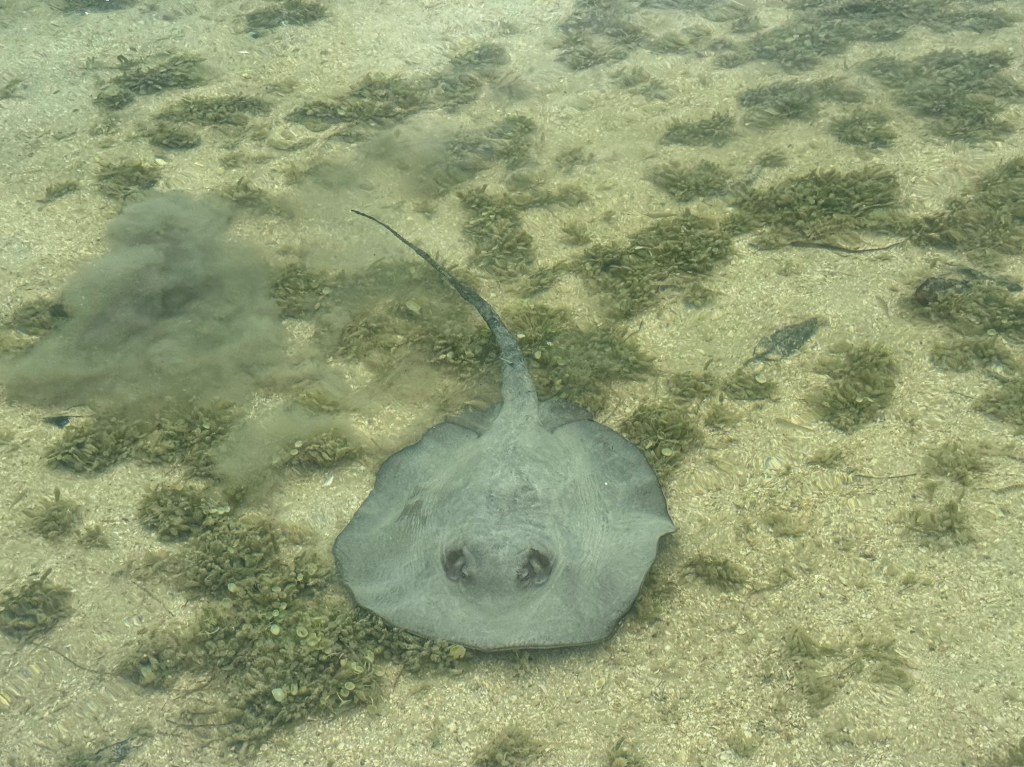
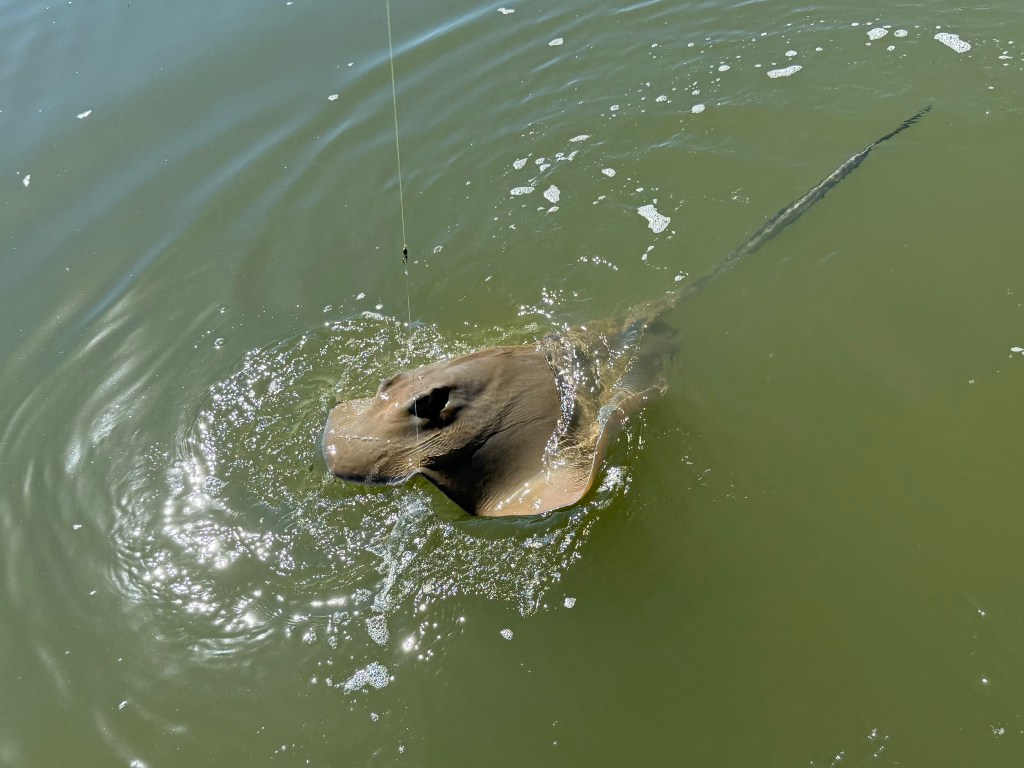
I mostly keep my eye on the fish but glance down to avoid stepping on a sting rays in the shallows. Shuffling one’s feet is a safe practice but it stirs up the sediments.
I try not to step on one of these dudes, which are common in the shallows.
Though I landed my first Permit myself, Chepo wants to land this one, and I let him – he likely knows something I don’t. Holding his cellphone-camera aloft in one hand, Chepo tries twice to grab the permit by its tail with his other hand, but each time the fish bolts back to deep water, forcing Chepo to duck the whizzing fly line.
Chepo has good reflexes. A guide doesn’t want to break off his client’s Permit.
Third time’s a charm and we have the fish to hand.
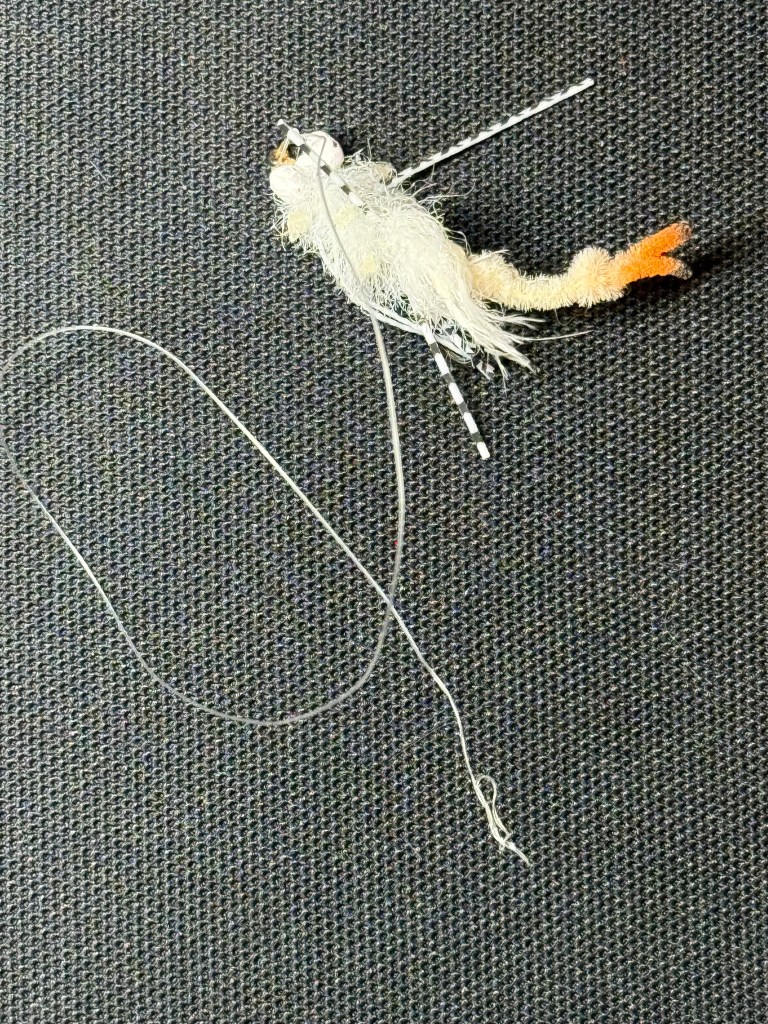
That’s a proper Permit, not a monster, but solid. When I remove the fly from its mouth, the tippet breaks in my hand.
This Permit has not only chewed my fly to a pulp, it has shredded the tippet most of the way through, probably by rubbing it against corals. I really don’t know how this fish didn’t break off before we landed it. That risk is probably why Chepo was so eager to grab the Permit as soon as possible.
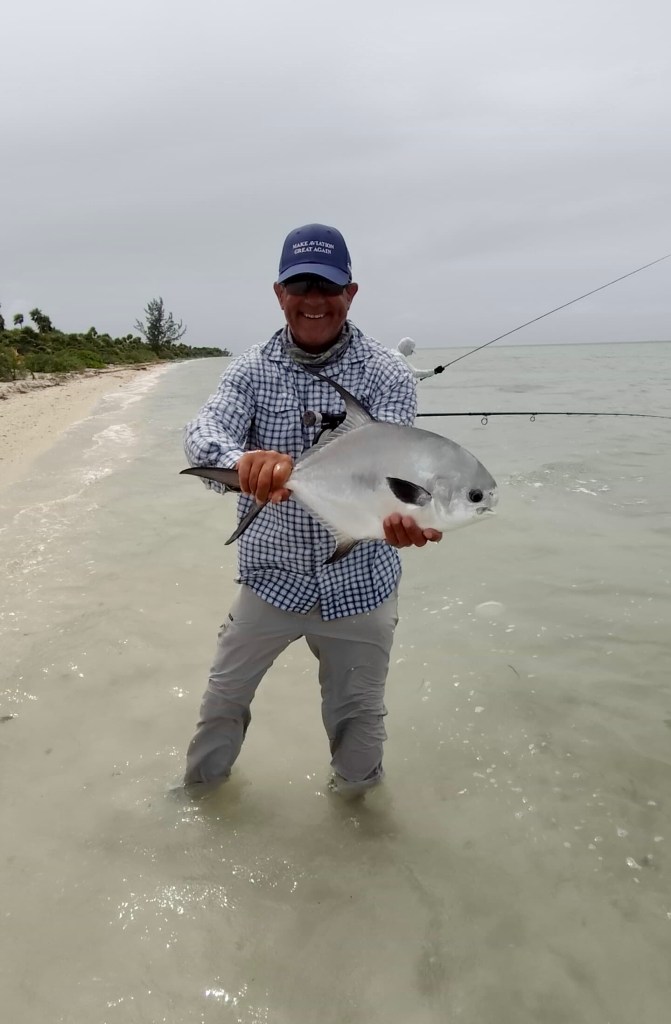
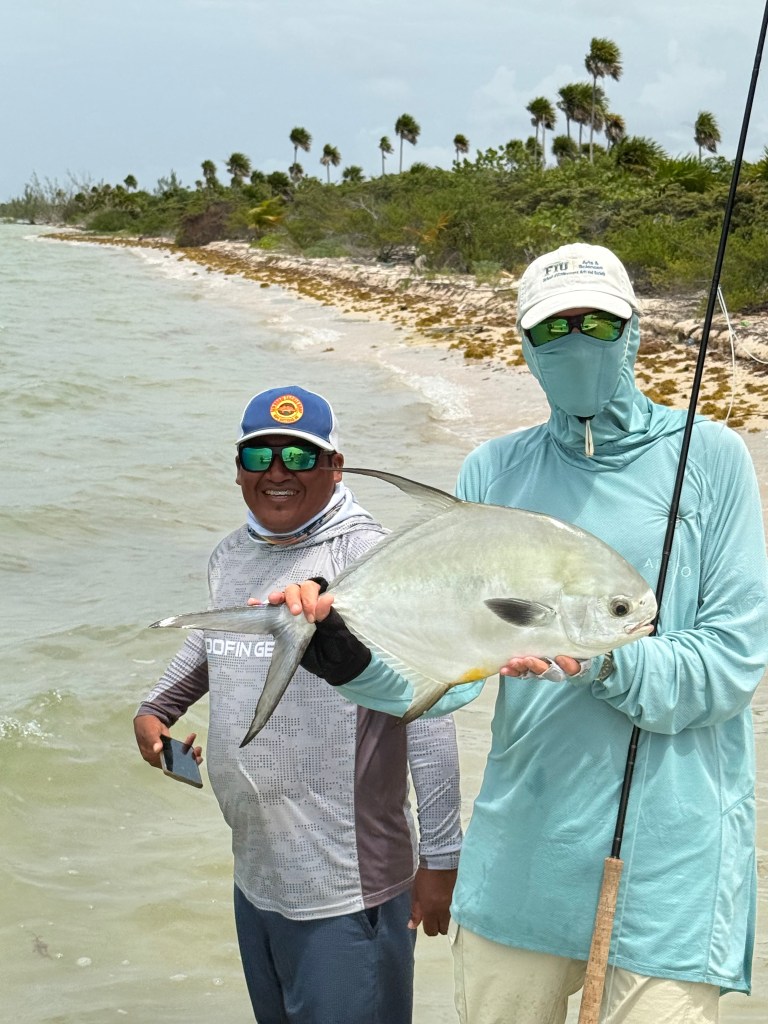
After quick photos, I release this Permit, perhaps the first caught on a Spey rod. It hurries off to rejoin its school in the green waters of Bahia del Espiritu Santo.
Breakfast at Playa Blanca Lodge is whatever you want. I had coffee, OJ, fresh tropical fruits, an omelette, and two strips of bacon. We packed our lunches from an equally splendid spread of ceviche, fried fish, leftover roast beef or BBQ ribs, fruits, sandwich fixings, French cheeses, you name it. You want bottles of water, limeade, beer? How many?
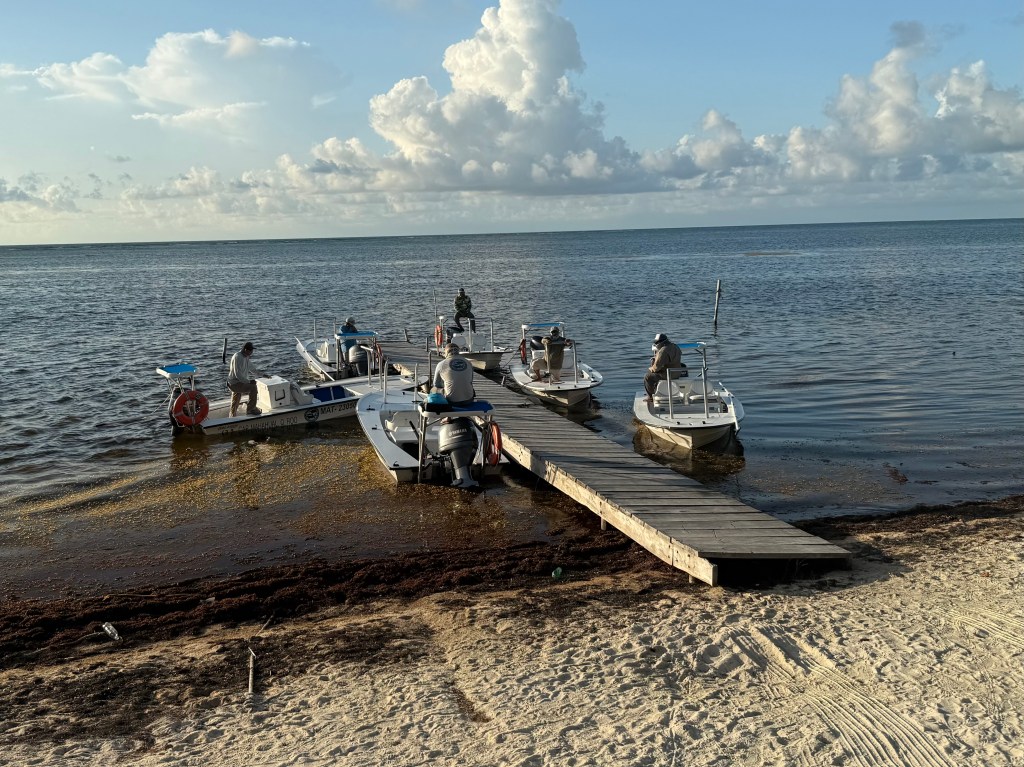
At 07:10, fly fishing guests assembled at the truck for the 20 minute ride south to the dock. Skiffs departed the dock each day at 07:30 and returned by 16:00.
The flats of Espiritu Santo Bay (Bahia del Espiritu Santo) are accessed by a fleet of small Dolphin skiffs. The ride south is bouncy in the waves driven by the prevailing SE trade winds, but the small craft are dry and easy for guides to pole. The guides are all local fellows from the Yucatan. My guide the first four days was a short, stocky fellow named Chepo, pronounced “Chay-Poe”. The first day on the water, I had Chepo and his boat to myself.
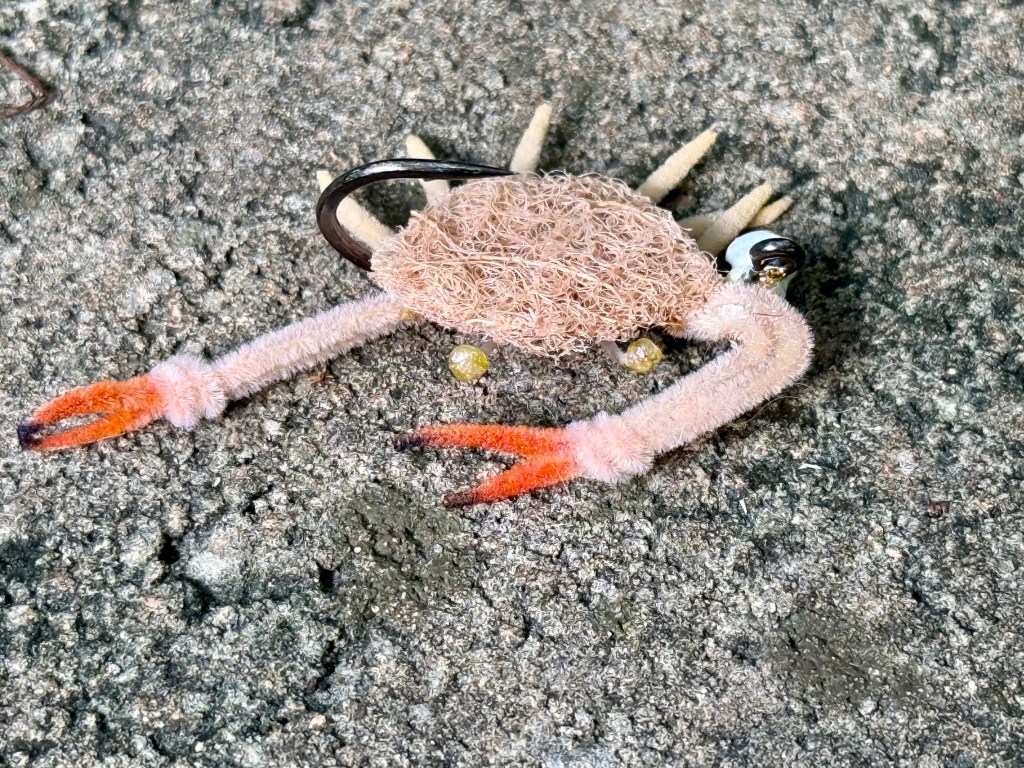
Chepo looked in my box of permit flies and picked out a crab fly, my favorite by chance, that I’d crafted from a coconut fibre scrubbing pad and some “ultra chenille”.
Up on the poling platform, Chepo deployed his magic flats vision, spotting fish invisible to me under the shimmering waves.
In addition to Spanish, Chepo speaks a dialect of fly fishing English, enhanced with his own units of measure:
“Eleven o’clock, forty feet” means “Cast 45° left of center, sixty feet”.
“White, white…” means “Wait, wait…”
“Cast again! More longer!” means “Throw the fly in the same direction, but seventy feet.”
Once I learned to follow Chepo’s directions (“white” took the longest), I began to catch fish.
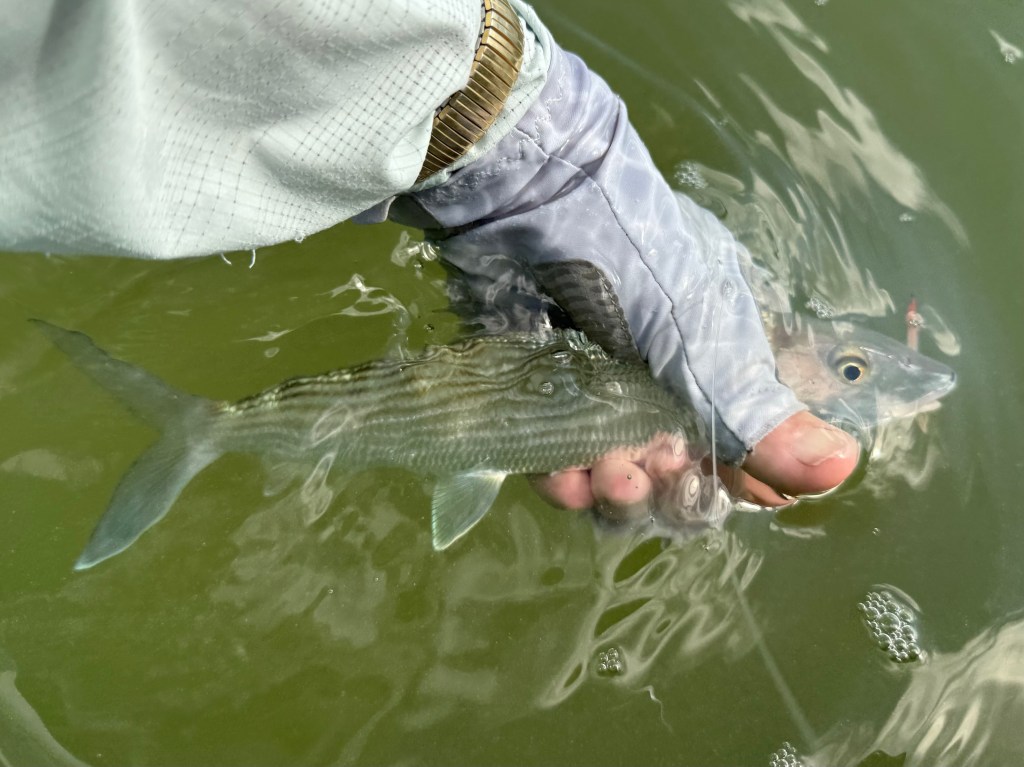
A baby Bonefish, my smallest ever on fly, somehow managed to stuff most of that crab fly in its mouth.
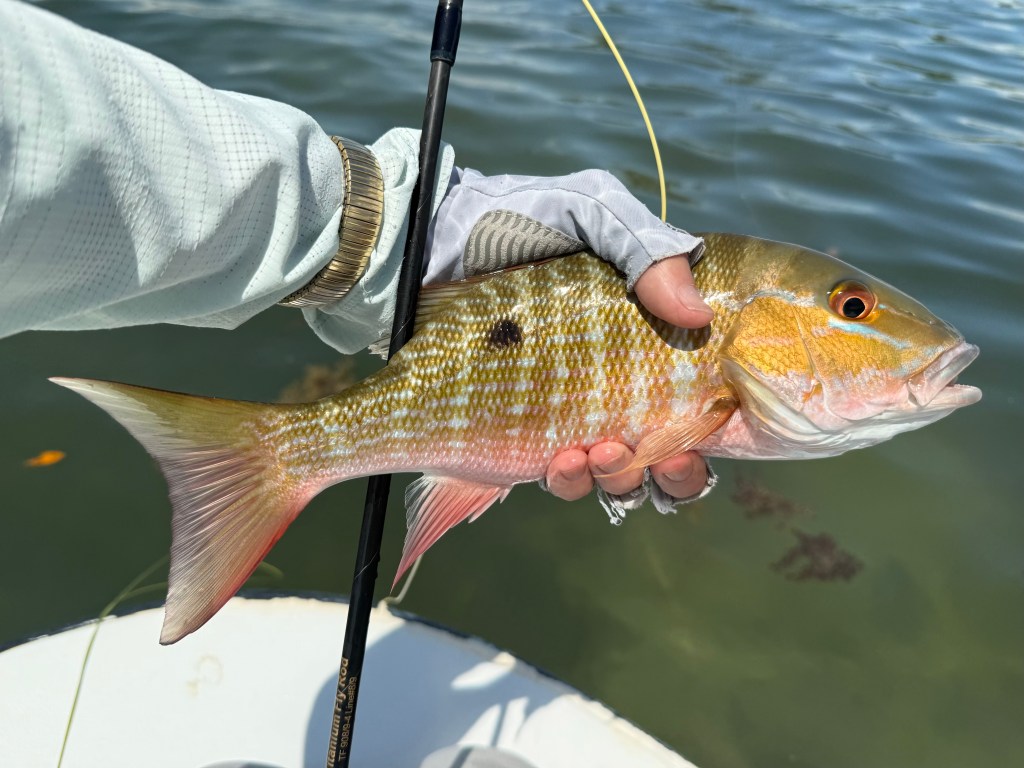
Some juvenile Mutton Snappers likewise gulped down the crab fly, my first ones on a fly rod.
An uncounted mess of small Blue Runners and Mangrove Snappers did their best to rip the fly to pieces, yanking loose bits of coconut fiber, and chewing the fuzz off the leading claw so it flopped pitifully.
Finally a permit appeared, using my new rod, I cast what little remained of the fly: a small disk of coconut fiber, two eyes, and a trailing claw.
The Permit connected with my bedraggled fly. I cleared the line and the reel drag sang the happy buzzing song that flats fishers so love to hear as the fly line sliced water in two.
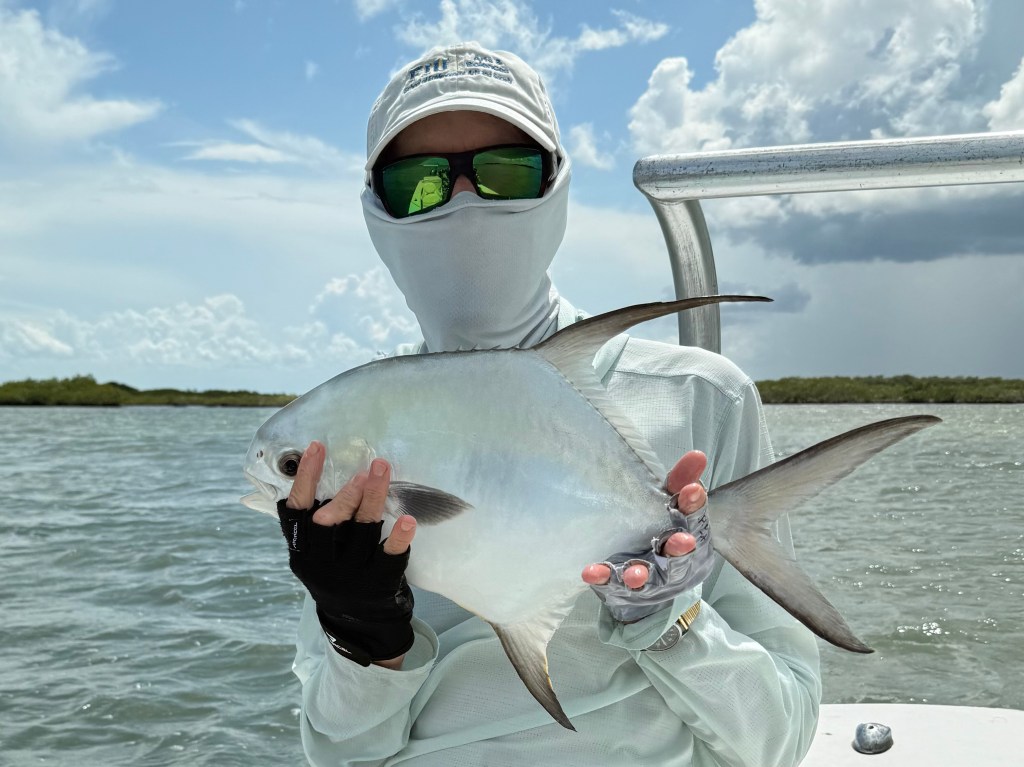
My first Permit on fly, not huge, but just dandy, on my first day fishing the flats of Bahia del Espiritu Santo, on the tattered remnants of a file that I tied, cast with a rod that I built. What’s better than that?
Thank you Andy, Juan, and Chepo.
Two ways to eat a scorpion
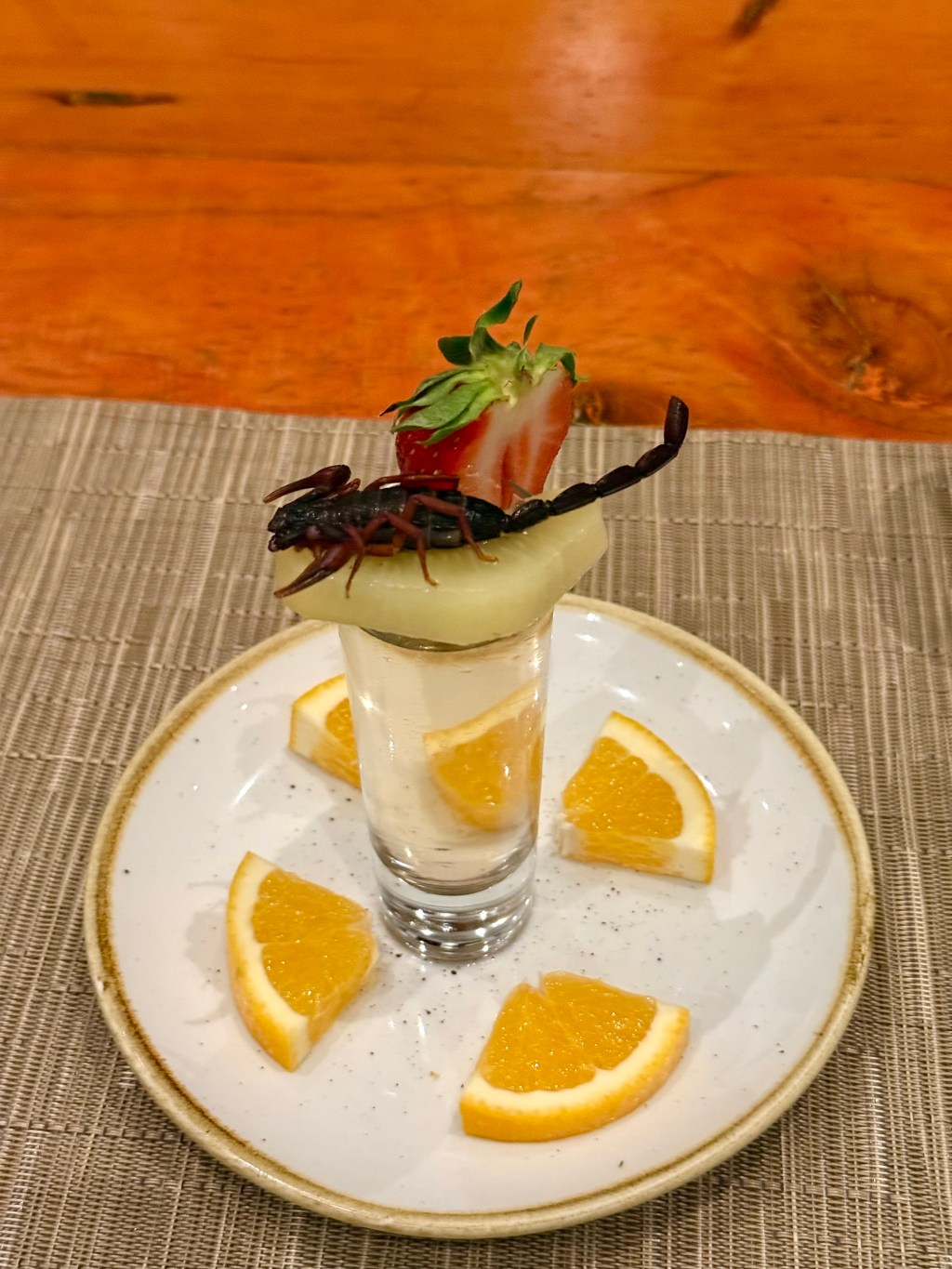
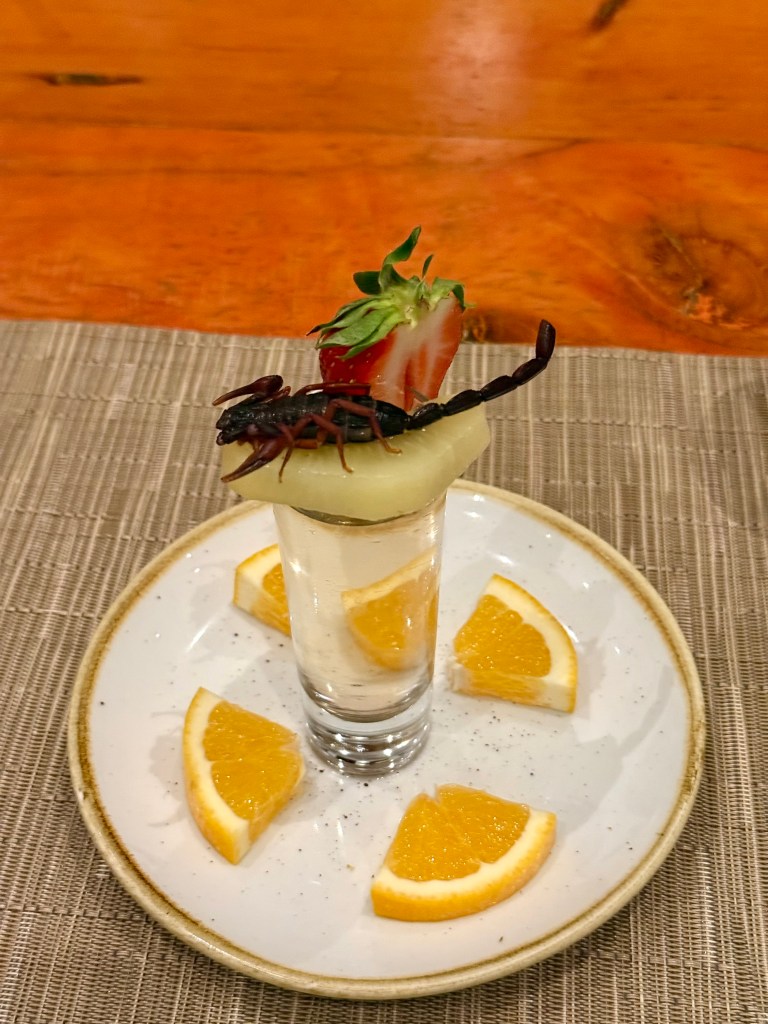
Playa Blanca Lodge has one sacred tradition: when an angler catches his or her first Permit, he or she must eat a scorpion.
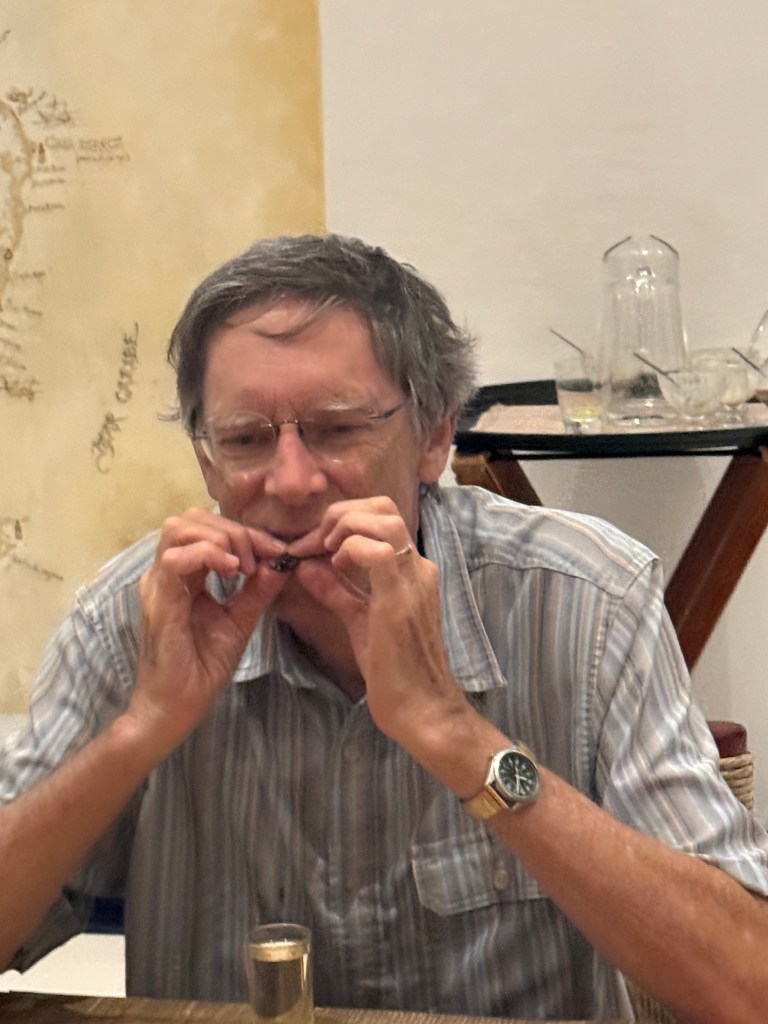
Accordingly, after dinner that night, young Calvin and I were each served a scorpion, pickled in mescal.
Florida Bark Scorpion, Centruroides gracilis
I recognized my dessert topping as a Florida Bark Scorpion, common in the Florida Keys. For years I kept one in a jar of alcohol on my desk at work. They’re big and scary when they skitter across the floor, and their sting hurts like a wasp if you are unfortunate enough to contact one, but their venom is not lethal. The terminal segment of the tail that holds the venom had already been removed.
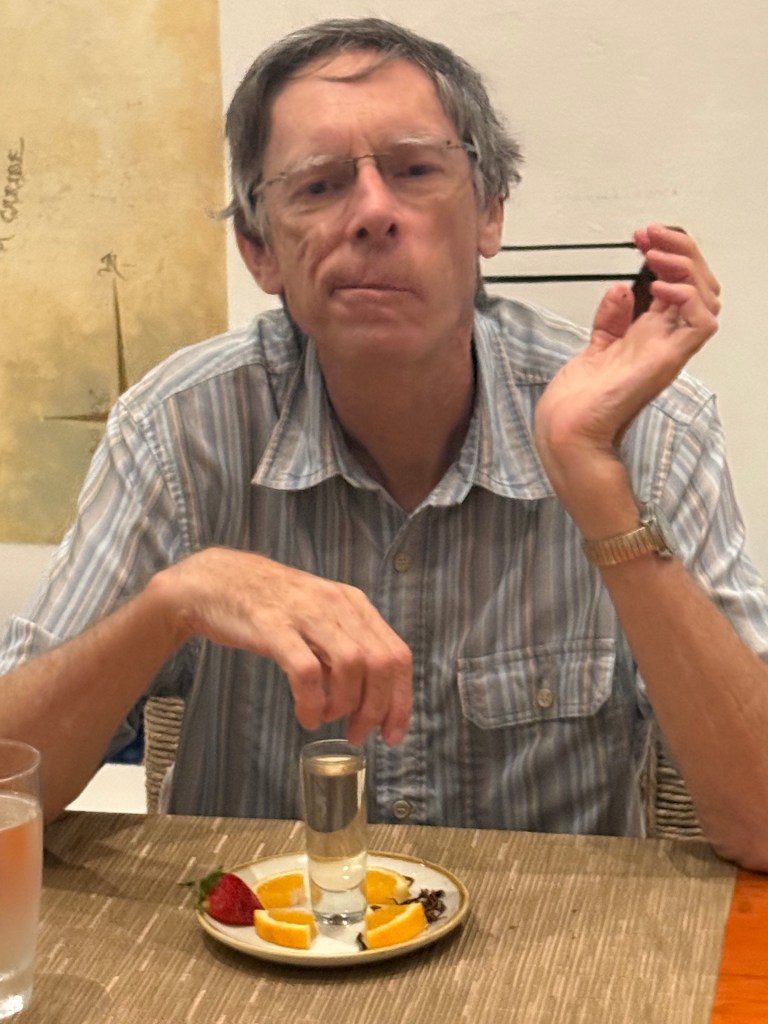
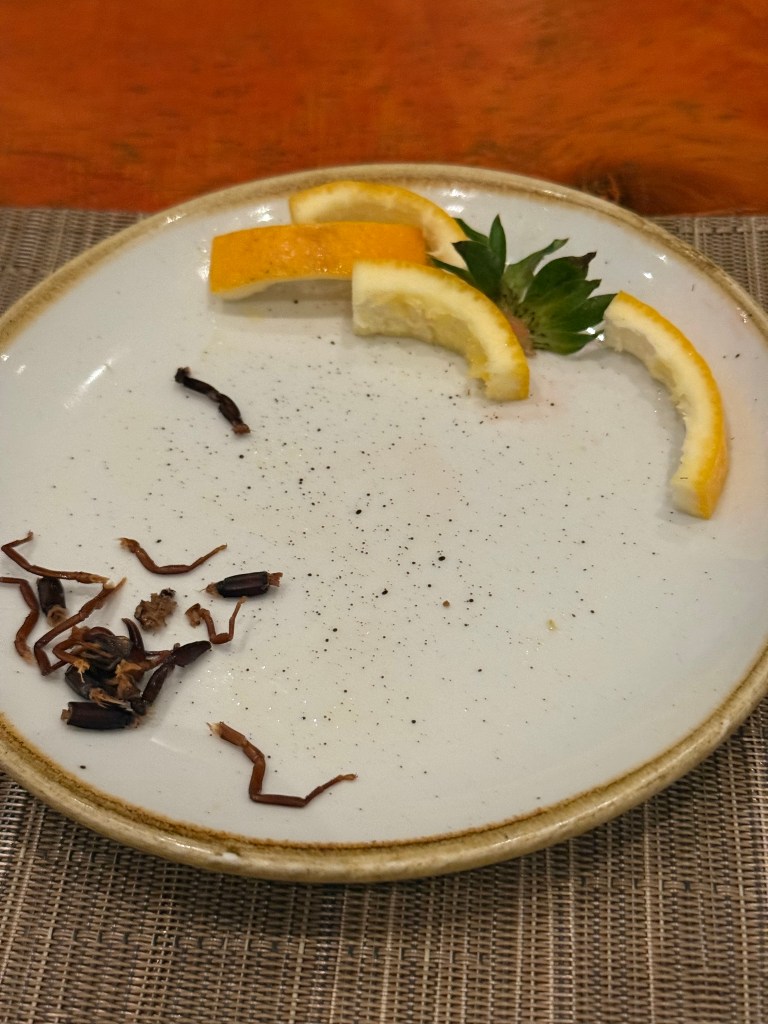
I took my scorpion apart leg-by-leg, squeezing the meat out of each segment with my teeth like one does with the legs of a fried tarantula, a tasty Cambodian delicacy.
Glancing back and forth between his own intact scorpion and me, actively nibbling my prize, Calvin looked worried. Finally, he picked up the 8-legged horror and tossed it down the hatch in one gulp, aided by the double shot of tequila.
The chitin exoskeleton of arthropods is indigestible, so you can guess what happens, or rather, what doesn’t happen, if one swallows said arthropod without chewing. Not wanting my scorpion to reappear as a scorpion, ever, I channeled my inner squirrel monkey and thoughtfully munched it down.
After its soak in mescal, the scorpion tasted more like mescal than the assorted terrestrial arthropods I’ve eaten on prior tropical adventures. I gave it a rating of meh-minus, but the fruit was good. I’ll happily take a deep-fried tarantula over a mescal-soaked scorpion any day.
Four days of icing and rest have rejuvenated my sore forearm, so it’s time to write up the fishing trip responsible for its unhappy condition.
In short, I wore out my arm fighting a mess of high energy fish on a fly rod. If you don’t want to read about fly fishing, you can enjoy the pretty photos and get back to swatting mosquitoes.
* * *
Last year I learned that a former FIU student of mine from 1994 had become a fishing charter captain. I looked him up and gave him a call. Capt. Mike Haines had relocated his business from Flamingo, where I fish regularly, to Jupiter Florida, two hours north of me, where I never fish. Mike mentioned that he sometimes takes fly fishers out for albies in the summer.
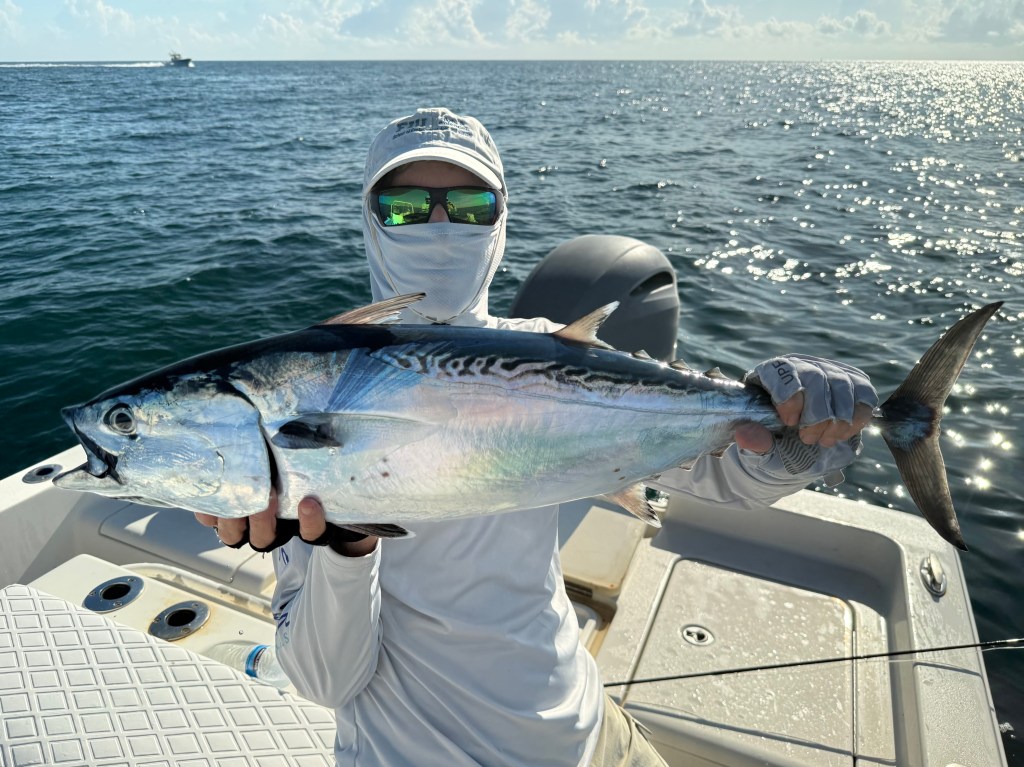
A small member of the tuna tribe, Euthynnus alletteratus resides in the Atlantic and Mediterranean. In New England their common name is the undignified Little Tunny. Down here in South Florida, these fish are larger, stronger, and are called False Albacore, or “albies” for short (fortunately the name “falsies” was already taken). Some fishers call them “bonito”, which they are not. Whatever you call them, albies are spectacular fish, silver with black and blue vermiculated striping on the back.
Albies swim 40 mph in pursuit of their sardine prey or when escaping fast predators such as marlin or mako sharks. They’re famous for wearing out fishermen with their long, powerful runs and their extraordinary stamina.
Summer mosquitoes have arrived in force in South Everglades, so I welcomed the news when Mike let me know the albies were on the ocean off Jupiter. We settled on a charter for July 1st and I invited my neighbor Rex to join us.
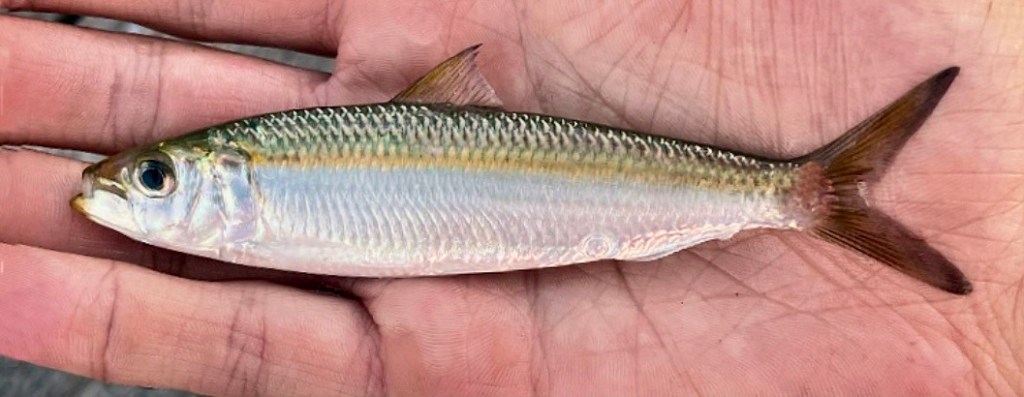
In the meantime, I read up on albies and consulted knowledgeable friends. In New England, albies feed on tiny baitfish, so small fishy flies are the ticket. Down here in Florida, albies feed on larger prey, Spanish Sardines 3-5” long.
Spanish Sardine (from the web)
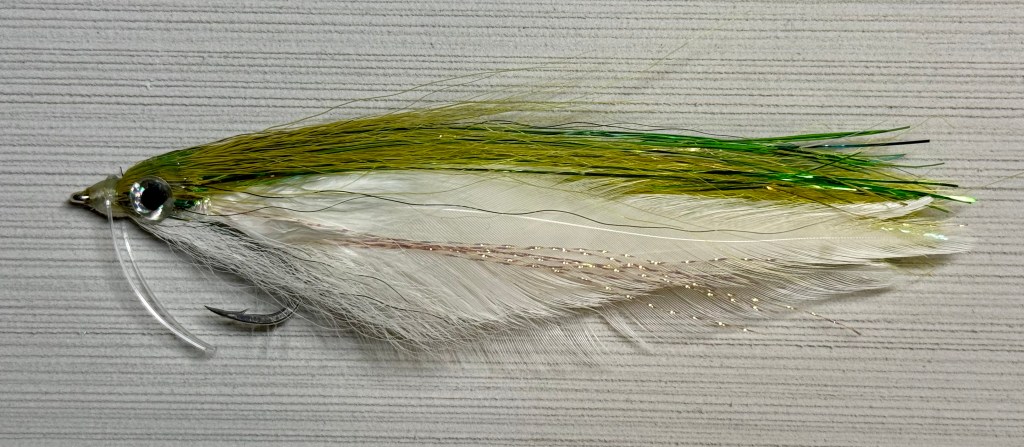
I tied up some mimics: 3-5” versions of Lefty’s Deceiver in colors that match the Spanish Sardine.
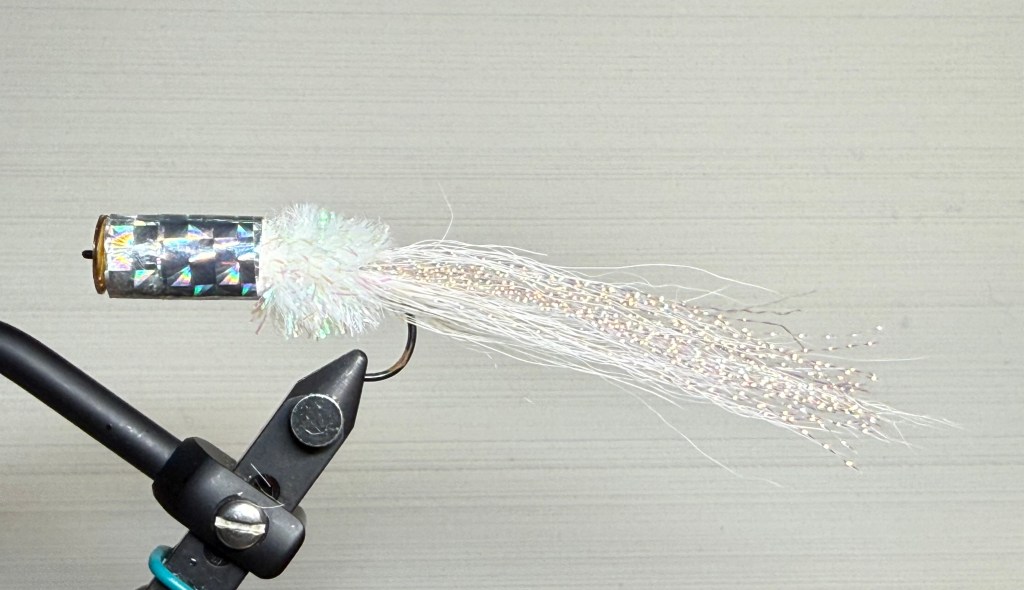
Sometimes, albies feed on the surface, so I made some sparkly poppers as well.
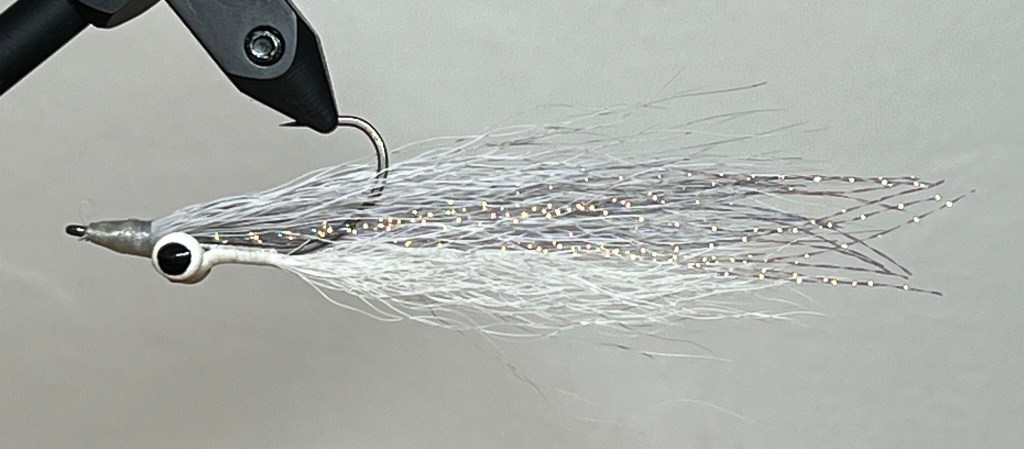
Local fly fishing friends mentioned getting albies on Clouser Deep Minnows, which I had already tied in gray over white.
For rods, I packed a conventional 9wt rigged with a floating line as well as my 7wt two-hander (13’ Spey rod) rigged with an intermediate line that sinks slowly. All my advisors recommended a sinking line when fish are feeding below the surface or when floating sargassum seaweed is present. My grumpy right elbow prefers casting the two-handed rod.
Neighbor Rex knows better than to mess with fly gear – he brought a substantial spinning rod.
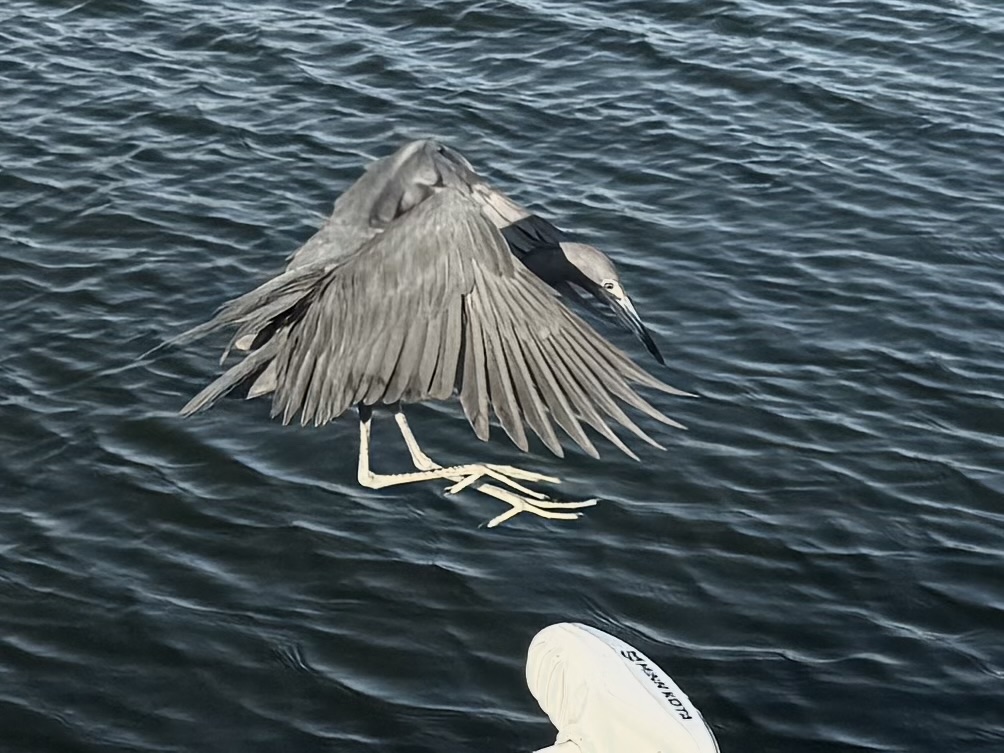
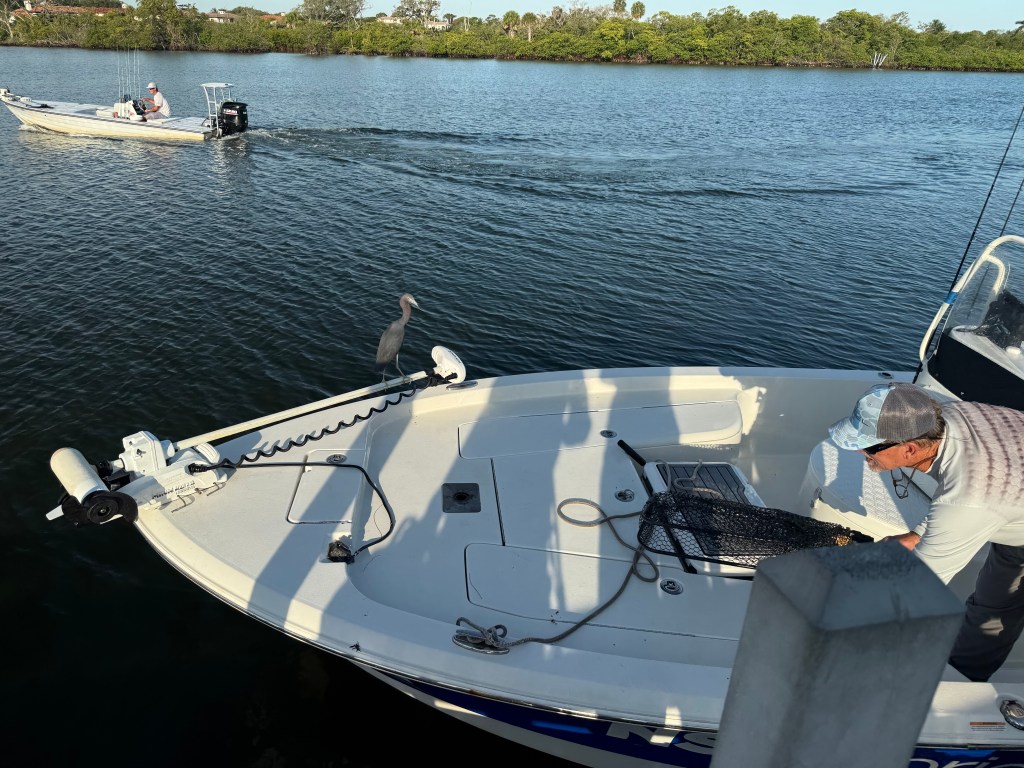
We caught up with Mike at the dock where he had some small baitfish, pilchards, in the live well of his boat. A Little Blue Heron showed up, hoping Mike had neglected to close the lid.
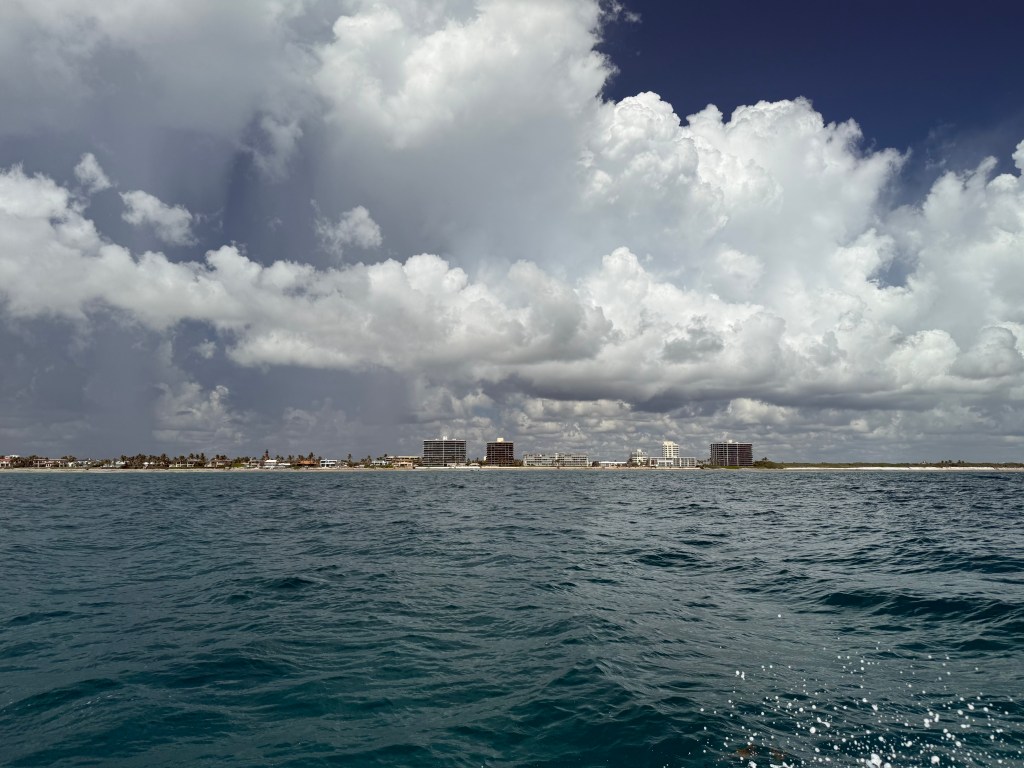
Mike cruised us out the inlet to the ocean and selected his spot about half a mile off the shore and spot-locked us in place with the trolling motor. Big fish broke the surface. Maybe albies are everywhere, or perhaps one Captain Mike Haines knows exactly where to look for them.
Mike suggested I use a smallish white fly that that would match the baitfish in his livewell. Best listen to the pro. I selected the Clouser to fish sub-surface on the two-handed setup.
While I was doodling with flies and leaders Mike tossed out half a dozen little pilchards and the water exploded. Rex cast his spinning lure over the fray and hooked up on his first albie of the day. Despite his beefy spinning rod, Rex was outgunned as that albie ran him ragged. Mike loaned him an even bigger rod for the next one.
My fly was ready, and Mike said to go ahead and cast, despite another albie on Rex’s line still racing around in the ocean. I cast my fly a short distance, let it sink five seconds, and started the retrieve. WHAM! An albie grabbed the fly and roared off, snapping the 16lb tippet. I was not even using the lightest tippet recommended. Mike informed me that, contrary to online tutorials from the New England albie fishers, the big albies in South Florida are not leader-shy, Rather than lightening the drag and risking being spooled, he suggested I scale up to 25 or 30 pound tippet instead. I went to 25 pound and sure enough, another albie roared off with the fly, pulling the remaining fly line off the reel plus a hundred yards of backing with the drag set high.
Rex and I were “doubled up”, in the lingo of boat-fishing. The two albies wove back and forth helter-skelter while Mike danced about the boat, threading Rex’s spinning rod over or under my 13’ two-handed fly rod as the fish weaves warranted. Rex has a bad knee and sensibly did not engage me in the two albie tango on a small boat.
Like some sharks, albies can’t flap their operculi to pump water over their gills, so they respire by opening their mouths as they swim, a process known as ram ventilation. Accordingly, when you release an albie, you hold it by the tail (caudal peduncle) and thrust it head first into the water to give it some speed and push water through the gills.
Albie caught on gray/white #2 Clouser & 9wt full intermediate line using the 7wt Spey rod.
After catching and releasing couple of albies on the subsurface setup, I switched to the surface popper on the floating line for the fun of watching fish blow up a fly in plain sight.
A couple of albies and dozens of blue runners exploded on the popper in rapid succession. We watched them streak through the water and hit the fly in a blast of spray. I could shake most of the blue runners free of the popper, but the albies stuck and roared off.
After one popper eat by an albie, the fly line looped around my left hand and jammed as the fish made its run and before the loose line had fully cleared the rod guides. Fortunately the tippet broke. Without a breakable tippet in that situation, a fly fisher can lose a finger. Some people fish a straight 60 pound fluorocarbon leader for tarpon and other strong fish, but I have considered it too dangerous. This experience only solidified my decision to stick with breakable tippets. I press the barbs down on my flies so a fish can more easily rid itself of the fly after a break-off.
I tried one of my beautiful sardine flies, but the fish had no interest in it. Too big for today, I guess. I tied on a heavily chewed Clouser and the fish were back on it in an instant. Oh well, they know what they want to eat… some big fish somewhere will want those sardine flies.
I’d caught five albies and couldn’t resist tossing the fly another time. A chunky blue runner grabbed it, pulled line off the real, and shot straight down 40 feet. I bent the rod double but it refused to budge.
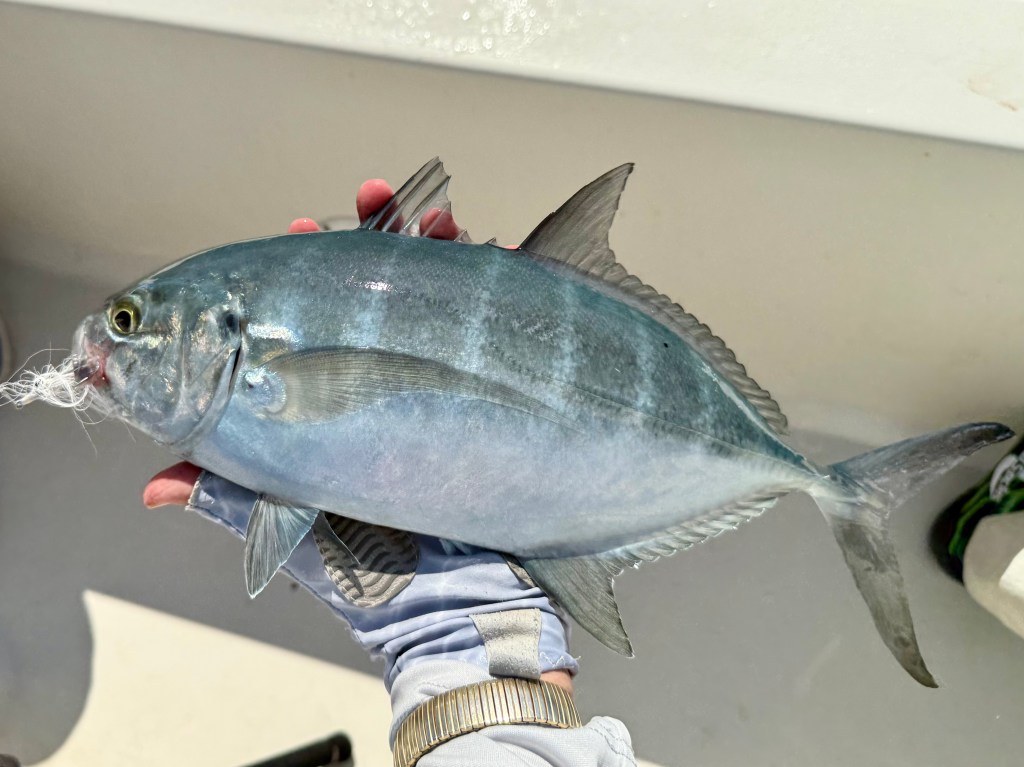
The absurdly strong Blue Runner that parked under the boat. Notice how rounded and chunky this little jack species is.
Getting that runner up to the boat to release it overworked my already tired right forearm. I wound up my line, reluctantly – sigh. It’s hard to leave when great fish are still biting. Rex was smarter and quit after his 4th albie.
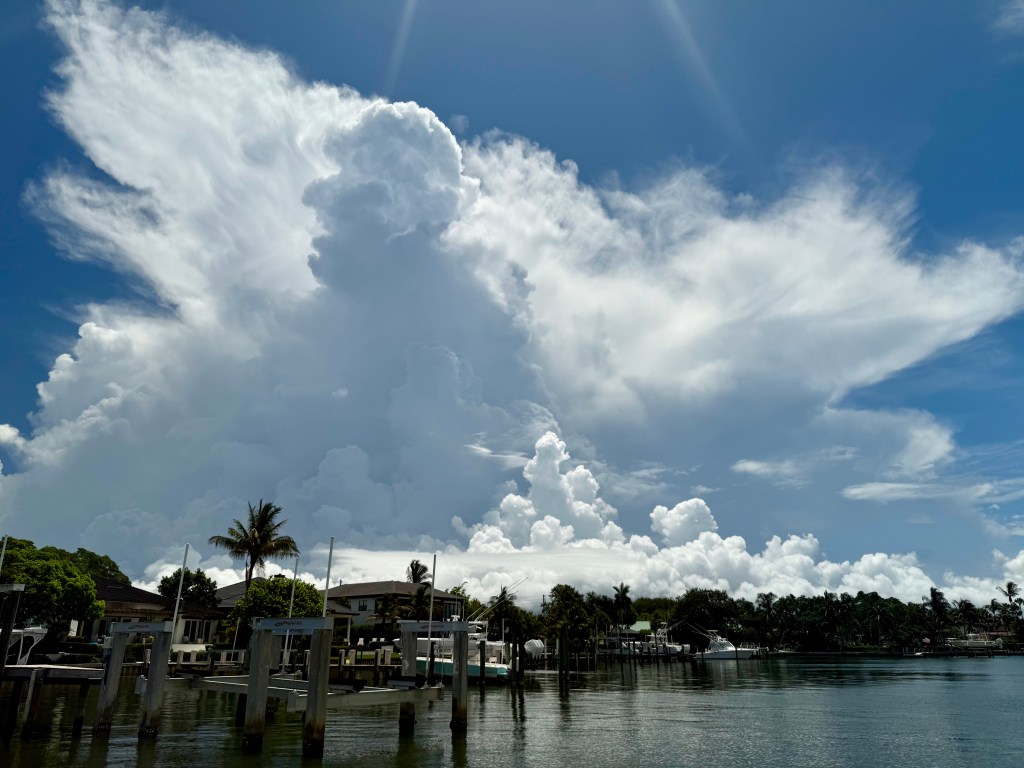
We came back to the inlet and fished a dock for snook while admiring the storm clouds building.
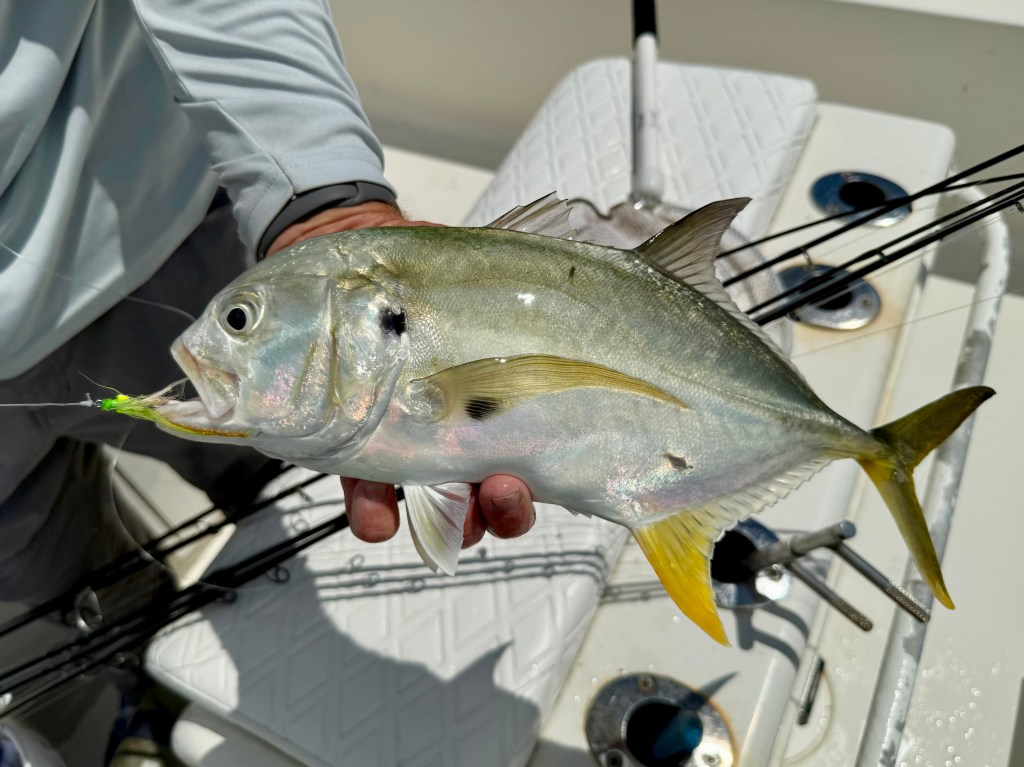
Rex caught one snook on a pilchard, but they wouldn’t take my fly. Instead, it caught a Jack Crevalle…
Jack Crevalle with the yellow fins and black spots.
… plus a small Ladyfish that squirted poop all over me before I could release it. I’ve learned to aim Ladyfish away from me and the boat before they let loose, but this one was too fast. Another reason I carry a change of clothes in the car.
* * *
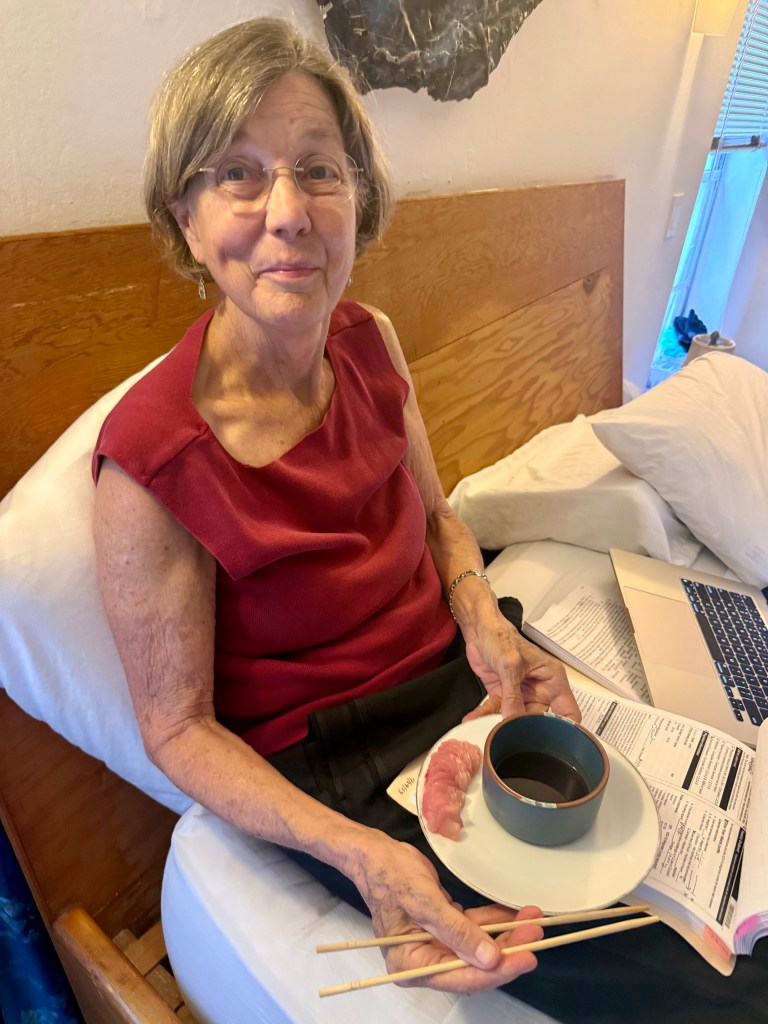
In contrast to bonefish, our #1 piscine speed demon, taking albies on fly requires more brawn than brain. They are truly gorgeous fish though, and especially thrilling when they hit on the surface. Albies are better kept in the ocean than served at the table, but blue runners are superb eating. I kept a few medium-sized runners, Mike filleted them (thanks Mike!), and I prepared a little sashimi for a snack and a big bowl of ceviche that was our dinner for the next two nights.
Gray finds Blue Runner sashimi the perfect complement to late afternoon paperwork.
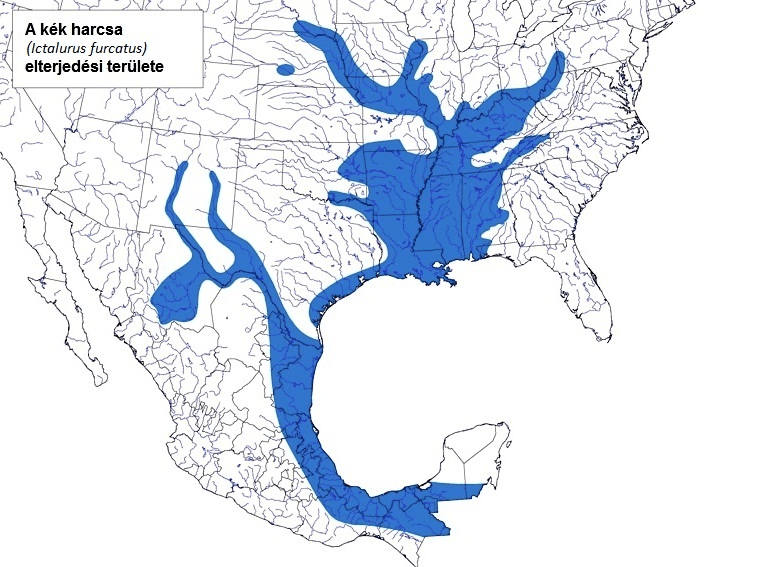
The Blue Catfish (Ictalurus furcatus), is native to the Mississippi Valley, Gulf Coast, and east coast rivers of Central America:
In 1974, the Virginia Department of Wildlife Resources introduced Blue Catfish to rivers on the western side of Chesapeake Bay. The DWR biologists assumed these catfish would remain confined to the freshwater systems. Their distribution along most of the Gulf coast should have been a hint that Blue Catfish tolerate salt water – duh.
Blue Catfish took no time moving into the saltwater and spreading throughout the Chesapeake. In the Bay they grow to over 50 pounds and devour every blue crab, clam, and menhaden in their path. The only good news is that Blue Catfish are delicious.
With fuel prices up, Gray and I took the EV north to visit family and friends, 4577 miles in all.
I squeezed in a bit of fishing, of course. Visiting Gray’s family on the Eastern Shore of Maryland gives me a chance to fish with Jon Shaw, the husband of Gray’s second cousin. We fished off the family farm dock that extends into the Chester River, a brackish tributary of the Chesapeake Bay.
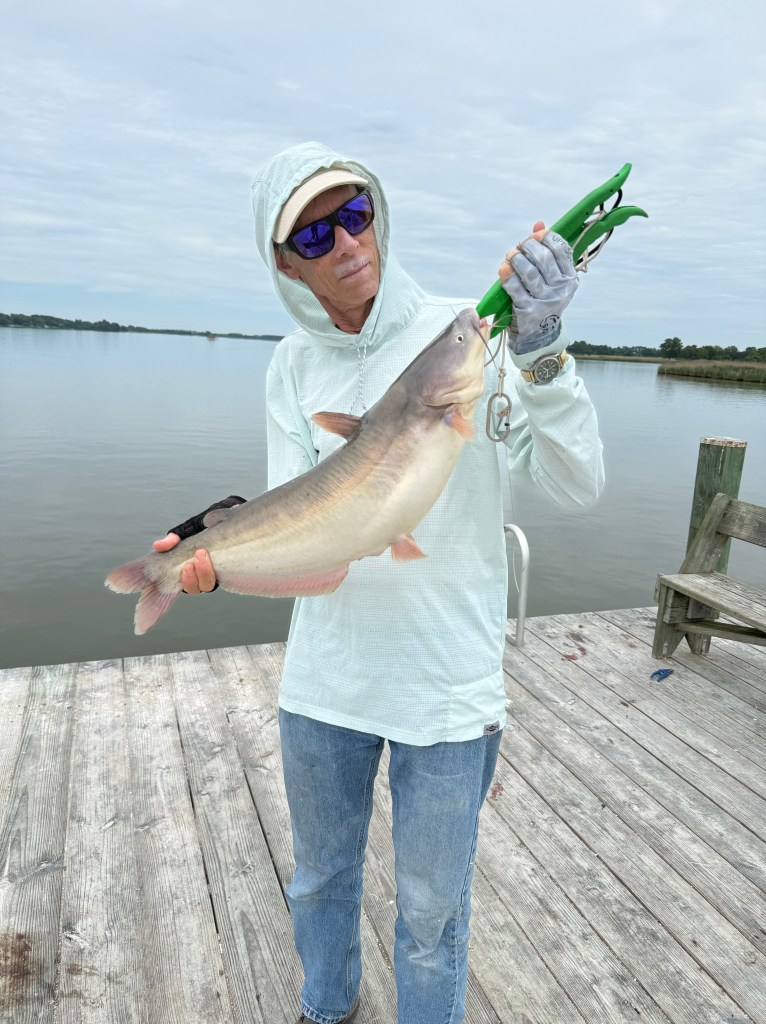
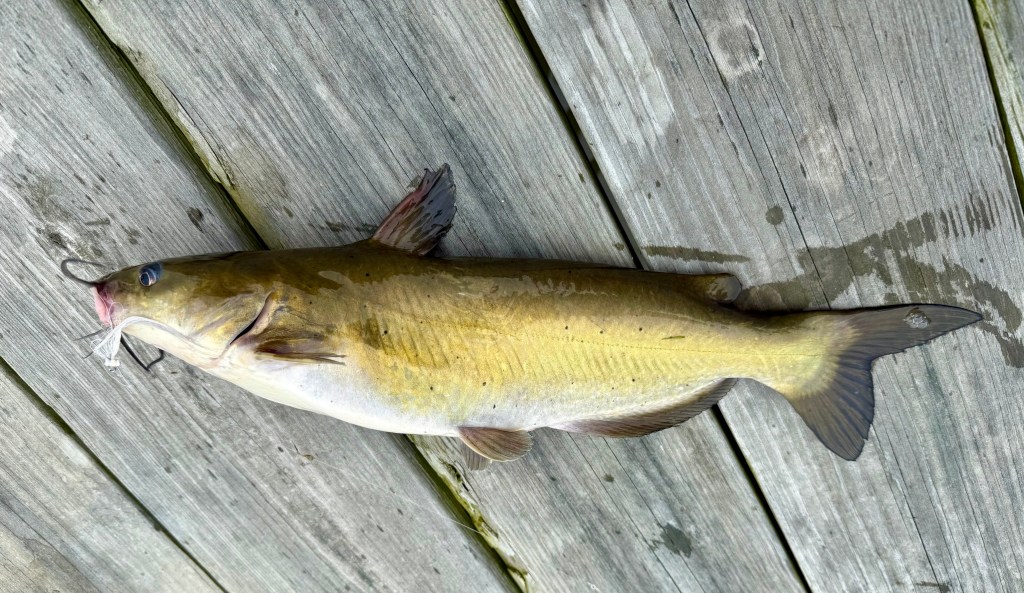
Jon and I bait-fished for a family dinner, finding 6-12 pound catfish off the end of the dock. Our first afternoon together Jon caught four catfish and I caught zero. Hmm.
To catch catfish as well Jon, I realized I’d have to ignore what he says (tie on a heavy leader and a 7/0 or 9/0 circle hook), and do what he does (tie on a light leader and a 3/0 or 5/0 circle hook). The discrepancy between his instructions and his practice should have come as no surprise to me insofar as all fishermen are liars, myself excepted. The second day I rigged my rod like his and did a lot better.
Catfish overflowed Jon’s dinky cooler, so we filleted some on the spot to make them fit.
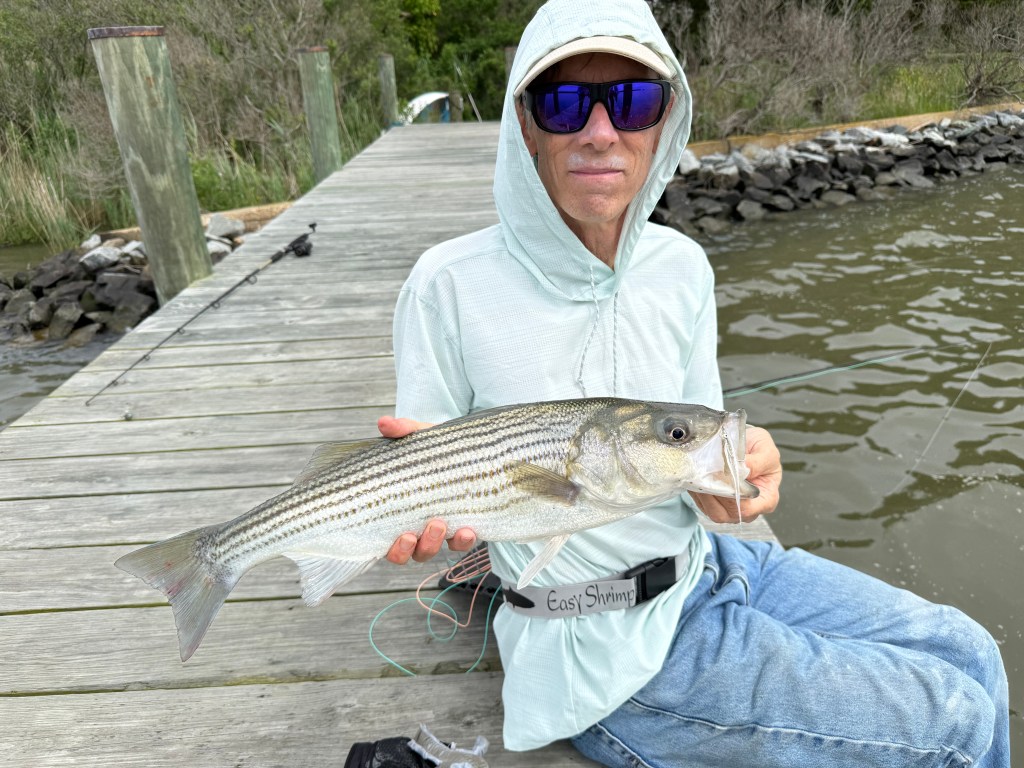
With enough catfish to feed Gray’ cousins and plenty to freeze, I switched to fly fishing. Sitting on the dock near shore, I tied on a favorite snook fly, the gray over white Clouser Deep Minnow. The water swirled under my feet, so I flipped the fly beyond the swirl- nothing – try again – boom. A perfect dinner-sized Striped Bass, known locally as rockfish.
The river was closed for rockfish for six more days of spawning season, so my catch went back in the river to make more of them.
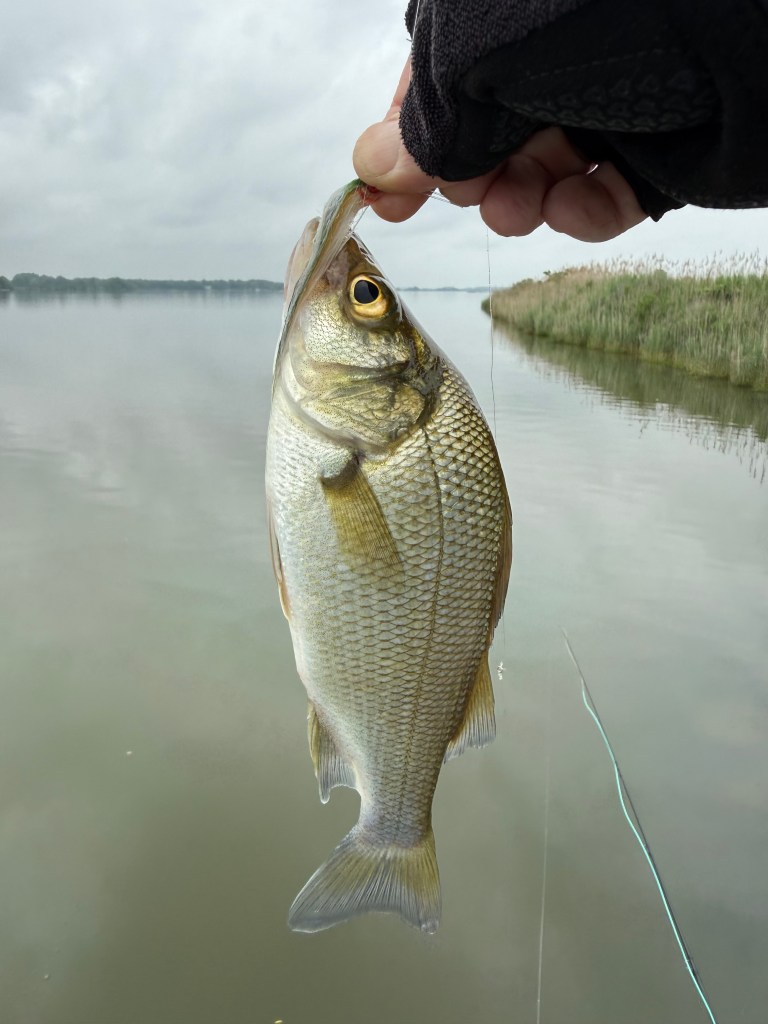
I caught a few little White Perch on fly. They also went back in the river – too small.
Another fish took the fly and fought above its weight, attempting the old run-under-the-dock-and-break-your-fly-rod-or-cut-your-line maneuver. When it flashed bronze instead of silver, I realized it was not another rockfish, but rather a Channel Catfish (Ictalurus punctatus). I’d never taken one on fly. It’s a spirited gamefish.
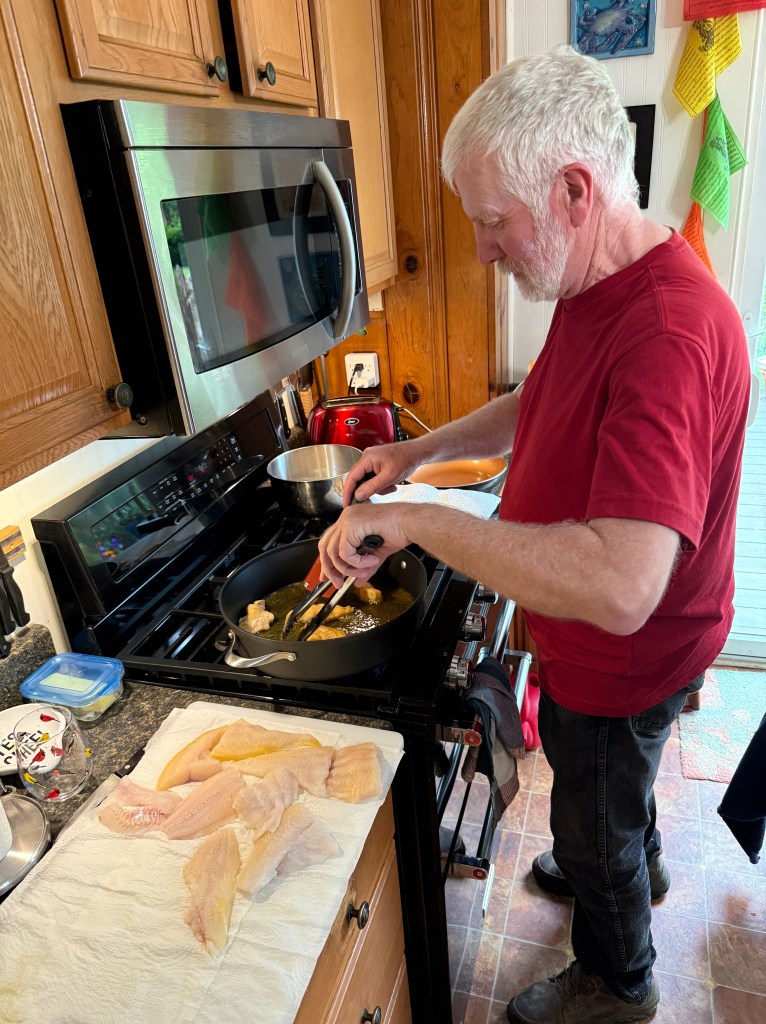
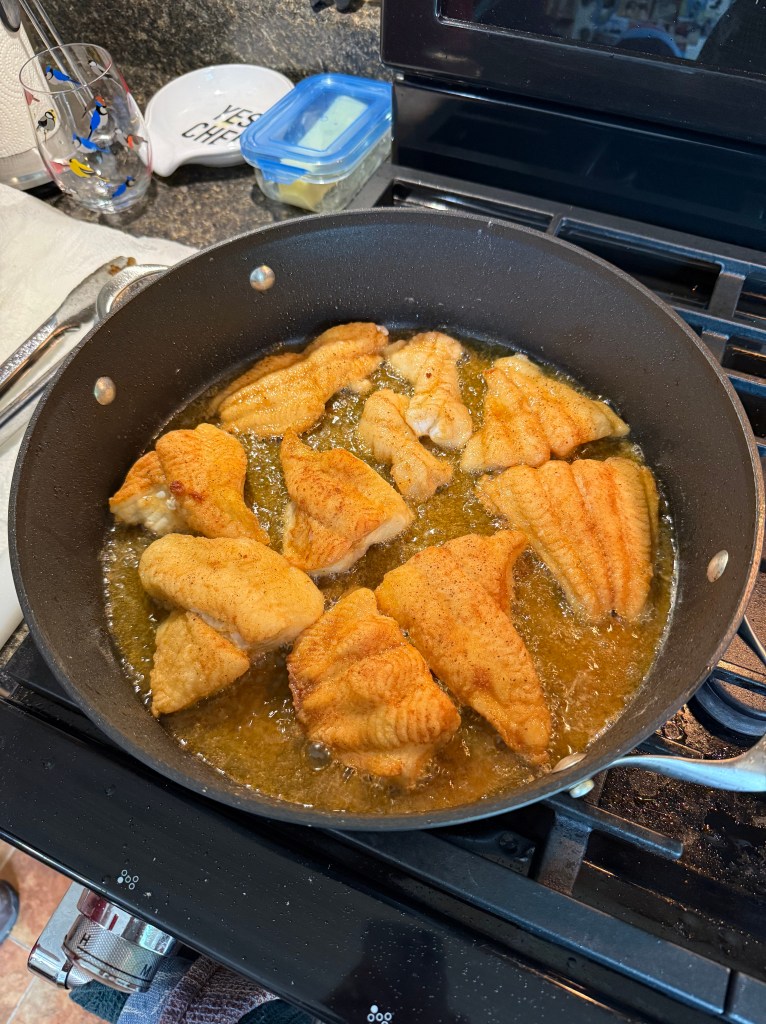
Back at the barn, Jon and I filleted Blue Catfish. The females were full of eggs and the stomach of one spilled a load of Atlantic Ribbed Mussels (Geukensia demissa). The Blue Catfish is mostly head and stomach, yielding one pound of meat for each four pounds of catch. Jon put the ample carcasses out for his resident Bald Eagles and we all had a fine dinner.
A trip by paddle craft to the coastal marshes and flats can be a breeze or a slog depending on wind and tides. It took me one arduous kayak trip to Rabbit Key and another escaping the Snake Bight flat to become a tide chart addict.
The wind. Paddling home against a stiff headwind is somewhere between exhausting and impossible. Returning from Sandfly Pass in the Ten Thousand Islands I was stopped in my tracks by a squall that forced me to get out of the boat in the rocky shallows and wade back to the launch, pulling the kayak behind me. My favorite hat blew off and disappeared in the distance.
Tides are the same, but more predictable. Get the tides right and you get a free ride. Get them wrong, and you fight a river, ferry-crossing back and forth to seek eddies and weaker currents.
My purchase of a motorized skiff made it possible to move against the elements, to cover long distances, and sometimes to dodge a localized thunderstorm. Very efficient, but I missed the quiet and stealth of the pedal kayak. And the exercise. It’s the difference between a car and a bike: the motor craft is useful, the pedal craft enjoyable.
When I itch to be on the water, I open the marine weather forecast and the tide chart phone apps, looking for happy windows of winds and tides. Living on a peninsula provides choices. My choice of location and craft is based on the forecasts. If conditions are unfavorable on the east coast, nearby Biscayne Bay or the Keys, how about Flamingo on the southern tip of the peninsula? No? Then check the west coast out of Chokoloskee / Everglades City. If all three look threatening, I may opt for the interior mangrove creeks or central Everglades marshes. If it looks horrible everywhere, I stay home and tie flies while imagining the next outing.
A TAXI TIDE
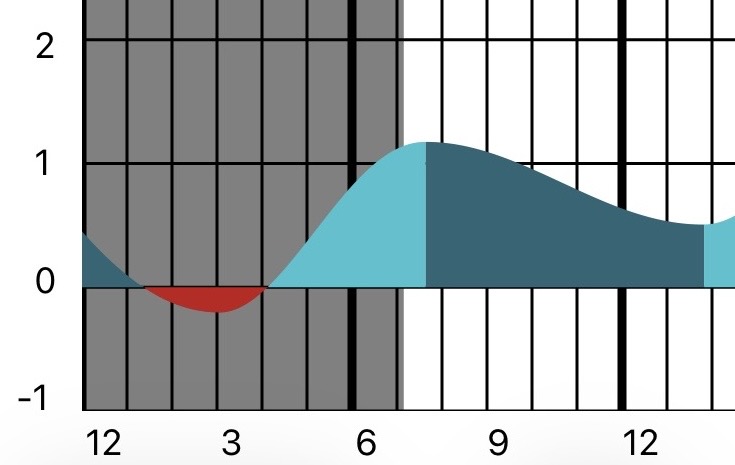
I normally I take the skiff into Snake Bight in Everglades National Park to escape against the incoming tide, but the tide chart for Tuesday showed the rare, magical tide cycle that’s perfect for kayak exploration. One can ride the incoming tide into Snake Bight before sunrise, fish and bird well into the morning, then ride the outgoing tide back out again.
Snake Bight’s tides are one hour delayed from the Flamingo tide chart shown here.
I wake at 3:30 am and check the weather report. The wind looks to remain low through the morning. Rain looks iffy – it’s supposed to rain solid until 6 am, then let up until afternoon. Hopefully the algorithm running on the National Weather Service computer gets it right today.
Scary-hard rain pounds my drive south to the bottom of the peninsula, then stops to let me set up and launch the kayak in the dark. I can see the odd lightning flash to the south. Gradually the clouds break up and I have a lovely morning waiting for me on the water with 50 minutes to sunrise.
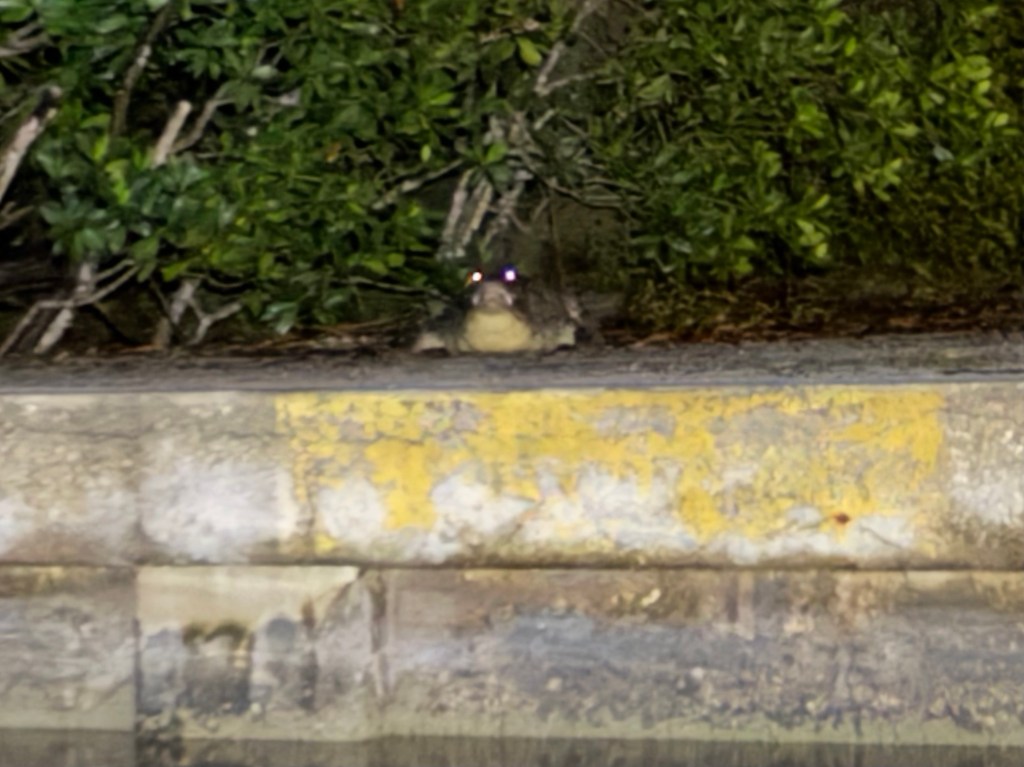
The half moon is still blocked by clouds and it is DARK. I turn on the pole-mounted kayak light. Its #1 job is to keep me from being run over by powered craft, but as a bonus, it casts a bit of soft light in all directions. Sitting above and behind me, the light doesn’t shine in my eyes. It does, however, shine in the eyes of the crocodiles.
American Crocodile perched on the marina wall. Amazing what the iPhone’s camera can do with the faintest of light sources.Here’s the same croc in motion.
Several more crocs take umbrage at my passage and splash off in a huff.
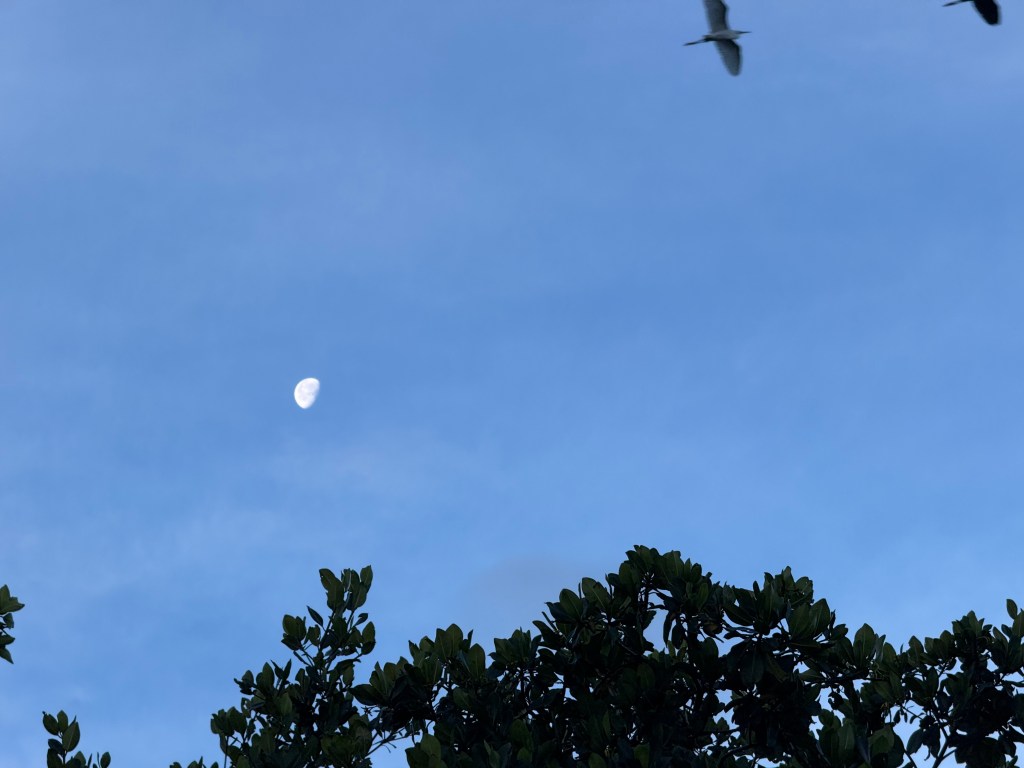
In time, the clouds melt away, allowing the half moon to illuminate the mangrove shoreline.
A Spotted Sandpiper perches on a fallen log, bobbing up and down. The end of the log has eyes and large teeth. Eek!
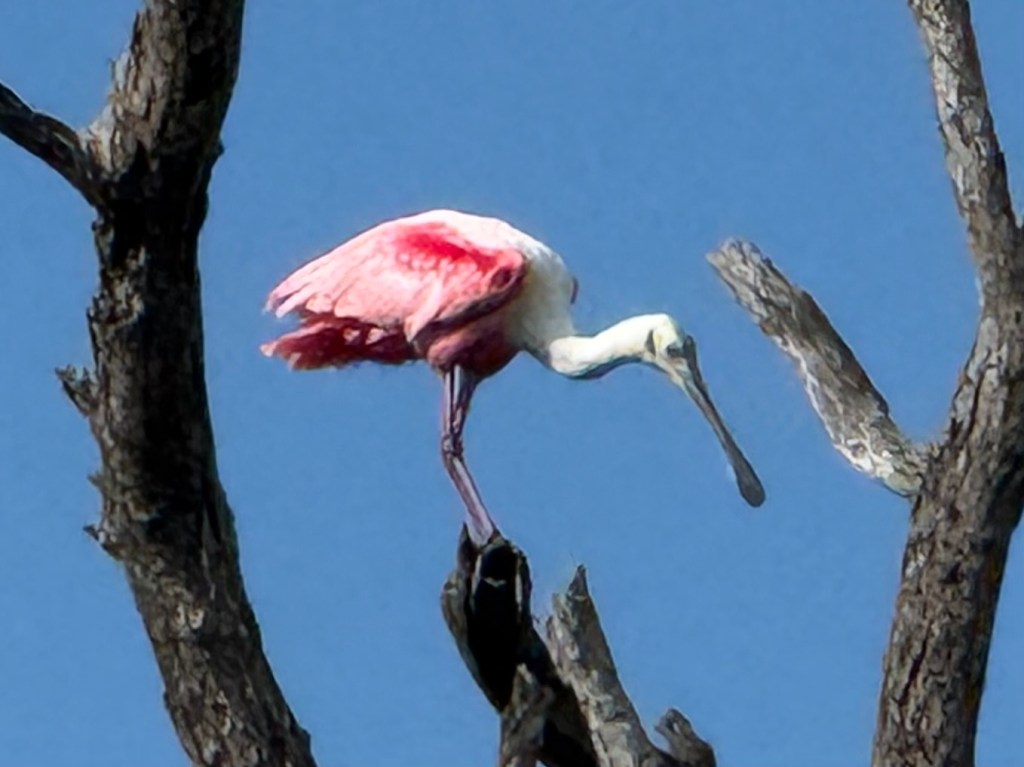
The sun glows as I round the corner into the Snake Bight flat. The north edge of the flat has a thin line of shocking pink. Though I’m looking for fish, Roseate Spoonbills always steal the show.
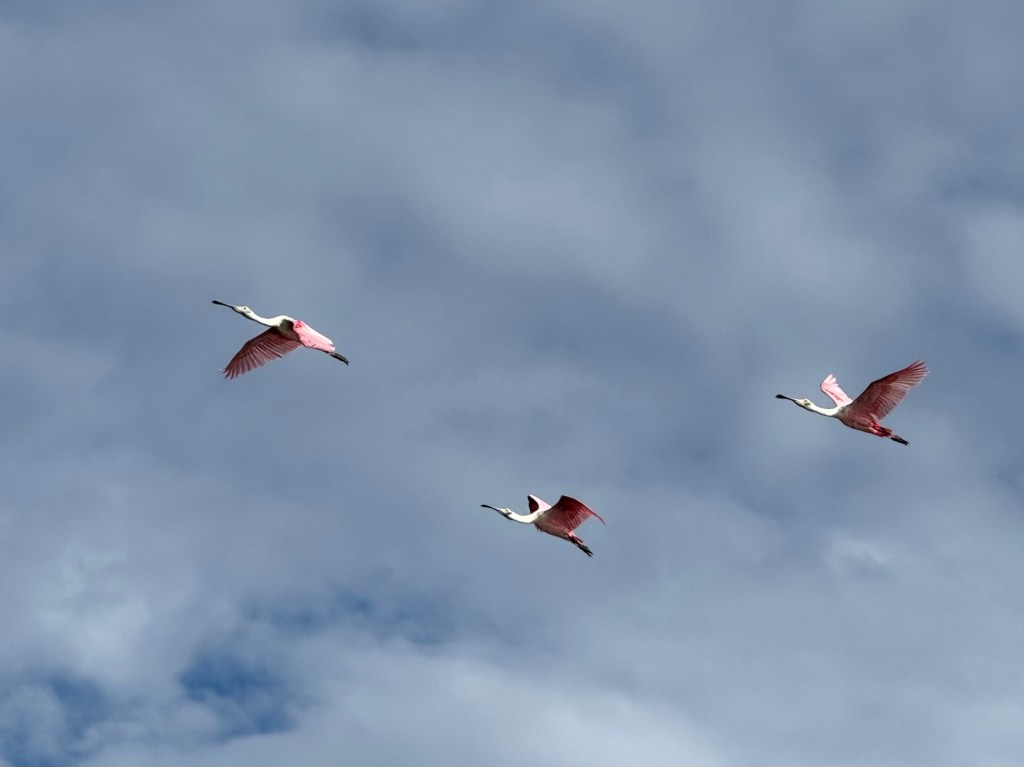
Some spoonbills fly over my kayak enroute to their favorite roost of snags by a mangrove creek.
I spot another kayaker approaching the cove where the spoonbills are roosting. He pulls out a camera with a giant lens, then paddles in too close, spooking some of the spoonbills. If that’s not bad enough, he starts paddling in even closer – too much.
If I can use an iPhone to get this photo without spooking the spoonbills, a kayaker with a giant lens doesn’t need to crawl down their throats.
First rule of not spooking birds is to act like you are interested in something else. Definitely do not aim your kayak directly at them. I call out: “That’s close enough!” He stops, turns around, and leaves. Good thing too. In half an hour, a carefully guided kayak tour comes by specifically to see the spoonbills.
* * *
FISHING REPORT (stop here if fishing bores you)
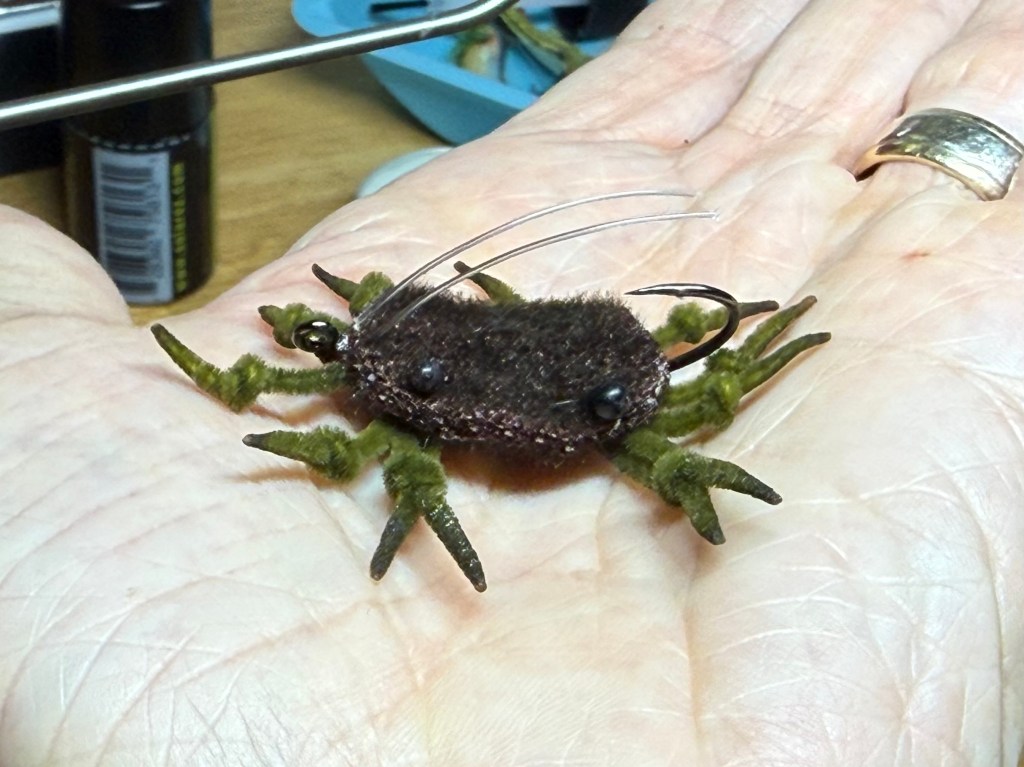
Last weekend I tied a mangrove crab fly using whatever I had lying around, with a notion to try for redfish feeding in the mangrove roots along the edge of Snake Bight. It came out pretty well.
Never mind the fish – I think it’s adorable.
I try it out. Crabby casts fine and stays upright while it sinks, but the legs entangle too much sea grass detritus. I’ll try it again in the Ten Thousand Islands where there’s less sea grass.
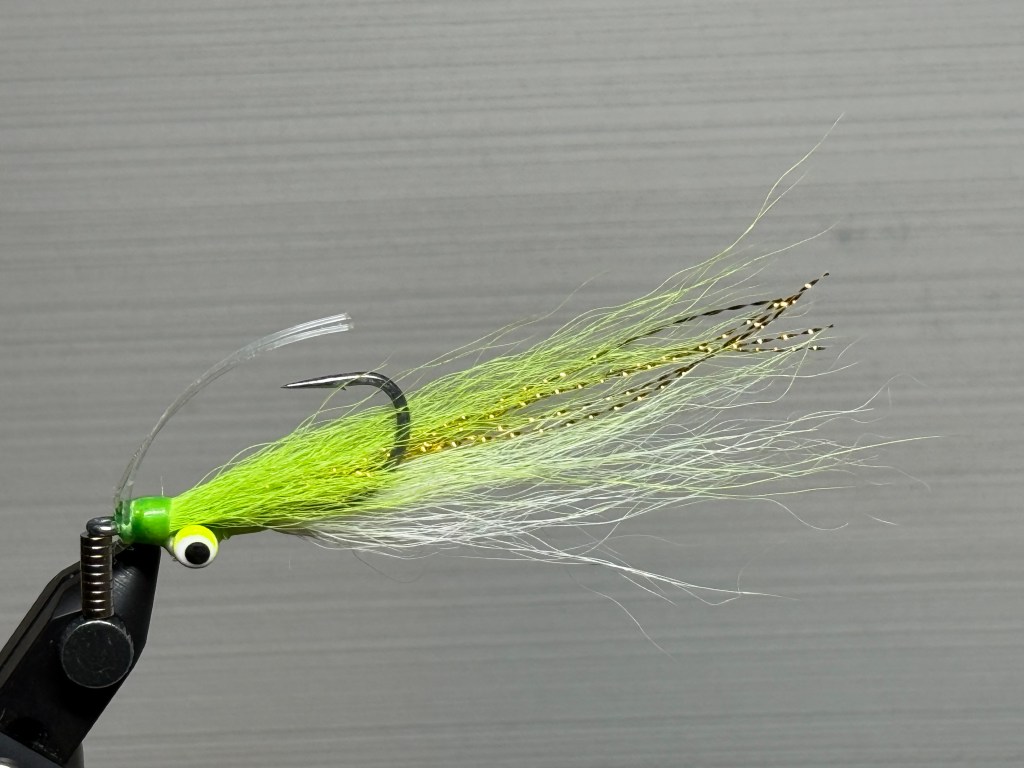
Instead, the winning fly today is my weedless tie of the classic chartreuse-over-white Clouser Deep Minnow.
It catches seven snook 18-22”.
20″ male snook with Clouser fly.
Snook in this size range are all males, turning into females when they get bigger, around 26-28”. I wonder if our Florida State legislators know that many of our prize game fish are transexual, “protandrous”, to be exact.
Somewhere else out there lurk the female snook. Research by FIU professor Jenn Rehage indicates that most of the females are still up-river, fattening up on sunfish and cichlids for the breeding season. This rainy spell should get them moving downriver again.
I have caught countless redfish on spinning gear but exactly zero on fly. I tied this sparkly fly in the hopes of temping a bite. Don Quixote jousts at yet another windmill.
Snook are great but I am still hoping to catch at least one redfish today. I swap out the Clouser for a sparkly redfish attractor pattern. Instead of a redfish, it catches my biggest snook of the morning (23″) plus a pretty little sea trout.
Lunch is leftover tamales from Moreno’s Tortilla Shop, re-heated in the sun. Gentle rain resumes on the drive home, kindly washing the saltwater drips from kayak and car. Fine morning all around.
As I went walking I saw a sign there, And on the sign it said “No Trespassing.” But on the other side it didn’t say nothing. That side was made for you and me.
Contrary to my religious practice, I have been off the water for two long weeks. Bunch of pressing things going on, despite which, my psyche demands TOW (time on water). Rain is predicted for Saturday afternoon but the morning looks good in the western Everglades if I stay south of the fire. The plan unfolds to shirk the day’s assorted social obligations and start the morning fly fishing for juvenile tarpon from my kayak. I’ll play it by ear after that.
I packed the car the night before, bringing a single 7-weight fly rod, a clear-tip intermediate sink-tip line, and an assortment of proven flies that I tied to entice juvenile tarpon. Going “fly or die”.
* * *
FINDING JUVENILE TARPON AFTER A COLD SNAP
A few days back, a friend reported 100 dead juvenile tarpon in my favorite Everglades tarpon fishing area, casualties of the recent cold event. The spot I chose for today, ~60 miles northwest of there, is a brackish canal network dug 20’ deep to excavate fill to create adjacent dry land for buildings. Some people still think building in the Everglades is a good idea. On the plus side, deep water makes a good thermal refuge for manatees and juvenile tarpon during a winter cold snap. I always find tarpon holed up there in the winter and especially when it’s cold.
The general area sees significant fishing pressure, evidenced by snagged fishing lures I pluck from mangrove branches and by the landing net sitting next to a kayak on the shore at a nearby residence. Pressured tarpon are hard to catch, especially on fly, and these particular ones often refuse Mike Connor’s Glades Minnow and Jay Levine’s black micro-bunny, my two best-producing flies for tarpon along the Tamiami Trail.
Water access here is controversial. There’s a public boat launch a mile away, but a clear “NO TRESPASSING” sign is posted on a buoy you’d have to pass to get to the canal network. It’s all public water but I assume someone of authority doesn’t want motor boats shattering the peace in the canal area. Some fishermen told me they were issued a $125 fine plus administrative fees when they were caught on the wrong side of that sign by an officer from the Florida Wildlife Commission.
Florida Statutes Ch 810.011 states that No Trespassing signs must be “…placed conspicuously at all places where entry to the property is normally expected or known to occur.”
When I approach the canal system in a kayak from the tidal creek on other side, the only posted sign says not to feed the alligators. By my read of the statute and the signage, a person can lawfully enter by kayak or canoe from this creek (nix the paddleboard – see below). To honor the implied intent, I paddle solo and fish in silence.
While no sign prohibits entry from the creek, a militia of large alligators guards a shallow area in the creek outflow. It’s such a good spot to snap up a passing fish that only the biggest gators can command a seat at the table. They allowed me to pass hassle-free on prior trips, but I always treat them with respect and get past them quickly lest they think up some excuse to engage.
* * *
THE WEE HOURS
Dream after dream has me looking for a bathroom. At 1:35 am, my conscious brain integrates the repeated hints that I need to get up to pee. Sleep is over. The alarm is set for 3:30 am, but lying awake at 3:05 I give up and start my day. Dress, shave, sunscreen, pet the cat, coffee, granola, Heather Cox Richardson, pack the cooler, and hit the road to cross the Tamiami Trail in the dark.
A dense fog in the Everglades blocks the full moon and lowers my driving speed to 35 mph. Ninety minutes later, I am parked a short walk from the creek mouth. It’s pitch dark. Fifty minutes to sunrise, and twenty to the start of civil twilight.
* * *
GATOR GAUNTLET
Water levels are very low this winter. The gators’ usual ambush spot in the shallow portion of the creek bed is high and dry. Seeing no gator eyes glowing in the beam of my headlamp, I haul my kayak overland in the dark to the rocky exposed creek bed. The eastern sky shows the very first glow of dawn as I launch in the fog.
Dark water explodes into spray around my kayak. The gators hadn’t gone far. Huge bodies, black and cream, churn in front of me and to either side. So much for silence.
Waves subside and I can see the glassy water is dotted with dead cichlids killed by the cold, mostly tilapia. I’m sure the gators have been feasting on them. Just past the gators, foot-long mullet begin leaping into the air and crashing onto their sides. Nobody knows why mullet jump, but I’m pretty confident it’s a courtship display. Fifty yards further, a dorsal fin and tail nick the surface. Tarpon can breathe air and come up to the surface for a quick gulp in a behavior known as “rolling”.
Tarpon are alive and rolling. The morning holds promise.
* * *
FLIES
In very tannic or murky water, tarpon will bite dark-colored flies, but in clear water they prefer white flies. The water today is clear but somewhat tannic, so it’s anybody’s guess what shade of fly will do best. I start with a black baitfish fly that’s been super-effective for tarpon and snook in dark water.
I pull some fly line off the reel and make my first cast in front of three rolling tarpon. Nice to have my right arm working again after four months of physical therapy for a torn muscle in my rotator cuff.
The tarpon ignore this black fly over the next dozen casts. That means they won’t take Jay’s black micro-bunny either. I switch to a white micro-bunny fly. They like that one better, but not enough. They nip and pull its tail, “short-strikes” in fly fishing parlance. I begin counting short strikes.
Since they don’t want black or white, how about olive? I try an olive micro-bunny. Nothing. Black & white bunny? Nope. White baitfish with swishy peacock herl tail? Nope. Black & purple tie of Paul Nocifora’s BMF? It gets a bunch more short strikes, but no eats. I see them charge the fly, rolling onto their silver sides to rip off bits of the BMF’s purple tail, but they don’t want to eat it, even after I snip off the weed guard. How about a black & purple tie of Chico Fernandez’s Marabou Madness, weighted to get down deeper? Nope.
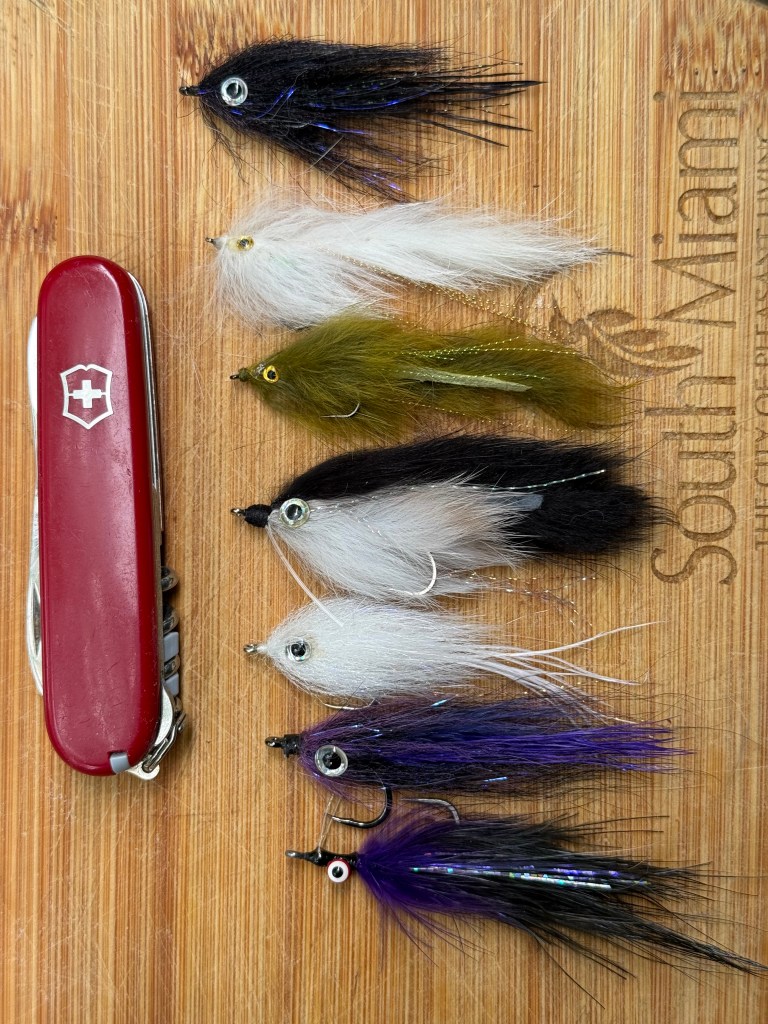
Seven proven tarpon flies that did not catch tarpon today.
I have been on the water for the best two hours of the day. I have pitched a hundred casts at rolling tarpon, swapped through seven flies, two of which received 13 short strikes between them but zero eats. Mangroves lining the canals have been more eager than the tarpon, grabbing my flies on the errant backcasts. My newly rehabilitated rotator cuff is starting to complain.
I suppose it’s possible the tarpon, though plentiful, just won’t bite today.The water feels coolish but not cold, maybe 68°.
Not catching fish is hardly the worst thing on a spring morning in the western Everglades. A bull manatee is swimming back and forth underneath me, probably curious about my kayak. Chortling songs of Purple Martins grace the air. Mullet sploosh nonstop under the watch of Great Blue Herons waiting in ambush on the odd bit of open shoreline. Anhingas and cormorants dry in the trees overhead as they digest their breakfasts. Alligators rise and sink as I pedal-paddle past.
* * *
THE DEVIL’S DAUGHTER
Master fly designer Drew Chicone of Ft. Myers publishes an email newsletter with detailed instructions for tying his more successful fly designs.
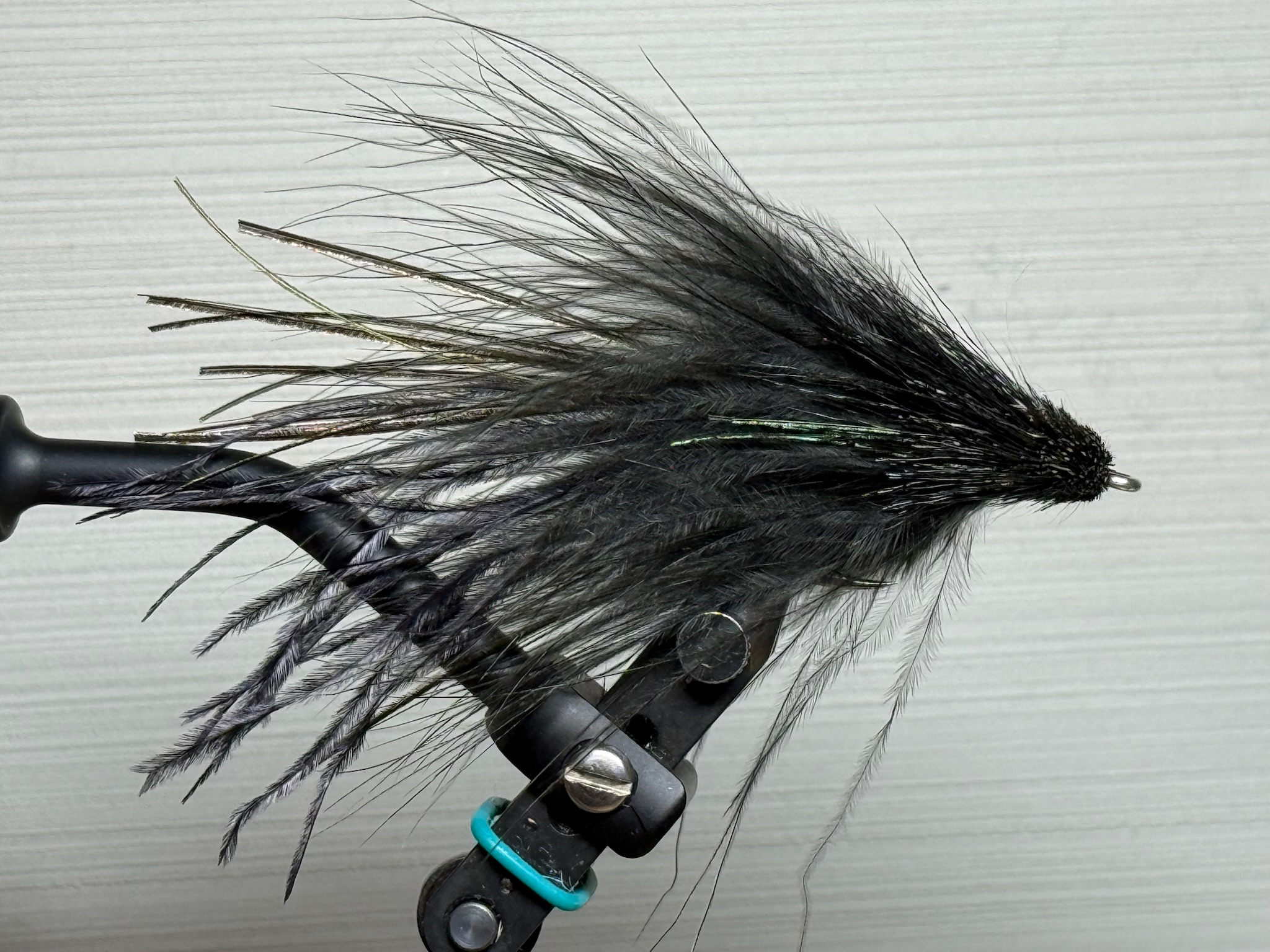
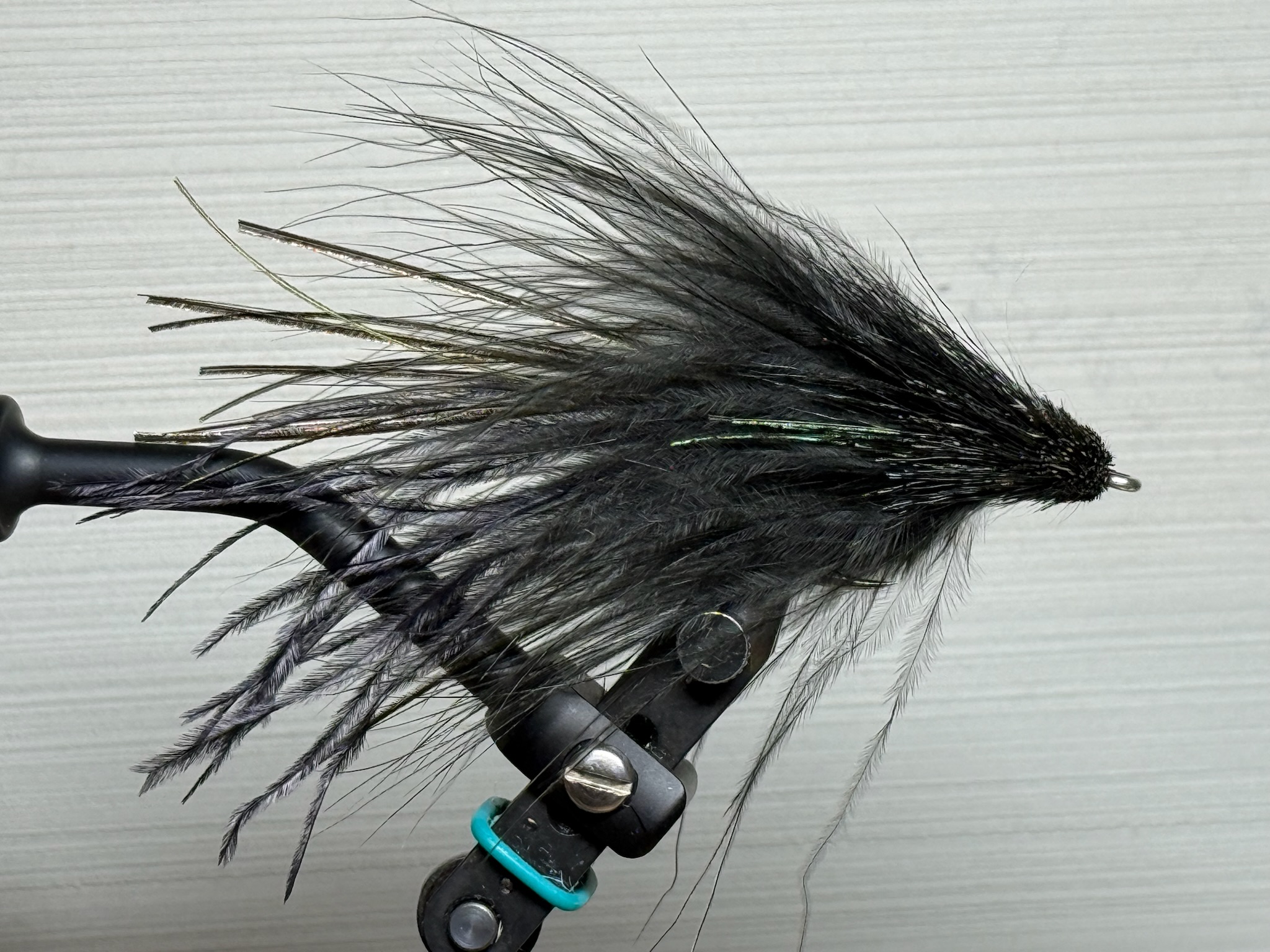
Drew invented “The Devil’s Daughter”, a big black fly for targeting those overfished snook and juvenile tarpon that have wised to every fly in the box. It’s a complicated tie as saltwater flies go, combining shimmering peacock herl, swishy ostrich herl, and fluffy marabou feathers into a pulsating body, with a head of spun black deer hair and peacock herl that displaces water as the fly moves. The fly is light for its size, lands softly, wets quickly, swishes enticingly, and pushes water to announce its passage. I had tied one and used it only once, but it caught a 40 pound canal tarpon.
Devil’s Daughter, freshly tied and before being gnawed by a lot of tarpon.
This fly is in my collection today so I throw it in front of the rolling tarpon and move it through the water, mostly steady with tiny twitches to make it quiver. The fly stops and I give the line a tug…
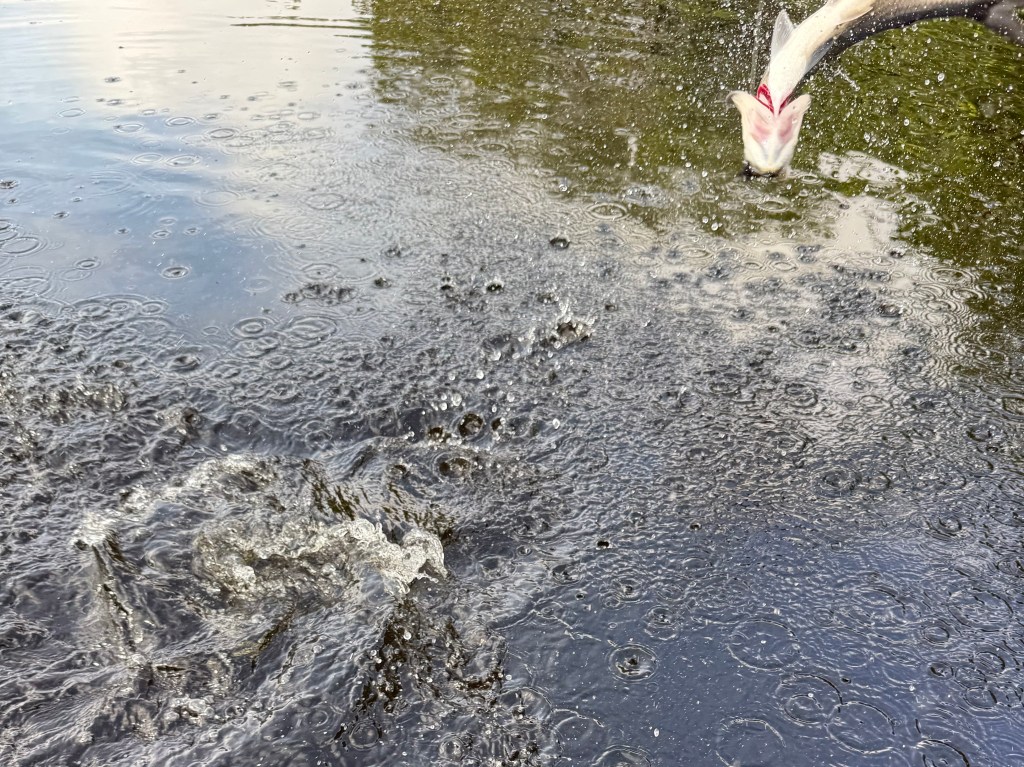
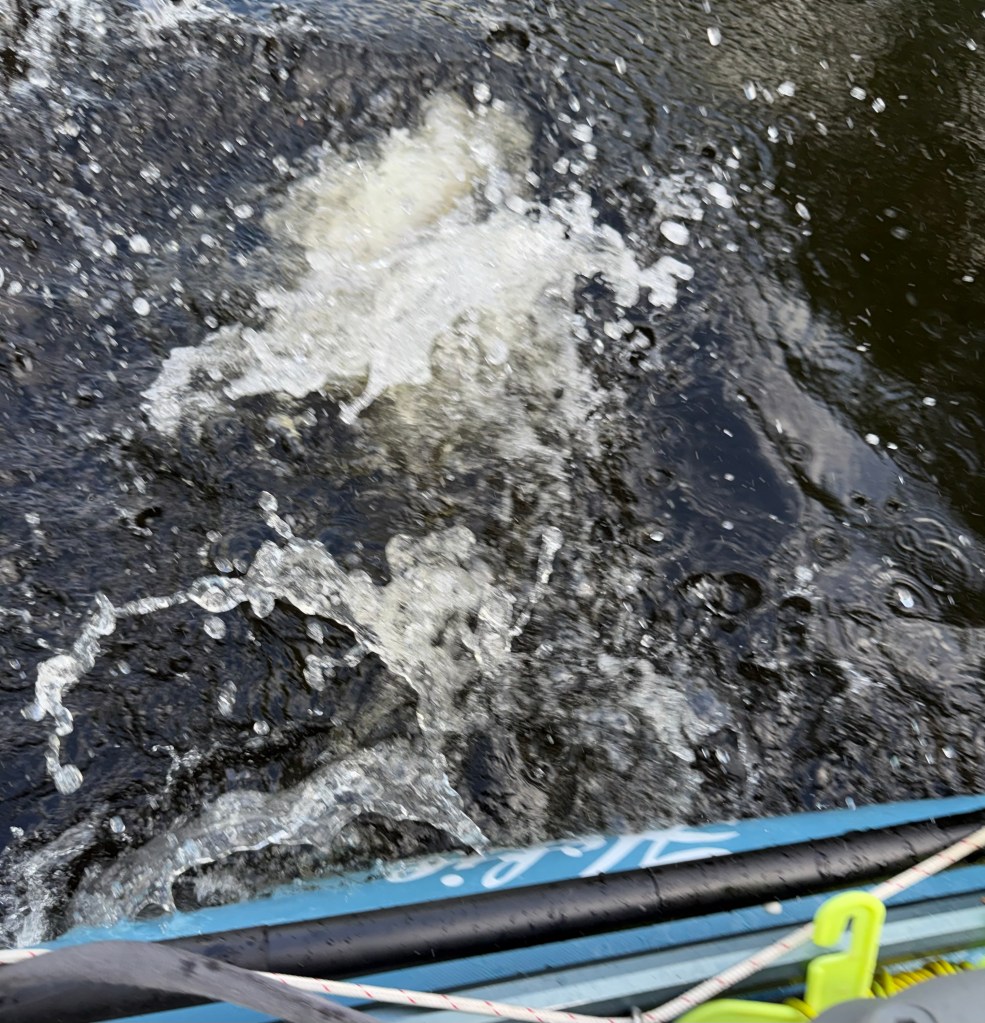
Line rips out of my hand and screams off the reel. I take back line and a five pound tarpon goes airborne. They always do and it’s always a splendid show of athleticism.
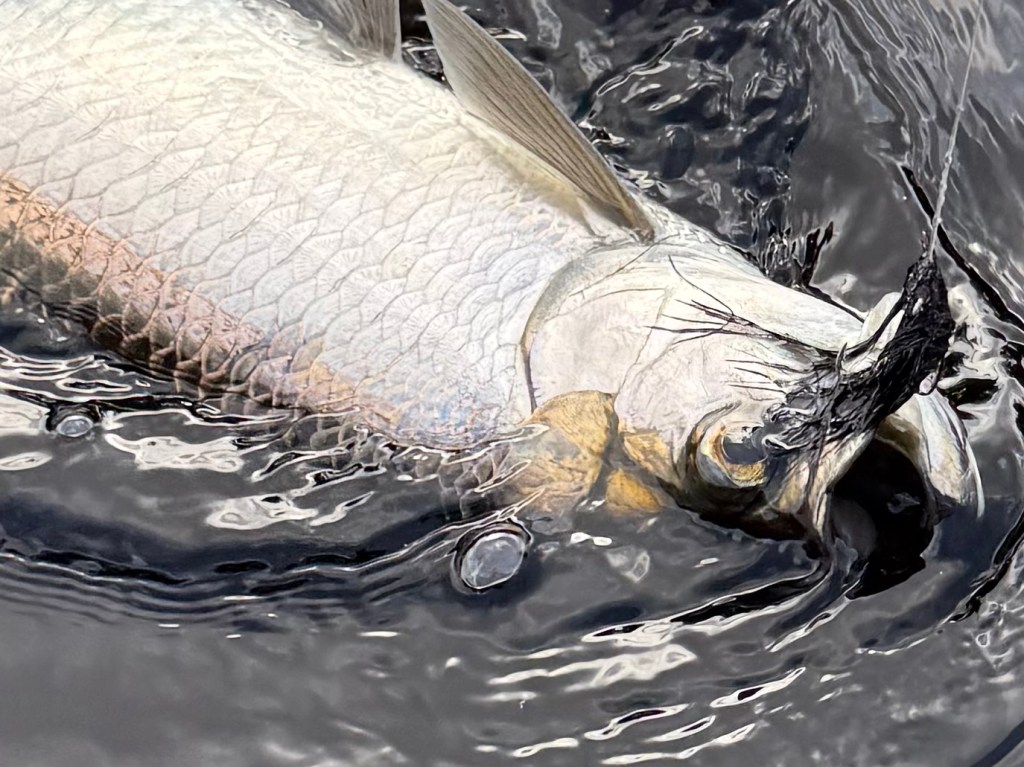
The pink and lavender iridescence leaves me awestruck.
Over the next two hours I catch and release eight tarpon ranging from 3 to 10 pounds. Two manage to toss the fly and six have to be unhooked in the net.
After being unhooked, this ten pound tarpon chose not to stick around for the photo op.
Expert wisdom has it that the fly design matters much less than how you move the fly in the water. True enough, but this morning’s fishing success has hinged on one black fly designed by Drew Chicone. Both times I’ve fished it, a third of tarpon contacts resulted in hook-ups: two nips then an eat. Heck of a fly, Drew.
* * *
The sky opens up as I pull into our driveway. I could use a nap.
One last nod to the enduring spirit of Woody Guthrie. Roll on sweet tarpon, roll on.
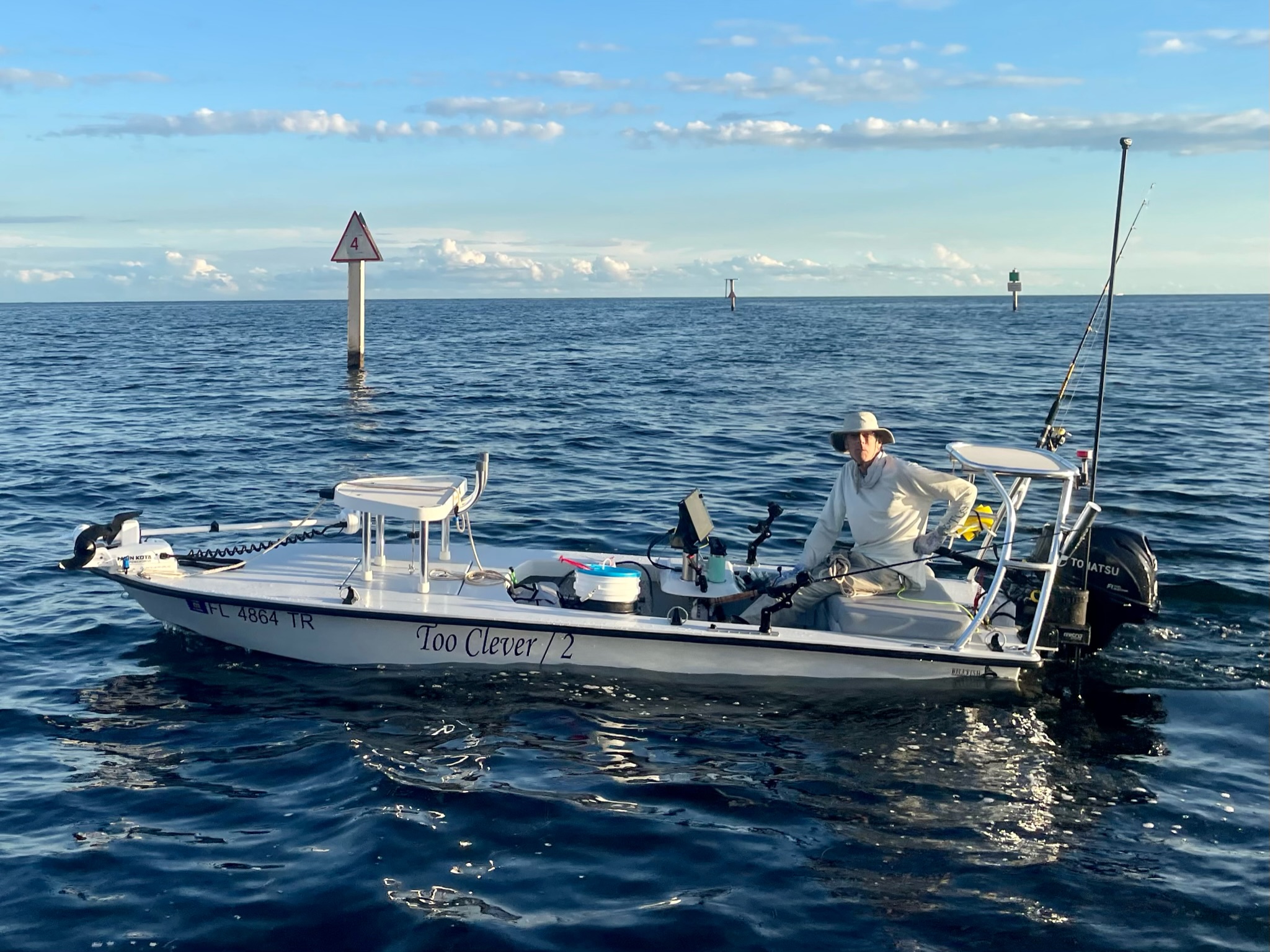
Here’s a stupid story that also explains the name of my little flats skiff.
* * *
Monday morning before sunrise, I launch my skiff from the front boat ramp at the marina at Flamingo in the south end of Everglades National Park.
When launching the boat solo, I secure the loop of a dock line rope to the cleat on the front of the skiff and tie the other end to one of the two vertical PVC posts at the rear of the boat trailer. Then I back the trailer into the water and stop abruptly. The boat floats off the trailer into the water, tethered to the rear of the trailer by the dock line.
Dock lines come in 15’ and 25’ lengths, so when I got my 14.5′ skiff, I bought a pair of 15′ dock lines, one for each end of the skiff. Fifteen foot dock lines are the perfect length if I’m backing the trailer down the boat ramp and someone else is guiding the boat along the dock. Launching solo, however, a 15’ rope is just long enough to tie a clove hitch around one of the 2.5” diameter PVC pipes enclosing the risers on my boat trailer. The clove hitch is not the most secure knot one could tie onto a slick PVC pipe, but it’s the only snug hitch knot I can manage given the limited length of the dock line.
Launching solo this morning, I remove the safety straps, tie on the dock line, back the trailer into the water, and the boat floats backwards off the trailer as planned. I ease the car forward to bring the back of the trailer onto the dry part of the boat ramp, placing the rope within my reach.
As the rope comes taught, its tip pulls free of the clove hitch on the trailer’s riser, the knot unwinds, and the skiff continues its backwards drift untethered.
Expletives fly as I leap from the car. It’s early on a chilly weekday morning and nobody is on the water nearby where they might grab my skiff before it floats across the cove.
The air is 47°F, the water is 59°F, and I am not up for a frigid swim in my fishing clothes. More to the point, I am not up for a half-hour run to Cape Sable in soaking-wet fishing clothes. I scamper down the adjacent dock, hoping I might find a way to intercept the skiff as it floats past.
The boat’s drift takes it close to the end of the dock. Jumping from the dock into the small skiff looks possible.
Now is a good time to tune in to my two inner voices, akin to what Terry Pratchett dubbed “first sight” and “second sight”.
The first voice says:
“I should make this jump OK … but it’s a moving target, I might miss, and the boat has many sharp angles and no soft surfaces.“
“If I miss the jump and break a bone, neither my wife nor my orthopedist will show me any sympathy, and that’s assuming I don’t break something then fall in the cold water and drown.”
“The internet has a thousand videos of people who injure themselves attempting to jump from docks into boats.”
Not everybody tunes in to their second inner voice, but I heard mine state clearly:
“Did you hear the part about broken bones and drowning? Listen to the first voice.”
Heeding the sage advice, I abandon the jumping idea posthaste.
Instead, I climb down from the dock onto a wooden beam just above the waterline, wrap my right arm around the nearest piling, and extend my left leg over the water as far as it will go. My toe catches the errant skiff. Whew! I ease the skiff close to the dock step onto the deck, and motor to the closest tie-up spot. My car is waiting for me on the boat ramp, the driver’s door still wide open.
Half an hour later, I’m 10 miles away. The water is too cold to catch fish on flies or lures, but the fish will bite shrimp soaked on the bottom. I bought three dozen live shrimp on my way to the marina this morning. Here are some of my catches:
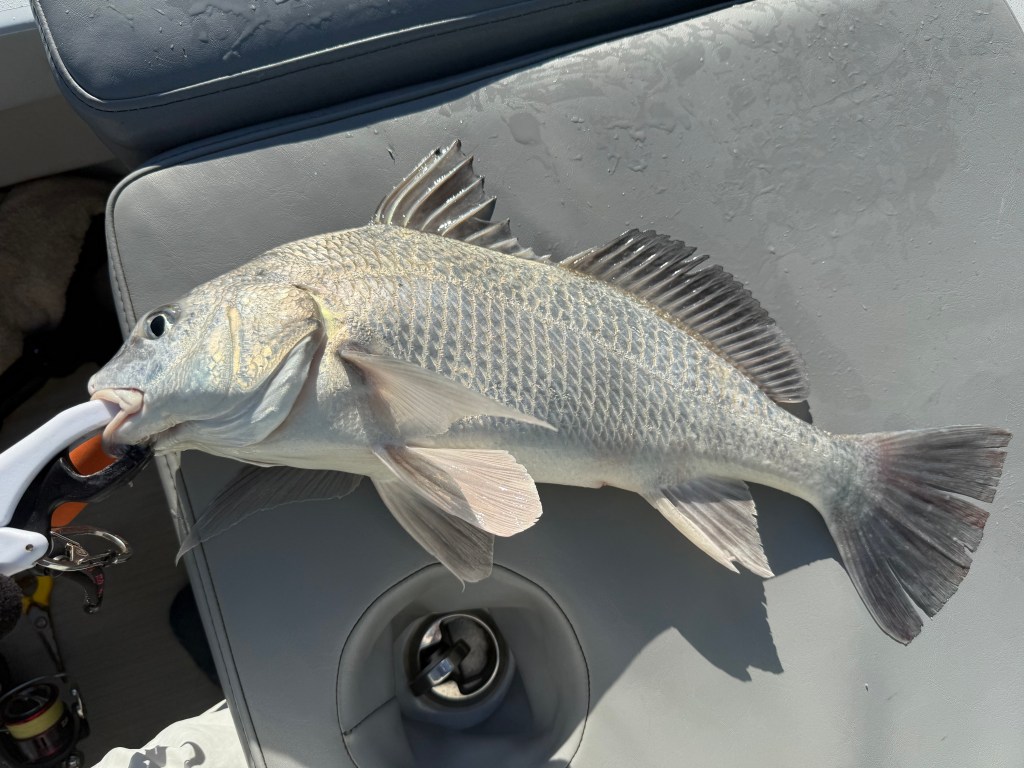
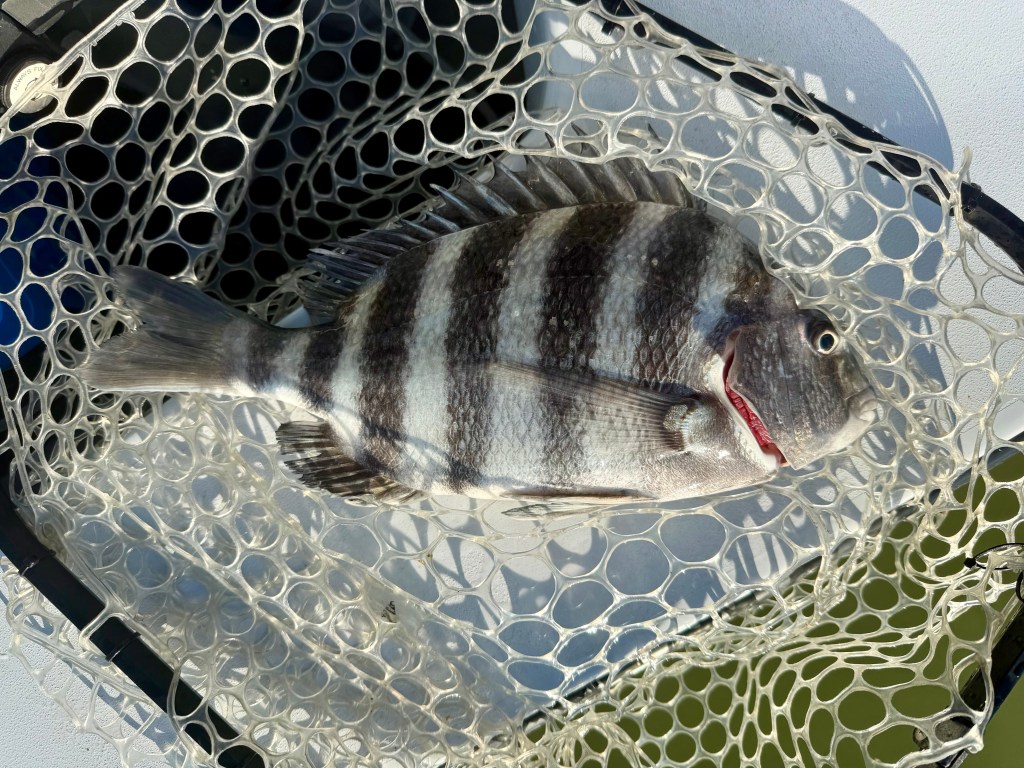
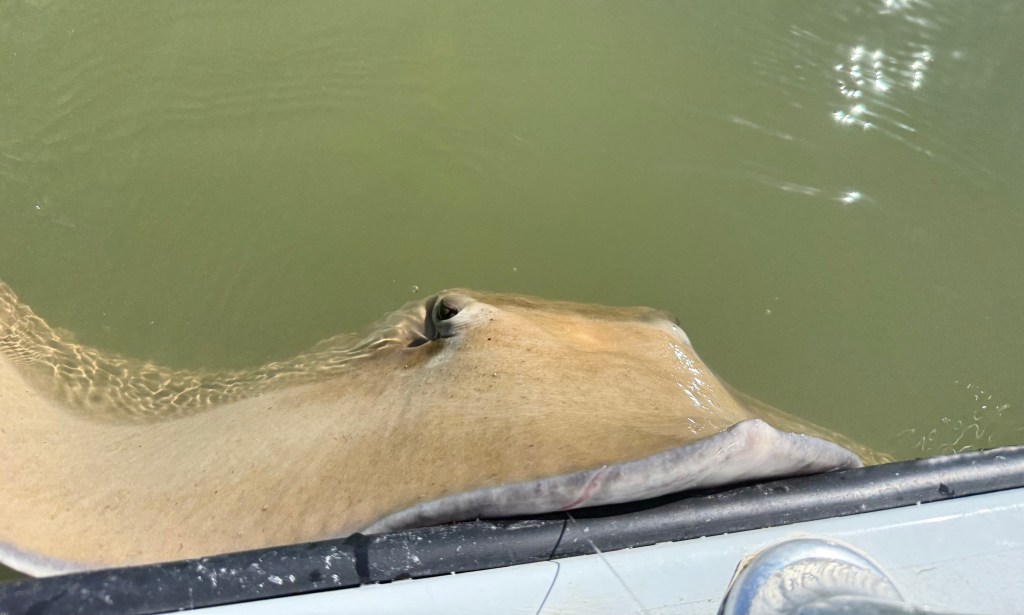
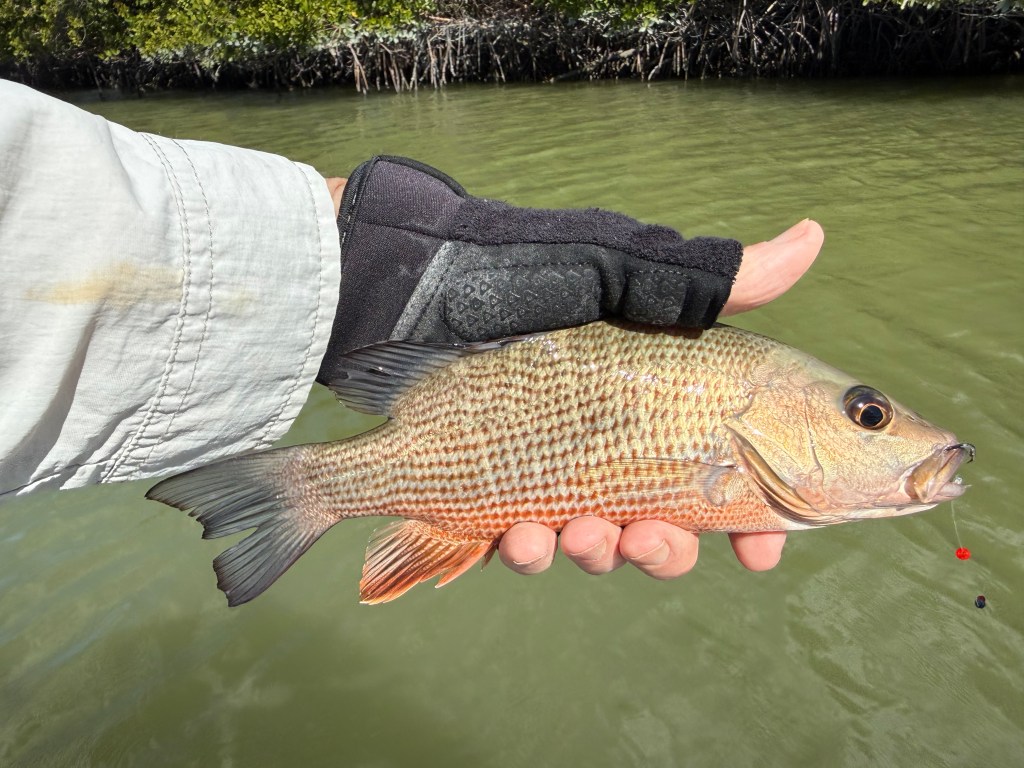
Black DrumSheepsheadSouthern Stingray, 2 meters long nose-to-tail, and a 13 cm stinger barb.I did not bring the sting ray into the boat. Those inner voices again.a little Mangrove Snapper
I hear a song of rising buzzes, my first Prairie Warbler of the year. A crocodile that slid from the sunlit bank is now eyeing me jealously, but keeping its distance. Good croc. A pod of dolphins spout spray as they venture past, chasing their own fish and not pestering the ones in my vicinity.
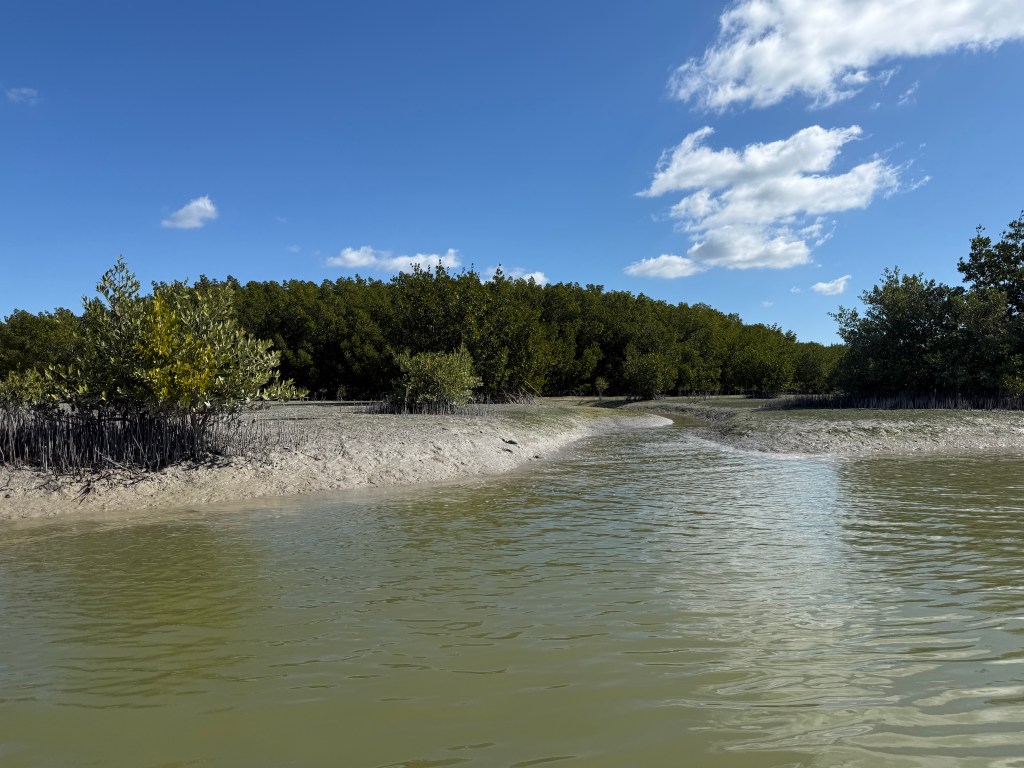
When the fish stop biting, I watch birds and explore my way a couple of miles up a tidal creek where I eat lunch in a wild place with egrets, ibis, and rails for company, but no humans.
Up the creek. Tide is down.
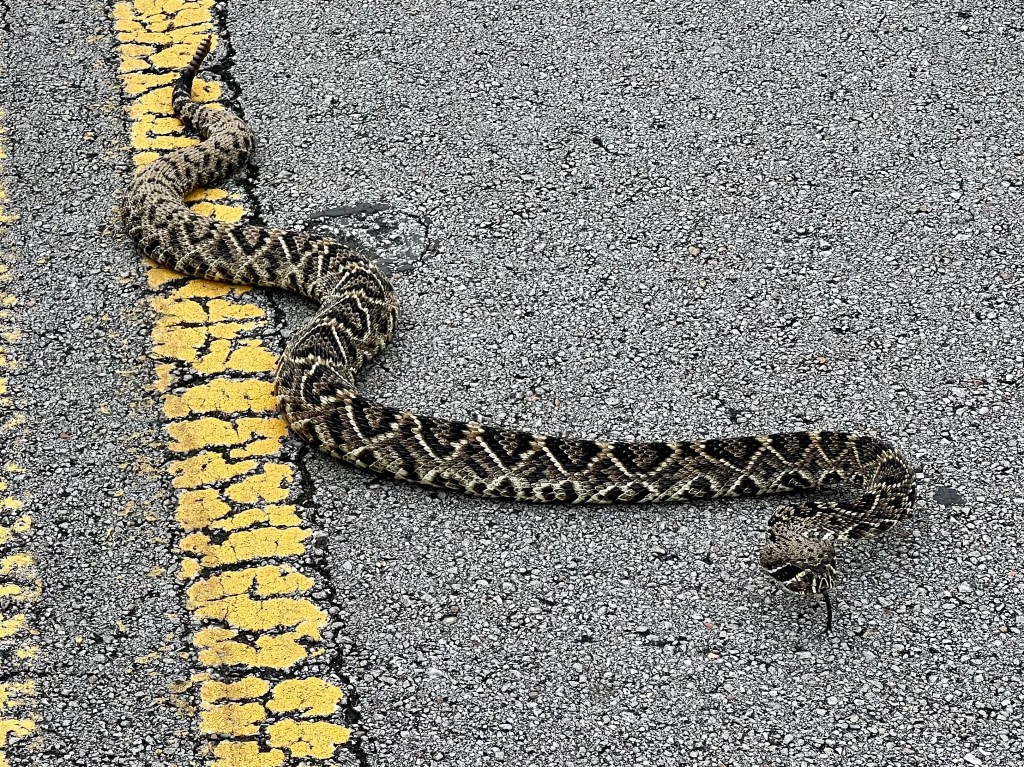
Driving home from the marina, I spot a large Eastern Diamondback Rattlesnake crossing the Park Road.
Eastern Diamondback Rattlesnake
Monday morning would the SECOND time that my over-extended dock line has freed itself from the trailer during a solo launch.
A quick trip the marine store and I am the proud owner of a 25’ dock line, long enough to tie the securest of Secret Navy Knots and then some. Of course I coulda-shoulda purchased a longer dock line the first time the boat escaped, or gee, maybe even before that.
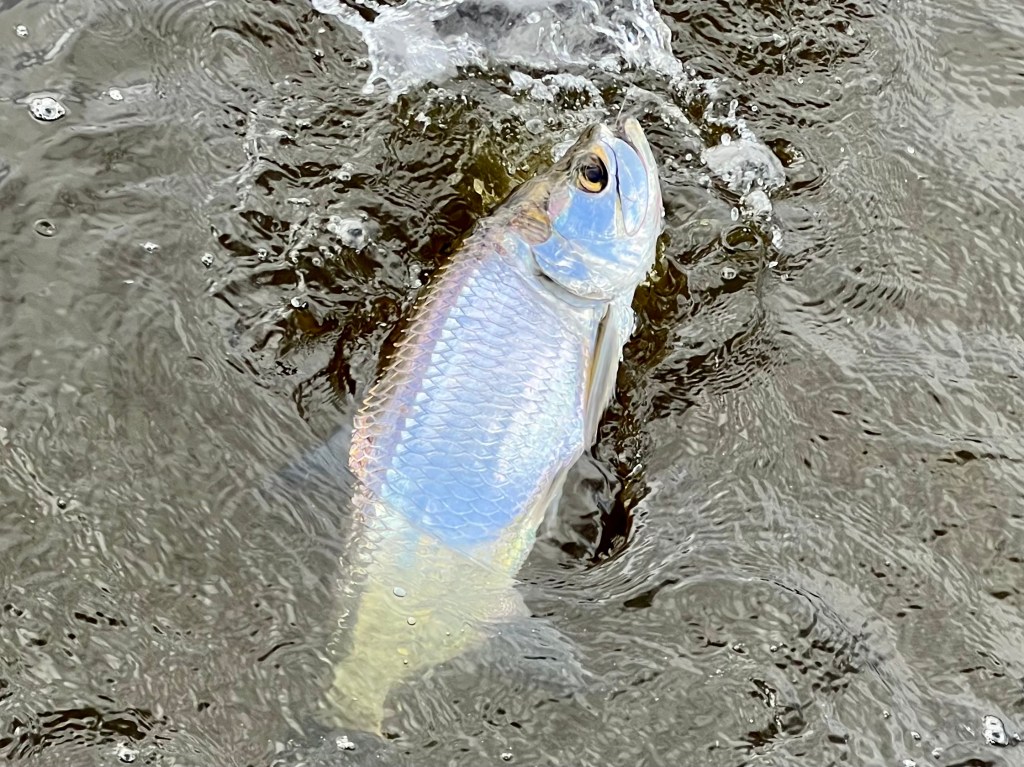
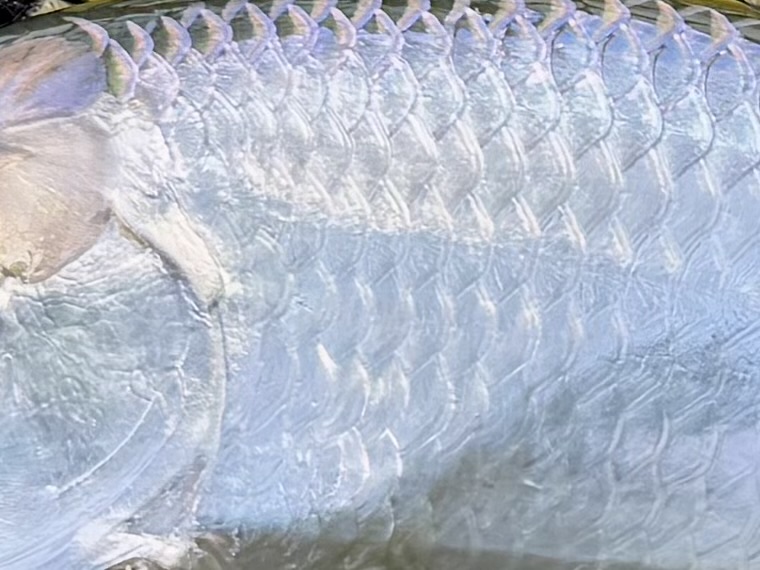
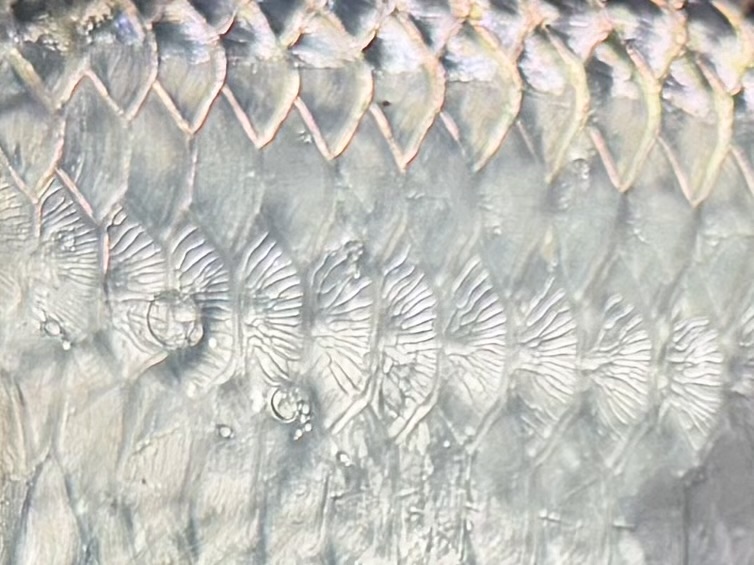
Fish are often camouflaged, some by color and patterns that resemble their backgrounds, others by reflecting the light around them and thus matching any and every background. Tarpon do the latter with scales that work like mirrors.
Juvenile tarpon are about my favorite fish to chase on the fly rod. I say “juvenile” because the adults weigh 70 to 200 pounds. I normally avoid disturbing the adults and fly fish instead for smaller juveniles weighing 3 to 20 pounds, reasonably common in the canals and tidal creeks of South Florida.
Tarpon are smart and strong, and they are spirited jumpers. The mantra among tarpon fishers is “Bow to the King”, meaning when the tarpon jumps, you lower the rod to create slack and prevent it breaking off or throwing the fly.
Instead, I lightly tension the fly line during a jump to help the tarpon toss the fly without breaking the line. My goal is to fool the tarpon into eating my fly, have it give me a showy jump or two, but spare it the exhaustion of a complete fight and spare me the guilt of exhausting a beautiful fish.
Yesterday, while kayak-fishing a saltwater canal, three miles from home as the cormorant flies, I spotted a couple of big juvenile tarpon in the 40-60 pound range. I swapped up to a larger fly “the Devil’s Daughter”, a muted black pattern designed by Drew Chicone for catching tarpon that are wise to the fly fisher’s usual sparkly fare.
Tarpon can breath air, “rolling” on the surface to gulp a bubble before descending into the murky water. Following a roll, I’d cast the fly 6-10 feet in front, let it sink a bit, and retrieve it steadily. Twice I felt “short strikes”, in which an unseen tarpon grabbed only the feathery tail of the fly. A couple of casts later the fly stopped mid-retrieve, like I’d hooked a log. I set the hook and the line began to pull. The fish was in no hurry.
Smaller tarpon jump immediately. Instead this tarpon went deep and swam away slowly. I took up the slack and kept reeling until my 7wt rod bent double and the leader touched the tip guide of the rod. The tarpon turned and made a dash under the kayak. I flattened the propulsion flippers to keep the line free as I worked it around the bow and the tarpon took off. Once in a while, I’m glad for the smooth drag on my fly reel.
We had been pulling back and forth on the fly line (intermediate clear tip) for a couple of minutes and the tarpon had enough. It took to the air, arcing its body in a fast reciprocating shake that tossed the fly. I got my fly back and the tarpon continued on its hunt for hapless baitfish. I was ecstatic – that’s about as good as it gets in my book.
Sometimes the fly won’t shake loose and I must net the fish to release it. While I have it in the net, I usually take a photo to document the spectacular purples, pinks, blues, and greens reflected by the tarpon’s mirrored scales. Here are some photos from my collection.
My last few fishing trips onto the flats have been unproductive. The late summer water has been hot and low in oxygen. Maybe the fish are somewhere else, or maybe they’re just laying low. Tomorrow morning I’m venturing back into the mangrove lakes of Mosquito Hell, an area where I always find fish this time of year, assuming the Black Salt Marsh Mosquitoes (BSSMs) don’t drive me out first.
Trip planning
The moon is near full tonight, so the morning fishing activity is likely to be brief. I plan to arrive in the dark to maybe find a snook or two before the sun comes up. Then I’ll peddle-paddle my kayak to an area where the tarpon hang out and snook spend their day hiding in the mangroves. Occasionally, a snook wakes up for a mid-morning snack. If I find the juvenile tarpon rolling, I can see if they’ll play with me. Like snook, tarpon feed actively at night on a full moon, so they may be sated by the time I arrive.
I’m preparing for the BSSMs the night before, putting into play a few improvements over my last trip to Mosquito Hell:
I take my khaki fishing pants, outer shirt, and gloves to the driveway, spray them with DEET, and place them inside a 2-gallon zip-loc bag. I lay out a towel to protect the car seat from the DEET. The rest of my special mosquito gear I place on the passenger seat: for my head, a Tilley hat and insect head net; for my feet, Simm’s neoprene wading gaiters and neoprene dive booties. Mosquitoes are not going to bite through 5 mm of neoprene.
My scheme is to drive to the launch in the dark, and change into my stinky DEET-soaked clothes, then get out of the car to rig and launch my kayak. I will start fishing at 06:00, before the first dawn light. The nearly full moon sets at 05:49 and the sun rises at 07:06, with civil twilight starting at 06:36.
It’s tricky fishing in total darkness, and tricker fly fishing. I only know that a snook is nearby if I hear it blow up the water while chasing mullet. Sometimes the water is silent. Other times I cast too far and hang the fly into a mangrove tree. Then I have to turn on my head lamp to untangle the line and of course the light attracts mosquitoes to my head. But other times I cast the fly near a snook and things get exciting in a much better way. Hope springs eternal.
My alarm is set for 3:50 am. Time for bed.
Fishing report
On the Mosquito Horror Scale (0-10) the morning ranks an 8, “Severe” but not “Extreme”. My mosquito gear system works perfectly. The only mosquitoes that try to bite me are 3 or 4 that go for the pads of my fingers where I have no repellant. That’s not a safe place for a mosquito to bite a human, and they are instantly dispatched with a pat of the finger. With my DEET-soaked outer clothes, mosquitoes don’t even follow me into the car.
No mullet are splashing around the kayak launch area in the dark, so no predatory fish are there either. Too bad – sometimes the fishing is amazing right there. I light out for the far mangrove shore, about a mile’s paddle.
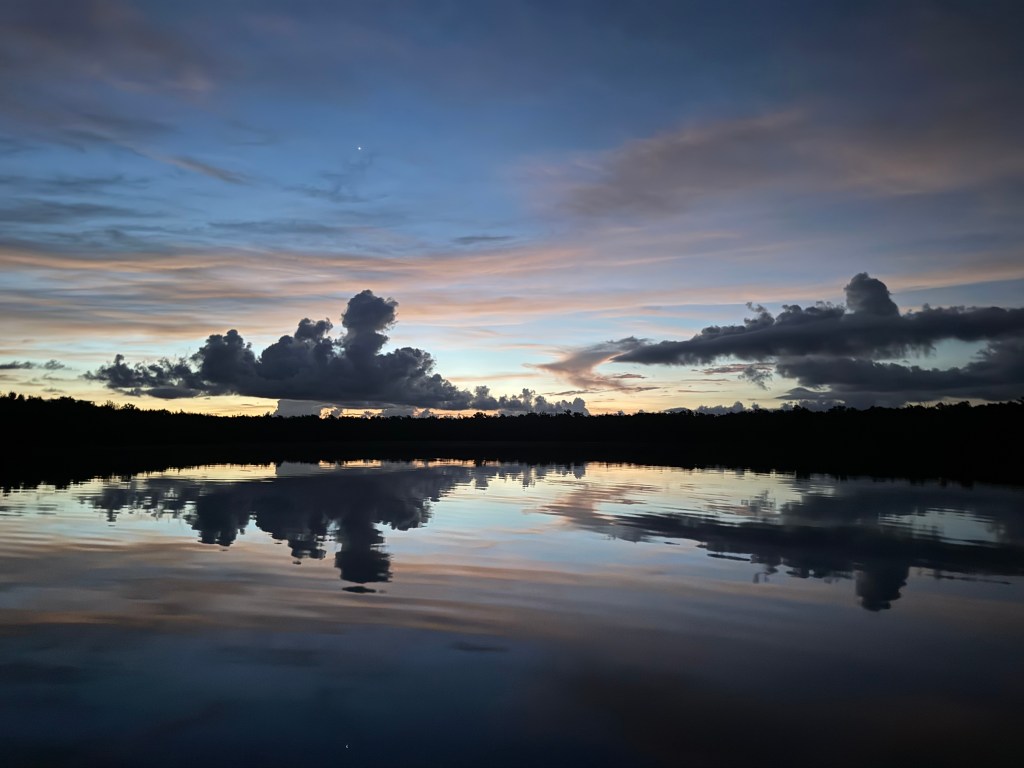
The first traces of dawn light appear, with Venus still visible directly above the tallest thunderhead on the left.
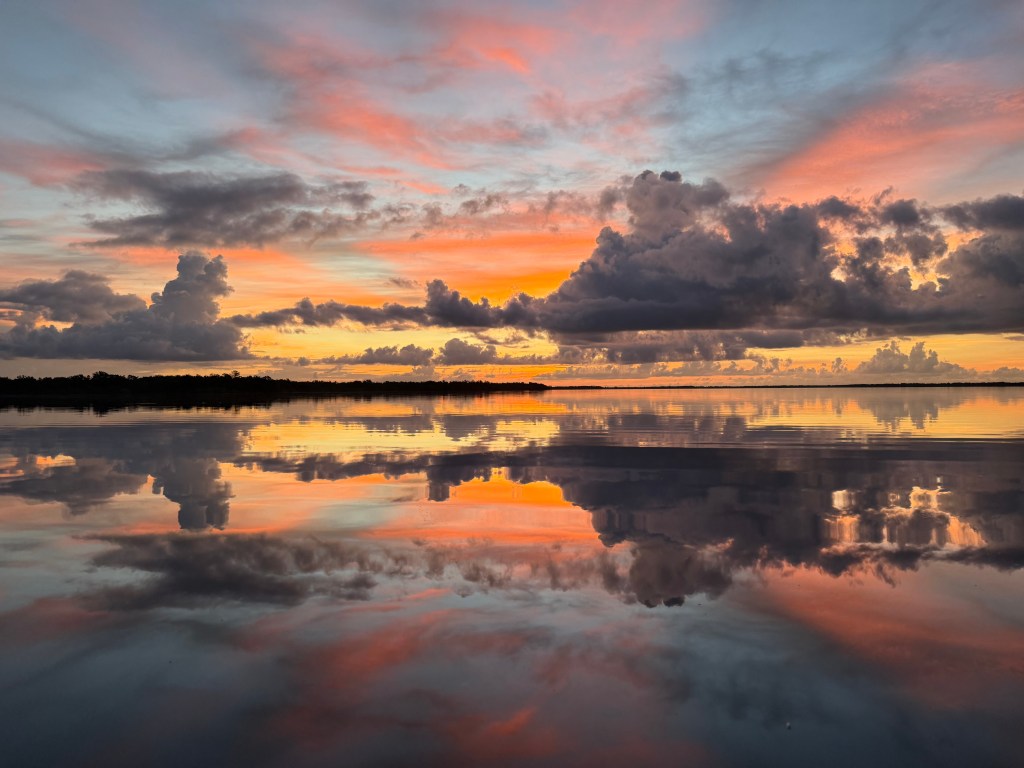
Dawn explodes enroute. Yowza.
I reach the other side eight minutes after sunrise. The water is extremely murky and tannic, like donut shop coffee with a tiny splash of horrid non-dairy creamer. I dip my finger in the water and taste it through the head net: slightly brackish.
To find fish in water this opaque I need a “search bait” that’s dark, for maximum contrast when viewed from below against the sky, but with some sparkle and a lot of vibration to get a fish’s attention. I put away the fly rod and rig my spinning rod with a 4” paddletail in rootbeer & gold with a gold underspin jig – just the ticket.
The paddletail, true to its name, wiggles its tail back and forth, and the underspin leaf twirls up a storm.
At 7:15, my second cast is slammed by a snook in the 30″ range. It makes one jump, a brief lateral run pulling line off the reel, then runs straight for me as fast as I can take up line. It passing directly under the middle of the kayak, bending the rod hard. The tip section of my three-piece TFO travel rod snaps, creating a brief moment of slack that pops the lure free of the fish’s mouth.
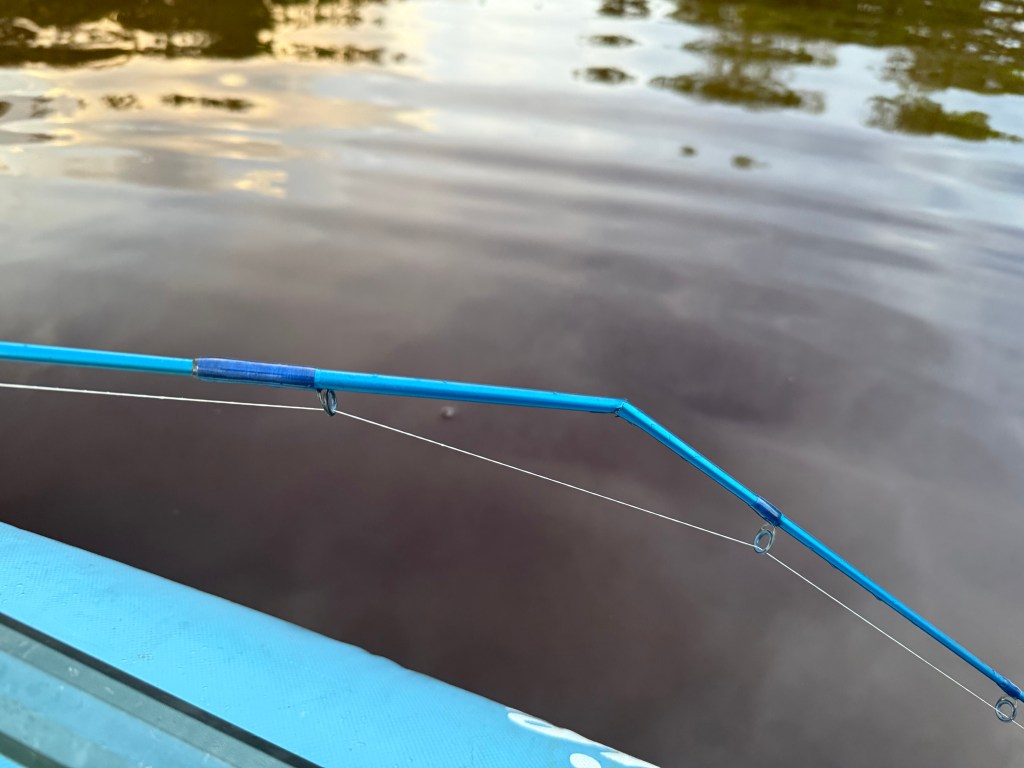
This is the 4th time this spinning rod has broken, every time in exactly the same spot, 5″ above the ferule. Until now, I’ve blamed myself, but thinking on it, each break occurred under a different circumstance and stress geometry and I’ve never broken any other spinning rod. I’d wager the TFO Traveler is weak at the internal edge of a carbon fiber sheet wrap. I will write the company about this problem. I bought two replacement tip sections the last time one broke, so I still have one left, but I need a more reliable multi-piece spinning rod.
Why even bring a travel rod on a local fishing trip? When kayak fishing tight to the mangroves, it helps to have the rods I am not using at the moment disassembled and stowed safely out of the way. That’s a key advantage of multi-piece rods, not to mention the obvious advantage when I travel.
Back to fishing. Having broken the spinning rod, it’s “fly or die”. I re-assemble the 8wt fly rod and choose a black dark-water fly, this one tied from Drew Chicone’s pattern, The Devil’s Daughter. The tail is ostrich and peacock herl, the body is fluffy marabou feathers, and the head is spun deer hair. Peacock herl gives It shimmer and the ostrich and marabou make it swish enticingly in the water.
I start with the fly in the photo and immediately hang it in a mangrove. Impatiently, I shove my kayak into the mangroves to untangle the fly, leader, and line, then tie on another I’d made with a weed guard to keep it from hanging in trees and roots.
Predatory fish that have spent the night foraging under a bright moon generally won’t be hungry again until the afternoon. This morning fits that typical pattern, with fish ending their feeding spree shortly after sunrise, shortly as in 9 minutes. In the next hour, I get rained on briefly (feels good) and catch a couple of small juvenile tarpon on fly (they’re always hungry), while their older cousins roll on the surface for air but won’t eat.
Fishing is over until afternoon but the shoreline holds birds, orchids, and bromeliads. I can see for miles, the mosquitoes have let up, the rain shower has cooled things off, and I have yet to spot another human. It’s has turned into a pretty fine Sunday in the Everglades wilderness, but it’s time to get out. Bigger storm clouds are assembling and I don’t want to be crossing open water in an electric storm.
On the way home I stop by Moreno’s Tortilla shop in Florida City to pick up hot tamales and a pack of corn tortillas. Josephine greets me and knows what I want without my asking. This little hole-in-the-wall makes the best Mexican tamales and you can’t buy all-corn tortillas this good in a supermarket.
On the drive back, I divert 10 miles to check out a canal that friend Jay and I had identified from a YouTube video. In the video, a young kayak fisher from out of town was catching lots of fish while getting bitten on the eyelids and lips by something he called “yellow flies”. As soon as I step out of the car I am engulfed by a swarm of hungry deer flies. Uh oh.
I consider deer flies even worse than mosquitoes because they are active midday when it’s too hot for protective bug clothes, they will find the the tiniest spot of skin on which you did not apply repellant (e.g. lips and eyelids), and their bites really hurt.
Climbing over two metal gates, swat swat swat, I find the kayak put-in, swat swat. From the vague track through the vegetation, swat swat swat, I can tell it’s rarely used. I wonder why not, swat swat.
I mash the deer flies that followed me into the car and photograph one that wasn’t too mangled.
Serious rain slows the drive home but returns a few minutes by washing salt from the kayak and car.
Unpacking my fishing gear, two stow-away mosquitos escape into the house. It’s still summer here in South Florida where if it’s not one nasty biting bug it’s another. I’ll bet the Wisconsin Driftless Area is getting really nice about now.