This post is for the subset of serious knot nerds out there who fish using lures or streamer flies.If that doesn’t sound like you, I’ll see you next time with something less arcane.
Fishers connect their leaders to artificial lures and streamer flies using nonslip loop knots to allow these bait mimics to move more naturally in the water.
It really irks me when a nice fish, typically a bonefish, black bass, or peacock bass, breaks my line at the loop knot. The Kreh Nonslip Loop Knot that I’ve used for years retains about 80% of the leader strength, which is pretty good, but a sharp tug can lower that strength and break the knot.
Loop knot breakage is rarely an issue for the real inshore bruisers I fish, snook and tarpon, because we add a heavy bite tippet to resist their abrasive mouths, and the loop knot in that short segment is stronger than the thinner “class tippet” behind it. But the peacock bass in the lake where I fish them regularly have wised up to my leaders and won’t take my streamer fly unless it’s tied on a tippet thin enough for them to break.
In frustration, I devised a stronger loop knot, which subsequent testing showed was as strong as the line itself. This knot is only the second known loop knot to retain 100% of the line strength under static loading. The first such knot is the Bimini Twist, a great knot, but too big for direct fly connection in most cases. Phil’s 100% Loop Knot fills the void.
Phil’s 100% Loop Knot on a streamer fly. The loop allows a fly or lure to bounce around freely, better imitating the movements of an anxious or injured baitfish.
[Addition since original post: Andy Mill on his podcast states that the Improved Homer Rhode Loop Knot retains 100% of the line strength. I tied and tested 14 of them, and found the Improved Homer Rhode Loop broke, on average, at 64% of the line strength compared to 79% for the Kreh Loop, and 100% for the Phil Loop.]
Instructions to tie “Phil’s 100% Loop Knot”:
Summary: tie a Kreh Loop with doubled line and 1.5 wraps.
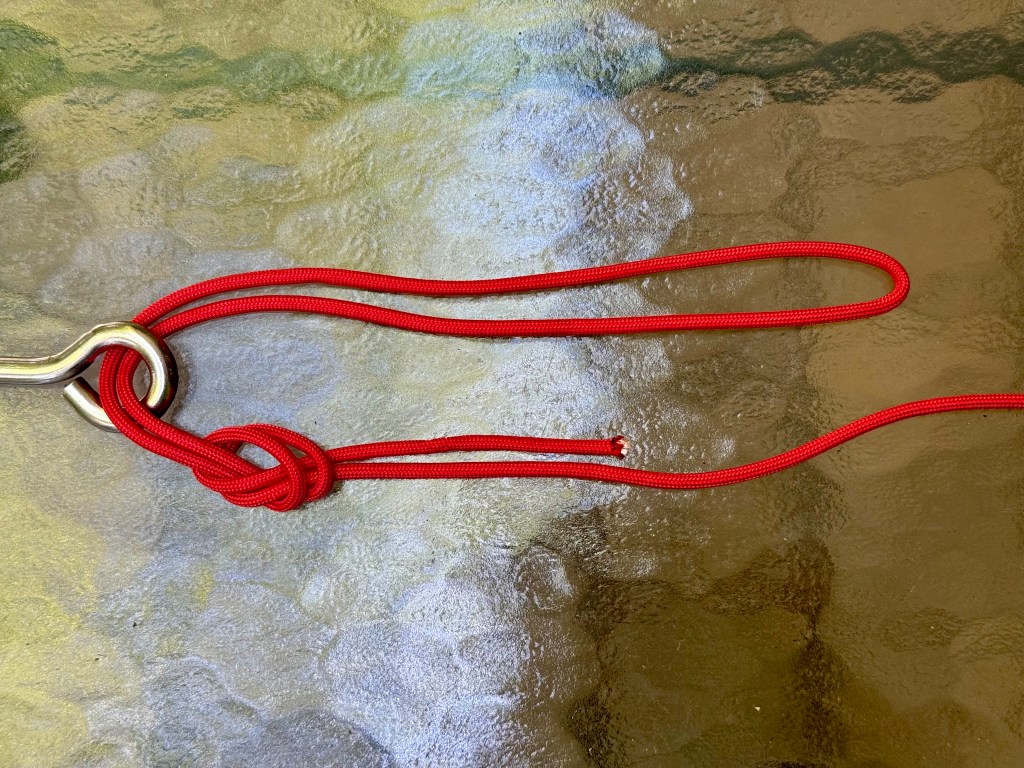
The working knot, like the one above, is tied in thin monofilament or fluorocarbon leader that is hard to visualize from a photograph. In the photos that follow, I tie the knot using parachute cord to make it easier for you to see.
Steps 1-4 below. (1) The line is doubled, (2) an overhand knot tied in it, (3) the loop end is slipped through the hook eye, and (4) the overhand knot is positioned close to the hook eye.
(1) Double the line. You can fold the line over on itself, or lay another segment of the same material along side if you don’t want to shorten your leader as much. In a thin line, make this doubled section 3” long (try 4″ the first time you tie it).
(2) Tie an overhand knot in the doubled section,~2” from the tag end. Don’t snug it tight yet, but keep it open 1/8 to 1/6”.
(3) Slip the doubled end through the hook eye. With hook sizes #6 and smaller, that loop won’t fit through the hook eye without a fight, so I cut the line to make two ends and slip them through one after the other.
(4) Slide the line through the hook eye until the overhand knot touches or comes close to the hook eye, and lay the loop beside the doubled reel-ends of the line.
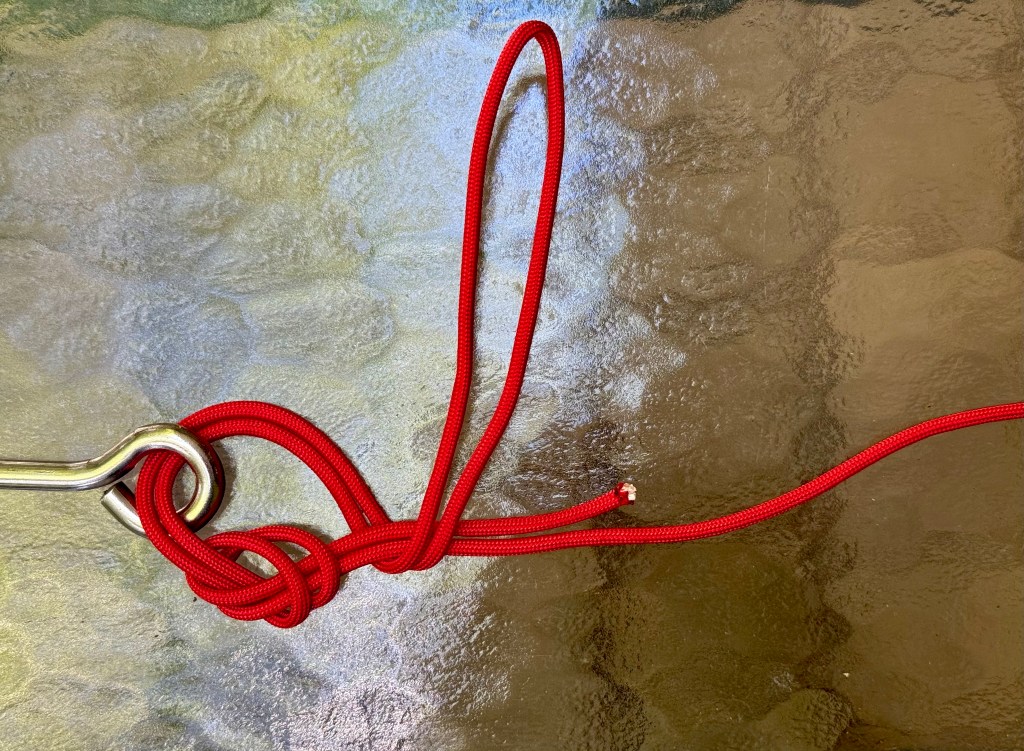
Half wrap around – keep going…One and a half wraps around. That’s enough for full strength.
(5) Wrap the loop end (or 2 cut ends) 1.5 times around the double reel-ends of the line.
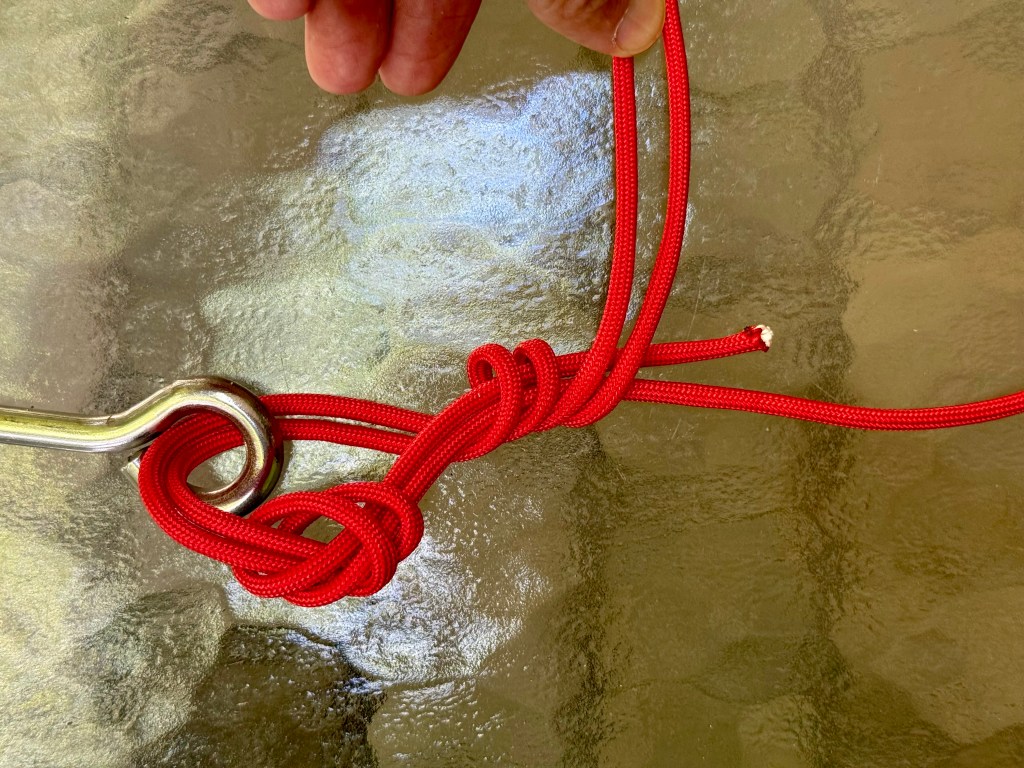
Loop pulled through the overhand knot.
(6) Slip the loop end (or 2 cut ends) back up through the overhand knot.
Knot pulled tight.
(7) Pull the knot tight, being sure to tug all involved strands.
Finished knot.
(8) Cut the 3 tags short.
The knot typically consumes 6 inches of my tippet or leader. To conserve the original leader, you can tie the same knot with a second piece of line instead of folding over the tippet on itself. Here’s an example where yellow parachute cord is the 2nd piece of line:
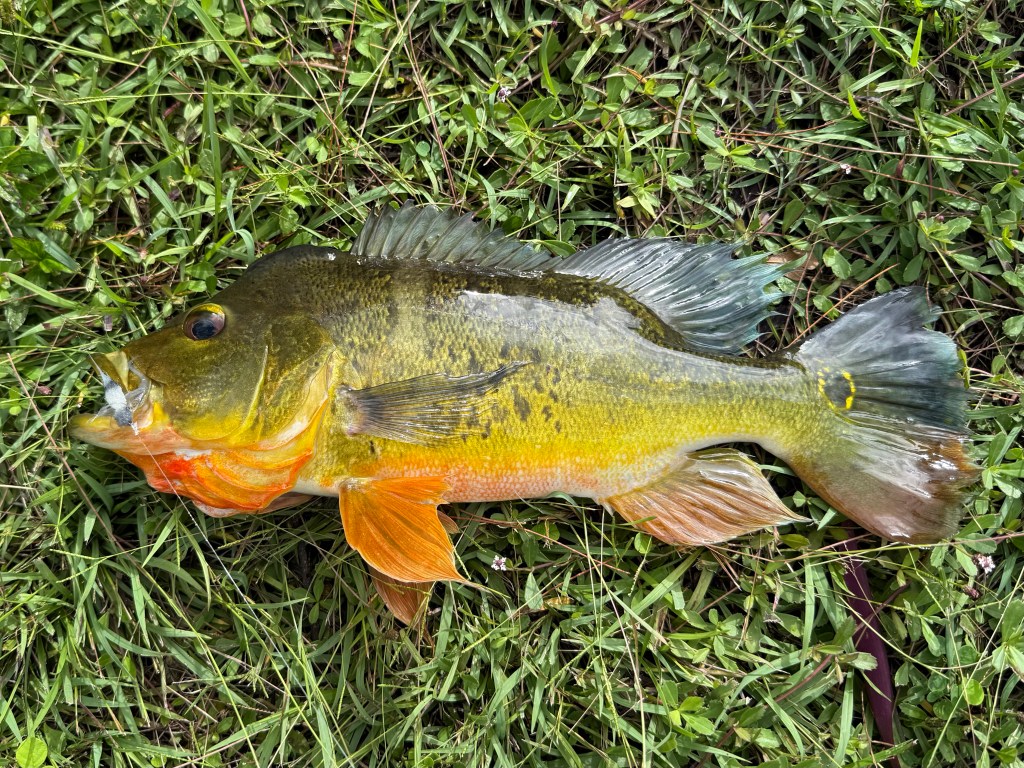
Here it is holding an 18” peacock bass on 1X tippet. Let me know how it works for you: pkstoddard@gmail.com
Today I am volunteering as a poll-watcher in the City of Miami elections. Early voting is in progress.
I’m stationed at a polling site in a community center in the north end of Miami on the edge of the area known as Little Haiti. The conversation among the elections staff alternates sentence-by-sentence between English and Haitian Creole, both with the same Caribbean cadence and accent.
The Elections Clerk at this polling site is delightful, a nutritionist by trade and a proud alumna of FIU. She shares with me her recipe for the sauce she applies to snappers before she fries them.
This morning, the large TV in the hall of the community center is playing Fox News, highly political and inappropriate for a polling site.
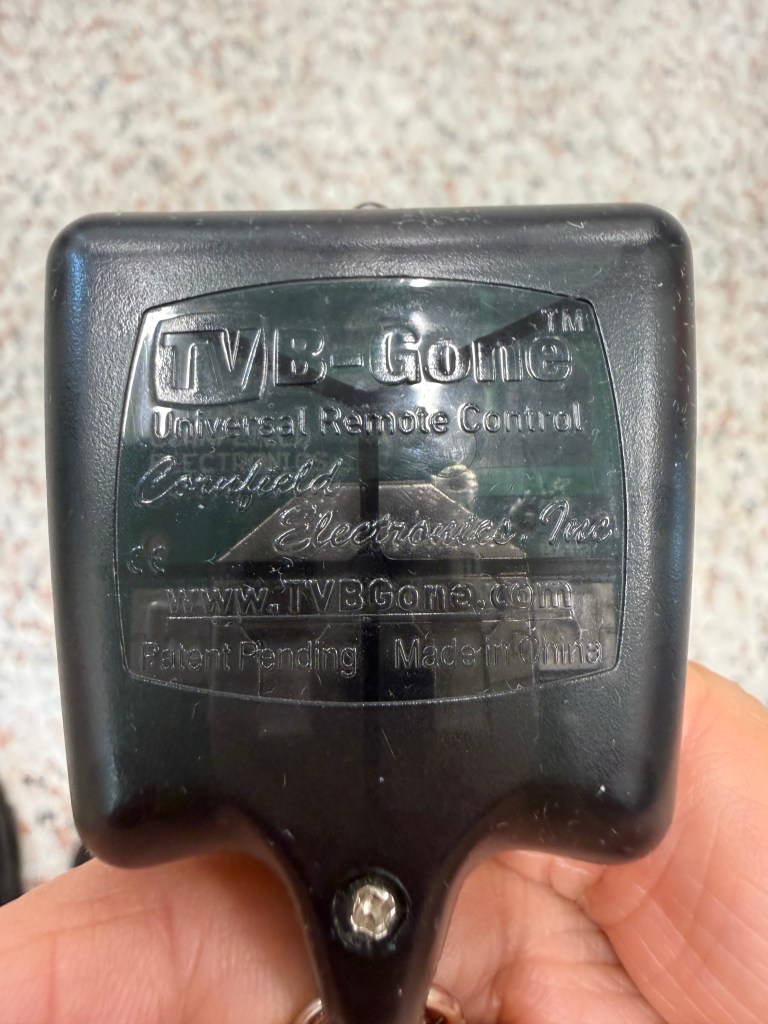
The young elections worker sitting nearby would prefer to see the football game, however the TV controls are in a locked-off area so the Clerk cannot change the channel or even turn off the TV. While she ponders the problem, I trot to my car and return with my TV-B-Gone, an electronic device the size of a matchbook that turns off any television.
The TV-B-Gone contains a microchip that cycles through all the TV “off” codes. Aim its infrared LED at a TV, press the button, and wait… it never fails. The IR beam will also bounce off reflective surfaces and light-colored walls, so you can use it surreptitiously.
One click, a brief pause, and the offending TV goes dark.
Are you wondering why Phil carries a TV-B-Gone in the glove compartment of his car?
I deploy the device in restaurants where TVs are interfering with the table conversation, or, on rare occasion when the devil gets into me, to create havoc in a sports bar. Never during a FIFA soccer match, though. The Argentinian fans are so spirited they might break something… or someone.
The Elections Clerk wants to buy her own TV-B-Gone ($15 on eBay) and maybe a cell phone jammer as well to use on her husband’s phone.
My new dad, Ted Stoddard, was a Naval Intelligence Reserve officer. At the age of 4, I knew the Navy had ships, that ships had lots of ropes, and ropes had to be secured with just the right knots. Since Ted’s work was classified, I determined that he had to know the US Navy’s trove of secret navy knots. Under questioning, he admitted this was true. I set out to learn as many of these knots as I could, but of course they were secret so he couldn’t reveal them.
My favorite bathtub toy was a 3 foot length of India rubber tubing. I’d sit in the tub at bath time and tie a complex knot in the rubber tube then ask: “Is THIS one of the Secret Navy Knots?”
Lt. Commander Stoddard would gravely inspect the knot and answer “No, not that one.” After inspecting half-dozen of my intricate tangles he’d bend down closer to the splash zone and whisper, “Yes, that’s one.”
That was in the 1961, around the time of the Cuban Missile Crisis. Most of the Secret Navy Knots have been declassified since then, but I suspect a few remain secret. I can’t know for sure.
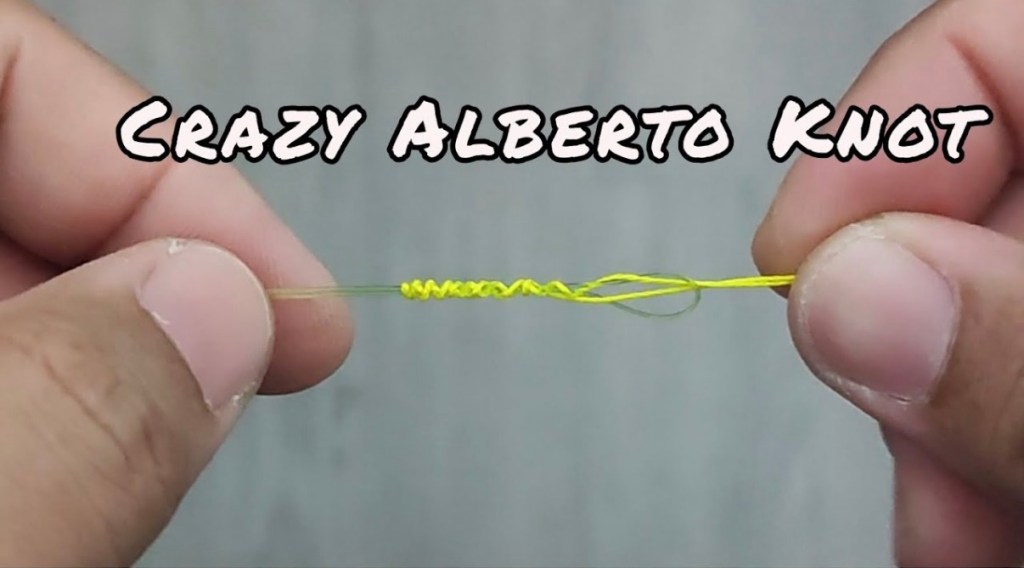
Some knots are named for their inventors. My favorite named knot is the Crazy Alberto knot, invented by Alberto Knie, who is intense, high-spirited, and very funny, but not crazy. Alberto is an unusually astute observer of wild fish, a great fisherman, and a lovely guy. His knot is terrific.
I’m a fan of Alberto and I use his knot to attach the bite tippet in every leader I tie for snook or juvenile tarpon. As of my writing, Alberto is recovering from a massive heart attack – if you are also a fan, you can help him out at https://gofund.me/4b854b908
I’m not in Alberto’s league as a fisherman, but I’m good with knots and I’ve long aspired to have a knot named after me. Of course, I’d have to invent a knot so good that a lot of people would use it, and the knot would have to be so unique that a graphic name like “figure-8 knot” wouldn’t capture it.
I do have a candidate.
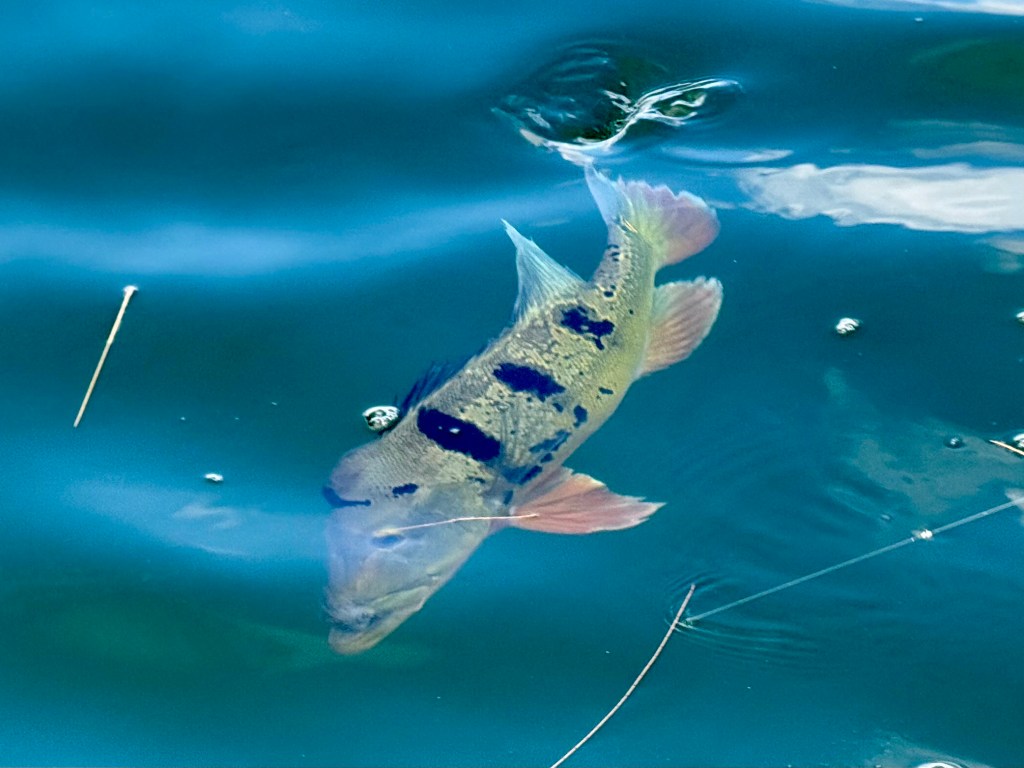
On days I want to fly fish but I don’t feel like messing with boats in heavy winds and/or heavy rain, I often grab my 5-weight fly rod and head over to a local lake to fish for Butterfly Peacock Bass (“peas” for short). There, if the sky opens up on me, it’s a short dash to the car and not too far home to change into dry clothes.
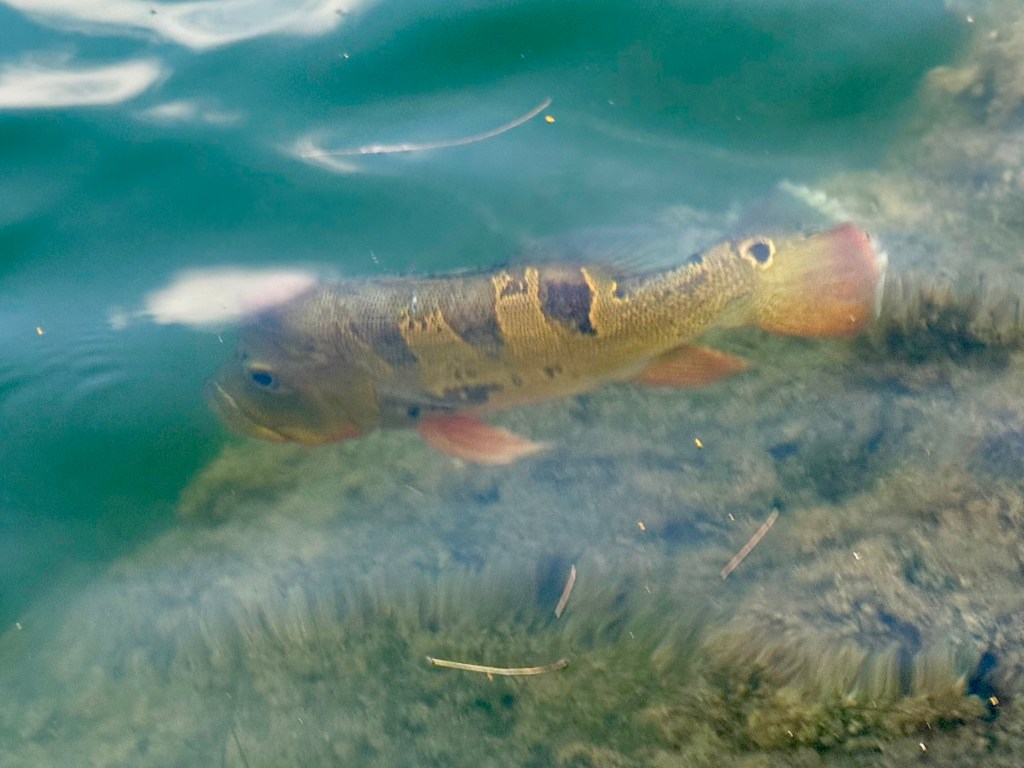
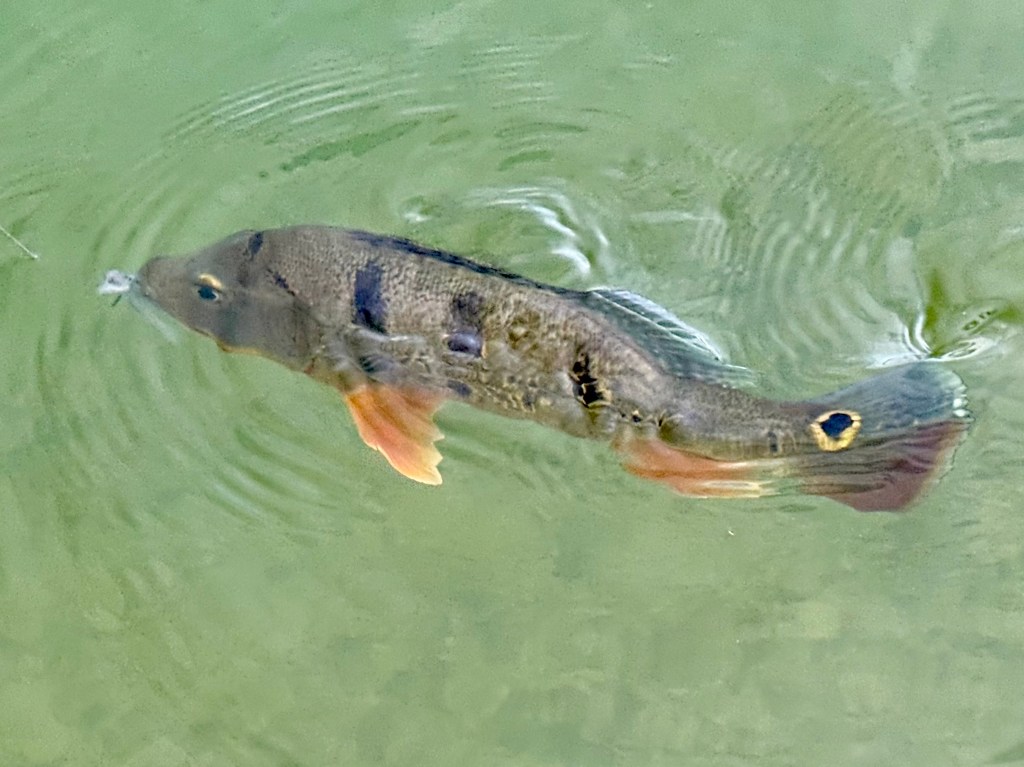
Peas aren’t the hardest-pulling fish I catch, but they’re gorgeous and they fight plenty hard, leaping into the air or diving and delivering a series of sharp body snaps. Here’s a big male in action:
If the line has enough tension, the pea’s body snap can break the monofilament tippet that joins the leader to the fly. The tippet breaks at the weakest point, usually the loop knot that connects the tippet to my streamer fly. The pea’s other trick is to head for the nearest submerged branch tangle where it will break off for sure. It takes a lot of line tension to keep a big pea out of the branch tangles, to which it responds with – yes – sharp body snaps, breaking the line at the loop knot.
The obvious solution is to use sufficiently heavy tippet to resist breaking, but the peas in this lake have become educated and won’t eat a fly if they can spot the tell-tale tippet. When I upsize to thicker, stronger tippets, the peas stop eating my flies. When I downsize to thinner, less visible tippets, I get bites once again but the peas break off at the loop knot. This trade-off has only arisen recently, a byproduct of the fish education that arises from my catch-and-release fly fishing. The peas have learned to watch for my tippets and I’m stuck.
Earlier this week I hooked a not-so-big pea on my special mosquitofish fly, and the pea broke off at the loop knot once again. Dang! I can’t go up in tippet diameter and I’m tying the strongest known loop knot, the Kreh Loop, invented by Lefty Kreh. The Kreh Loop is slightly stronger than another great loop knot, the Duncan Loop, invented by Norman Duncan. I need an even stronger knot.
I sat on the bank for a few minutes and pondered until I hatched an idea for a new loop knot, a cross between the Palomar knot and the Kreh Loop. If I was lucky, this new loop knot would combine the best traits of both, the enhanced strength of the Palomar and the non-slip property of the Kreh Loop.
I tied on my fly with a prototype of the new loop knot. Here’s it is, photographed against my shorts:
In a few minutes I’d hooked a scrappy, medium-sized peacock bass and the knot held despite the pea’s snapping tugs.
The next fish was a much larger pea that put up a long and vigorous fight, and again the knot held.
Lucky coincidence? As a scientist I can tell you that empirical testing can never rule out coincidence entirely, but with enough tests one can reduce the likelihood of coincidence to a very tiny number. One percent is the standard comfort level for most scientists.
METHODS
First thing when testing knots is to test the line to make sure it performs as expected. I tie one end of the line to a digital archery bow scale with peak hold function ($18 on Amazon). Obviously securing the line to the scale requires a knot, so I use a Bimini Twist, one of the rare “100% knots”, that retains 100% of the original line strength. The other end of the line I keep on the spool. I put on gloves to protect my hands from being cut when the line breaks (learned my lesson there), grip the spool and scale in my two hands and pull slowly and steadily until the line breaks. This is a static line test. Admittedly, the fish breaks the line with faster dynamic loading, conditions under which even the Bimini Twist is no longer a 100% knot, but for now a static load test will do.
My original tippet that was breaking at the knot, Rio Powerflex 1X, is rated at 13 pounds, but my spool was breaking around 10 pounds. Oops. That’s an issue right there and explains part of my break-off problem. Next I tried Rio’s 16 pound fluorocarbon tippet material but it also broke well below its rated strength. Hmm. Does Rio have production problems? If single strand line stays too hot during production it can lose strength.
Next I tried Yo-Zuri Hybrid 12# line, a nylon-fluorocarbon mix. I have discarded spools of Yo-Zuri Hybrid that tested far below their rated strength, but other spools have tested fine. My open 12 pound spool breaks at 14.0 pounds (standard deviation 2.8 pounds), so that’s what I used for my knot testing session.
I tied and broke a dozen Kreh Loop Knots, my standard knot for streamer flies. These I alternated with a dozen of my new loop knots. Why a dozen? With the variance in the strength of this line spool (mean=14, SD=2.8) a sample size of 12 per group gives me a decent chance of finding an effect if an effect exists (i.e., good statistical power). I could do the mathematical power analysis, but I’ve run similar statistical tests for 46 years, long enough to ballpark it.
After each break, I pulled a foot of line off the spool and discarded it to get all fresh line for the next test.
RESULTS
All 12 of the Kreh Loops broke at the knot, and all 12 of my new loop knots broke in the middle of the line.
The odds of getting a result this extreme by chance alone is the same as flipping a fair coin 24 times and calling it correctly in the air all 24 times: one in 16,777,216. A little better than one in 100? My best run of coin flips ever was 11 in a row, the odds of which are one-in-2048. I won’t waste my time trying for a run of 24 unless I achieve a life sentence in a prison with a coin but no library.
Since the new loop knot never broke, I can’t know how strong it actually is. However, the Kreh loop knots broke, on average, at 79% of the line strength with a standard deviation of 2.2 pounds. A two-sample T-test comparing the peak breaking tensions of the two knot types showed that the new loop knot is statistically stronger. The P-value of this statistical test is 0.005, meaning that a pattern this extreme or more extreme would occur by chance in only 5 of 1000 similar knot break-off contests using 12 knots of each type. That’s 1-in-200 odds, twice as good as my 1% criterion.
[31-Oct-2025, Addition since original post: Andy Mill on his recent Mill House podcast stated that the Improved Homer Rhode Loop Knot retains 100% of the line strength. Competitive tarpon fishers swear by this knot. I tied and tested 14 of them, and found the Improved Homer Rhode Loop broke, on average, at 64% of the line strength compared to 79% for the Kreh Loop, and 100% for the my new knot. The standard deviation was 2.1, similar to the Kreh Loop. The Improved Homer Rhode is significantly weaker than either the Kreh Loop or my new knot. Woof woof, it’s a dog.]
DISCUSSION
The two statistical tests are good enough for me to have faith that the difference is real. The fact that in tests of my new knot the line always broke in the middle and never at the knot, means this new loop knot is at least as strong as the line itself, making it the first 100% line-to-hook loop knot. That’s a knot worthy of a name.
Hey, this is exciting!
Oops. Can’t say that. Successful scientists might pop the cork on a bottle of good Champagne to celebrate a major discovery, but it’s considered unprofessional to fully convey our excitement in print. Even Watson & Crick, in their original publication about the structure of DNA forced themselves to remain understated when explaining how a double helix structure could facilitate DNA replication: “It has not escaped our notice….”
This study also helps explain my break-off problem. My original 13 pound-rated tippet was functioning at 10 pounds, and the Kreh Loop was reducing that strength by 21% to ~8 pounds. The standard deviation was 2.2 pounds which means that in over a third of my knots the functional strength is reduced to under 6 pounds static load, and maybe half that under dynamic loading. The peacock bass are having a much lighter task breaking that tippet than the nominal 13 pound strength I might have thought I had going for me. I will switch to the Yo-Zuri Hybrid 12 pound spool for now, and use my new loop knot to tie on the streamer flies.
This new loop knot might be a Secret Navy Knot. If it is, the US Navy’s PR office certainly won’t tell me. After illegally blowing up several boatloads of Venezuelans, some of whom now appear to be fishermen, the US Navy will be too anxious about media shit storms to field a loony call from an American fisherman inquiring about “secret knots”. I might do better calling the Office of Naval Research.
My father Ted will turn 99 next month, having retired long ago at the rank of Captain. I will ask him about this knot for sure.
I’d call the National Institute of Standards and Technology (NIST) to find out if my knot is in their collection of Standard Knots, but they’re closed during the government shutdown, stemming from a dispute as to whether Americans, such as my brother’s family, should be able to afford health insurance, versus rich people getting a big tax break. My wife and I are on Medicare now, but we think all families should have access to affordable health care. We support the goals of those in Congress holding out to restore affordable health care to middle and low income Americans, and to keep community hospitals from closing.
* * *
Returning to the prosaic, I have simplified the new loop knot slightly, to make it easier to tie while retaining its strength. I will explain how to tie this knot in another post, but first it needs a name.
My last few fishing trips onto the flats have been unproductive. The late summer water has been hot and low in oxygen. Maybe the fish are somewhere else, or maybe they’re just laying low. Tomorrow morning I’m venturing back into the mangrove lakes of Mosquito Hell, an area where I always find fish this time of year, assuming the Black Salt Marsh Mosquitoes (BSSMs) don’t drive me out first.
Trip planning
The moon is near full tonight, so the morning fishing activity is likely to be brief. I plan to arrive in the dark to maybe find a snook or two before the sun comes up. Then I’ll peddle-paddle my kayak to an area where the tarpon hang out and snook spend their day hiding in the mangroves. Occasionally, a snook wakes up for a mid-morning snack. If I find the juvenile tarpon rolling, I can see if they’ll play with me. Like snook, tarpon feed actively at night on a full moon, so they may be sated by the time I arrive.
I’m preparing for the BSSMs the night before, putting into play a few improvements over my last trip to Mosquito Hell:
I take my khaki fishing pants, outer shirt, and gloves to the driveway, spray them with DEET, and place them inside a 2-gallon zip-loc bag. I lay out a towel to protect the car seat from the DEET. The rest of my special mosquito gear I place on the passenger seat: for my head, a Tilley hat and insect head net; for my feet, Simm’s neoprene wading gaiters and neoprene dive booties. Mosquitoes are not going to bite through 5 mm of neoprene.
My scheme is to drive to the launch in the dark, and change into my stinky DEET-soaked clothes, then get out of the car to rig and launch my kayak. I will start fishing at 06:00, before the first dawn light. The nearly full moon sets at 05:49 and the sun rises at 07:06, with civil twilight starting at 06:36.
It’s tricky fishing in total darkness, and tricker fly fishing. I only know that a snook is nearby if I hear it blow up the water while chasing mullet. Sometimes the water is silent. Other times I cast too far and hang the fly into a mangrove tree. Then I have to turn on my head lamp to untangle the line and of course the light attracts mosquitoes to my head. But other times I cast the fly near a snook and things get exciting in a much better way. Hope springs eternal.
My alarm is set for 3:50 am. Time for bed.
Fishing report
On the Mosquito Horror Scale (0-10) the morning ranks an 8, “Severe” but not “Extreme”. My mosquito gear system works perfectly. The only mosquitoes that try to bite me are 3 or 4 that go for the pads of my fingers where I have no repellant. That’s not a safe place for a mosquito to bite a human, and they are instantly dispatched with a pat of the finger. With my DEET-soaked outer clothes, mosquitoes don’t even follow me into the car.
No mullet are splashing around the kayak launch area in the dark, so no predatory fish are there either. Too bad – sometimes the fishing is amazing right there. I light out for the far mangrove shore, about a mile’s paddle.
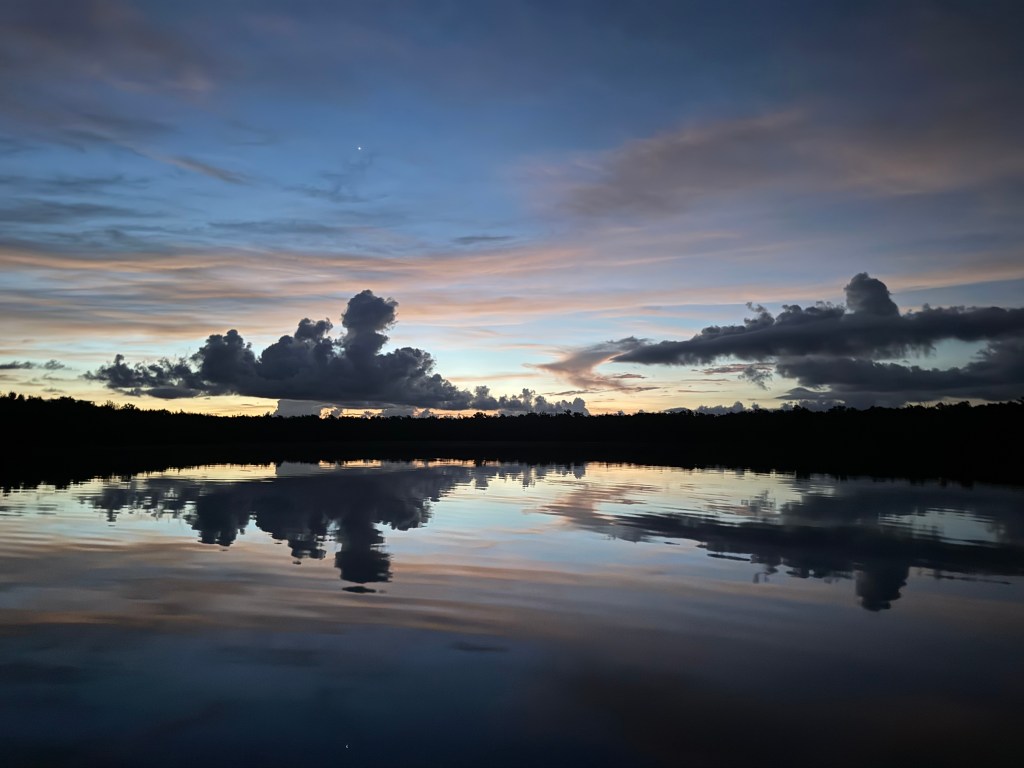
The first traces of dawn light appear, with Venus still visible directly above the tallest thunderhead on the left.
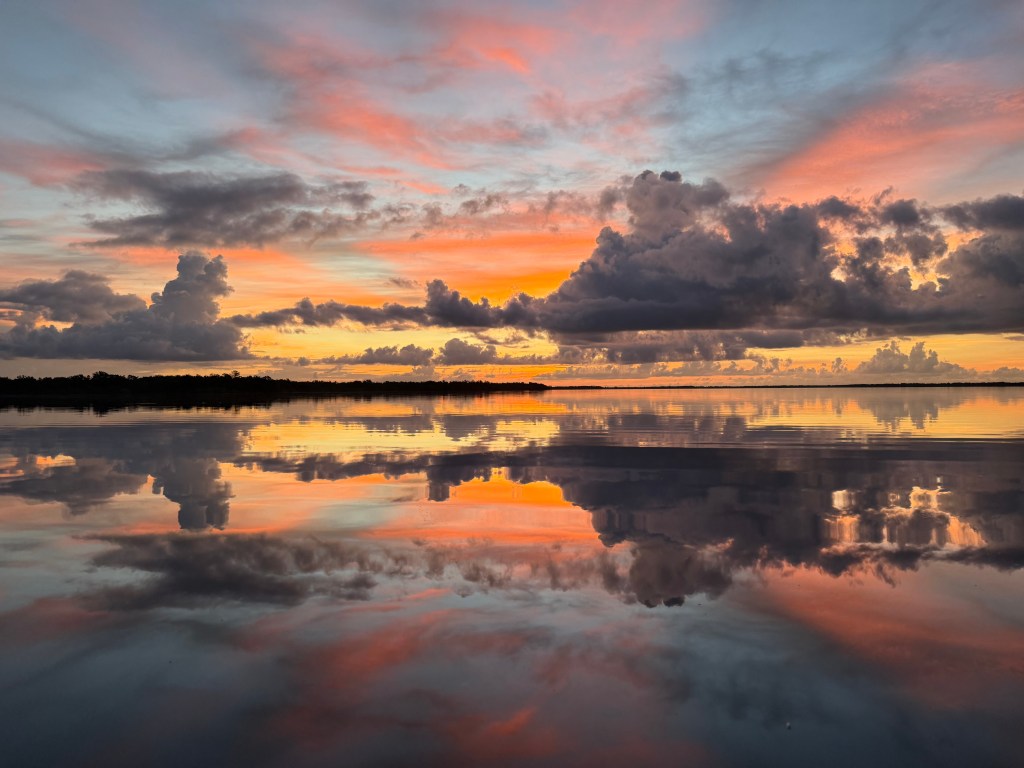
Dawn explodes enroute. Yowza.
I reach the other side eight minutes after sunrise. The water is extremely murky and tannic, like donut shop coffee with a tiny splash of horrid non-dairy creamer. I dip my finger in the water and taste it through the head net: slightly brackish.
To find fish in water this opaque I need a “search bait” that’s dark, for maximum contrast when viewed from below against the sky, but with some sparkle and a lot of vibration to get a fish’s attention. I put away the fly rod and rig my spinning rod with a 4” paddletail in rootbeer & gold with a gold underspin jig – just the ticket.
The paddletail, true to its name, wiggles its tail back and forth, and the underspin leaf twirls up a storm.
At 7:15, my second cast is slammed by a snook in the 30″ range. It makes one jump, a brief lateral run pulling line off the reel, then runs straight for me as fast as I can take up line. It passing directly under the middle of the kayak, bending the rod hard. The tip section of my three-piece TFO travel rod snaps, creating a brief moment of slack that pops the lure free of the fish’s mouth.
This is the 4th time this spinning rod has broken, every time in exactly the same spot, 5″ above the ferule. Until now, I’ve blamed myself, but thinking on it, each break occurred under a different circumstance and stress geometry and I’ve never broken any other spinning rod. I’d wager the TFO Traveler is weak at the internal edge of a carbon fiber sheet wrap. I will write the company about this problem. I bought two replacement tip sections the last time one broke, so I still have one left, but I need a more reliable multi-piece spinning rod.
Why even bring a travel rod on a local fishing trip? When kayak fishing tight to the mangroves, it helps to have the rods I am not using at the moment disassembled and stowed safely out of the way. That’s a key advantage of multi-piece rods, not to mention the obvious advantage when I travel.
Back to fishing. Having broken the spinning rod, it’s “fly or die”. I re-assemble the 8wt fly rod and choose a black dark-water fly, this one tied from Drew Chicone’s pattern, The Devil’s Daughter. The tail is ostrich and peacock herl, the body is fluffy marabou feathers, and the head is spun deer hair. Peacock herl gives It shimmer and the ostrich and marabou make it swish enticingly in the water.
I start with the fly in the photo and immediately hang it in a mangrove. Impatiently, I shove my kayak into the mangroves to untangle the fly, leader, and line, then tie on another I’d made with a weed guard to keep it from hanging in trees and roots.
Predatory fish that have spent the night foraging under a bright moon generally won’t be hungry again until the afternoon. This morning fits that typical pattern, with fish ending their feeding spree shortly after sunrise, shortly as in 9 minutes. In the next hour, I get rained on briefly (feels good) and catch a couple of small juvenile tarpon on fly (they’re always hungry), while their older cousins roll on the surface for air but won’t eat.
Fishing is over until afternoon but the shoreline holds birds, orchids, and bromeliads. I can see for miles, the mosquitoes have let up, the rain shower has cooled things off, and I have yet to spot another human. It’s has turned into a pretty fine Sunday in the Everglades wilderness, but it’s time to get out. Bigger storm clouds are assembling and I don’t want to be crossing open water in an electric storm.
On the way home I stop by Moreno’s Tortilla shop in Florida City to pick up hot tamales and a pack of corn tortillas. Josephine greets me and knows what I want without my asking. This little hole-in-the-wall makes the best Mexican tamales and you can’t buy all-corn tortillas this good in a supermarket.
On the drive back, I divert 10 miles to check out a canal that friend Jay and I had identified from a YouTube video. In the video, a young kayak fisher from out of town was catching lots of fish while getting bitten on the eyelids and lips by something he called “yellow flies”. As soon as I step out of the car I am engulfed by a swarm of hungry deer flies. Uh oh.
I consider deer flies even worse than mosquitoes because they are active midday when it’s too hot for protective bug clothes, they will find the the tiniest spot of skin on which you did not apply repellant (e.g. lips and eyelids), and their bites really hurt.
Climbing over two metal gates, swat swat swat, I find the kayak put-in, swat swat. From the vague track through the vegetation, swat swat swat, I can tell it’s rarely used. I wonder why not, swat swat.
I mash the deer flies that followed me into the car and photograph one that wasn’t too mangled.
Serious rain slows the drive home but returns a few minutes by washing salt from the kayak and car.
Unpacking my fishing gear, two stow-away mosquitos escape into the house. It’s still summer here in South Florida where if it’s not one nasty biting bug it’s another. I’ll bet the Wisconsin Driftless Area is getting really nice about now.
When I took up fishing again after a 50 year hiatus, my wife Gray was bewildered: “Phil, you’ve spent your whole career being nice to fish. Why do you suddenly want to be mean to them?”
I could say I went fishing for the spectacular sunrises and experience of nature, but Gray would quickly note that I could get up at 3:30 am to be on Florida Bay for the sunrise, spend the morning watching shorebirds, manatees, dolphins, rays, and sharks, and come home to enjoy lunch and a nap, all while leaving the fish in peace.
So hers is a fair question. I studied electric fish and mosquitofish for 35 years at Cornell and FIU. I had a massive fish-rearing facility on the roof of my building where our fish bred because we made them so happy. An undercover plant from PETA worked as a technician in my lab for a few months then left because he couldn’t find any evidence that we were inhumane in our treatment of fish. I definitely don’t want to be mean to fish.
So, yes, my love of fishing embodies a patent contradiction in my values. I truly love all the wild things and trying to catch fish. I especially enjoy chasing fish with a fly rod, widely recognized as the least efficient way to actually catch a fish.
With that bed of nettles as our background, let’s relocate temporarily to the site of the sunrise photo, a seagrass flat in Florida Bay, two miles south of the Flamingo Marina in Everglades National Park. In a future essay, I’ll tell you all the reasons you should NOT fish there, but this day I will share some of its magic.
Here’s the flat surrounding a mangrove key a few minutes after sunrise. This light always enchants me. Look for a moment and you’ll see the water is pink dimpled with dark blue, far prettier to my eye than Christo’s famous pink island wrapping.
The water surface reflects the sky at low sun angles so my iPhone camera can’t see into the water to document for you how the fish are going about their morning activities. That would require a circular polarizer on my iPhone (wait, look it up… PolarPro makes a good one). But I’m up on the poling platform of my skiff this morning wearing polarized sunglasses. You’ll have to trust me when I tell you what fish I’m seeing and what they are doing.
Mullet are flipping and splooshing in the shallows, while egrets line up to try for the small ones. From the key comes the hollow whinny of a Bald Eagle, the raucous clatter of a Mangrove Clapper Rail, and the sweet song of a Yellow Warbler. Against the key lies a deeper channel where I spot a nice redfish but I won’t try for it. A five foot lemon shark cruises the channel, not far behind. Hooking a snook or redfish in any channel at Flamingo is tantamount to feeding a shark. I do not feed sharks or alligators, for similar reasons.
Two juvenile Goliath Groupers, about 18” long, are out in the open on the flat. Young Goliaths normally spend their days holed up in the mangroves, roving the flat at night. But here they are in the light of day.I watch to see what these young groupers will do when they’re caught out in their pj’s with a flats skiff poling towards them. When I get closer, they panic and swim to the nearest clump of red mangroves, sticking their heads in the roots and leaving their mottled brown and black bodies sticking out in the open. With their heads concealed, they can’t see me, so I guess I’m not supposed to see them either, but they look thoroughly silly.
Two young redfish with light gold bodies and blue tails are cruising the shoreline. I pitch a sparkly spoon fly in front of them, then retrieve it. One redfish starts to follow the fly, then changes its mind and wanders back to cruise with its friend. A different fly might have worked better, but which one? Unlike a rising trout that feeds for a while in one spot while the flyfisher tries one fly after another, a flats fish on the move rarely affords a second chance.
The edge of the flat becomes a reverse shower of small jacks taking to the air. Underneath the water, I presume, a school of large jacks roars through the water in hot pursuit. In fifteen seconds, the water is still once again. It’s a fish-eat-fish world on the flats.
I round the corner of the key and the glassy water surface erupts and goes still in alternation. Silver tails appear briefly and disappear. A school of juvenile tarpon is actively feeding on baitfish.
The prey this morning is a school of anxious young mangrove snappers that’s holding in one area. To my happy surprise, the tarpon are cruising back and forth to take multiple shots at the bait school and affording me a parallel opportunity with my fly rod.
I throw a black tarpon fly in front of the advancing tarpon with no success. The same fly worked last week in murky water four miles to the east, but the water here today is clear. Oh, right. Light-colored flies work better in clear water than dark patterns because fish (including baitfish) in clear water change to lighter, more reflective body colors for better camouflage. I knew that. The tarpon will be coming back soon for another pass at the snappers, so I remove the black fly and select a big gray & white snook fly that I tied but never put in front of a fish. If I stretch my imagination, this fly could resemble a young mangrove snapper. It looks very fishy in the water and it’s not black.
I attach this snook fly to the heavy tarpon-proof bite tippet on my leader, and cast it in front of the tarpon school. To complete the illusion of a small fish finding itself in the wrong place at the wrong time, I make the fly attempt an escape. It works. One of the larger tarpon breaks from the school and grabs the hapless fly. I set the hook, but the tarpon doesn’t seem to care. The lining of a tarpon’s mouth is as tough as Kevlar – I’ve seen a tarpon consume a whole blue crab without chewing. But, feeling the line resistance, the tarpon forcibly yanks some fly line from my left hand and swims back into formation in the school. I restore tension on the line, putting a good arc into the 7-weight fly rod. The tarpon resists for a moment, then jumps clear of the water, snapping its body back and forth in the air and creating the slack needed to neatly toss my fly.
You normally drop the rod tip when a tarpon jumps, precisely to keep it from creating that line slack, but I kept light tension on specifically to help the tarpon escape. More on that in a moment.
Free of the leader’s encumbrance, the young tarpon, roughly 10 pounds’ worth, once again resumes its position in the school as the members continue their search for yummy little mangrove snappers.
* * *
Even though a fish’s face doesn’t change with mood, I swear this tarpon glared with an annoyed expression in its whole body. Perhaps it was in the way it shouldered loose some free line and went back to what it was doing before. It was never so clear that my hard earned fly-fishing skills, such as they are, do indeed annoy the fish.
When a woman sends me a message like this, it stings. Same with a fish it turns out. I didn’t spend 35 years studying fish behavior to no effect.
Increasingly, I compromise, seeking a bite on the fly then a self-release at a distance.
When a fish takes a fly that I tied myself, I delight at having completed the illusion. My heart skips a beat at the sudden appearance of weight and power on the other end of the fly line gripped in my left hand. If I’m lucky, the fish makes a fast initial run, and maybe, if it’s the right species, it makes a couple of spectacular jumps. If it’s a new species for me, I want to see it up close and take a photo to remember it better. But for familiar species I do what I can to help the fish pitch the fly and get on with its fish life, ideally without my having to net and unhook it.
We’ll see how that deal sits with me. And, I suppose, with the fish.
As a rule, backcountry alligators avoid people, while those dwelling in human-infested waters learn that associating with humans can provide an easy meal.
Feeding alligators is a very bad idea, though alligators in this second group believe that feeding alligators is a very good idea. They hold that the highest calling of human newcomers to the swamps is to catch big fish and feed them to deserving alligators. These alligators can be bold, aggressive, and very dangerous. If you toss a rock at one to scare it off, it assumes you are throwing food and comes closer.
I fly fish tarpon in the tidal creeks and ponds along the Tamiami Trail, Florida Route 40 (“The Trail”), about 70 miles west of Miami.
Last year, two human-adapted alligators ran me out of a productive pair of ponds. The smaller gator, an 8-footer, even came out of the water and chased me overland in a bid to snatch the tarpon I’d caught and had intended to release unharmed. Sprinting from a gator with a 10 pound tarpon in your arms is an effective cardio workout. I always think back on that morning when people tell me “I want to take up fly fishing – it looks so relaxing”.
The ponds along the Trail do hold a lot of fish, but I cannot manage a big fish and fend off a bold alligator at the same time. I needed a way to convince the gators to leave me alone before I would fish there again. I needed a partner. A brave partner with experience in the ways of alligators.
I met Gabriel Ross through an online fishing club. In time I learned that Gabriel knows a lot about freshwater fishing in South Florida. He fishes the Trail regularly and has both a sunny disposition and a high tolerance for mosquitoes. Importantly, Gabriel is not unhinged by alligators, which he has fished around all his life. Just the fellow I’d wanted to meet.
On our first fishing trip together, I brought along two special items. The first was a new net with a long handle and silicone mesh, ideal for lifting big fish clear of the water quickly and gently. I don’t want to fall in the drink with a hungry and excited alligator moving in, and I don’t want to let a precious gamefish bounce around on the ground. Nothing annoys me like seeing video on YouTube featuring some proud, clueless asshole letting a tarpon flop around in the rocky dirt or on the pavement while he gropes around trying to unhook it. The second item was the 18’ carbon fiber push pole from my skiff, already proven useful for poking nosy sharks on the flats. Eighteen feet seemed like a good minimum distance to maintain between myself and a hungry alligator. I’d replaced the push pole’s sharp metal point with a flat-tipped cone 3D-printed of polyurethane, so a hard poke from the pointy end would not make a hole in the recipient.
Gabriel and I met up at dawn at the appointed pond on the Tamiami Trail. As Gabriel set up his minnow trap, an alligator began to move out of the mangroves. More and more of it. It was massive, 9’+, and it was coming towards us.
At 18 feet and closing I made my move. Holding the push pole aloft with a firm grip on the broad shoe end, I let the other end fall two feet through the air onto the alligator’s head with an audible clunk.
A gator this big is never challenged. He wheeled around and snapped at the push pole. I whipped the pole upwards in time to save it, and again dropped it on the alligator’s head – BONK!
The gator wasn’t scared, he was pissed. He turned to face me, opened his mouth, and hissed. My next two strikes were a couple of sharp, well-placed pokes in the nose. Inspection of an alligator’s skull shows the nose is bony, not soft like a shark’s. Still, you’d think it would make an impression to have an 18’ pole thrust directly onto the tip of one’s nose, reinforced or not.
I was preoccupied when the big gator was around, so here’s a photo of a smaller one later in the day.
The alligator went underwater, but did not flee. Two sharp nudges in the ribs finally convinced him he was not going to be left alone, much less fed a snook or a tarpon, and he reluctantly departed.
Cool as a cucumber, Gabriel never batted an eye throughout the commotion, quietly tending his minnow trap and bait bucket and re-rigging his spinning rod for bait-fishing. Only when he stood up did Gabriel mention that he carries a handgun to fire into the ground if a gator comes too close. Gators, he explained, are frightened off by the noise. Me too. Glad he told me before he had need to use it.
With the big guy gone, the pond’s usual resident gator, a 6-footer, came out of the mangroves and swam up to us.
“Feed me a fish?”
It only took three pokes to send her to a far corner of the pond, where she found something else to eat (num num num). She stayed far away from the two-legged maniac with the push pole and from Gabriel’s minnow trap. Minnow traps are a favorite snack food of alligators.
Oddly, the tarpon that are always common in the ponds north of the Trail were largely absent. I gave up pitching flies for missing tarpon, and got my first lesson in bait-fishing freshwater snook on the Trail.
Bait
The African Jewelfish (Hemichromis bimaculatus), also known as the Jewel Cichlid, is an invasive exotic from the pet trade. My former doctoral student, Vanessa Trujillo, studied Jewelfish in the Everglades. Vanessa found that African Jewelfish beat up the small native fish species during the spring drydown, which they can do because they’re tough and mean. Jewelfish outbreed native fish in rainy summer floods because they have biparental care that ensures better survival of their offspring.
African Jewelfish, photo Gabriel Arenciba, The Art of Microfishing
African Jewelfish are abundant in these ponds, so snook are already cued into looking for them. Because jewelfish are tough, they hold up well as bait until a snook eats them. Gabriel finds jewelfish easy to catch in a minnow trap baited with stale, week-old brioche. Bien sure.
Gabe recommended connecting the jewelfish’s lower lip to a 4/0 circle hook. Circle hooks have the point concealed inside the hook gap, so when a predator fish swallows the bait (bye-bye jewelfish), the hook does not lodge in the predator’s stomach, but slips free until it encounters the jaw, yielding a clean hookset. An additional trick I learned from Chico Fernandez’s book on bonefish is to press down the very tip of the hook barb rather than pressing the whole barb flat or leaving the barb intact. The goal is to leave the barb shaped as a bit of a hump; it hooks up more reliably this way and makes it possible to remove the hook without tearing anything.
Time to fish
Gabriel tossed his Jewelfish bait into the pond and quickly connected with a hefty snook. Gabe barely kept her out of the mangroves but finally got her in range of my spiffy new net.
Mrs. Snook measured out to 28.5”. She would be the biggest of the day. I took a quick photo then Gabe put her back in the water across the road so our alligator friends wouldn’t grab her before she regained full orientation and composure. It’s a short swim from there back to the pond.
Snook are protandrous, meaning they start life as males and change to become female, transitioning when they reach 25-27 inches or so. Every badass snook is a trans female.
I caught a couple of snooklets in the pond in quick succession before catching a Florida Soft-shelled Turtle. Ugh. Gabe caught a big Florida Gar. Lots of teeth and smelly slime – double ugh. The slime left in my net attracted fire ants. One got inside my shirt and stung me. I hate fire ants – triple ugh.
We could hear snook under the bridge making audible pops as it or they snatched small fish from near the surface. Gabriel lay on his stomach and pitched jewelfish into the slim gap under the bridge.
We caught several more snook that way.
In time the mosquitoes let up enough that we could take off the armor.
At 10 am, a wall of white appeared in the East. We had just enough time to dive into our cars before the rain squall hit. As is typical in the Everglades, the rain passed in half an hour, cooling the moist air and leaving enough cloud cover to darken the sky a bit. Perfect conditions for Black Salt Marsh Mosquitoes to come back out.
We fished a few more creeks along the Trail. I’d never caught a fish at my favorite kayak put-in spot, but it always looked promising. Turns out the bridge there was stacked with snook eager to nosh on jewelfish.
At another spot Gabriel knew about, I finally caught a sparkly young tarpon that took a jewelfish snack.
I also caught a blue crab. Everything eats jewelfish.
A second rain squall further improved conditions for mosquitoes.
We returned to our starting point. There, without warning, the water erupted in an explosion of snook. A mob of them had roared out from under the bridge all at once and raided a school of jewelfish or mollies – I couldn’t identify the prey in the mix of froth and silver.
I don’t think I’ve done justice to the summer mosquito experience in the tidal mangrove swamps lining the western end of Tamiami Trail. As challenging as the alligators are to fish around, the summer mosquitoes in the mangrove ponds and creeks are just as bad, but in their own way. Alligators are finite while mosquitoes are infinite.
Beyond sheer annoyance, the Black Salt Marsh Mosquito is a known carrier of Eastern Equine Encephalitis (EEE) and Venezuelan Equine Encephalitis (VEE). I lost a colleague to mosquito-borne encephalitis my first year at FIU. Because of the potential for contracting a lethal virus it’s best to minimize the number of bites one gets. Gabriel and I wore semi-breathable mosquito suits dosed with the repellant picaridin, a plant-derived product that doesn’t dissolve synthetic fabrics, fishing gear, or car seats. The bug suits work, but South Florida summers are hot enough as it is without adding a second layer to further restrict air circulation.
I’d like to wear a GoPro camera to capture some of the action, but a camera mounted on my hat doesn’t work under a bug net and a chest strap mount would create constriction points in my clothes for mosquitoes to bite though.
Am I trying to convince you to stay away from my fishing spots? Yes, but I’m not exaggerating about the contents of Pandora’s box you encounter on the Trail 9-10 months out of the year.
I enjoyed fishing with Gabriel because he’s good company and is supercool around alligators. He liked fishing with me because I could handle the mosquitoes. It’s too beautiful out there to spend your day with someone who complains about nature.
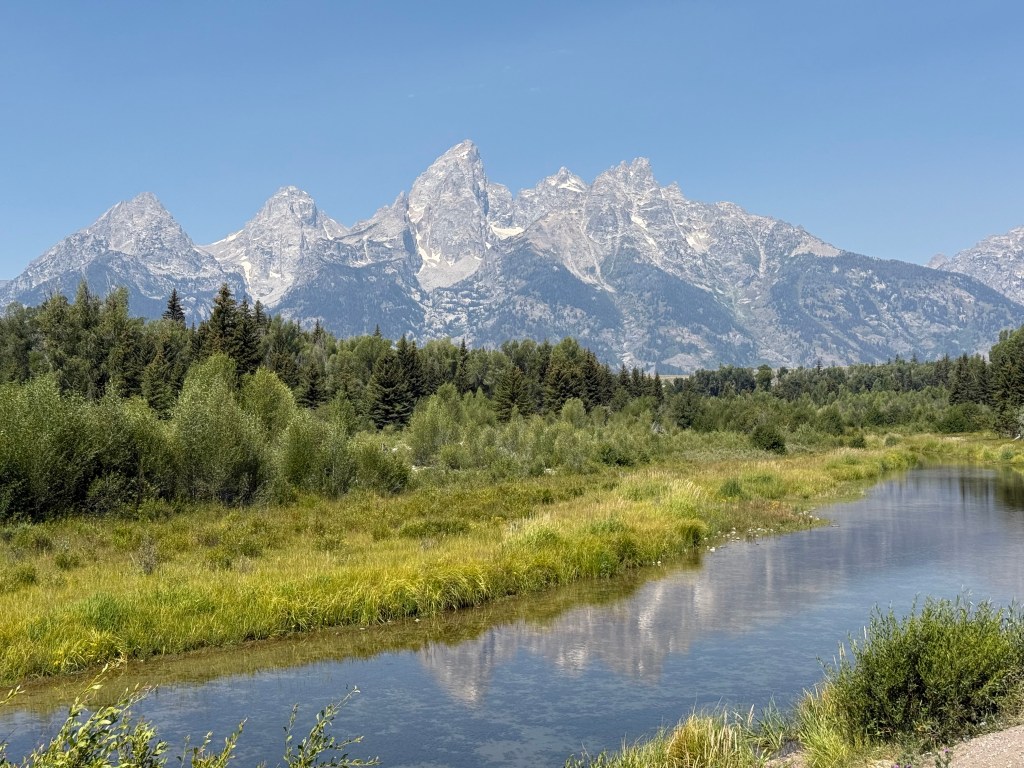
I last visited Grand Teton National Park in August of 1980. Since then, the Tetons have moved about four feet due to fault slippage, not so noticeable for a mountain range 43 miles long. Indeed, most things seem about the same, but one thing that has changed noticeably is the tenfold increase in number of fly fishers.
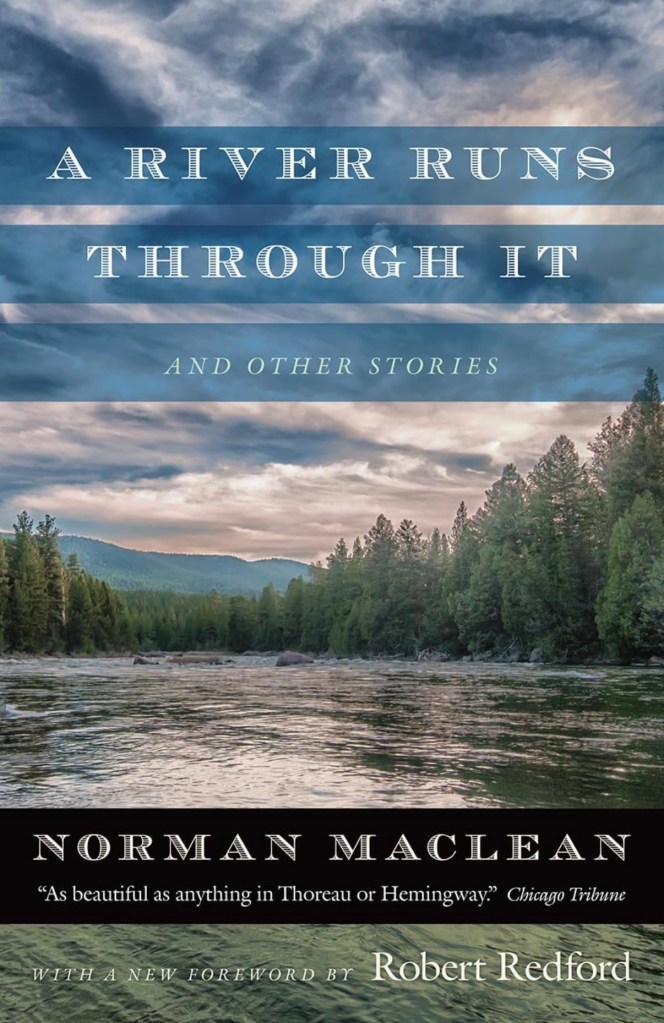
The exponential rise in the popularity of trout fishing is widely attributed to the movie made from Norman Maclean’s wonderful novel.
People tell me all the time “I LOVED that movie. It made me want to take up fly fishing. It looks so relaxing.” Relaxing? They missed how seriously the menfolk in that family took the challenging and technical craft of trout fishing on a big western river. The narrator recalled his father’s sermon:
“He told us about Christ’s disciples being fishermen, and we were left to assume, as my brother and I did, that all first-class fishermen on the Sea of Galilee were fly fishermen and that John, the favorite, was a dry-fly fisherman.”
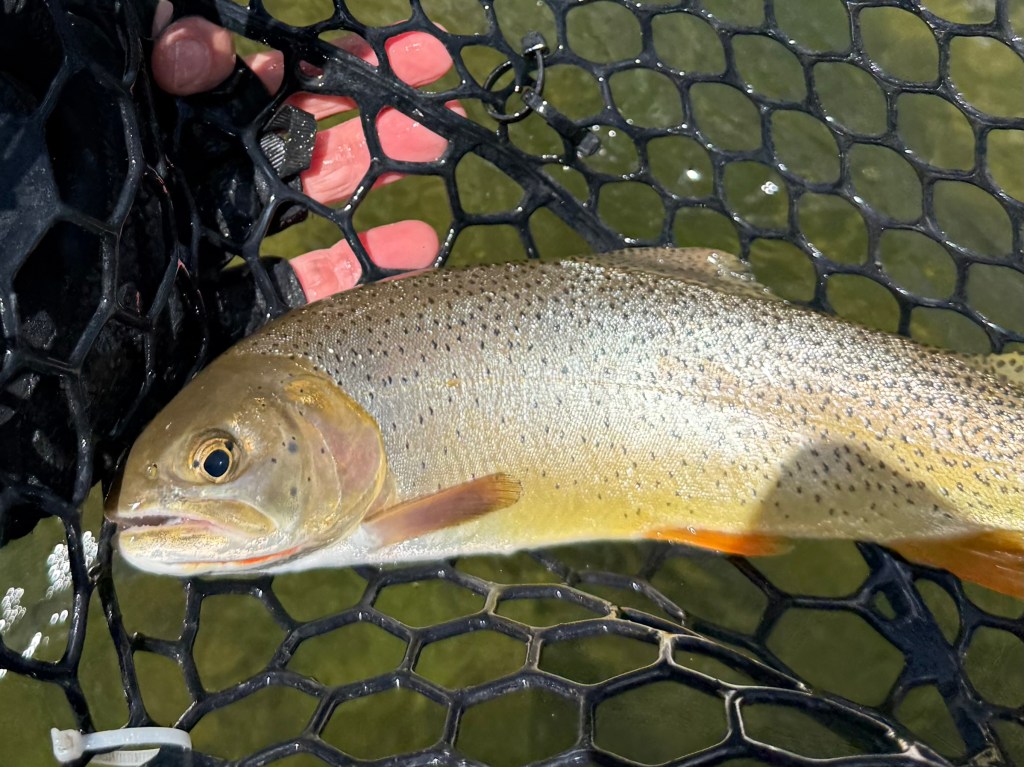
The Snake River is the region’s big trout fishing draw, and even has its own race of fine-speckled Cutthroat Trout. Snake River Cutthroats are gorgeous creatures, silver and gold with little black dots, orange fins, and the trademark orange lines under the chin for which they are named.
Dozens of guided drift boats ply the river each day, and as many people fish from shore. Small trout are gullible but the medium and large ones have learned the mantra “look twice, bite once”.
Our first day exploring Teton Park I spotted a distant, shallow creek below a splendid overlook. The Snake River was open for fishing, but creeks in the park were closed for one more day. Gray was painting, so I wandered down to the creek for a look. Descending through the dense brush I sang a little song: “Go away bears – go away moose”.
The creek was brimming with solid cutthroats, 12”-18” in length. Here they are:
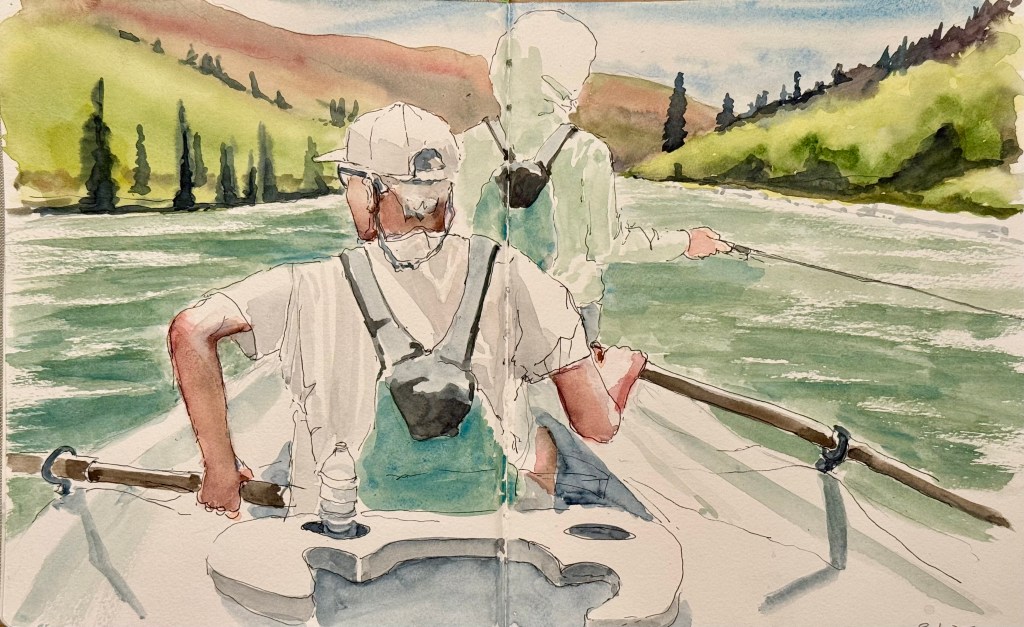
The next day we had our big splurge, a full-day float trip down the Snake in a drift boat manned by Larry Milton of Mangis Fishing Guides. In addition to a day of glorious scenery, an oared drift boat (shallow draft dory) provides a fly fisher access to many good trout holes inaccessible to those wading or fishing from shore. Even so, Larry, with his 30+ years of floating the Snake, kept saying “this hole SHOULD get you a bite”.
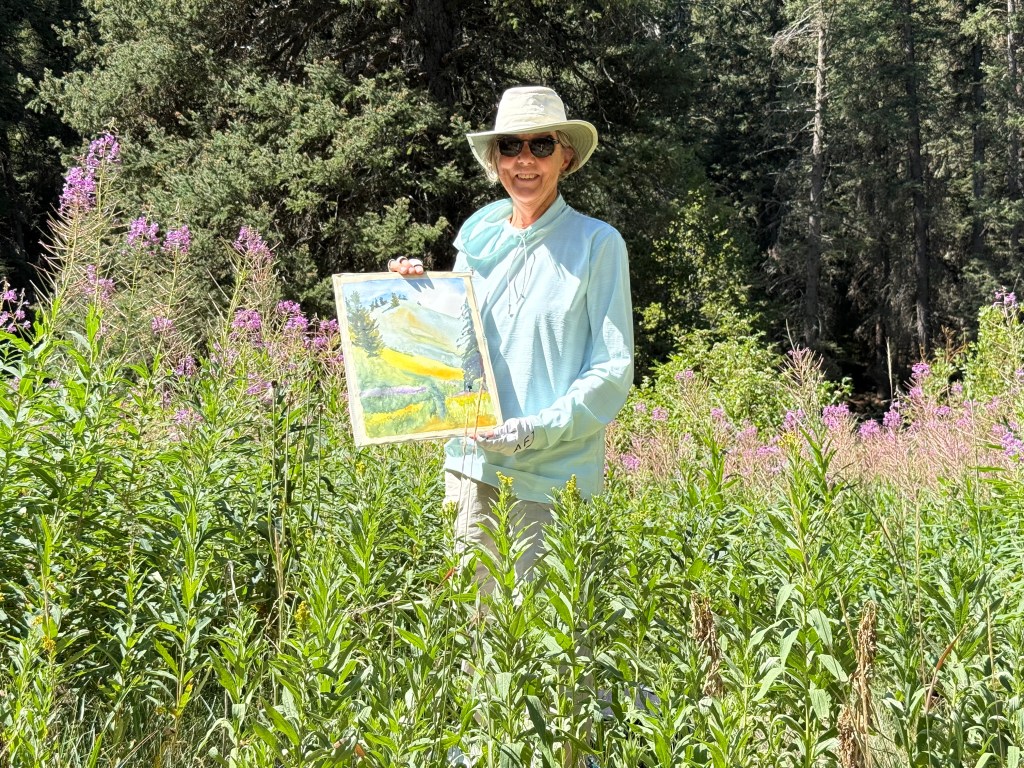
Watercolor by Gray Read
The “hatch” on the river that day was a random hoard of hapless spruce moths that either fell in the water or ventured close enough for a trout to leap up and grab one.
I started out the day casting a “hopper-dropper” rig, a floating grasshopper dry fly with a small sparkly nymph fly dangling below. Usually 90% of bites come on the nymph, but this day 90% of the bites came on the dry fly. I snipped off the nymph to get a better drift of the dry and did a little better.
Of ~20 cutthroat trout I caught and released, one was 16-17”, three were about 11”, and the rest were little pookers, 5-8”. Not a bad day.
The water was warming – better to get fish back in the river post haste than pose them for a pretty photo.
The evening of the next day, we returned to that first creek, me with my fly rod, Gray with her watercolor kit. A fellow watching for moose from the overlook told me he’d seen a dozen fishermen trudge up the hill from the creek below. I went exploring anyway, expecting the lovely trout from before would be gone or hiding. To my surprise, every trout from two evenings prior was holding in exactly the same spot as before, lazily rising to pick the odd caddisfly off the surface.
Gray paints while I fish. Amid the scattered raindrops on the water, you can see the expanding ring where a trout has just picked a bug off the surface. Perfect dry fly conditions.
Alas, these beauties showed exactly zero interest in the assorted flies I drifted past them on fine 6X tippet. They weren’t even disturbed by me casting at them. I could just as well have been a moose.
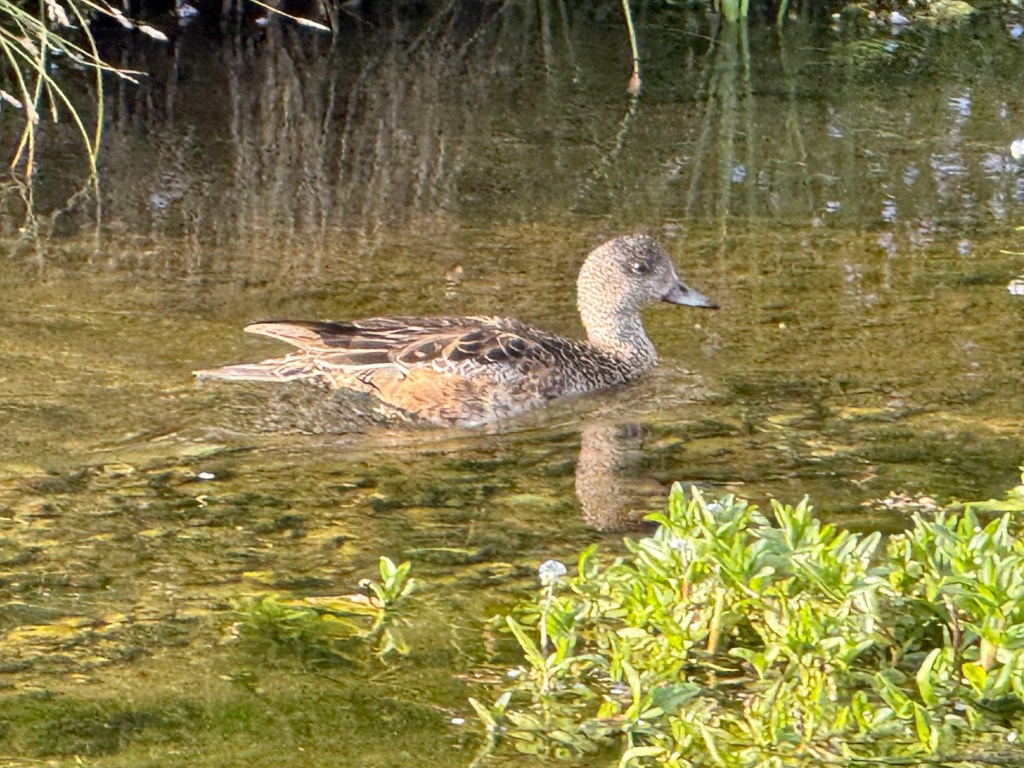
I did get some attention, though. I was followed down the creek, then back up the creek, by a female Cinnamon Teal. She squawked at me the whole time. When I sat down to change flies she flew up into the air to spy on me from above.
Between bouts of nibbling aquatic vegetation, Mrs. Teal had no compunction against splashing directly over a big trout to keep up with me. I saw no sign of ducklings and it was too late in the year for nesting. She was just a busybody. The extended mountain twilight was coming to an end, and moose were wandering in – time to leave.
Jenny Lake had opened to fishing, but we found the water was over 65° F, too warm to fish trout without stressing them.
Same with Cottonwood Creek that flows from Jenny Lake.
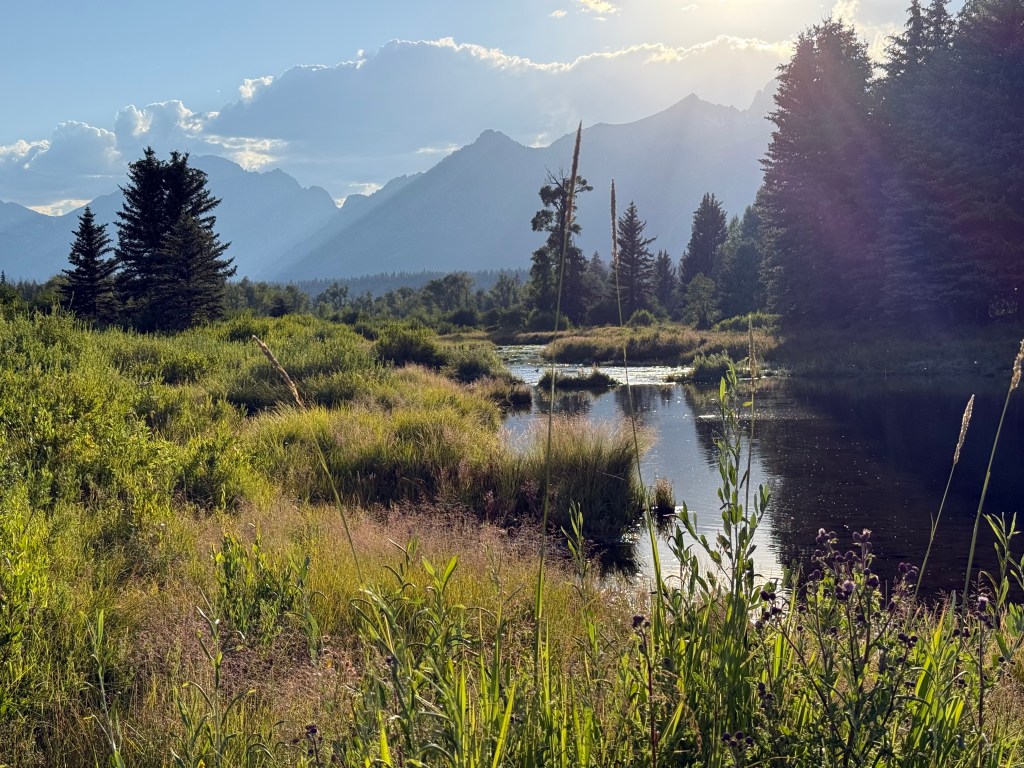
Instead, we hiked in to some beaver ponds to look for moose. Tiny trout dappled the surface or leapt into the air for flying insects, popping from the glassy water like slippery watermelon seeds squeezed between the fingers. Good dry fly fishing for naive 4-5” trout, but mind your backcast and keep an eye peeled for thirsty megafauna.
Funny looking moose by the beaver pond.
On our last morning we stopped by Flat Creek in the National Elk Refuge, a spot recommended for wade fishing by Larry the river guide. From the number of parked cars with single-purpose fly rod transport tubes clamped to their roof racks, I estimated 40 experienced and dedicated fly fishers were already stalking this narrow winding creek. Assuming I could even find a couple of bends to myself, I knew these fish would be highly over-educated.
We left the crowded stream and drove over to the Gros Ventre River, which I’d also wanted to explore. We parked at a turnout away from the river and hiked to a section of water not visible from the road.
I had this cold, braided river to myself as far in each direction as I cared to wander. Each bend offered promising trout spots. As I walked the banks, the air filled with small brown grasshoppers. Freshly expired stonefly nymphs littered the gravel bars. Easy to guess what these trout were eating. Indeed, I SAW lots of trout swim up and check out my flies: “Ooo, brown Morish Hopper, size 10” or “Golden Stone nymph, nicely tied.” Indeed, I had a wonderful time picking my way along the game trails, fording the river to access the promising holes and seams, and seeing trout flash my flies in such a beautiful spot, even though I didn’t get a single bite.
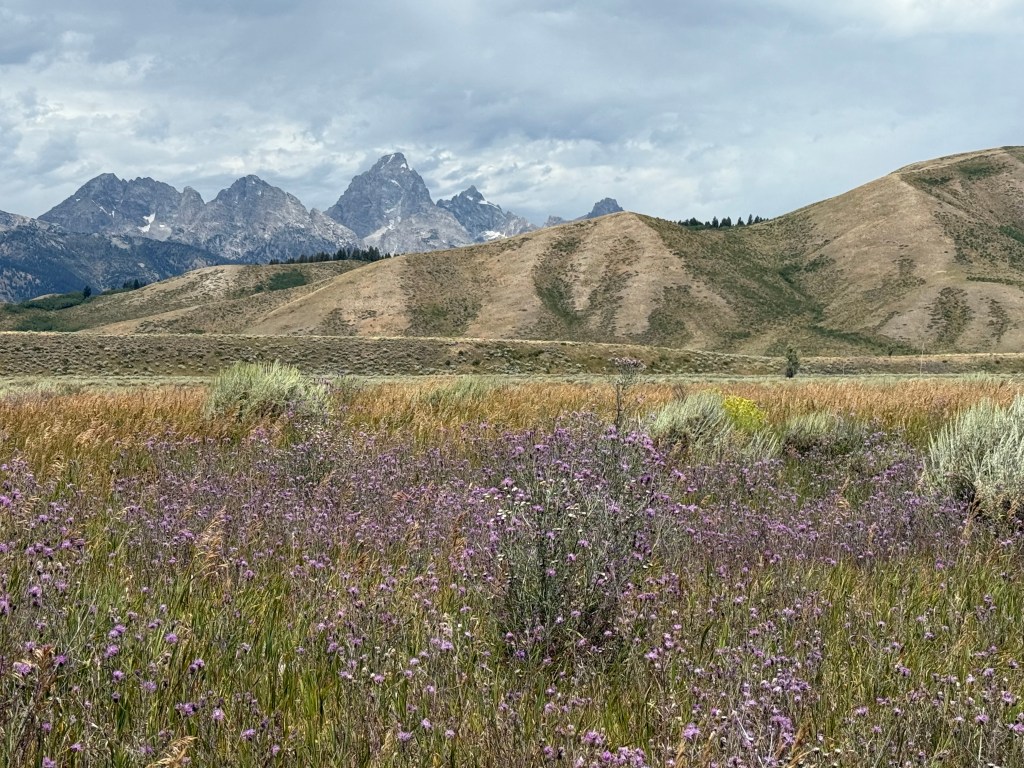
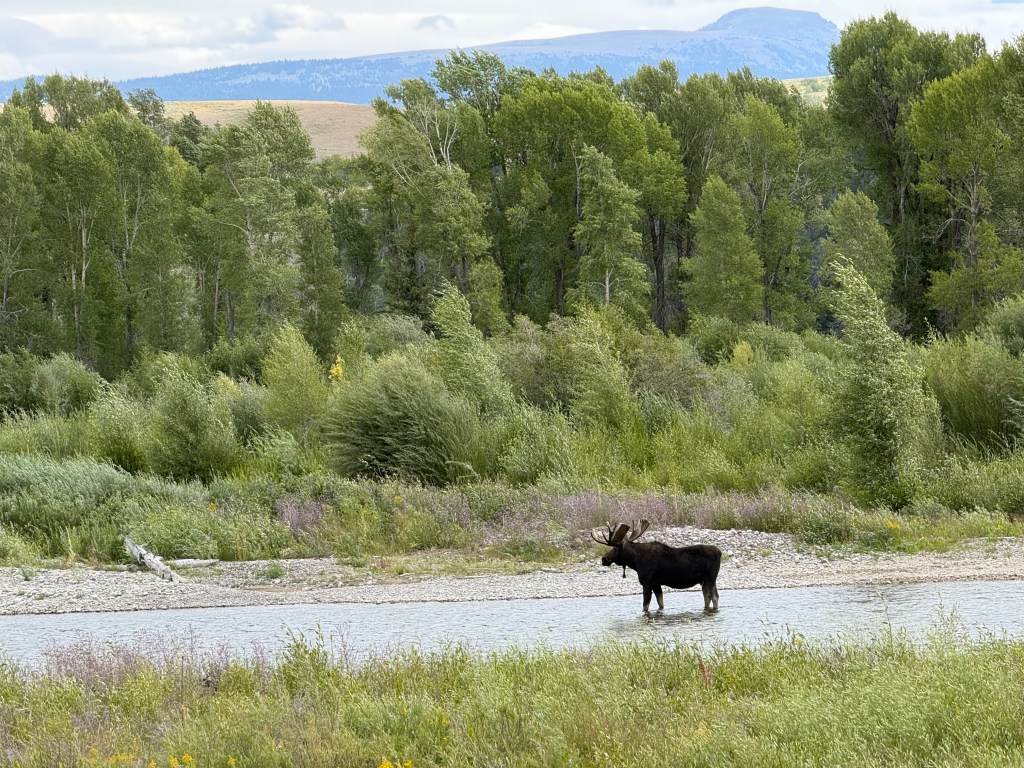
As we hiked back to the car, the rangeland had every color on display. Hard to believe that’s a photograph.Three bull moose grazed in the river as we too ate our lunch.
In contrast to our day in the drift boat, I caught one trout and a whitefish while wade-fishing a couple of hours a day across the rest of the week.
You can’t beat the Tetons for scenery, hiking, and critter-watching. I was delighted to spot my first Pine Marten and spent half an hour happily watching a Dipper bobbing and swimming in a mountain creek while Gray painted nearby, surrounded by a patch of fireweed and its attendant Rufus Hummingbird.
But, if you thrill when a trout eats your fly, and again seeing it up close in your net, the Driftless Area of SW Wisconsin draws far fewer people, and, as a result, offers much more productive trout-fishing.
“Phil, I get the draw of fly fishing in Wyoming, but Wisconsin?” email from friend in Miami
”Someday I want to go fly fishing in the Driftless.” overheard on train to car rental at Chicago O’Hare
The Driftless area of Wisconsin was not glaciated, so it has some big rocks sticking up, topography conducive to springs and formation cool water trout streams. It’s pretty countryside, with cornfields in the flatter areas framed by woodlands in the dolomite and limestone ridges and valleys.
The nearby town of Viroqua was described to us as a college town without a college. Many of its local businesses are named for the Driftless area, e.g., the Driftless Cafe, Driftless Books and Music, Driftless Angler, even the Driftless Humane Society. At the Viroqua Food Co-op you can buy Driftless Coffee.
Brook Trout are native to the Driftless streams and Brown Trout are naturalized.
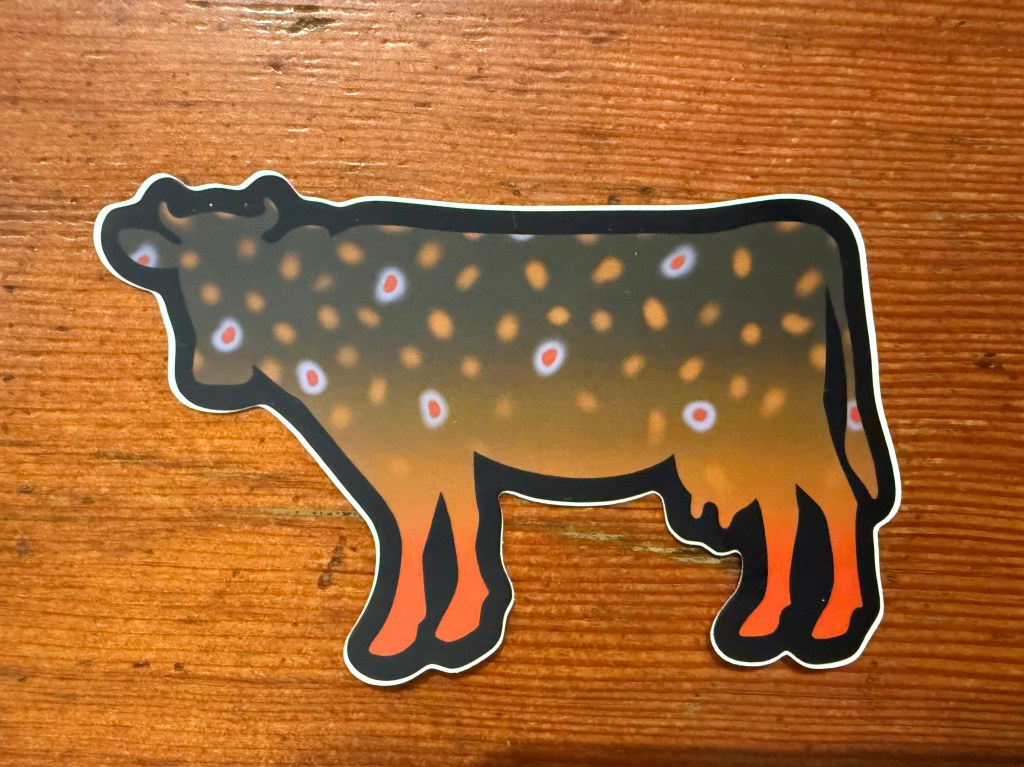
In the Driftless, Brook Trout and cows come together.
In addition to these self-sustaining trout populations, the Wisconsin DNR stocks streams with Rainbow Trout so the googans armed with spinning rods and barbed treble-hook spinners have something to catch on opening day. Any rainbows that survive that onslaught provide the big brown trout with something to snack on the other 364 days of the year, aside from their own offspring and hapless field mice. The Driftless streams grow some big browns, big like 30”. Fishing at night, when these leviathans are out feeding, is disallowed most of the year.
In my week of fishing, I saw hundreds of brown trout and brookies, but not a single rainbow. No monster browns either – the largest was about 18”, a nice trout by my standards.
Our first Drifltess afternoon we were joined by Adrian Livangood, a fishing guide from the outfitter Extreme Driftless. Adrian had spent five hours the day before scouting streams to find one with cool enough water, not higher than 65°F.
Adrian finally chose his home stream, one he’d fished since he was a kid. Not surprisingly, he knows every ripple and sand ridge, and how they change with each rain storm.
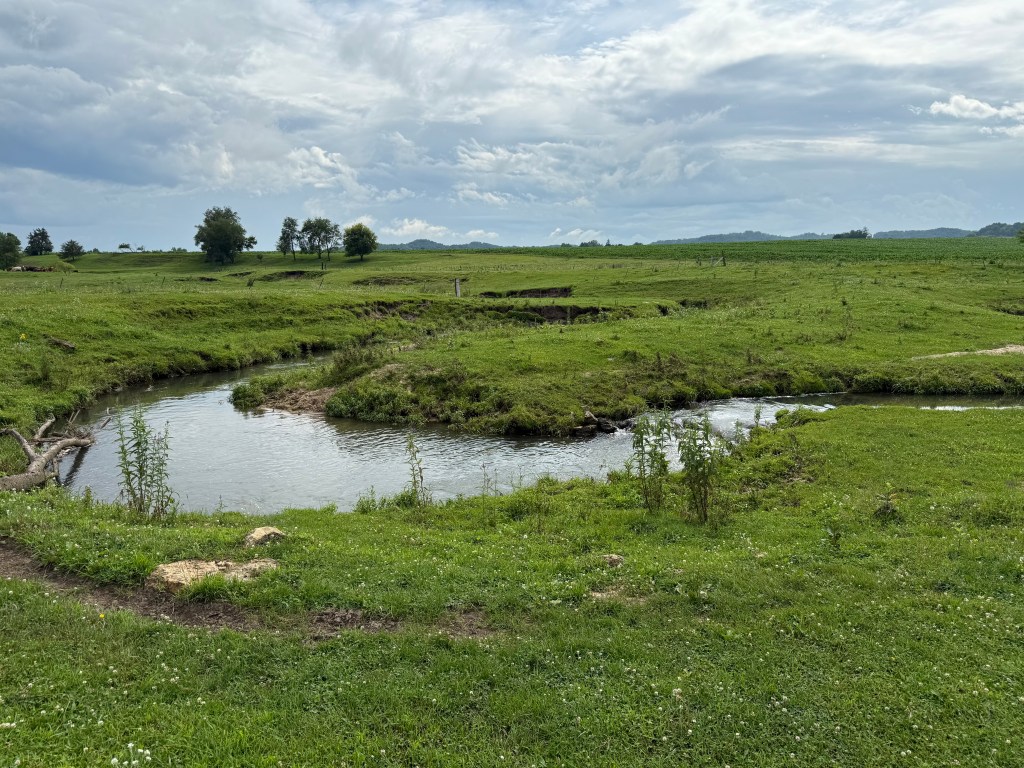
The stream, like many in the Driftless area, is accessed via a fishing easement, a strip of private land on which the owner has received a tax break for allowing access for trout fishing.
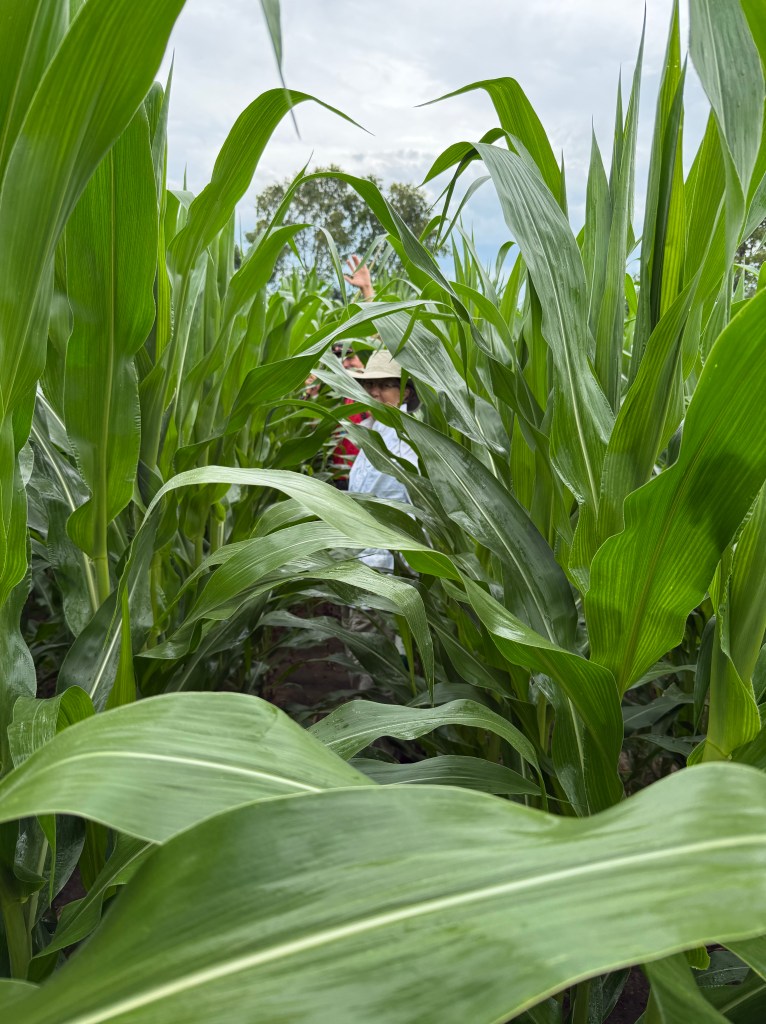
Following Adrian, we tunneled through 100 yards of tall corn, crossed under a barbed wire fence, then stepped out onto a cow pasture through which flowed a beautiful cool stream.
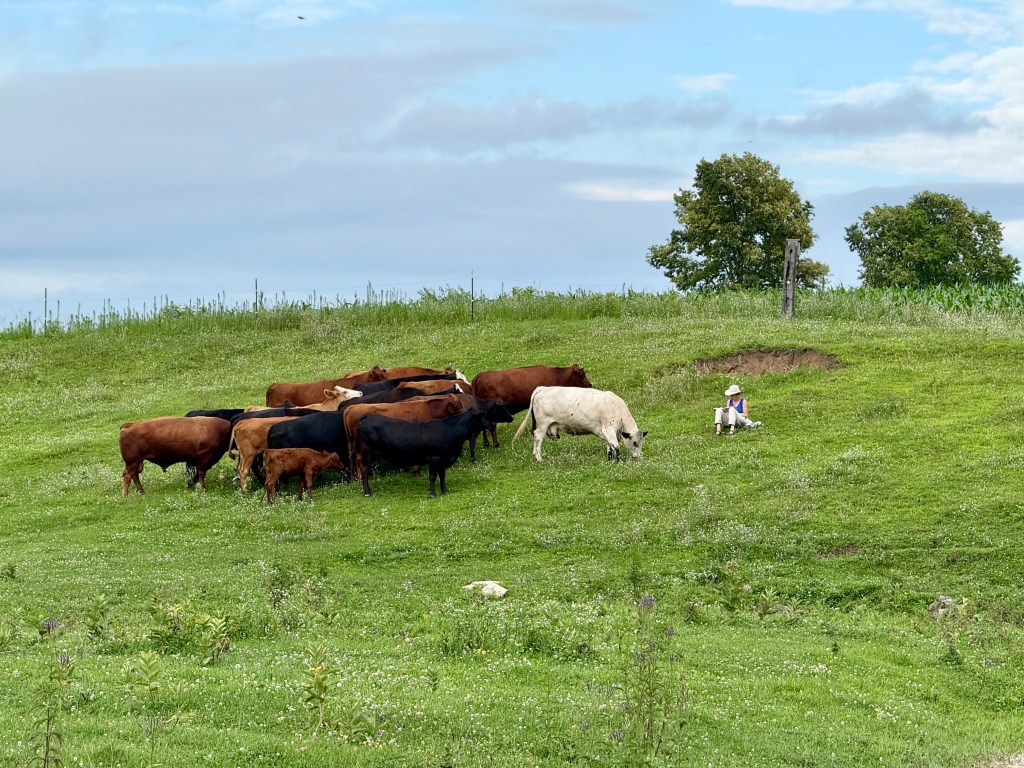
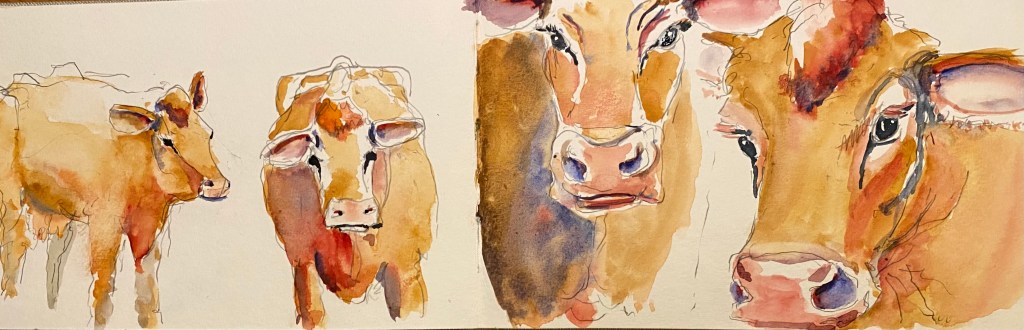
As Adrian and I stalked the stream bank for trout, Gray sat in the pasture and drew. A herd of dairy cows and their attendant bull kept their distance from Gray at first, but grew increasingly curious. They hadn’t seen an artist before.
One cow came close enough to drool on Gray’s notebook.
The afternoon was not too fishy, as fishing goes, but I got the feel of where trout hang in the local streams, catching eight brown trout on dry flies, dropper nymphs, and streamers.
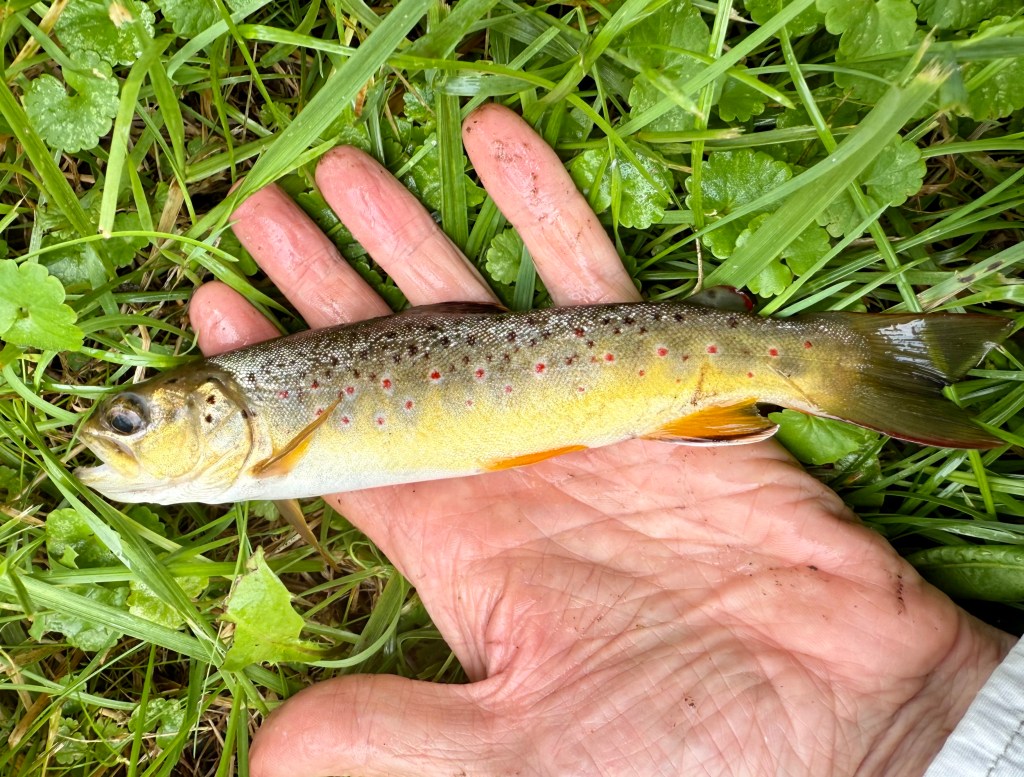
Brown Trout.
Nothing I saw that afternoon was huge, but Adrian showed me three holes inhabited by “lunker” browns 29-30” in length. He hooked one as a kid when he was starting out, and of course it got away. He has seen them in that stream a few times since then but hasn’t caught one. In winter and spring Adrian catches at least one big brown (20-25”) daily on a nearby river.
Weekday mornings during our stay, I woke with the first song of the Indigo Bunting, and headed out to fish a different Class 1 trout stream each day. Weekends I left to the locals who work during the week, and who, by all rights, shouldn’t have to complete with visitors on their home creek.
The streams I fished are designated catch-and-release, and all had cold water 58-64°F. I caught lots of trout on dry flies, typically a Parachute Adams, but also terrestrial insect imitations: grasshoppers and ants.
This 14” native Brook Trout was a prize catch on the size 12 Parachute Adams dry fly.
After my introduction to the Driftless in a grazed pasture, I quickly came to understand why fly fishers like short rods for creeks. My 9-foot long, 5-weight rod was fine for fishing a stream with cow-mown banks, but proved ungainly in the more typical, heavily vegetated streams. There I lost multiple flies in tree branches and cow parsnips and spent hours unhooking flies from vegetation and tying up new hopper-dropper rigs.
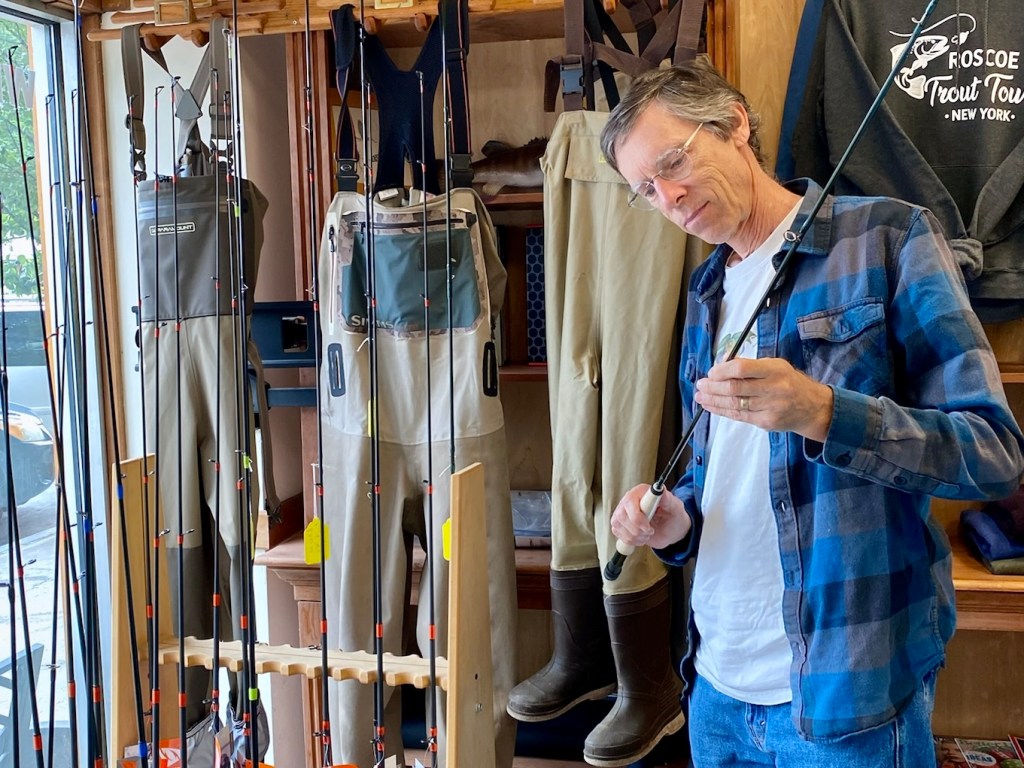
I stopped by the Driftless Angler in Viroqua to replace my lost #12 Parachute Adams dry flies and made the mistake of wandering over to the rod rack to drool over their collection of short 3wt rods.
Here I am fondling a nice 4wt fly rod at a shop in the Catskills. Substitute your favorite class of merchandise and you’ll get the picture.
The St. Croix ($400) seemed like a good fit for these streams, but felt like a tent pole compared to the Sage Dart ($825). The urge to buy terrorizes me. Time to leave.
Near our home exchange house, I fished a beautiful wooded stream, this one a particularly tight fit for a 9’ fly rod.
Good pool for trout, but tight for casting a 9’ fly rod.
Once I did find a good use for the long rod, flipping the #12 Parachute Adams around a bush into an upstream pool that I could not see. Hearing the splash of a bite, I twitched the rod tip sideways and hooked a nice 11” brown.
Brown that munched a Parachute Adams
The next pool held a rising fish that repeatedly ignored the Adams. I noticed black ants marching along the bank, so I tied on a floating #16 black ant fly and flipped that into the pool. A small brook trout jumped into the air, did a back flip and dove onto the ant fly. It missed the fly, but earned top marks from the judges for difficulty and style.
Floating ant fly.
The adjacent pool upstream was wide open, so I tried the ant again. A second brookie came at the ant fly from below and connected.
Easier pool to fish. A Brook trout waits unseen for bugs to appear at the back of the bend on the right.The Driftless Anteater.
These two were the only trout I caught that morning before the rain set in, but their capture and release through fiddly persistence, the essence of fly fishing for trout, made the morning entirely successful in my view.
The Driftless streams tend to be clear during the summer, which makes the trout more wary. Footpaths along the sides of many indicate the older trout are well-educated. But even on the most heavily fished stream I visited, the ancillary rewards are beyond words: picture rattling calls making you look up to see a pair of Sandhill Cranes flying low overhead, lit amber by the rising sun.
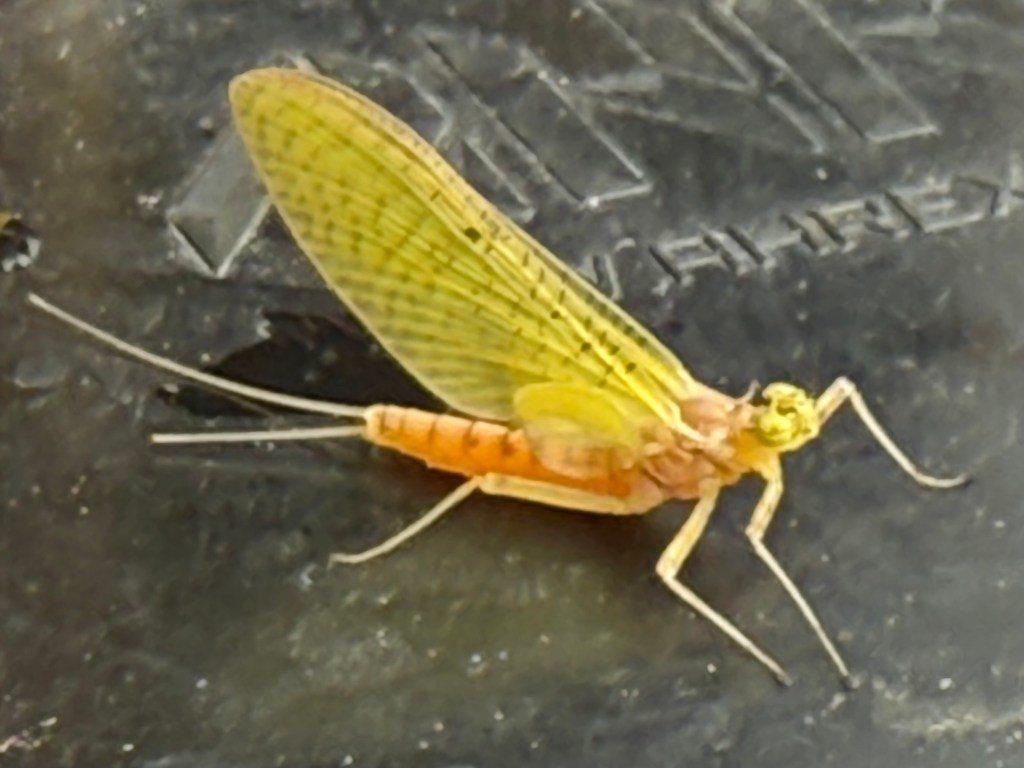
Some days the trout were actively feeding on bugs that did not resemble the gray-bodied Adams flies. For instance, this big yellow mayfly held the trouts’ attention a couple of morning on different streams, but my fly box lacked the size 8-12 Parachute Sulfur fly that would have “matched the hatch”.
Stenacroncanadense , sometimes referred to as a “Light Cahill”.
Other mornings trout were taking small, unseen insects off the surface or jumping a foot in the air to snap at something they could see and I could not. At those times, I couldn’t get a bite on an Adams dry fly of any size. Looking around, I saw the odd caddis fly and some tiny gnats or blackflies buzzing around. The rising trout refused my size 18 Elk Hair Caddis. Maybe they’d have taken Griffith’s Gnat in size 20 or 22.
If I’d had some.
An article on the Orvis site says that fly anglers who fish clear, spring-fed streams carry multiple fly boxes. Oh. So I’ll need to wear a backpack too?
Adrian wore a backpack…Click, grind, wheeze, the penny drops.
I did make two other relevant discoveries: (1) coffee makes my left hand shake too much to thread thin tippet into the hook eyes of #18 & 20 dry flies, and (2) The smaller-sized dry flies I bought mail order from The Fly Shack had hook eyes blocked by hackle, tying thread, and/or head cement – I gave the company an earful.
When surface feeding trout ignored my dry flies, a sinking nymph fly under an indicator (tiny foam float) or foam grasshopper fly sometimes did the trick. The best such nymph was the Jig Hot Butt Hare’s Ear that I’d bought last summer from Kelly Galloup’s fly shop on the Madison River in Montana. This nymph is said to be good where caddis flies are present.
Jig Hot Butt Hare’s Ear, in olive, size 16
Last morning in the Driftless, after releasing ten brown trout caught on this cute little fly – including a nice 14-incher – plus another on the dry grasshopper, I lost both of my Jig Hot Butt Hare’s Ear flies to grabby overhead branches. A timely sign to wind in my line. Indeed, wiggling free of my waders back at the car, the sky opened up. If I lived near the Driftless area, I’d assemble the materials to tie this little fly myself, plus the Parachute Sulfur. And I’d splurge on that Sage Dart stream rod.
I had a day open to fish before we leave town for a vacation in the Wisconsin Driftless area.
Moon is approaching full, allowing the fish to stay up all night feeding, which often makes for a poor morning fishing the flats. But the winds promised to be lowish which means I could go anywhere.
So many possibilities. How to decide?
One more wrinkle. I find Mondays are the worst day of the week for fishing in South Florida. I do have the water to myself, but the majority of my fellow fishers, who are not yet retired, have worked-over most of the good areas on the weekend. The worried fish often spend Mondays hiding under the bed.
I figured it would be best to fish a spot off the beaten trail. How about off the Tamiami Trail?
I headed out to fly fish for tarpon and snook in a favorite lake in the western Everglades / Big Cypress / Fakahatchee Strand ecosystem, arriving well before sunrise. Perfect. I rigged my Spey rod with a good tarpon fly for this lake.
I had dressed for effective mosquito protection: head net, two shirts, neoprene dive booties to protect my feet and ankles, gloves, and picaridin spray around the seams. Good thing too – the black salt marsh moskeeters (BSMMs) were thick.
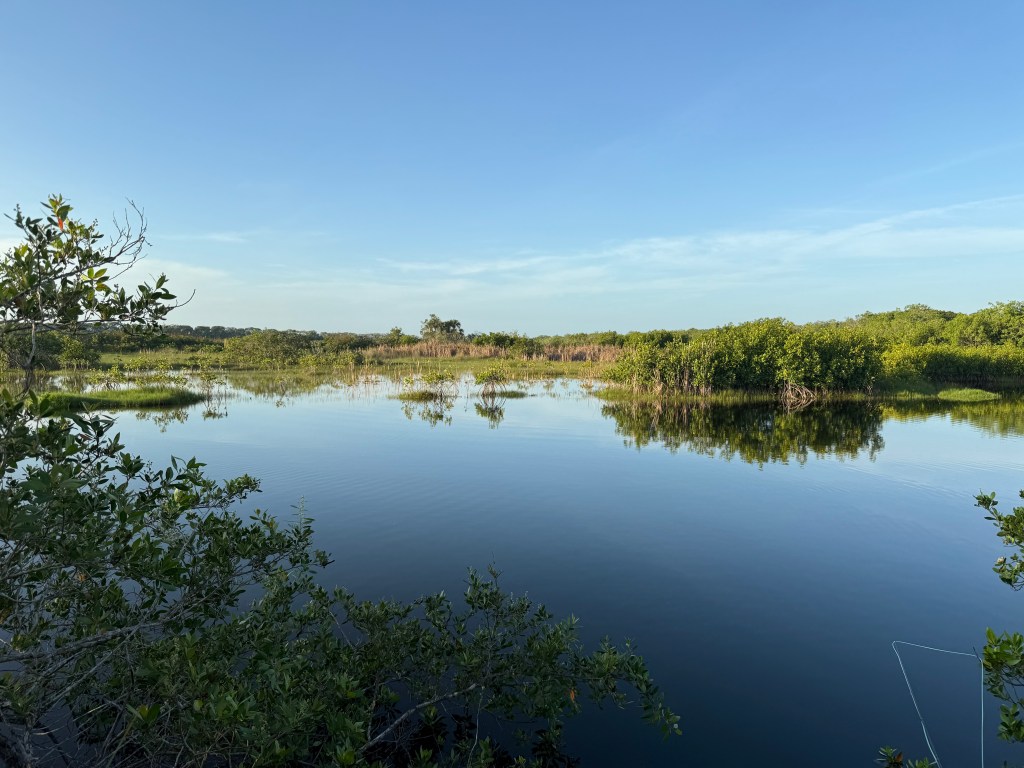
Otherwise, it’s a nice lake. It has only two alligators: the South gator is afraid of humans and the North gator is easily avoided. If he shows, I just move down the lake to another opening in the mangroves. The lake holds lots of juvenile tarpon and some big snook and bass.
This morning I saw an expanse of glassy water, with the occasional tip of a tarpon tail breaking the surface. Not many fish, not very active, and not too promising.
Soon the sweat rolling down my forehead inside my head net began to condense on my glasses and I couldn’t make out as much detail, but I had the general picture: the tarpon did not appear to be feeding actively, which makes sense given they’d had 10 hours of moonlight in which to feed. I walked the perimeter, casting through openings in the mangroves in front of the odd disappearing tail. No takers. I startled the North gator and so moved on down the lake shore to avoid him.
Just after I took this photo, something broke the surface, likely a snook or bass from the way it splashed. Though the Spey rod casts a long distance, I found that it needs a slightly wider opening in the trees than does a single-handed fly rod. I had to disentangle the fly line from the foliage of a Poisonwood tree. Mental note to self: wash fly line in soapy water when I get home.
Poisonwood (Metopium toxiferum) is a common tree in the Everglades and coastal hammocks. Related to Poison Ivy and Poison Sumac, it produces the same irritant, urushiol. I once pointed out the Poisonwood to a visiting seismologist friend who said “It looks like everything else.” I replied “Yes, but don’t touch it.” Every time I looked at him, he had his camera up to his eye and one elbow or the other poked into a clump of Poisonwood foliage. By the end of the day, both his elbows were red and puffy.
I left and drove to another good spot. The Mosquito Host Committee took a vote and decided to come along for the ride.
By the next spot, the sun was high and the mosquitoes had begun retreating to the shade. I removed the stifling head net and extra shirt and downed a Yeti bottle of Liquid IV to replace what I’d lost. Whew! In the summer it’s warm and humid around the mangrove lakes, but you knew that.
I could hear a school of snook feeding noisily under a bridge, loud smacks punctuating the silence. Anxious-looking Sail-finned Mollies shoaled tightly nearby. I could drift a mollie-sized baitfish fly under the bridge, but first, best take a quick scan for gators. Oops.
Not far off a cheerful alligator waited, ready and hopeful. Might some thoughtful human catch a snook that would make a nice breakfast for some deserving alligator? It happens, you know.
I don’t fish near a gator like that. Too easy to lose a snook and/or break a fly rod. Pass.
At another lake I found a large school of feeding tarpon. I walked the edge, watching them roll. Periodically a feeding tarpon would crash the surface in an explosion of spray. So cool. The Spey rod could reach them easily. Full stop. I had previously lost an encounter with the 9-foot owner of that lake, breaking off a nice tarpon as the big gator moved in. Pass again.
At the next spot feeding rings indicated tarpon, but another hopeful gator swam out and looked up at me. “Catch me a fish?” Pass.
Final spot, two big gators sitting side-by-side and facing opposite directions. Nothing will get past that pair. But around the corner there were no gators (that I could see) and I could see the ripples left by a big fish that had broken the surface. I traipsed over towards the shore and was enveloped by a WALL of black salt marsh mosquitoes lying in wait under the shade of a Wild Tamarind tree. Holy shit!
I ran for the car but couldn’t shake them.
I ran away from the car and circled around a cluster of Cabbage Palms, but the hoard stayed with me.
I ran past the car, dropping off my stuff so I could run faster, and did another lap around the neighborhood. No use.
I tossed my stuff in the car, hopped in, opened the windows, and drove for home, swatting mosquitoes the whole way.
Florida’s new gulag at Mile 48 had fancy new signs reading: “Alligator Alcatraz”. No protest scheduled today, but two women were outside, holding their signs. I gave them a hearty thumbs up and they smiled and waived back.
Some of the BSMMs that hitch-hiked home left the car as I unpacked and were waiting for me on the front porch where Gray had prepared us a lunch. Swat swat swat. A few of those slipped in the front door and into the house. Swat swat.
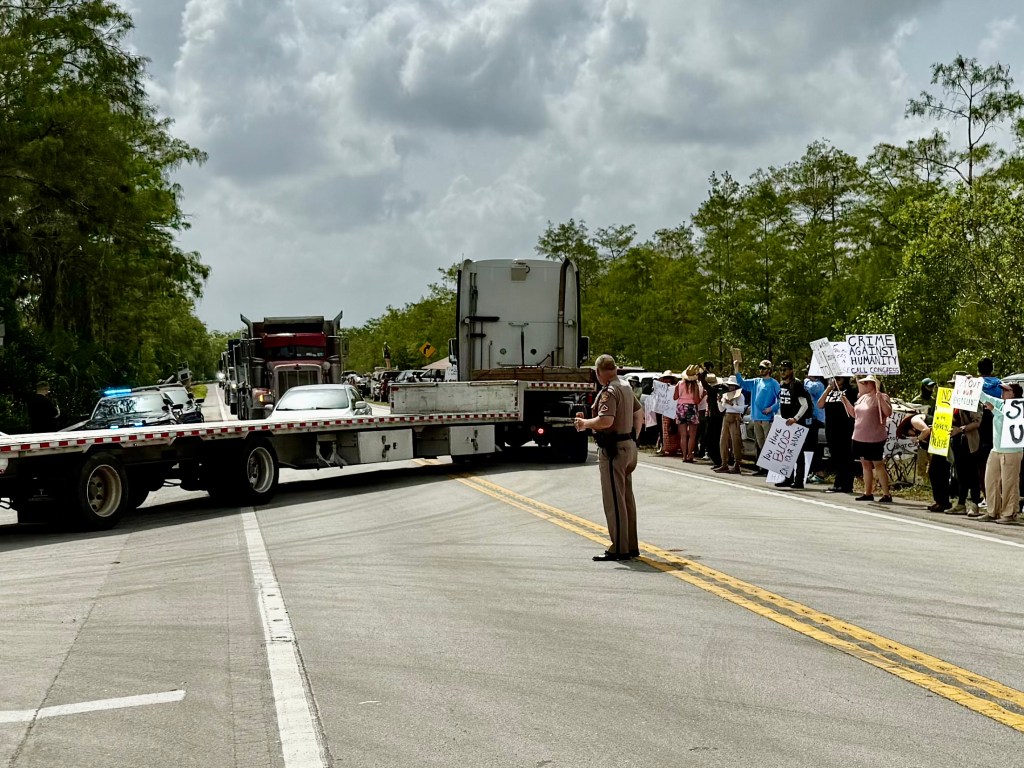
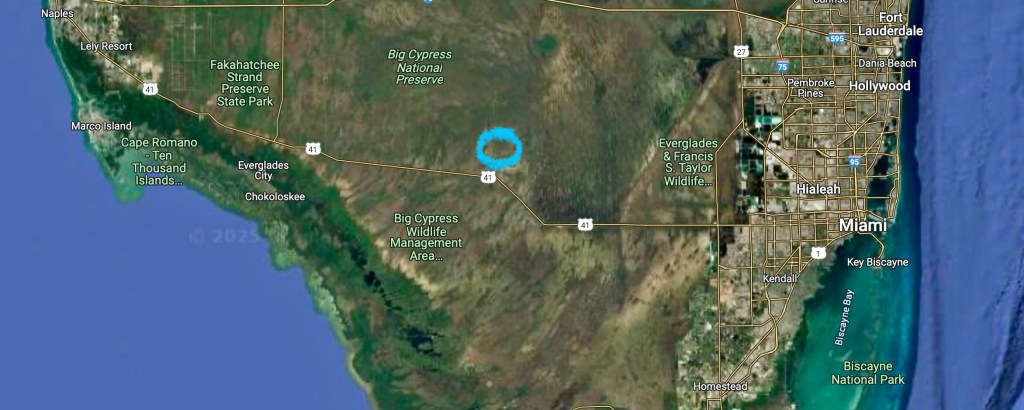
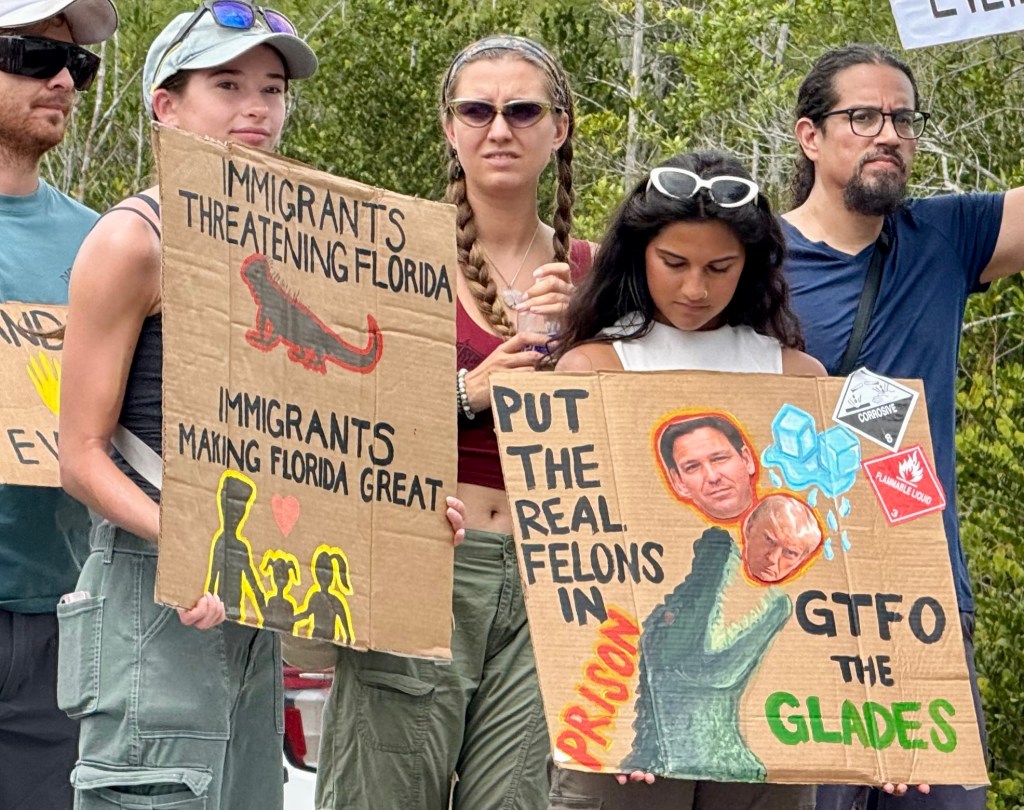
Construction has begun on Alligator Alcatraz, the 1000 person immigration prison that Florida Governor Ron DeSantis is building in the heart of a sensitive wetland. Once again, 400 concerned Floridians made the trek out to the center of the Big Cypress National Preserve to stand and protest for 4 hours under the midday sun.
On the drive out to the second protest on Saturday morning we passed 8 concrete mixing trucks returning from the site and dozens of tractor-trailer rigs lined up to deliver construction materials.
In winter, the center of Big Cypress National Preserve is a nature lover’s paradise, but in summer you reach a terminal sweat in the unrelenting heat and saturating humidity. Mosquitoes are big and fierce. The nearest small town is Everglades City, 40 miles away. This site has the makings of a Siberian style gulag, described by Alexandr Solzhenynitzyn in The Gulag Archipelago.
Environmental activist Betty Osceola of the Miccosukee Tribe led the crowd of peaceful protesters. We could hear the drum beats in the distance as the Miccosukees themselves protested to a higher authority.
Friends of the Everglades and the Center for Biological Diversity have filed for an injunction pending the full environmental review required by federal law, and ignored by Gov. DeSantis. DeSantis plows ahead, ignoring the law, his trademark modus operandi.
DeSantis has seized the land under his 2023 emergency declaration, but the only emergencies we’re seeing here in South Florida are unnecessary ICE raids in our communities and unnecessary prison construction in a cherished and protected wetland.





























 Eye of the Cormorant