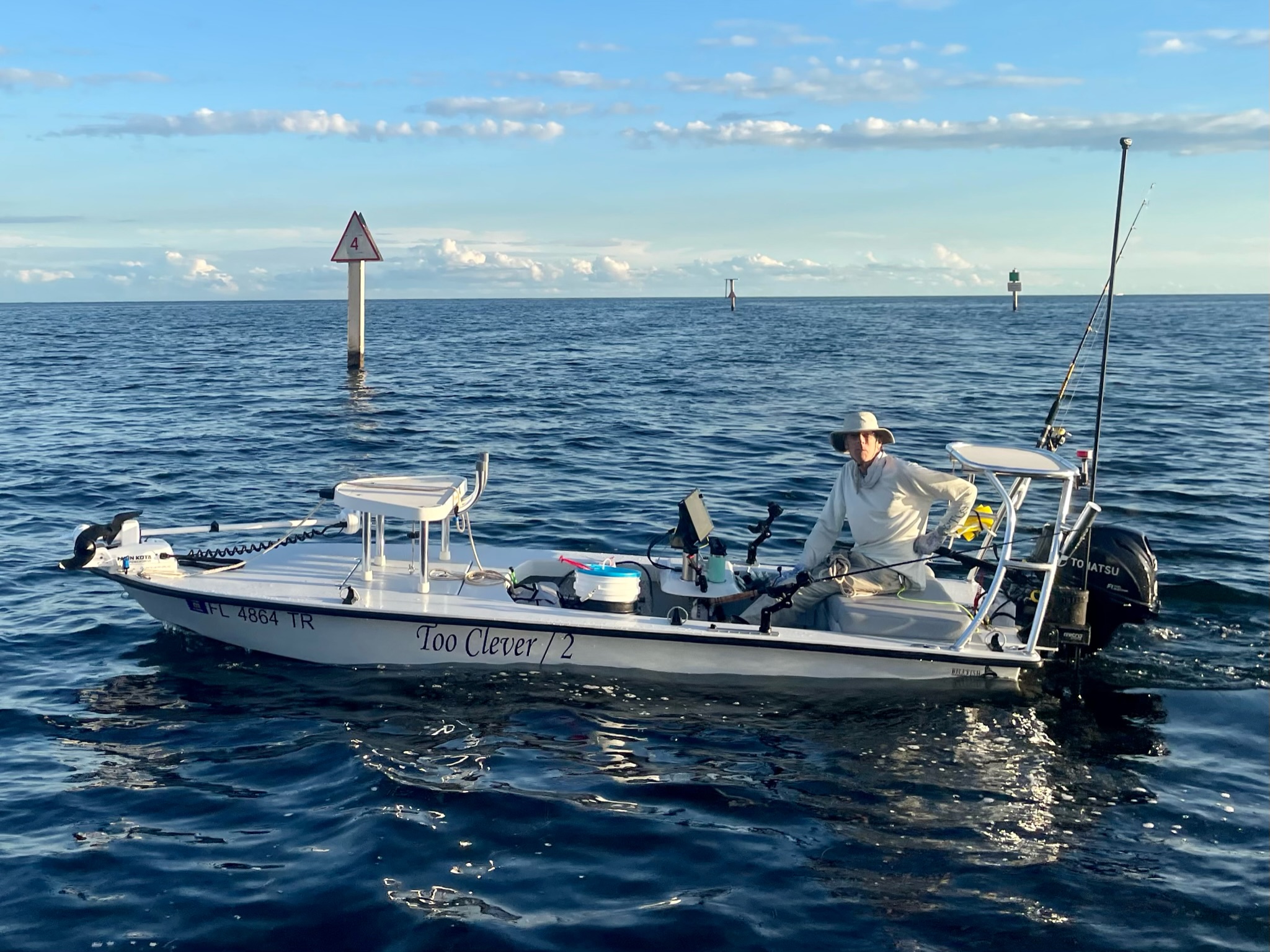
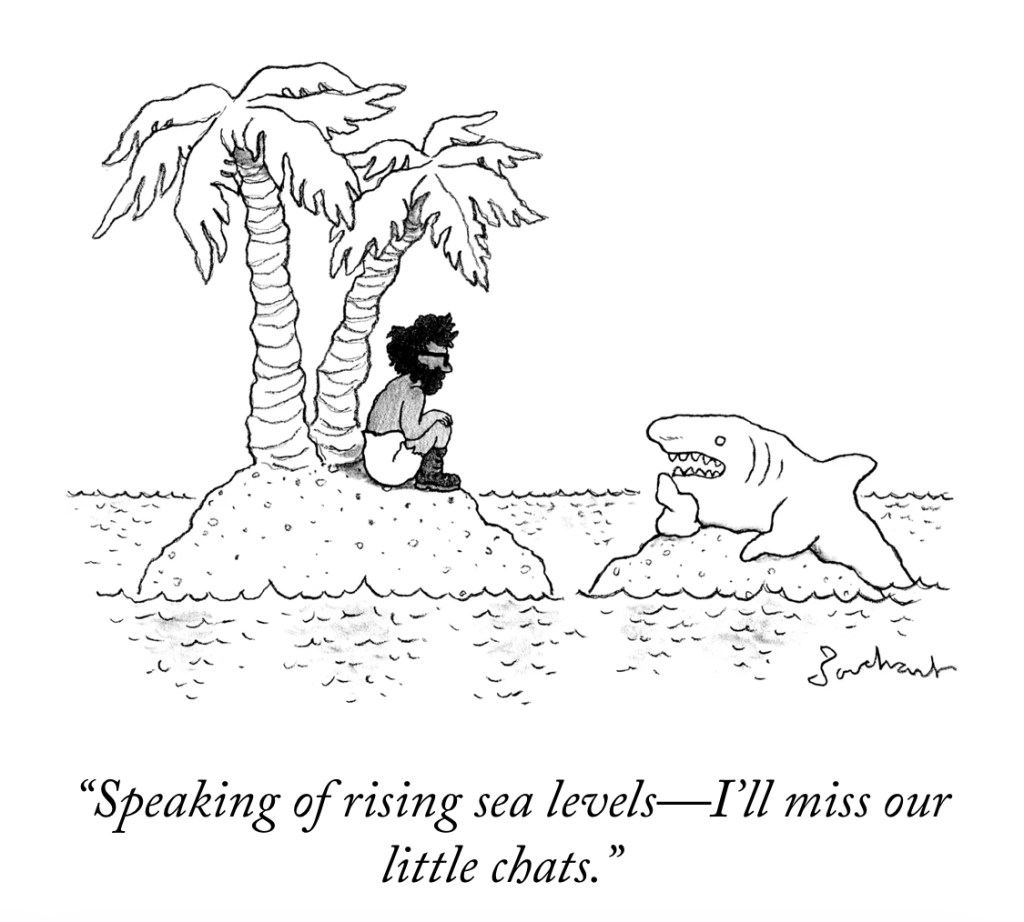
Here’s a stupid story that also explains the name of my little flats skiff.
* * *
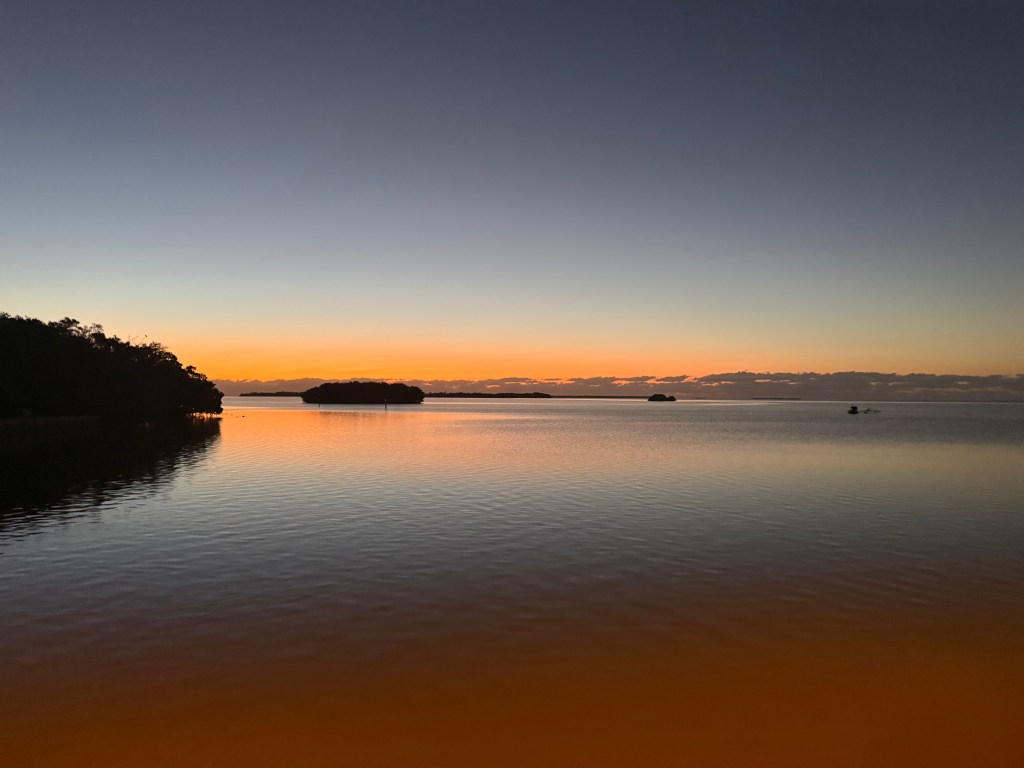
Monday morning before sunrise, I launch my skiff from the front boat ramp at the marina at Flamingo in the south end of Everglades National Park.
When launching the boat solo, I secure the loop of a dock line rope to the cleat on the front of the skiff and tie the other end to one of the two vertical PVC posts at the rear of the boat trailer. Then I back the trailer into the water and stop abruptly. The boat floats off the trailer into the water, tethered to the rear of the trailer by the dock line.
Dock lines come in 15’ and 25’ lengths, so when I got my 14.5′ skiff, I bought a pair of 15′ dock lines, one for each end of the skiff. Fifteen foot dock lines are the perfect length if I’m backing the trailer down the boat ramp and someone else is guiding the boat along the dock. Launching solo, however, a 15’ rope is just long enough to tie a clove hitch around one of the 2.5” diameter PVC pipes enclosing the risers on my boat trailer. The clove hitch is not the most secure knot one could tie onto a slick PVC pipe, but it’s the only snug hitch knot I can manage given the limited length of the dock line.
Launching solo this morning, I remove the safety straps, tie on the dock line, back the trailer into the water, and the boat floats backwards off the trailer as planned. I ease the car forward to bring the back of the trailer onto the dry part of the boat ramp, placing the rope within my reach.
As the rope comes taught, its tip pulls free of the clove hitch on the trailer’s riser, the knot unwinds, and the skiff continues its backwards drift untethered.
Expletives fly as I leap from the car. It’s early on a chilly weekday morning and nobody is on the water nearby where they might grab my skiff before it floats across the cove.
The air is 47°F, the water is 59°F, and I am not up for a frigid swim in my fishing clothes. More to the point, I am not up for a half-hour run to Cape Sable in soaking-wet fishing clothes. I scamper down the adjacent dock, hoping I might find a way to intercept the skiff as it floats past.
The boat’s drift takes it close to the end of the dock. Jumping from the dock into the small skiff looks possible.
Now is a good time to tune in to my two inner voices, akin to what Terry Pratchett dubbed “first sight” and “second sight”.
The first voice says:
“I should make this jump OK … but it’s a moving target, I might miss, and the boat has many sharp angles and no soft surfaces.“
“If I miss the jump and break a bone, neither my wife nor my orthopedist will show me any sympathy, and that’s assuming I don’t break something then fall in the cold water and drown.”
“The internet has a thousand videos of people who injure themselves attempting to jump from docks into boats.”
Not everybody tunes in to their second inner voice, but I heard mine state clearly:
“Did you hear the part about broken bones and drowning? Listen to the first voice.”
Heeding the sage advice, I abandon the jumping idea posthaste.
Instead, I climb down from the dock onto a wooden beam just above the waterline, wrap my right arm around the nearest piling, and extend my left leg over the water as far as it will go. My toe catches the errant skiff. Whew! I ease the skiff close to the dock step onto the deck, and motor to the closest tie-up spot. My car is waiting for me on the boat ramp, the driver’s door still wide open.
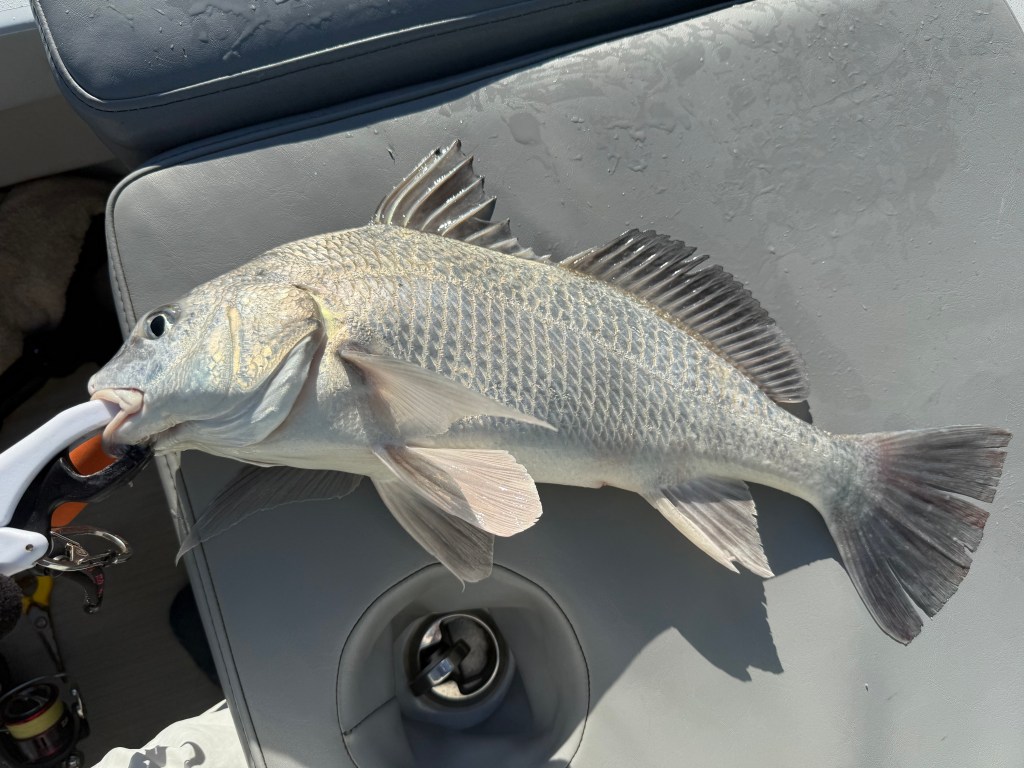
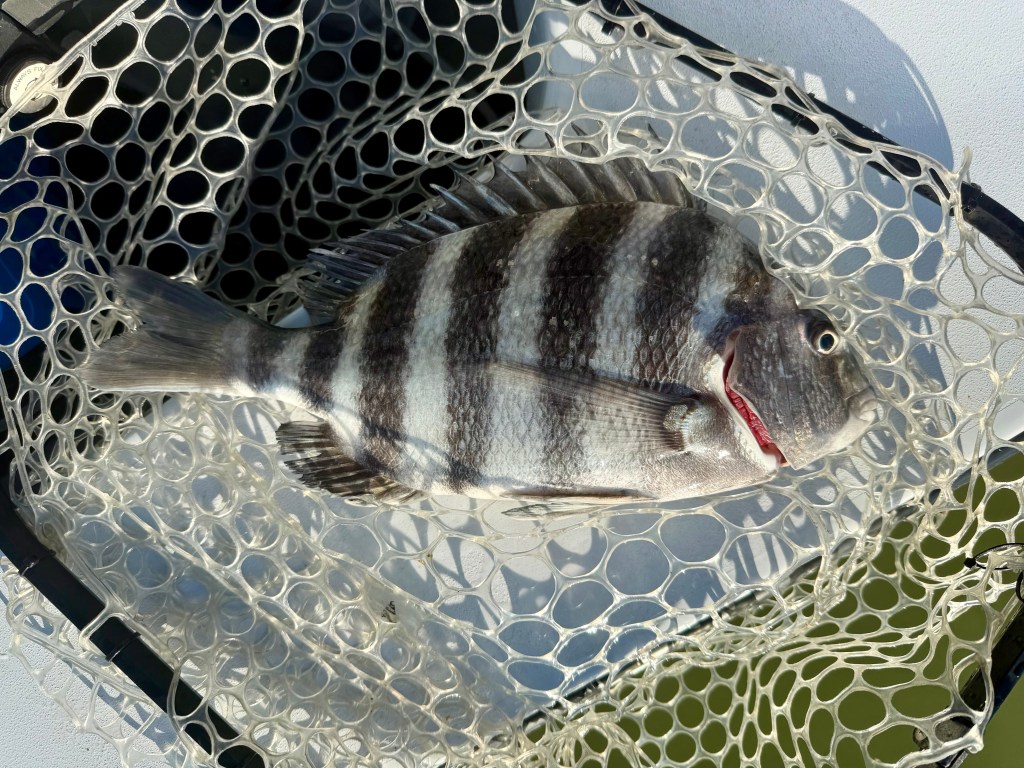
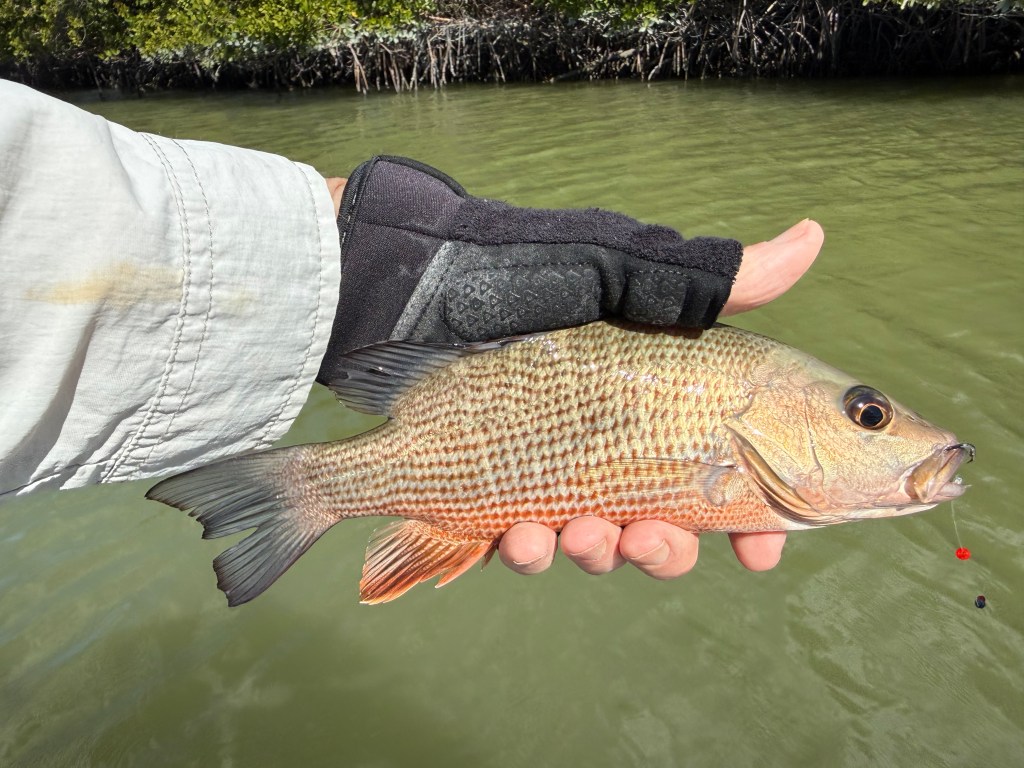
Half an hour later, I’m 10 miles away. The water is too cold to catch fish on flies or lures, but the fish will bite shrimp soaked on the bottom. I bought three dozen live shrimp on my way to the marina this morning. Here are some of my catches:
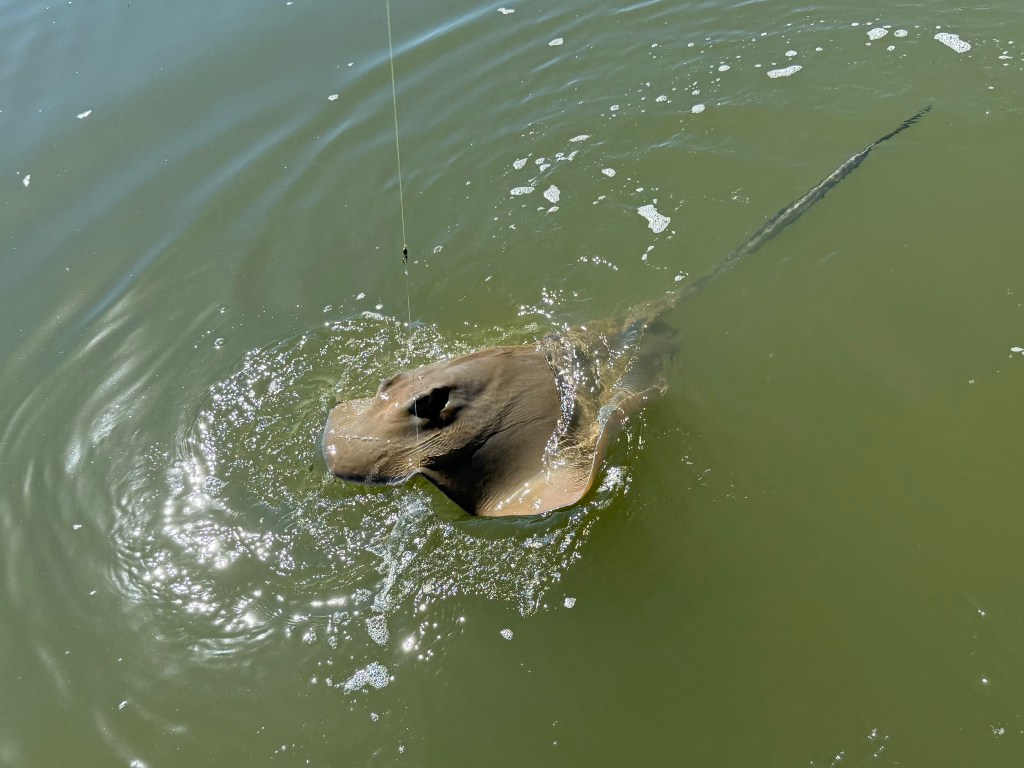
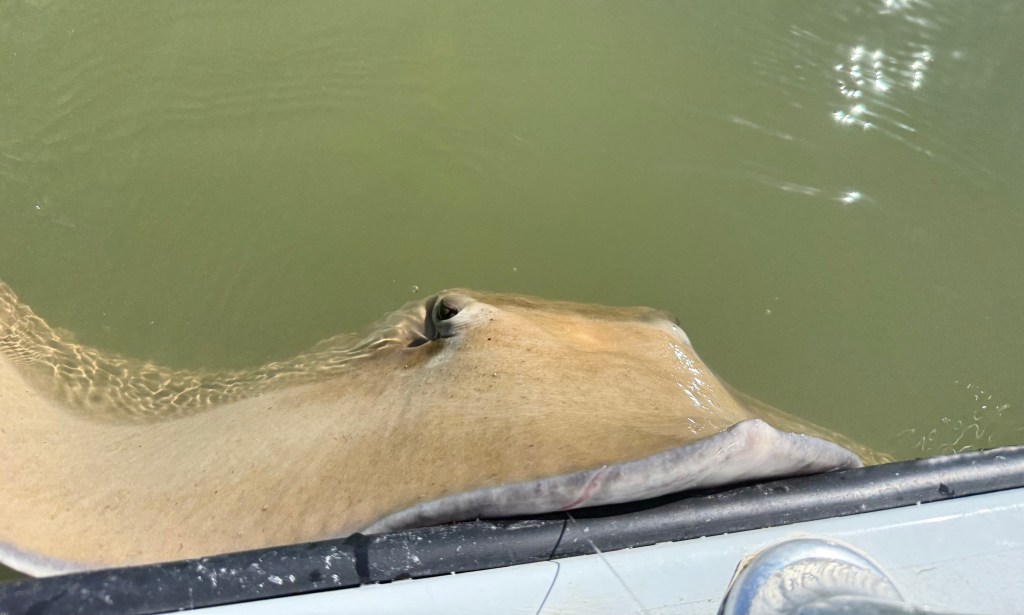
Black DrumSheepsheadSouthern Stingray, 2 meters long nose-to-tail, and a 13 cm stinger barb.I did not bring the sting ray into the boat. Those inner voices again.a little Mangrove Snapper
I hear a song of rising buzzes, my first Prairie Warbler of the year. A crocodile that slid from the sunlit bank is now eyeing me jealously, but keeping its distance. Good croc. A pod of dolphins spout spray as they venture past, chasing their own fish and not pestering the ones in my vicinity.
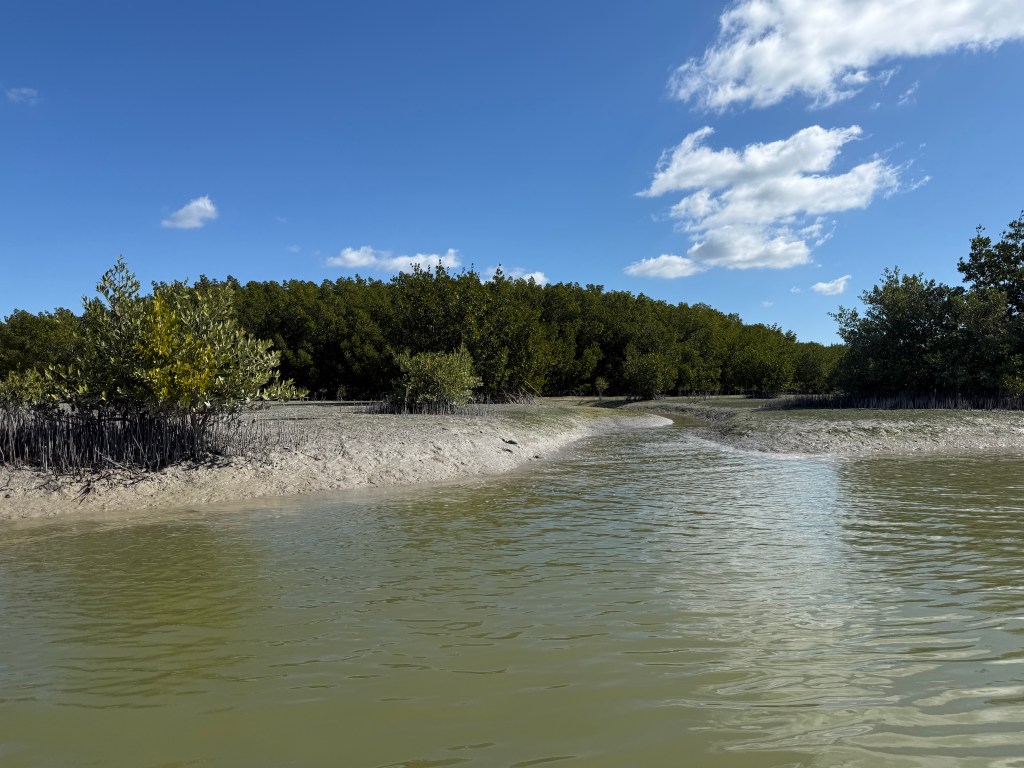
When the fish stop biting, I watch birds and explore my way a couple of miles up a tidal creek where I eat lunch in a wild place with egrets, ibis, and rails for company, but no humans.
Up the creek. Tide is down.
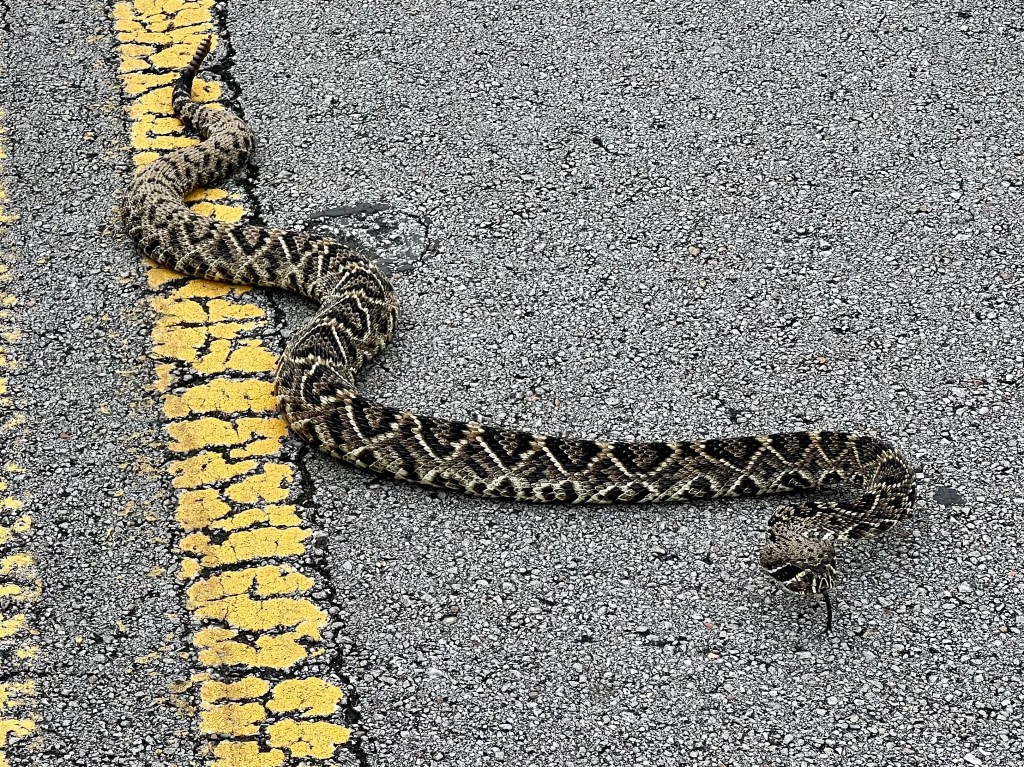
Driving home from the marina, I spot a large Eastern Diamondback Rattlesnake crossing the Park Road.
Eastern Diamondback Rattlesnake
Monday morning would the SECOND time that my over-extended dock line has freed itself from the trailer during a solo launch.
A quick trip the marine store and I am the proud owner of a 25’ dock line, long enough to tie the securest of Secret Navy Knots and then some. Of course I coulda-shoulda purchased a longer dock line the first time the boat escaped, or gee, maybe even before that.
I’ve been grappling with a multi-way conflict: (1) trying shake the “forever cold” while (2) healing a torn rotator cuff muscle (supraspinatus) in my fly casting arm, and (3) enjoying every nice day I can on the water with a fly rod and binoculars. At least I don’t have to grade papers.
A cold front reached South Florida, knocking down the mosquitoes and moving sharks away from the shallows. The Everglades mangrove flats beckoned me southwards.
Entrance to the flats.
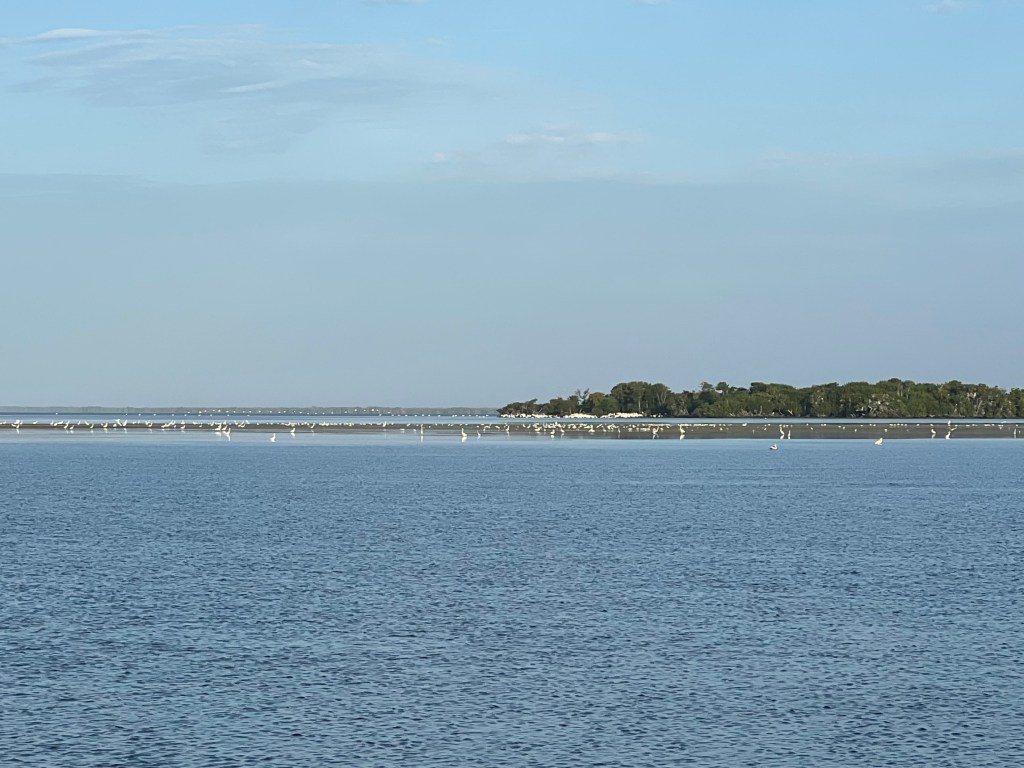
One shallow flat in particular draws me to watch shorebirds and chase game fish.
Birds gather on the falling tide. Snook and Redfish forage near that edge.
To get the best experience, you have to get the tides right. Depending on the moon and tide phases, the area can be 16 square miles of water (birds wait in the trees and fish are everywhere), 15 square miles of exposed mud (birds dispersed everywhere and fish are concentrated in the channels with the sharks), or something in between (birds and fish both concentrated on the edge of the tide). If the wind comes up, water might blow onto or off the flat, superseding the tidal prediction.
Several two mile trails lead to the edge of the flat. When my late colleague George Dalrymple took his zoology class down the Snake Bight Trail, one student had to be carried out after she fainted from the sheer horror of the Black Salt Marsh Mosquitoes. I found that pedaling my bicycle down the trail lets me keep ahead of the swarm. Just don’t stop! But the best access is in a shallow-draft boat, a kayak, canoe, or technical poling skiff.
Coming by boat, you have access to more of the flat and can approach the edge of the tide where birds and fish are concentrated. However, it’s easy to get trapped by the falling tide, particularly when distracted by fish or shorebirds, both of which follow the rapidly moving tidal edge. If Poseidon empties the bathtub while you are far from a channel, there’s no walking out. The deep, sucking mud steals your sandals before eating you whole.
People who get stuck sometimes phone the Park dispatch office. The ranger explains:“Yes, we see you out there, but we can’t get to you. Unless it’s an emergency and you want to pay for a helicopter, you are going to sit there until the tide comes back in.” You might spend up to eight hours waiting for the next high tide to free your boat. Hope you brought extra water and a granola bar, and good luck with the lightning.
I have willingly allowed myself get stranded at the bottom of the outgoing tide while watching shorebirds, chasing fish, or watching shorebirds chase fish. I eat lunch then escape when the tide returns to float my boat. The show can be worth the wait.
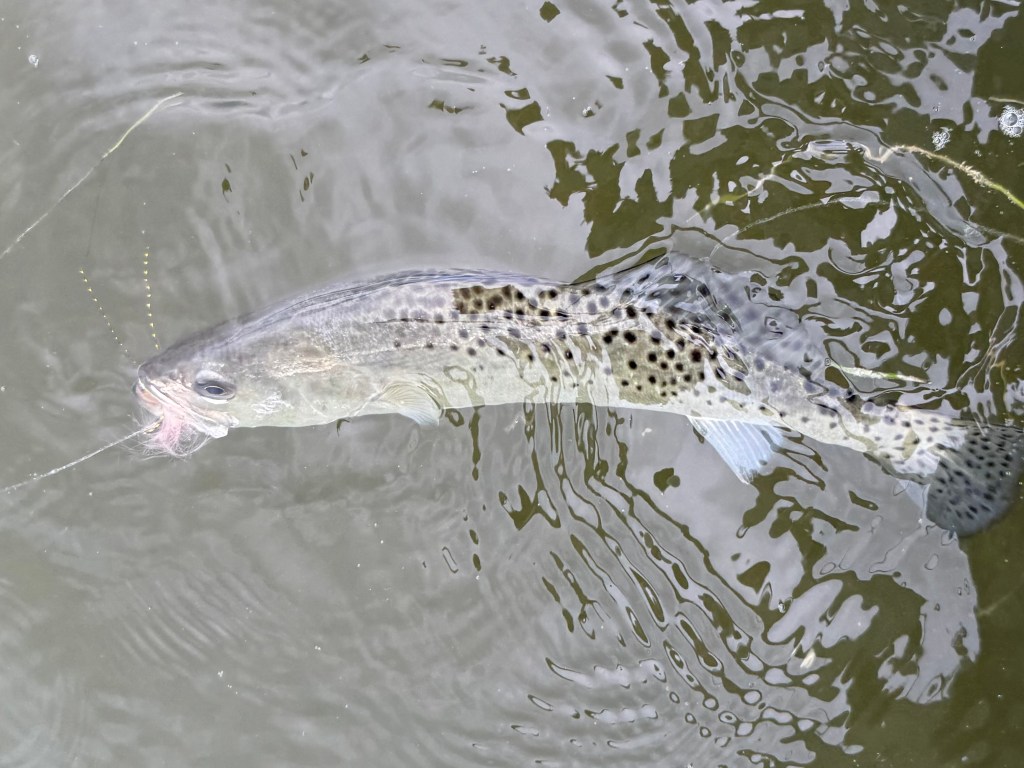
Tricolored HeronBlack-necked StiltSpeckled Seatrout that took my fly.
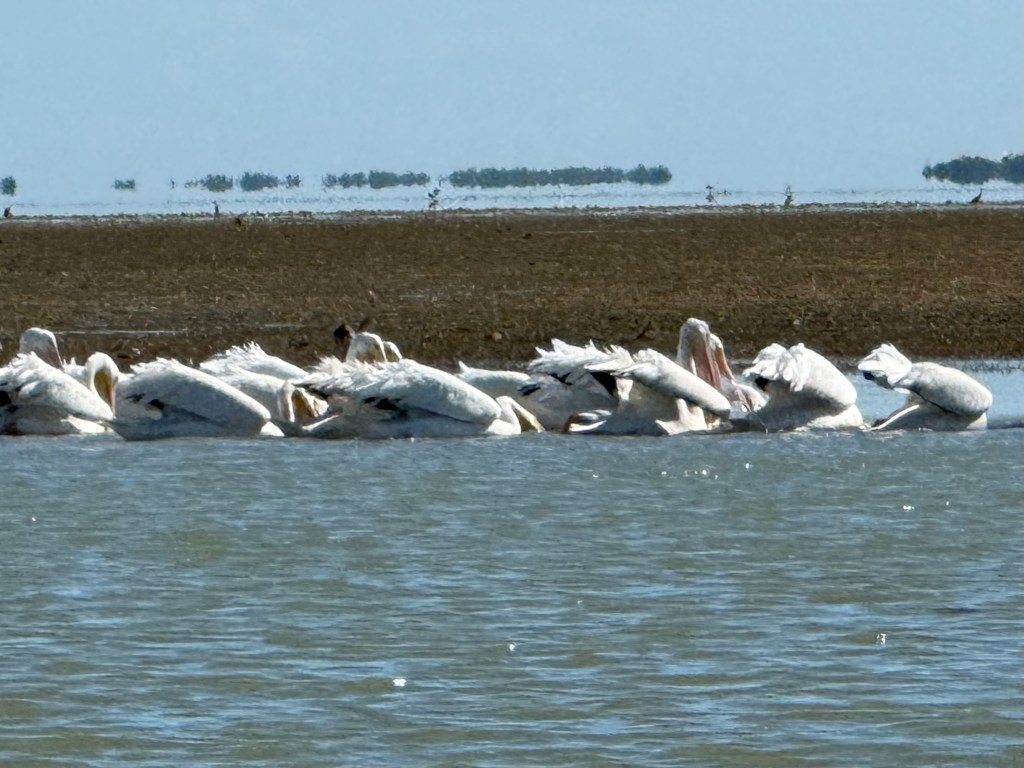
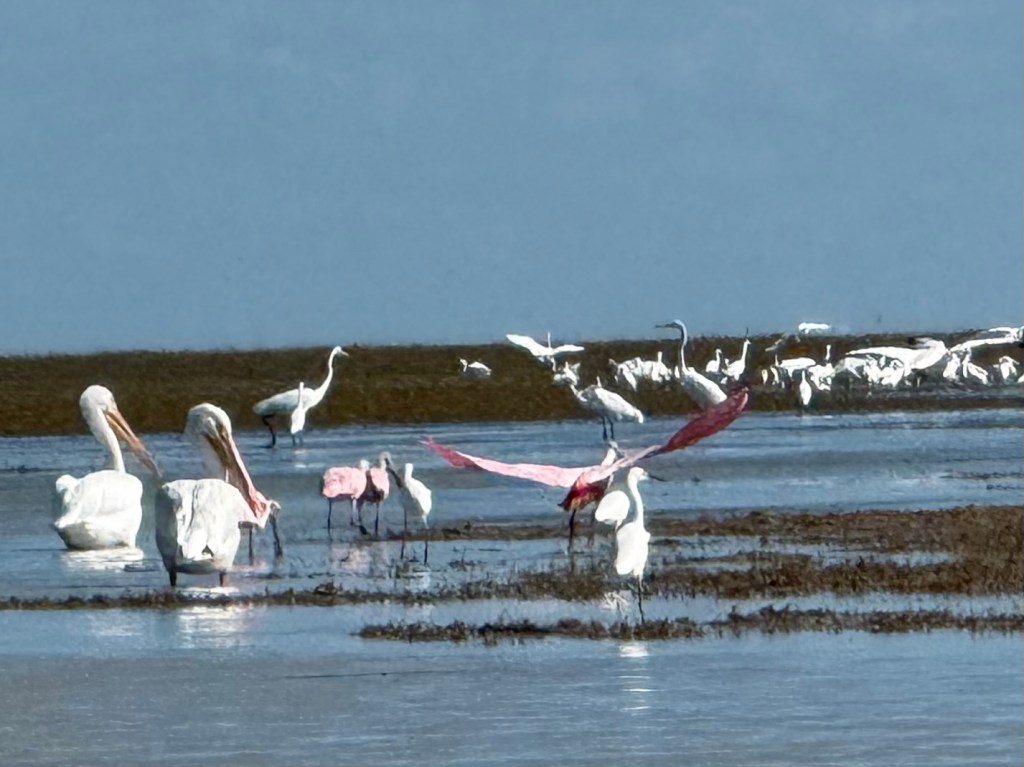
The low tide can bring spectacular birding as it did last week when baitfish and birds filled the runouts along one of the main channels. The flats were covered with winter waterbirds: White Pelicans, Black Skimmers, all the long-legged waders, Marbled Godwits, Short-billed Dowitchers, Wilson’s Plovers, and assorted “peeps”.
White Pelicans fishing cooperatively for mullet.Black Skimmers leaving the flat as the tide rises.White Pelicans, Great White Herons, Great Egrets, Roseate Spoonbills, Snowy Egrets, all fishing the shallow run-out at dead low tide.
When the high tide pushes birds off the flats, some regroup on the highest shorelines, while others settle into the mangrove trees.
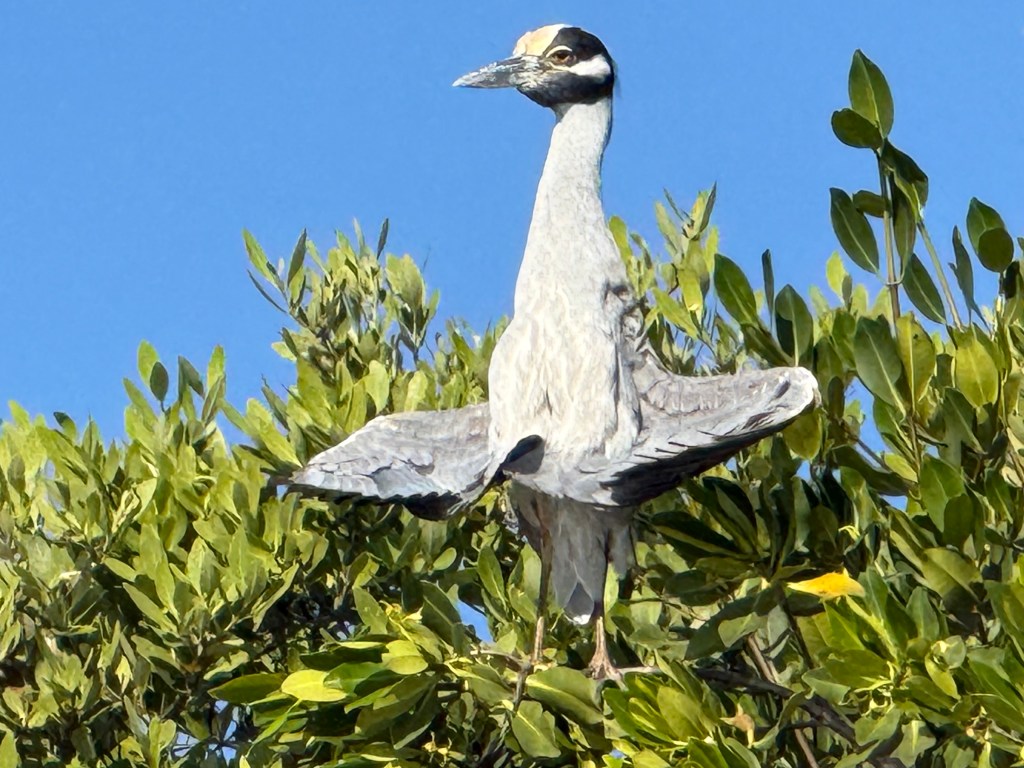
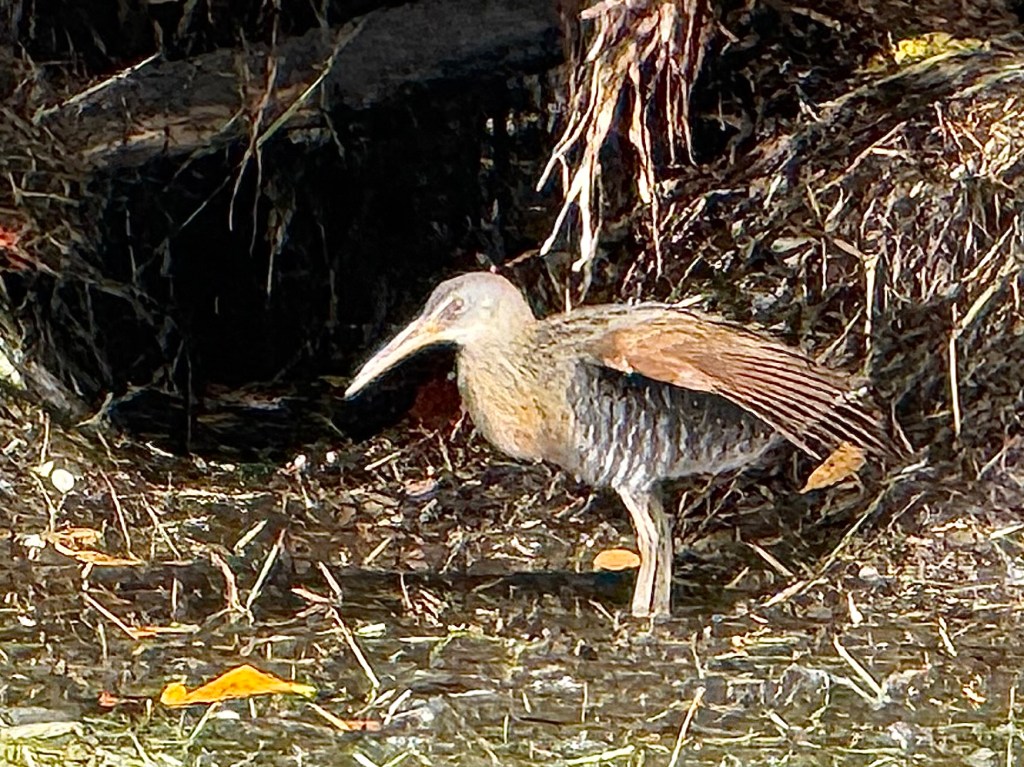
Reddish Egret takes refuge from the high tide on a mangrove island.Yellow-crowned Night heron practices the Angeli Mudra yoga pose.Roseate Spoonbill looks down to assess the water level while waiting for the tide to recede.A Mangrove Clapper Rail skulks through the matted seagrass caught in the mangrove roots.
A couple of days prior, my friend Jay Levine had caught and released 30 Snook on fly in a channel and had zero shark hassles. But when I arrived, the water had rewarmed, the sharks were returning, and the Snook were making themselves scarce. I caught and released a couple of Snook safely but an unseen shark took the third one and I called it quits.
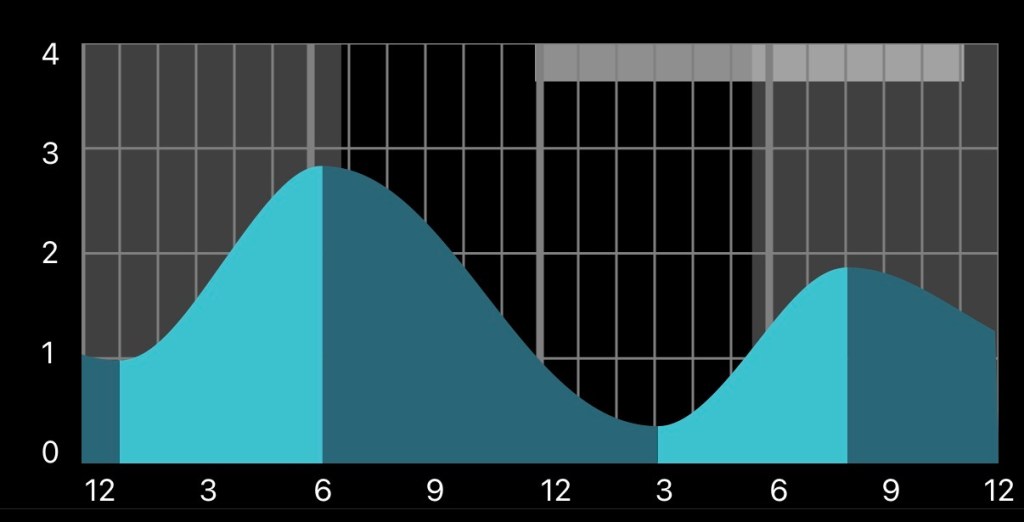
Four days later, my fishing friend Jeremy Nawyn asked me to join him kayak fishing this same flat once again. At first I declined, but then I took a look at the tide chart:
Tide chart for Flamingo on 26 Nov 2025. The black band in the middle is daylight and the gray bar at the top is the moon. The tide on the flat we are fishing is delayed by an hour. It will fall for eight hours, from 7:45 am until 4 pm .
I normally fish this flat by motorized skiff because it’s so exhausting to exit by kayak. If you fish the rising tide (safest) you must paddle back against the fast incoming tidal current to escape, but a long falling tide like this one is a virtual water taxi service. As a lagniappe, the wind would be at our backs coming out. I texted Jeremy that the tide chart had changed my mind. I was in.
Jeremy’s proposal was to head out in the dark before dawn and ride the incoming tide up a narrow unmarked channel on the edge of the flat, then ride the outgoing tide back toward the marina with the wind at our backs. We faced little risk of getting stranded if we stayed in or near the narrow channel, and would not have to fight the tides or winds to escape.
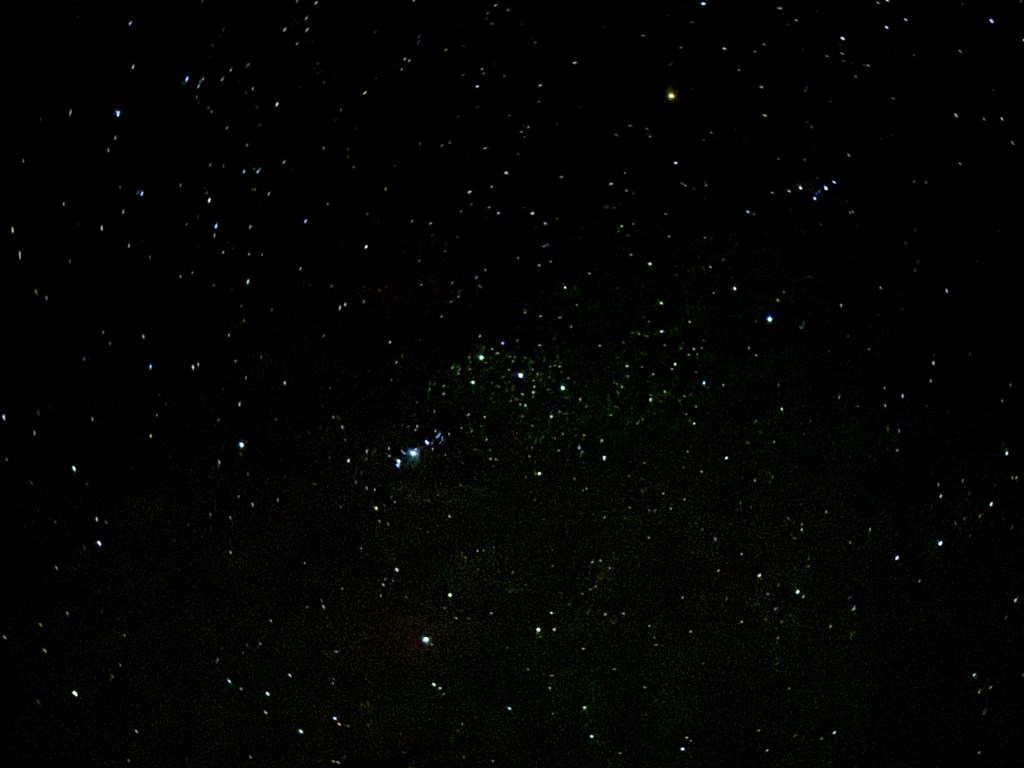
I arrived early to enjoy the starry moonless sky.
Orion.
I rigged my kayak while the resident Barred Owl hooted:“Who cooks for you? Who cooks for you-all?”
Jeremy arrived at 5:30 am with his kayak mostly rigged in the back of his pickup truck. We were on the water by 5:45 am, 70 minutes before sunrise.
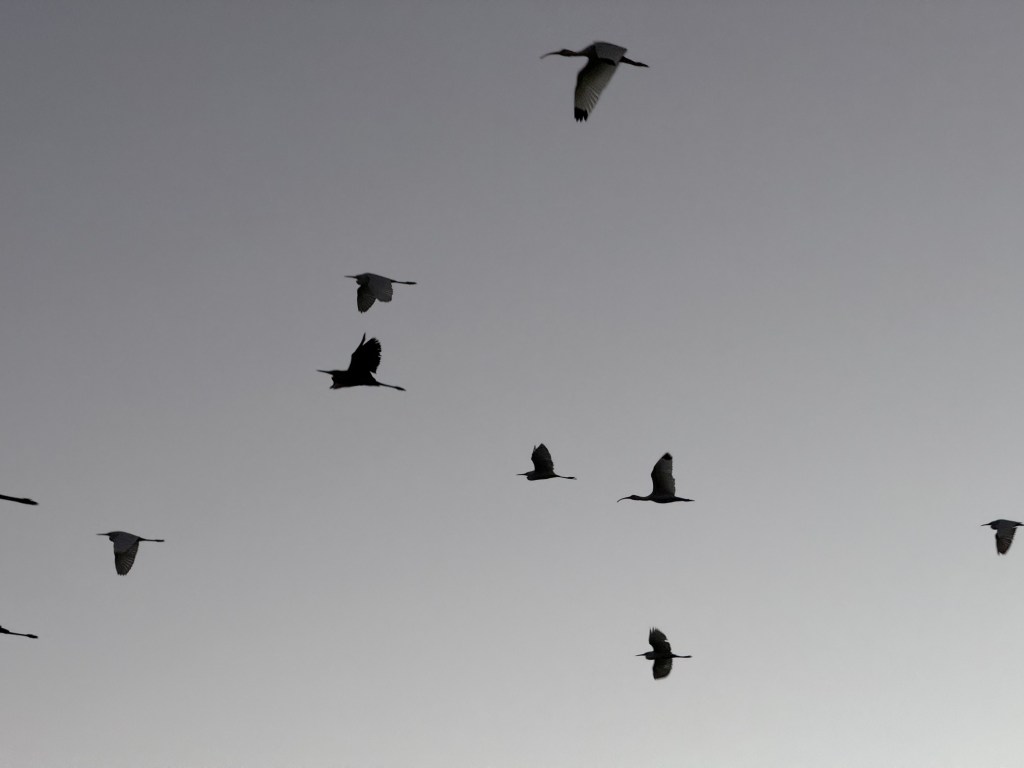
Great Egrets and White Ibis leaving their roosts. White birds look black in the pre-dawn light.Jeremy in the lead. One of his teenage kids sometimes joins us, but not if we’re going out this early.
Our fishing strategy was to paddle the narrow channel and cast toward the mangrove roots on shore where the predatory fish typically forage for crabs and small fish when the tide is up.
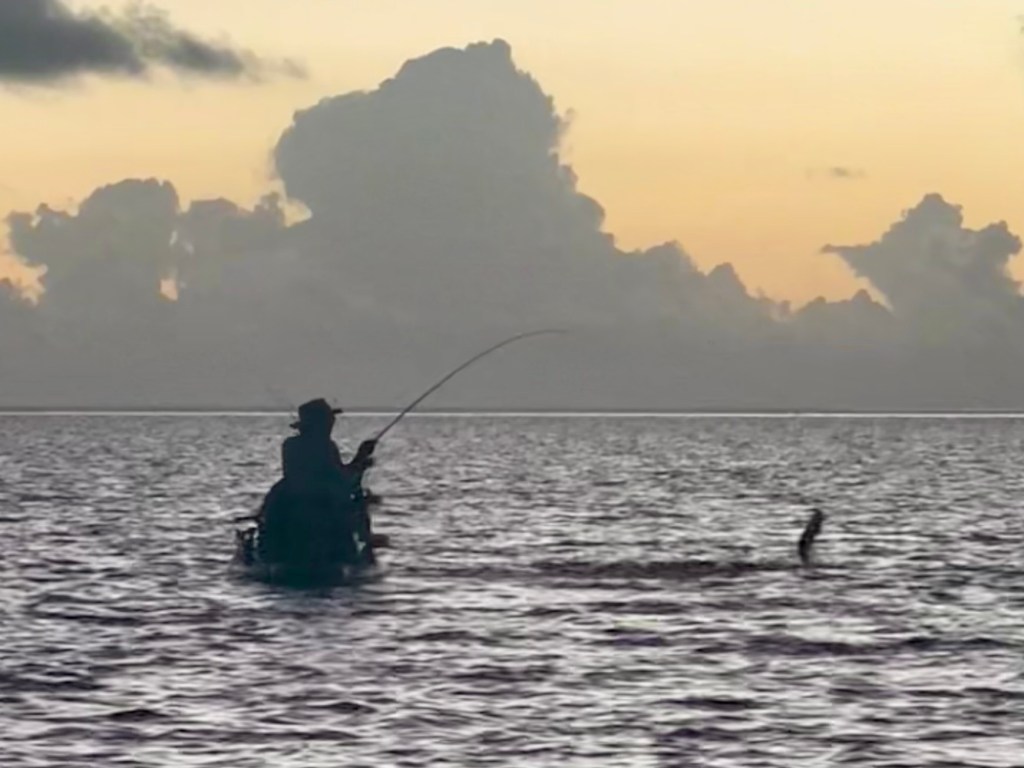
I hooked a nice Snook near the mangroves then pedaled my kayak hellbent-for-leather onto the shallow flat, grounding the Hobie’s pedal flippers on the mud before stopping to work the fish to my landing net for a quick measurement and release.
Phil with Snook in shallow water. Photo by Jeremy Nawyn
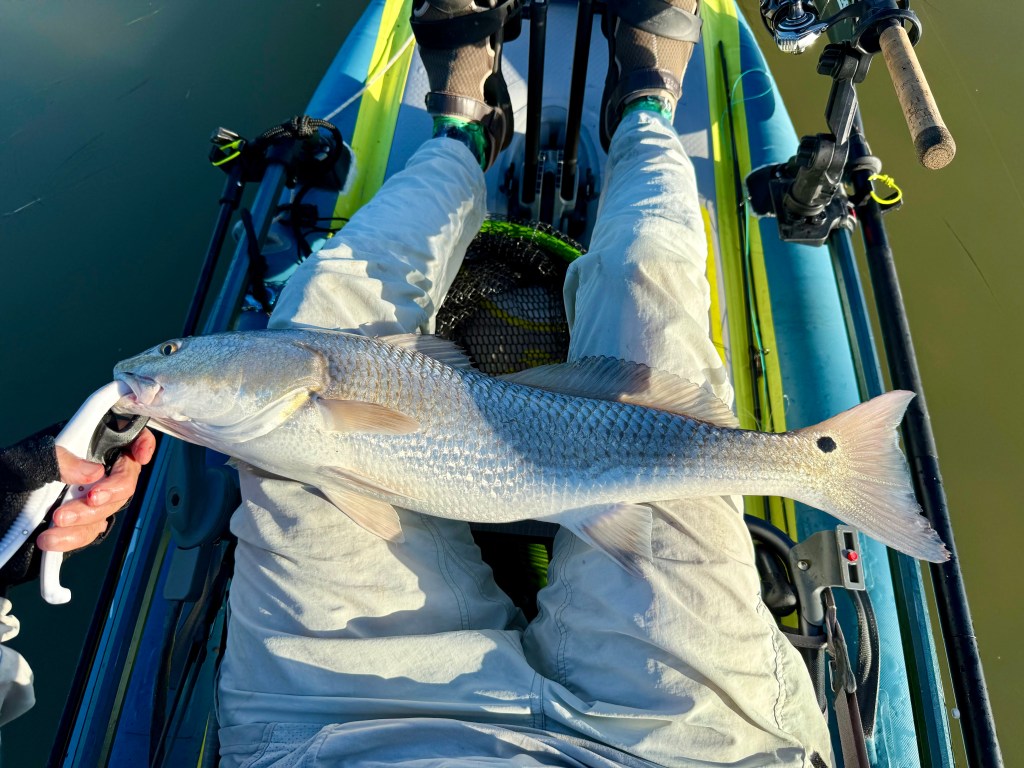
Grounding the kayak on the flat might seem like an odd thing to do on purpose, but it prevents unseen sharks from popping up from below and grabbing the fish on my line. A Snook or Redfish hides handily in a foot of water, but a Lemon Shark or Bull Shark is conspicuous. If a shark comes for my fish in super-skinny water, I can see its approach, open the reel, and let the fish run. My trick worked this morning with a handsome Snook and a chunky Redfish.
Snook, 24″.Redfish, 24.5″
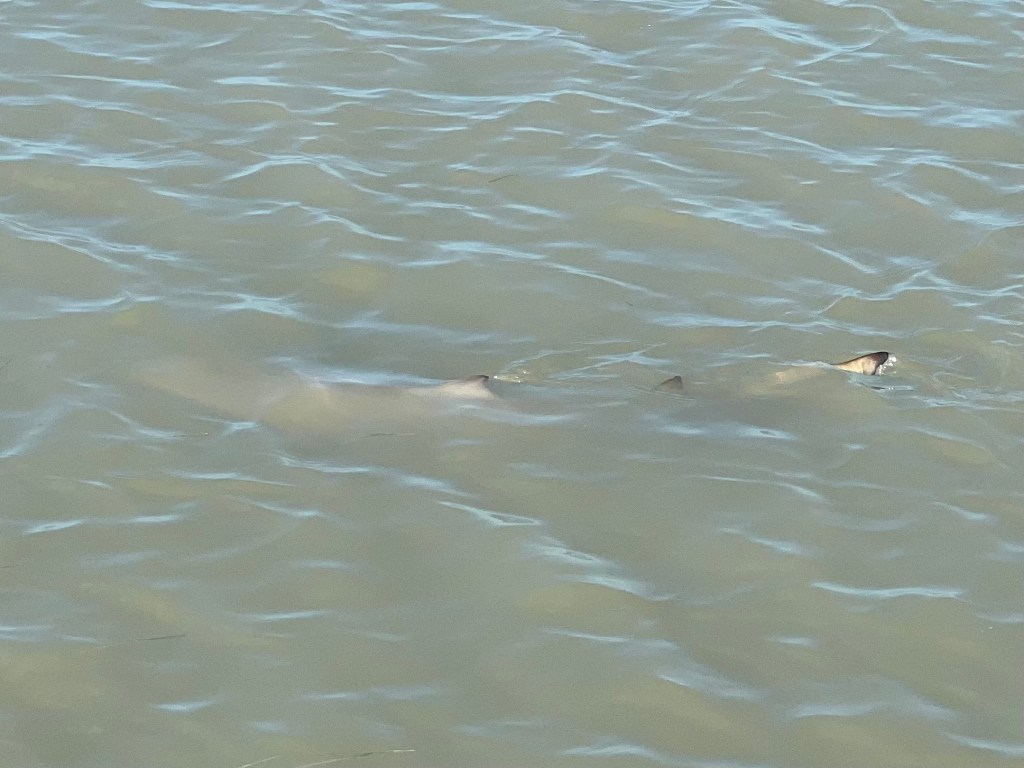
A Lemon Shark circled my kayak looking for my redfish as I hefted it in my landing net from one side of the kayak to the other.
Pesky Lemon Shark circling the kayak.
Enough already. I pedaled the kayak right at the shark to chase it away.
Typical of this flat, the water was opaque with sediment. One could only make out detail in the top 6”, which made it hard to spot fish. At the farthest extent of the tiny channel, a three-foot tarpon swam under my kayak, which I only saw because the water was just a foot deep… and dropping. Time to turn around.
I stopped in at a favorite cove on the way back, wherein I often find Snook and Tarpon. A four foot Lemon Shark had gotten in ahead of me and was working over the cove, chasing all the fish up the mangrove creek – definitely time to head back. As cool as they are to see up close, I don’t want sharks hanging around my boat jonesing for my fish. Lemon Sharks at Flamingo have bitten the hands of several fishermen in the past couple of years and even dragged one careless lad overboard and into the water (YouTube video).
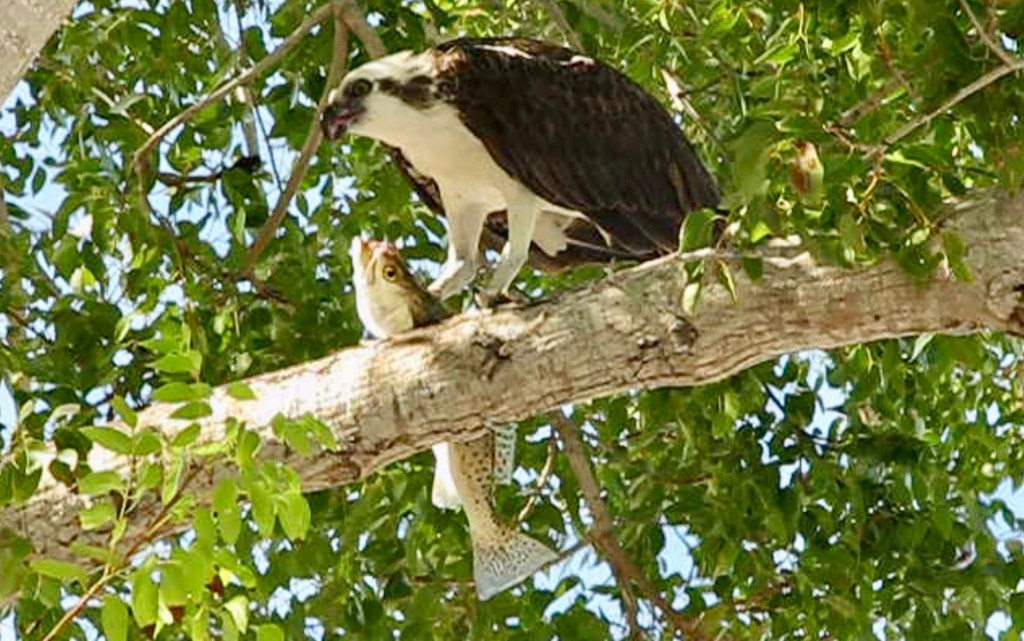
I paused to watch eight Ospreys circle a mullet school, diving in succession, snatching hapless fish, and landing in the trees on shore to enjoy a sashimi breakfast.
This lucky Osprey caught a yummy seatrout.
Full of fresh fish, the Ospreys set about collecting soft material to line their stick nests. Some carried clumps of dead seagrass in their feet.
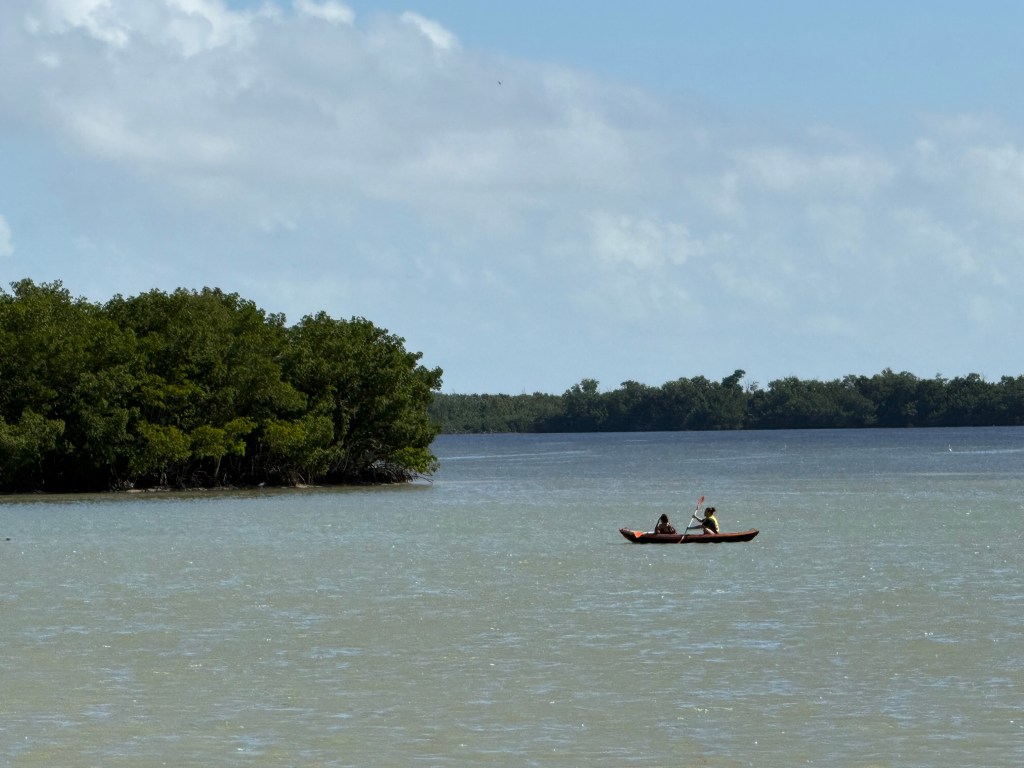
On our way back to the marina, I spotted a young couple in an inflatable kayak paddling the opposite direction, heading toward the heart of the flat. Unless they knew what they were doing, they stood to get stranded in about 20 minutes and stuck there for the next 5 hours. Seeing neither fishing gear nor binoculars, I took them for tourists. I paddled over and asked whether they came here often. “First time” responded the young man in a British accent.
I explained about the tides and the mud, and pointed them toward a channel marker. If they paddled directly to that marker they could spend all day watching birds, sea turtles, and marine mammals from the main channel without getting stranded.
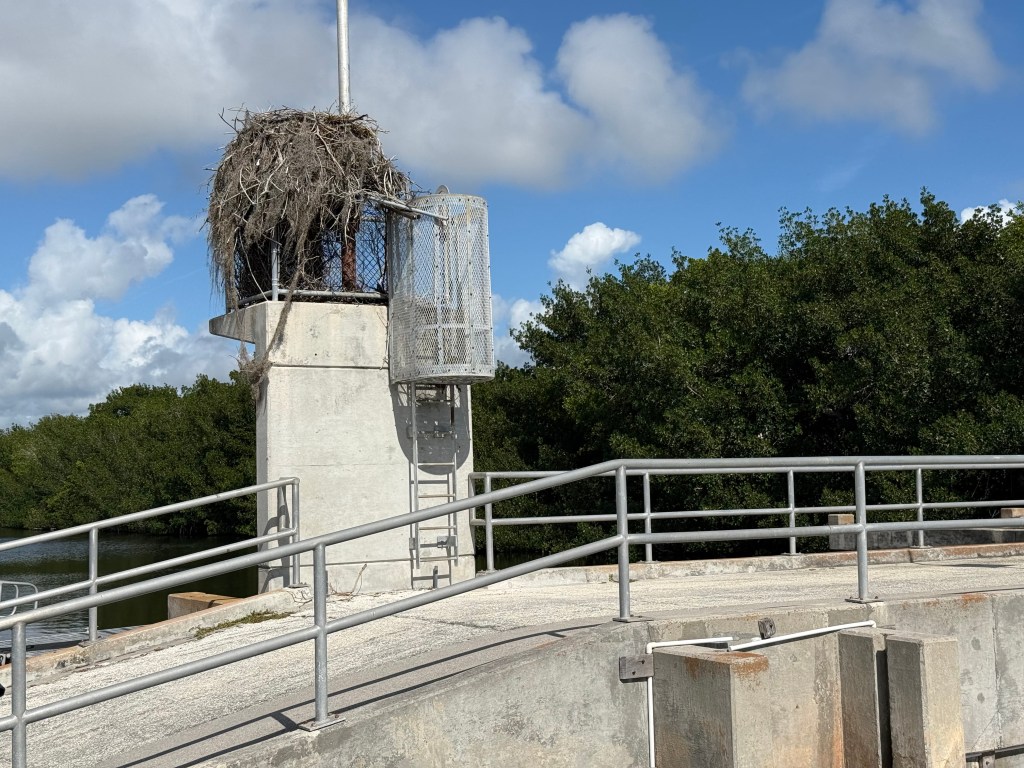
As I packed my gear in the car, I watched another Osprey pair skimming the West Indian Mahogany trees to collect Spanish moss for their bulky nest on the water control lock that separates the Buttonwood Canal from Florida Bay.
Lock Moss Nesters
I ate my lunch while overlooking Florida Bay from the refurbished visitor center. In addition to the wildlife viewing it’s entertaining to watch international visitors enjoying this National Park in their own ways.
Keeping up with Instagram is priority anywhere you go.More my style.
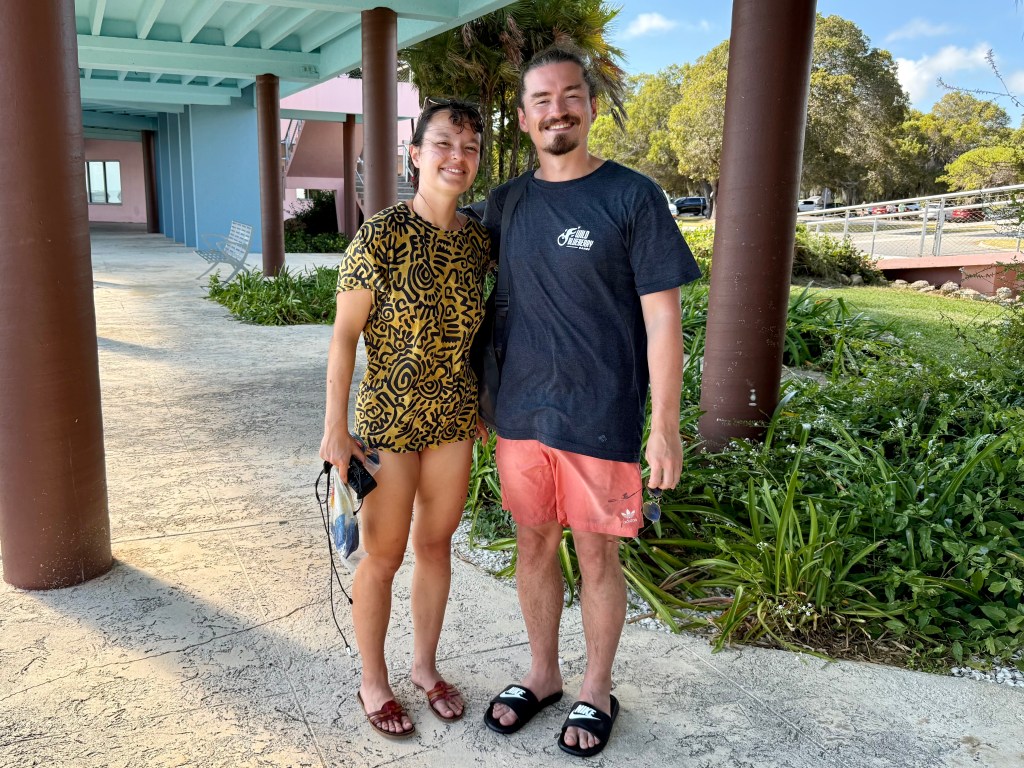
Hey, that’s the same couple in the kayak I saw earlier, now returning from the flats. They pulled their boat ashore and stopped by to say “hi”.
Caroline from Strasbourg and Jason from London.
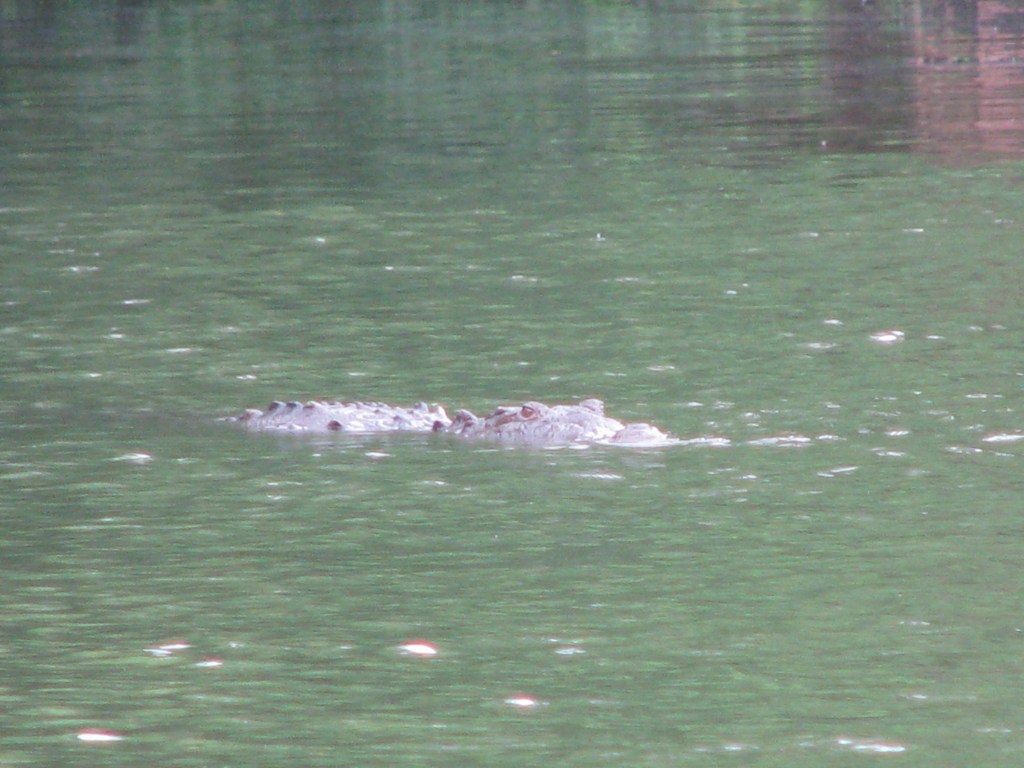
They had decided to head back in after a large American Crocodile surfaced in the channel next to their inflatable kayak.
My photo, not theirs, but you can see why they might have felt unsafe in an inflatable kayak.
Until recently, I’d have told them not to worry about the normally docile American Crocodile, but last summer an experienced fly fisherman told me of a large croc at Flamingo that went airborne in its best attempt to take him off the deck of his skiff.
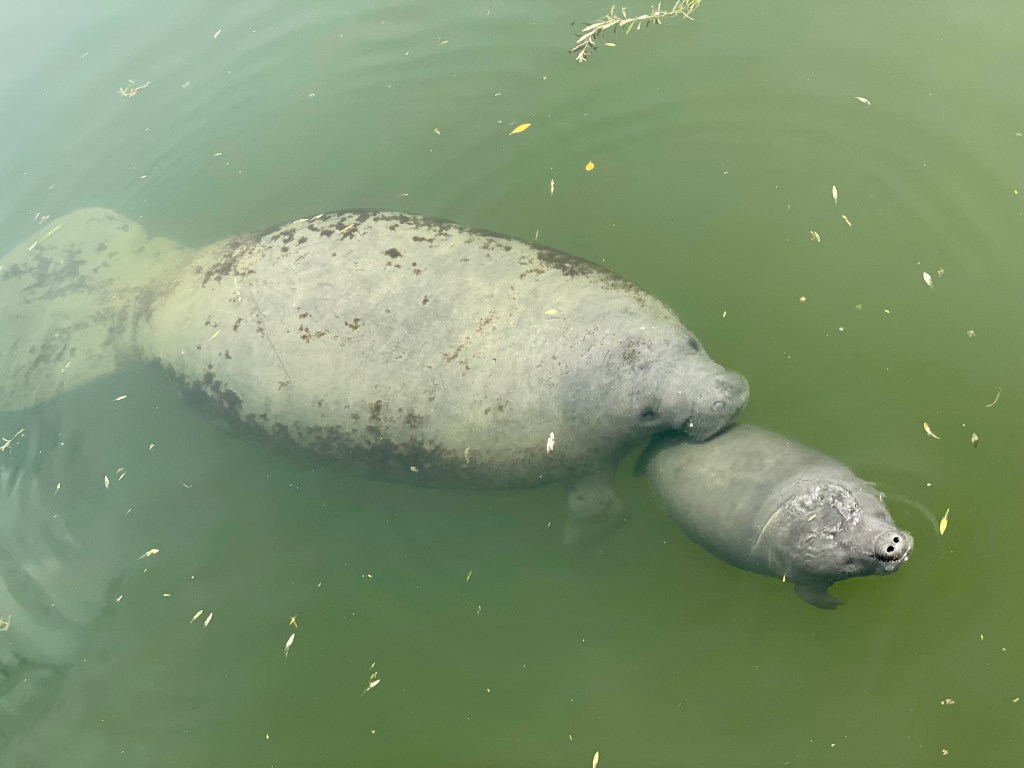
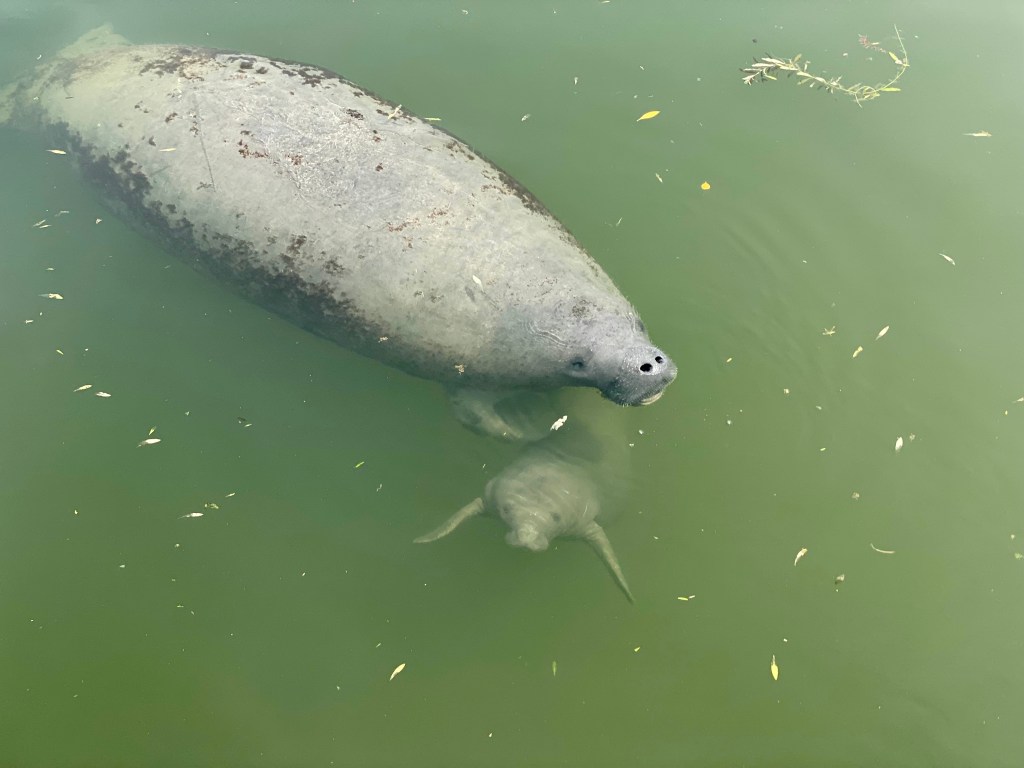
I took Caroline and Jason over to the marina to admire the assembly of mother and baby manatees.
Too cute.
* * *
Pandora’s Flats
A couple of months back, I promised to write an essay about why you shouldn’t fish at Flamingo. The dense mosquito swarms are sufficient reason for normal people to stay away nine months of the year. Risk of stranding on the flats while exposed to sun and lightning should give pause to any sane person. We recently acquired the man-made problem of habituated sharks and crocodiles popping up at random from the opaque water below – recreational fishing boats have trained them well. If you just wanted to fish, you might find an equally productive area with fewer ancillary hazards.
American Crocodile. Note the skinny snoot, Roman nose, and 4th tooth on the bottom that sticks up.
All of these risks have proven insufficient to keep a certain zoologist away. The combination of birds, fish, and scenery will keep me coming back as long as my health and the rising seas allow.
My last few fishing trips onto the flats have been unproductive. The late summer water has been hot and low in oxygen. Maybe the fish are somewhere else, or maybe they’re just laying low. Tomorrow morning I’m venturing back into the mangrove lakes of Mosquito Hell, an area where I always find fish this time of year, assuming the Black Salt Marsh Mosquitoes (BSSMs) don’t drive me out first.
Trip planning
The moon is near full tonight, so the morning fishing activity is likely to be brief. I plan to arrive in the dark to maybe find a snook or two before the sun comes up. Then I’ll peddle-paddle my kayak to an area where the tarpon hang out and snook spend their day hiding in the mangroves. Occasionally, a snook wakes up for a mid-morning snack. If I find the juvenile tarpon rolling, I can see if they’ll play with me. Like snook, tarpon feed actively at night on a full moon, so they may be sated by the time I arrive.
I’m preparing for the BSSMs the night before, putting into play a few improvements over my last trip to Mosquito Hell:
I take my khaki fishing pants, outer shirt, and gloves to the driveway, spray them with DEET, and place them inside a 2-gallon zip-loc bag. I lay out a towel to protect the car seat from the DEET. The rest of my special mosquito gear I place on the passenger seat: for my head, a Tilley hat and insect head net; for my feet, Simm’s neoprene wading gaiters and neoprene dive booties. Mosquitoes are not going to bite through 5 mm of neoprene.
My scheme is to drive to the launch in the dark, and change into my stinky DEET-soaked clothes, then get out of the car to rig and launch my kayak. I will start fishing at 06:00, before the first dawn light. The nearly full moon sets at 05:49 and the sun rises at 07:06, with civil twilight starting at 06:36.
It’s tricky fishing in total darkness, and tricker fly fishing. I only know that a snook is nearby if I hear it blow up the water while chasing mullet. Sometimes the water is silent. Other times I cast too far and hang the fly into a mangrove tree. Then I have to turn on my head lamp to untangle the line and of course the light attracts mosquitoes to my head. But other times I cast the fly near a snook and things get exciting in a much better way. Hope springs eternal.
My alarm is set for 3:50 am. Time for bed.
Fishing report
On the Mosquito Horror Scale (0-10) the morning ranks an 8, “Severe” but not “Extreme”. My mosquito gear system works perfectly. The only mosquitoes that try to bite me are 3 or 4 that go for the pads of my fingers where I have no repellant. That’s not a safe place for a mosquito to bite a human, and they are instantly dispatched with a pat of the finger. With my DEET-soaked outer clothes, mosquitoes don’t even follow me into the car.
No mullet are splashing around the kayak launch area in the dark, so no predatory fish are there either. Too bad – sometimes the fishing is amazing right there. I light out for the far mangrove shore, about a mile’s paddle.
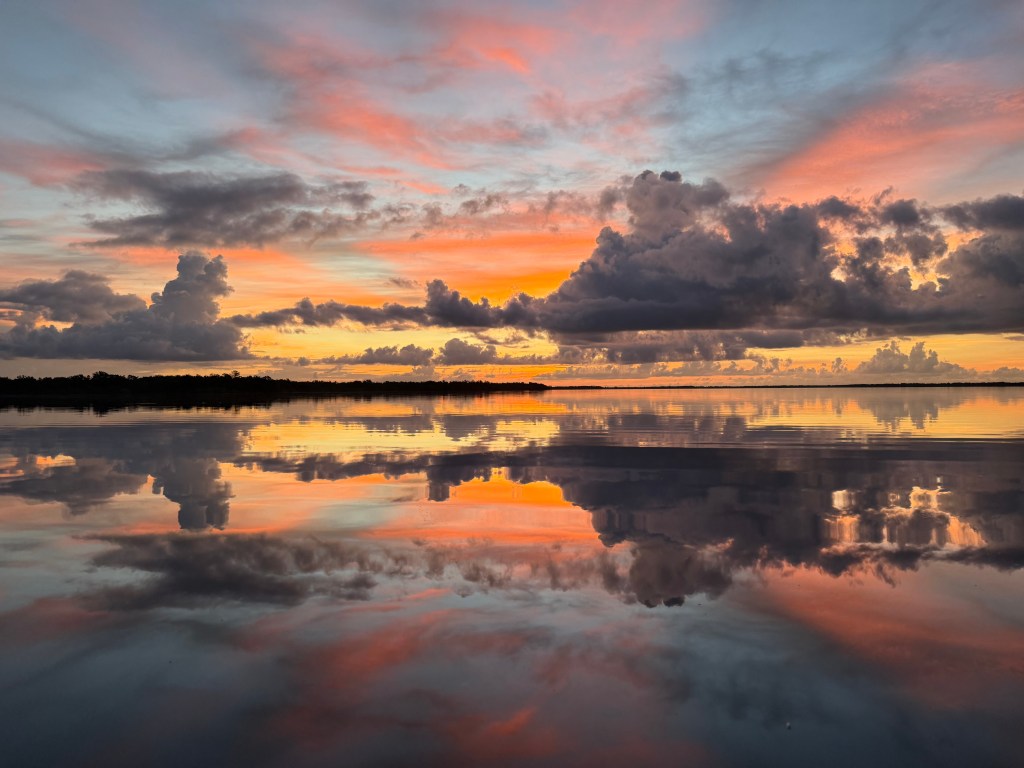
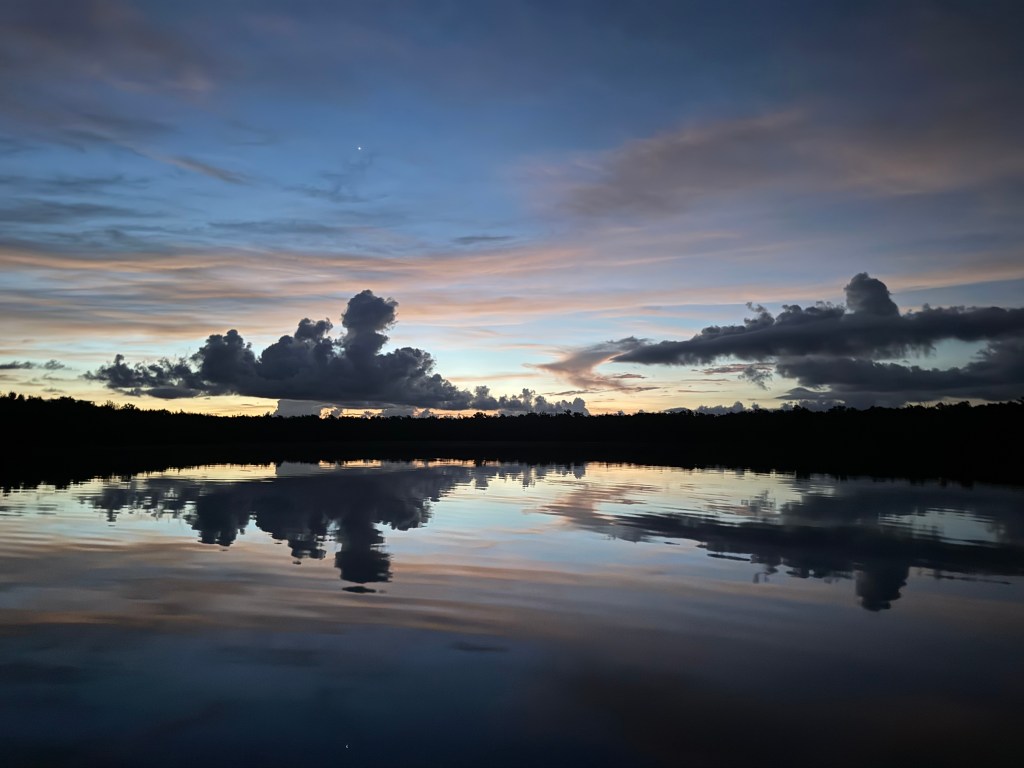
The first traces of dawn light appear, with Venus still visible directly above the tallest thunderhead on the left.
Dawn explodes enroute. Yowza.
I reach the other side eight minutes after sunrise. The water is extremely murky and tannic, like donut shop coffee with a tiny splash of horrid non-dairy creamer. I dip my finger in the water and taste it through the head net: slightly brackish.
To find fish in water this opaque I need a “search bait” that’s dark, for maximum contrast when viewed from below against the sky, but with some sparkle and a lot of vibration to get a fish’s attention. I put away the fly rod and rig my spinning rod with a 4” paddletail in rootbeer & gold with a gold underspin jig – just the ticket.
The paddletail, true to its name, wiggles its tail back and forth, and the underspin leaf twirls up a storm.
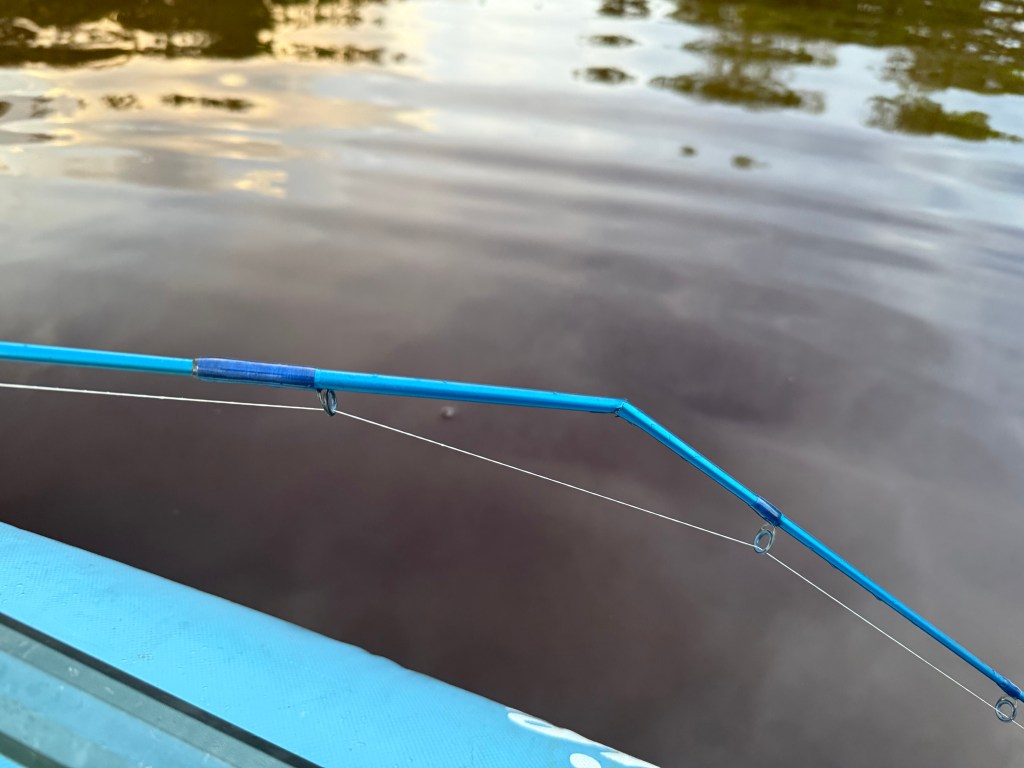
At 7:15, my second cast is slammed by a snook in the 30″ range. It makes one jump, a brief lateral run pulling line off the reel, then runs straight for me as fast as I can take up line. It passing directly under the middle of the kayak, bending the rod hard. The tip section of my three-piece TFO travel rod snaps, creating a brief moment of slack that pops the lure free of the fish’s mouth.
This is the 4th time this spinning rod has broken, every time in exactly the same spot, 5″ above the ferule. Until now, I’ve blamed myself, but thinking on it, each break occurred under a different circumstance and stress geometry and I’ve never broken any other spinning rod. I’d wager the TFO Traveler is weak at the internal edge of a carbon fiber sheet wrap. I will write the company about this problem. I bought two replacement tip sections the last time one broke, so I still have one left, but I need a more reliable multi-piece spinning rod.
Why even bring a travel rod on a local fishing trip? When kayak fishing tight to the mangroves, it helps to have the rods I am not using at the moment disassembled and stowed safely out of the way. That’s a key advantage of multi-piece rods, not to mention the obvious advantage when I travel.
Back to fishing. Having broken the spinning rod, it’s “fly or die”. I re-assemble the 8wt fly rod and choose a black dark-water fly, this one tied from Drew Chicone’s pattern, The Devil’s Daughter. The tail is ostrich and peacock herl, the body is fluffy marabou feathers, and the head is spun deer hair. Peacock herl gives It shimmer and the ostrich and marabou make it swish enticingly in the water.
I start with the fly in the photo and immediately hang it in a mangrove. Impatiently, I shove my kayak into the mangroves to untangle the fly, leader, and line, then tie on another I’d made with a weed guard to keep it from hanging in trees and roots.
Predatory fish that have spent the night foraging under a bright moon generally won’t be hungry again until the afternoon. This morning fits that typical pattern, with fish ending their feeding spree shortly after sunrise, shortly as in 9 minutes. In the next hour, I get rained on briefly (feels good) and catch a couple of small juvenile tarpon on fly (they’re always hungry), while their older cousins roll on the surface for air but won’t eat.
Fishing is over until afternoon but the shoreline holds birds, orchids, and bromeliads. I can see for miles, the mosquitoes have let up, the rain shower has cooled things off, and I have yet to spot another human. It’s has turned into a pretty fine Sunday in the Everglades wilderness, but it’s time to get out. Bigger storm clouds are assembling and I don’t want to be crossing open water in an electric storm.
On the way home I stop by Moreno’s Tortilla shop in Florida City to pick up hot tamales and a pack of corn tortillas. Josephine greets me and knows what I want without my asking. This little hole-in-the-wall makes the best Mexican tamales and you can’t buy all-corn tortillas this good in a supermarket.
On the drive back, I divert 10 miles to check out a canal that friend Jay and I had identified from a YouTube video. In the video, a young kayak fisher from out of town was catching lots of fish while getting bitten on the eyelids and lips by something he called “yellow flies”. As soon as I step out of the car I am engulfed by a swarm of hungry deer flies. Uh oh.
I consider deer flies even worse than mosquitoes because they are active midday when it’s too hot for protective bug clothes, they will find the the tiniest spot of skin on which you did not apply repellant (e.g. lips and eyelids), and their bites really hurt.
Climbing over two metal gates, swat swat swat, I find the kayak put-in, swat swat. From the vague track through the vegetation, swat swat swat, I can tell it’s rarely used. I wonder why not, swat swat.
I mash the deer flies that followed me into the car and photograph one that wasn’t too mangled.
Serious rain slows the drive home but returns a few minutes by washing salt from the kayak and car.
Unpacking my fishing gear, two stow-away mosquitos escape into the house. It’s still summer here in South Florida where if it’s not one nasty biting bug it’s another. I’ll bet the Wisconsin Driftless Area is getting really nice about now.













 Eye of the Cormorant