We have a 2023 Tesla Model-Y. We might not have bought one today, given the company’s CEO and largest stock-holder, but selling the car would not hurt this asshole one iota, and it’s still a great car, especially for long road trips.
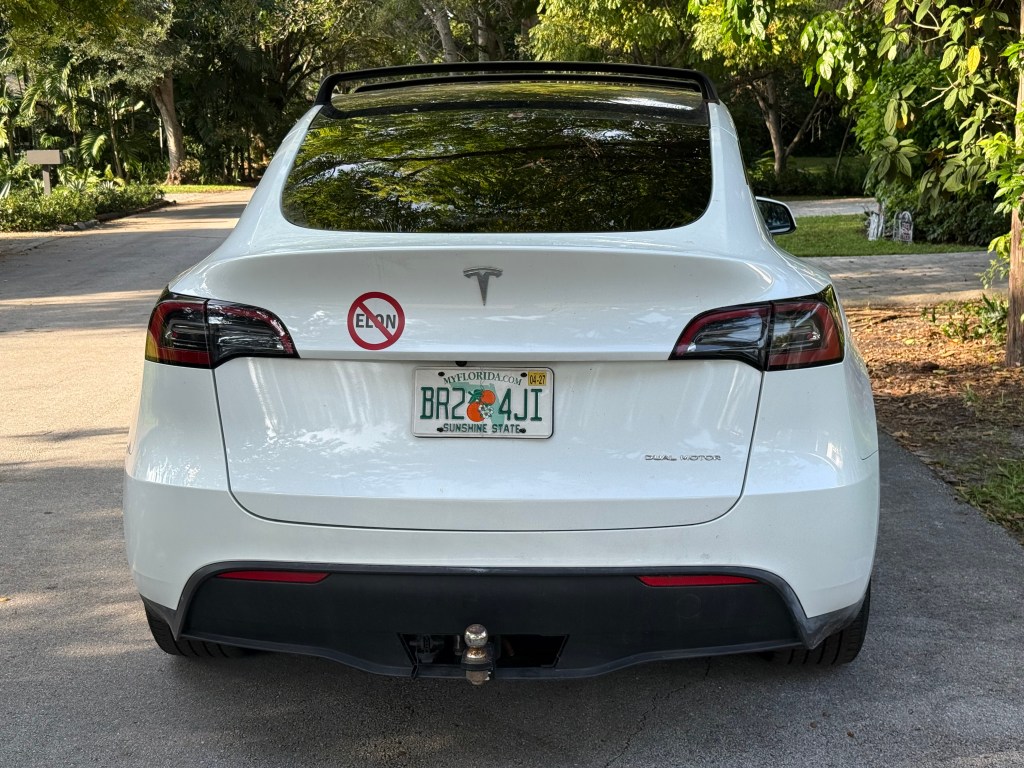
When we got the Y, nicknamed “the Batmobile”, the all-wheel drive model was the only EV on the market that could tow my boat trailer to Flamingo and back on a single charge. It’s been a great car overall. My friend at Tesla says it’s the best of the Tesla line, and that you’d have to get a Rivian at double the price to get a better EV.
One thing I like is that the car keeps getting better instead of staying the same or getting worse. Every two weeks, Tesla pushes a software update to the car. The most recent one adjusts the headlight angle dynamically to keep the beams level when the car is loaded differently (e.g., towing a boat trailer). No more beams tipped up into the eyes of unhappy oncoming drivers.
Two and a half years ago, Tesla offered a free one-month subscription to “Full Self-Driving Mode (Supervised)”. This is the software that lets the car drive itself autonomously. The word “Supervised” means that you have to keep your eyes on the road, and the car watches to make sure you do. It also wants you to keep hold of the steering wheel.
This would also be the same software that has produced some spectacular and fatal crashes. Essentially Tesla encouraged customers to pay for the experience of beta-testing self-driving software on American roads at 70 plus miles an hour.
Since I got a month free, I decided to try it on my morning drive to work. What could go wrong?
I quickly found that my car visually tethered itself to the car directly in front, speeding up and slowing down constantly to maintain an exact interval of 7 car lengths. It failed to anticipate problematic traffic conditions that were visible to me several blocks ahead and which could have been avoided by changing lanes early. Plus, the car required constant supervision. I had to be ready to intervene instantly if it did something stupid or unexpected. It was like being driven to work by an over-caffeinated student driver, not relaxing in the slightest. After 15 minutes, I’d had more than enough. I turned off the self-driving software and ended my free subscription 29 days early.
Fast forward two and a half years.
My climate scientist friend John Van Leer was an early Tesla adopter, driving his Model S all over the country. John now owns a Tesla Cybertruck, which he operates in Full Self-Driving Mode (Supervised). After my experience, I was amazed to hear John say it drives better than he does. Either John is a terrible driver or Tesla’s Full Self-Driving Mode has improved considerably.
Another friend, Peter Rabbino, has a Tesla Model-Y in which he too has “handed over the keys” to Full Self-Driving Mode (note: a Tesla does not have keys). Hearing my disparaging view, he asked when I last used Self-Driving Mode. Two and a half years ago? Peter insisted that today’s software had learned an immense amount in that time and was a different beast entirely. He urged me to give it another try.
So I did. Here’s my report.
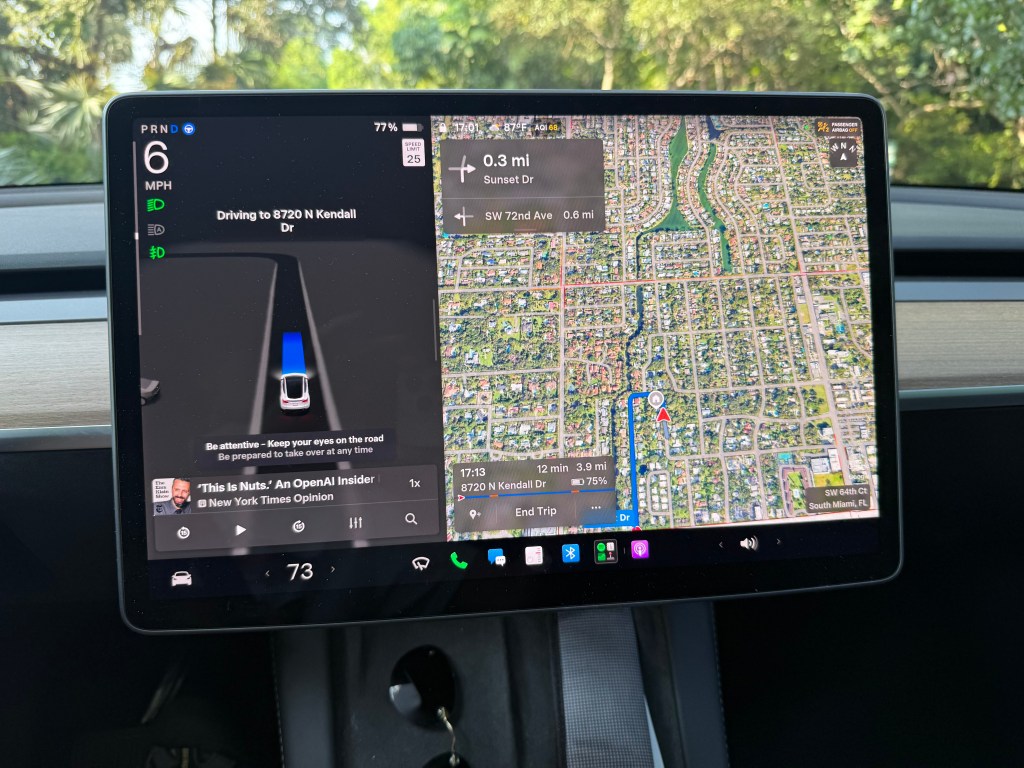
Executive summary
Tesla’s Full Self-Driving Mode (Supervised) is now great on the highway but still sucks in town.
Suburban driving test
On Monday, the software drove me around Miami for a couple of medical appointments, one of which was the ophthalmologist who would dilate my pupils and make it hard to drive home. The car got me where I wanted to go, but it made regular mistakes that required my intervention. Here are some of its bone-headed maneuvers:
- Turning out of a medical office complex driveway at a blind intersection on SW 87th Ave, my car started to pull into traffic. It noticed a car coming, slammed on the brakes, and sat there. The driver of the other car stopped in the middle of traffic and waved her hand for me to go. Of course my car didn’t recognize her hand gestures and wouldn’t move, so I took over and pulled out, waving a thank you / apology to the other driver.
- Preparing to make a left turn at a traffic light on US 1, my car abandoned the left turn lane for the next lane over, a thru lane with fewer cars. Then it tried to cut back into the turn lane it had abandoned. I’m not an asshole (Elon), so I took over and waited for all those cars to clear the intersection on the left arrow before pulling back in and waiting through the next light cycle for my turn.
- The software got stumped by an orange plastic barrier erected in a complex parking lot at Baptist Hospital and had to be rescued, which I managed through two pairs of sunglasses, despite my chemically compromised vision.
Highway driving test
On Tuesday I had the software drive me to Jupiter FL and back for a fishing trip, two hours each way.
I hadn’t slept well after a late dinner and was pretty tired when I headed out from home in the dark at 4:45 am. Not a bad morning to have someone else do the driving.
At site of the new SR 836 bridge over the downtown, the highway was closed for construction. The car got off the highway on its own, wended through a maze of twists and turns near the Miami River, and wound up back up on I95 headed north. One thing that can mess me up on a trip through unfamiliar territory is the double right exit problem. Sometimes you’re directed to make a turn then encounter two exits close together that are not well-enough marked to figure out in a limited time which one you should take. The software knew and chose the correct turn every time. Much appreciated.
I truly hate driving on a highway in the dark with a concrete construction barrier on one side of me and trucks roaring along on the other side. Full Self-Driving Mode handled it with grace, holding smoothly to the lane without causing me anxiety. I made it through the construction zone at the posted speed without the usual white knuckles. Thank you, car.
After that I had to do nothing except watch the road, hands on the wheel, until the car pulled into the parking lot for the boat ramp in Jupiter.
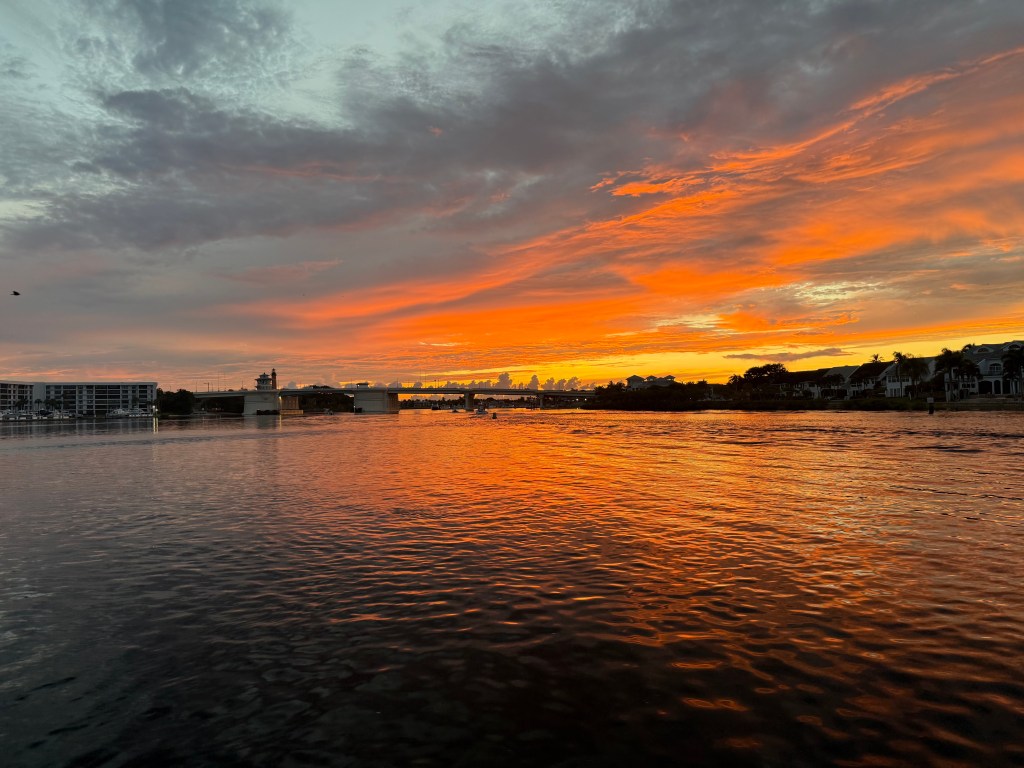
It proved a gorgeous morning to be on the water with my former student, Capt. Mike Haines.
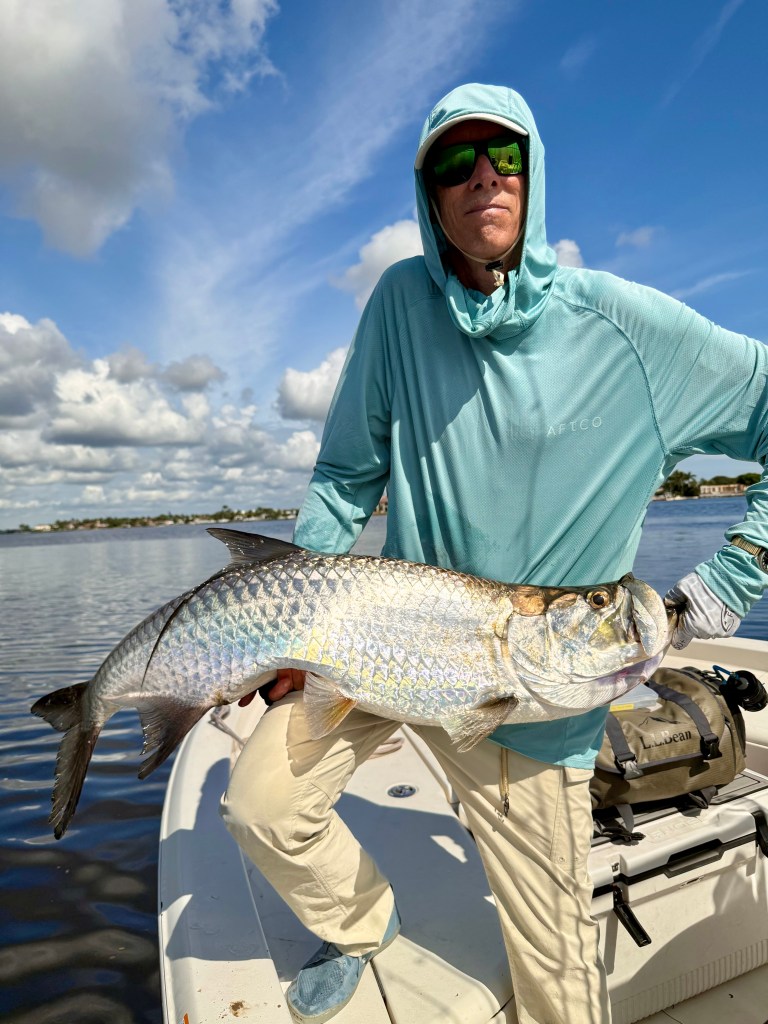
I caught and released some nice fish.
Driving home was smooth, save for the software making one significant suburban driving mistake and one minor highway driving mistake.
Just as the car reached an intersection between the boat ramp and the highway, a traffic light turned yellow. The car drove on through the yellow, which was fine, but mid-intersection, it tapped the brakes three times in rapid succession. NO! BAD CAR! Stop before the intersection or go through it, but for heaven’s sake, don’t split the difference.
The car dId a great job monitoring speed limit signs and adjusting the speed accordingly, but it did miss one speed limit sign in a construction zone. I caught it and slowed down.
Heading south on Florida’s Turnpike, a thunderstorm opened up full bore. I let the software continue driving to see how it would perform. It did surprisingly well. The car held the lane perfectly despite the low visibility. We slowed down just a little because the cars in front of us had done so.
The self-driving software has three modes “Chill”, “Standard” and “In a Hurry”. I started out the day in Chill mode and found it a bit too chill. Coming up behind another car going 5 mph under the speed limit, my car tended to hang back. When I bumped the mode up to “Standard”, it was more inclined to change lanes so as to maintain the speed limit. The car’s cameras look in all four directions at once, so it changes lanes really well, better than I do. It does a famously good job of avoiding the bad driver who shifts lanes without looking.
I found that I could maintain sufficient attention for the odd situation that might require my intervention, such as the missed speed limit sign. I appreciated that the robotic system never got tired, its mind never drifted, and it could hold the lane on a curve while I selected a new podcast.
* * *
As of October 2026
Tesla’s Full Self-Driving Mode (Supervised) resembles other AI systems in that it doesn’t have a social conscience. It defines other vehicles in its working space as car, truck, or motorcycle objects and doesn’t recognize the rights, desires, or intentions of their drivers. Nor does it pay attention to their brake lights. The Tesla has such good regenerative braking, I almost never touch the brake pedal. But lacking even the simplest theory of mind, the self-driving software fails to anticipate the actions of other drivers (e.g., the driver of the car in front of us is probably going to slow before reaching the red light), so it has to brake fairly often. Frequent braking makes the ride less smooth, the EV less efficient, and it puts unnecessary wear on the brake shoes.
I don’t drive that way and I don’t want to be driven by a robot that drives that way, so I won’t use the self-driving software when driving in town, where social accommodation is a priority.
However, I will definitely use Full Self-Driving Mode for future highway driving on long road trips, where the software might outperform a normal driver. On the highway, being careful and predictable is generally sufficient courtesy to the other drivers. I don’t mind taking over when we leave the highway in order to get a more relaxed experience with fewer snafus.

