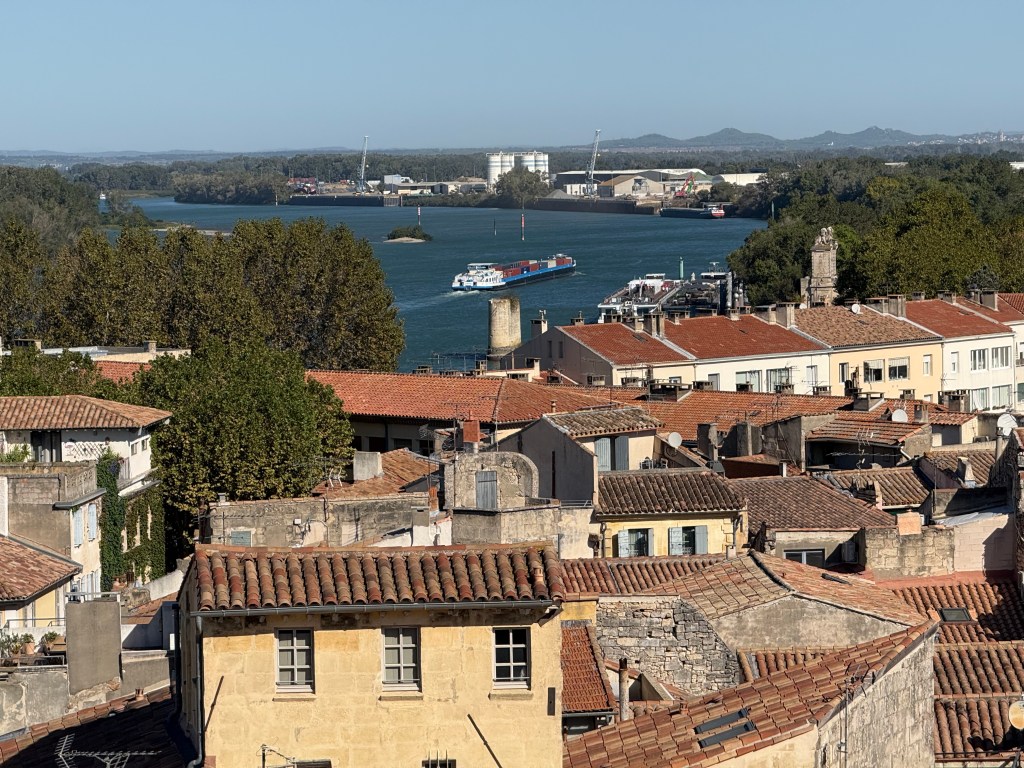
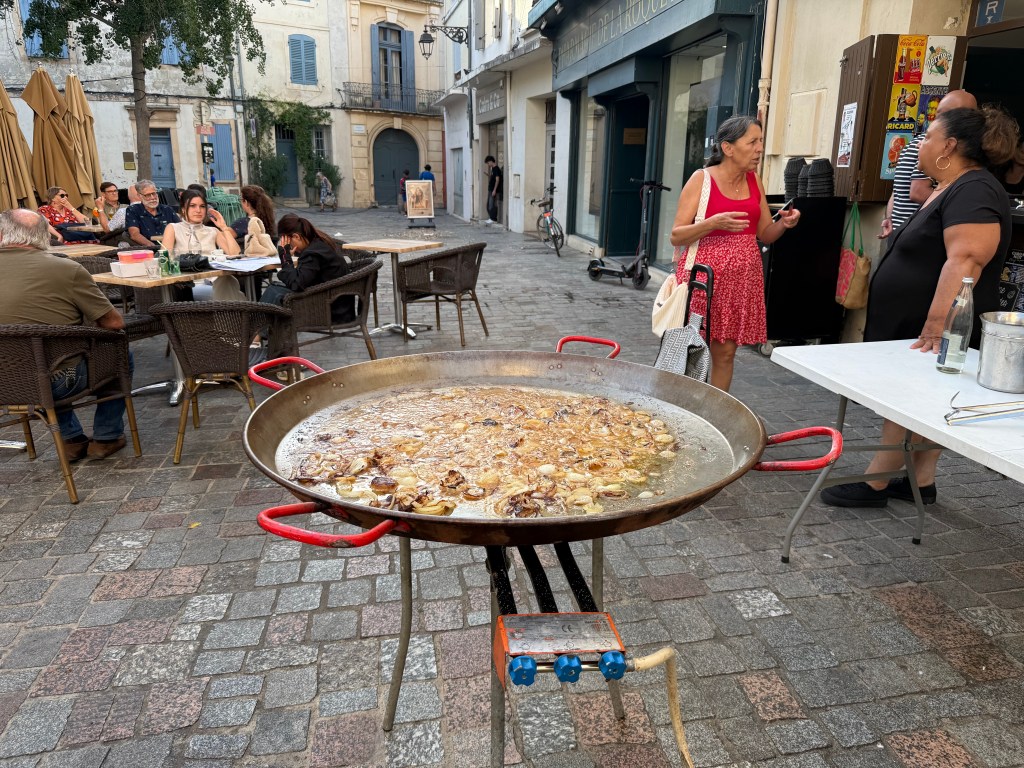
The city of Arles in the south of France dates to pre-Roman times. Built at the mouth of the Rhône, three millennia of silt deposition has left the city ~50 km inland of its original situation on the Mediterranean.
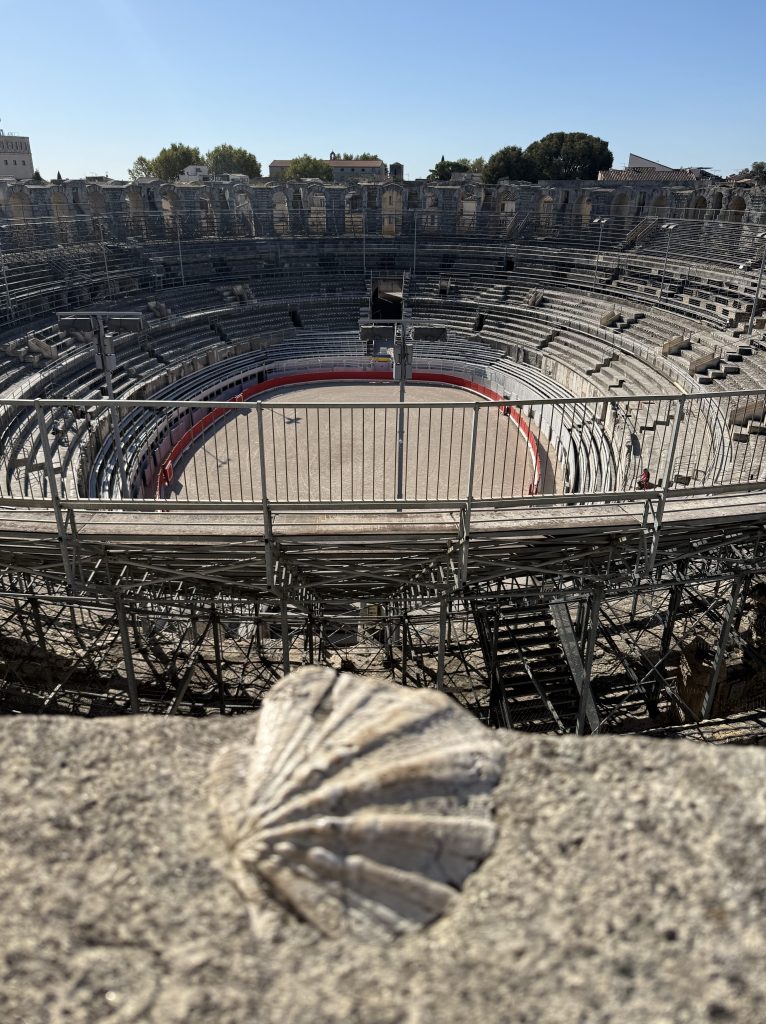
Romans took control of the city and built an arena to entertain their new subjects with gladiator fights. The arena has been partially restored. Incongruous metal bleachers with safety rails were added to accommodate modern audiences in the highest places where the original stone seating could not be supported. Ascending and descending the steep stone stairways in the strong Mistral wind of the Rhône valley, we appreciated the new iron hand rails.
Not wishing to restrict entertainment to the martial arts, the Romans followed up their arena with an elegant semicircular amphitheater next door. It has been partially reconstructed as well. While we sat in the top row, one of a group of Japanese tourists stepped up to the stage at the coaxing of his friends. Here’s a snippet of what happened next:
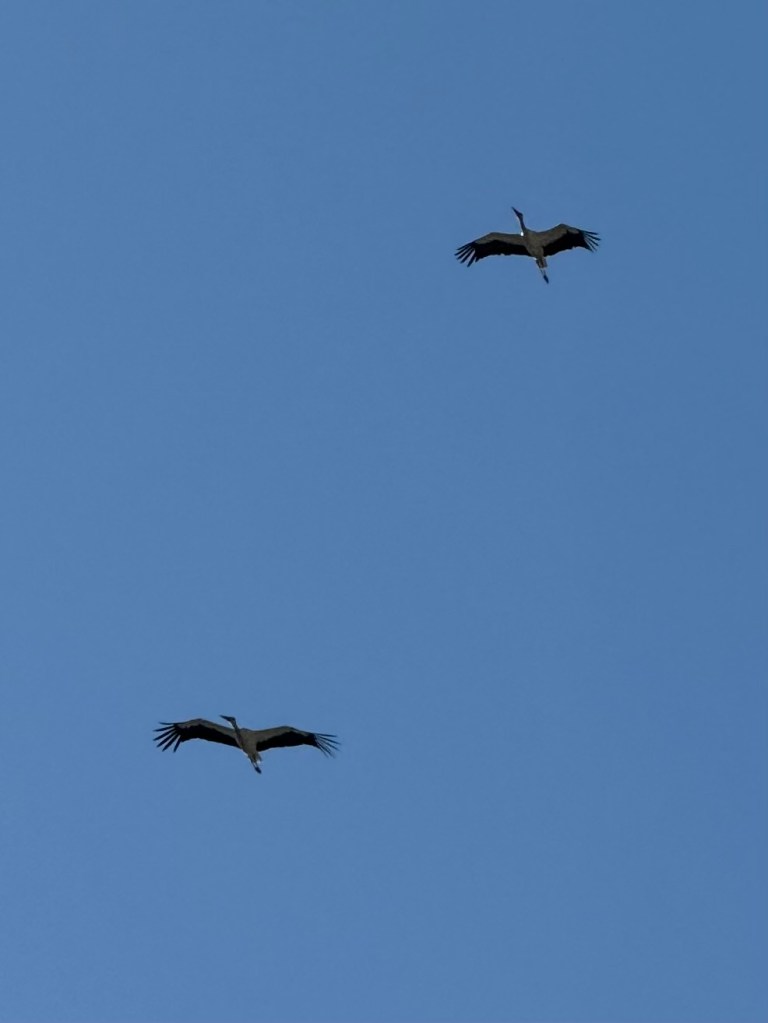
Wherever I go, I seek out nature the way a beagle hunts a dropped slice of pepperoni. Accordingly, I spotted wild things on the periphery of the urban hardscape. High atop the rim of the ancient arena, I watched White Storks catching thermals to assist their migration southward to sub-Saharan Africa.
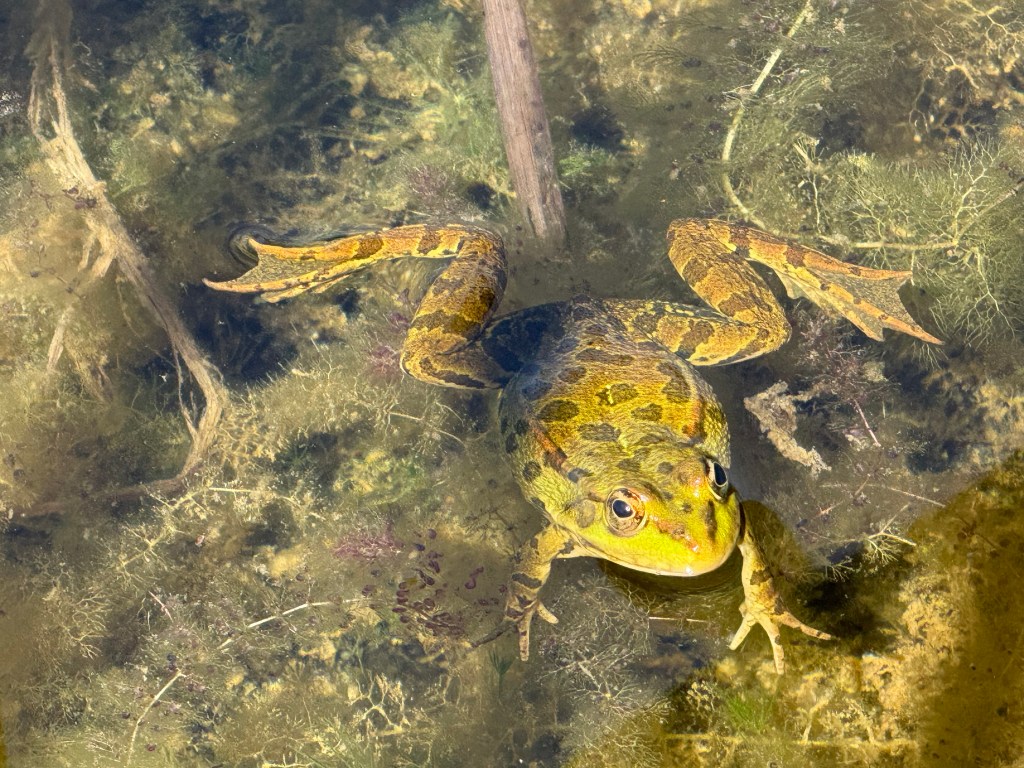
In the marsh of a finely landscaped park next to Frank Gehry’s shiny LUMA tower, I found happy frogs of Arles celebrating the departure of the hungry storks.
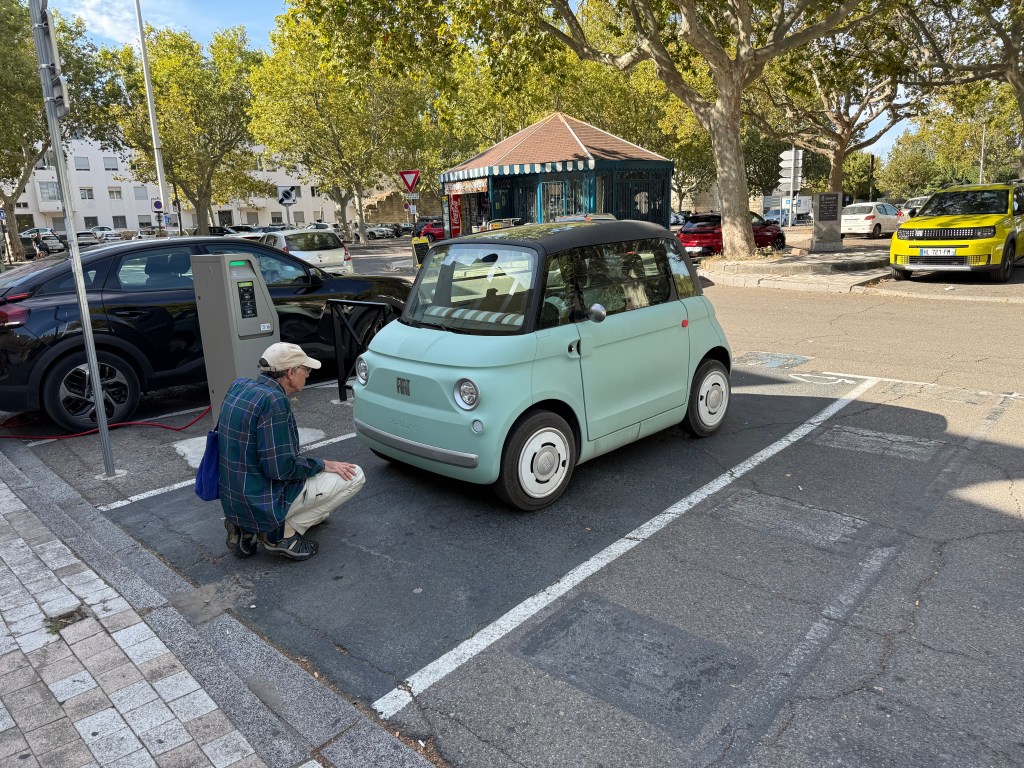
Does a tiny Fiat Topolino (“little mouse”) EV count as animal, vegetable, or mineral?
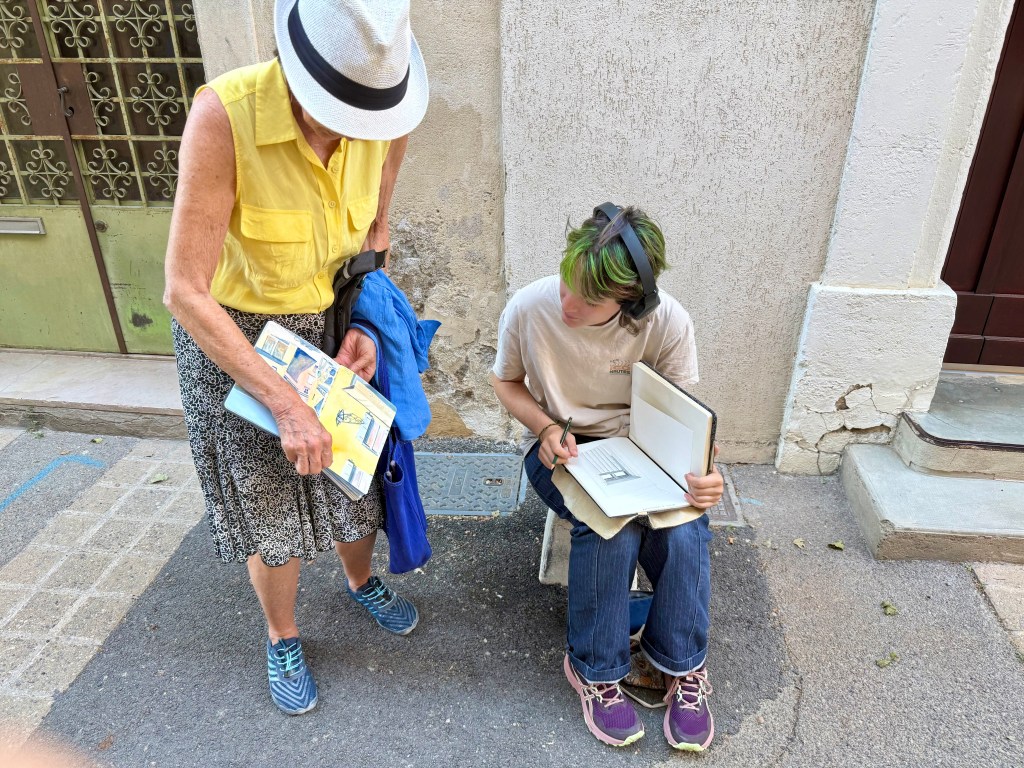
Vincent van Gogh, during his 16 month stay in Arles, produced 300 paintings. Gray, sketchbook and watercolor set in hand, cooed in ecstasy our entire week in Arles.
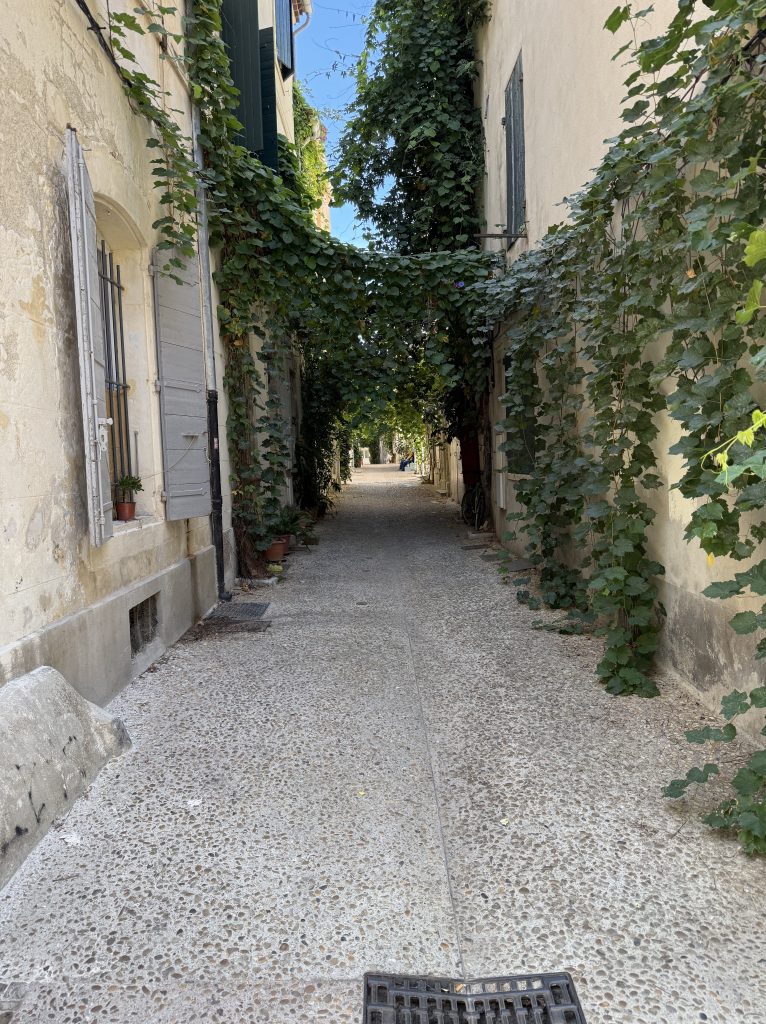
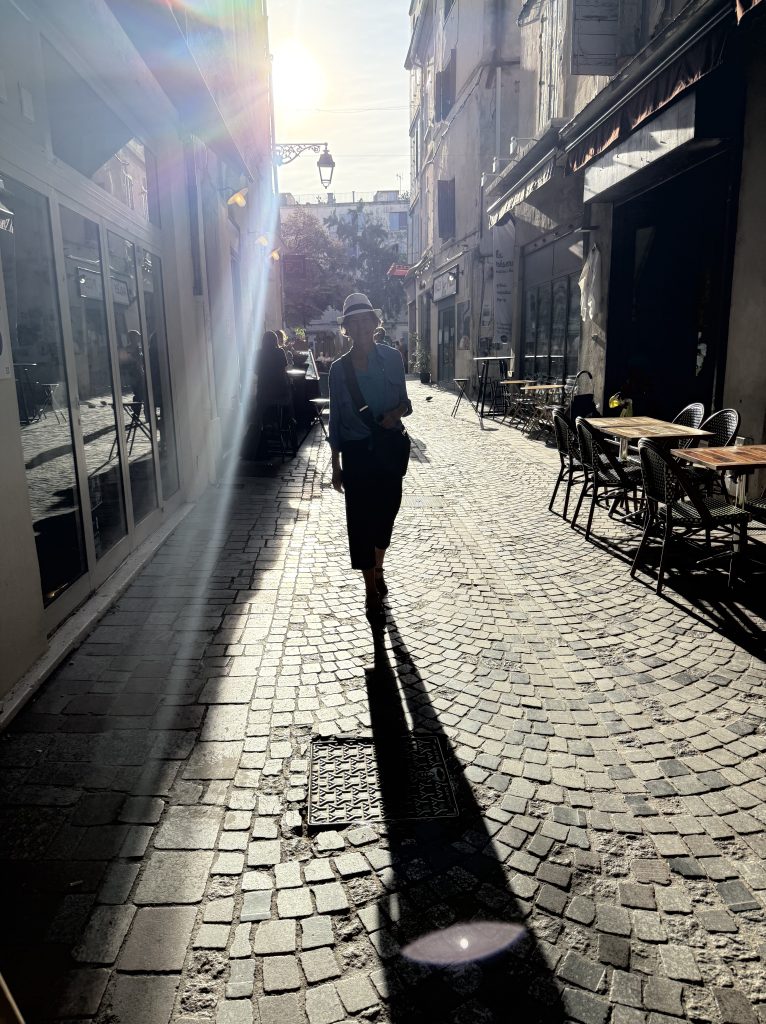
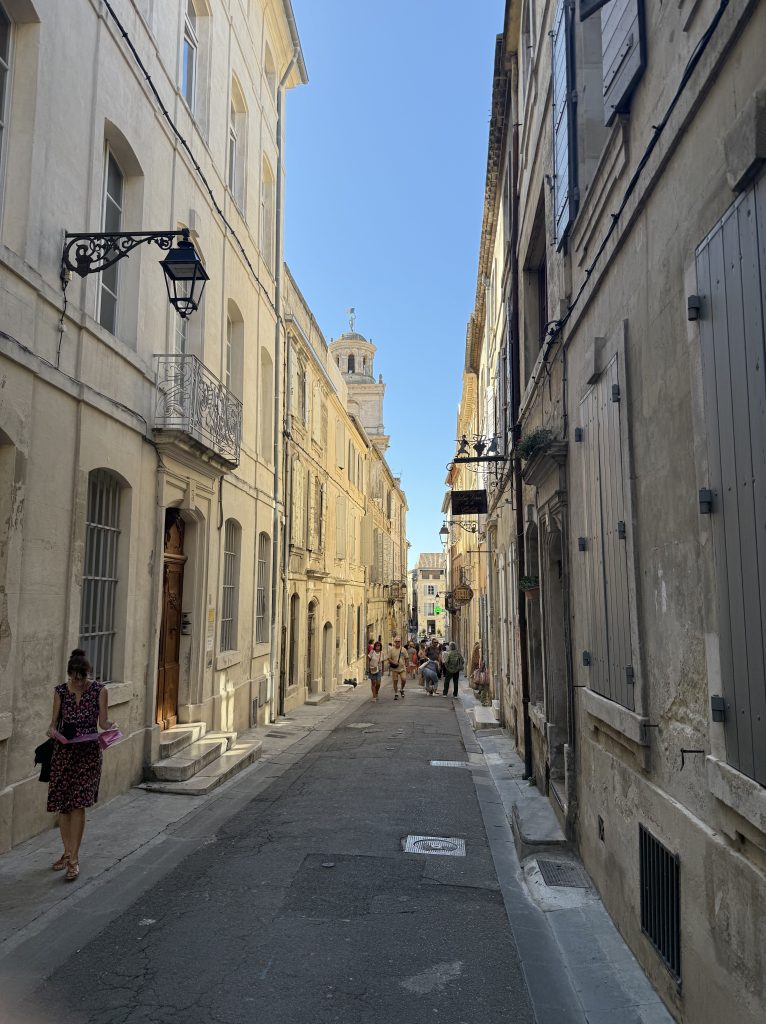
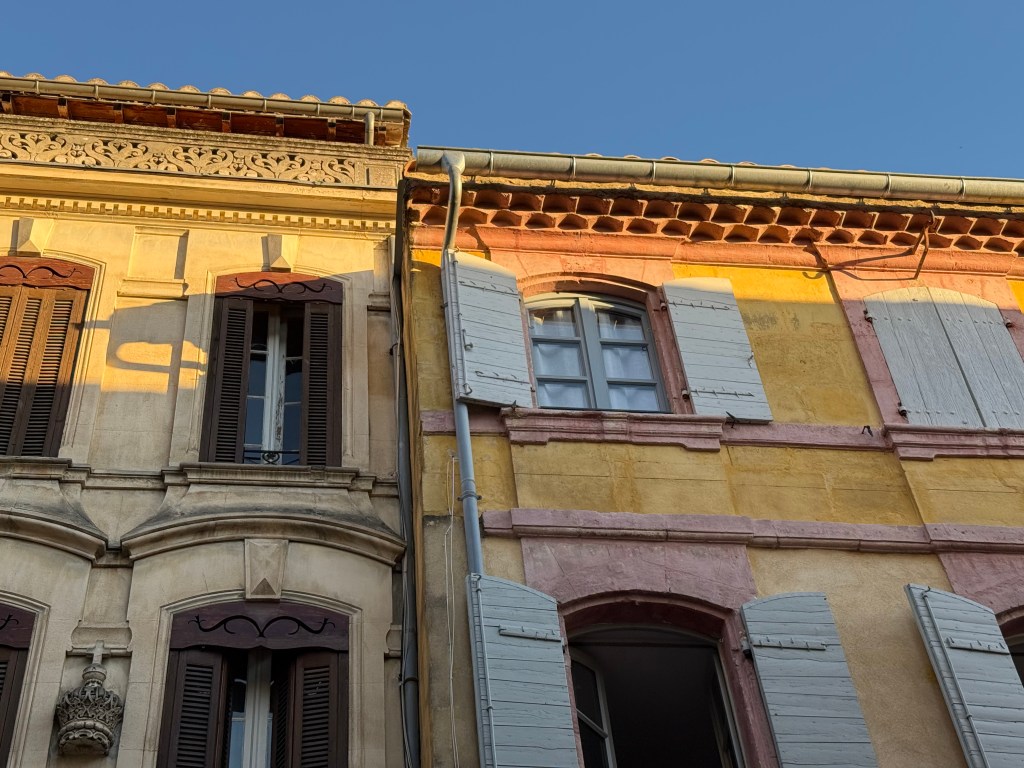
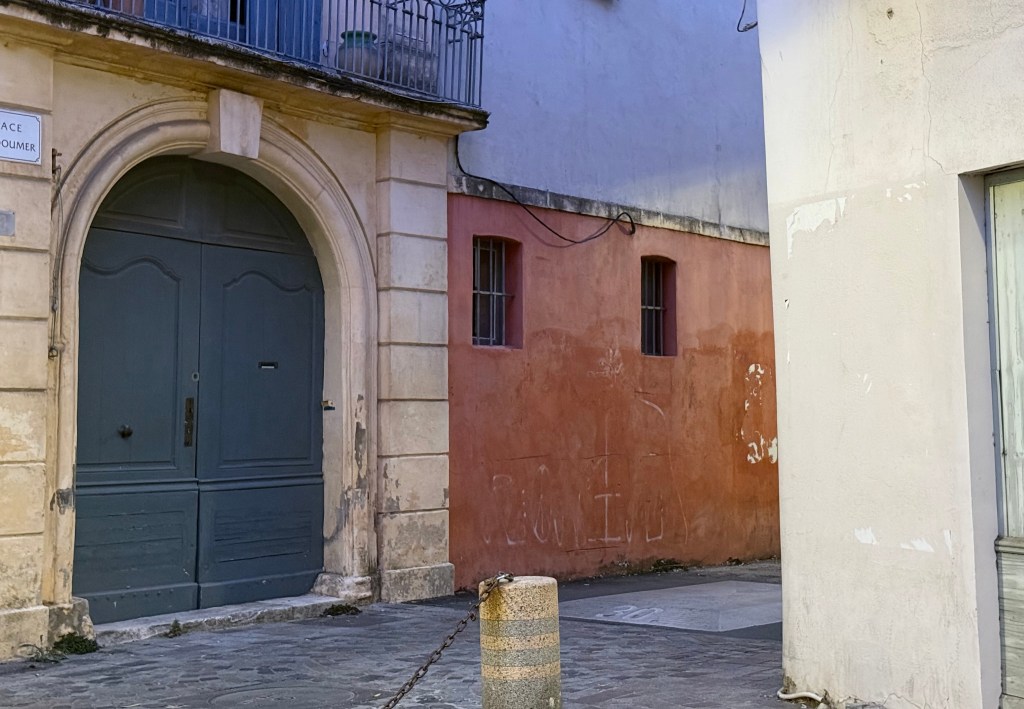
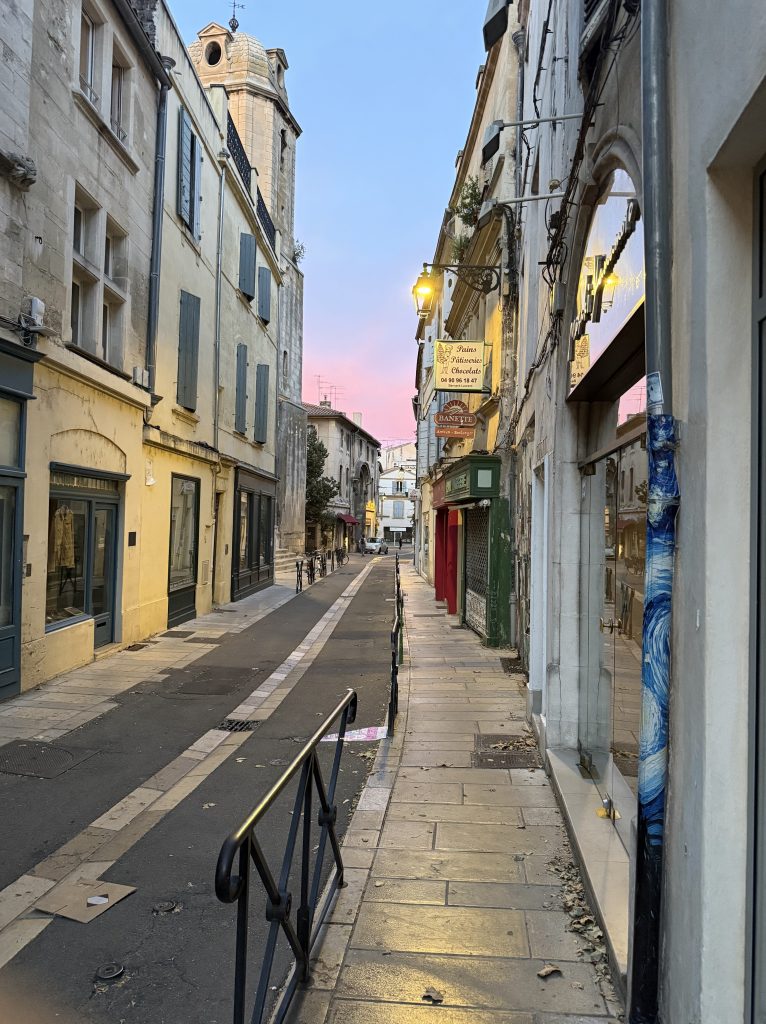
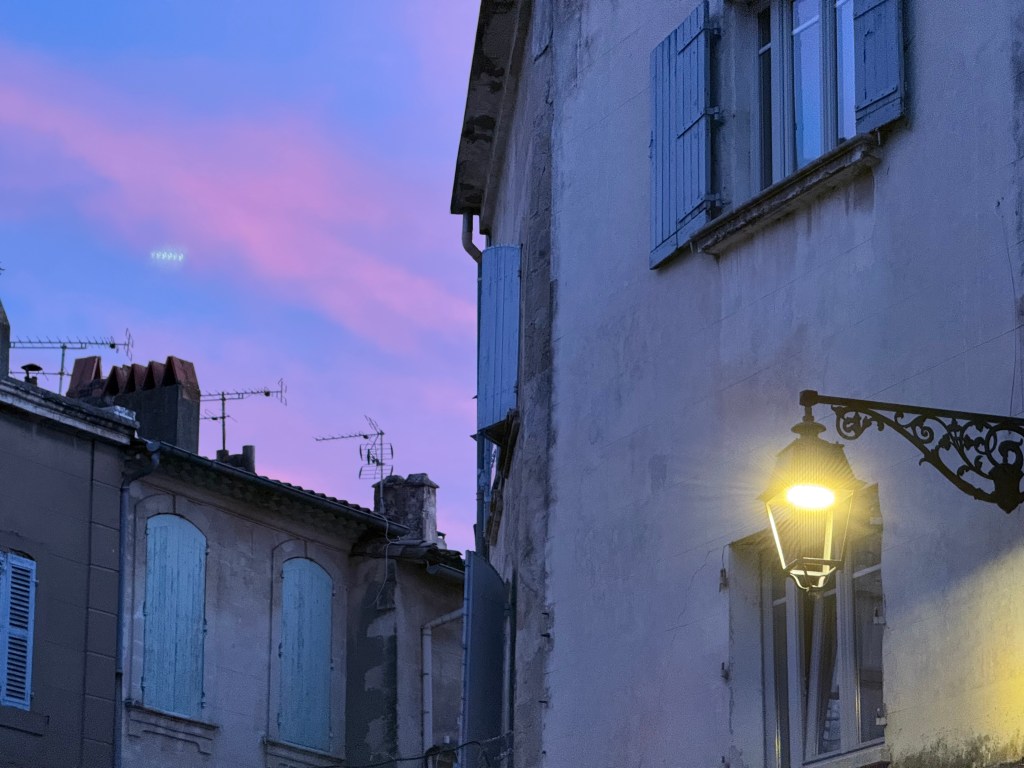
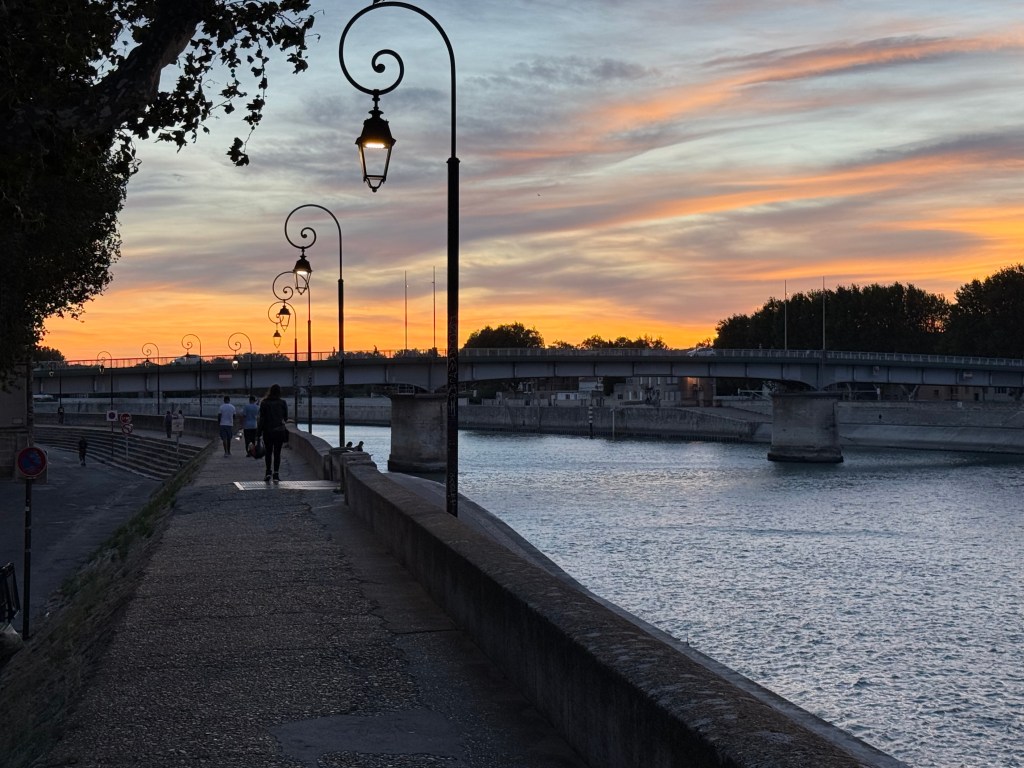
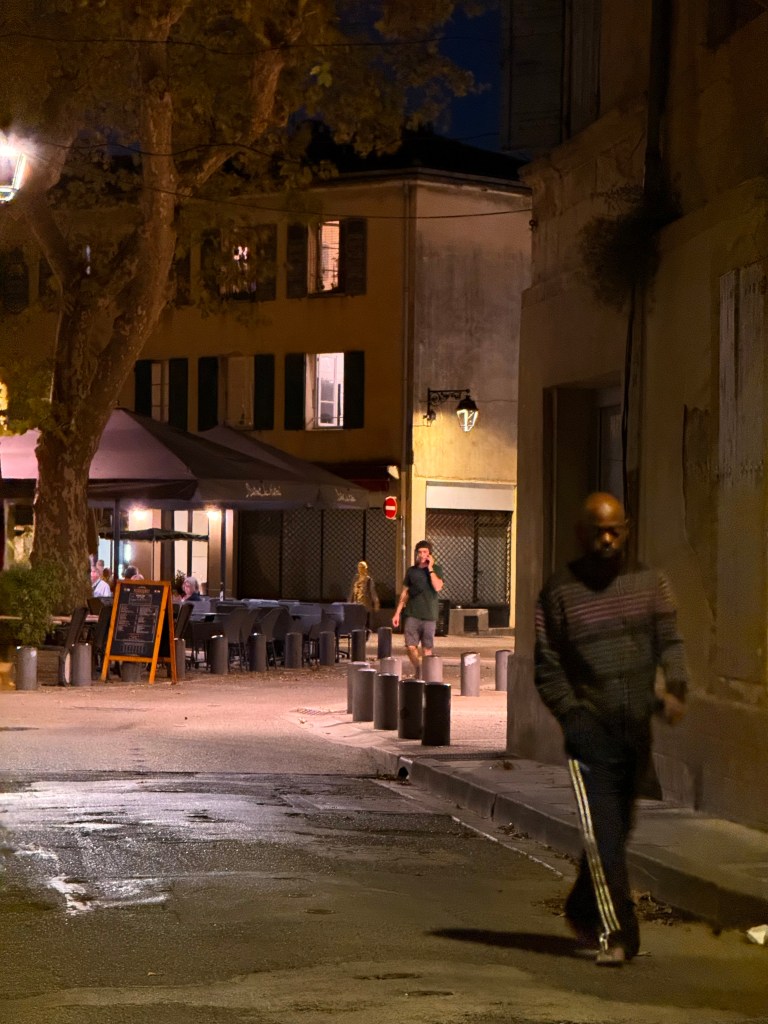
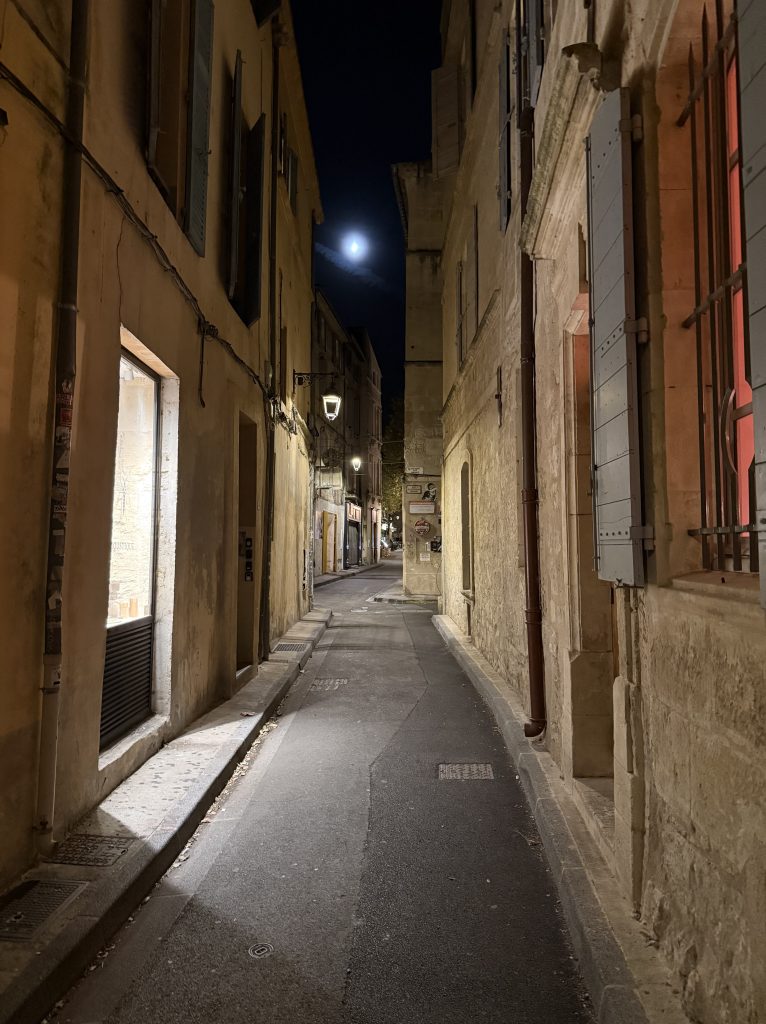
Gray’s excitement over the painting possibilities was contagious. As sun angles dropped each day, my eye was increasingly drawn to the glow and shadow of buildings along narrow streets of the old city.
I finish with a progression of photos showing the changing light through the afternoon and into the night. I promise I did not enhance the colors.
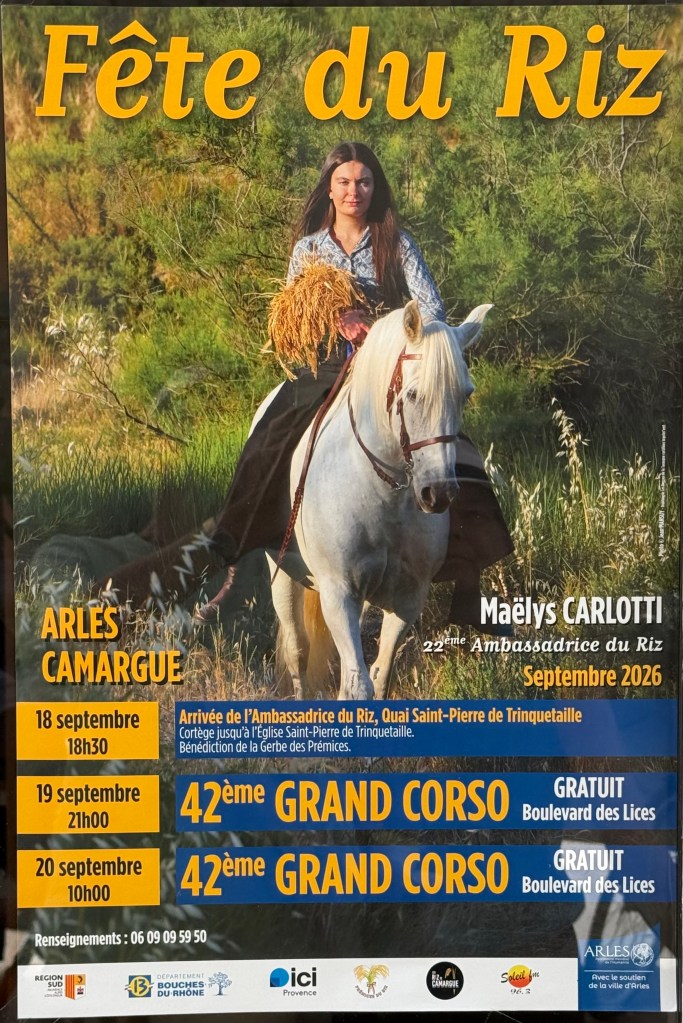
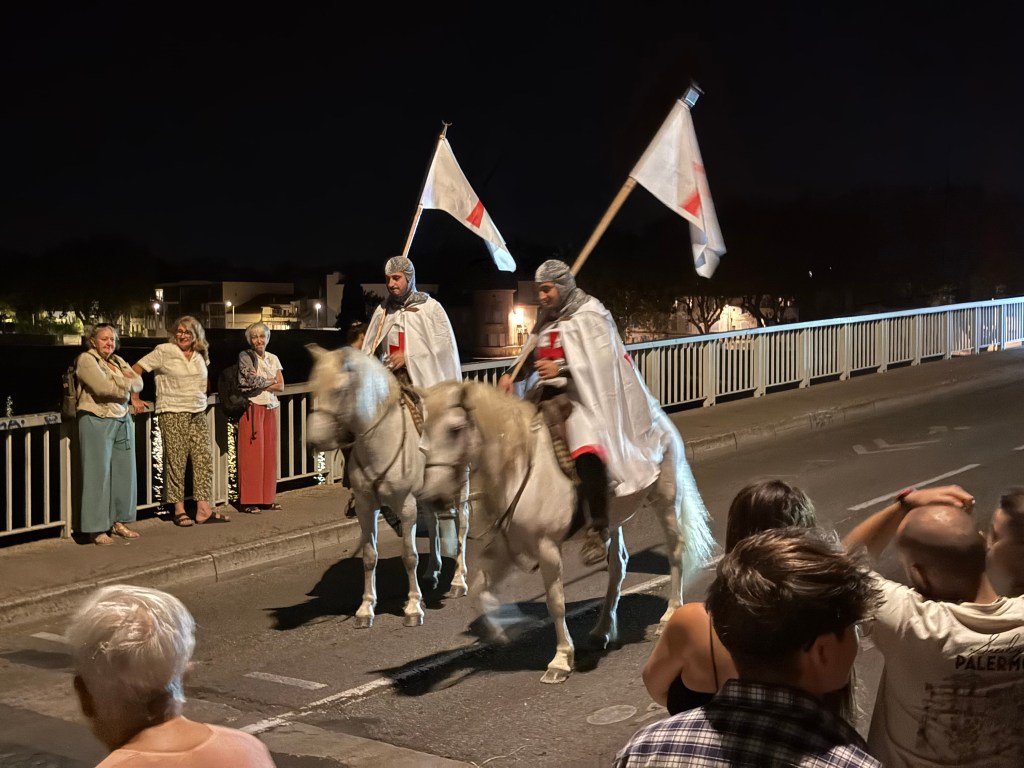
Wandering the city of Arles, France, near the mouth of the Rhône, we keep seeing posters for the Fête du Riz (festival of the rice), featuring the 22eme Ambassadrice du Riz, Maëlys Carlotti, on horseback, holding a corsage of rice blossoms. She’s adorable:
Yesterday, Gray and I took a rental car to Camargue, the marshy delta where the Rhône meets the Mediterranean. We saw tall rice plants growing in and around the small villages. More on that trip to follow.
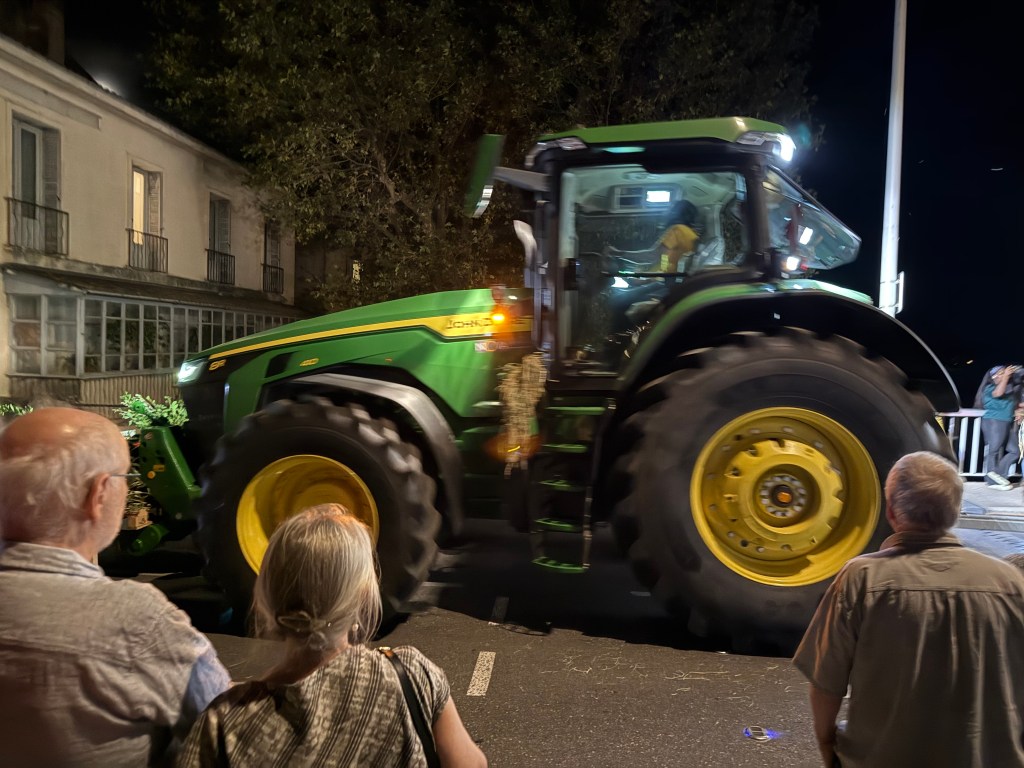
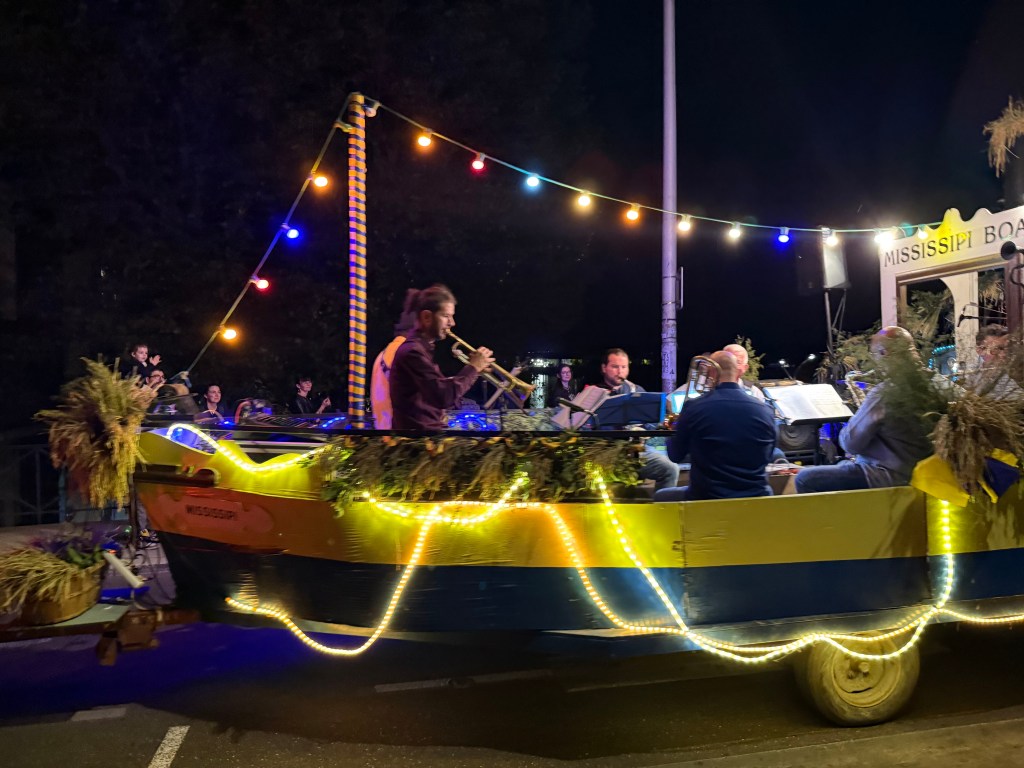
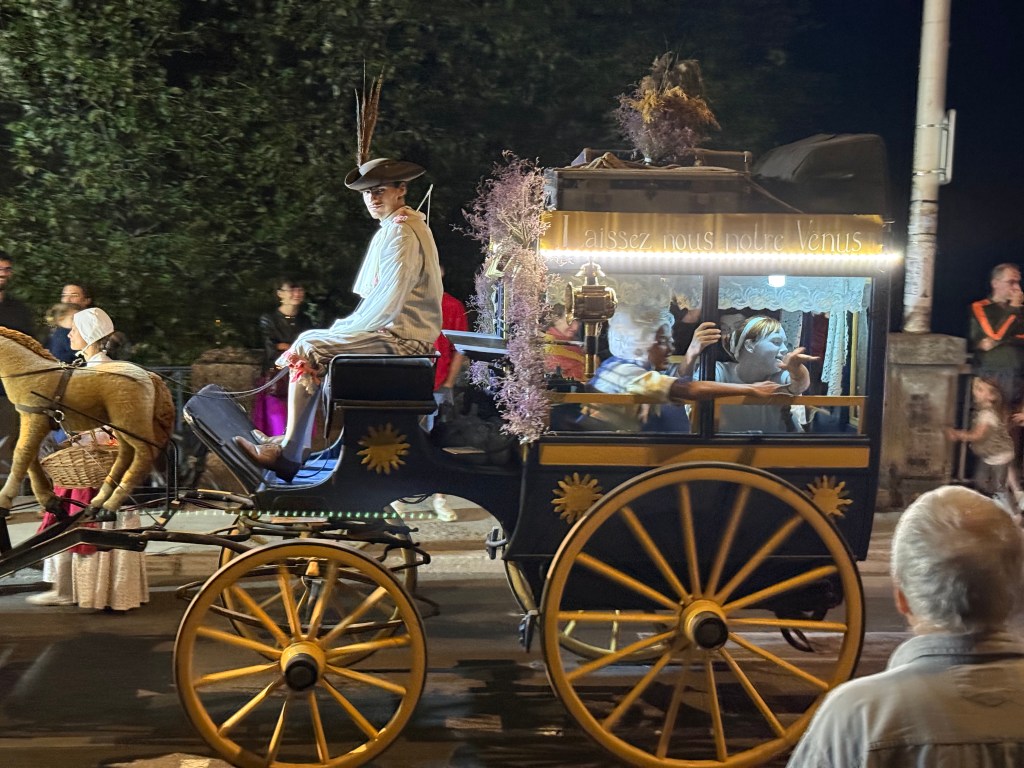
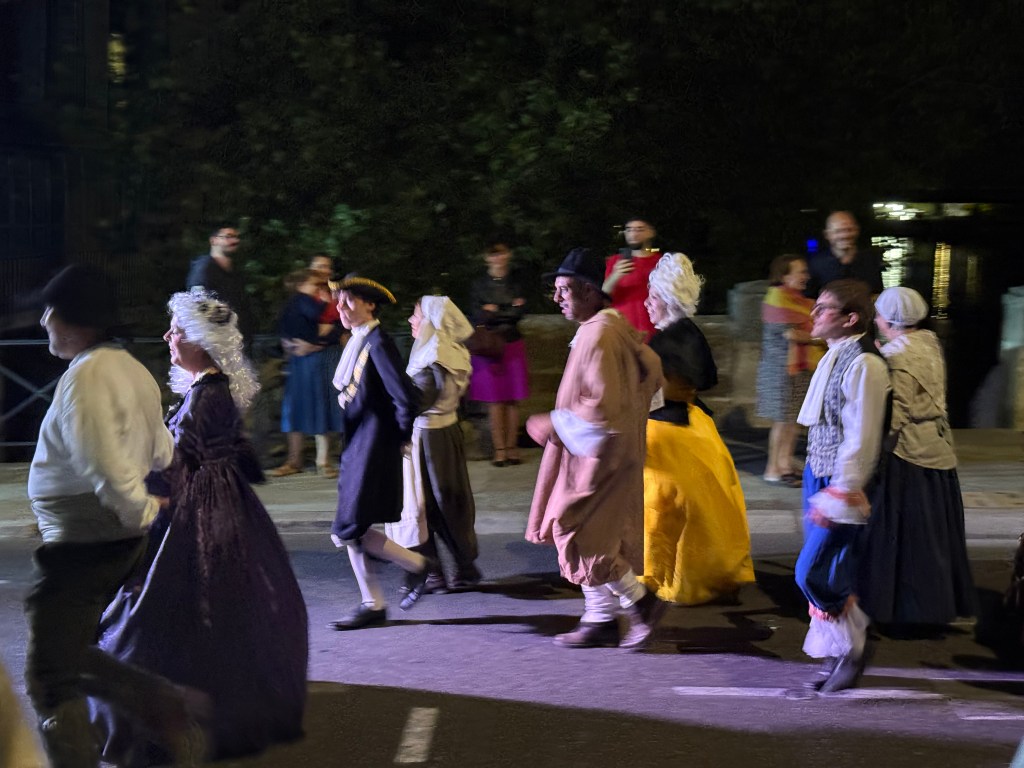
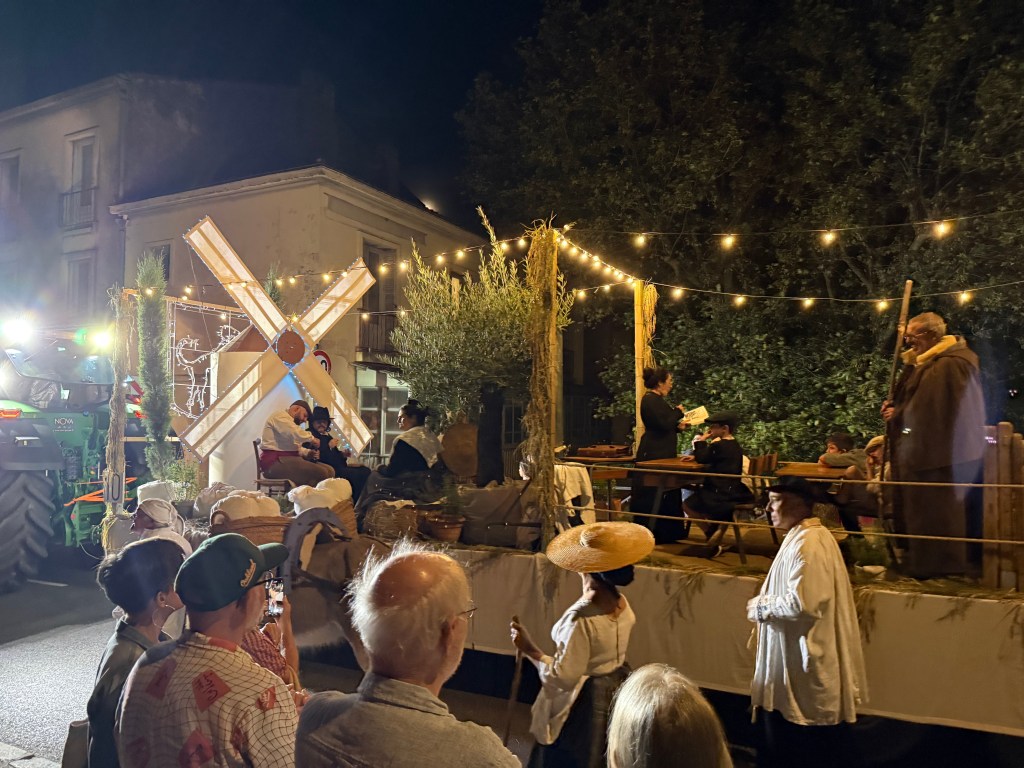
Back in Arles, returning from our dinner in the old city, we heard New Orleans jazz coming from across the river. We figured we’d walk over the bridge to hear the band close up, but the music came to us. The band was aboard a decorated wagon being drawn over the bridge by a farm tractor.
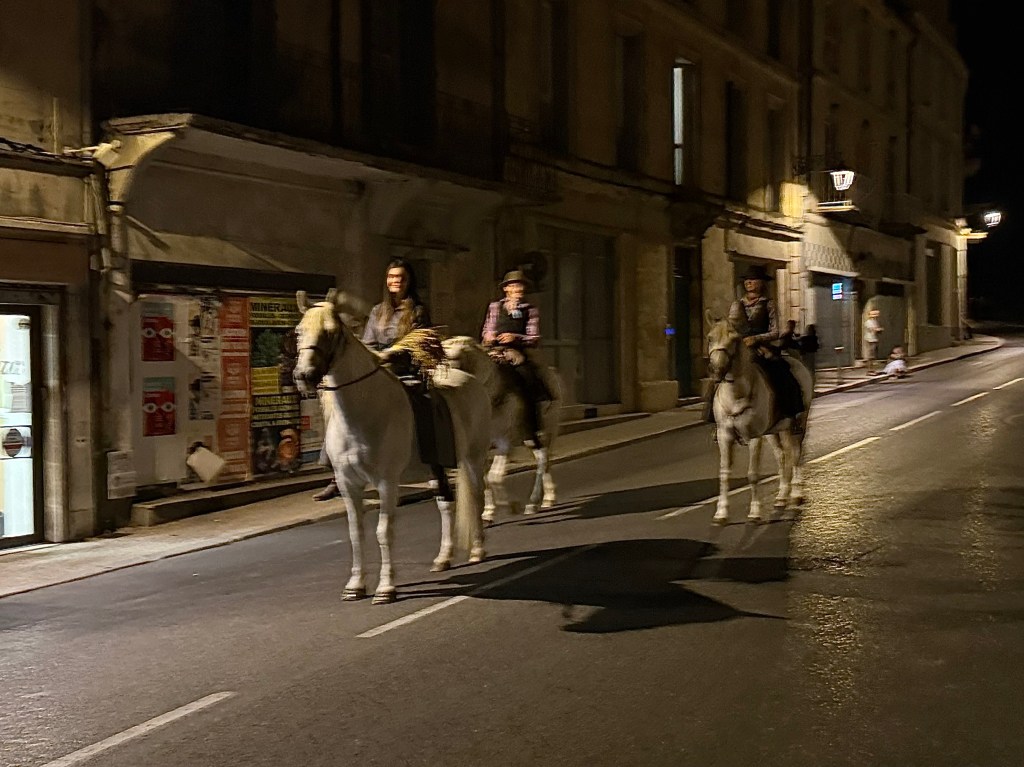
Behind the float were three women on horseback:
In the lead was Maëlys Carlotti, le Ambassadrice du Riz herself on her beautiful white horse!
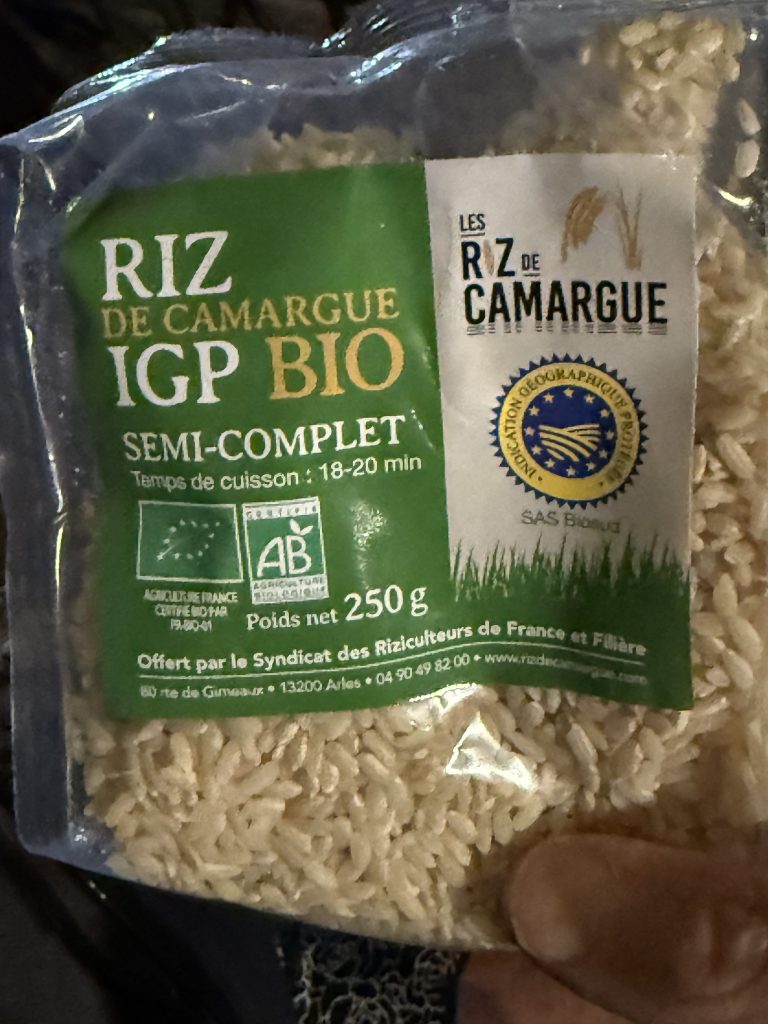
Her entourage gave us a pack of organic brown rice from the Camargue, where we’d been earlier in the day.
You’d imagine rice would be on the menu in all the fine restaurants of Arles. Au contraire. Rice noodles at a Vietnamese restaurant were as close to rice as we’d come until now. This being the 42nd rice festival, rice must be an impossible sell to the wheat-loving French.
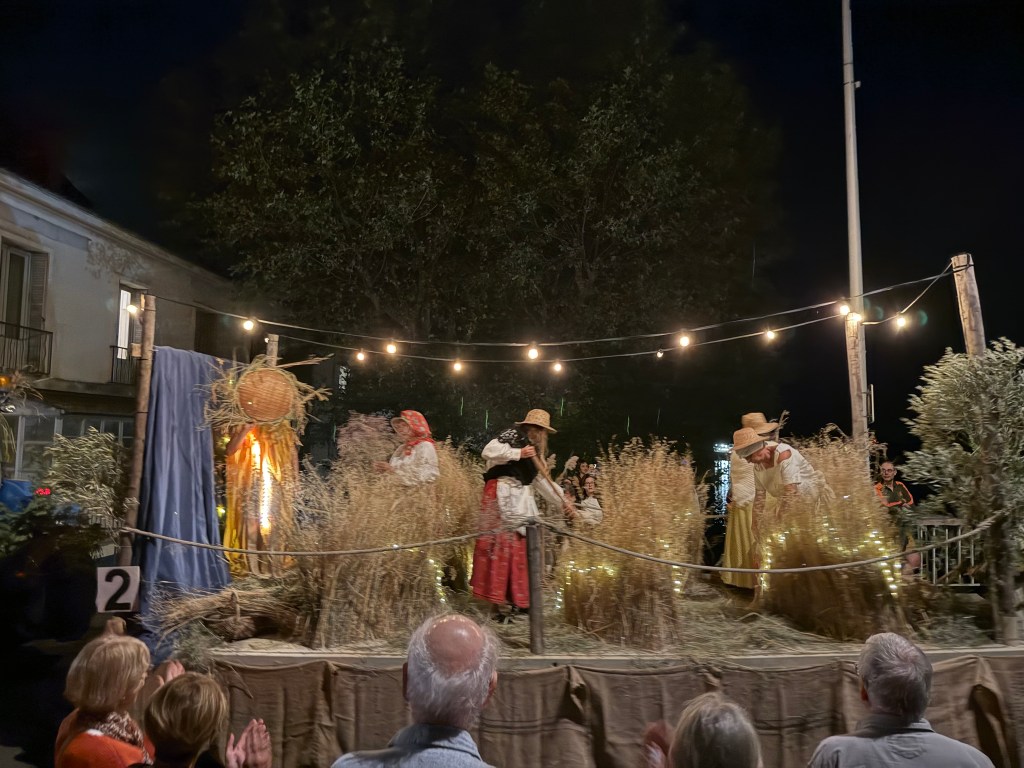
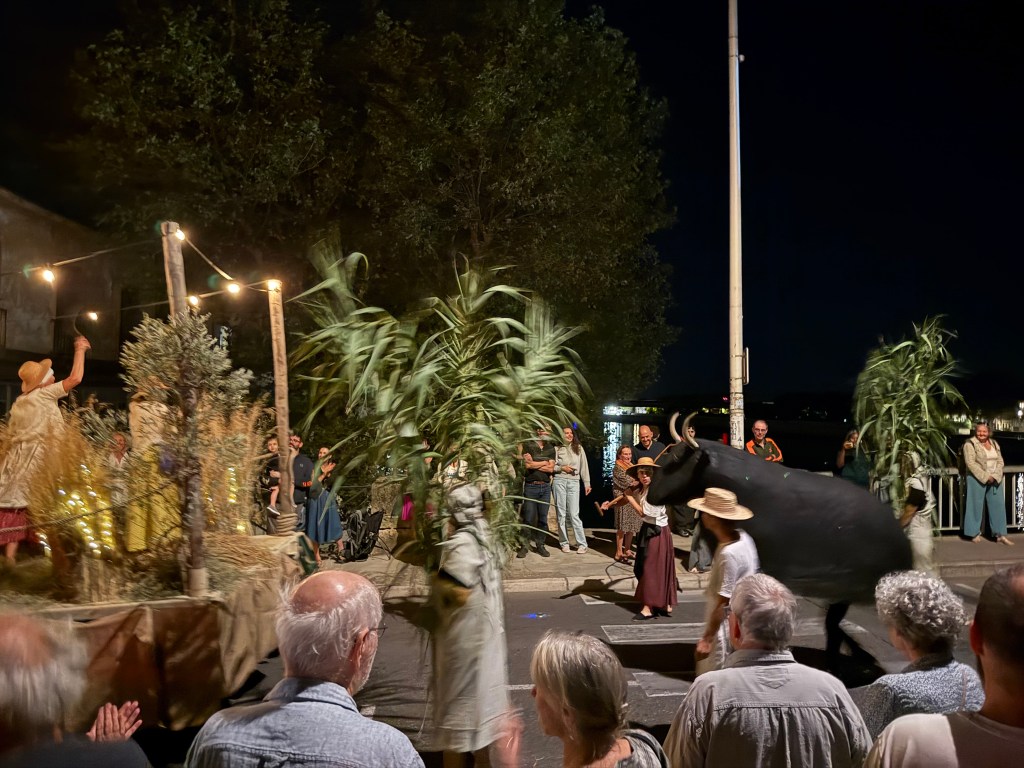
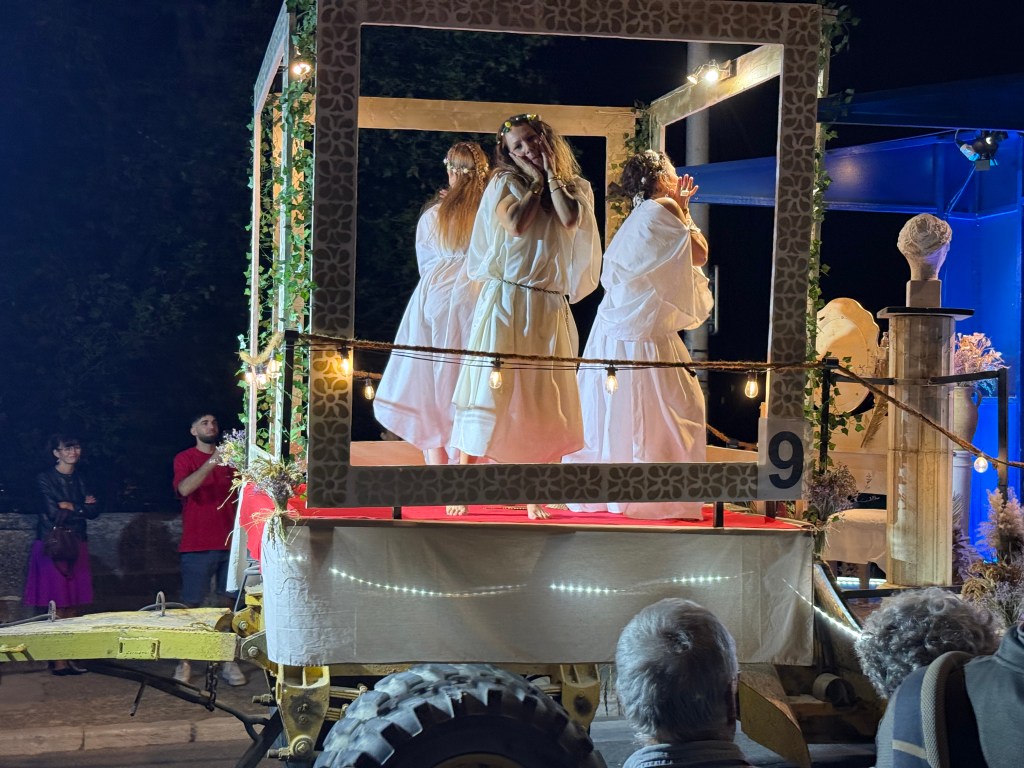
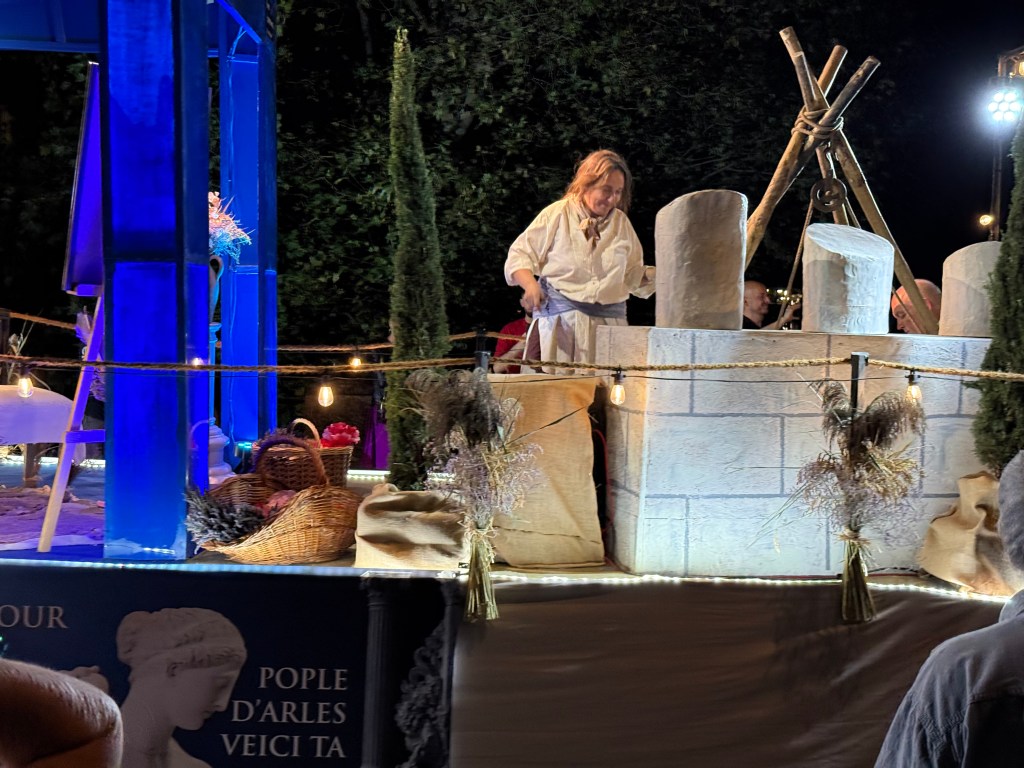
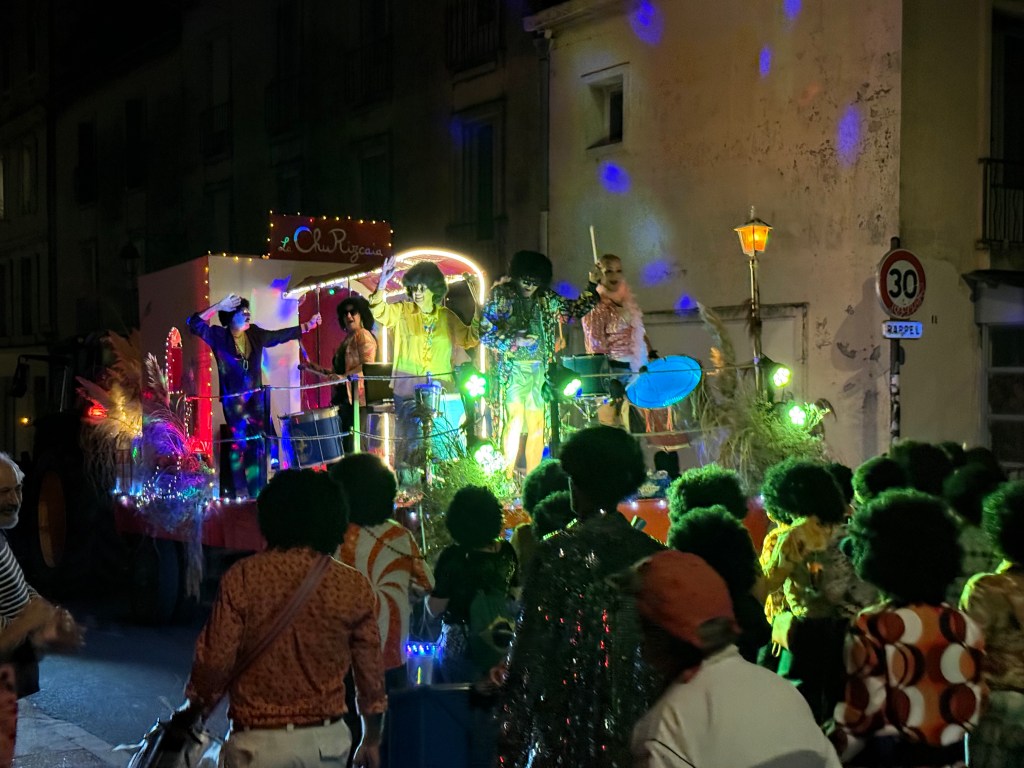
But the magic was not over. Floats were lined up across the river to pass over the bridge and into the city, each with its own music and theme, and each followed by an entourage of costumed adults and kids, on foot. Here’s a sample:
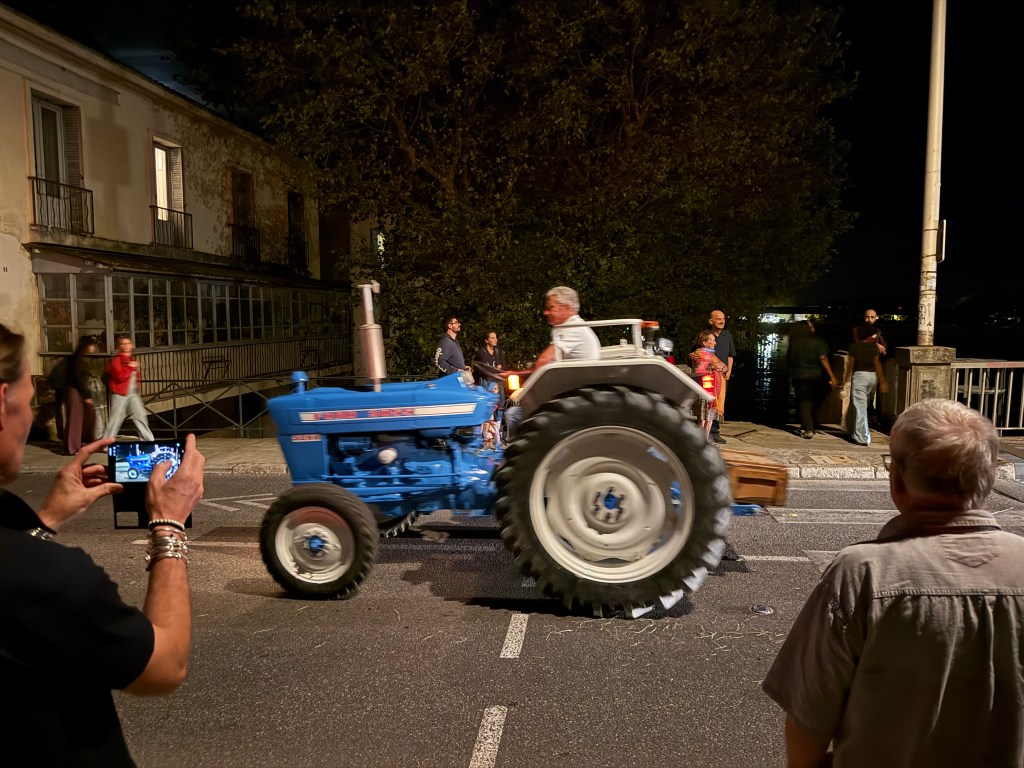
A dozen floats in all rolled past, each with a team of marchers trailing behind on foot. Then we were treated to a parade of old tractors, some real antiques.
This was the last one. C’est finis.
p.s. I finally found a Senegalese restaurant that serves a rice dish, on Sunday nights only.
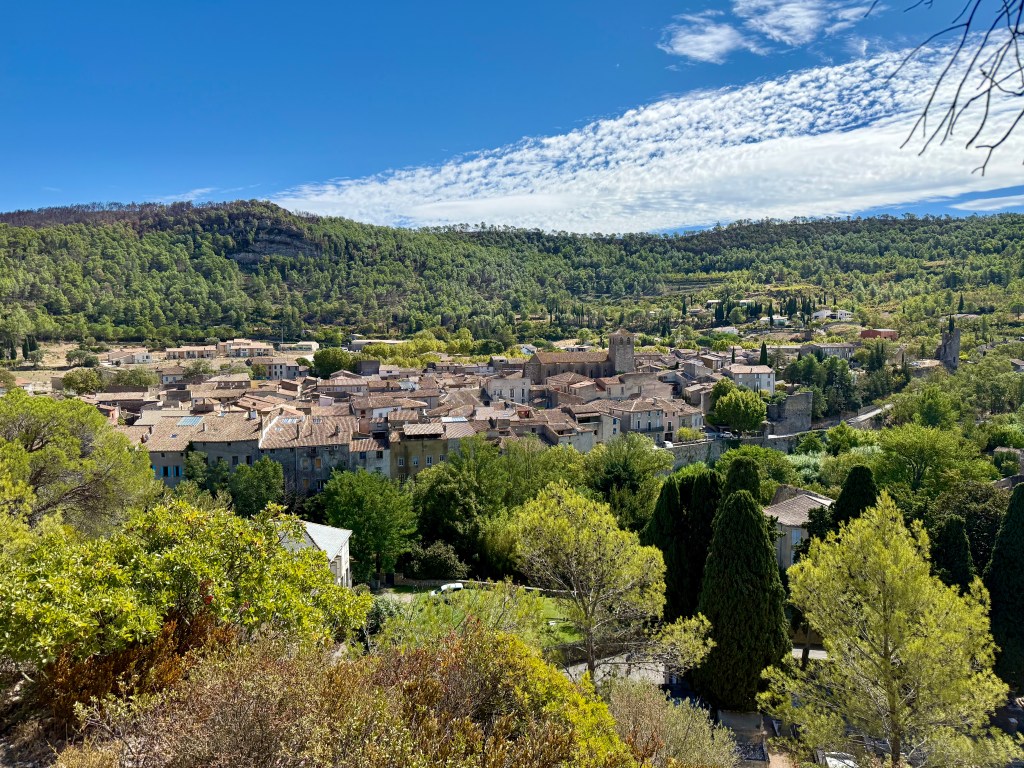
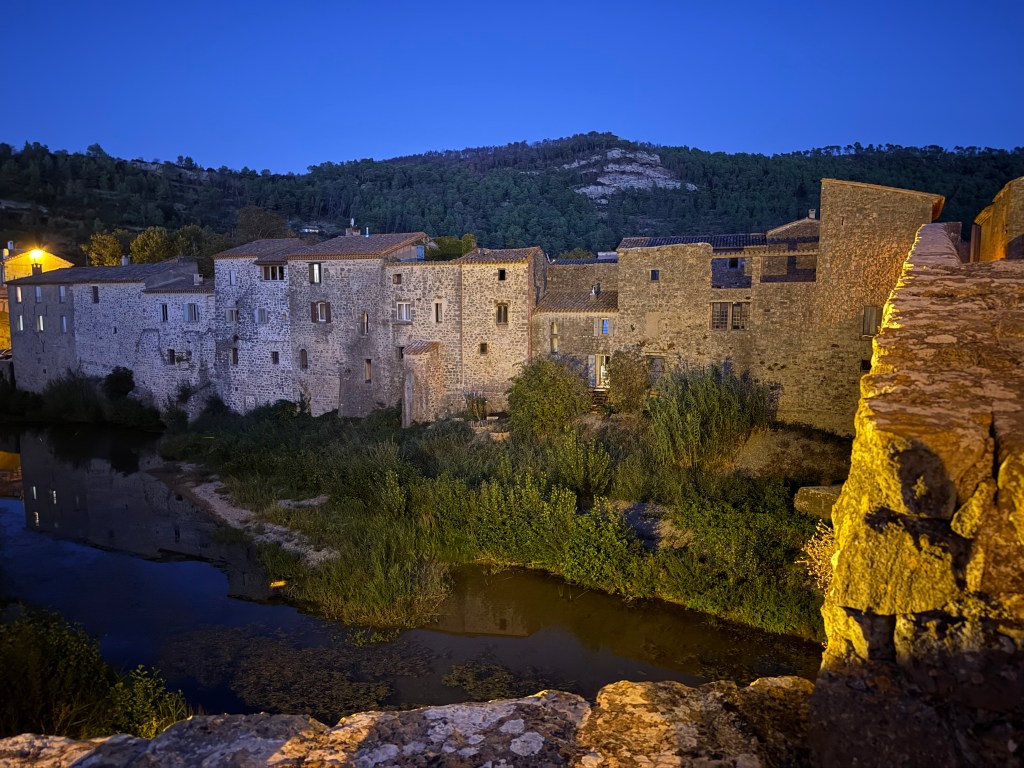
We have spent an enchanted week-plus in the medieval town of Lagrasse, in the south of France.
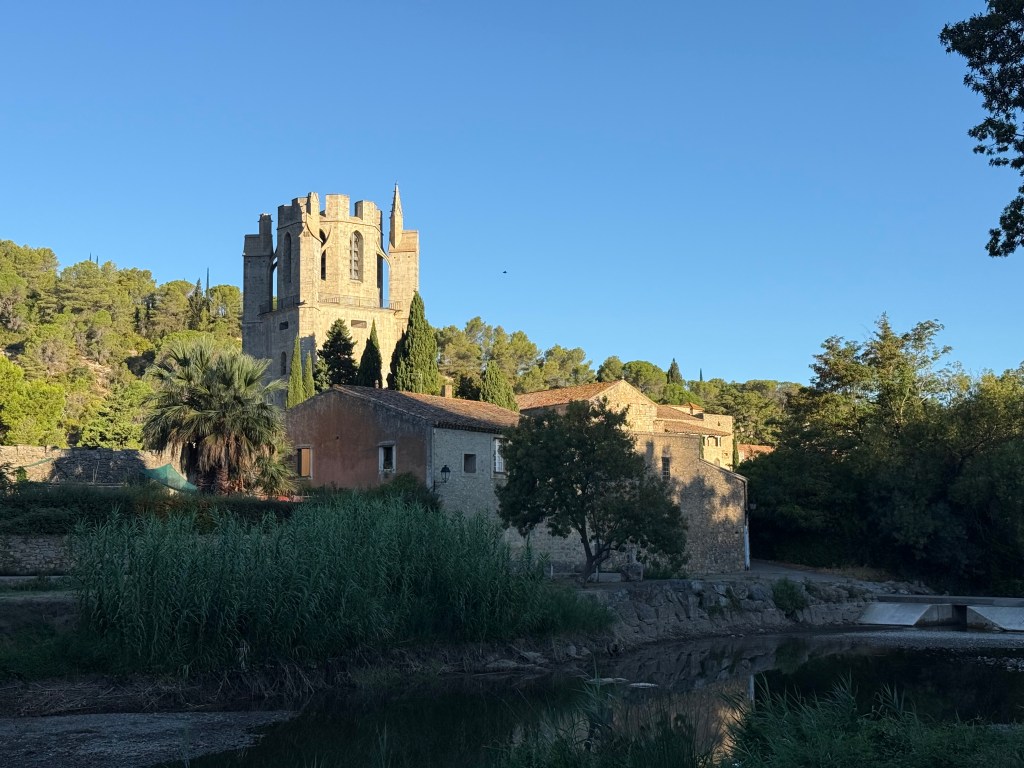
After the Catholic Church successfully eradicated the heretical Cathars in the 14th Century, they established an abbey to preserve the Church’s grip on the populace. The town of Lagrasse grew up beside the abbey.
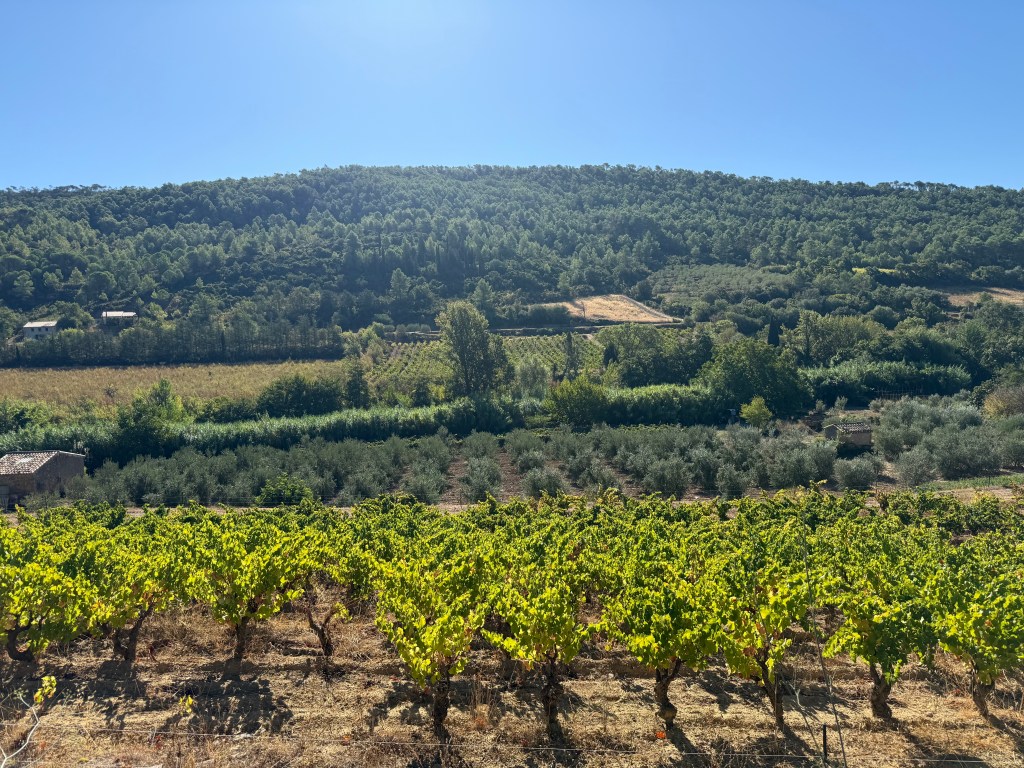
The abbey today is inhabited by Jesuits who grow olives and wine grapes. In their long brown robes they play soccer with the local kids.
The abbey’s bell rings on the half hour, followed exactly two minutes later by the bell of the local Catholic church.
We stayed in the apartment of our old (but younger than us) friends Michael and Nan. A couple of days after we arrived, they drove the 12 hours from their residence in Delft, Netherlands, to join us for the week.
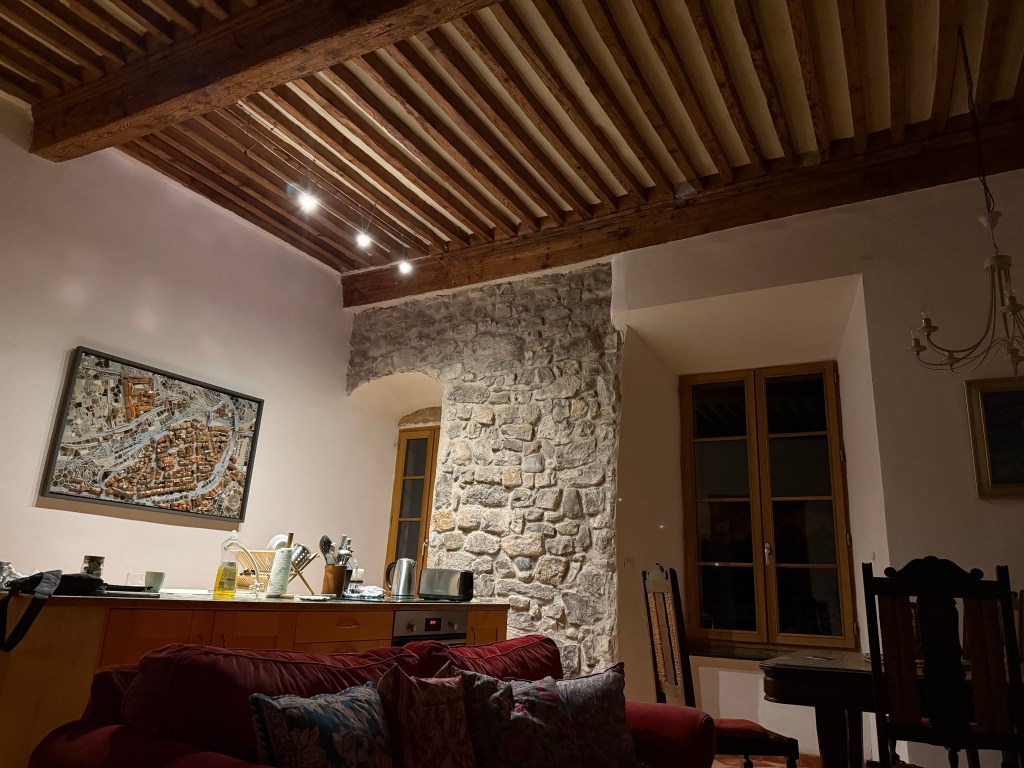
The outer wall of their apartment is stone, a full meter thick, forming part of the outer wall of the town, properly defensible from whoever might attempt to take by force the local resources: wine, olive oil, and violet ice cream.
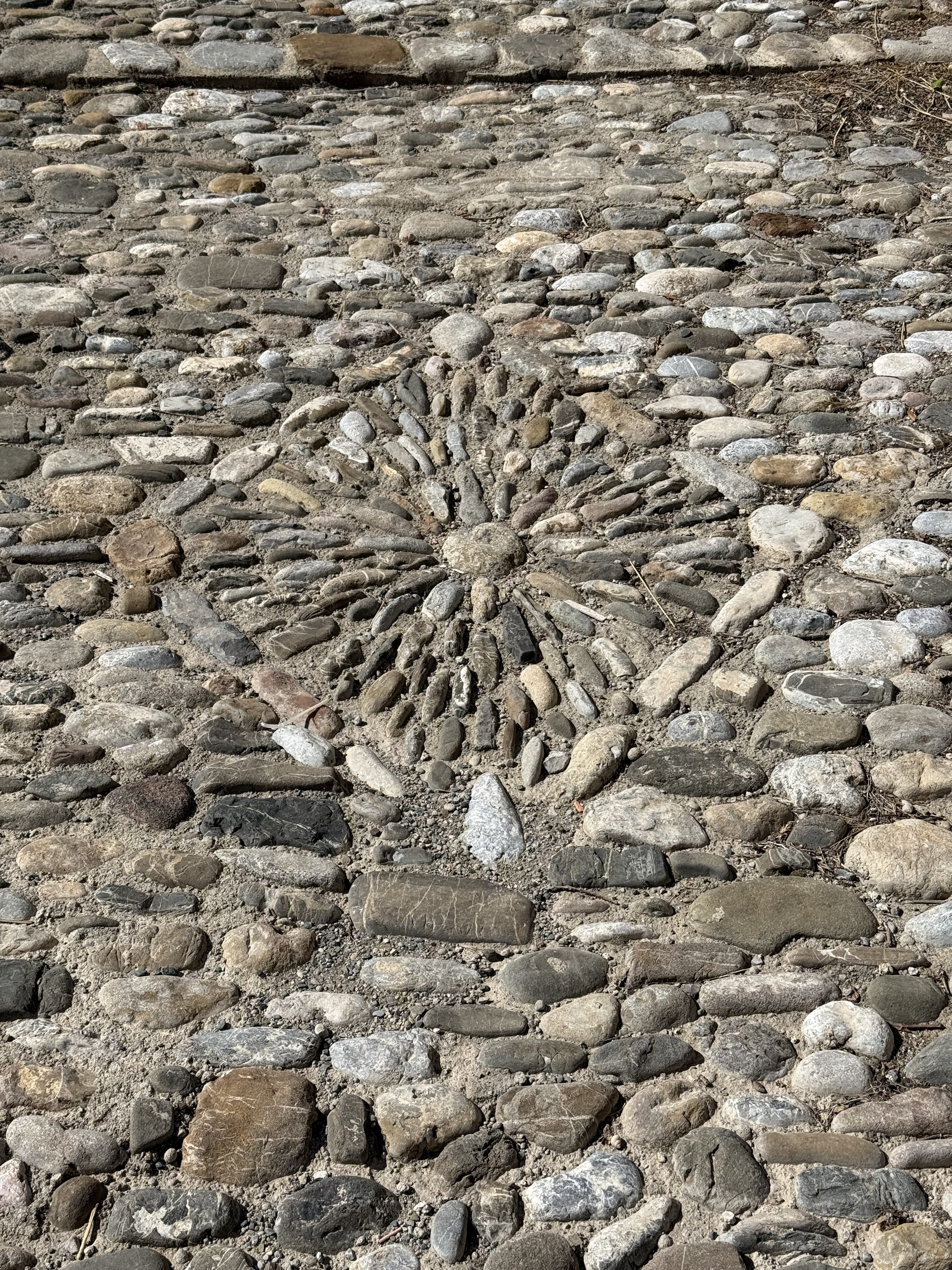
Just a random bit of the cobblestone street.
Every inch of the town begs for a watercolor painter. If only we knew one.
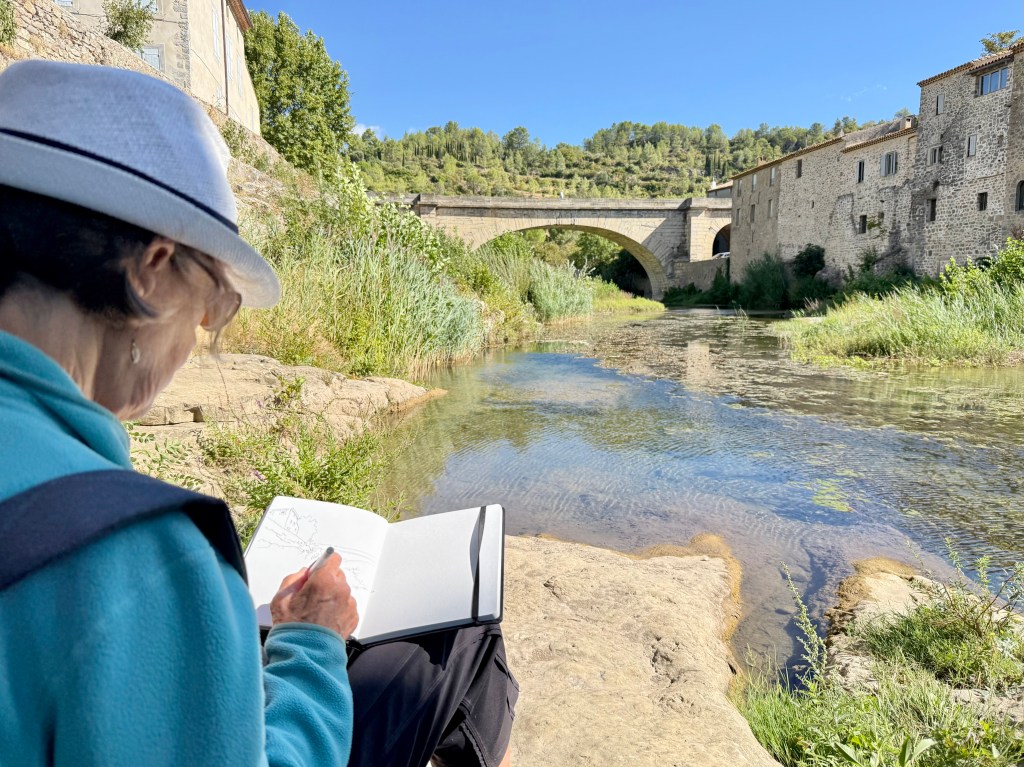
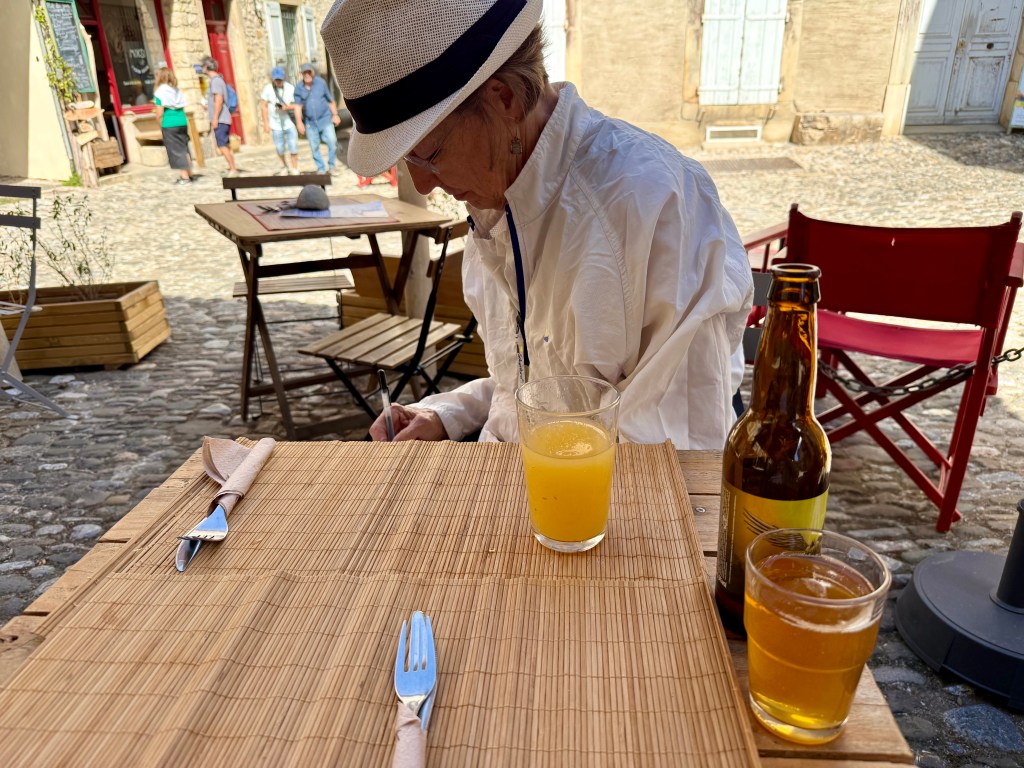
The only times Gray was without her sketchbook in hand were sleeping, swimming, and meals.
Ok, scratch “and meals”.
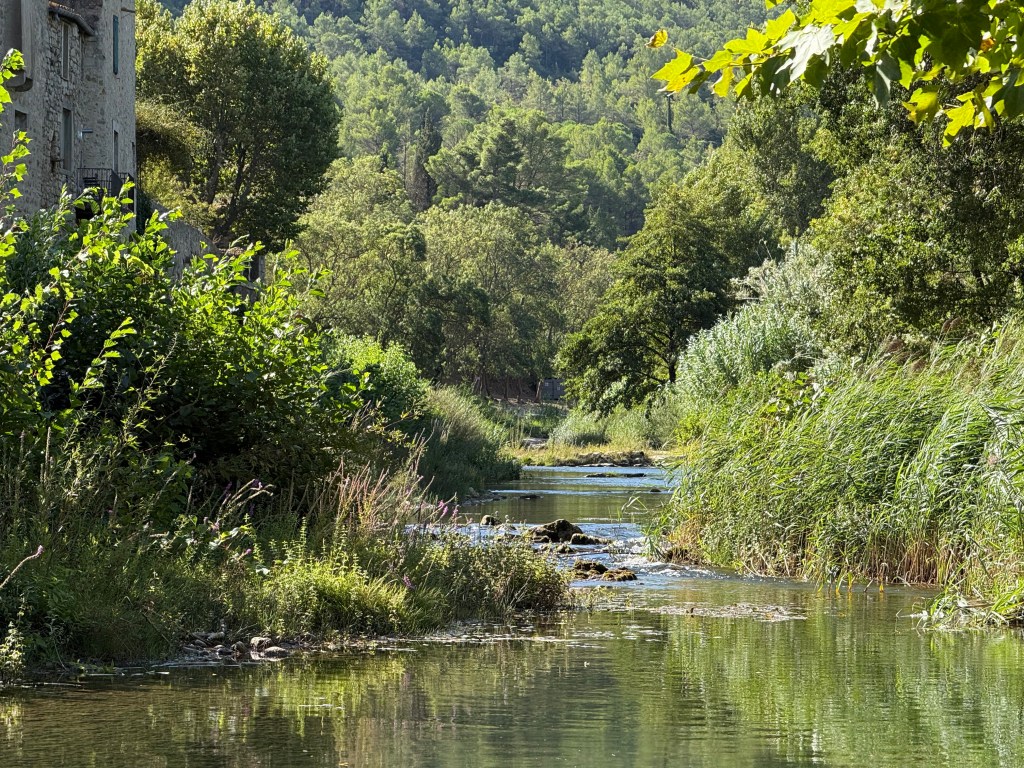
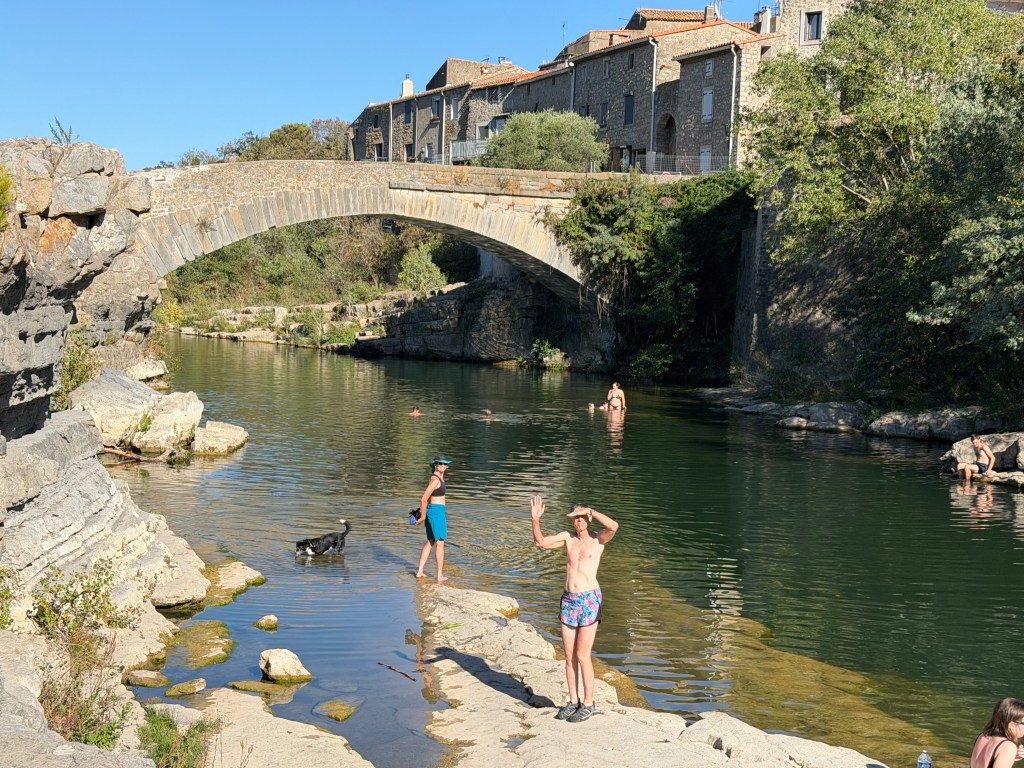
Lagrasse sits on the d’Orbieu River, a clear-running creek this time of year, which can rise 30 feet in flood, filling basements and first floors in the town. In late summer, it’s more of a creek.
The only grocer in town keeps random shop hours and stocks a random selection of wares to match.
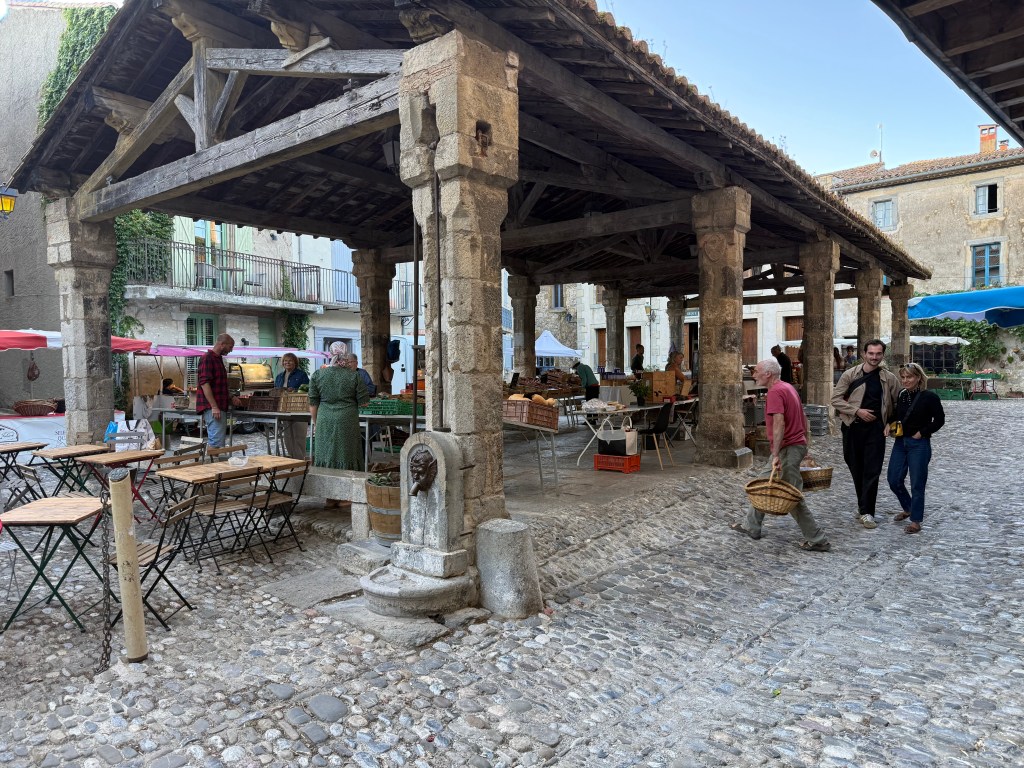
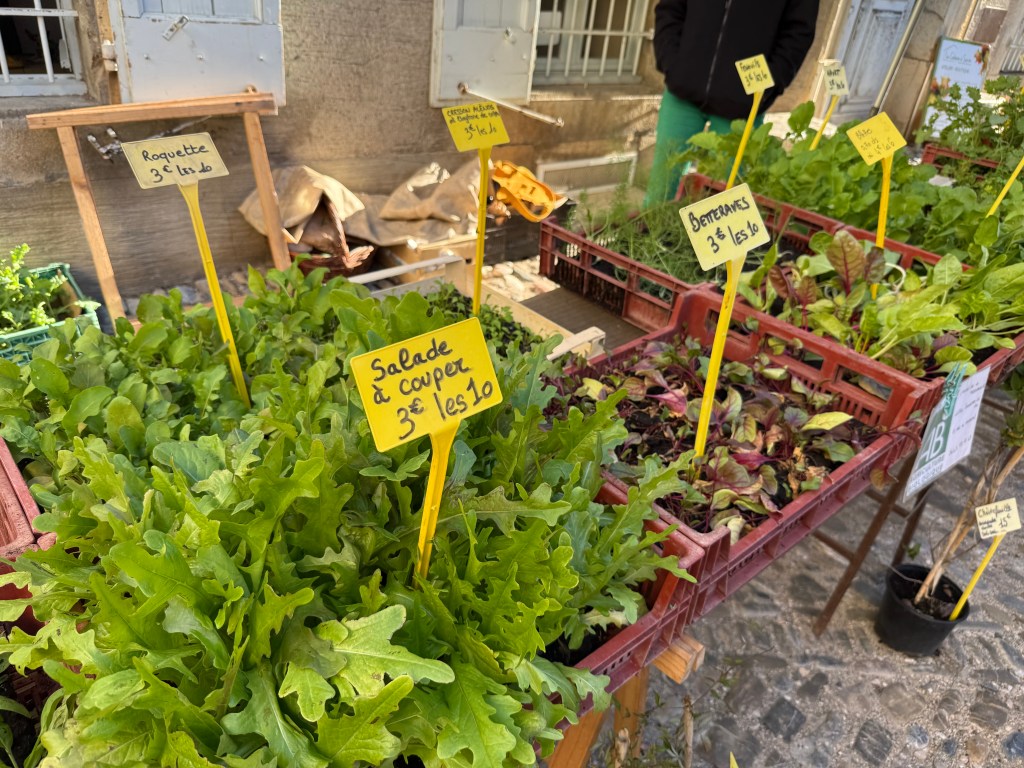
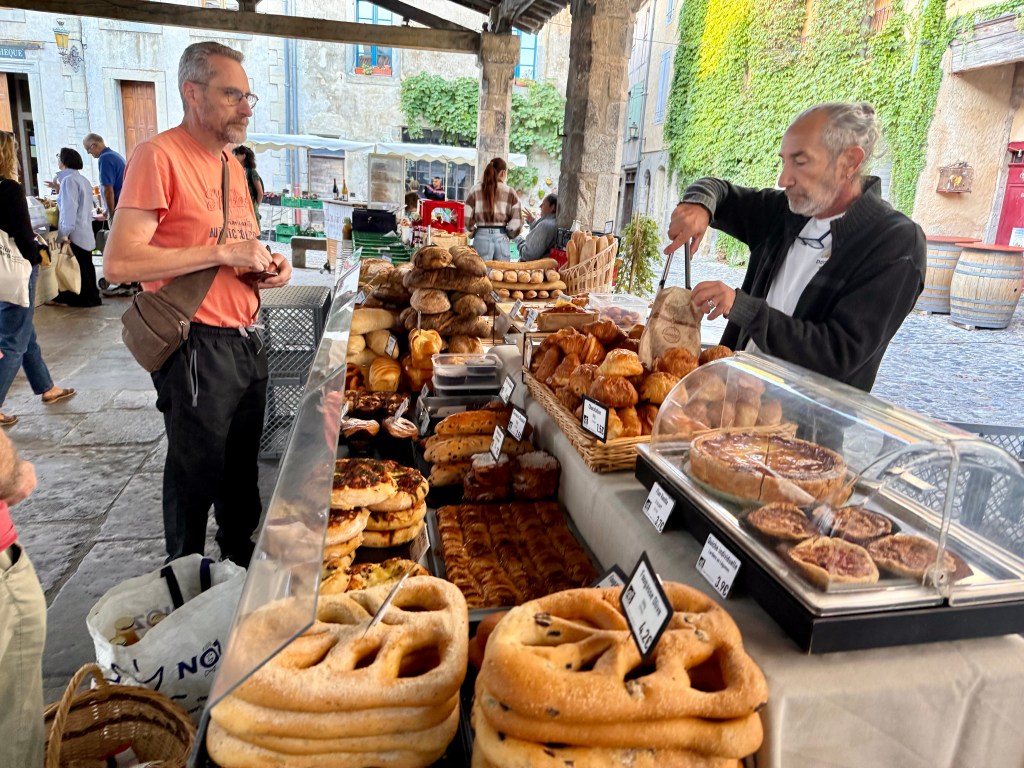
On Saturday morning, though, a market is held in the open square outside the apartment.
On first glance, it doesn’t look like much, but step inside and look again…
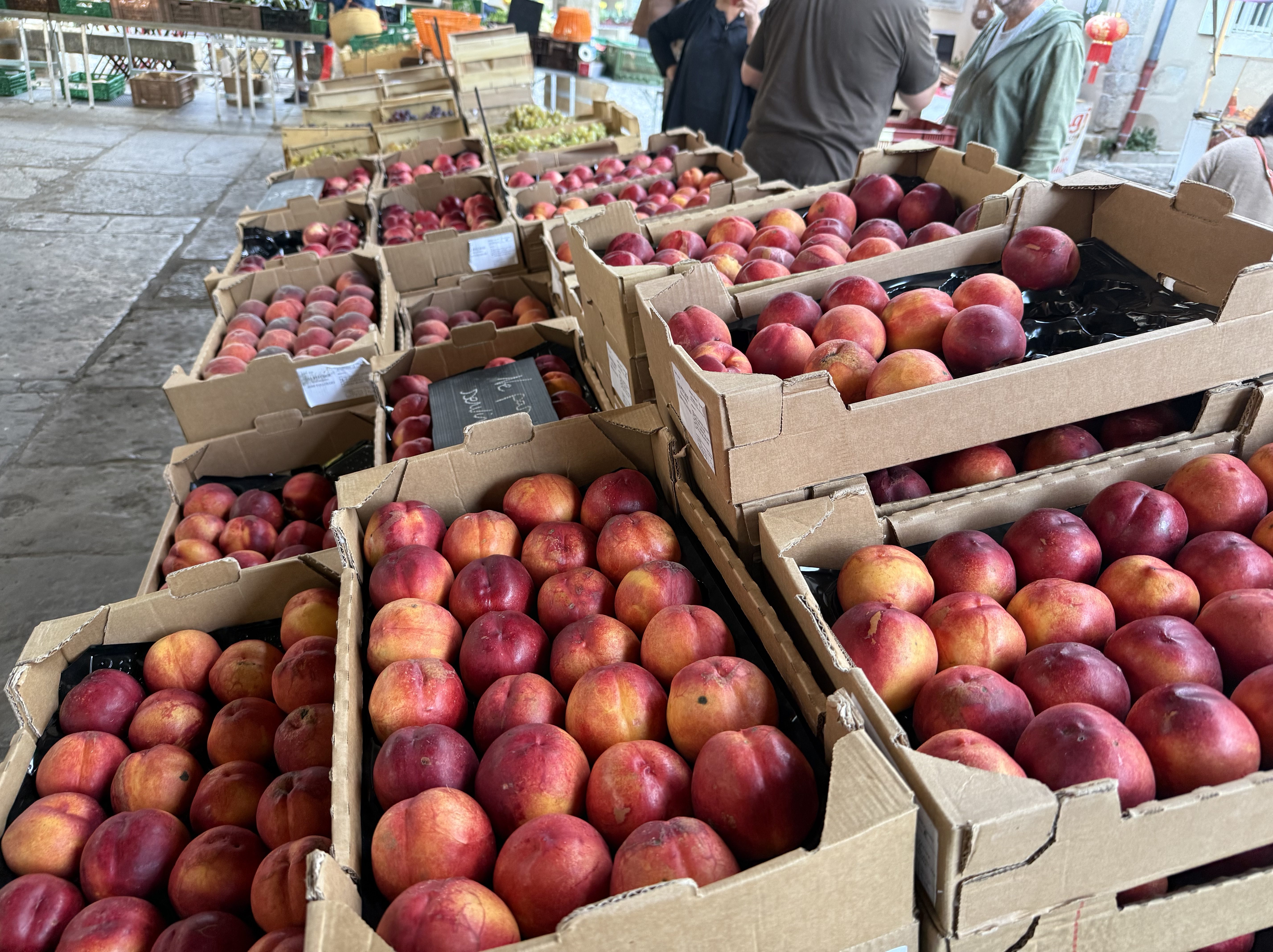
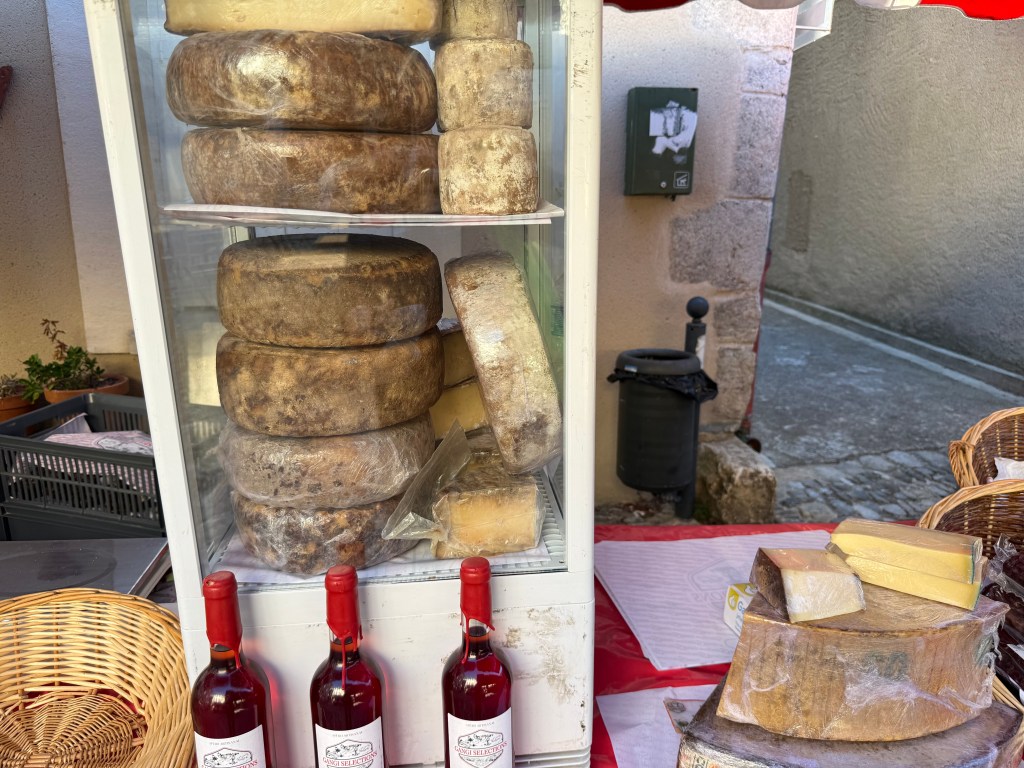
We stocked up on peaches, plums, vegetables, beef, poultry, sausage, salami, paté, cheeses, wine, and gluten-free bread. It’s France.
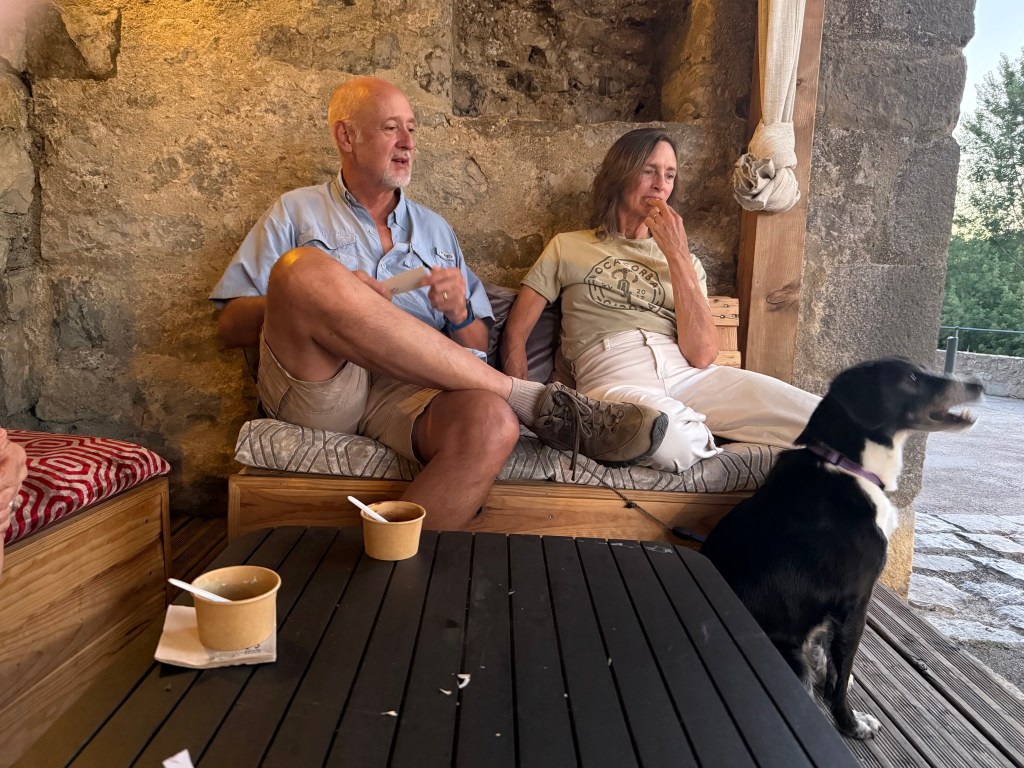
For dessert we could wander down the lane along the river to an ice cream shop. Gray had mint chip in a cup. I had violet ice cream in a cone. It’s a thing.
Michael and Nan, basking in the glow of ice cream.
The river is home to herons, ducks, wagtails, astoundingly beautiful kingfishers, and Great Gray Herons that look like our Great Blue Heron but say “snirk!” instead of “snork!”. And fish.
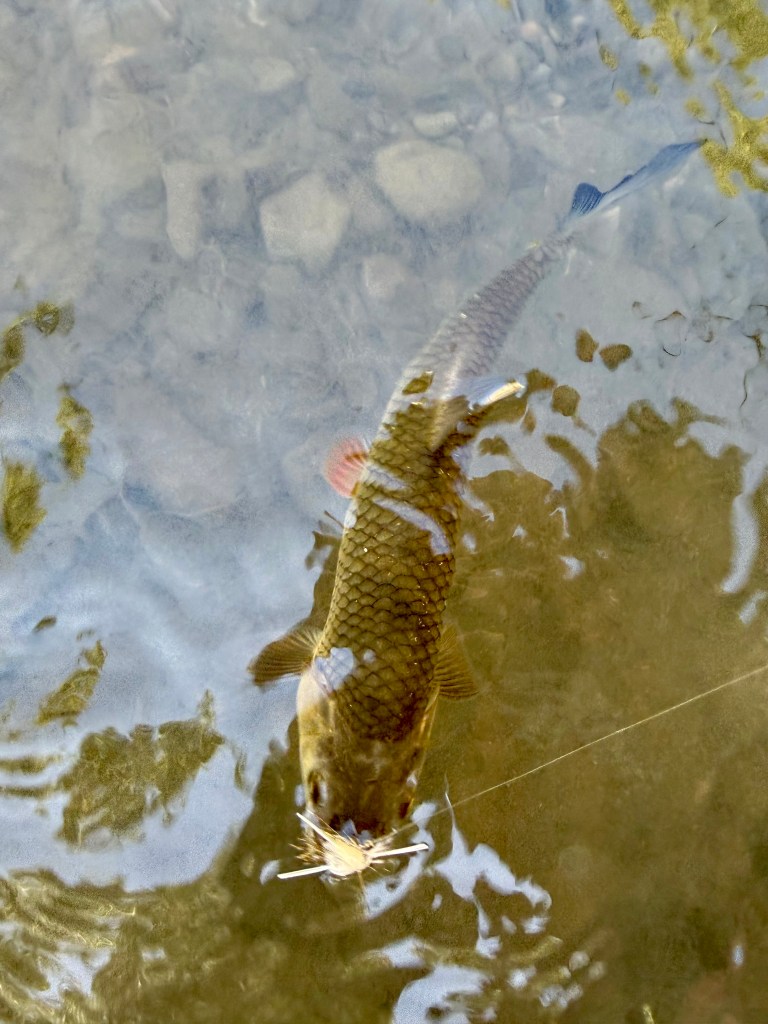
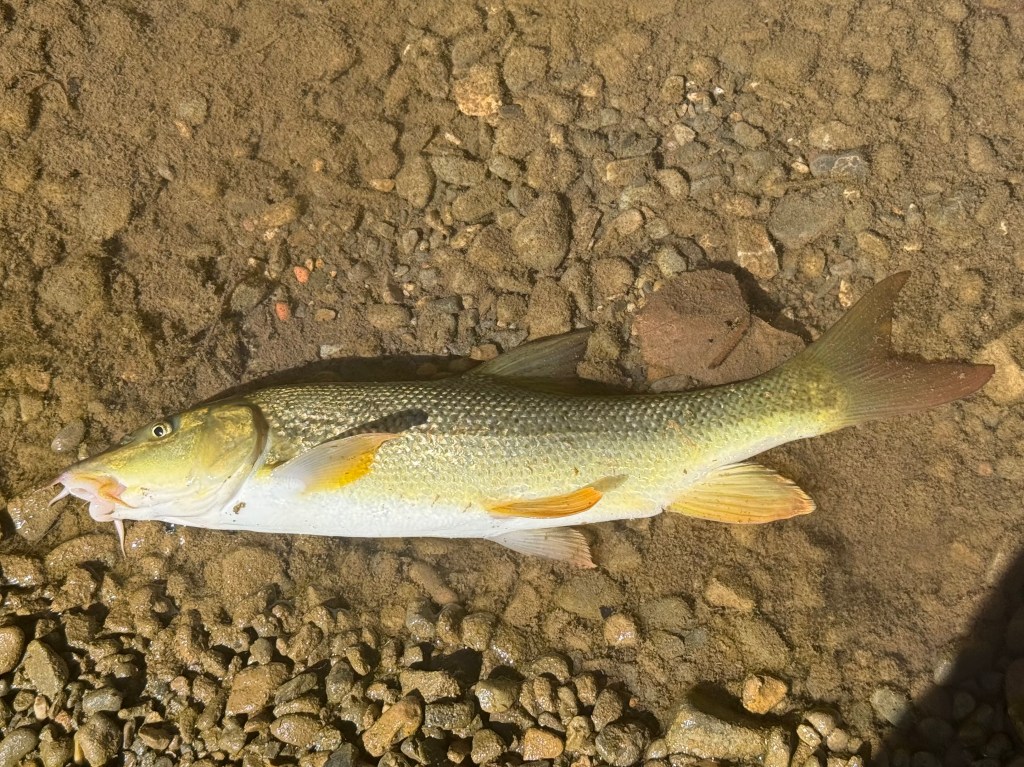
The d’Orbeau looks like a trout stream and is stocked with trout in the spring, but this time of year the visible fish are Chevesne aka Chevaine (Squalius cephalus) up to 18” in length and Mediterranean Barbel (Barbus meridionalis) up to 24”.
I had planned a fishing-free vacation for my right hand to recover after a summer of excessive fly casting. But Michael discovered that I fly fished, disappeared into their store room, and emerged with four fly rods, reels to match, and assorted fly tackle, left over from his days fishing trout in the Colorado Rockies.
The water was cool, but warm enough for me to wade in my sandals. I found the little Chevesne would pick at dry flies all day and the bigger ones would take a dry fly in the late afternoon.
Chevesne caught on dry fly
Barbels, however, preferred a slice of salami.
Mediterranean Barbel, caught on salami.
The Barbel looks like a bonefish and fights even harder than a wet rag. They try. I took a special liking to Barbels when I read they are considered a biological indicator of high water quality. Both species are eaten by the French, though the Barbel has poisonous roe. I let mine go back in the “river” to enjoy life and make more.
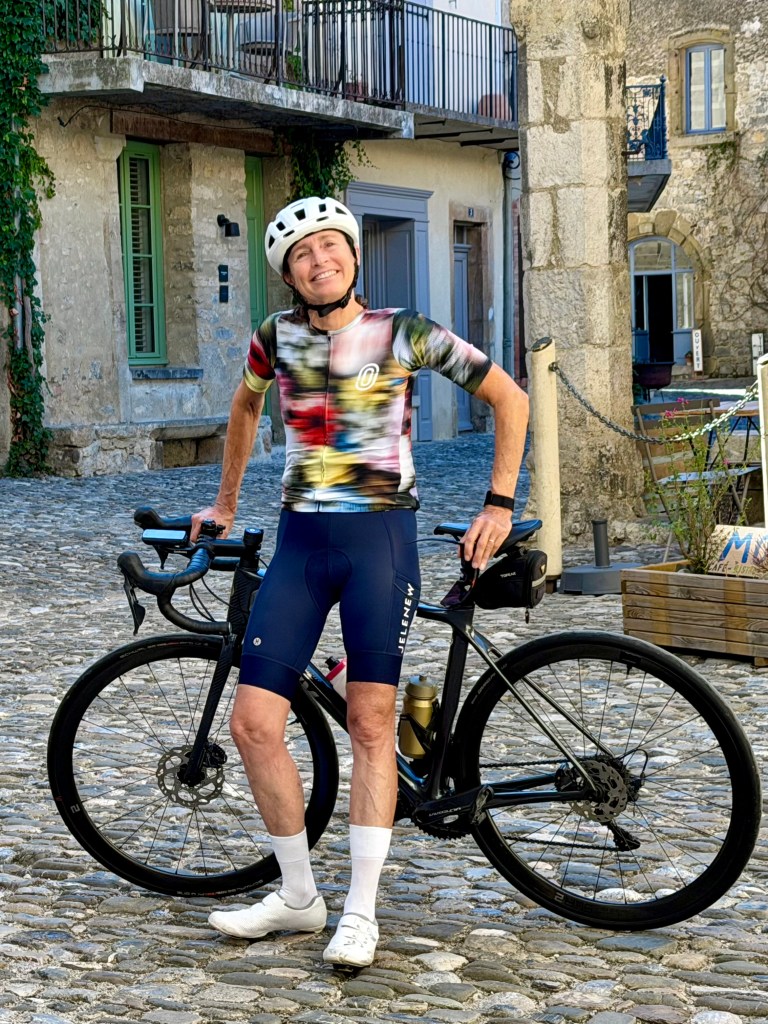
Michael and Nan are former bike racers, and took regular bike rides on their featherweight carbon fiber bicycles.
Nan, petite and svelte, remains a cycling beast, riding a fast 35 km through the foothills of the nearby Pyrenees one morning.
Their apartment was briefly visible to television viewers of the Tour de France. Michael watched the Tour de Spain at night on his computer.
Afternoons included a swim in the river.
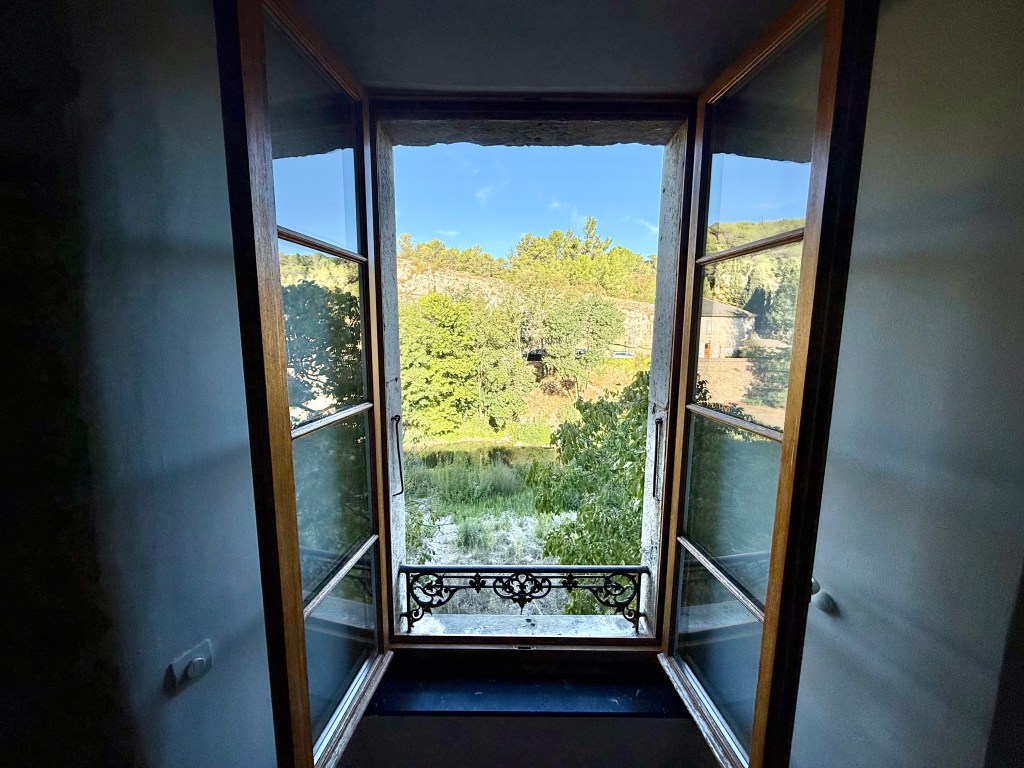
At 1:30 am I woke to soft rustling and crunching noises. Had a rat had gotten in to nibble my chocolate bar? I slipped out of bed to investigate and found the sounds were coming from outside. I stood in the cool breeze of the open window and strained to see and hear in the moonless night.
From the rustling noises and footsteps I could localize two large beings roaming around in the dark directly below. The one on the left was concealed by the stirring bushes. My view of the one on the right was blocked by a balcony one floor below. That one was making loud hollow crunches, like bones being crushed in the teeth of a bear or large dog. CRACK! A Scops Owl tooted intermittently in the distance. CRUNCH!
My best guess was that I was listening to a pair wild boars that had descended from the forested hills above the abbey and waded across the river, but what was the crunching? In the morning, the ground by the patio was covered with large, cloven footprints, in the shade of a pair of bearing walnut trees.
The next evening we wandered up the street for dessert but found the ice cream shop had closed. The owner, who puts trout in the river every spring, was gone for a week of boar hunting. Filling the larder and making Lagrasse safer for walnuts.
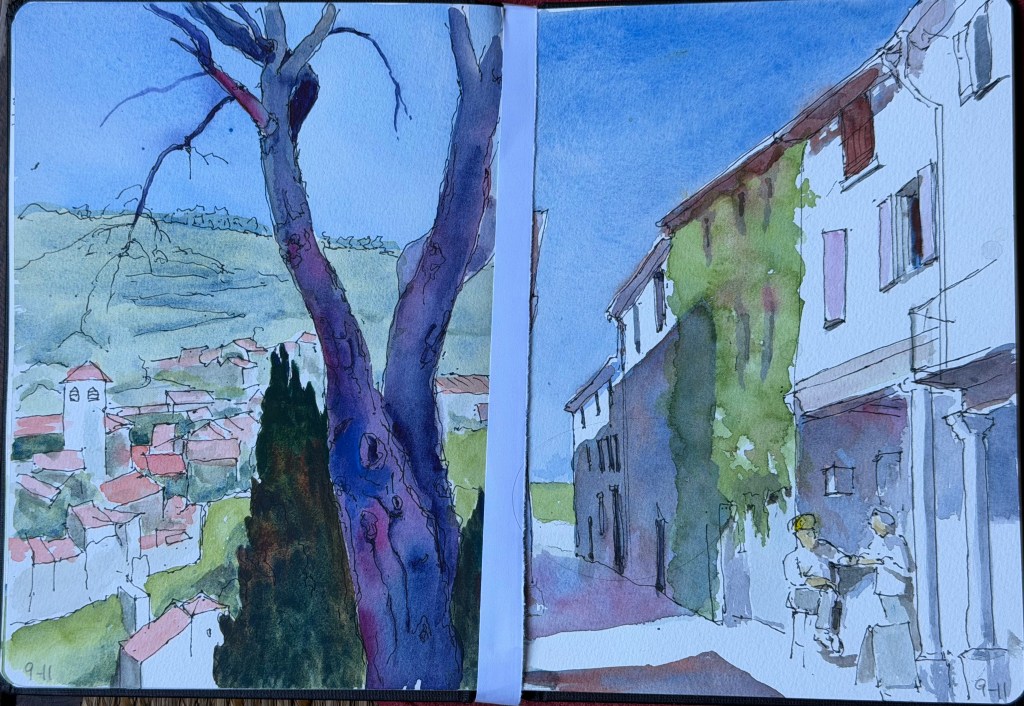
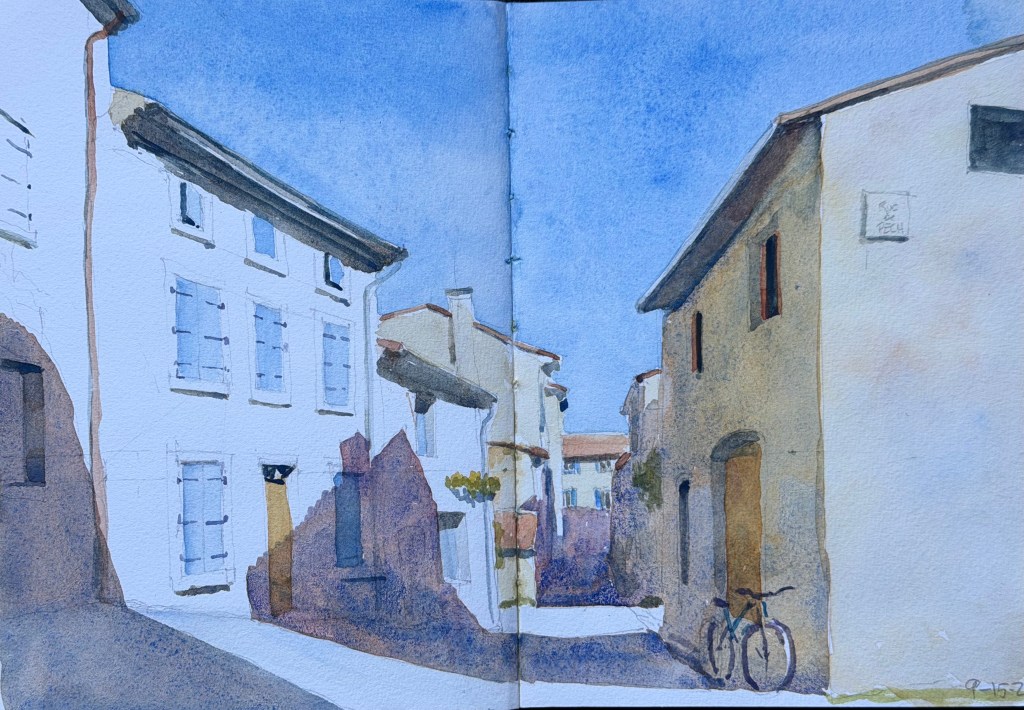
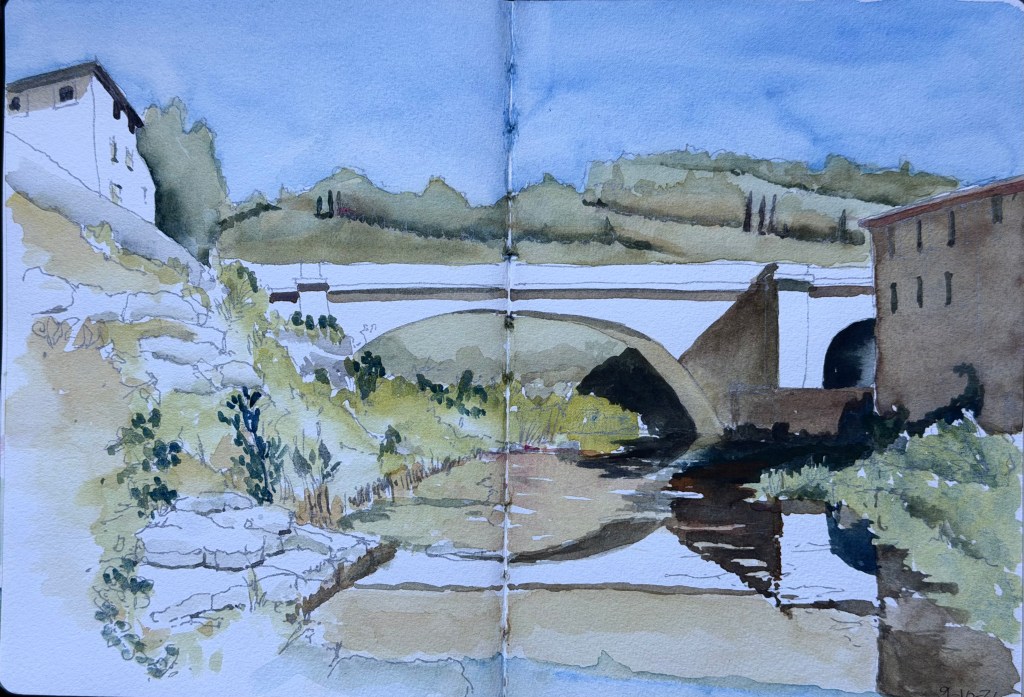
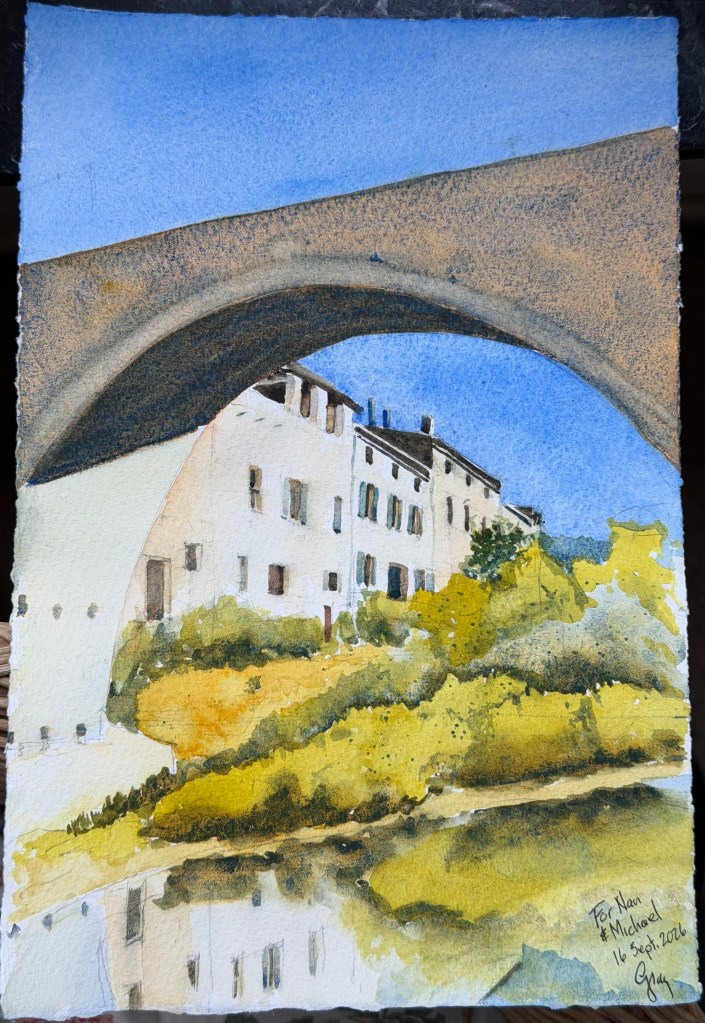
Some pics from Gray’s sketchbook:
We are off to the town of Arles on the Rhône, close to the Mediterranean.
recent question from a friend upon learning we have spent a week in Paris.
First impression: Paris has changed for the better since I was here last in the summer of 2004. Protected bike lanes line the major streets, and the streets now have far more bikes than cars. The bikes make no sound, so watch where you step. Lots of electric bikes are available for rent. The Metro, never more than a 10 minute walk from anywhere, is still fast, clean, quiet, and comes every 4 or 5 minutes. I cannot fathom why Miami’s Metro service is so noisy – it doesn’t have to be that way.
My cousin Judy still has her atelier where she makes baroque stringed instruments. Her website is http://judithkraft.net – you’ll get a warning that the site is not secure because the web protocol is not https, but it is safe to visit.
Our Home Exchange apartment in the 7th arrondissement is on a narrow, one lane street, just wide enough to squeeze one car down it without knocking down the sidewalk dining. People walk in the street, including parents with strollers, so no drivers go fast.
Courtyard and apartment entrance at 25 Rue de Cotte, Paris. Watercolor by Gray Read.
Our apartment itself is curious – narrow and vertical, spread over 4 levels. I manage to strike my head on the ceiling of the staircase entrances, while Gray has no problem. Otherwise it’s comfortable. It has a courtyard where I water the plants. A mouse ventured into the apartment, saw us and left promptly, not to be seen again.
Nextdoor on one side is an excellent Vietnamese restaurant where the waitress wears a black tee-shirt that reads “Purdue Mom”, while nextdoor on the other side is a preschool “Petite Académie. The sign is particularly sweet.
Up the street is the Troll Café where people hang out on the street drinking beer but leave no trash. Down the street is a covered market with excellent cheeses and meats at superb prices. Next to the covered market is an open air market. Peaches are ripe and aromatic. We ate a lot of peaches.
The neighborhood compost container, airtight, is around the corner. A short walk on the main street nearby takes us to a cash machine, a supermarket, pharmacy, a gluten-free bakery, and a park.
At the lunch hour, the neighborhood park fills with groups of tweens from the nearby school, but you may not bring your rhinodoodle.
Every evening, dining out is a new delightful experience. Good wine is inexpensive, so I have to be careful.
Moules frites, with beer. Particularly good.
One night we joined my cousin and her husband for a concert on a barge in a wide canal. An Armenian jazz pianist, Lucy Kahnyan, played her own compositions, accompanied by a fabulous percussionist whose name I cannot relocate (he was really good).
French pleasure boaters weave erratically on the canal, so rental boats are enshrouded in fenders for the general welfare.
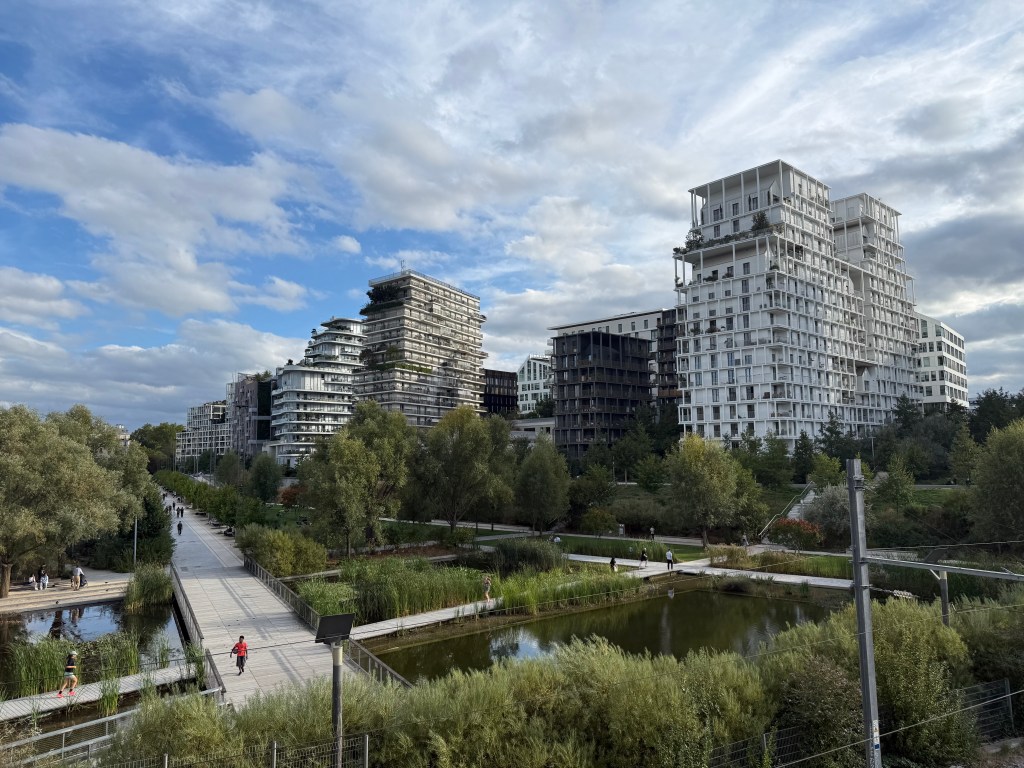
We visited a new neighborhood of high-rises in the 17th arrondissement, each different and interesting, adorned with terrace gardens, green walls, solar panels, and paintings. At the ground level is an extensive park of trees, small playing fields, walking paths, cleverly designed playgrounds, a skateboard park, benches of course, and an extensive array of shallow ponds comprising an artificial wetland where we saw assorted waterbirds and carp.
Children were everywhere, having fun with balls, climbing the innovative play equipment, watching the fish, and zooming around the kid-scale skateboard ramps and half-pipes on small scooters. As it came on 6 pm, children thinned out, replaced by joggers, home from work.
Our last day we visited the National Picasso Museum, which houses Picasso’s private collection – his works that he wouldn’t or couldn’t sell and his own collection of works by Matisse and others.
Now we have relocated to Lagrasse, a tiny medieval town in the south of France, staying with friends, former FIU colleagues, in their beautiful apartment with fortified stone walls four feet thick.