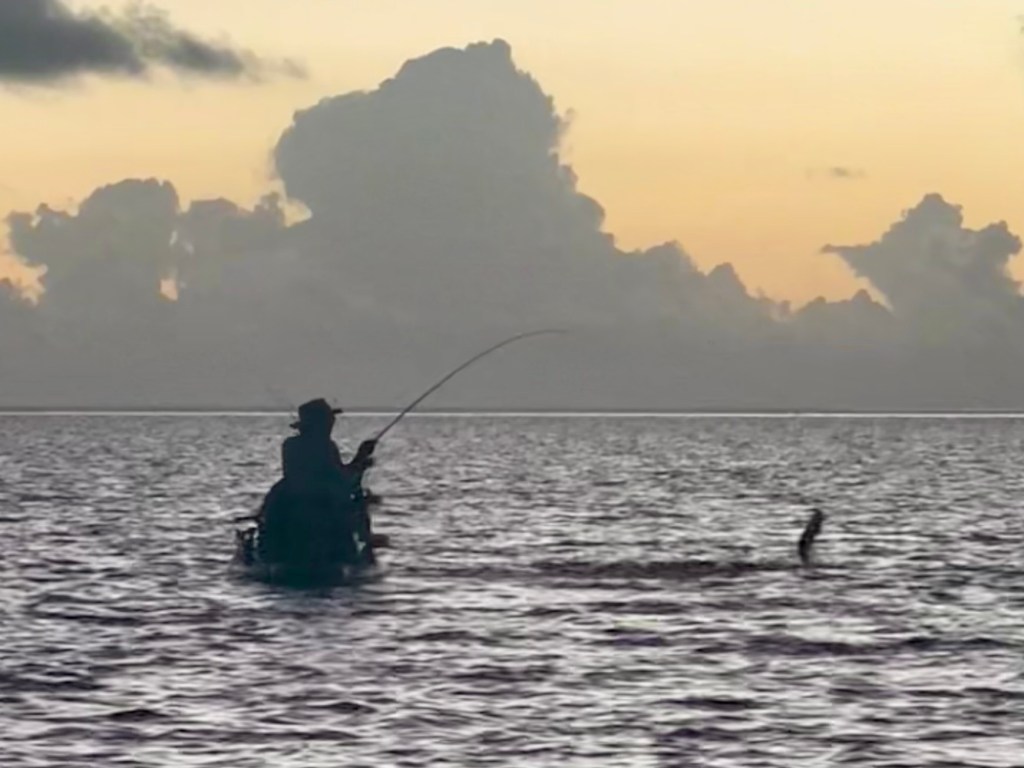
Eye of the Cormorant

another odd bird who chases fish.

Tag: outdoors

  • Pandora’s Flats

    I’ve been grappling with a multi-way conflict: (1) trying shake the “forever cold” while (2) healing a torn rotator cuff muscle (supraspinatus) in my fly casting arm, and (3) enjoying every nice day I can on the water with a fly rod and binoculars. At least I don’t have to grade papers.

    A cold front reached South Florida, knocking down the mosquitoes and moving sharks away from the shallows. The Everglades mangrove flats beckoned me southwards.

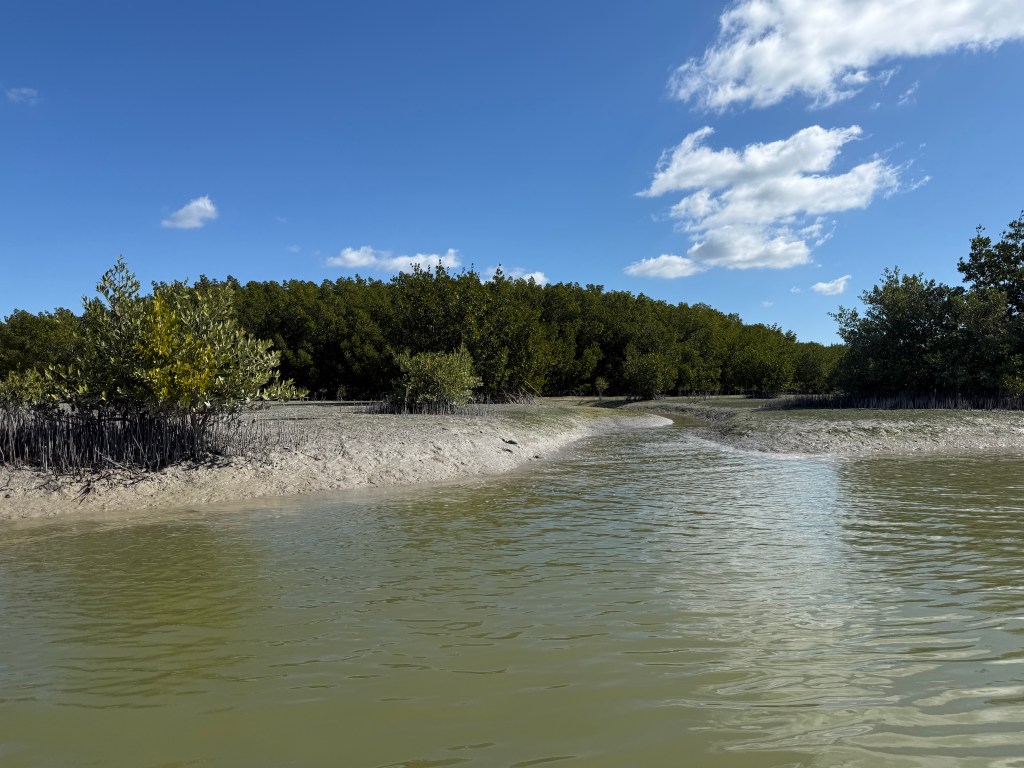
    Entrance to the flats.

    One shallow flat in particular draws me to watch shorebirds and chase game fish.

    Birds gather on the falling tide. Snook and Redfish forage near that edge.

    To get the best experience, you have to get the tides right. Depending on the moon and tide phases, the area can be 16 square miles of water (birds wait in the trees and fish are everywhere), 15 square miles of exposed mud (birds dispersed everywhere and fish are concentrated in the channels with the sharks), or something in between (birds and fish both concentrated on the edge of the tide). If the wind comes up, water might blow onto or off the flat, superseding the tidal prediction.

    Several two mile trails lead to the edge of the flat. When my late colleague George Dalrymple took his zoology class down the Snake Bight Trail, one student had to be carried out after she fainted from the sheer horror of the Black Salt Marsh Mosquitoes. I found that pedaling my bicycle down the trail lets me keep ahead of the swarm. Just don’t stop! But the best access is in a shallow-draft boat, a kayak, canoe, or technical poling skiff.

    Coming by boat, you have access to more of the flat and can approach the edge of the tide where birds and fish are concentrated. However, it’s easy to get trapped by the falling tide, particularly when distracted by fish or shorebirds, both of which follow the rapidly moving tidal edge. If Poseidon empties the bathtub while you are far from a channel, there’s no walking out. The deep, sucking mud steals your sandals before eating you whole.

    People who get stuck sometimes phone the Park dispatch office. The ranger explains:“Yes, we see you out there, but we can’t get to you. Unless it’s an emergency and you want to pay for a helicopter, you are going to sit there until the tide comes back in.” You might spend up to eight hours waiting for the next high tide to free your boat. Hope you brought extra water and a granola bar, and good luck with the lightning.

    I have willingly allowed myself get stranded at the bottom of the outgoing tide while watching shorebirds, chasing fish, or watching shorebirds chase fish. I eat lunch then escape when the tide returns to float my boat. The show can be worth the wait.

    Tricolored Heron
    Black-necked Stilt
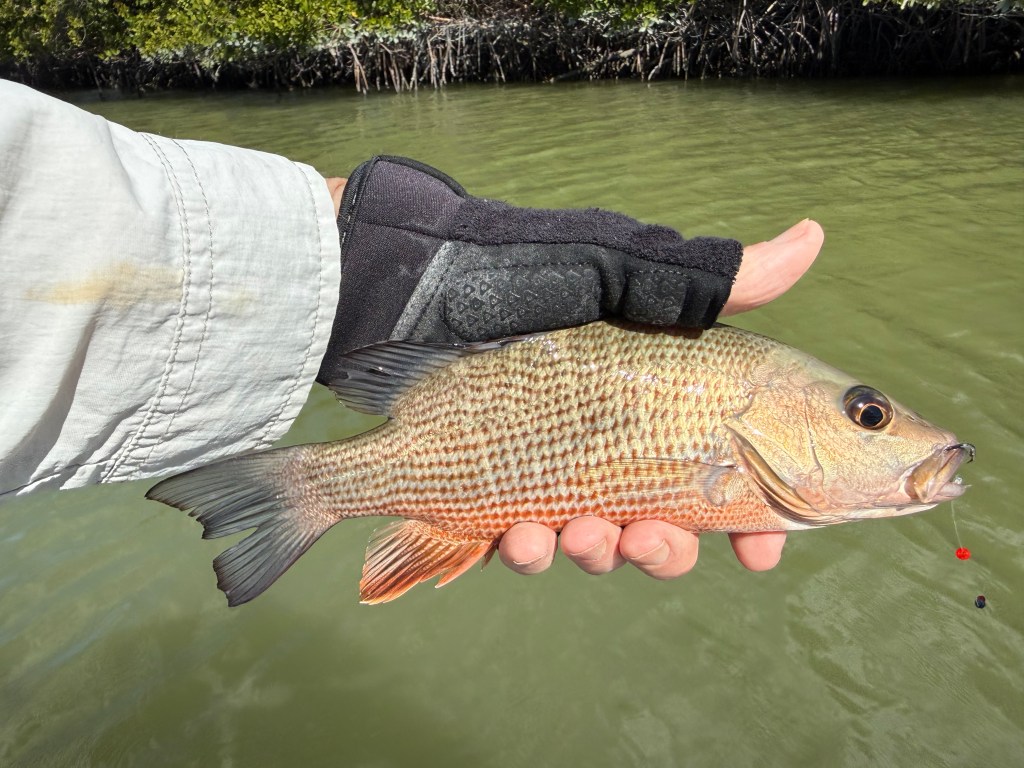
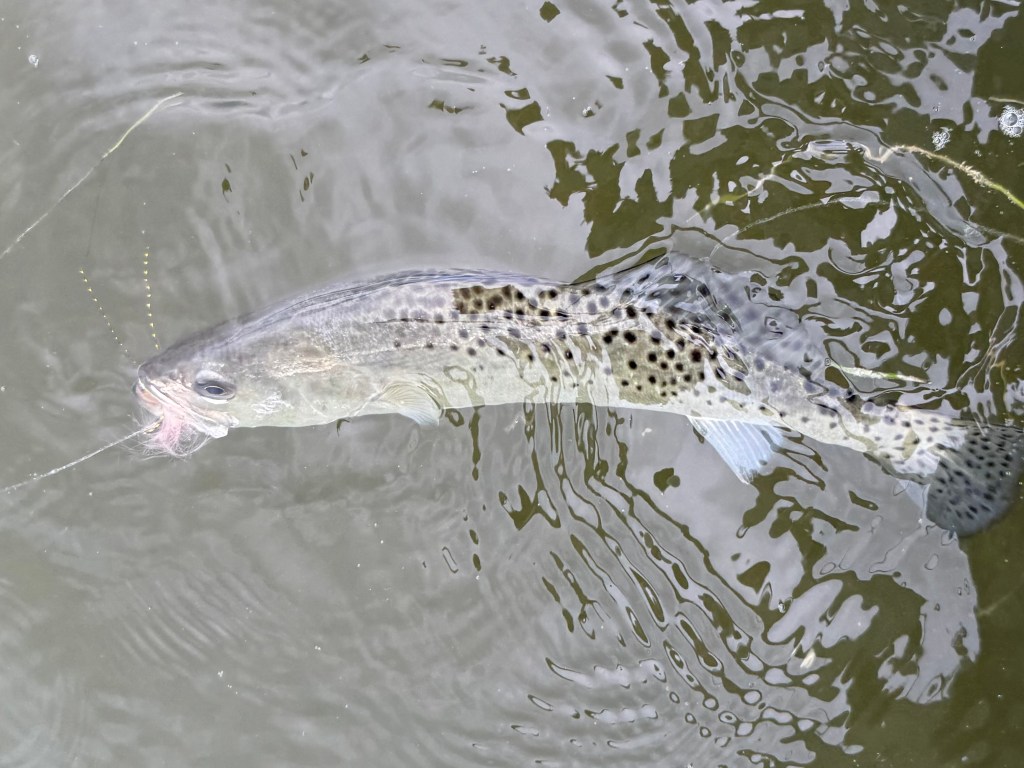
    Speckled Seatrout that took my fly.

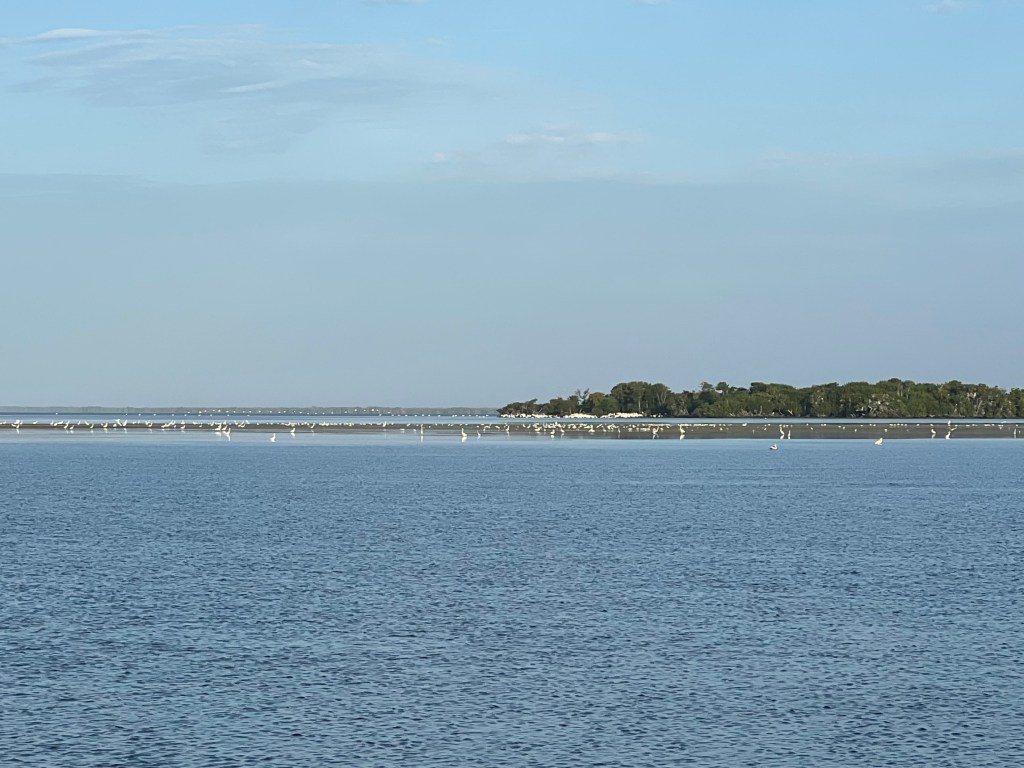
    The low tide can bring spectacular birding as it did last week when baitfish and birds filled the runouts along one of the main channels. The flats were covered with winter waterbirds: White Pelicans, Black Skimmers, all the long-legged waders, Marbled Godwits, Short-billed Dowitchers, Wilson’s Plovers, and assorted “peeps”.

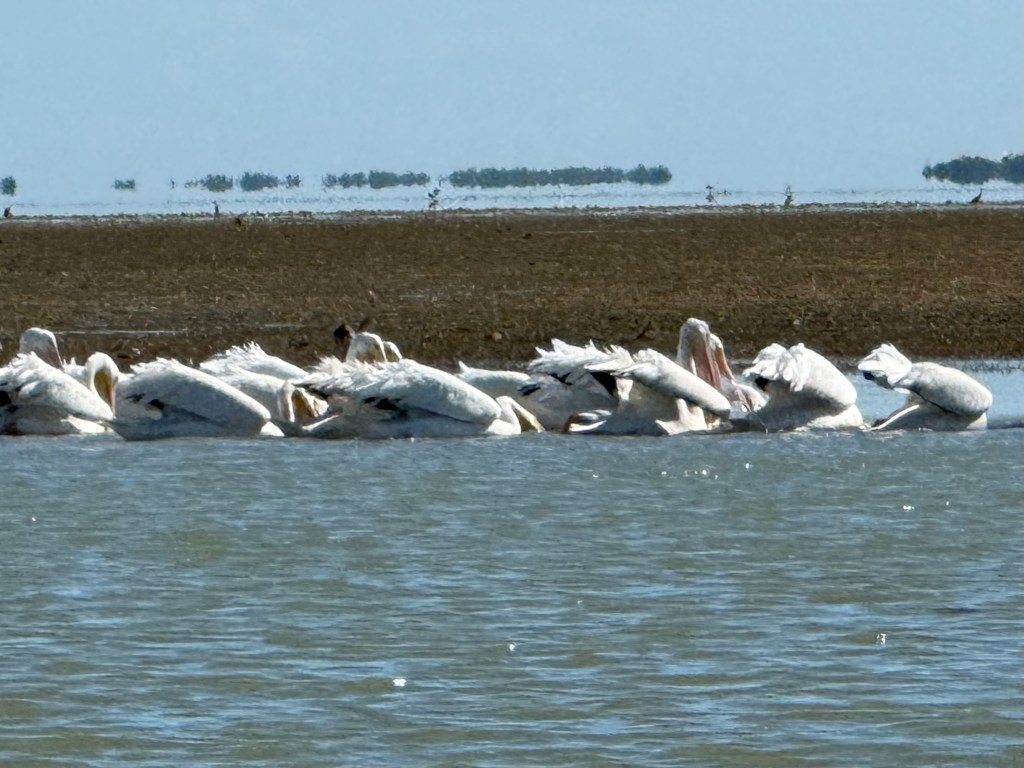
    White Pelicans fishing cooperatively for mullet.
    Black Skimmers leaving the flat as the tide rises.
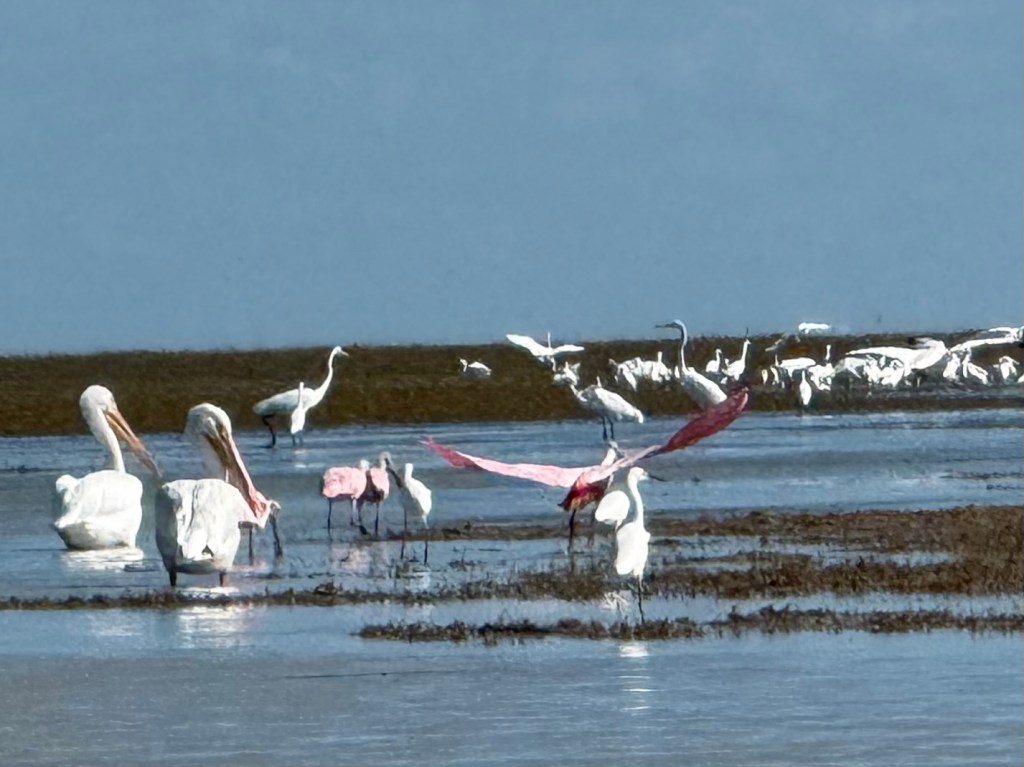
    White Pelicans, Great White Herons, Great Egrets, Roseate Spoonbills, Snowy Egrets, all fishing the shallow run-out at dead low tide.

    When the high tide pushes birds off the flats, some regroup on the highest shorelines, while others settle into the mangrove trees.

    Reddish Egret takes refuge from the high tide on a mangrove island.
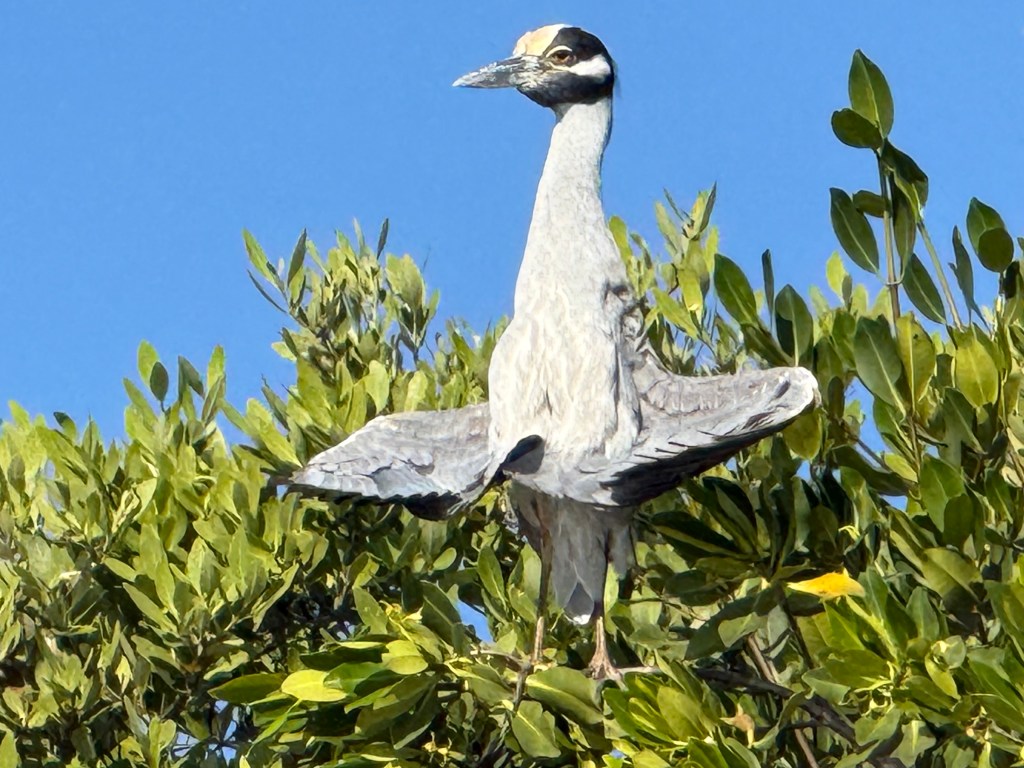
    Yellow-crowned Night heron practices the Angeli Mudra yoga pose.
    Roseate Spoonbill looks down to assess the water level while waiting for the tide to recede.
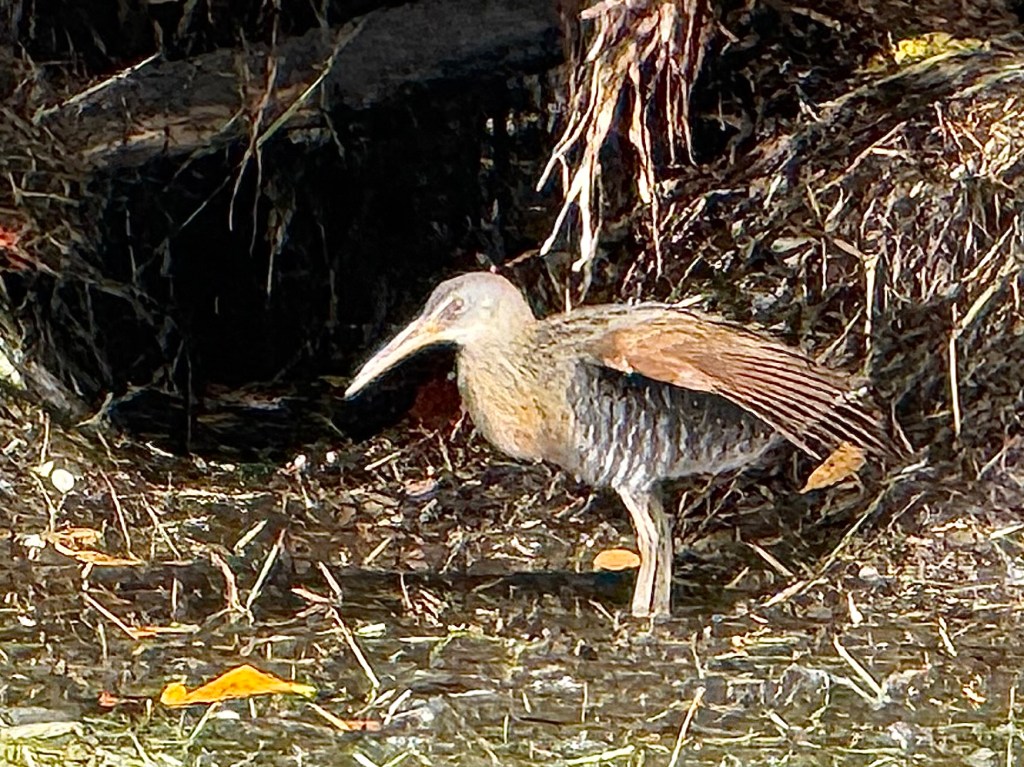
    A Mangrove Clapper Rail skulks through the matted seagrass caught in the mangrove roots.

    A couple of days prior, my friend Jay Levine had caught and released 30 Snook on fly in a channel and had zero shark hassles. But when I arrived, the water had rewarmed, the sharks were returning, and the Snook were making themselves scarce. I caught and released a couple of Snook safely but an unseen shark took the third one and I called it quits.

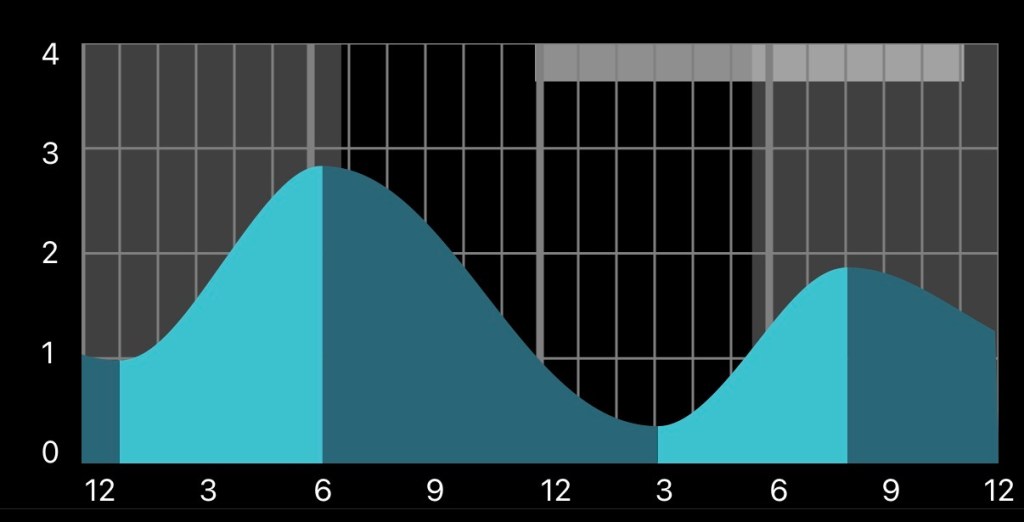
    Four days later, my fishing friend Jeremy Nawyn asked me to join him kayak fishing this same flat once again. At first I declined, but then I took a look at the tide chart: 

    Tide chart for Flamingo on 26 Nov 2025. The black band in the middle is daylight and the gray bar at the top is the moon. The tide on the flat we are fishing is delayed by an hour. It will fall for eight hours, from 7:45 am until 4 pm .

    I normally fish this flat by motorized skiff because it’s so exhausting to exit by kayak. If you fish the rising tide (safest) you must paddle back against the fast incoming tidal current to escape, but a long falling tide like this one is a virtual water taxi service. As a lagniappe, the wind would be at our backs coming out. I texted Jeremy that the tide chart had changed my mind. I was in.

    Jeremy’s proposal was to head out in the dark before dawn and ride the incoming tide up a narrow unmarked channel on the edge of the flat, then ride the outgoing tide back toward the marina with the wind at our backs. We faced little risk of getting stranded if we stayed in or near the narrow channel, and would not have to fight the tides or winds to escape.

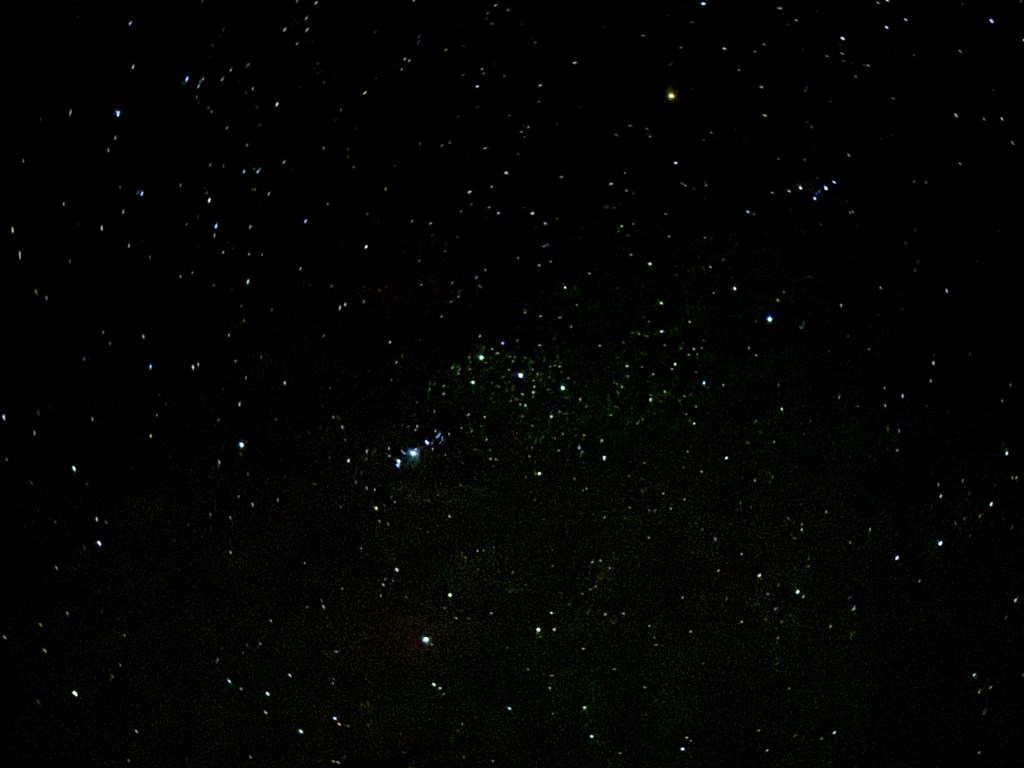
    I arrived early to enjoy the starry moonless sky.

    Orion.

    I rigged my kayak while the resident Barred Owl hooted:“Who cooks for you? Who cooks for you-all?”

    Jeremy arrived at 5:30 am with his kayak mostly rigged in the back of his pickup truck. We were on the water by 5:45 am, 70 minutes before sunrise.

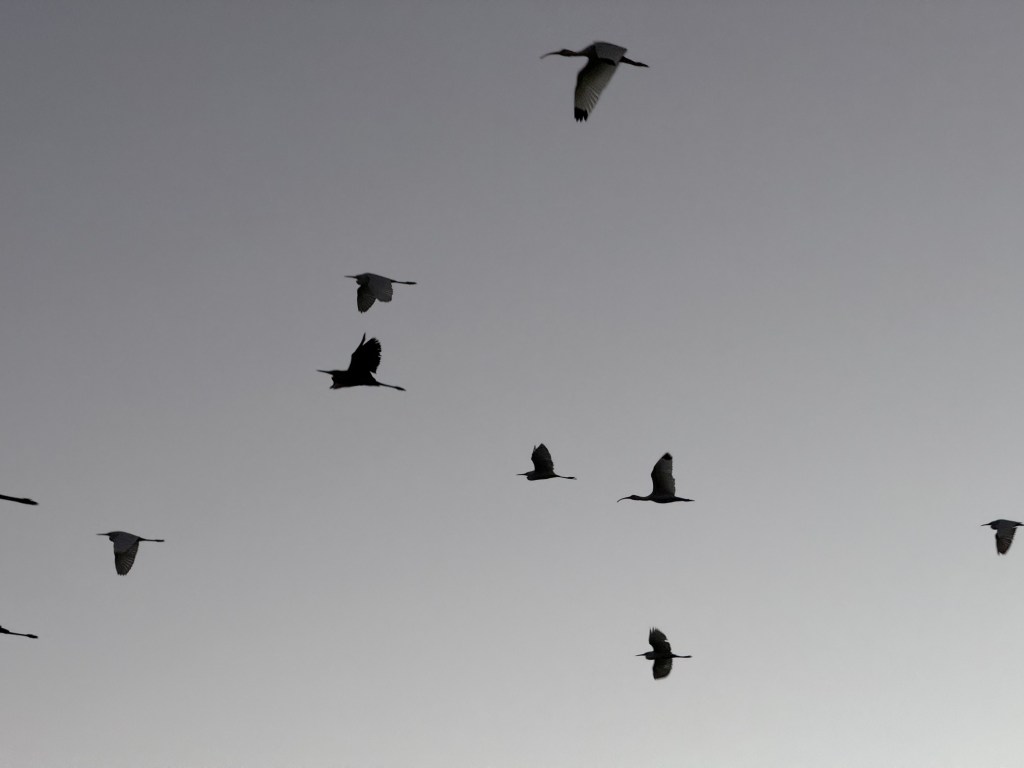
    Great Egrets and White Ibis leaving their roosts. White birds look black in the pre-dawn light.
    Jeremy in the lead. One of his teenage kids sometimes joins us, but not if we’re going out this early.

    Our fishing strategy was to paddle the narrow channel and cast toward the mangrove roots on shore where the predatory fish typically forage for crabs and small fish when the tide is up.

    I hooked a nice Snook near the mangroves then pedaled my kayak hellbent-for-leather onto the shallow flat, grounding the Hobie’s pedal flippers on the mud before stopping to work the fish to my landing net for a quick measurement and release.

    Phil with Snook in shallow water. Photo by Jeremy Nawyn

    Grounding the kayak on the flat might seem like an odd thing to do on purpose, but it prevents unseen sharks from popping up from below and grabbing the fish on my line. A Snook or Redfish hides handily in a foot of water, but a Lemon Shark or Bull Shark is conspicuous. If a shark comes for my fish in super-skinny water, I can see its approach, open the reel, and let the fish run. My trick worked this morning with a handsome Snook and a chunky Redfish.

    Snook, 24″.
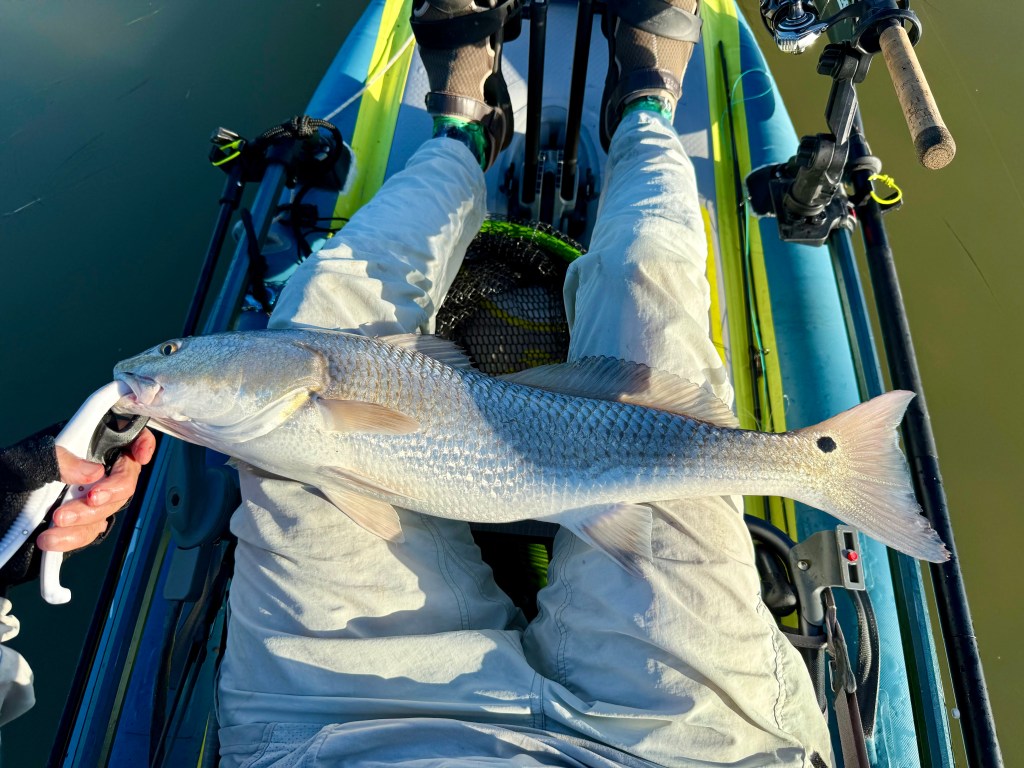
    Redfish, 24.5″

    A Lemon Shark circled my kayak looking for my redfish as I hefted it in my landing net from one side of the kayak to the other. 

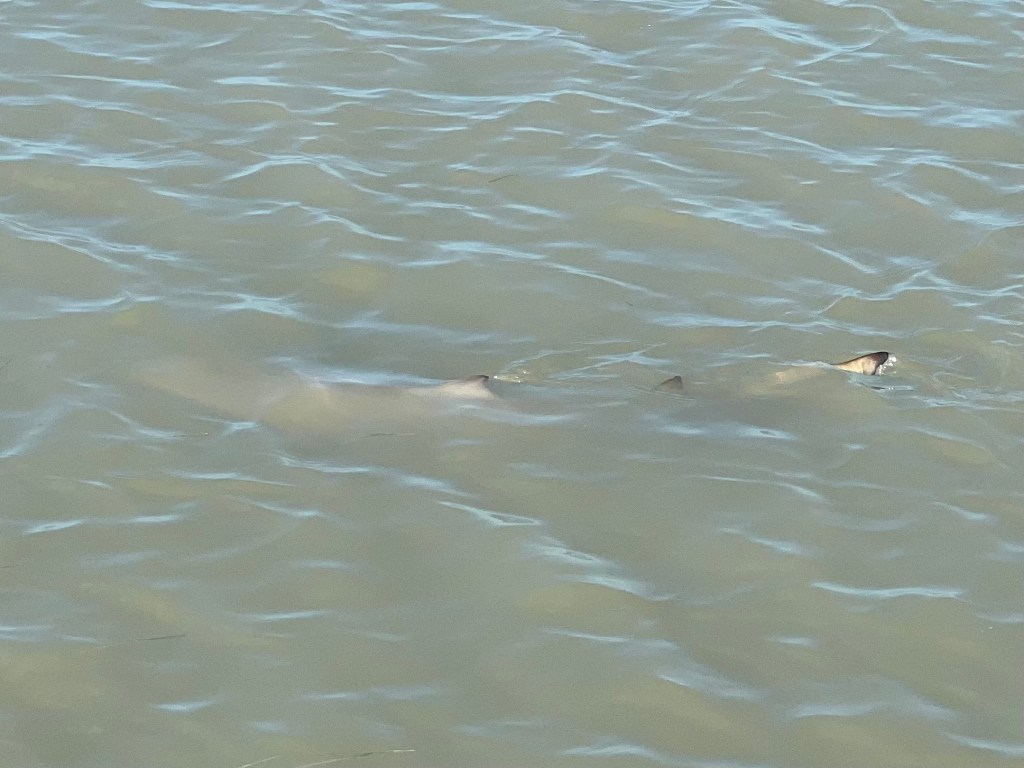
    Pesky Lemon Shark circling the kayak.

    Enough already. I pedaled the kayak right at the shark to chase it away. 

    Typical of this flat, the water was opaque with sediment. One could only make out detail in the top 6”, which made it hard to spot fish. At the farthest extent of the tiny channel, a three-foot tarpon swam under my kayak, which I only saw because the water was just a foot deep… and dropping. Time to turn around.

    I stopped in at a favorite cove on the way back, wherein I often find Snook and Tarpon. A four foot Lemon Shark had gotten in ahead of me and was working over the cove, chasing all the fish up the mangrove creek – definitely time to head back. As cool as they are to see up close, I don’t want sharks hanging around my boat jonesing for my fish. Lemon Sharks at Flamingo have bitten the hands of several fishermen in the past couple of years and even dragged one careless lad overboard and into the water (YouTube video).

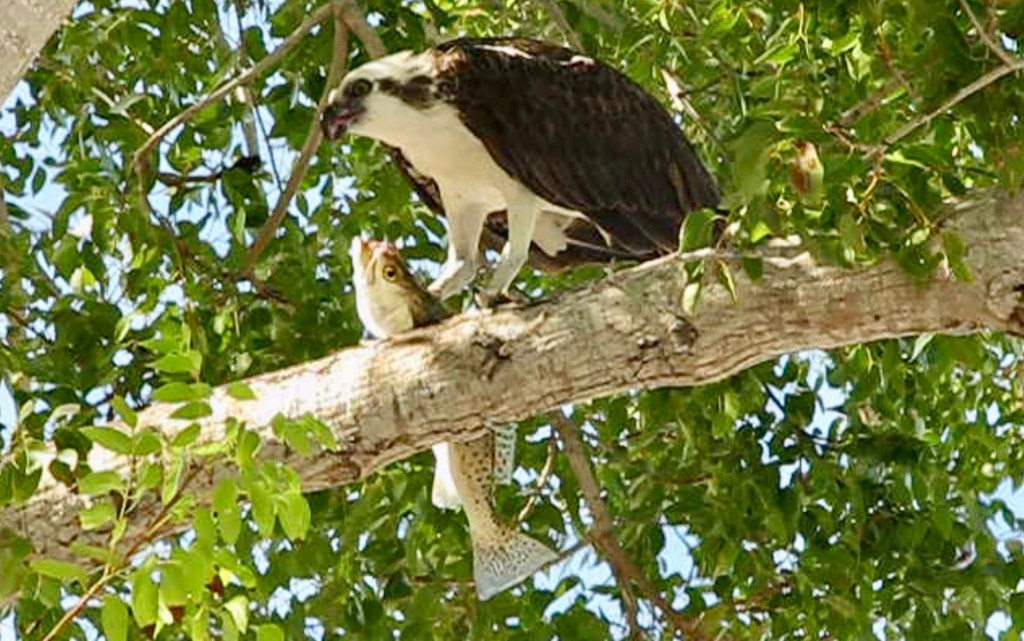
    I paused to watch eight Ospreys circle a mullet school, diving in succession, snatching hapless fish, and landing in the trees on shore to enjoy a sashimi breakfast.

    This lucky Osprey caught a yummy seatrout.

    Full of fresh fish, the Ospreys set about collecting soft material to line their stick nests. Some carried clumps of dead seagrass in their feet.

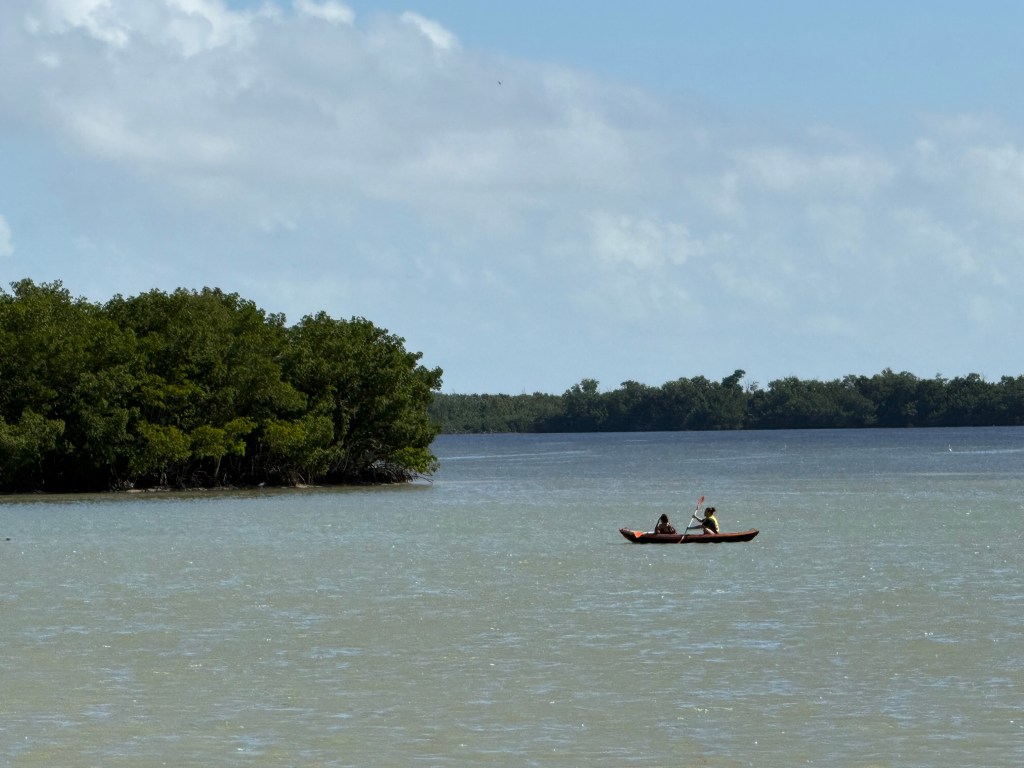
    On our way back to the marina, I spotted a young couple in an inflatable kayak paddling the opposite direction, heading toward the heart of the flat. Unless they knew what they were doing, they stood to get stranded in about 20 minutes and stuck there for the next 5 hours. Seeing neither fishing gear nor binoculars, I took them for tourists. I paddled over and asked whether they came here often. “First time” responded the young man in a British accent.

    I explained about the tides and the mud, and pointed them toward a channel marker. If they paddled directly to that marker they could spend all day watching birds, sea turtles, and marine mammals from the main channel without getting stranded.

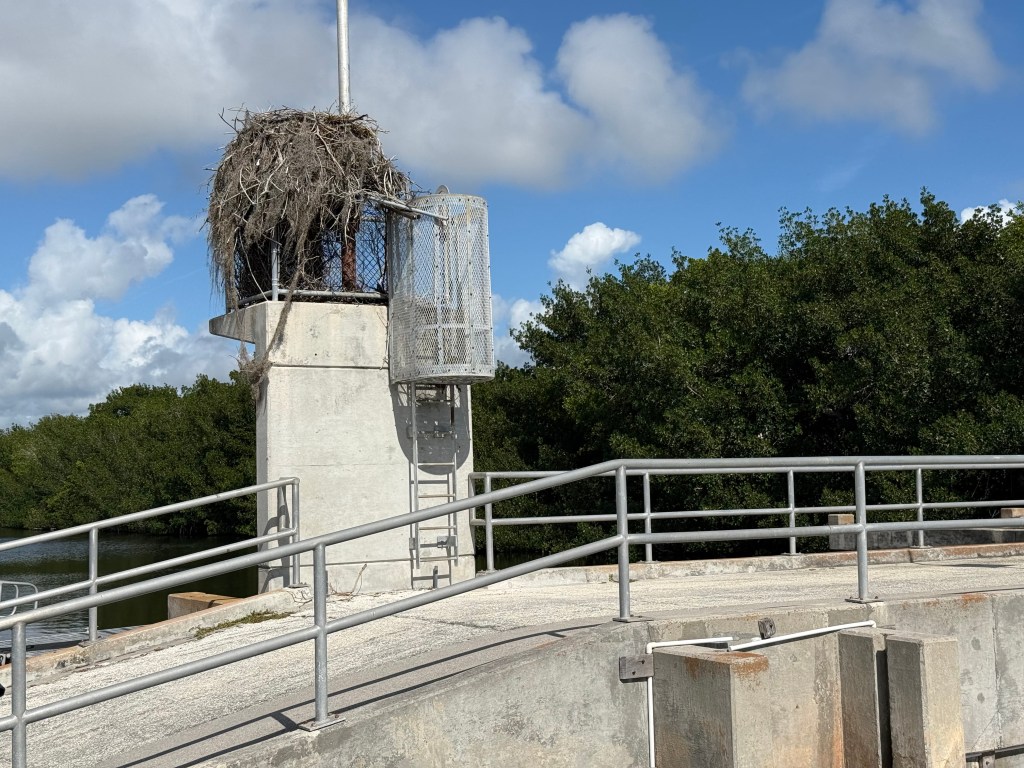
    As I packed my gear in the car, I watched another Osprey pair skimming the West Indian Mahogany trees to collect Spanish moss for their bulky nest on the water control lock that separates the Buttonwood Canal from Florida Bay. 

    Lock Moss Nesters

    I ate my lunch while overlooking Florida Bay from the refurbished visitor center. In addition to the wildlife viewing it’s entertaining to watch international visitors enjoying this National Park in their own ways.

    Keeping up with Instagram is priority anywhere you go.
    More my style.

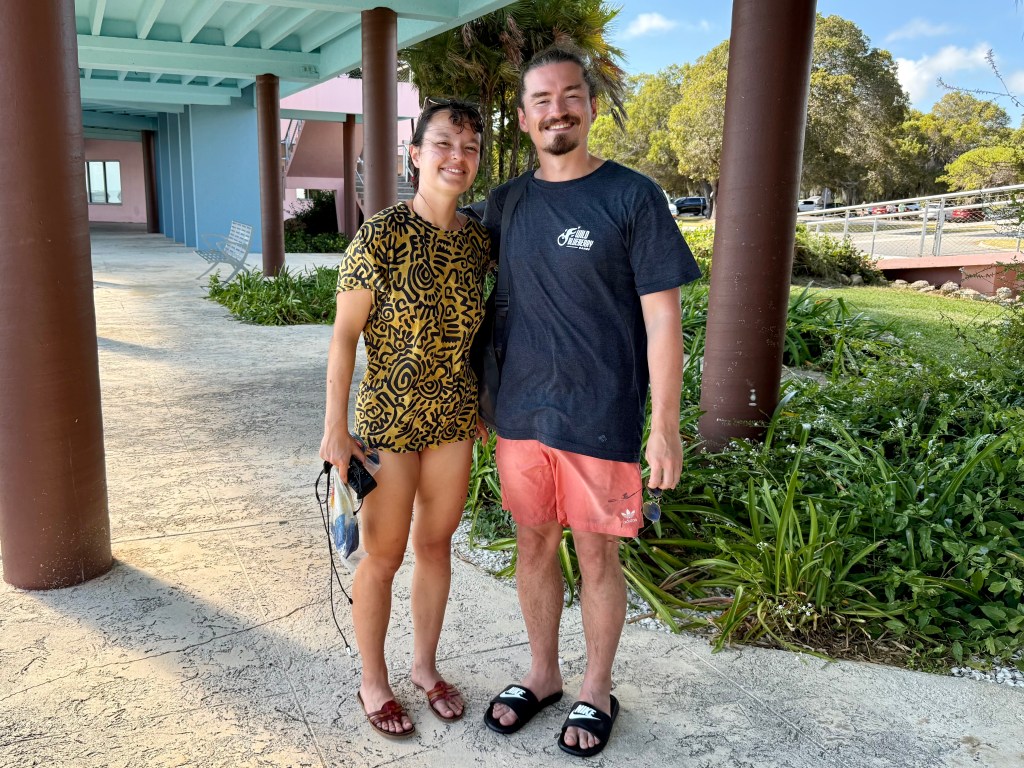
    Hey, that’s the same couple in the kayak I saw earlier, now returning from the flats. They pulled their boat ashore and stopped by to say “hi”.

    Caroline from Strasbourg and Jason from London.

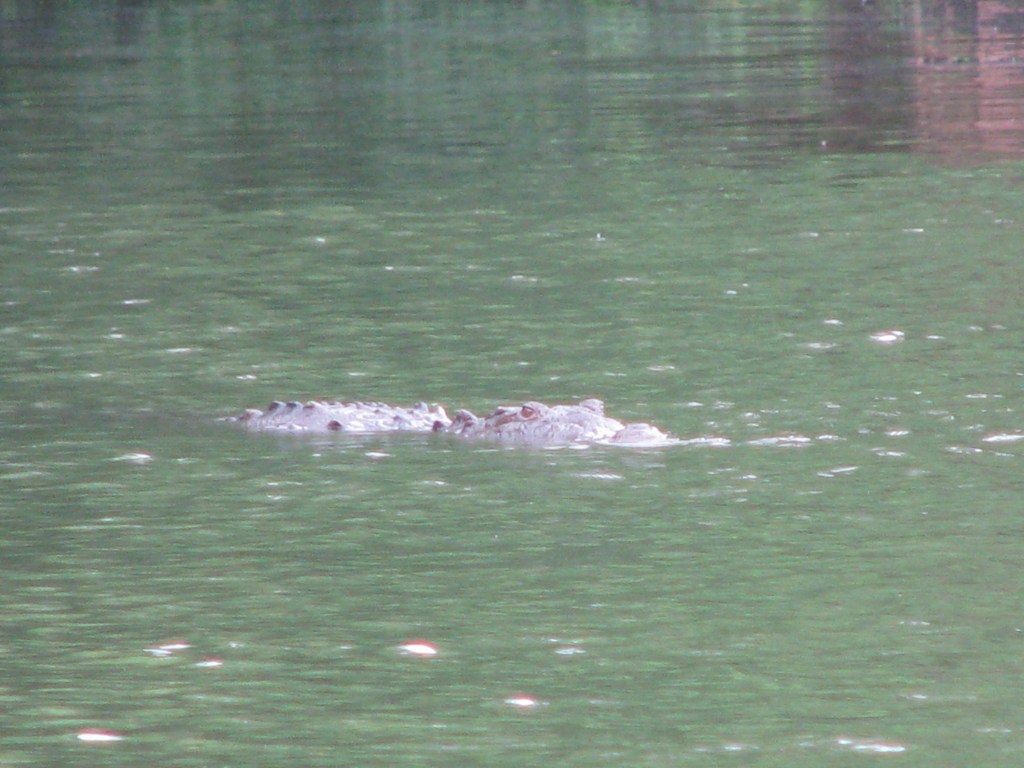
    They had decided to head back in after a large American Crocodile surfaced in the channel next to their inflatable kayak.

    My photo, not theirs, but you can see why they might have felt unsafe in an inflatable kayak.

    Until recently, I’d have told them not to worry about the normally docile American Crocodile, but last summer an experienced fly fisherman told me of a large croc at Flamingo that went airborne in its best attempt to take him off the deck of his skiff.

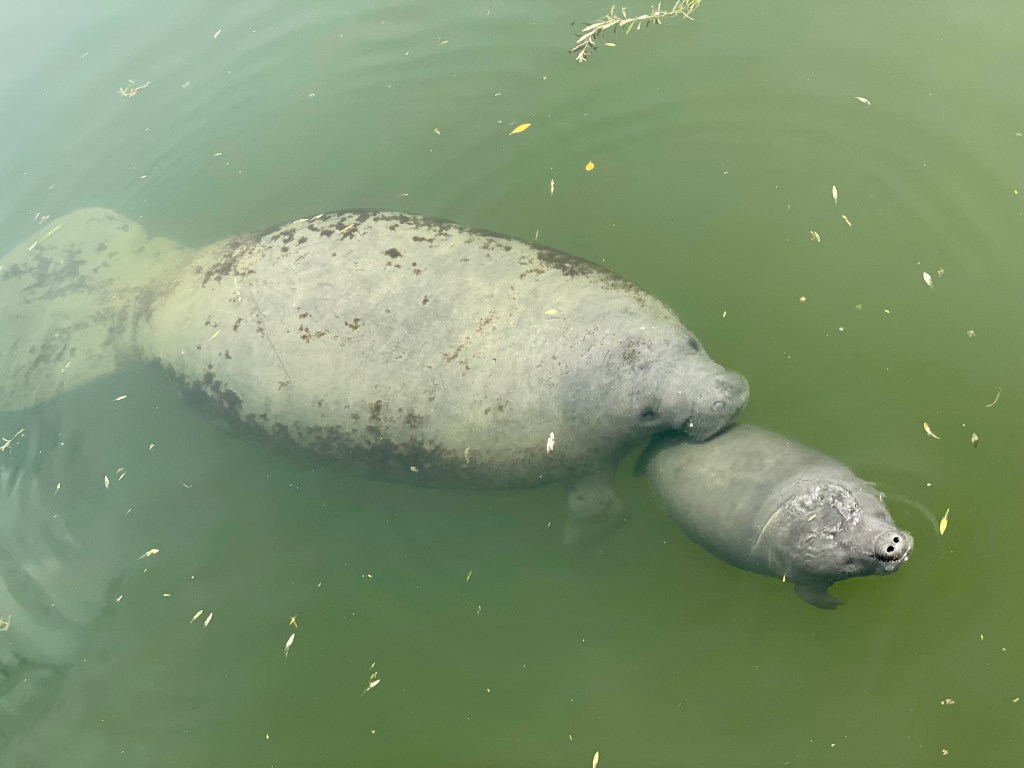
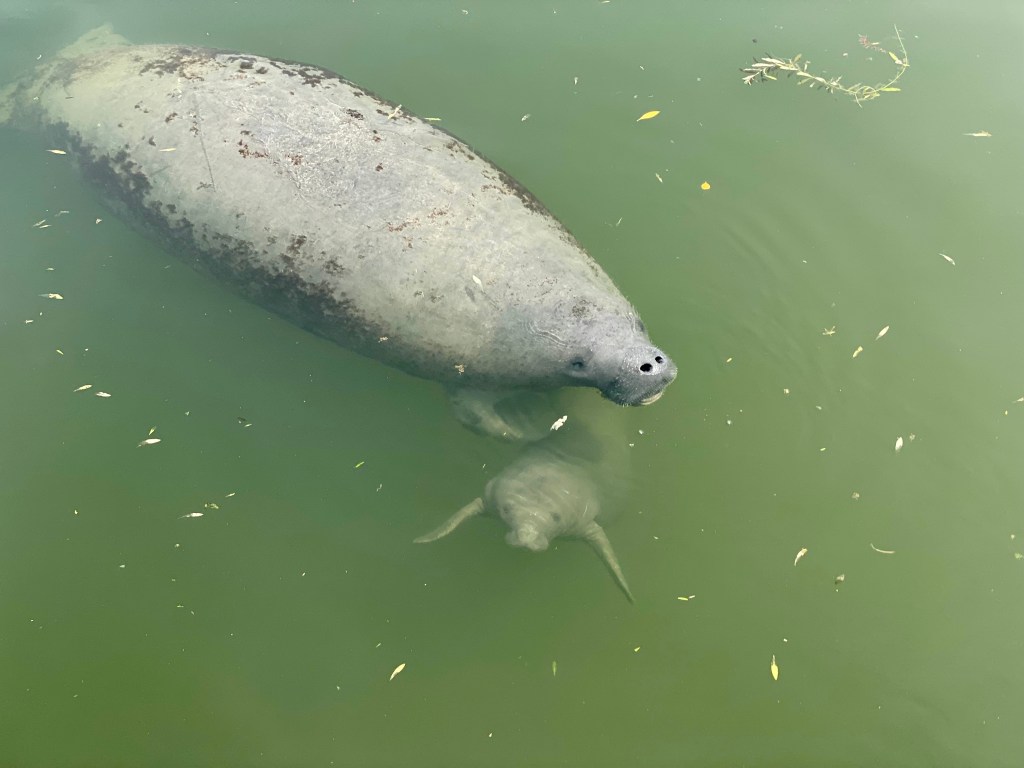
    I took Caroline and Jason over to the marina to admire the assembly of mother and baby manatees.

    Too cute.

    * * *

    Pandora’s Flats

    A couple of months back, I promised to write an essay about why you shouldn’t fish at Flamingo. The dense mosquito swarms are sufficient reason for normal people to stay away nine months of the year. Risk of stranding on the flats while exposed to sun and lightning should give pause to any sane person. We recently acquired the man-made problem of habituated sharks and crocodiles popping up at random from the opaque water below – recreational fishing boats have trained them well. If you just wanted to fish, you might find an equally productive area with fewer ancillary hazards.

    American Crocodile. Note the skinny snoot, Roman nose, and 4th tooth on the bottom that sticks up.

    All of these risks have proven insufficient to keep a certain zoologist away. The combination of birds, fish, and scenery will keep me coming back as long as my health and the rising seas allow.

  • Return to Mosquito Hell, with a most striking dawn

    Return to Mosquito Hell, with a most striking dawn

    My last few fishing trips onto the flats have been unproductive. The late summer water has been hot and low in oxygen. Maybe the fish are somewhere else, or maybe they’re just laying low. Tomorrow morning I’m venturing back into the mangrove lakes of Mosquito Hell, an area where I always find fish this time of year, assuming the Black Salt Marsh Mosquitoes (BSSMs) don’t drive me out first.

    Trip planning

    The moon is near full tonight, so the morning fishing activity is likely to be brief. I plan to arrive in the dark to maybe find a snook or two before the sun comes up. Then I’ll peddle-paddle my kayak to an area where the tarpon hang out and snook spend their day hiding in the mangroves. Occasionally, a snook wakes up for a mid-morning snack. If I find the juvenile tarpon rolling, I can see if they’ll play with me. Like snook, tarpon feed actively at night on a full moon, so they may be sated by the time I arrive.

    I’m preparing for the BSSMs the night before, putting into play a few improvements over my last trip to Mosquito Hell:

    I take my khaki fishing pants, outer shirt, and gloves to the driveway, spray them with DEET, and place them inside a 2-gallon zip-loc bag.  I lay out a towel to protect the car seat from the DEET. The rest of my special mosquito gear I place on the passenger seat: for my head, a Tilley hat and insect head net; for my feet, Simm’s neoprene wading gaiters and neoprene dive booties. Mosquitoes are not going to bite through 5 mm of neoprene.

    My scheme is to drive to the launch in the dark, and change into my stinky DEET-soaked clothes, then get out of the car to rig and launch my kayak. I will start fishing at 06:00, before the first dawn light. The nearly full moon sets at 05:49 and the sun rises at 07:06, with civil twilight starting at 06:36.

    It’s tricky fishing in total darkness, and tricker fly fishing. I only know that a snook is nearby if I hear it blow up the water while chasing mullet. Sometimes the water is silent. Other times I cast too far and hang the fly into a mangrove tree. Then I have to turn on my head lamp to untangle the line and of course the light attracts mosquitoes to my head. But other times I cast the fly near a snook and things get exciting in a much better way.  Hope springs eternal.

    My alarm is set for 3:50 am. Time for bed.

    Fishing report

    On the Mosquito Horror Scale (0-10) the morning ranks an 8, “Severe” but not “Extreme”. My mosquito gear system works perfectly. The only mosquitoes that try to bite me are 3 or 4 that go for the pads of my fingers where I have no repellant. That’s not a safe place for a mosquito to bite a human, and they are instantly dispatched with a pat of the finger. With my DEET-soaked outer clothes, mosquitoes don’t even follow me into the car.

    No mullet are splashing around the kayak launch area in the dark, so no predatory fish are there either. Too bad – sometimes the fishing is amazing right there. I light out for the far mangrove shore, about a mile’s paddle.

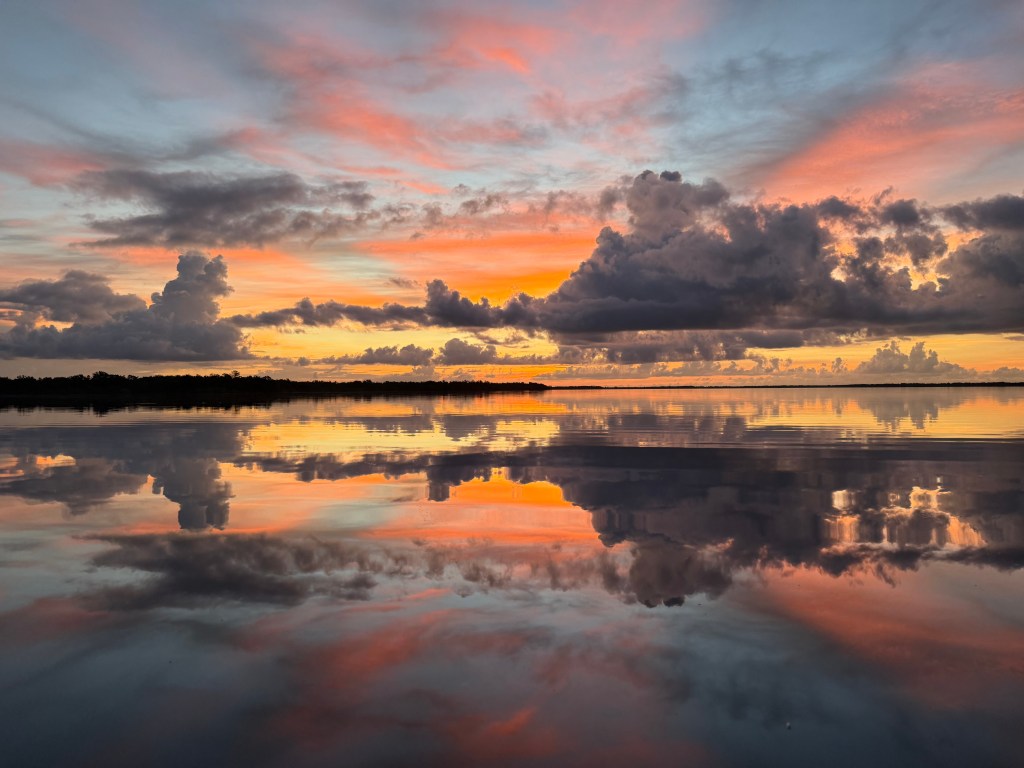
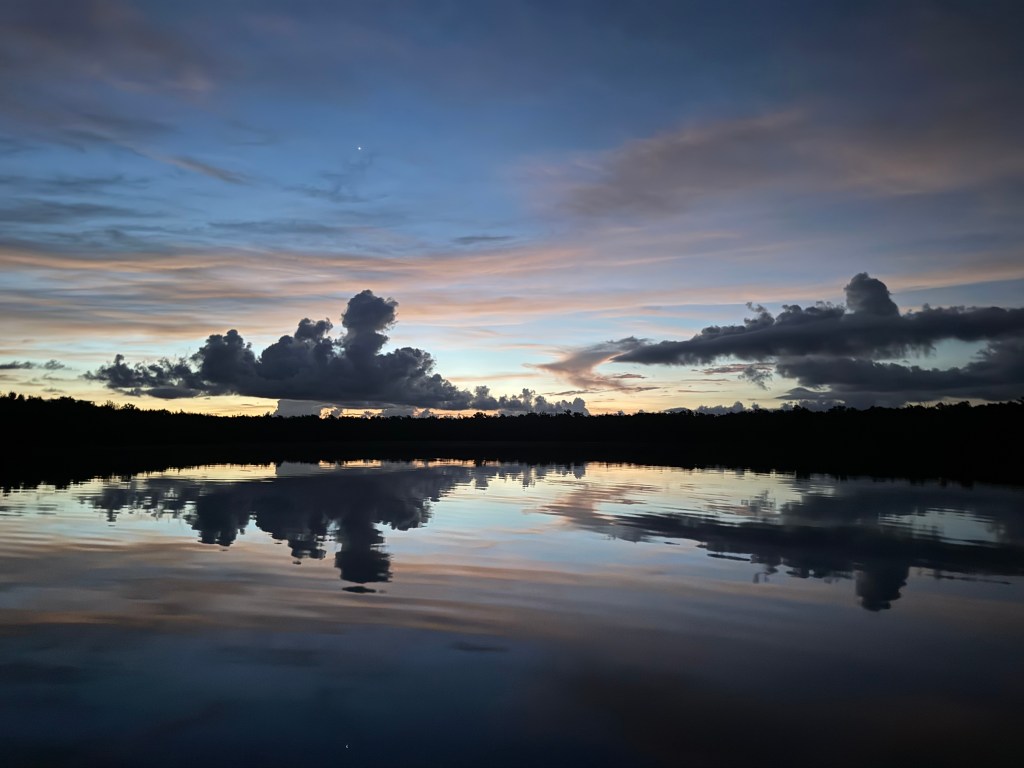
    The first traces of dawn light appear, with Venus still visible directly above the tallest thunderhead on the left.

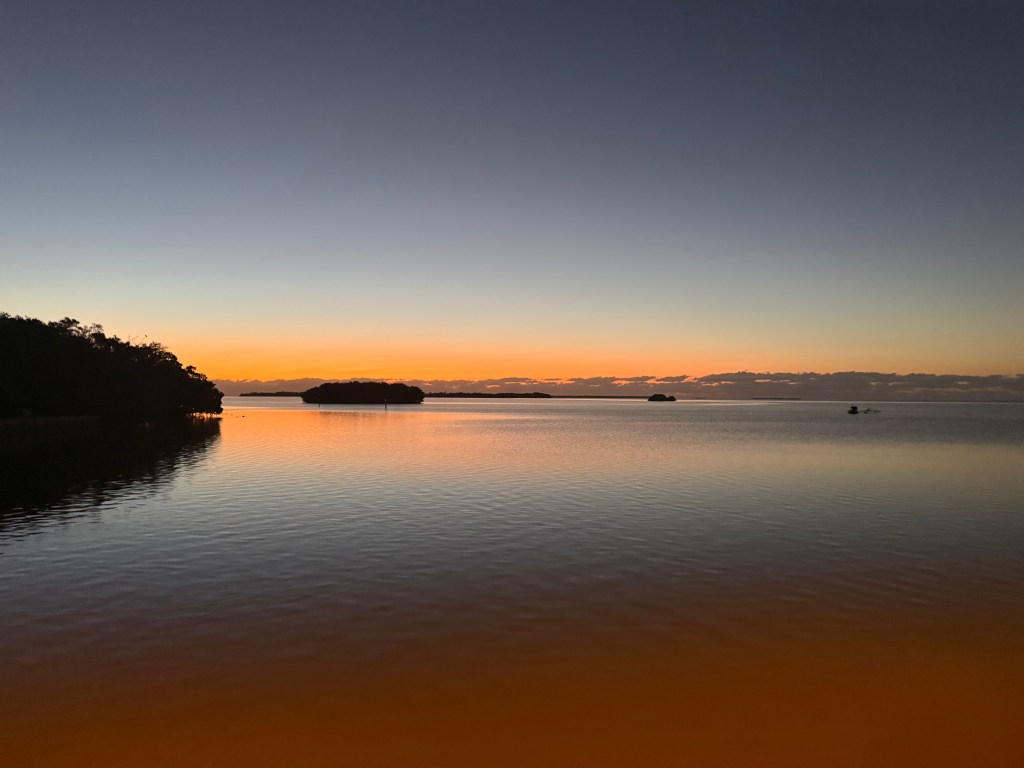
    Dawn explodes enroute. Yowza.

    I reach the other side eight minutes after sunrise. The water is extremely murky and tannic, like donut shop coffee with a tiny splash of horrid non-dairy creamer. I dip my finger in the water and taste it through the head net: slightly brackish.

    To find fish in water this opaque I need a “search bait” that’s dark, for maximum contrast when viewed from below against the sky, but with some sparkle and a lot of vibration to get a fish’s attention. I put away the fly rod and rig my spinning rod with a 4” paddletail in rootbeer & gold with a gold underspin jig – just the ticket.

    The paddletail, true to its name, wiggles its tail back and forth, and the underspin leaf twirls up a storm.

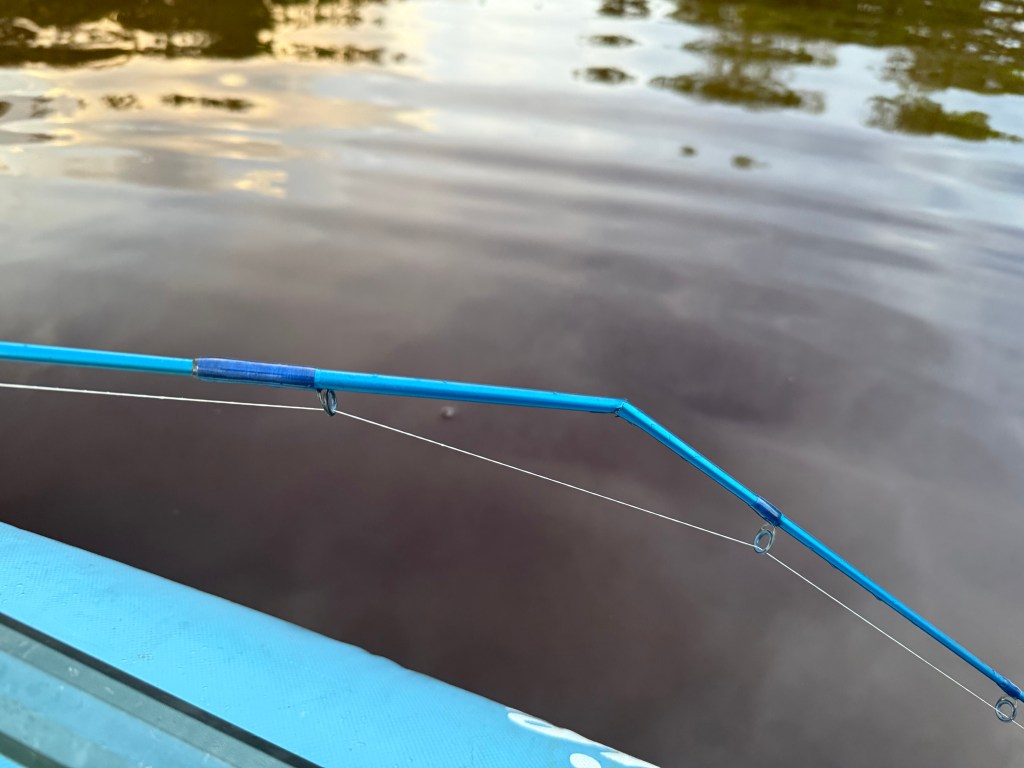
    At 7:15, my second cast is slammed by a snook in the 30″ range. It makes one jump, a brief lateral run pulling line off the reel, then runs straight for me as fast as I can take up line. It passing directly under the middle of the kayak, bending the rod hard. The  tip section of my three-piece TFO travel rod snaps, creating a brief moment of slack that pops the lure free of the fish’s mouth.

    This is the 4th time this spinning rod has broken, every time in exactly the same spot, 5″ above the ferule. Until now, I’ve blamed myself, but thinking on it, each break occurred under a different circumstance and stress geometry and I’ve never broken any other spinning rod. I’d wager the TFO Traveler is weak at the internal edge of a carbon fiber sheet wrap. I will write the company about this problem. I bought two replacement tip sections the last time one broke, so I still have one left, but I need a more reliable multi-piece spinning rod.

    Why even bring a travel rod on a local fishing trip? When kayak fishing tight to the mangroves, it helps to have the rods I am not using at the moment disassembled and stowed safely out of the way. That’s a key advantage of multi-piece rods, not to mention the obvious advantage when I travel.

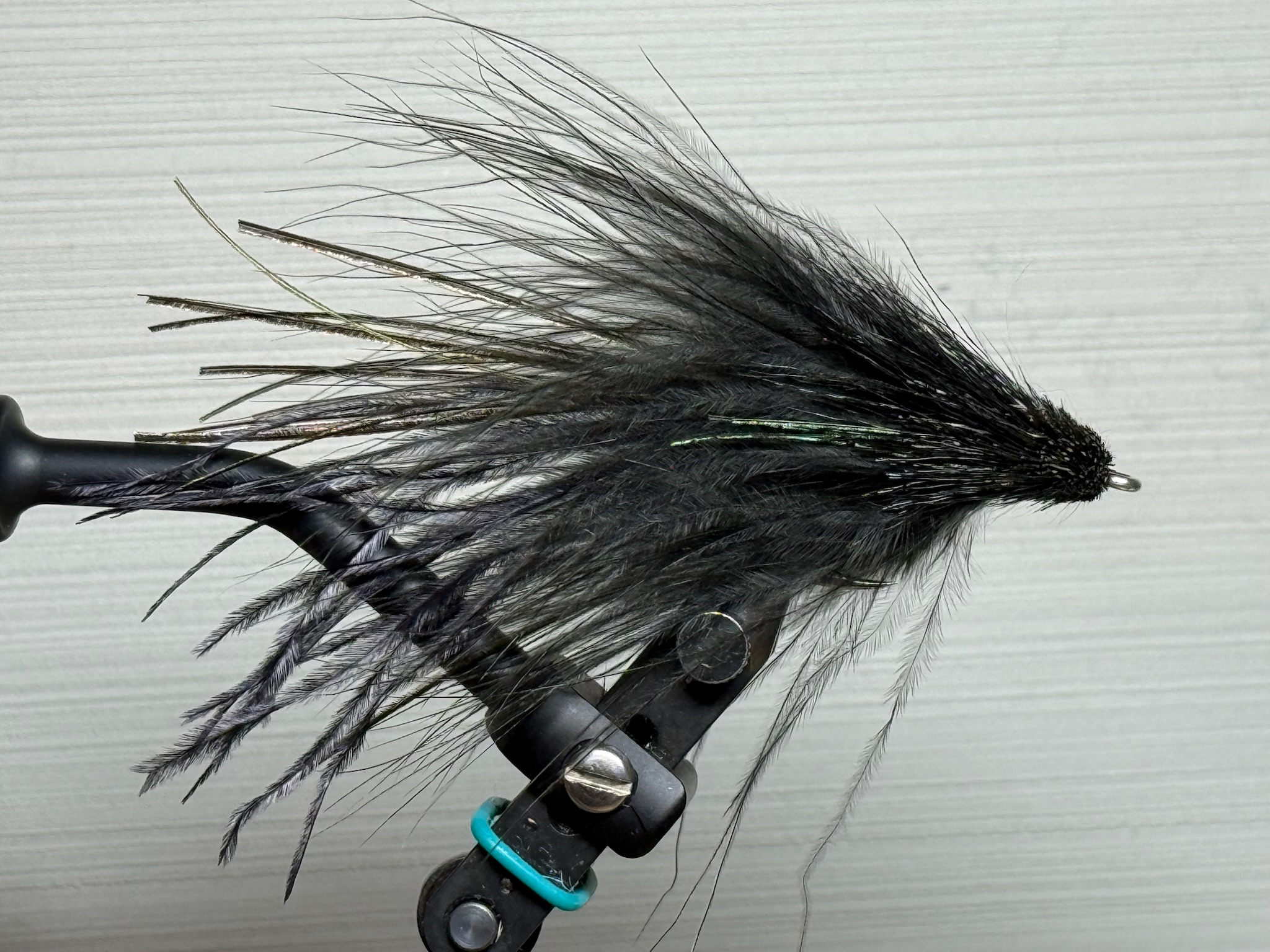
    Back to fishing. Having broken the spinning rod, it’s “fly or die”. I re-assemble the 8wt fly rod and choose a black dark-water fly, this one tied from Drew Chicone’s pattern, The Devil’s Daughter. The tail is ostrich and peacock herl, the body is fluffy marabou feathers, and the head is spun deer hair. Peacock herl gives It shimmer and the ostrich and marabou make it swish enticingly in the water.

    I start with the fly in the photo and immediately hang it in a mangrove. Impatiently, I shove my kayak into the mangroves to untangle the fly, leader, and line, then tie on another I’d made with a weed guard to keep it from hanging in trees and roots.

    Predatory fish that have spent the night foraging under a bright moon generally won’t be hungry again until the afternoon. This morning fits that typical pattern, with fish ending their feeding spree shortly after sunrise, shortly as in 9 minutes. In the next hour, I get rained on briefly (feels good) and catch a couple of small juvenile tarpon on fly (they’re always hungry), while their older cousins roll on the surface for air but won’t eat.

    Fishing is over until afternoon but the shoreline holds birds, orchids, and bromeliads. I can see for miles, the mosquitoes have let up, the rain shower has cooled things off, and I have yet to spot another human. It’s has turned into a pretty fine Sunday in the Everglades wilderness, but it’s time to get out. Bigger storm clouds are assembling and I don’t want to be crossing open water in an electric storm.

    On the way home I stop by Moreno’s Tortilla shop in Florida City to pick up hot tamales and a pack of corn tortillas. Josephine greets me and knows what I want without my asking. This little hole-in-the-wall makes the best Mexican tamales and you can’t buy all-corn tortillas this good in a supermarket.

    On the drive back, I divert 10 miles to check out a canal that friend Jay and I had identified from a YouTube video. In the video, a young kayak fisher from out of town was catching lots of fish while getting bitten on the eyelids and lips by something he called “yellow flies”. As soon as I step out of the car I am engulfed by a swarm of hungry deer flies. Uh oh.

    I consider deer flies even worse than mosquitoes because they are active midday when it’s too hot for protective bug clothes, they will find the the tiniest spot of skin on which you did not apply repellant (e.g. lips and eyelids), and their bites really hurt.

    Climbing over two metal gates, swat swat swat, I find the kayak put-in, swat swat. From the vague track through the vegetation, swat swat swat, I can tell it’s rarely used. I wonder why not, swat swat.

    I mash the deer flies that followed me into the car and photograph one that wasn’t too mangled.

    Serious rain slows the drive home but returns a few minutes by washing salt from the kayak and car.

    Unpacking my fishing gear, two stow-away mosquitos escape into the house. It’s still summer here in South Florida where if it’s not one nasty biting bug it’s another. I’ll bet the Wisconsin Driftless Area is getting really nice about now.

    © Philip Stoddard
  • Annoying the fish

    When I took up fishing again after a 50 year hiatus, my wife Gray was bewildered: “Phil, you’ve spent your whole career being nice to fish. Why do you suddenly want to be mean to them?”

    I could say I went fishing for the spectacular sunrises and experience of nature, but Gray would quickly note that I could get up at 3:30 am to be on Florida Bay for the sunrise, spend the morning watching shorebirds, manatees, dolphins, rays, and sharks, and come home to enjoy lunch and a nap, all while leaving the fish in peace.

    So hers is a fair question. I studied electric fish and mosquitofish for 35 years at Cornell and FIU. I had a massive fish-rearing facility on the roof of my building where our fish bred because we made them so happy. An undercover plant from PETA worked as a technician in my lab for a few months then left because he couldn’t find any evidence that we were inhumane in our treatment of fish. I definitely don’t want to be mean to fish.

    So, yes, my love of fishing embodies a patent contradiction in my values. I truly love all the wild things and trying to catch fish. I especially enjoy chasing fish with a fly rod, widely recognized as the least efficient way to actually catch a fish.

    With that bed of nettles as our background, let’s relocate temporarily to the site of the sunrise photo, a seagrass flat in Florida Bay, two miles south of the Flamingo Marina in Everglades National Park. In a future essay, I’ll tell you all the reasons you should NOT fish there, but this day I will share some of its magic.

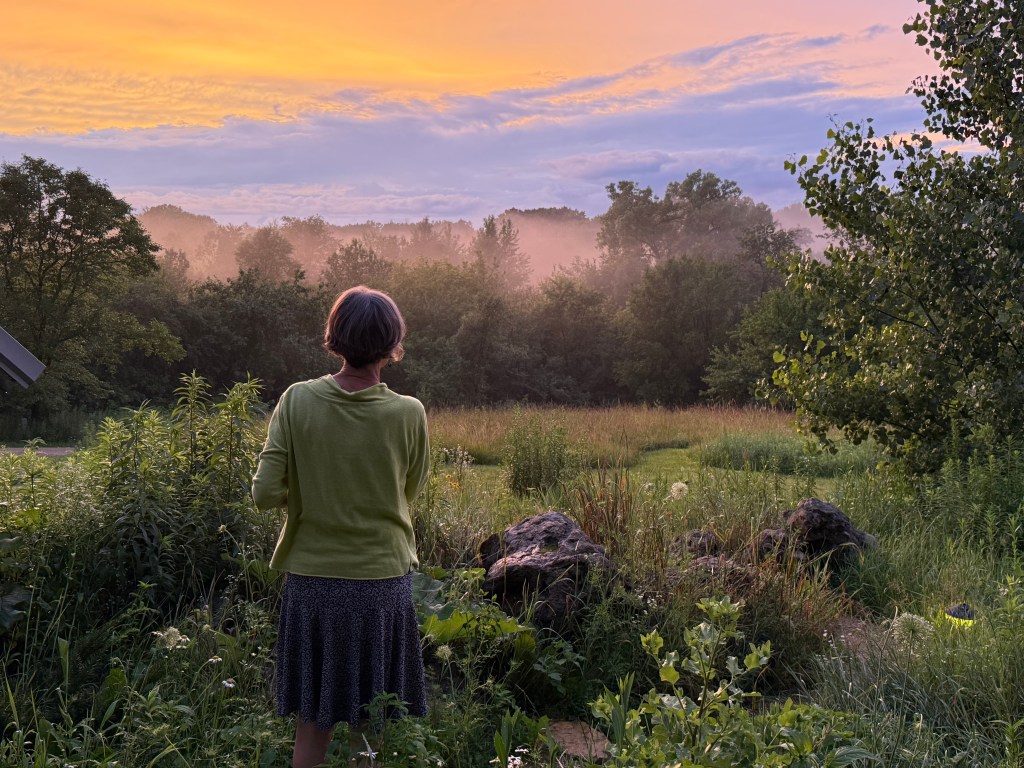
    Here’s the flat surrounding a mangrove key a few minutes after sunrise. This light always enchants me. Look for a moment and you’ll see the water is pink dimpled with dark blue, far prettier to my eye than Christo’s famous pink island wrapping.

    The water surface reflects the sky at low sun angles so my iPhone camera can’t see into the water to document for you how the fish are going about their morning activities. That would require a circular polarizer on my iPhone (wait, look it up… PolarPro makes a good one). But I’m up on the poling platform of my skiff this morning wearing polarized sunglasses. You’ll have to trust me when I tell you what fish I’m seeing and what they are doing.

    Mullet are flipping and splooshing in the shallows, while egrets line up to try for the small ones. From the key comes the hollow whinny of a Bald Eagle, the raucous clatter of a Mangrove Clapper Rail, and the sweet song of a Yellow Warbler. Against the key lies a deeper channel where I spot a nice redfish but I won’t try for it. A five foot lemon shark cruises the channel, not far behind. Hooking a snook or redfish in any channel at Flamingo is tantamount to feeding a shark. I do not feed sharks or alligators, for similar reasons.

    Two juvenile Goliath Groupers, about 18” long, are out in the open on the flat. Young Goliaths normally spend their days holed up in the mangroves, roving the flat at night. But here they are in the light of day.I watch to see what these young groupers will do when they’re caught out in their pj’s with a flats skiff poling towards them. When I get closer, they panic and swim to the nearest clump of red mangroves, sticking their heads in the roots and leaving their mottled brown and black bodies sticking out in the open. With their heads concealed, they can’t see me, so I guess I’m not supposed to see them either, but they look thoroughly silly.

    Two young redfish with light gold bodies and blue tails are cruising the shoreline. I pitch a sparkly spoon fly in front of them, then retrieve it. One redfish starts to follow the fly, then changes its mind and wanders back to cruise with its friend. A different fly might have worked better, but which one? Unlike a rising trout that feeds for a while in one spot while the flyfisher tries one fly after another, a flats fish on the move rarely affords a second chance.

    The edge of the flat becomes a reverse shower of small jacks taking to the air. Underneath the water, I presume, a school of large jacks roars through the water in hot pursuit. In fifteen seconds, the water is still once again. It’s a fish-eat-fish world on the flats.

    I round the corner of the key and the glassy water surface erupts and goes still in alternation. Silver tails appear briefly and disappear. A school of juvenile tarpon is actively feeding on baitfish.

    The prey this morning is a school of anxious young mangrove snappers that’s holding in one area. To my happy surprise, the tarpon are cruising back and forth to take multiple shots at the bait school and affording me a parallel opportunity with my fly rod.

    I throw a black tarpon fly in front of the advancing tarpon with no success. The same fly worked last week in murky water four miles to the east, but the water here today is clear. Oh, right. Light-colored flies work better in clear water than dark patterns because fish (including baitfish) in clear water change to lighter, more reflective body colors for better camouflage. I knew that. The tarpon will be coming back soon for another pass at the snappers, so I remove the black fly and select a big gray & white snook fly that I tied but never put in front of a fish. If I stretch my imagination, this fly  could resemble a young mangrove snapper. It looks very fishy in the water and it’s not black.

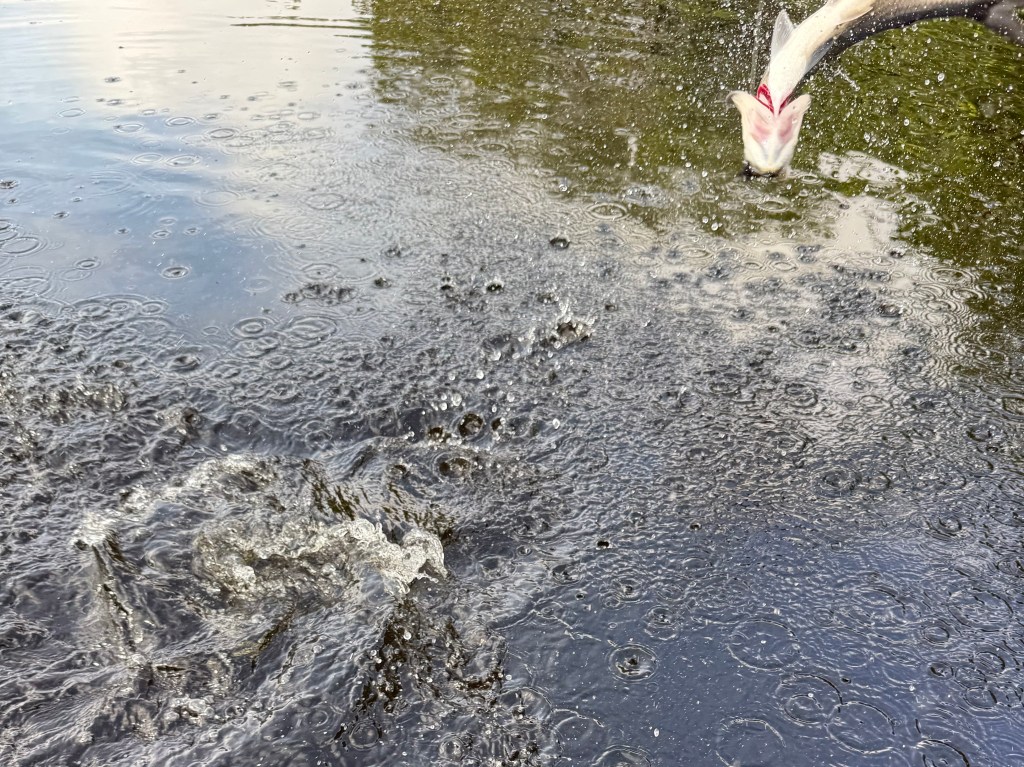
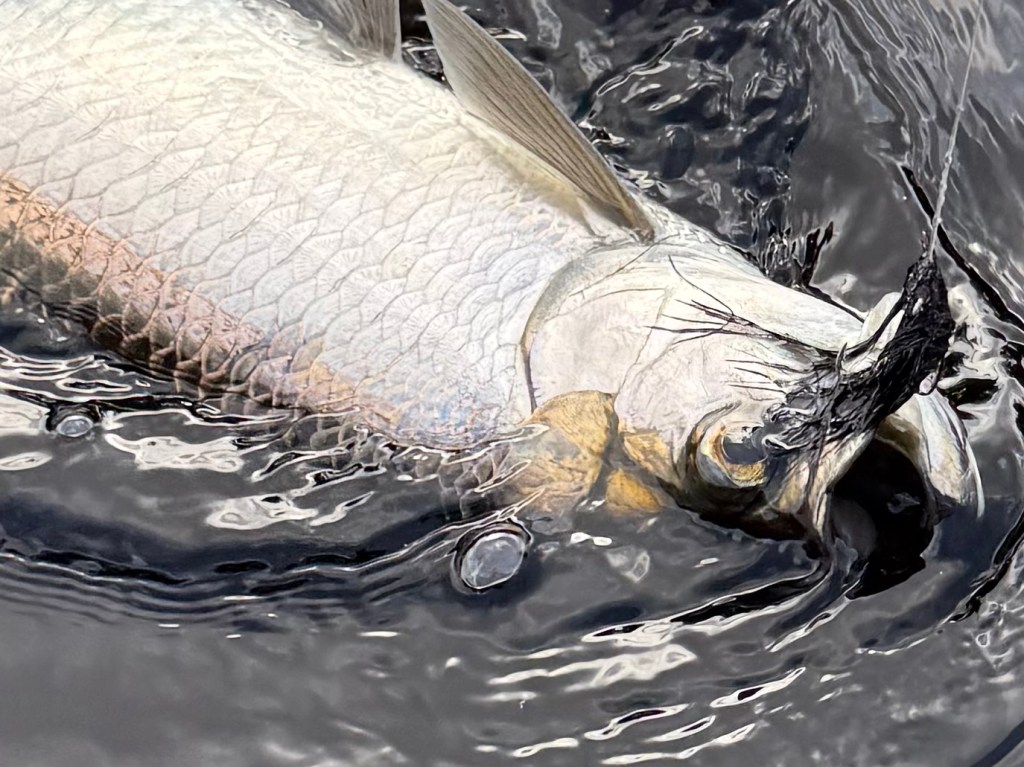
    I attach this snook fly to the heavy tarpon-proof bite tippet on my leader, and cast it in front of the tarpon school. To complete the illusion of a small fish finding itself in the wrong place at the wrong time, I make the fly attempt an escape. It works. One of the larger tarpon breaks from the school and grabs the hapless fly. I set the hook, but the tarpon doesn’t seem to care. The lining of a tarpon’s mouth is as tough as Kevlar – I’ve seen a tarpon consume a whole blue crab without chewing. But, feeling the line resistance, the tarpon forcibly yanks some fly line from my left hand and swims back into formation in the school. I restore tension on the line, putting a good arc into the 7-weight fly rod. The tarpon resists for a moment, then jumps clear of the water, snapping its body back and forth in the air and creating the slack needed to neatly toss my fly.

    You normally drop the rod tip when a tarpon jumps, precisely to keep it from creating that line slack, but I kept light tension on specifically to help the tarpon escape. More on that in a moment.

    Free of the leader’s encumbrance, the young tarpon, roughly 10 pounds’ worth, once again resumes its position in the school as the members continue their search for yummy little mangrove snappers.

    * * *

    Even though a fish’s face doesn’t change with mood, I swear this tarpon glared with an annoyed expression in its whole body. Perhaps it was in the way it shouldered loose some free line and went back to what it was doing before. It was never so clear that my hard earned fly-fishing skills, such as they are, do indeed annoy the fish.

    When a woman sends me a message like this, it stings. Same with a fish it turns out. I didn’t spend 35 years studying fish behavior to no effect.

    Increasingly, I compromise, seeking a bite on the fly then a self-release at a distance.

    When a fish takes a fly that I tied myself, I delight at having completed the illusion. My heart skips a beat at the sudden appearance of weight and power on the other end of the fly line gripped in my left hand. If I’m lucky, the fish makes a fast initial run, and maybe, if it’s the right species, it makes a couple of spectacular jumps. If it’s a new species for me, I want to see it up close and take a photo to remember it better. But for familiar species I do what I can to help the fish pitch the fly and get on with its fish life, ideally without my having to net and unhook it.  

    We’ll see how that deal sits with me. And, I suppose, with the fish.

    © Philip Stoddard
  • Fishing with alligators

    Fishing with alligators

    As a rule, backcountry alligators avoid people, while those dwelling in human-infested waters learn that associating with humans can provide an easy meal.

    Feeding alligators is a very bad idea, though alligators in this second group believe that feeding alligators is a very good idea. They hold that the highest calling of human newcomers to the swamps is to catch big fish and feed them to deserving alligators. These alligators can be bold, aggressive, and very dangerous. If you toss a rock at one to scare it off, it assumes you are throwing food and comes closer.

    I fly fish tarpon in the tidal creeks and ponds along the Tamiami Trail, Florida Route 40 (“The Trail”), about 70 miles west of Miami.

    Last year, two human-adapted alligators ran me out of a productive pair of ponds. The smaller gator, an 8-footer, even came out of the water and chased me overland in a bid to snatch the tarpon I’d caught and had intended to release unharmed. Sprinting from a gator with a 10 pound tarpon in your arms is an effective cardio workout. I always think back on that morning when people tell me “I want to take up fly fishing – it looks so relaxing”.

    The ponds along the Trail do hold a lot of fish, but I cannot manage a big fish and fend off a bold alligator at the same time. I needed a way to convince the gators to leave me alone before I would fish there again. I needed a partner. A brave partner with experience in the ways of alligators.

    I met Gabriel Ross through an online fishing club. In time I learned that Gabriel knows a lot about freshwater fishing in South Florida. He fishes the Trail regularly and has both a sunny disposition and a high tolerance for mosquitoes. Importantly, Gabriel is not unhinged by alligators, which he has fished around all his life. Just the fellow I’d wanted to meet.

    On our first fishing trip together, I brought along two special items. The first was a new net with a long handle and silicone mesh, ideal for lifting big fish clear of the water quickly and gently. I don’t want to fall in the drink with a hungry and excited alligator moving in, and I don’t want to let a precious gamefish bounce around on the ground. Nothing annoys me like seeing video on YouTube featuring some proud, clueless asshole letting a tarpon flop around in the rocky dirt or on the pavement while he gropes around trying to unhook it. The second item was the 18’ carbon fiber push pole from my skiff, already proven useful for poking nosy sharks on the flats. Eighteen feet seemed like a good minimum distance to maintain between myself and a hungry alligator. I’d replaced the push pole’s sharp metal point with a flat-tipped cone 3D-printed of polyurethane, so a hard poke from the pointy end would not make a hole in the recipient. 

    Gabriel and I met up at dawn at the appointed pond on the Tamiami Trail. As Gabriel set up his minnow trap, an alligator began to move out of the mangroves. More and more of it. It was massive, 9’+, and it was coming towards us. 

    At 18 feet and closing I made my move.  Holding the push pole aloft with a firm grip on the broad shoe end, I let the other end fall two feet through the air onto the alligator’s head with an audible clunk.

    A gator this big is never challenged. He wheeled around and snapped at the push pole. I whipped the pole upwards in time to save it, and again dropped it on the alligator’s head – BONK!

    The gator wasn’t scared, he was pissed. He turned to face me, opened his mouth, and hissed. My next two strikes were a couple of sharp, well-placed pokes in the nose. Inspection of an alligator’s skull shows the nose is bony, not soft like a shark’s. Still, you’d think it would make an impression to have an 18’ pole thrust directly onto the tip of one’s nose, reinforced or not.

    I was preoccupied when the big gator was around, so here’s a photo of a smaller one later in the day.

    The alligator went underwater, but did not flee. Two sharp nudges in the ribs finally convinced him he was not going to be left alone, much less fed a snook or a tarpon, and he reluctantly departed.

    Cool as a cucumber, Gabriel never batted an eye throughout the commotion, quietly tending his minnow trap and bait bucket and re-rigging his spinning rod for bait-fishing. Only when he stood up did Gabriel mention that he carries a handgun to fire into the ground if a gator comes too close. Gators, he explained, are frightened off by the noise. Me too. Glad he told me before he had need to use it.

    With the big guy gone, the pond’s usual resident gator, a 6-footer, came out of the mangroves and swam up to us.

    “Feed me a fish?”

    It only took three pokes to send her to a far corner of the pond, where she found something else to eat (num num num). She stayed far away from the two-legged maniac with the push pole and from Gabriel’s minnow trap. Minnow traps are a favorite snack food of alligators.

    Oddly, the tarpon that are always common in the ponds north of the Trail were largely absent. I gave up pitching flies for missing tarpon, and got my first lesson in bait-fishing freshwater snook on the Trail.

    Bait

    The African Jewelfish (Hemichromis bimaculatus), also known as the Jewel Cichlid, is an invasive exotic from the pet trade.  My former doctoral student, Vanessa Trujillo, studied Jewelfish in the Everglades. Vanessa found that African Jewelfish beat up the small native fish species during the spring drydown, which they can do because they’re tough and mean. Jewelfish outbreed native fish in rainy summer floods because they have biparental care that ensures better survival of their offspring. 

    African Jewelfish, photo Gabriel Arenciba, The Art of Microfishing

    African Jewelfish are abundant in these ponds, so snook are already cued into looking for them. Because jewelfish are tough, they hold up well as bait until a snook eats them. Gabriel finds jewelfish easy to catch in a minnow trap baited with stale, week-old brioche. Bien sure.

    Gabe recommended connecting the jewelfish’s lower lip to a 4/0 circle hook. Circle hooks have the point concealed inside the hook gap, so when a predator fish swallows the bait (bye-bye jewelfish), the hook does not lodge in the predator’s stomach, but slips free until it encounters the jaw, yielding a clean hookset. An additional trick I learned from Chico Fernandez’s book on bonefish is to press down the very tip of the hook barb rather than pressing the whole barb flat or leaving the barb intact. The goal is to leave the barb shaped as a bit of a hump; it hooks up more reliably this way and makes it possible to remove the hook without tearing anything.

    Time to fish

    Gabriel tossed his Jewelfish bait into the pond and quickly connected with a hefty snook. Gabe barely kept her out of the mangroves but finally got her in range of my spiffy new net. 

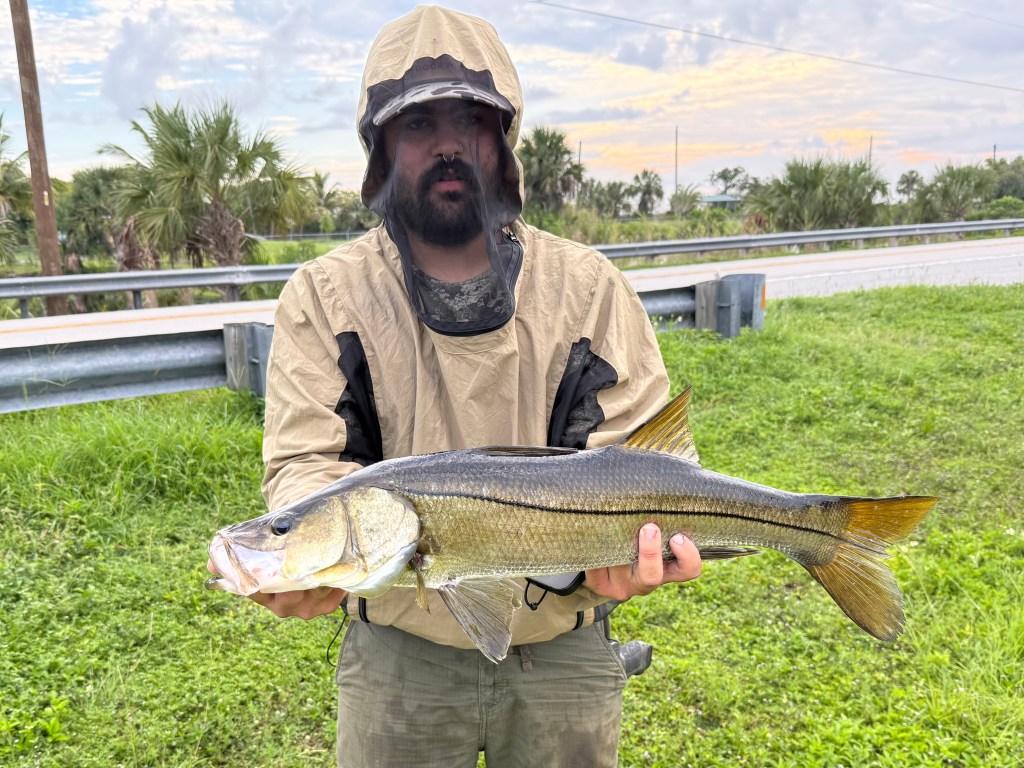
    Mrs. Snook measured out to 28.5”. She would be the biggest of the day. I took a quick photo then Gabe put her back in the water across the road so our alligator friends wouldn’t grab her before she regained full orientation and composure. It’s a short swim from there back to the pond.

    Snook are protandrous, meaning they start life as males and change to become female, transitioning when they reach 25-27 inches or so. Every badass snook is a trans female.

    I caught a couple of snooklets in the pond in quick succession before catching a Florida Soft-shelled Turtle. Ugh. Gabe caught a big Florida Gar. Lots of teeth and smelly slime – double ugh.  The slime left in my net attracted fire ants. One got inside my shirt and stung me. I hate fire ants – triple ugh.

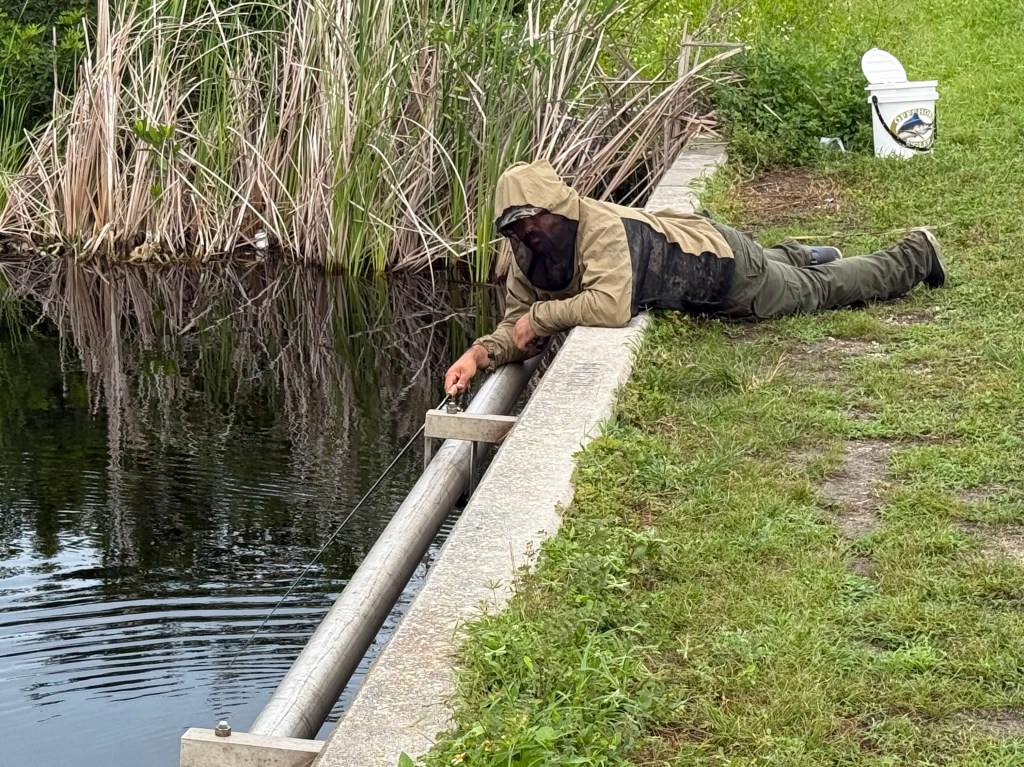
    We could hear snook under the bridge making audible pops as it or they snatched small fish from near the surface. Gabriel lay on his stomach and pitched jewelfish into the slim gap under the bridge. 

    We caught several more snook that way.

    In time the mosquitoes let up enough that we could take off the armor.

    At 10 am, a wall of white appeared in the East. We had just enough time to dive into our cars before the rain squall hit. As is typical in the Everglades, the rain passed in half an hour, cooling the moist air and leaving enough cloud cover to darken the sky a bit. Perfect conditions for Black Salt Marsh Mosquitoes to come back out.  

    We fished a few more creeks along the Trail. I’d never caught a fish at my favorite kayak put-in spot, but it always looked promising. Turns out the bridge there was stacked with snook eager to nosh on jewelfish.

    At another spot Gabriel knew about, I finally caught a sparkly young tarpon that took a jewelfish snack.

    I also caught a blue crab. Everything eats jewelfish.

    A second rain squall further improved conditions for mosquitoes.

    We returned to our starting point. There, without warning, the water erupted in an explosion of snook.  A mob of them had roared out from under the bridge all at once and raided a school of jewelfish or mollies – I couldn’t identify the prey in the mix of froth and silver.

    I don’t think I’ve done justice to the summer mosquito experience in the tidal mangrove swamps lining the western end of Tamiami Trail. As challenging as the alligators are to fish around, the summer mosquitoes in the mangrove ponds and creeks are just as bad, but in their own way. Alligators are finite while mosquitoes are infinite.

    Beyond sheer annoyance, the Black Salt Marsh Mosquito is a known carrier of Eastern Equine Encephalitis (EEE) and Venezuelan Equine Encephalitis (VEE). I lost a colleague to mosquito-borne encephalitis my first year at FIU. Because of the potential for contracting a lethal virus it’s best to minimize the number of bites one gets. Gabriel and I wore semi-breathable mosquito suits dosed with the repellant picaridin, a plant-derived product that doesn’t dissolve synthetic fabrics, fishing gear, or car seats. The bug suits work, but South Florida summers are hot enough as it is without adding a second layer to further restrict air circulation.

    I’d like to wear a GoPro camera to capture some of the action, but a camera mounted on my hat doesn’t work under a bug net and a chest strap mount would create constriction points in my clothes for mosquitoes to bite though.

    Am I trying to convince you to stay away from my fishing spots? Yes, but I’m not exaggerating about the contents of Pandora’s box you encounter on the Trail 9-10 months out of the year.

    I enjoyed fishing with Gabriel because he’s good company and is supercool around alligators. He liked fishing with me because I could handle the mosquitoes. It’s too beautiful out there to spend your day with someone who complains about nature.

    © Philip Stoddard
  • Trout Fishing the Driftless Area

    “Phil, I get the draw of fly fishing in Wyoming, but Wisconsin?”
    email from friend in Miami

    Someday I want to go fly fishing in the Driftless.”
    overheard on train to car rental at Chicago O’Hare

    The Driftless area of Wisconsin was not glaciated, so it has some big rocks sticking up, topography conducive to springs and formation cool water trout streams. It’s pretty countryside, with cornfields in the flatter areas framed by woodlands in the dolomite and limestone ridges and valleys.

    The nearby town of Viroqua was described to us as a college town without a college. Many of its local businesses are named for the Driftless area, e.g., the Driftless Cafe, Driftless Books and Music, Driftless Angler, even the Driftless Humane Society. At the Viroqua Food Co-op you can buy Driftless Coffee.

    Brook Trout are native to the Driftless streams and Brown Trout are naturalized.

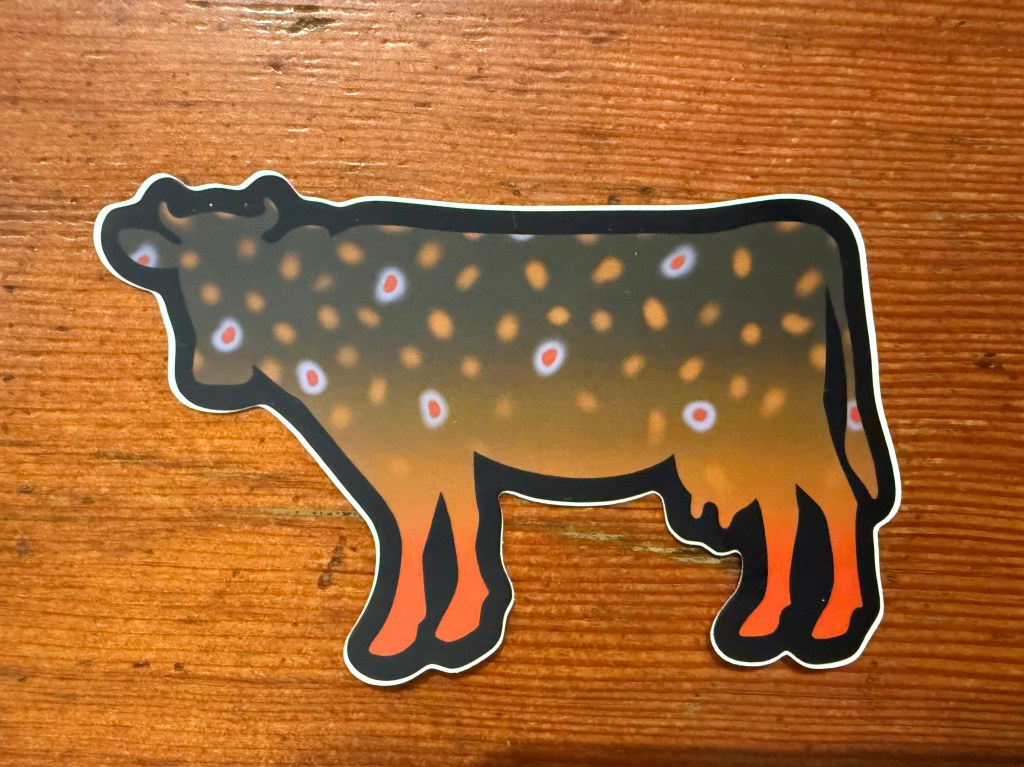
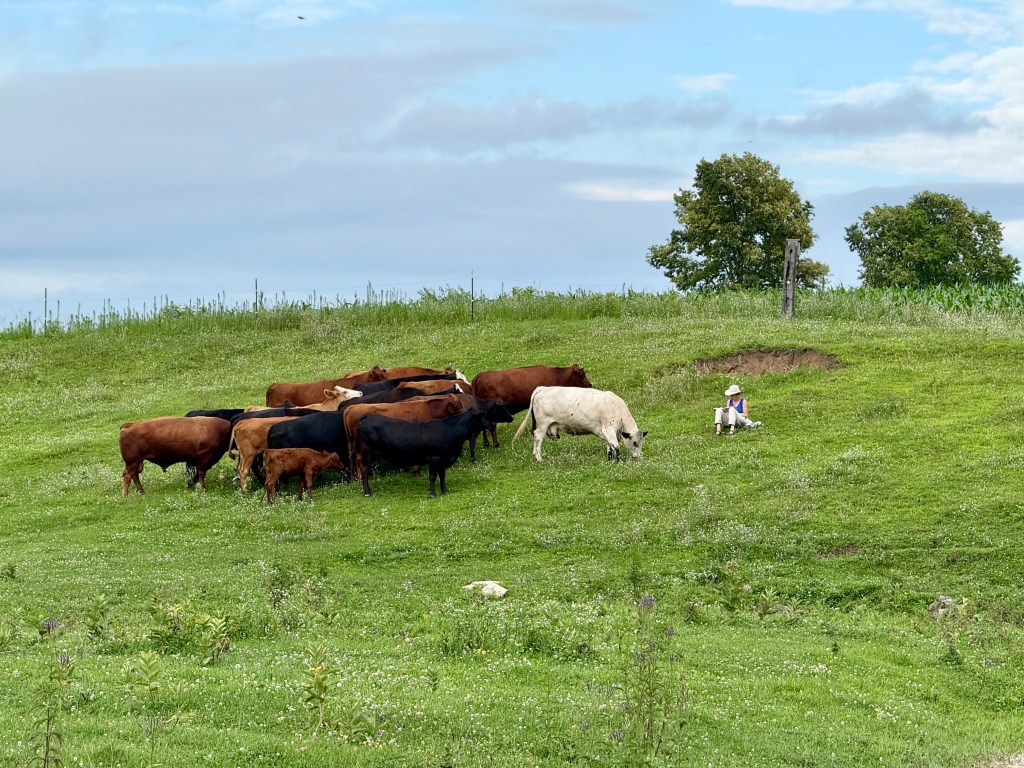
    In the Driftless, Brook Trout and cows come together.

    In addition to these self-sustaining trout populations, the Wisconsin DNR stocks streams with Rainbow Trout so the googans armed with spinning rods and barbed treble-hook spinners have something to catch on opening day. Any rainbows that survive that onslaught provide the big brown trout with something to snack on the other 364 days of the year, aside from their own offspring and hapless field mice. The Driftless streams grow some big browns, big like 30”. Fishing at night, when these leviathans are out feeding, is disallowed most of the year.

    In my week of fishing, I saw hundreds of brown trout and brookies, but not a single rainbow. No monster browns either – the largest was about 18”, a nice trout by my standards.

    Our first Drifltess afternoon we were joined by Adrian Livangood, a fishing guide from the outfitter Extreme Driftless. Adrian had spent five hours the day before scouting streams to find one with cool enough water, not higher than 65°F.

    Adrian finally chose his home stream, one he’d fished since he was a kid. Not surprisingly, he knows every ripple and sand ridge, and how they change with each rain storm.

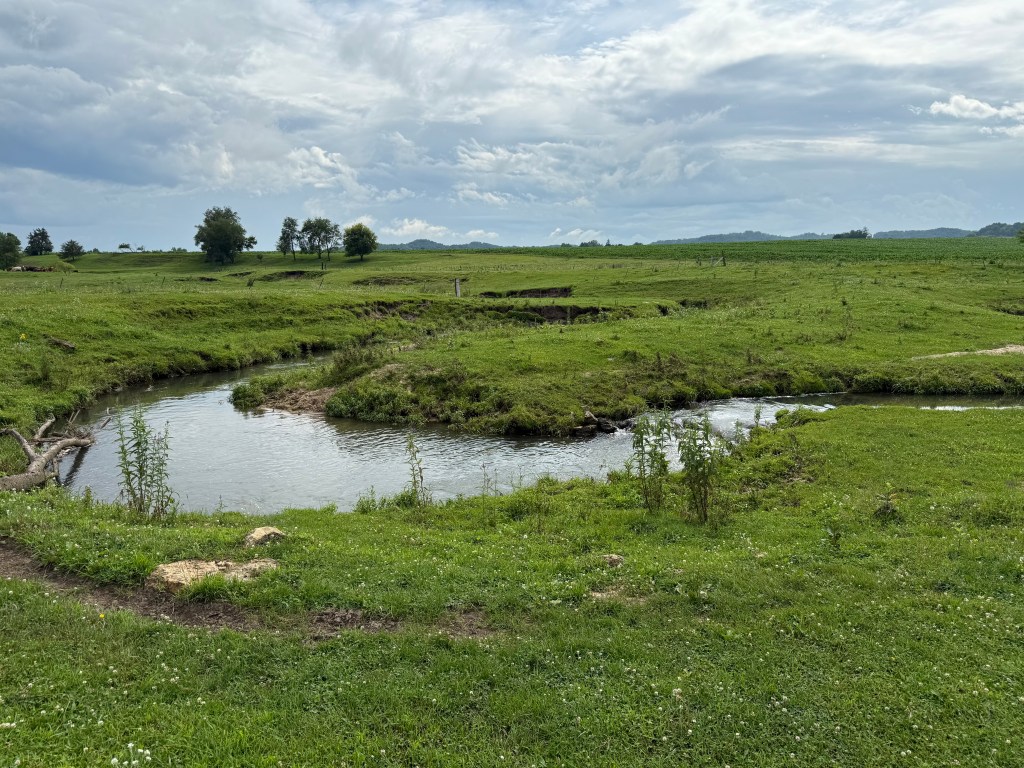
    The stream, like many in the Driftless area, is accessed via a fishing easement, a strip of private land on which the owner has received a tax break for allowing access for trout fishing.

    Following Adrian, we tunneled through 100 yards of tall corn, crossed under a barbed wire fence, then stepped out onto a cow pasture through which flowed a beautiful cool stream.

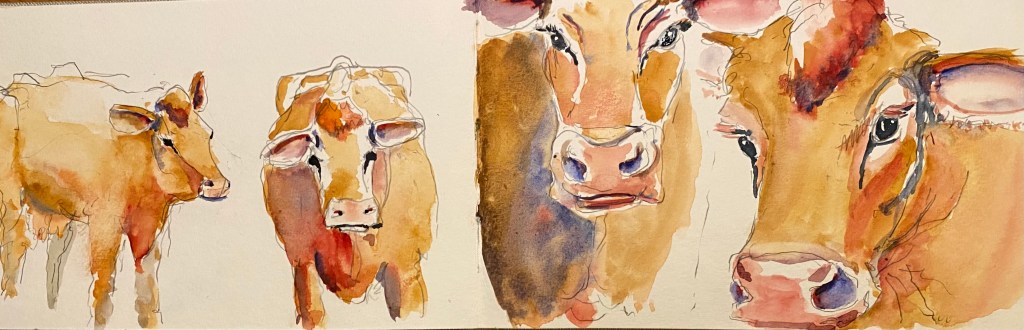
    As Adrian and I stalked the stream bank for trout, Gray sat in the pasture and drew. A herd of dairy cows and their attendant bull kept their distance from Gray at first, but grew increasingly curious. They hadn’t seen an artist before.

    One cow came close enough to drool on Gray’s notebook.

    The afternoon was not too fishy, as fishing goes, but I got the feel of where trout hang in the local streams, catching eight brown trout on dry flies, dropper nymphs, and streamers. 

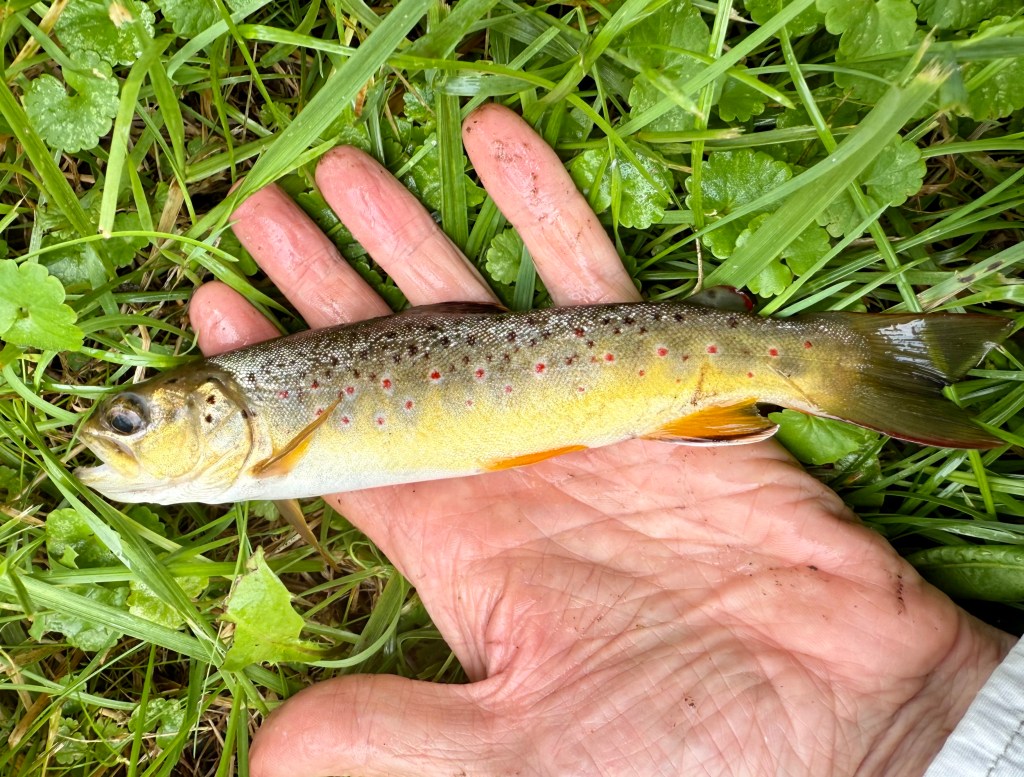
    Brown Trout.

    Nothing I saw that afternoon was huge, but Adrian showed me three holes inhabited by “lunker” browns 29-30” in length. He hooked one as a kid when he was starting out, and of course it got away. He has seen them in that stream a few times since then but hasn’t caught one. In winter and spring Adrian catches at least one big brown (20-25”) daily on a nearby river. 

    Weekday mornings during our stay, I woke with the first song of the Indigo Bunting, and headed out to fish a different Class 1 trout stream each day. Weekends I left to the locals who work during the week, and who, by all rights, shouldn’t have to complete with visitors on their home creek.

    The streams I fished are designated catch-and-release, and all had cold water 58-64°F.  I caught lots of trout on dry flies, typically a Parachute Adams, but also terrestrial insect imitations: grasshoppers and ants.

    This 14” native Brook Trout was a prize catch on the size 12 Parachute Adams dry fly.

    After my introduction to the Driftless in a grazed pasture, I quickly came to understand why fly fishers like short rods for creeks. My 9-foot long, 5-weight rod was fine for fishing a stream with cow-mown banks, but proved ungainly in the more typical, heavily vegetated streams. There I lost multiple flies in tree branches and cow parsnips and spent hours unhooking flies from vegetation and tying up new hopper-dropper rigs.

    I stopped by the Driftless Angler in Viroqua to replace my lost #12 Parachute Adams dry flies and made the mistake of wandering over to the rod rack to drool over their collection of short 3wt rods.

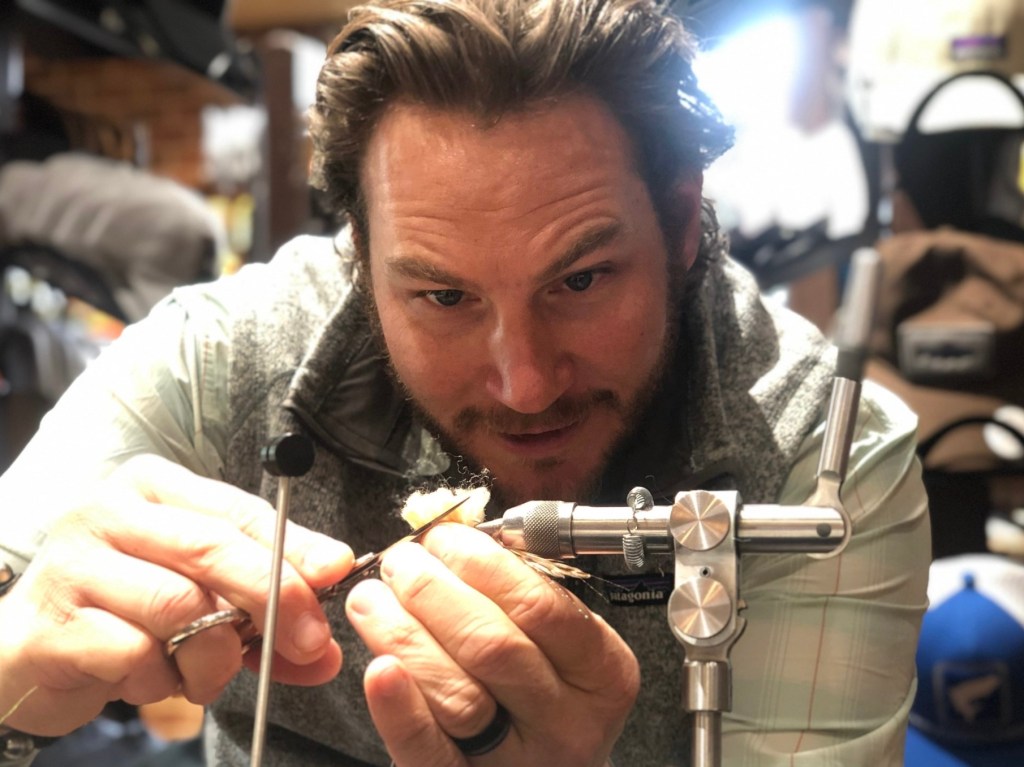
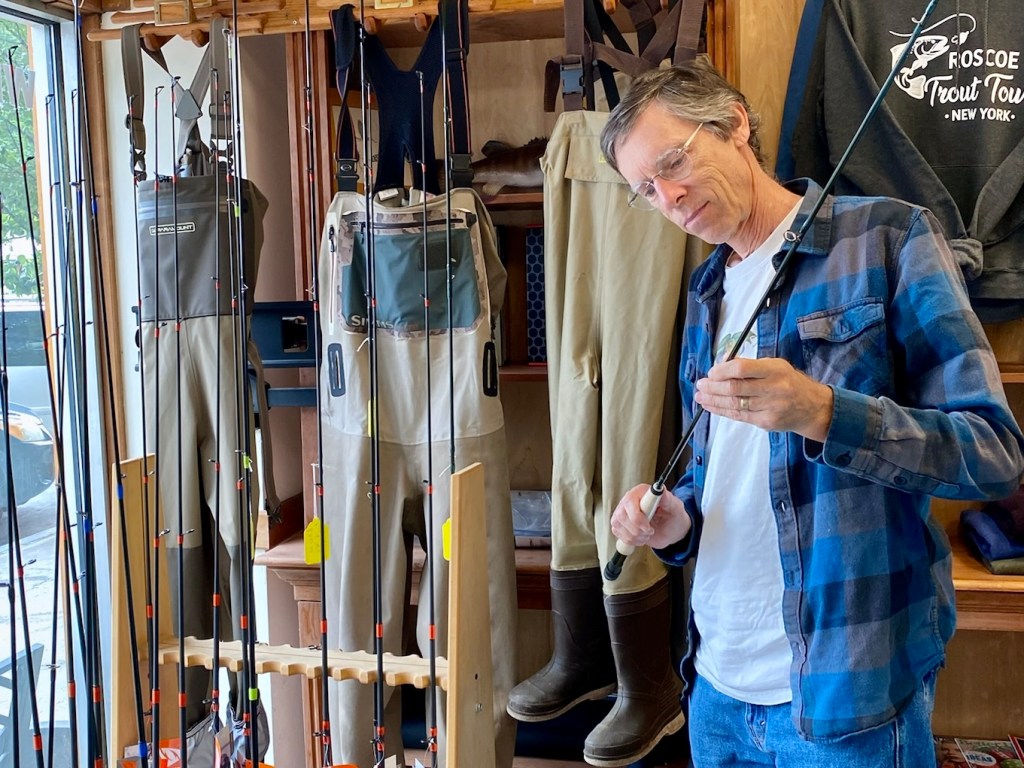
    Here I am fondling a nice 4wt fly rod at a shop in the Catskills. Substitute your favorite class of merchandise and you’ll get the picture.

    The St. Croix ($400) seemed like a good fit for these streams, but felt like a tent pole compared to the Sage Dart ($825). The urge to buy terrorizes me. Time to leave.

    Near our home exchange house, I fished a beautiful wooded stream, this one a particularly tight fit for a 9’ fly rod. 

    Good pool for trout, but tight for casting a 9’ fly rod.

    Once I did find a good use for the long rod, flipping the #12 Parachute Adams around a bush into an upstream pool that I could not see. Hearing the splash of a bite, I twitched the rod tip sideways and hooked a nice 11” brown.

    Brown that munched a Parachute Adams

    The next pool held a rising fish that repeatedly ignored the Adams. I noticed black ants marching along the bank, so I tied on a floating #16 black ant fly and flipped that into the pool. A small brook trout jumped into the air, did a back flip  and dove onto the ant fly.  It missed the fly, but earned top marks from the judges for difficulty and style.

    Floating ant fly.

    The adjacent pool upstream was wide open, so I tried the ant again. A second brookie came at the ant fly from below and connected.

    Easier pool to fish. A Brook trout waits unseen for bugs to appear at the back of the bend on the right.
    The Driftless Anteater.

    These two were the only trout I caught that morning before the rain set in, but their capture and release through fiddly persistence, the essence of fly fishing for trout, made the morning entirely successful in my view.

    The Driftless streams tend to be clear during the summer, which makes the trout more wary. Footpaths along the sides of many indicate the older trout are well-educated. But even on the most heavily fished stream I visited, the ancillary rewards are beyond words: picture rattling calls making you look up to see a pair of Sandhill Cranes flying low overhead, lit amber by the rising sun.

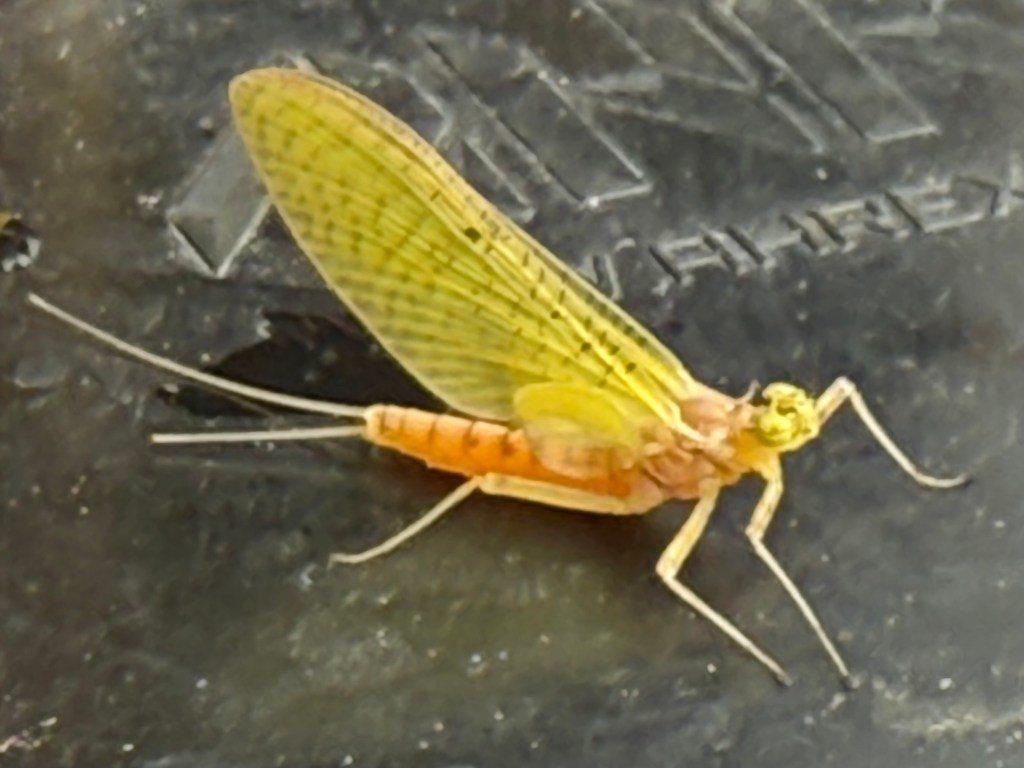
    Some days the trout were actively feeding on bugs that did not resemble the gray-bodied Adams flies. For instance, this big yellow mayfly held the trouts’ attention a couple of  morning on different streams, but my fly box lacked the size 8-12 Parachute Sulfur fly that would have “matched the hatch”.

    Stenacron canadense , sometimes referred to as a “Light Cahill”.

    Other mornings trout were taking small, unseen insects off the surface or jumping a foot in the air to snap at something they could see and I could not. At those times, I couldn’t get a bite on an Adams dry fly of any size. Looking around, I saw the odd caddis fly and some tiny gnats or blackflies buzzing around. The rising trout refused my size 18 Elk Hair Caddis. Maybe they’d have taken Griffith’s Gnat in size 20 or 22.

    If I’d had some.

    An article on the Orvis site says that fly anglers who fish clear, spring-fed streams carry multiple fly boxes. Oh. So I’ll need to wear a backpack too?

    Adrian wore a backpack…Click, grind, wheeze, the penny drops.

    I did make two other relevant discoveries: (1) coffee makes my left hand shake too much to thread thin tippet into the hook eyes of #18 & 20 dry flies, and (2) The smaller-sized dry flies I bought mail order from The Fly Shack had hook eyes blocked by hackle, tying thread, and/or head cement – I gave the company an earful.

    When surface feeding trout ignored my dry flies, a sinking nymph fly under an indicator (tiny foam float) or foam grasshopper fly sometimes did the trick. The best such nymph was the Jig Hot Butt Hare’s Ear that I’d bought last summer from Kelly Galloup’s fly shop on the Madison River in Montana. This nymph is said to be good where caddis flies are present. 

    Jig Hot Butt Hare’s Ear, in olive, size 16

    Last morning in the Driftless, after releasing ten brown trout caught on this cute little fly – including a nice 14-incher – plus another on the dry grasshopper, I lost both of my Jig Hot Butt Hare’s Ear flies to grabby overhead branches. A timely sign to wind in my line. Indeed, wiggling free of my waders back at the car, the sky opened up. If I lived near the Driftless area, I’d assemble the materials to tie this little fly myself, plus the Parachute Sulfur.  And I’d splurge on that Sage Dart stream rod.

  • DeSantis Gulag: Protest #2 at Alligator Alcatraz

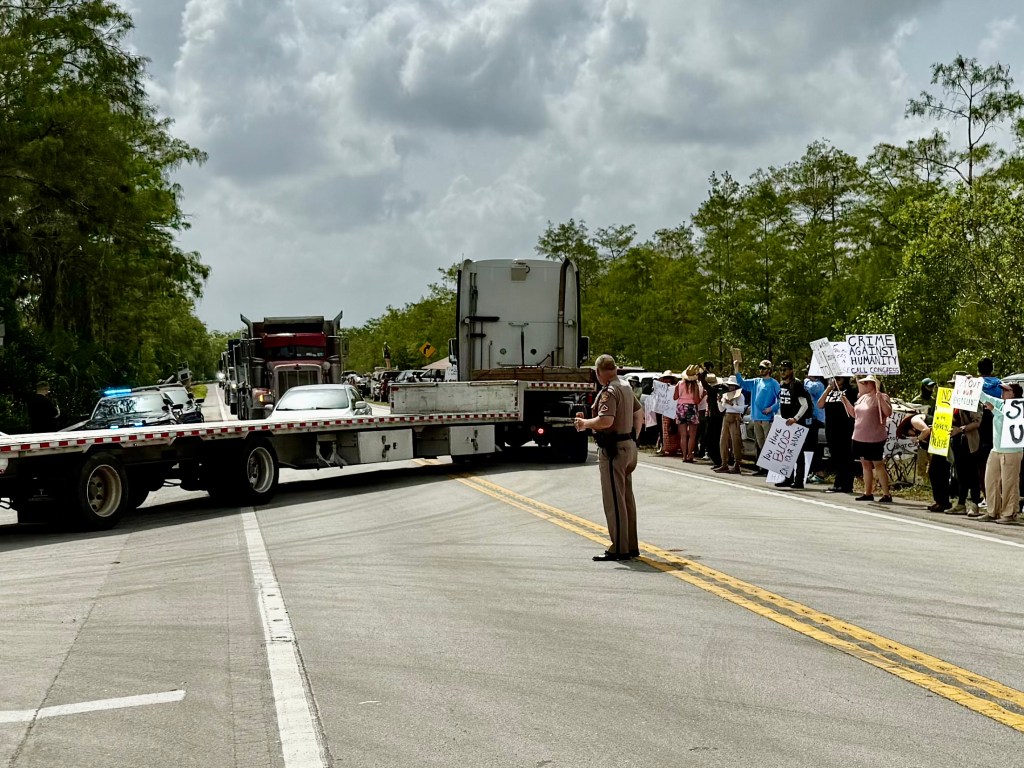
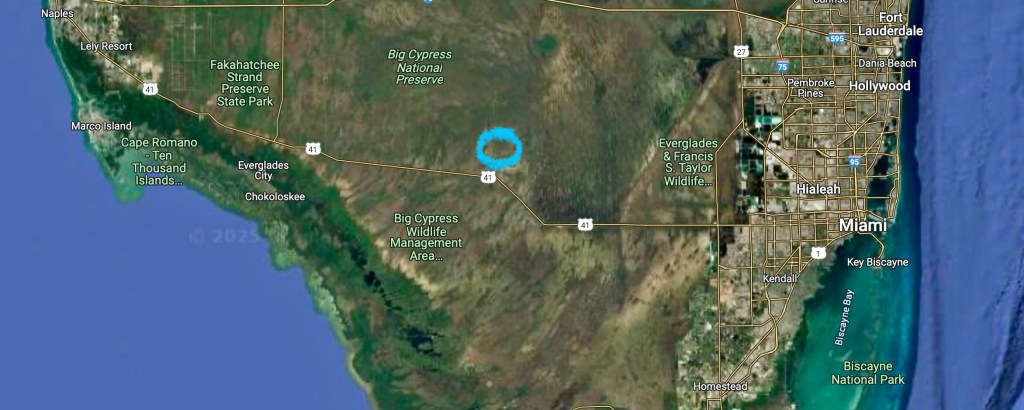
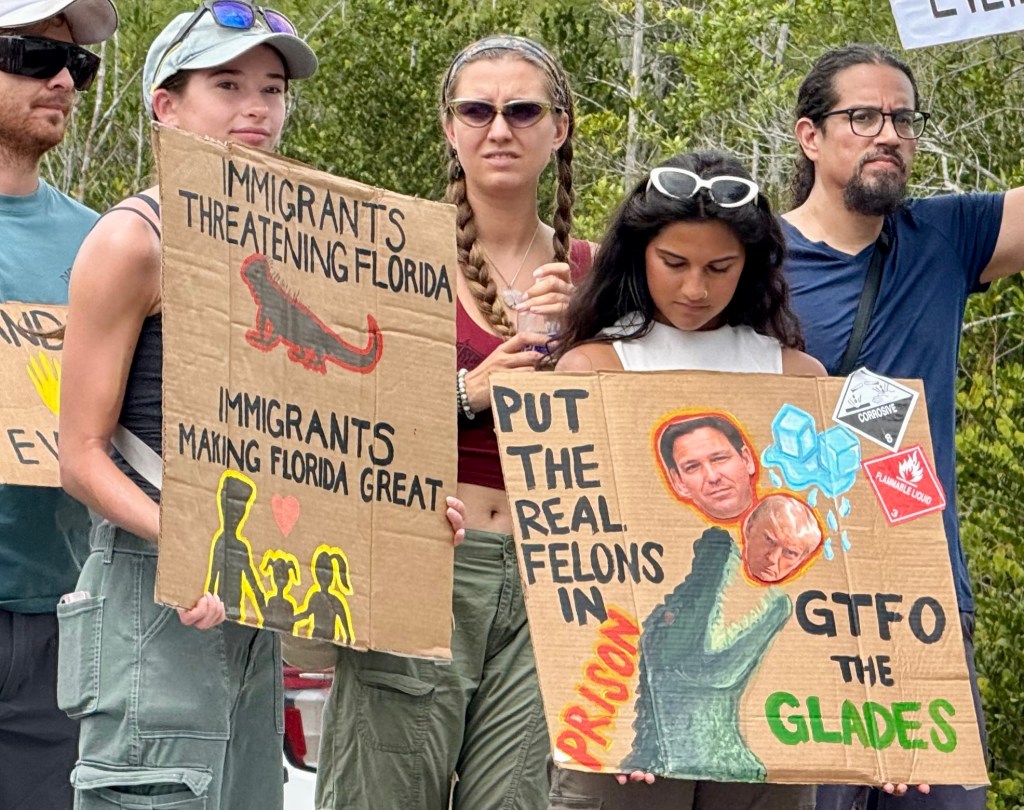
    Construction has begun on Alligator Alcatraz, the 1000 person immigration prison that Florida Governor Ron DeSantis is building in the heart of a sensitive wetland. Once again, 400 concerned Floridians made the trek out to the center of the Big Cypress National Preserve to stand and protest for 4 hours under the midday sun.

    On the drive out to the second protest on Saturday morning we passed 8 concrete mixing trucks returning from the site and dozens of tractor-trailer rigs lined up to deliver construction materials.

    In winter, the center of Big Cypress National Preserve is a nature lover’s paradise, but in summer you reach a terminal sweat in the unrelenting heat and saturating humidity. Mosquitoes are big and fierce. The nearest small town is Everglades City, 40 miles away. This site has the makings of a Siberian style gulag, described by Alexandr Solzhenynitzyn in The Gulag Archipelago.

    Environmental activist Betty Osceola of the Miccosukee Tribe led the crowd of peaceful protesters.  We could hear the drum beats in the distance as the Miccosukees themselves protested to a higher authority.

    Friends of the Everglades and the Center for Biological Diversity have filed for an injunction pending the full environmental review required by federal law, and ignored by Gov. DeSantis.  DeSantis plows ahead, ignoring the law, his trademark modus operandi.

    DeSantis has seized the land under his 2023 emergency declaration, but the only emergencies we’re seeing here in South Florida are unnecessary ICE raids in our communities and unnecessary prison construction in a cherished and protected wetland.

  • Dodging Keraunos on the flats at Flamingo

    Zeus used his lightning bolt “Keraunos”, a gift from Cyclops, to exercise divine authority over the sky and weather, wielding Keraunos in divine retribution as he saw fit (perhaps inspiration for you-know-who and his black Sharpie, only more final and definitive).

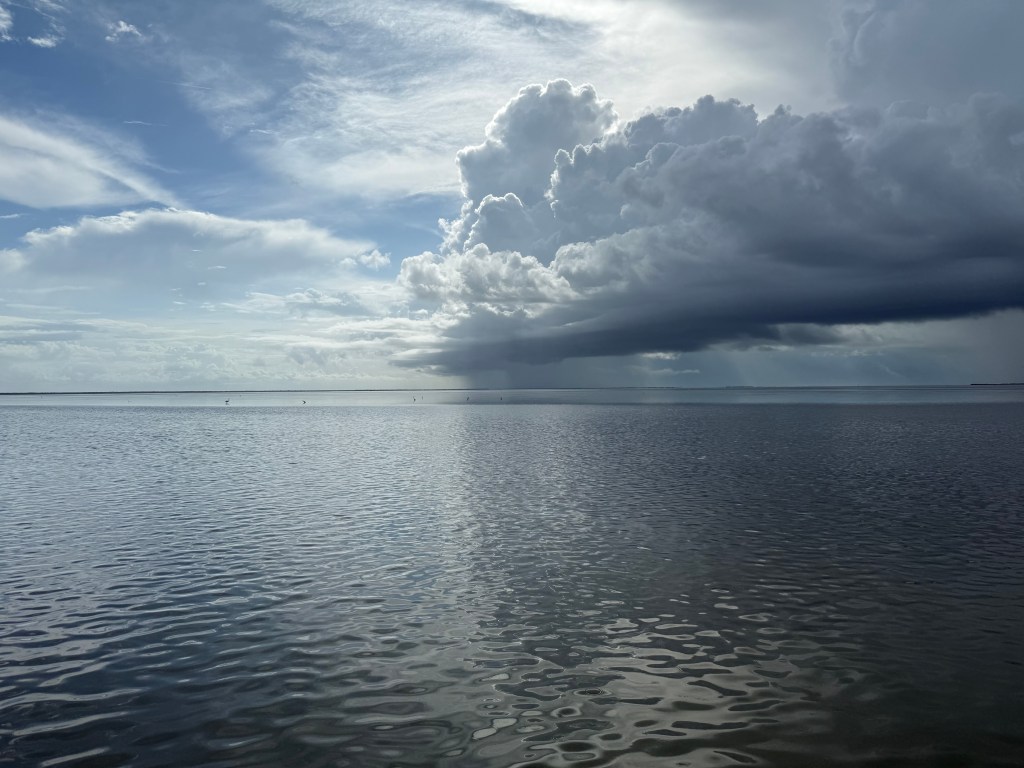
    I launched the skiff out of Flamingo before sunrise with the triple intent of (1) trying my new used Spey rod around actual fish, (2) seeing if small dark-colored paddletails, gifts from a friend, might pull a redfish out of the mangroves, and (3) not getting struck by lightning from any among the squadron of thunderheads coursing the flats.

    I fished wherever the storm cells were not, motoring away from every encroaching squall to the nearest patch of clear sky.

    Results:

    1. The two-handed Spey rod works. I caught four speckled seatrout, some ladyfish, and a catfish on assorted flies while Spey casting from the skiff’s poling platform.  Wind is not a serious problem.
    2. Throwing the tiny dark paddletail into the mangrove roots, I hooked a redfish, but it came off as I got it to the boat. That happens. But the tiny paddletail works as intended.
    3. I had to move around a lot, and could not fish where/when I wanted, but the outboard let me dodge the electric storms. One can’t do that in a kayak.
    This seatrout ate Tim Borski’s Mackerel Shrimp pattern.

    It turned out to be a pretty good day for bird- and fish-watching despite the ominous weather.

    I spotted this Mangrove Clapper Rail peering out from its secretive world.

    Mangrove Clapper Rail, Snake Bight ENP

    Roseate Spoonbills foraged on the adjacent flat. I counted 67 of them. When you find feeding spoonbills, the snook are usually close by, foraging on the same small fish and crustacea.

    The wind picked up, but no lightning, and then it rained. Between the wind, rain, and holding the boat steady in the tide coursing the shallow and narrow channel, the elemental chaos was too much for fly casting. With a spinning rod I still managed three snook in the low 20-something-inch range, just what the spoonbills had predicted.

    After the rain moved out, I paused to watch a Reddish Egret scampering after a shoal of baitfish. The one in this video I found at Key Biscayne, but it gives you a sense of their hyperactive hunting style.

    While I watched the antics of the egret, something to the right of it caught my eye. A snook was working its way below the surface, sneaking toward the same bait school as the egret, but from the other direction. They came closer and closer together until the snook made its move, charging the baitfish and showering the egret with spray. The surprised egret jumped into the air, flapping to land several feet back. Wish I’d gotten a video, but I was too mesmerized by the impending collision to reach for a camera.

    Three bull sharks formed a mullet-hunting party. After the trio dispersed around me, this six-footer came close enough to get a video.

    Keep your hands in the boat.

    With that many sharks hunting in the water, it’s time to wind it up.

    © Philip Stoddard
  • Tropical Spey

    Casting the new (used) Spey rod at Crandon Park, photo by Gabriella Parilla

    A favorite backyard game in the summer of 2006 was holding my 8-year old daughter aloft in both hands and tossing her headlong into the deep end of the pond. “Do it again, Daddy!”
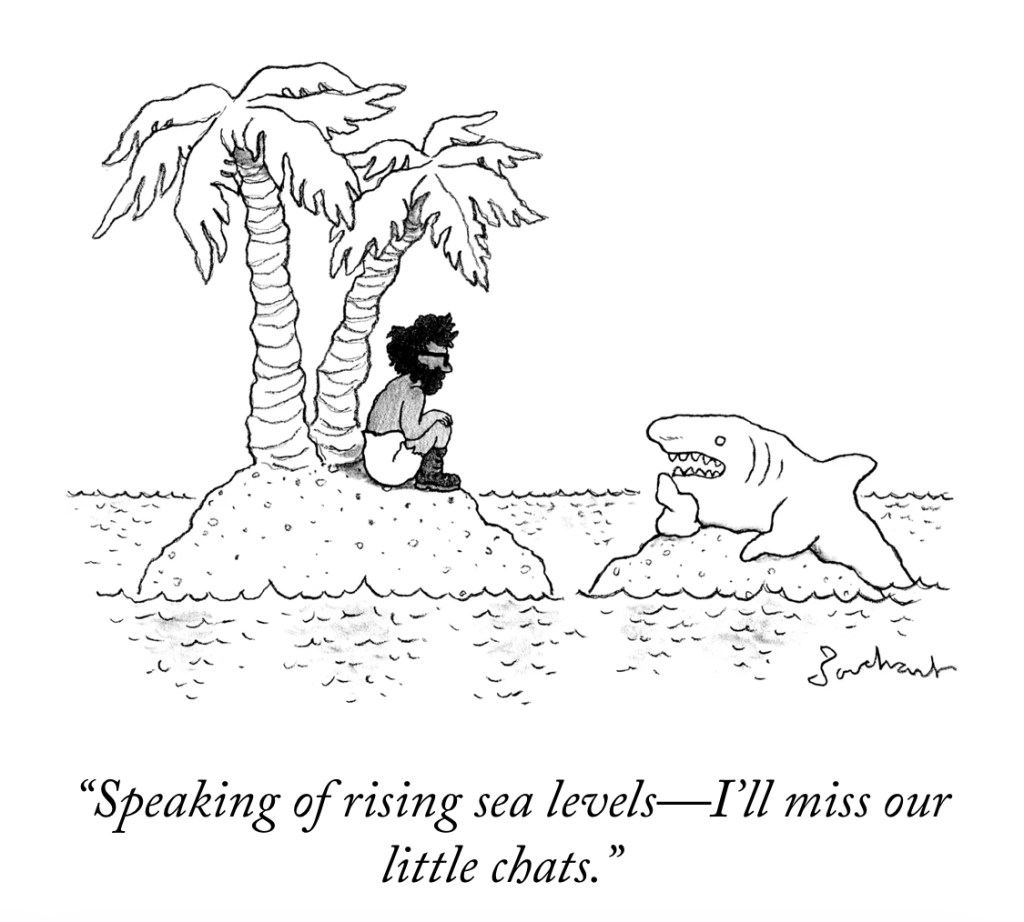
    And I did, over and over, until something went “pop”.  

    The regional elbow specialist, Dr. Obvious, diagnosed the injury:“You pulled a ligament in your elbow.”

    He prescribed the state-of-the-art treatment: “Baby it.” 

    Forever, it seems.

    After taking up saltwater fly fishing in 2022, I discovered that fly casting is an elbow-intensive sport. The heavier the rod and line, the greater the elbow strain. 

    I settled into elbow-friendly fly rods 7 weight and lighter. But I’ve found that a 7wt setup, situated in the middle of the weight range, has its limits: the 7wt can’t deliver big flies very far or turn a big snook away from the mangroves. Of greater consequence, a 7wt fly line cannot punch far through the coastal winds common on the open flats. Can I only pursue medium-sized fish using smallish flies on calm days?  

    This year has  been extra windy, as documented by the local avocado growers, who complain that wind desiccates the blooms and lowers their yields. I’ve been using the 8wt rod more than my elbow likes.

    To fish tarpon with my friend Chris Schneider in the Keys where it’s often windy, I really need an 11 or 12wt setup, but I can cast Chris’s elegant Hardy 11wt tarpon rod twice at most before my elbow calls Uncle.

    I’ve been pondering two solutions: left-handed casting (working on it) and two-handed casting. Left-handed casting is good relief, but when my left elbow began taking notes from the fussy right one and demanding equitable treatment, it came time to study up on two-handed casting.

    Salmon fishers on the River Spey in Scotland invented the two-handed Spey casting system for throwing big flies on big rivers with long rods and heavy lines. Queen Elizabeth II was said to be a good Spey caster in her day.

    Steelhead fishers on the Skagit River north of Seattle evolved their own variant of Spey casting, using shorter shooting heads on their fly lines.

    A two-handed cast with a long Spey rod should still load the elbow but minimize the elbow flexion that particularly irritates my injured ligament. In Spey casting, the caster’s dominant hand holds the rod above the reel and remains almost stationary as a fulcrum, while the other lightly hand grips the rod butt, performing a sharp, short, punch and tuck to lever the distant rod tip back then forward. In contrast, a single-handed fly rod cast is 100% forearm action, maximizing both elbow flexion and torsion.

    I looked up [Spey + tarpon] on the web. Wading past the page of retail ads, I spotted the podcast Wet Fly Swing featuring an hour-long interview with saltwater Spey casting evangelist John Grasta,. Grasta has adapted the Skagit Spey style to fishing Florida’s mangrove coasts for tarpon. And he lives in Florida within half a day’s drive of my house.

    I tracked down John Grasta at the Bass Pro Shop in Orlando, where he runs the store’s expansive fly fishing department.

    John is an affable guy who retains his Rochester accent. One could not find a more enthusiastic Spey coach. A couple of weeks ago, I hired John to give me a Spey orientation and casting lesson on one of his days off from work.

    I drove 215 miles north from Miami to Orlando, stayed overnight with a University of Central Florida colleague, and met John at his house in Winter Garden, Florida, following him to a park on the shore of Lake Apopka.

    Apopka is famous in zoological circles for its male alligators having been feminized by the endocrine disrupting effects of pesticide runoff. Here in Florida, that’s a lifestyle choice, right? But I digress.

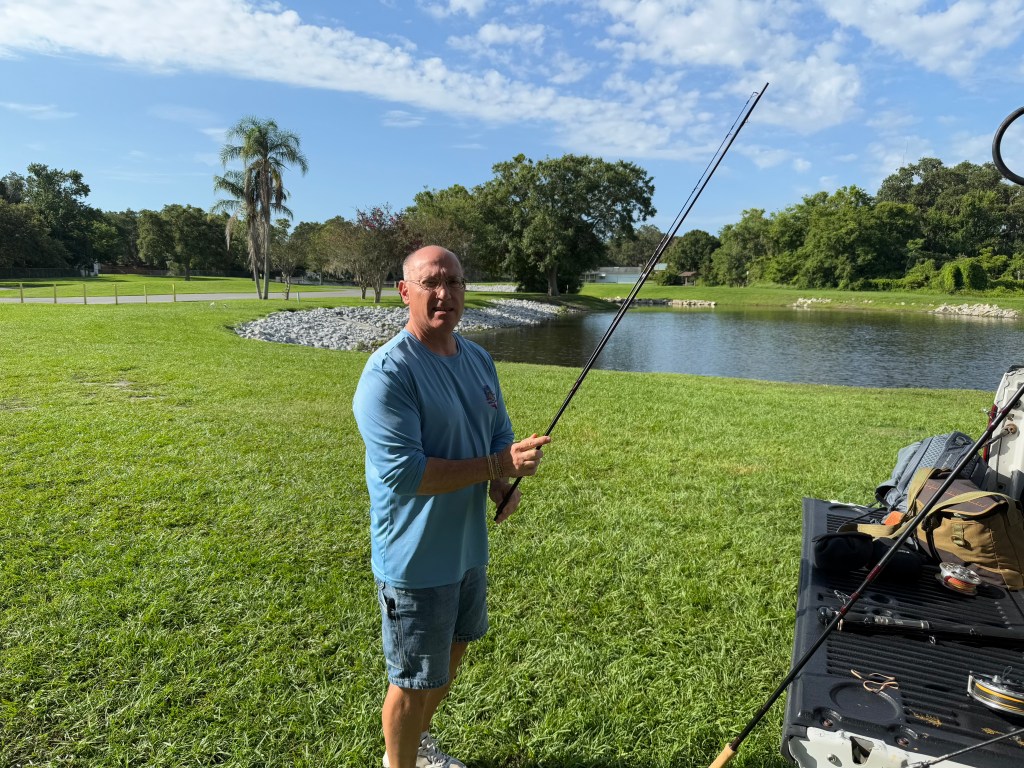
    John laid out his collection of Spey rods on the bed of his pickup.

    He rigged up a few rods, and spent the next hour explaining innovations in the specialized tackle and narrating the dynamics of the simpler Skagit Spey casts.

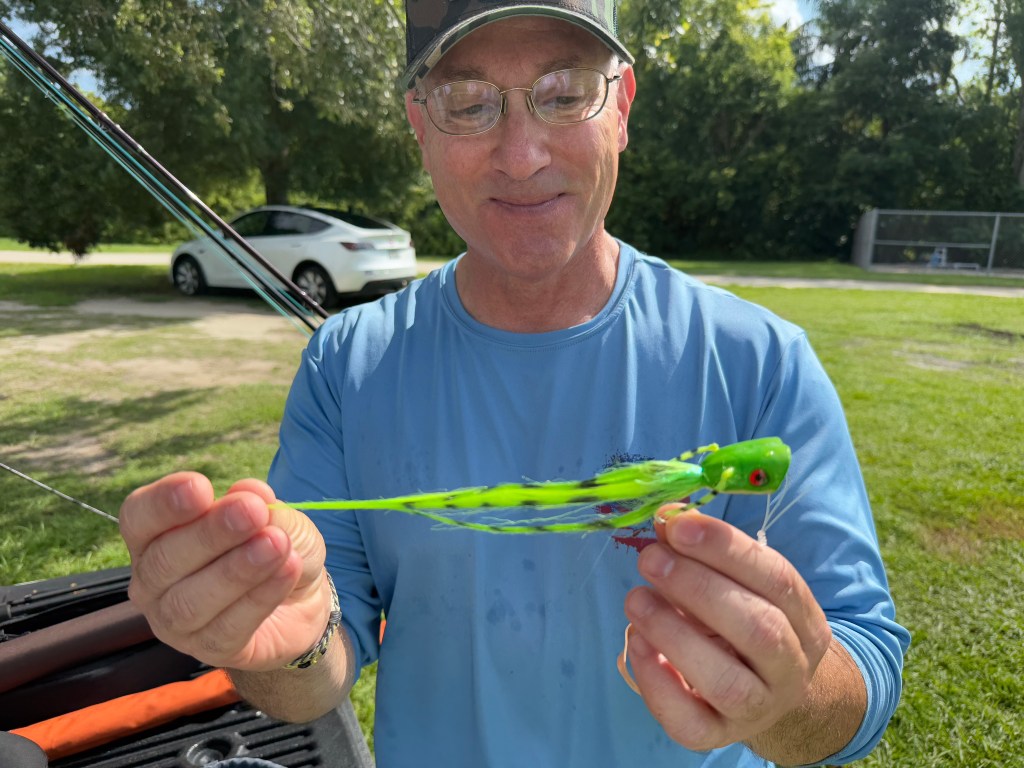
    John Grasta shows me one of his big iguana popper flies. A big Spey rod can throw this monster a long distance. And speaking of monsters, John recently caught a 200 pound arapaima on the Spey rod. You can see a video of its epic jumps on the JohnGrasta Instagram feed.

    I asked a million questions, taking notes, photos, and videos. 

    Video of John Grasta firing off a demo Spey cast.

    After an hour of explanations and demo casts, John handed me a 15 foot, 10wt rod rigged with a short Skagit shooting head.

    Hopes are high, but tempered by the recall of my learning curve with single-handed fly gear. I also remembered the podcast where John explains how many thousands of casts it takes to get competent with a Spey rod. To increase the challenge, a wind is blowing directly at us. Being realistic, I expect my first two dozen or so Spey casts will resemble hurled plates of spaghetti. 

    I took a breath and exhaled as I made my first cast…

    The line shot out 70 feet, dead straight. I couldn’t believe it. That’s my maximum single-handed cast range with no wind.

    I tried all the rods and, not surprisingly, my elbow chose the lightest one, a 12 foot, 7wt, fast action Sage Igniter that John had rigged with the equivalent of a 12wt single-handed tarpon line.

    After half an hour with the 7wt, I was throwing long casts that cleared all the line.  After the last one, I retrieved the thrown line from the lake, laid it out on the grass, and measured it with my calibrated paces: 96 feet +/- 3%. That should do.

    * * *

    On the long drive home I spotted fourteen Swallow-tailed Kites.

    Fishing the flats at Flamingo yesterday, a Swallow-tailed Kite danced in the sky over the mangroves.

    More kites swooped low over the trees as I drove home through Everglades Natl. Park.

    Last night as Gray and I shared mango slices for desert, we heard a chorus of whistled peeps above us – baby Swallow-tailed Kites! While I got odd glimpses through the trees (video below), Gray scrambled up the step ladder to the roof for a view of the open sky. Five kites circled our neighborhood, the parents with three noisy fledglings.
    In July, the Swallow-tailed Kites will leave the Southeast to winter in the tropics. Satellite tracking shows they depart the west coast of Florida and fly SW across the Gulf of Mexico to the Yucatan.

    Sensing a theme in the air, I take my recent flurry of kite sightings as an omen for a bright future of feathers making long flights over water.

    © Philip Stoddard, 2025

  • “F*ck Alligator Alcatraz”

    So read one young woman’s sign this morning, 40 miles west of Miami on the Tamiami Trail, in the heart of the Big Cypress National Preserve.

    Florida Attorney General James Uthmeier’s latest brainstorm is to build an ICE prison in the middle of the Big Cypress National Preserve, a plan he dubs “Alligator Alcatraz”.

    James Uthmeier came to notoriety as the brains behind the diversion of $10 million in public Medicare funds into Gov. DeSantis’ dark money campaign against the Florida ballot initiative to legalize marijuana.

    This would be the same A.G. Uthmeier who is now held in civil contempt for advising Florida law enforcement agencies they should ignore a federal judge’s order limiting enforcement of a Florida statute creating a state immigration policy.

    Hundreds of people showed up this morning to protest Alligator Alcatraz. The line of parked cars was 1/4 mile long on one side of the road and I didn’t measure the line on the other side. Virtually all the cars driving through gave us positive toots on the horn and thumbs up. Zero disapproval.

    Click any photo to see it full size.

    Uthmeier is promoting this site for an immigration prison because, according to him, it wouldn’t need a perimeter fence since nobody can escape through the Everglades. What a moron. Does any intelligent person think that immigrants who escaped gangs by walking through the tropical forests of the Panama’s Darien Gap will be stopped by the inviting waters of a South Florida cypress swamp? My wife and I take children and geezers on swamp walks through the Big Cypress.

    If any immigrants did escape, Miccosukees and Seminoles living nearby would likely take them in. These First Nation folks have a long history of hiding fugitives from the U.S. Government in the swamps of South Florida. The proud Miccosukee Tribe never signed a treaty with the U.S. Government.

    No, the real reason for a 1000 bed ICE prison at Mile 48 on the Tamiami Trail is the Dade-Collier Transition Airport. So easy to lock people up out of sight then fly them out of the country in the middle of the night.

    This land is jointly owned by Miami-Dade and Collier Counties. Will our County Mayor and Commission fight to prevent the state from snatching it for an immigration prison?

    The young woman got it right: “Fuck Alligator Alcatraz”.
    Silence is complicity.

    © Philip Stoddard, 2025

  • Fishing the mosquito-infested swamps of Hell

    on Friday the 13th

    What National Park offers so many opportunities for exciting wildlife encounters as the Everglades?

    In 1979, Professor Tim Williams, wrote me a grad school recommendation letter that ended with this line:  

    “If I were planning a research expedition to the mosquito-infested swamps of Hell, I would choose Philip as my field assistant.”  

    I was never 100% sure if Tim meant that as a compliment, but to my prospective grad school advisor, Mike Beecher, it sounded like high praise so he took me on.

    With that reputation as a prelude, I’m embarrassed to report that a year ago, in June of 2024, Black Salt Marsh Mosquitoes kicked by butt (well, bit my butt, to be precise) and drove me out of my favorite Everglades kayak-fishing spot when I’d barely gotten started. 

    I studied mosquitoes in the lab and I’m not a mosquito sissy. 

    This is my hand, feeding a precious batch of Aedes aegypti mosquitoes selected for the “Tiki Bar” phenotype in the which this normally diurnal mosquito is hyperactive after sundown.

    Even I have my limit, and the Black Salt Marsh Mosquito (BSMM) found it that morning.

    Determined vampirism of the summer BSSM hoard provides solitude for anyone hardy enough to fish the tidal mangrove estuaries of the Everglades backcountry. That morning, 30 minutes before sunrise, I was the only human within miles, attempting to cast a topwater fly at a large, actively feeding snook. The BSSMs were so brutal, it was hard to pay attention, much less savor the splendor. But the one single mosquito that managed the coup de grâce somehow found her way inside my head net, whereupon I inhaled her. Ten minutes of hard coughing to dislodge that mosquito from my trachea, while her sisters and cousins bit me through my clothes and chewed my exposed finger tips (despite the insect repellant) – that was too much. I gave up and went home with my bitten tail between my itching legs.

    Here’s what my pants looked like after 15 minutes.

    The secret antidote to mosquito bites:

    I don’t much react to bites of local mosquitoes, but the number of BSSM bites that day overwhelmed my acquired defenses. To sleep that night I had to take the antidote, the invention of my clever FIU colleague, Dr. Laura Serbus.

    Read the labels before ingesting, right?

    Mosquito bites irritate our skin via two histamine receptors, H1 and H2. H1 receptors produce about 20% of the itch and H2 receptors the other 80%. Typical antihistamines, like Benadryl, only block the H1. I use cetirazine instead, which lasts 24 hours and doesn’t make me drowsy. To block the H2, I use Pepsid AC, an over-the-counter drug for excess stomach acid.  Not everybody reacts well to the H2 blockers, but I’m OK with them. Itching disappears completely for 12 hours.

    * * *

    Back into the cauldron on Friday, June 13th, 2025

    It took me a full year to recover the motivation to venture back into Mosquito Hell, succumbing once again to the prospect of fly fishing snook, juvenile tarpon, and redfish from the intimacy of the kayak. Winds in the open were 14 mph with gusts to 22 mph and my usual flats and creek mouths were too exposed. That left the sheltered mangrove coves, areas best left for winter when the mosquito population is at a dull roar instead of a loud one.

    This time I had to better prepare myself for the onslaught of the June BSSM population.  Here’s what I wore:

    • Fishing pants. AFTCO, synthetic, light tan
    • Snow gaiters, calf height
    • Second pair of fishing pants
    • Sand socks
    • Crocs
    • Hoodie fishing shirt, knit fabric
    • Tight weave sun shirt, with top button fastened and collar turned up
    • Tilley hat
    • No-see-um proof head net, Cochrans
    • Insect repellant (Lemon Citronella) on my exposed fingertips and the edges of my gaiters where they met my Crocs sandals

    It worked well enough at keeping BSSMs from reaching my skin that I could enjoy a good morning fly fishing tarpon & snook. A great morning, in fact. I lost count of the tarpon hits.

    The BSSMs found a vulnerable spot where the gaiters met the Crocs [I’ll spare you the photo of my red-spotted ankle]. Next time, I will wear ankle-high neoprene dive booties instead of the Crocs.  

    Another twenty skeeters somehow managed to bite me on my butt [definitely no photo], though damned if I know how.  This happened before while camping on the Arctic tundra and I couldn’t figure it out that time either.

    High concentration DEET works pretty well but dissolves plastics on contact (thinking of my fly line here). Picaridin works well too but lasts half as long as DEET.

    Mosquitoes don’t see red light (ditto snook, tarpon, redfish). I outfitted my head lamp with a red lens (3D printers rock) so I could see to set up the boat without getting mobbed by BSSMs and no-see-ums.

    Two things I don’t think will work for me:

    (1) mosquito netting suit. It’s too easy to tear and simple for BSMMs to bite through where it touches my skin or another article of clothing.

    (2) permethrin-soaked clothing. Permethrin is a good mosquito excito-repellant, but new research shows it damages our heart and nervous system. 

    The next puzzle: How do you get 300 mosquitos out of a car? 

    It took three days to fully rid the car of BSSMs. Several hid in my stuff and found their way into the house. Next time, I’m going to open the car’s rear hatch and all four doors, then drive backwards around the parking lot in circles as fast as I can. Other suggestions are welcome by email or in the comments section below.

    buzz buzz buzz.

    P.S. I received a comment worth sharing from Dr. David Glabman: “As for the mosquitos in your car maybe try capturing a bat for release in the car since he will eat many times his weight in them.”

    Regarding Dr. Glabman’s idea, I very much like the concept. I’d need one of those tropical leaf-gleaning bats that can forage in tight spaces, and I’d have to wait until nightfall for the bat to feed. I do need to drive home with fewer vampires for company.  Mabel’s Orchard Spider, however, might do the job. They’re our most common orbweaver, voracious predators of mosquitoes, diurnal, completely harmless to humans, and their possession does not require federal and state permits. I might release a couple in the passenger seat next trip to see what they can do.

    © Philip Stoddard, 2025