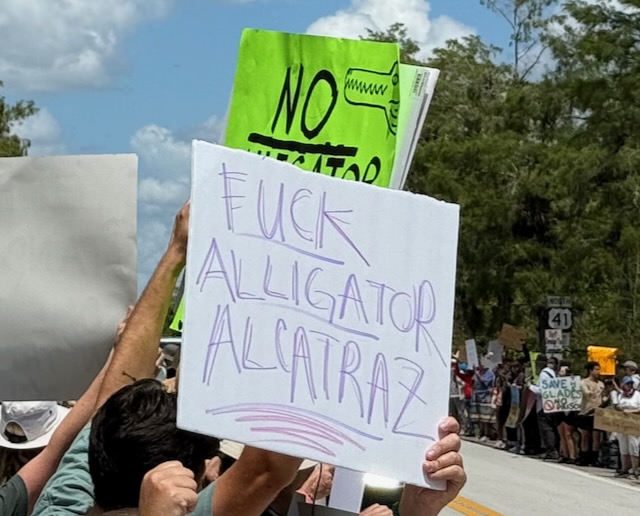
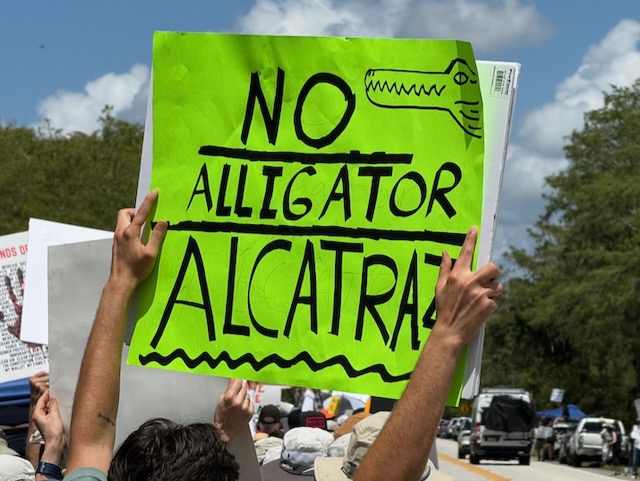
So read one young woman’s sign this morning, 40 miles west of Miami on the Tamiami Trail, in the heart of the Big Cypress National Preserve.
Florida Attorney General James Uthmeier’s latest brainstorm is to build an ICE prison in the middle of the Big Cypress National Preserve, a plan he dubs “Alligator Alcatraz”.
James Uthmeier came to notoriety as the brains behind the diversion of $10 million in public Medicare funds into Gov. DeSantis’ dark money campaign against the Florida ballot initiative to legalize marijuana.
This would be the same A.G. Uthmeier who is now held in civil contempt for advising Florida law enforcement agencies they should ignore a federal judge’s order limiting enforcement of a Florida statute creating a state immigration policy.
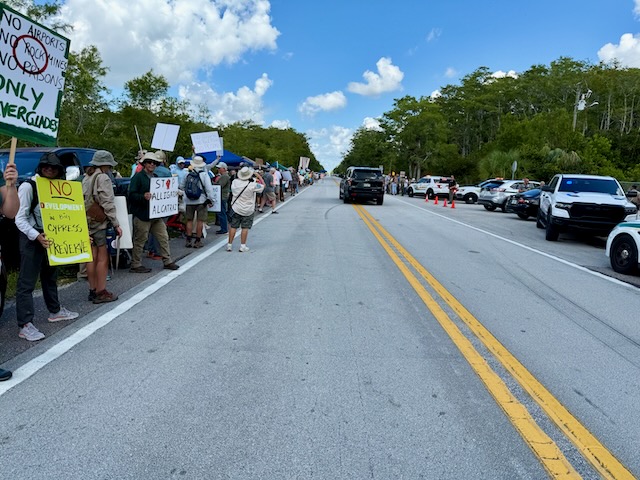
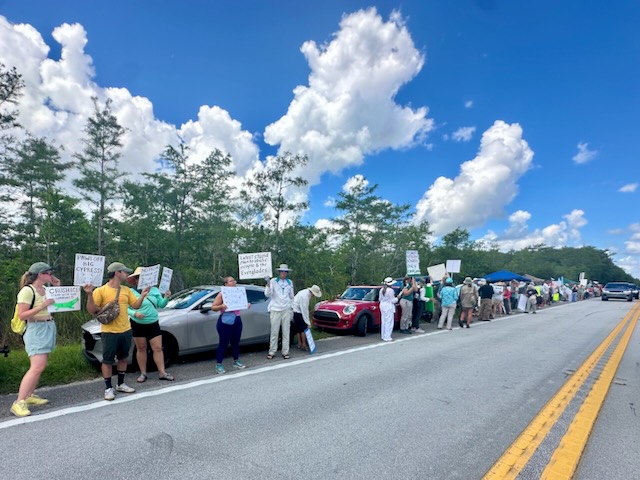
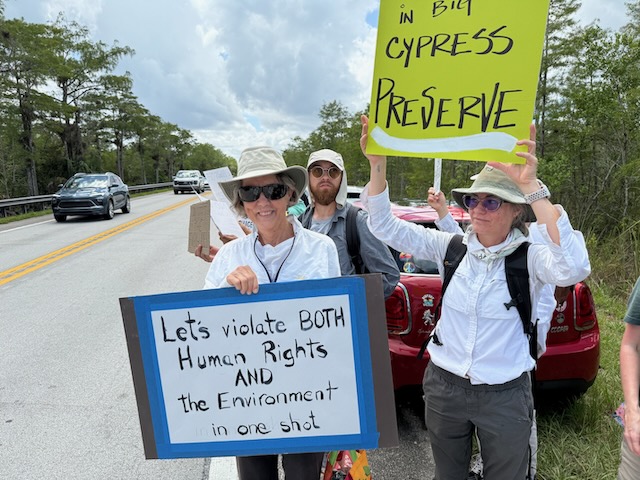
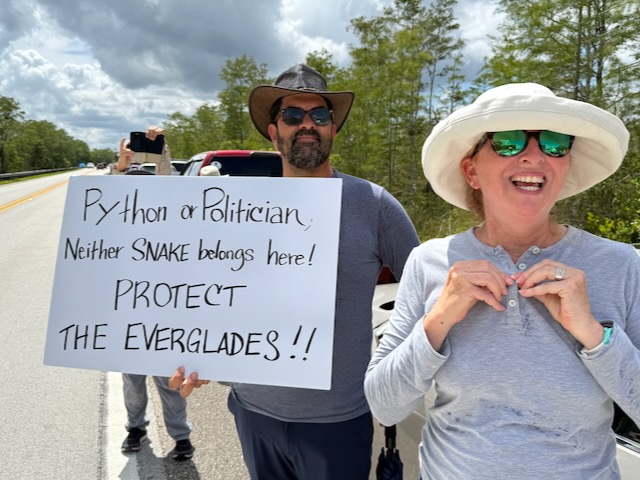
Hundreds of people showed up this morning to protest Alligator Alcatraz. The line of parked cars was 1/4 mile long on one side of the road and I didn’t measure the line on the other side. Virtually all the cars driving through gave us positive toots on the horn and thumbs up. Zero disapproval.
Click any photo to see it full size.
Betty Osceola speaks. That’s Clyde Butcher on the left.
Uthmeier is promoting this site for an immigration prison because, according to him, it wouldn’t need a perimeter fence since nobody can escape through the Everglades. What a moron. Does any intelligent person think that immigrants who escaped gangs by walking through the tropical forests of the Panama’s Darien Gap will be stopped by the inviting waters of a South Florida cypress swamp? My wife and I take children and geezers on swamp walks through the Big Cypress.
If any immigrants did escape, Miccosukees and Seminoles living nearby would likely take them in. These First Nation folks have a long history of hiding fugitives from the U.S. Government in the swamps of South Florida. The proud Miccosukee Tribe never signed a treaty with the U.S. Government.
No, the real reason for a 1000 bed ICE prison at Mile 48 on the Tamiami Trail is the Dade-Collier Transition Airport. So easy to lock people up out of sight then fly them out of the country in the middle of the night.
This land is jointly owned by Miami-Dade and Collier Counties. Will our County Mayor and Commission fight to prevent the state from snatching it for an immigration prison?
The young woman got it right: “Fuck Alligator Alcatraz”. Silence is complicity.
What National Park offers so many opportunities for exciting wildlife encounters as the Everglades?
In 1979, Professor Tim Williams, wrote me a grad school recommendation letter that ended with this line:
“If I were planning a research expedition to the mosquito-infested swamps of Hell, I would choose Philip as my field assistant.”
I was never 100% sure if Tim meant that as a compliment, but to my prospective grad school advisor, Mike Beecher, it sounded like high praise so he took me on.
With that reputation as a prelude, I’m embarrassed to report that a year ago, in June of 2024, Black Salt Marsh Mosquitoes kicked by butt (well, bit my butt, to be precise) and drove me out of my favorite Everglades kayak-fishing spot when I’d barely gotten started.
I studied mosquitoes in the lab and I’m not a mosquito sissy.
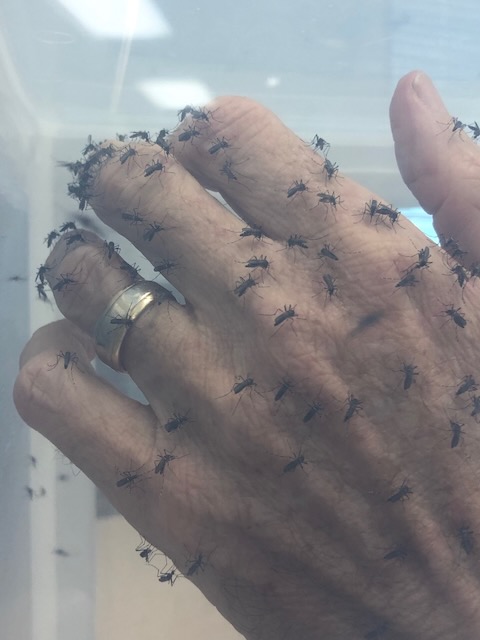
This is my hand, feeding a precious batch of Aedes aegypti mosquitoes selected for the “Tiki Bar” phenotype in the which this normally diurnal mosquito is hyperactive after sundown.
Even I have my limit, and the Black Salt Marsh Mosquito (BSMM) found it that morning.
Determined vampirism of the summer BSSM hoard provides solitude for anyone hardy enough to fish the tidal mangrove estuaries of the Everglades backcountry. That morning, 30 minutes before sunrise, I was the only human within miles, attempting to cast a topwater fly at a large, actively feeding snook. The BSSMs were so brutal, it was hard to pay attention, much less savor the splendor. But the one single mosquito that managed the coup de grâce somehow found her way inside my head net, whereupon I inhaled her. Ten minutes of hard coughing to dislodge that mosquito from my trachea, while her sisters and cousins bit me through my clothes and chewed my exposed finger tips (despite the insect repellant) – that was too much. I gave up and went home with my bitten tail between my itching legs.
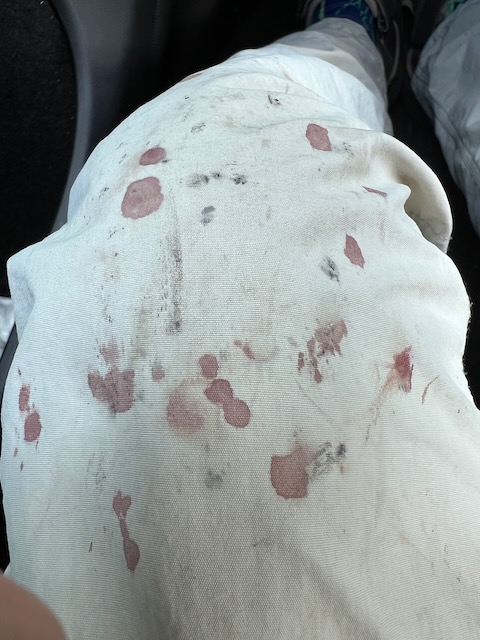
Here’s what my pants looked like after 15 minutes.
The secret antidote to mosquito bites:
I don’t much react to bites of local mosquitoes, but the number of BSSM bites that day overwhelmed my acquired defenses. To sleep that night I had to take the antidote, the invention of my clever FIU colleague, Dr. Laura Serbus.
Read the labels before ingesting, right?
Mosquito bites irritate our skin via two histamine receptors, H1 and H2. H1 receptors produce about 20% of the itch and H2 receptors the other 80%. Typical antihistamines, like Benadryl, only block the H1. I use cetirazine instead, which lasts 24 hours and doesn’t make me drowsy. To block the H2, I use Pepsid AC, an over-the-counter drug for excess stomach acid. Not everybody reacts well to the H2 blockers, but I’m OK with them. Itching disappears completely for 12 hours.
* * *
Back into the cauldron on Friday, June 13th, 2025
It took me a full year to recover the motivation to venture back into Mosquito Hell, succumbing once again to the prospect of fly fishing snook, juvenile tarpon, and redfish from the intimacy of the kayak. Winds in the open were 14 mph with gusts to 22 mph and my usual flats and creek mouths were too exposed. That left the sheltered mangrove coves, areas best left for winter when the mosquito population is at a dull roar instead of a loud one.
This time I had to better prepare myself for the onslaught of the June BSSM population. Here’s what I wore:
Fishing pants. AFTCO, synthetic, light tan
Snow gaiters, calf height
Second pair of fishing pants
Sand socks
Crocs
Hoodie fishing shirt, knit fabric
Tight weave sun shirt, with top button fastened and collar turned up
Tilley hat
No-see-um proof head net, Cochrans
Insect repellant (Lemon Citronella) on my exposed fingertips and the edges of my gaiters where they met my Crocs sandals
It worked well enough at keeping BSSMs from reaching my skin that I could enjoy a good morning fly fishing tarpon & snook. A great morning, in fact. I lost count of the tarpon hits.
The BSSMs found a vulnerable spot where the gaiters met the Crocs [I’ll spare you the photo of my red-spotted ankle]. Next time, I will wear ankle-high neoprene dive booties instead of the Crocs.
Another twenty skeeters somehow managed to bite me on my butt [definitely no photo], though damned if I know how. This happened before while camping on the Arctic tundra and I couldn’t figure it out that time either.
High concentration DEET works pretty well but dissolves plastics on contact (thinking of my fly line here). Picaridin works well too but lasts half as long as DEET.
Mosquitoes don’t see red light (ditto snook, tarpon, redfish). I outfitted my head lamp with a red lens (3D printers rock) so I could see to set up the boat without getting mobbed by BSSMs and no-see-ums.
Two things I don’t think will work for me:
(1) mosquito netting suit. It’s too easy to tear and simple for BSMMs to bite through where it touches my skin or another article of clothing.
(2) permethrin-soaked clothing. Permethrin is a good mosquito excito-repellant, but new research shows it damages our heart and nervous system.
The next puzzle: How do you get 300 mosquitos out of a car?
It took three days to fully rid the car of BSSMs. Several hid in my stuff and found their way into the house. Next time, I’m going to open the car’s rear hatch and all four doors, then drive backwards around the parking lot in circles as fast as I can. Other suggestions are welcome by email or in the comments section below.
buzz buzz buzz.
P.S. I received a comment worth sharing from Dr. David Glabman: “As for the mosquitos in your car maybe try capturing a bat for release in the car since he will eat many times his weight in them.”
Regarding Dr. Glabman’s idea, I very much like the concept. I’d need one of those tropical leaf-gleaning bats that can forage in tight spaces, and I’d have to wait until nightfall for the bat to feed. I do need to drive home with fewer vampires for company. Mabel’s Orchard Spider, however, might do the job. They’re our most common orbweaver, voracious predators of mosquitoes, diurnal, completely harmless to humans, and their possession does not require federal and state permits. I might release a couple in the passenger seat next trip to see what they can do.
… as in “The Burmese python is decimating native wildlife across their invaded range.” Miami Herald, 12-Jun-2025
Marsh Rabbit photo swiped from Animal Diversity Web. Such cute ears!
People today use “decimate” synonymously with “devastate” and it bugs me.
These two words sound similar, but to “decimate” is to reduce by 1/10th, not reduce to 1/10th.
I’d be thrilled if pythons had only decimated Everglades mammal populations.
Origin – The verb “decimate” dates back to ancient Rome. My high school Latin teacher, Mr. Downum, explained that if a member of the Roman Legion committed a heinous crime, and nobody among the ranks would identify the culprit, all the soldiers were lined up and every tenth one was killed. Wikipedia provides a similar explanation with more detail and historic record, albeit limited. Decimation didn’t happen a lot after the scary new word got around. The original meaning gave “decimate” the power to change human behavior for the better.
Here are more examples in which over-educated people are decimating the lexical diversity and power of our language:
“The first time I drove into Tuscaloosa after the storms, I had to pull over on the side of the road to take in the decimation and collect myself.” Joyce Vance, 17-May-2025
“A Fungus Decimated American Bats. Now Scientists Are Fighting Back” Headline, The New York Times, 17-Sep-2024
“In 1989, Hurricane Hugo decimated much of the remaining old-growth forest that is vital habitat for endangered red-cockaded woodpeckers, Leuconotopicus borealis.” @grrlscientist, 11-Oct-2024
It’s everywhere. Even Heather Cox Richardson and Paul Krugman conflate “decimate” and “devastate”, two erudite professors with a mastery of English.
In a living language, word meanings can change. Still, this one sticks in my craw every time I read it. Seems a shame to lose such a graphic and powerful word to confusion in common parlance.
* * *
I’d tell this to the marsh rabbits in the Everglades, if I could find one to tell. Not that a marsh rabbit ever listened to what I had to say. Not even back in the pre-python glory days, when legions of round-eared bunnies lined up ten feet apart along the swale of the Shark Valley tram road every evening. Had they merely been decimated by Burmese pythons, they’d line up today eleven feet apart. Like coral reefs and trees dripping with migrant warblers, or a savored word that’s lost its meaning to misuse, I miss them.
How can a fisher tell if one lure is better than another?
Say I am fishing and not getting a bite. I see a juvenile tarpon roll and throw a black fly in front of the expanding rings on the surface. I do it four times to four circles. Nothing.
That’s never happened to me, because I change up after three rejections, but say it did.
How do I know whether lack of a bite is because: (a) I have on the wrong lure or fly, (b) there’s something wrong with my presentation, (c) the fish aren’t biting, (d) or, if I am blind-casting, that the fish are simply elsewhere?
I postulate the problem is (a), tarpon don’t want black flies today, so I clip off my black fly and tie on a white fly.
Next cast, BOOM, I hook up.
I make another cast and hook up again. Ah ha! I’ve found it! White flies are the ticket. Pretty clever, huh?
Maybe.
Are white flies effective just here and now? Whenever / wherever the conditions are just like this? Every day, but just at this place? Did the tarpon bite finally turn on (right time or tide)? Or did a couple of naïve tarpon just happen by?
It’s hard to tell.
John Gierach (1988) noted that some fly fishers on The Henry’s Fork of Idaho switch flies regularly, cycling through all their mayfly imitation types (spinners, duns, emergers, and nymphs) until they connect with a feeding trout. Others cast their dry fly spinner imitation to multiple trout until they find the one that’s eating spinners (mayflies that have landed on the water after they finished breeding). Gierach described it as a question of how you want to spend your time on the river: looking down while tying minuscule flies onto a thin leader with tiny knots, or looking at a pretty river and fly casting.
But my point is that it’s hard for us fishers to know what we know.
Worse, a nerd like me sets out to enjoy himself on a beautiful day in nature and stumbles headlong into the tar pit of epistemology, the branch of philosophy that explores the nature, origin, and limits of human knowledge.
Back home, seeking enlightenment, I watch an online video where some fishing pro sets out to see which of two lures works best, perhaps two artificial shrimp, the new pink variety (lure A) or the old original shrimp-colored variety (lure B). He throws the two lures in alternate bouts of five on two identical fishing setups. Being scientific here.
Our pro gets a couple of bites on the original (B) but FOUR bites on the new pink one (A), including a really nice fish. The pink lure outperformed original color by a factor of two.
But the difference in effectiveness of the pink lure found in that video might not have been real. I don’t mean anyone faked the results, I mean that I know, in the back of my head, that a higher catch rate on one of two lures that day might not have been caused by the superior color, but by chance, like a run in a string of coin flips or rolls of the dice. Brings to mind Abelson’s 1st Law: “Chance is Lumpy“ (Abelson 1991).
Here’s the question that our pro ought to have asked before posting the video: “What is the likelihood of getting a result that extreme (i.e., twice as good) or more extreme (better than twice as good) by chance alone?”
To figure it out, I could do some probability math or write a quick computer simulation to estimate the odds of getting at least a two-to-one success ratio for six fish caught by two identical lures, just by chance.
I opt for the simulation because I enjoy programming. I have my computer do six virtual coin flips: [heads = lure A catches the fish] [tails = lure B catches the fish]. And, to make it accurate, I’ll repeat the test an astronomical number of times and take the average (computers are fast). Here are the results for Lure A:
What do we have here… First, I see a bell curve, as expected.
Lure A catches zero fish 2% of the time, one fish 9% of the time, two fish 23% of the time, half the fish (three) 32% of the time, and so on, eventually catching all six fish 2% of the time. A graph for lure B, not shown, would be the left-right mirror image: when Lure A catches zero fish, Lure B catches all six, and so on.
How impressed should we be that the pink lure (A) did twice as well as the gray one (B)? In my simulations it caught four of six fish 23% of the time, five of six 9% of the time, and all six fish 2% of the time.
23% + 9% + 2% = 34%
So roughly a third of the time, by chance alone, the new lure A will perform at least twice as well as the old lure B. Likewise, lure B will perform twice as well as lure A another third of the time. So 2/3 of the time we can expect one of the two lures to outfish the other by at least two-to-one. Just one third of the time they’ll perform similarly.
Four percent (2% + 2%) of the time, one fishing trip in 25, one lure or the other will totally clean up, catching all six fish while the other delivers a resounding skunk (see Vantesall et al. 1991, “Removing Skunk Odor”, citation below).
I might have just wasted my money on that new lure color.
But suppose that instead of spending just $7 on a pack of the new pink lures, my brother and I are making an important commercial decision, “Should we invest serious money in developing this new lure color for the marketplace?”
In theory, I suggest, we have to decide whether we’re willing to be wrong, given the high odds that there’s no real difference in effectiveness.
But then my brother reminds me that commercial success of a new lure depends on hooking fishermen rather than fish. It doesn’t matter if the new lure is actually better. As long as it looks great and works roughly as well the old one, our customers will be happy.
Plus, everybody with more experience than me knows that pink works for Redfish.
A few years ago, one of my favorite tackle vendors proudly touted their new pink lure as being especially attractive to Redfish. They even gave it a name to indicate its effectiveness “FRED: Fooling Redfish Everywhere Daily”. I want to fool Redfish too, so I clicked the link and ordered the new pink ones. Here they are, the old shrimpy one, and the new pink one:
The wise folks at my local tackle shop likewise swear by pink for Redfish: pink Rapala X Rap lures (bought one) and pink flies (tied some).
Then I discovered that the Redfish visual system doesn’t extend to the red end of the color spectrum. Redfish don’t have a cone receptor in their retina that’s stimulated by wavelengths longer than orange (Horodysky et al. 2008). Anything red, lacking a sensitive receptor, appears as black to them. Pink, a diluted red, appears as gray. That means Redfish cannot distinguish my pretty pink lures and flies from the shrimpy old gray ones. DOINK!
But humans see the difference, so merchants sells a lot of pink lures.
I don’t feel too bad, though. I justify my resources devoted to pink shrimp lures & flies because my beloved Bonefish, unlike Redfish, Snook, and Speckled Seatrout, actually do see red, so pink stands out to Bonefish in the waters I fish on the west side of Biscayne Bay. Here, with an N=1, is definitive proof that pink gets it done.
What are the chances a shrimpy-colored or silver one would have caught that same fish? I want to think that pink did the trick, my gut tells me about 99%, but I really have no way of knowing.
Side note: I prefer to throw flies at Bonefish because it makes the difficult into the borderline impossible, but these photos were taken when I was forced to use my spinning rod after snagging and breaking the tip of my fly rod on a “No Fishing” sign.
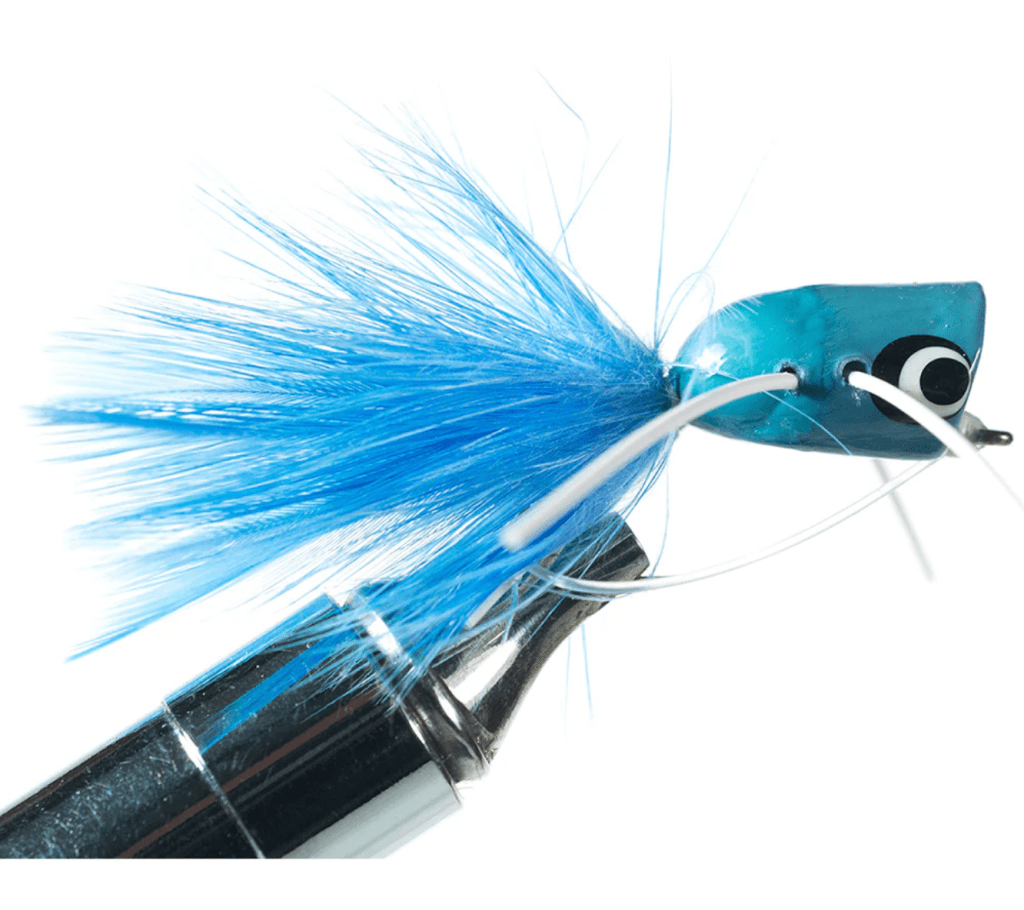
On a recent visit to Virginia, Smallmouth Bass guide John Waller mused to me how local fly fishers swear by the Shenandoah Blue Popper, despite all the research showing that Black Bass (including the Smallmouth) don’t see wavelengths as short as blue.
Shenandoah Blue popper, $9.90
This pretty blue popper looks gray to the bass. Apparently they’re just fine with neutral gray while bass fishers themselves strongly prefer blue.
If it’s hard to figure out what a fish will eat, it’s sometimes easier to figure out what they won’t eat. For instance, when fish are heavily pressured, they learn to avoid familiar things bearing hooks. Changing color can help. And pressured fish get spookier to presentation: lures and flies with less splash do better on wary fish. Natural selection.
Then there’s my friend, Andy Hong, who catches redfish on sautéed broccoli. For real. He’s posted the recipe.
In short, I have not yet seen the justification for all the cool lures and flies in my possession. At most, three shades of each lure or fly would probably set me up for life: light for clear water, dark for nighttime or tannic water, and medium-shaded for when the fish get wise to black and white. And maybe last night’s broccoli if I’m getting skunked.
Here’s my takeaway: If you find it more fun to mess with the new lures and flies go for it. If you want to stick with your old lures and flies, go ahead – the guys who outfish me regularly do so on their old favorites for a whole lot of reasons having nothing to do with lure selection.
Crawling from the tar pit, I realize that I am still only pretending I know what I’m doing.
Gierach, John (1988) “Big Empty River” in: The View from Rat Lake. Pruett Publishing Co., Boulder, CO
Horodysky, A. Z., Brill, R. W., Warrant, E. J., Musick, J. A. and Latour, R. J. (2008). Comparative visual function in five sciaenid fishes inhabiting Chesapeake Bay. Journal of Experimental Biology 211,3601-3612. https://doi.org/10.1242/jeb.023358
Vantasell SM, Hygnstrom SE, Ferraro DM (2011) Removing Skunk Odor. NebGuide, Univ Nebraska, Lincoln Extension, Institute of Agriculture and Natural Resources. edu/publication/g2100/2011/pdf/view/g2100-2011.pdf
Gray and I drove the EV north from Miami to check in on my parents in Northern Virginia, ages 98 & 91. We made a vacation of it, returning to a rental cottage on the South Fork of the Shenandoah, near the town of Shenandoah VA. The river teams with Smallmouth Bass and there’s paintable scenery everywhere you look.
The river by the cottage was easily wadable when we stayed here two years ago. It was so much fun I stood around in the cold water in my nylon pants until hypothermia set in. I never appreciated a hot tub so much.
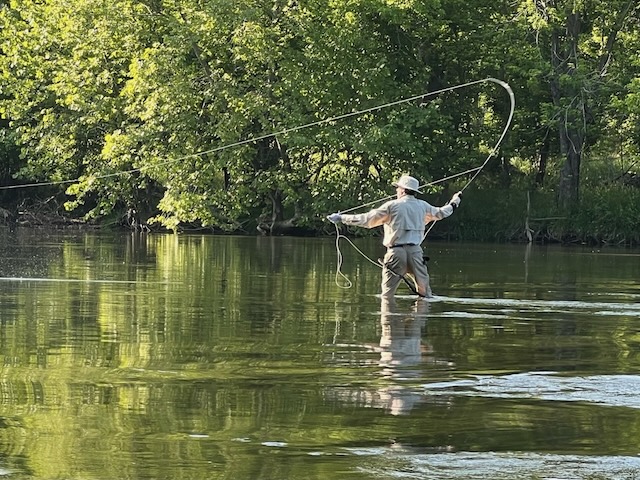
Here I am two years ago, wade-fishing the middle of the river. Easy-peasy. (photo, Gray Read, 2023)
This year I’d brought my new waders and wading boots. Arriving in the afternoon, I walk down the steep steps to the river and discover the small floating dock, despite being chained to a big sycamore, had washed away in a flood.
As the sun falls behind the mountain to the west, the hour when the fishing was best two years ago, I don my gear and wade out. The river is a good 2’ higher than before, with a faster current to match. I can wade with care and two hiking staffs, but the prospect of wading all the way across, as I did readily two years ago (photo above), is intimidating. Further, fly casting in that strong a current, while my boot cleats cling tentatively to submerged rock ledges of different heights and angles, is nothing like the relaxing Zen-ish experience I remembered from before.
Venturing forth in the waders towards deeper water. Clumps of leaves are still stuck in branches, leftover from the flood that took out the dock. (photo by Gray Read).
“There he stands, draped in more equipment than a telephone lineman, trying to outwit an organism with a brain no bigger than a breadcrumb, and getting licked in the process.” Paul O’Neil
On the plus side, the waders keep me dry and warm. Fortunately the house comes with three simple kayaks, and I had chartered a guide with a drift boat for tomorrow, so I don’t push my skill or luck tonight.
Day 1. Drift boat fishing with John Waller
We spend the day floating the river with guide John Waller in his spiffy inflatable raft. Summer has started in Miami, so Gray and I, acclimated to the heat as we are, arrive at the boat ramp bedecked in multiple synthetic layers, while John arrives in a pair of shorts and a light, long-sleeved shirt.
I stand in the bow, Gray sits in the back with her sketchbook, and John mans the oars in the middle, giving me welcome advice on where to cast and how to retrieve.
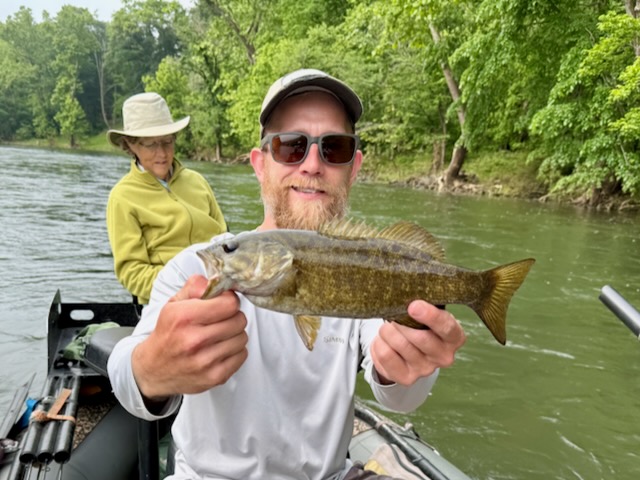
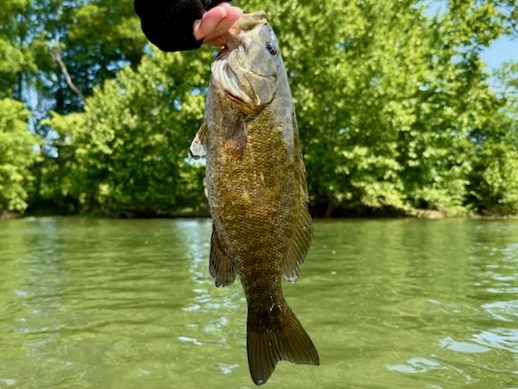
John Waller, guide, holding one of the Smallmouth Bass I caught, Gray sketching in her fleece jacket. We tropical geezers are not unhappy with our extra clothing.
Most of the day I happily cast a topwater frog fly (Umpqua Swimming Frog, 1/0) against the shoreline on John’s lovely Thomas & Thomas 8wt rod, strung with a 2x overweighted line (SA Titan Long). To my delight, I don’t make a complete fool of myself. My experience casting flies under mangroves for snook comes in handy pitching the frog fly under sycamore bows for smallies.
Umpqua Swimming Frog fly, size 1/0, a deer hair bass bug based on the Dahlberg Diver.
We also mess around with poppers (let it drift, not much popping), streamers (2 hard strips, and a pause), and floating a wooly bugger under an indicator (cast, mend, wait). These setups catch fish, but without question the topwater frog is the most fun. As with dry fly fishing for trout, it’s a hoot seeing Smallmouth Bass rise to the big deer hair frog fly. I especially enjoy watching one that comes up, stares at the fly, then changes its mind… three times in succession.
Around 3 pm, after seven hours of throwing that heavy fly line, my casting hand gives out, so I switch to the other hand. John looks at me and muses: “You waited all day to tell me you can cast left-handed.”
In all, I catch 20 Smallmouth Bass (3 big ones) and three Largemouth Bass (all small). John says that Largemouth are becoming much more common. Warmer times.
One of the big ones. (Photo by John Waller)
Another plus, l learn how to fish the river, or imagine I do.
Forty-five minutes after we get off the water, the weather explodes. Sheets of rain and gale force winds blow down the river. A tornado forms 20 miles north near Luray. Lucky timing for us.
Day 2. more wind
Today is also windy, gusting to 33 mph. Plus my brother Andrew came by to visit. Not a great day for fly fishing, much less from a kayak. Instead we fly Andrew’s stunt kite from a nearby field, fittingly situated on Kite Corner Road.
Pretty cool kite, beyond my capability to handle, but Andrew has it mostly figured out. Check out the video:
Looking the other direction toward Kite’s farm. (watercolor, Gray Read)
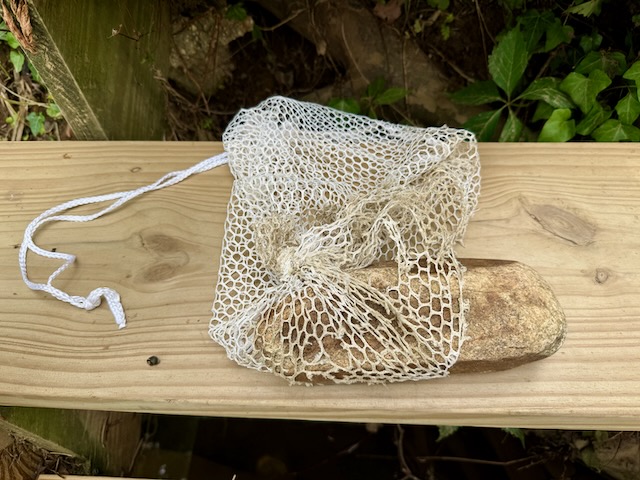
Before sundown, I rig one of the kayaks at our rental with parachute cord and carabiners, lower it down the steep steps, and tie it in the river for tomorrow. I fashion a kayak anchor by putting smooth river stones in a nylon mesh bag that I’d brought along for that purpose. I’ll take the kayak out in the morning and see how I do on my own.
Day 3. Kayak fishing
The air temperature was 49° F when I rose this morning. After seeing my brother off, I put on multiple layers and head out in the kayak to fish the section of river around our rental cabin. Across the river, Wild Turkeys gobble as several deer eye me suspiciously from the bank.
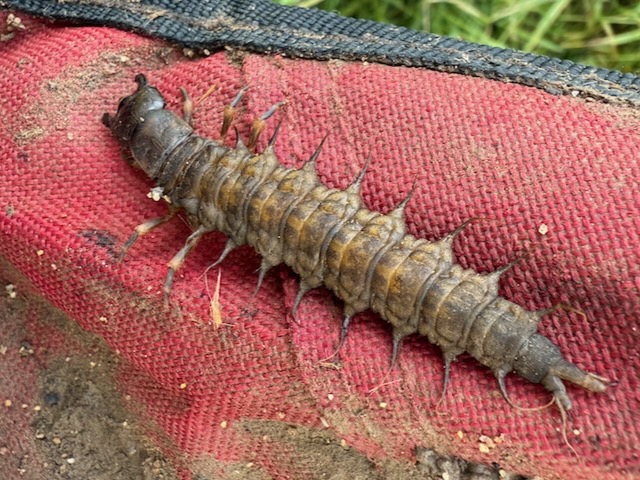
My homemade kayak anchor (v1.0) works OK, but slips a bit in the current. I find more smooth stones on a bar and added them to the bag (v1.1). I also find a folding stool concealing a big hellgramite (Dobsonfly nymph) in between the muddy folds. It crawls into the river, taking its chances with bass unknown over the large creature that I am.
I cast the swimming frog fly under and around every sycamore tree that overhands the river, but cannot get a bite. Ditto for the indicator/wooly bugger rig that John Waller showed me two days ago. This section of river by the house is shallower and faster than the places upstream and downstream where these methods caught fish: the topwater froggy drew bites in slack eddies and the wooly bugger dangling deep under the indicator (a light float) caught fish lurking in deeper holes.
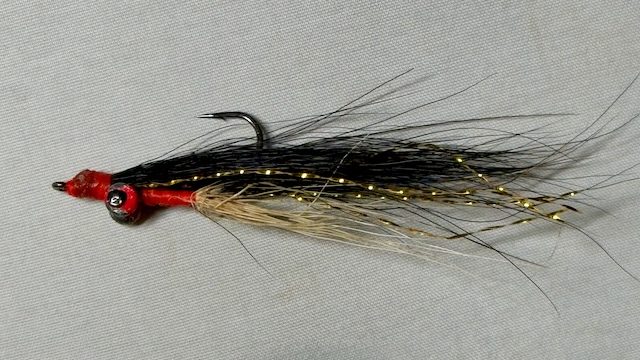
In frustration, I tie on the old faithful black & ginger #6 Clouser Deep Minnow with red eyes and gold flash. That was the fly I used two years ago to catch dozens of small bass in the river. Doink! It hooks up on the first cast. Small fish, but one fish is infinitely better than zero. John Clouser invented this fly for fishing Smallmouth Bass before discovering that it catches everything.
Black over ginger Clouser Deep Minnow with gold flash, tied on a #6 Gamakatsu B10S. The painted lead eyes on this one have seen their share of rocks and the bucktail has been chewed down by many Smallmouth Bass.
Smallies strike the Clouser 30 feet from shore, retrieved from down current with little strips (strip-strip-pause). The third fish, a big one, comes partway out of the water to take the fly, fighting longer and harder than the one I was holding in the photo above. I switch hands when my right wrist tires, then switch back when my left wrist tires – what a great fish! I’d heard that among North American fish species Smallmouth Bass are the strongest fighters for their weight. Now I believe it. When the fish is close enough to see some flashes in the water, I reach for my landing net and – OH NO – slack line. The fish got off! Rats!
If I’m not fishing for dinner I don’t need to lift a hooked fish from the water to be content, but I do want a good look at it before it takes off. Location noted. I will be back.
Anchor v1.1 worked great this morning until the mesh wore out from dragging along the rocky river bottom, allowing the stones to escape.
The last remaining river stone, caught in the act of escaping the mesh anchor bag.
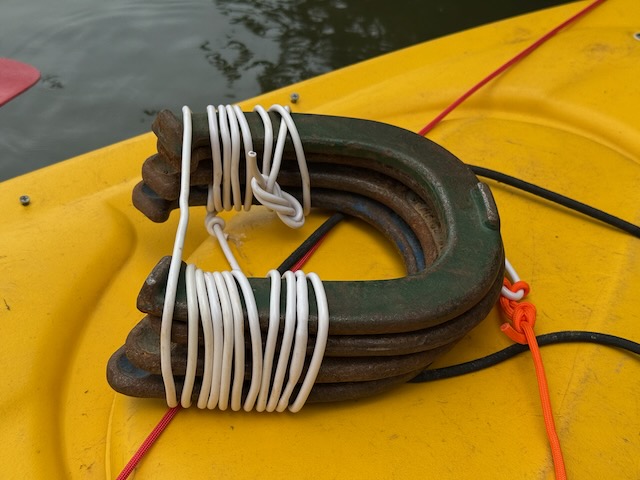
Time for lunch. The owner of the house stops by to survey the storm damage we’d reported to her. She kindly unlocks the shed and invites me to scrounge for anything I could use to McGyver up another anchor. Digging around I find a stack of iron horse shoes, the kind you throw, and some plastic coated wire cable to bind them up. Kayak anchor v2.0.
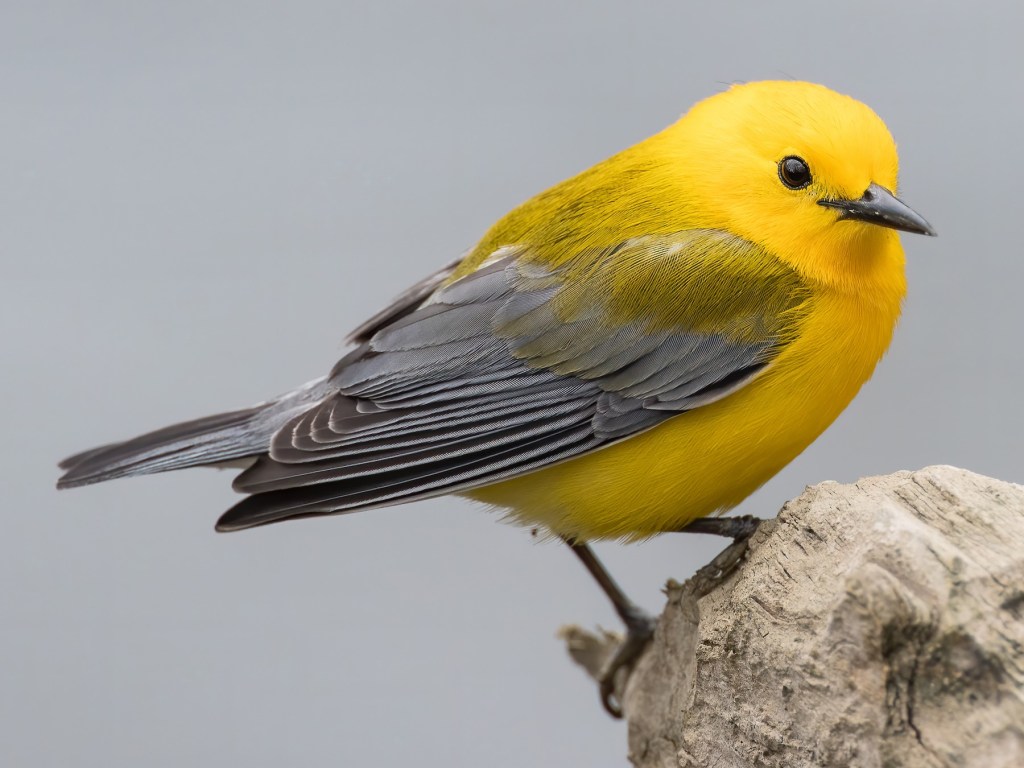
Birding break: I hear a male Prothonotary Warbler singing from a tree near the porch. He cooperates as Gray and I get good views through the binoculars. Quite the looker, described by eBird thus: “Shockingly bright warbler of swamps and wet forest. Adult males have gorgeous yellow head and body with greenish back and blue-gray wings.”
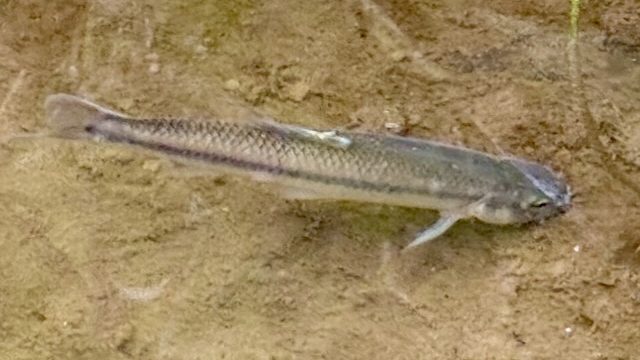
I attach the horseshoe anchor to the kayak, photograph a Black-nosed Dace (minnow-type fish) in the shallows, and spy on the tame young woodchucks living under the porch.
Young woodchuck savagely devours a hapless leaf.
Two fishermen in a guided drift boat come by, working the shorelines below the house. We exchange the typically terse fishermen’s infochat: “a good morning, slow afternoon, subsurface streamers working best.”
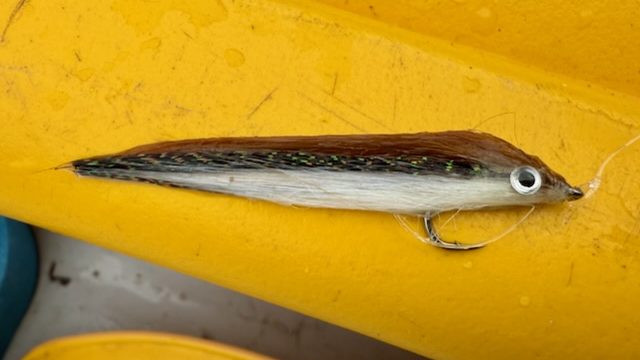
I will have to try casting my untested Black-nosed Dace subsurface streamer patterns against the shoreline.
Late afternoon bird-fish report. Tree Swallows have a nest with babies in a sycamore snag and Baltimore Orioles have a nest in the living part. A Warbling Vireo sings nonstop, but I haven’t found his nest. My first cast of the Clouser catches a fish. A young Bald Eagle flies over in the middle of my next cast. I “Clouser” the kayak while gawking at the eagle instead of minding my backcast. A few more small bass, then a medium-sized one hooked so tight I destroy the fly taking it out with the hemostat.
I needed an excuse to try out my new Black-nosed Dace imitations.
Black-nosed Dace in the shallows.My imitation dace streamer fly, tied with craft fur, black flash, and a mono weed-guard (more of a rock-guard in this river).
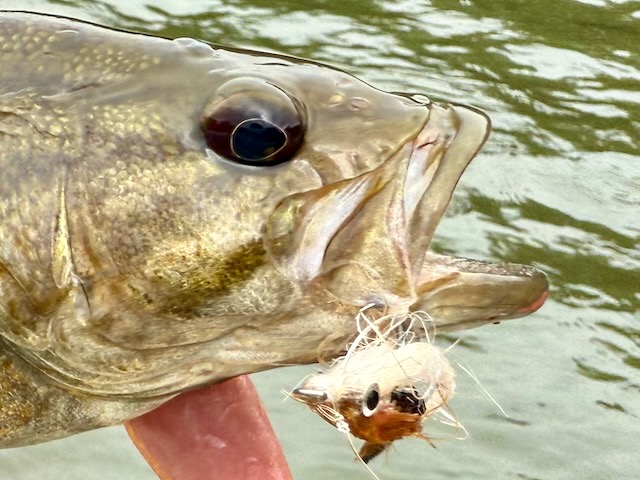
No action on the shoreline but out in the middle, above the rapid line, my dace fly gets a hit every cast. Adding a stinger hook will catch the short-strikers.
After dinner I go back out for the evening rise. Right on schedule the air over the river fills with big brown mayflies, but no fish rise to eat them as they had two years prior. Bobby, a neighbor spin fishing from his deck, tells me that in normal years smallmouth rise to mayflies at dusk, but this year the river is up 2-3’ from the rains and fish habits had changed.
I cover the same sections that had been productive before dinner but cannot get a take. Hurrying back in at 8 pm to join Gray for cold watermelon in the hot tub, I pause to cast at the shoreline and hook up four times. Huh. Maybe river fish move around as much as flats fish do.
Day 4. Working it.
I catch that big smallmouth again, or at least one of similar size in the same spot, on the same fly, at the same time of day, and which puts up the same interminable fight. This time Fishy stays hooked until released.
How about those stripes, huh? Back you go.
All day, I only kayak-fish the 1/3 mile section of river in front of the cabin between the class 1 rapid upstream and the class 2 rapid downstream. The upstream rapid was a mere riffle two years ago through which I’d easily pulled the kayak on foot.
I ponder running the lower rapid and think better of it. I am an experienced kayaker, skilled in low braces and competent to roll. I also know that no matter how adroit one is with a paddle, attempting to get over rocky drops in a large-hatched kayak, with no flotation bags or sealed hatches, no spray skirt, no helmet, a heavy unsecured anchor, a floating backpack loosely fastened to the deck, an expensive fly rod between the knees, and no one to assist if something goes wrong, is the epitome of a bad idea. Possibly the anchor gets loose and jams between two rocks, my kayak goes taught against the anchor line and turns crosswise to the current. Secured by the anchor line, the kayak does its very best to tip into the current, filling the open hatch with water and rolling it. Very hard not to break the fly rod. Worst case, I tangle in the paddle leash and/or hit my head on a rock and drown. John Geirach’s friend Archie “A.K.” Best put it this way:
“I enjoy fishing too much to risk my life at it. Death can really cut into your fishing time.”
An inflatable raft is the way to go.
The day’s final fish count when I quit at supper time is 34 smallies and one Pumpkinseed Sunfish, all caught in the safe span between the rough waters. (I counted the fish I caught in homage to my friend Jay Levine, who always counts his fish.)
Pumpkinseed Sunfish caught on a red / white Clouser bendback.
Day 5. Downstream
Before we leave for home, I really want to catch another fish on the swimming frog topwater fly that John Waller gave me. I snuffle some more around the shed and find a couple of ratchet tie-down straps. The kayak thus secured on the car’s roof rack, I drive downstream 1.5 miles, bypassing a couple of sets of rapids, to the Grove Hill Boat Ramp (“Boat ramp” might be an Appalachian euphemism for a mudslick bulldozed out of the riverbank). My intent is to look for slack eddies where fish might feel sufficiently rested to attempt a frog.
I spend an hour fishing an eddy shelf 2-4’ deep and 150 yards long. There I catch seven ambitious Pumpkinseed Sunfish and miss a dozen more strike attempts in which the sunfishes fail at stuffing that big fly into their tiny mouths. I don’t see or catch a single Smallmouth – so different from the area near the cabin. I feel like there’s a lesson for me somewhere, but mainly I come away appreciating John Waller’s inflatable drift boat and his proficient oarsmanship.
Good-bye, river. (watercolor, Gray Read)
The next day we drive out, by way of Luray Cavern, which I’d been wanting to see for the past 58 years. Well worth the wait.















 Eye of the Cormorant