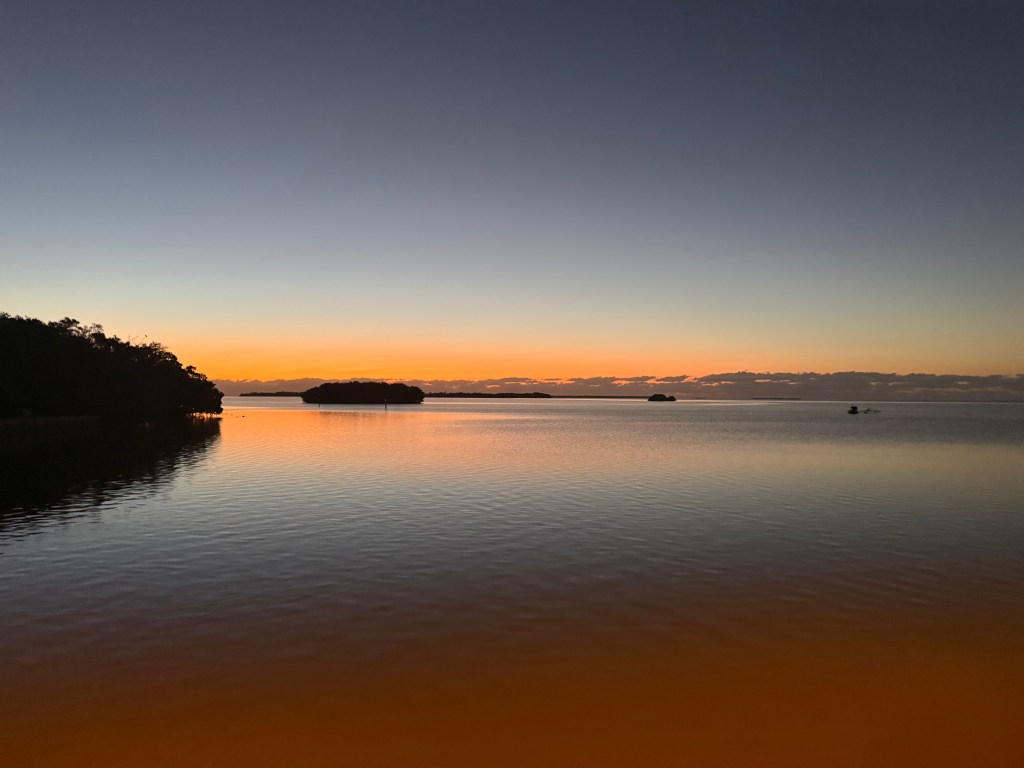
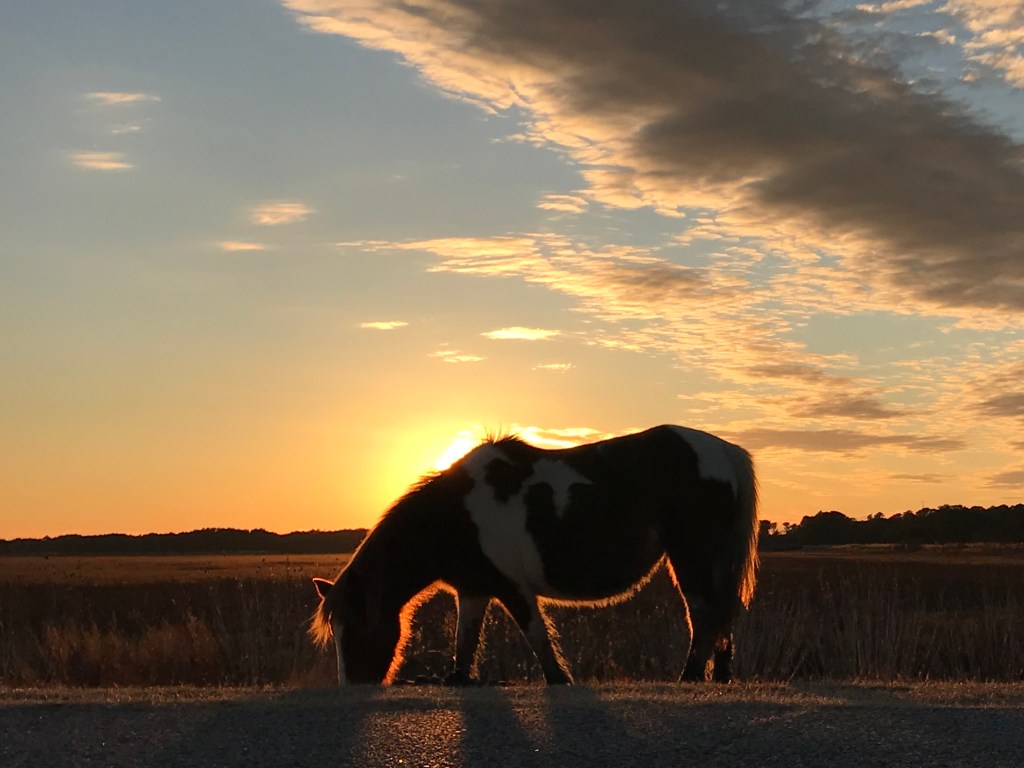
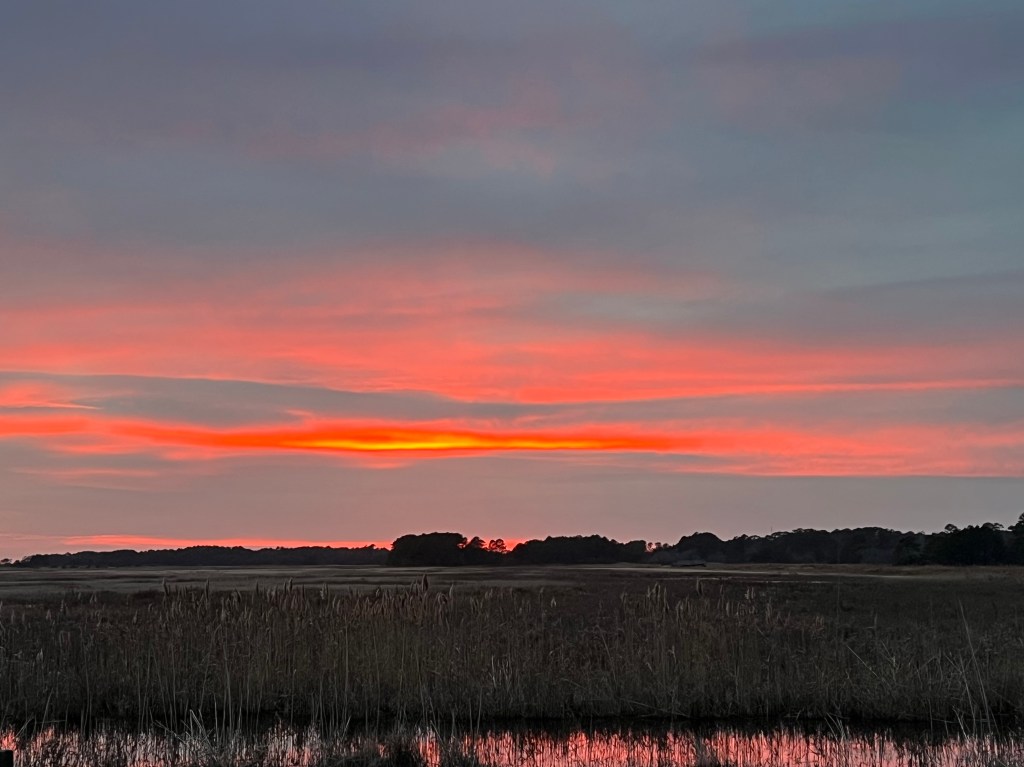
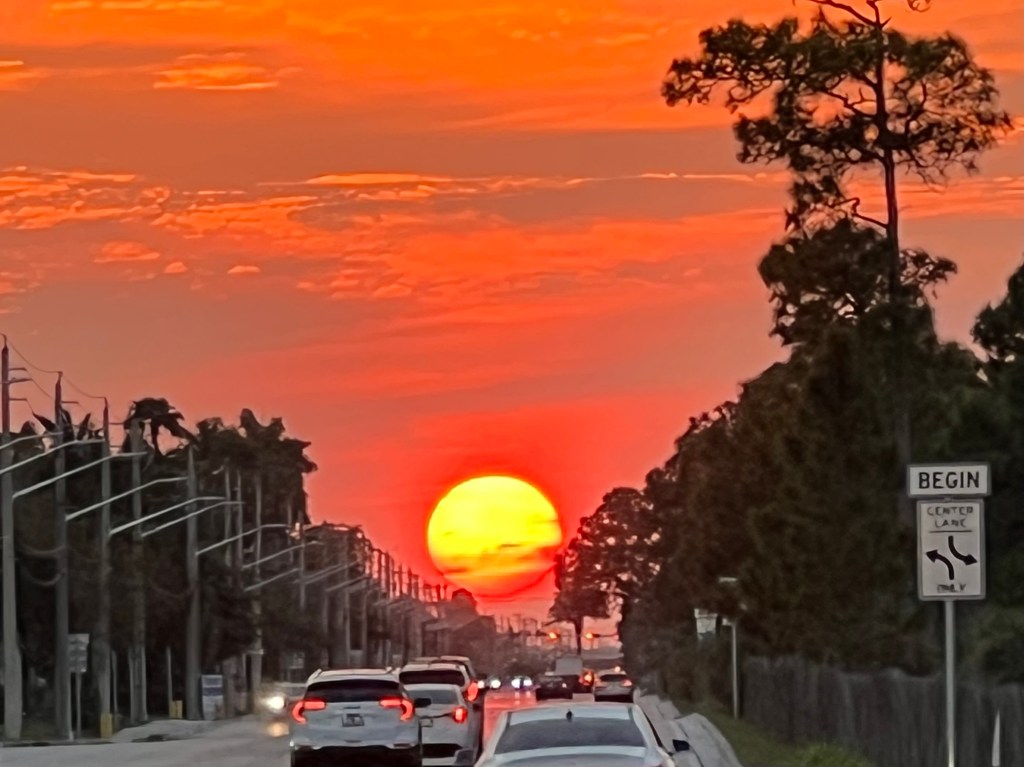
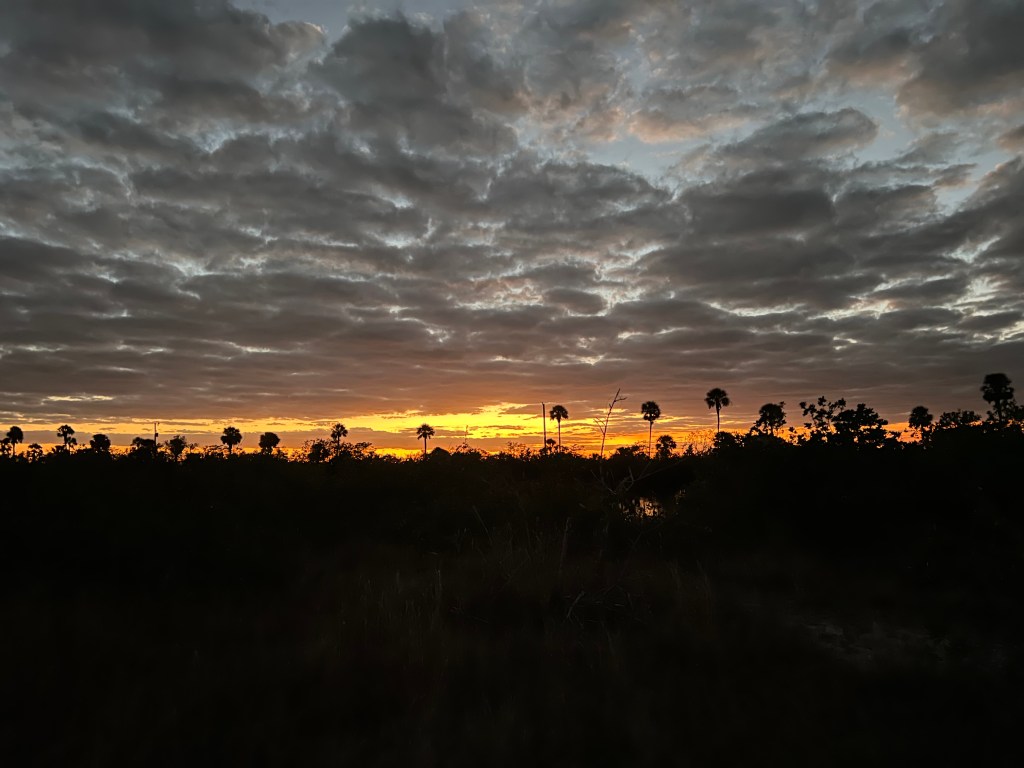
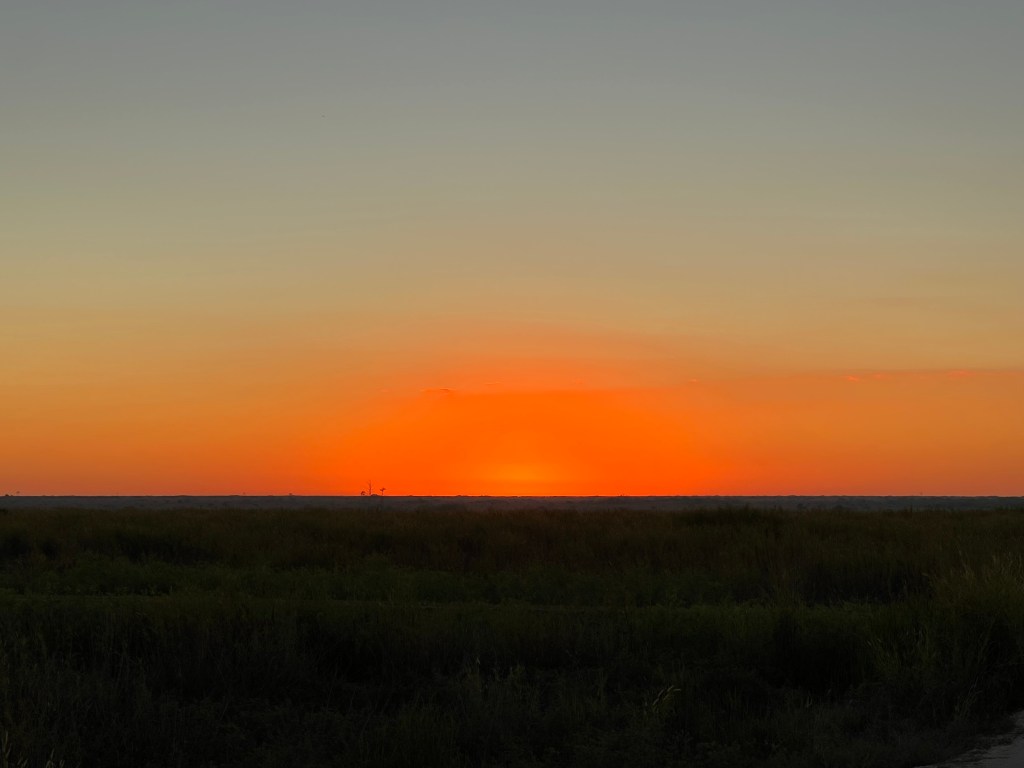
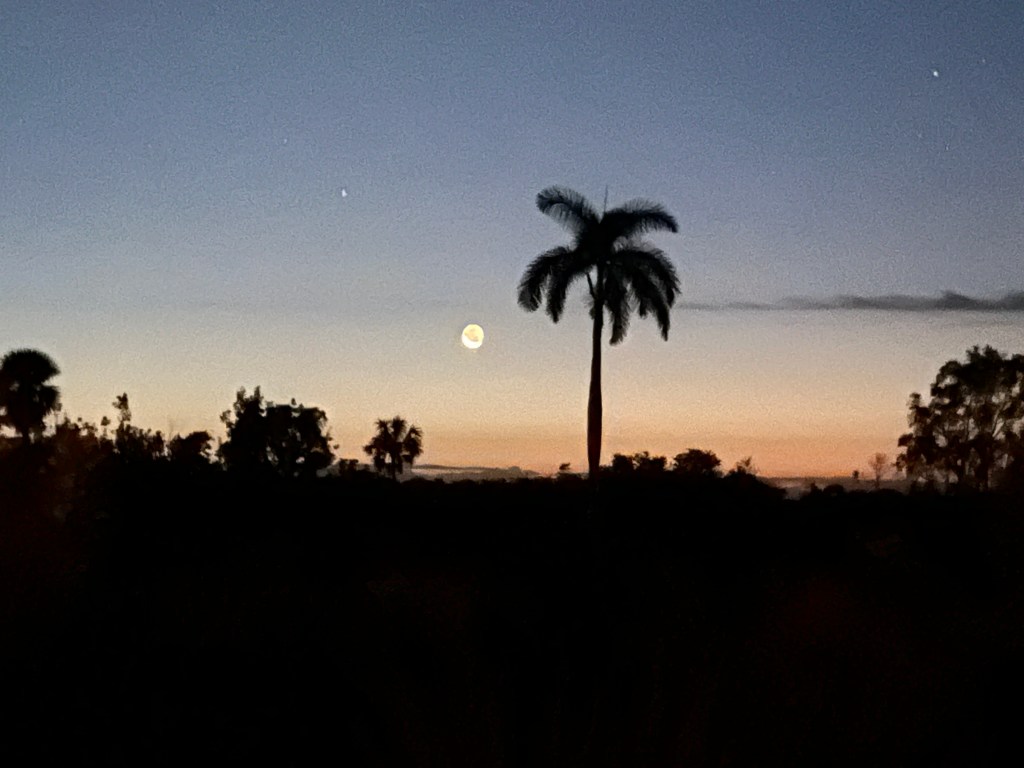
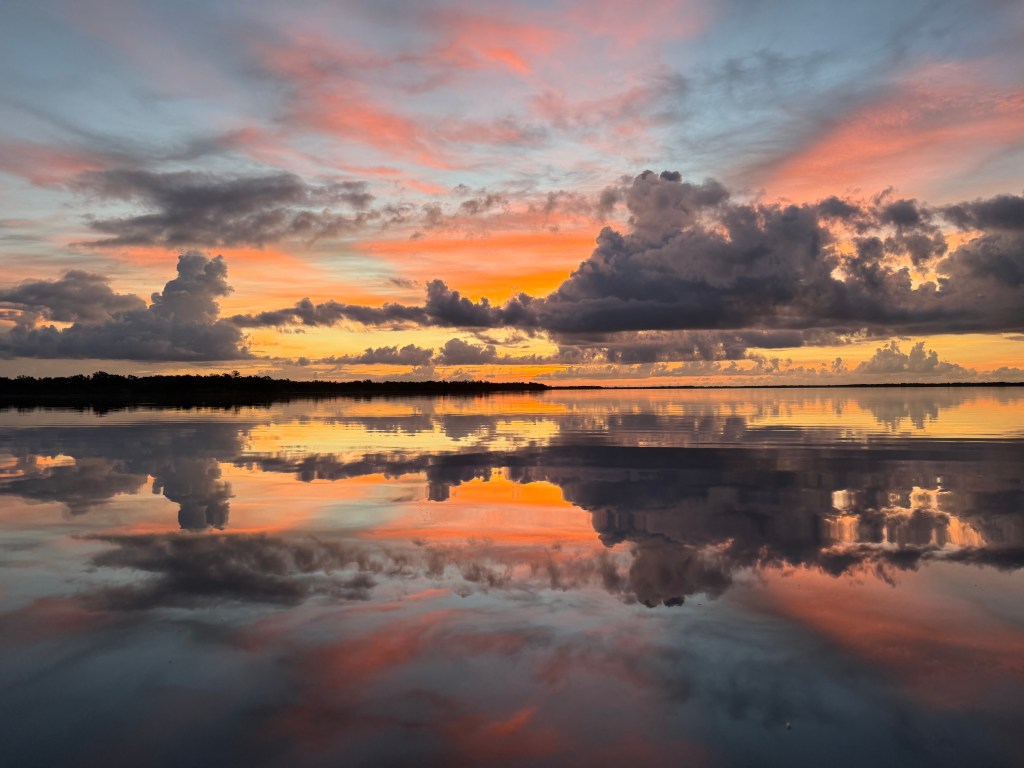
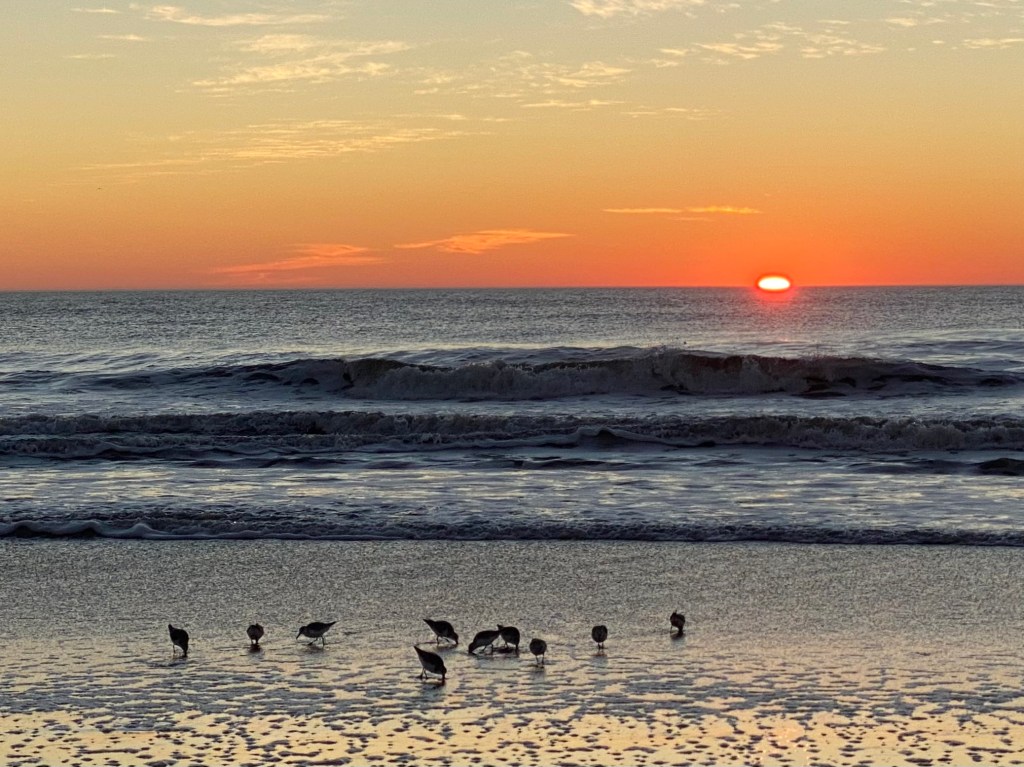
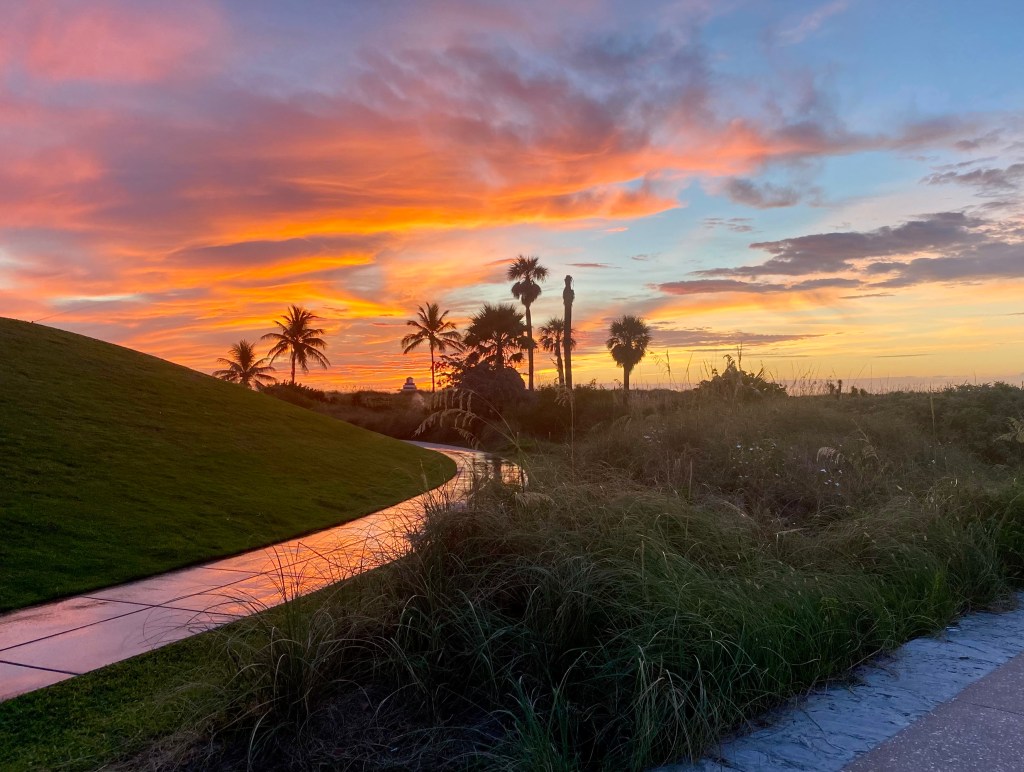
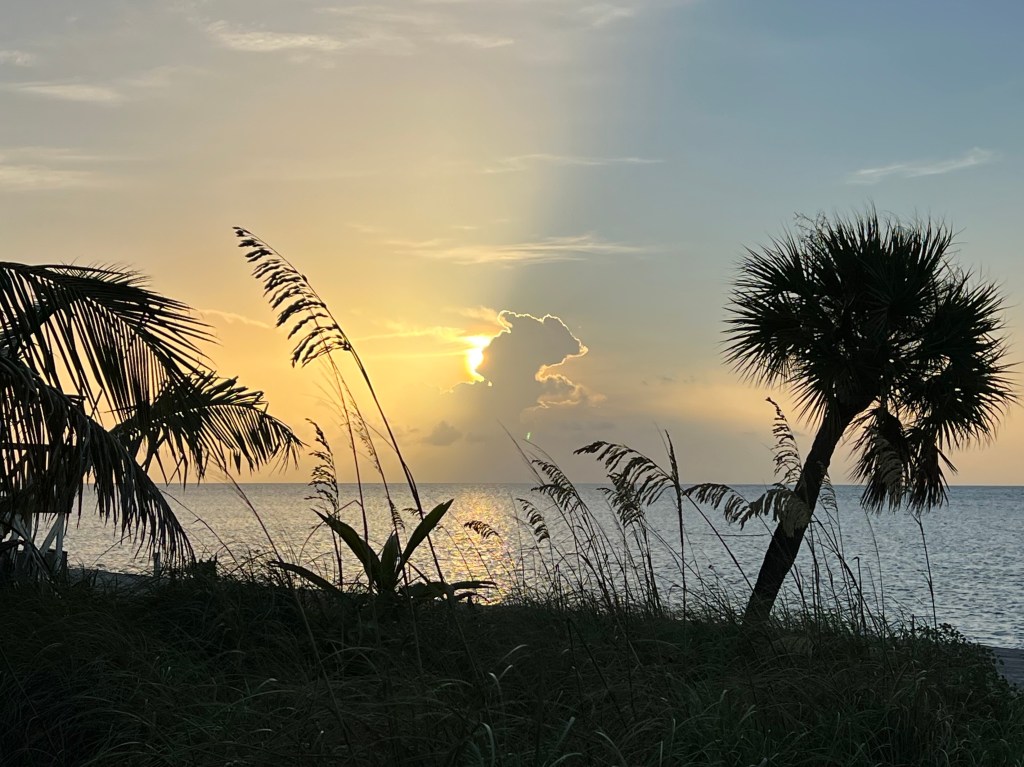
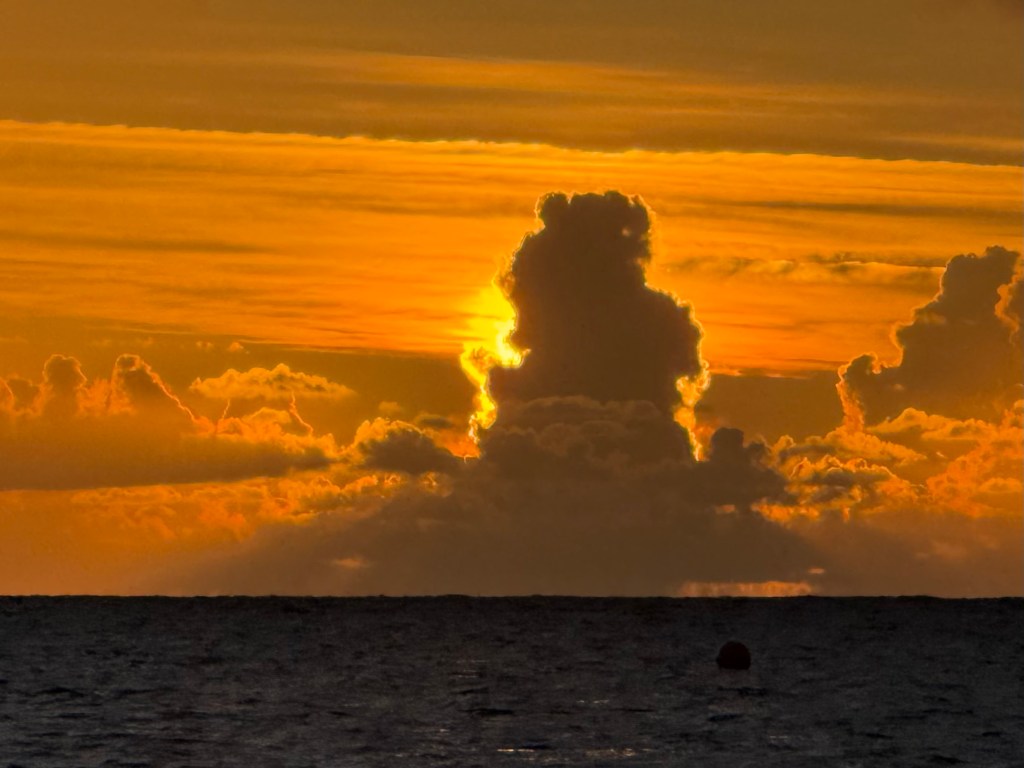
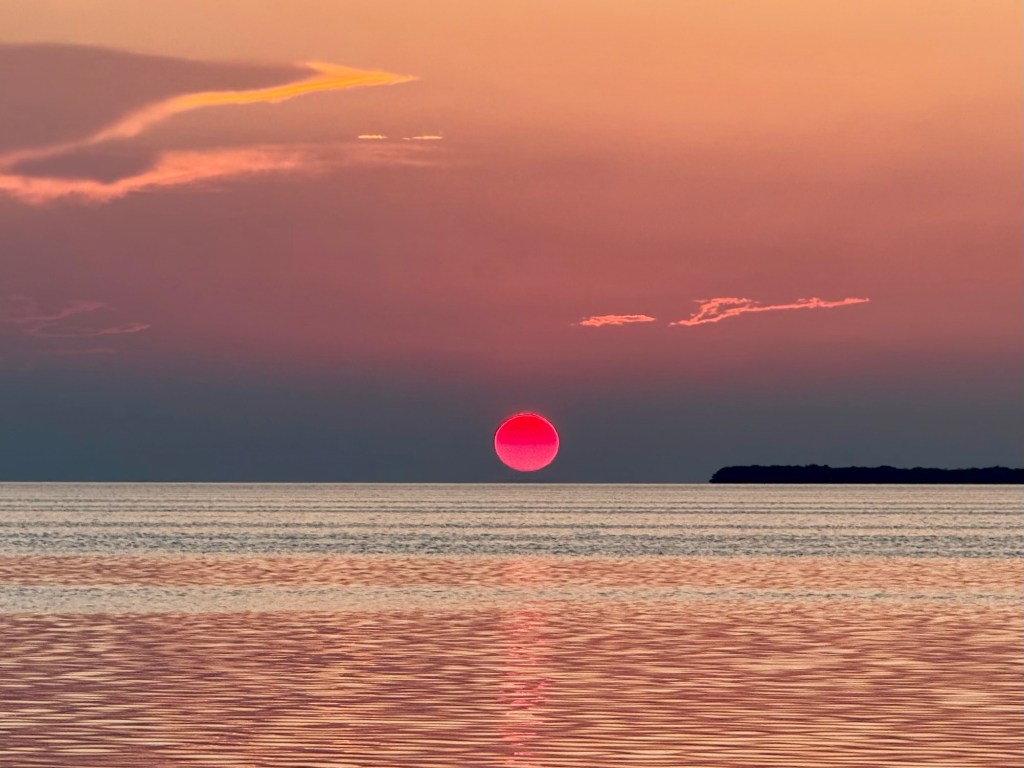
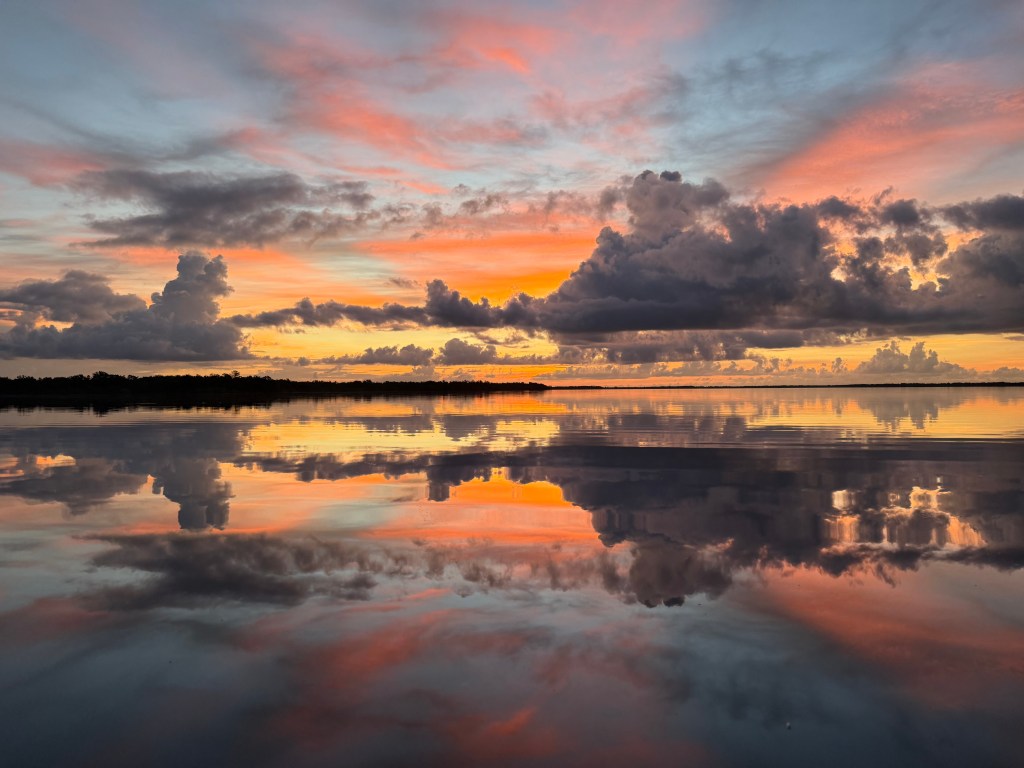
Dave Barry once noted that he’d seen more spectacular sunsets in his first year in Miami than his entire life in Philadelphia. Having an iPhone in my pocket helps to illustrate his point. Sunsets are splendid, though as a fisherperson, I’m partial to sunrises.
Dusk
Wild pony, Assateague Island, VAAssateague Island, VASpring equinox, Southwest Miami-Dade County, FLTarpon rise (lower right), Ochopee, FLWomenfolk on Rabbit Key, Everglades National ParkOchopee, FLEast Everglades, Miami
Dawn
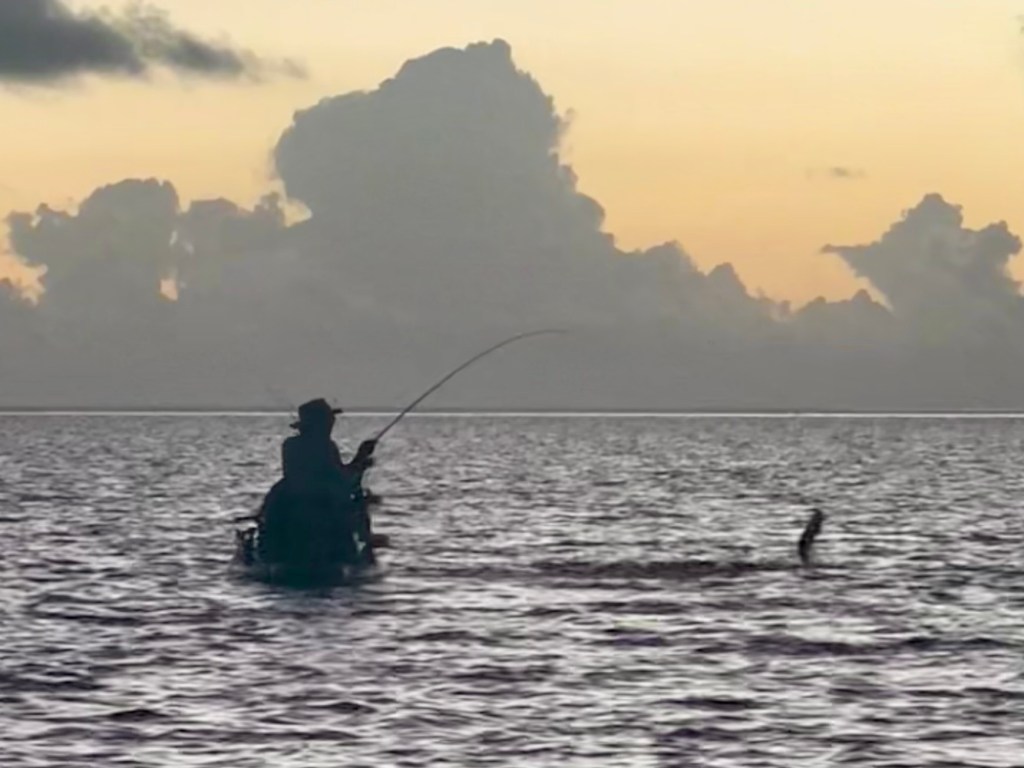
Fly fishing at the start of civil twilight, West Lake, Everglades National ParkTwo planets and a moon, Everglades National Park entrance roadWest Lake, Everglades National ParkAssateague Island, VASouth Pointe Park, Miami BeachCrandon Park, Key BiscayneKey Biscayne, FLLittle Duck Key, FLPalm Key, Everglades National Park
P.S. Last sunset of 2025
Assateague Island, VA.
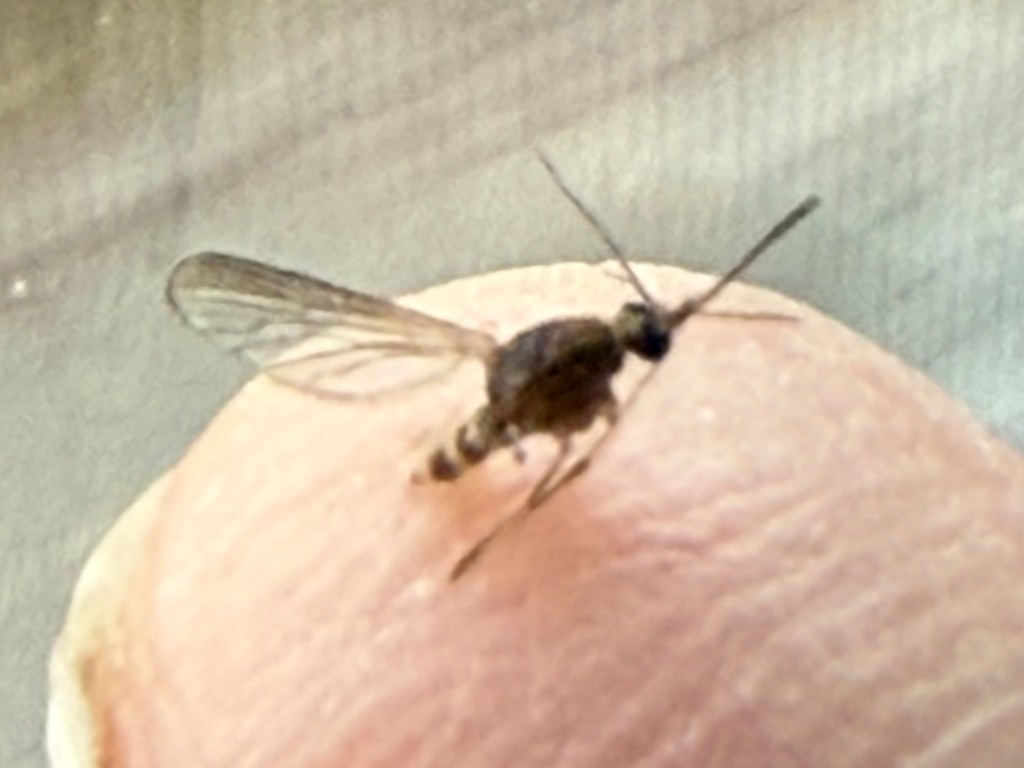
P.P.S. First mosquito of 2026
Remnants of a mosquito that entered through the heat vent at our rental house in Chincoteague VA, assisted by raccoons who partially dismantled the heating ducts under the house.
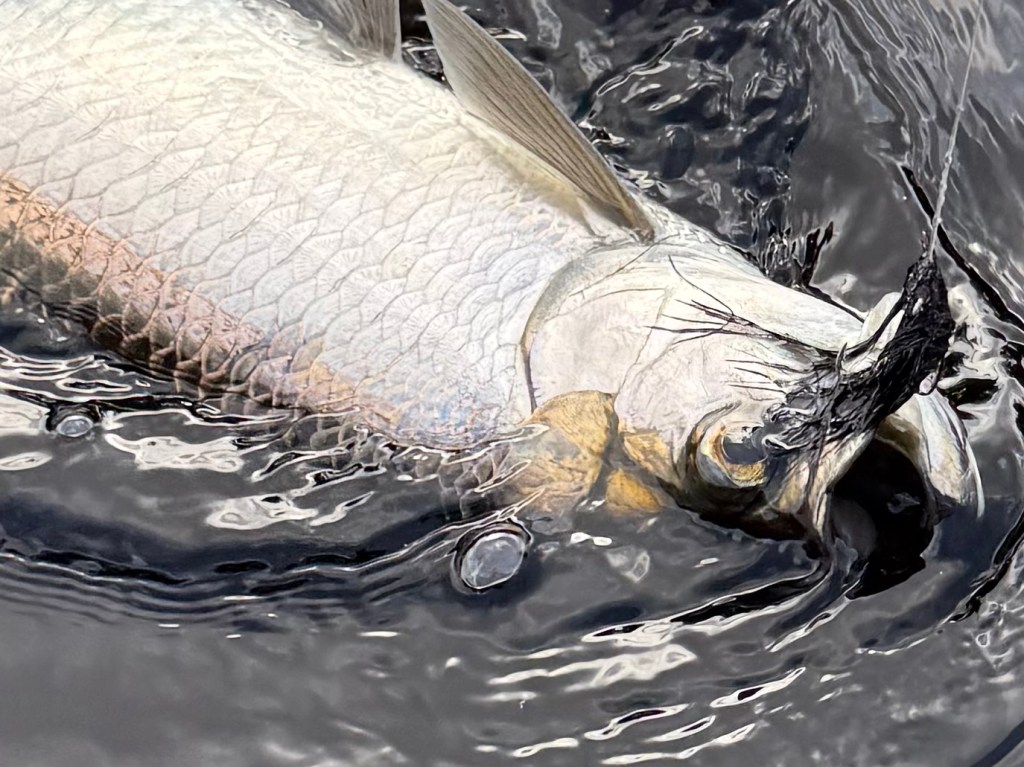
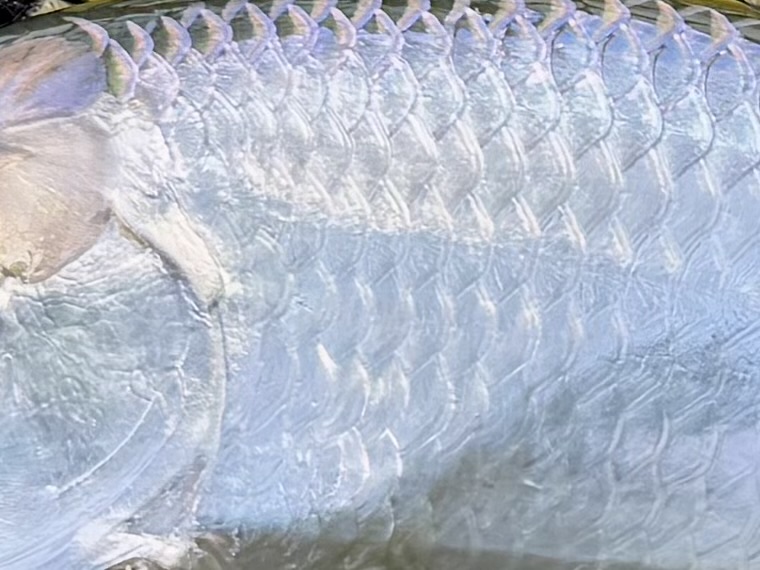
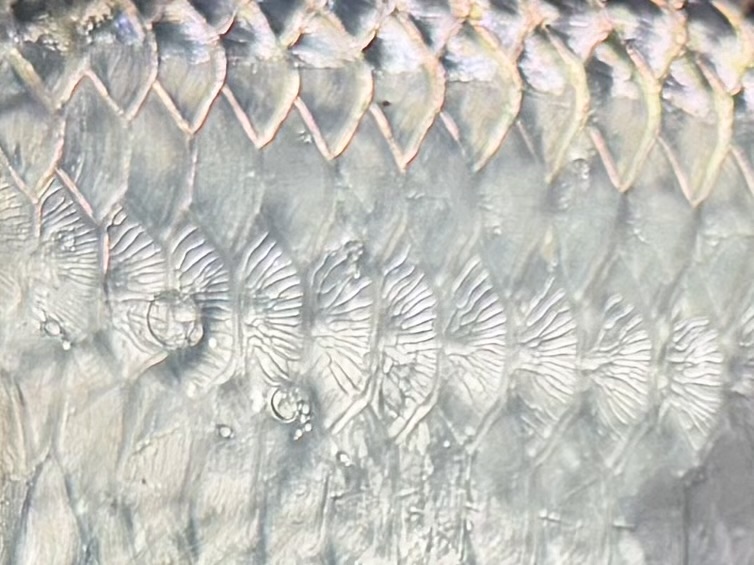
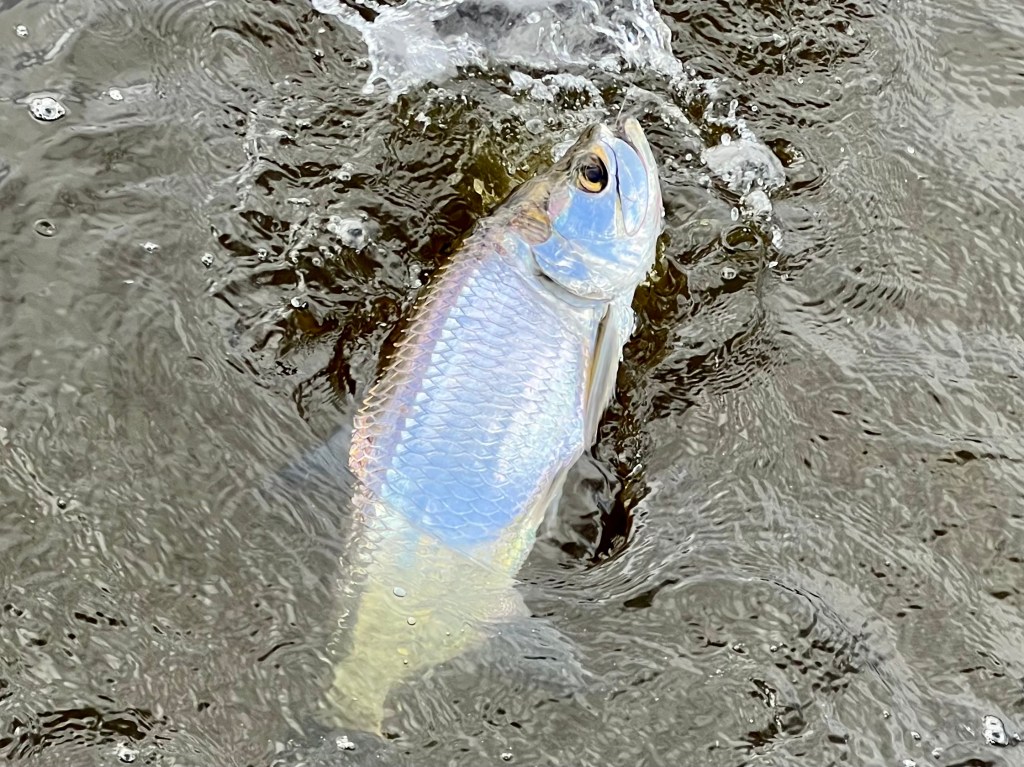
Fish are often camouflaged, some by color and patterns that resemble their backgrounds, others by reflecting the light around them and thus matching any and every background. Tarpon do the latter with scales that work like mirrors.
Juvenile tarpon are about my favorite fish to chase on the fly rod. I say “juvenile” because the adults weigh 70 to 200 pounds. I normally avoid disturbing the adults and fly fish instead for smaller juveniles weighing 3 to 20 pounds, reasonably common in the canals and tidal creeks of South Florida.
Tarpon are smart and strong, and they are spirited jumpers. The mantra among tarpon fishers is “Bow to the King”, meaning when the tarpon jumps, you lower the rod to create slack and prevent it breaking off or throwing the fly.
Instead, I lightly tension the fly line during a jump to help the tarpon toss the fly without breaking the line. My goal is to fool the tarpon into eating my fly, have it give me a showy jump or two, but spare it the exhaustion of a complete fight and spare me the guilt of exhausting a beautiful fish.
Yesterday, while kayak-fishing a saltwater canal, three miles from home as the cormorant flies, I spotted a couple of big juvenile tarpon in the 40-60 pound range. I swapped up to a larger fly “the Devil’s Daughter”, a muted black pattern designed by Drew Chicone for catching tarpon that are wise to the fly fisher’s usual sparkly fare.
Tarpon can breath air, “rolling” on the surface to gulp a bubble before descending into the murky water. Following a roll, I’d cast the fly 6-10 feet in front, let it sink a bit, and retrieve it steadily. Twice I felt “short strikes”, in which an unseen tarpon grabbed only the feathery tail of the fly. A couple of casts later the fly stopped mid-retrieve, like I’d hooked a log. I set the hook and the line began to pull. The fish was in no hurry.
Smaller tarpon jump immediately. Instead this tarpon went deep and swam away slowly. I took up the slack and kept reeling until my 7wt rod bent double and the leader touched the tip guide of the rod. The tarpon turned and made a dash under the kayak. I flattened the propulsion flippers to keep the line free as I worked it around the bow and the tarpon took off. Once in a while, I’m glad for the smooth drag on my fly reel.
We had been pulling back and forth on the fly line (intermediate clear tip) for a couple of minutes and the tarpon had enough. It took to the air, arcing its body in a fast reciprocating shake that tossed the fly. I got my fly back and the tarpon continued on its hunt for hapless baitfish. I was ecstatic – that’s about as good as it gets in my book.
Sometimes the fly won’t shake loose and I must net the fish to release it. While I have it in the net, I usually take a photo to document the spectacular purples, pinks, blues, and greens reflected by the tarpon’s mirrored scales. Here are some photos from my collection.
I’ve been grappling with a multi-way conflict: (1) trying shake the “forever cold” while (2) healing a torn rotator cuff muscle (supraspinatus) in my fly casting arm, and (3) enjoying every nice day I can on the water with a fly rod and binoculars. At least I don’t have to grade papers.
A cold front reached South Florida, knocking down the mosquitoes and moving sharks away from the shallows. The Everglades mangrove flats beckoned me southwards.
Entrance to the flats.
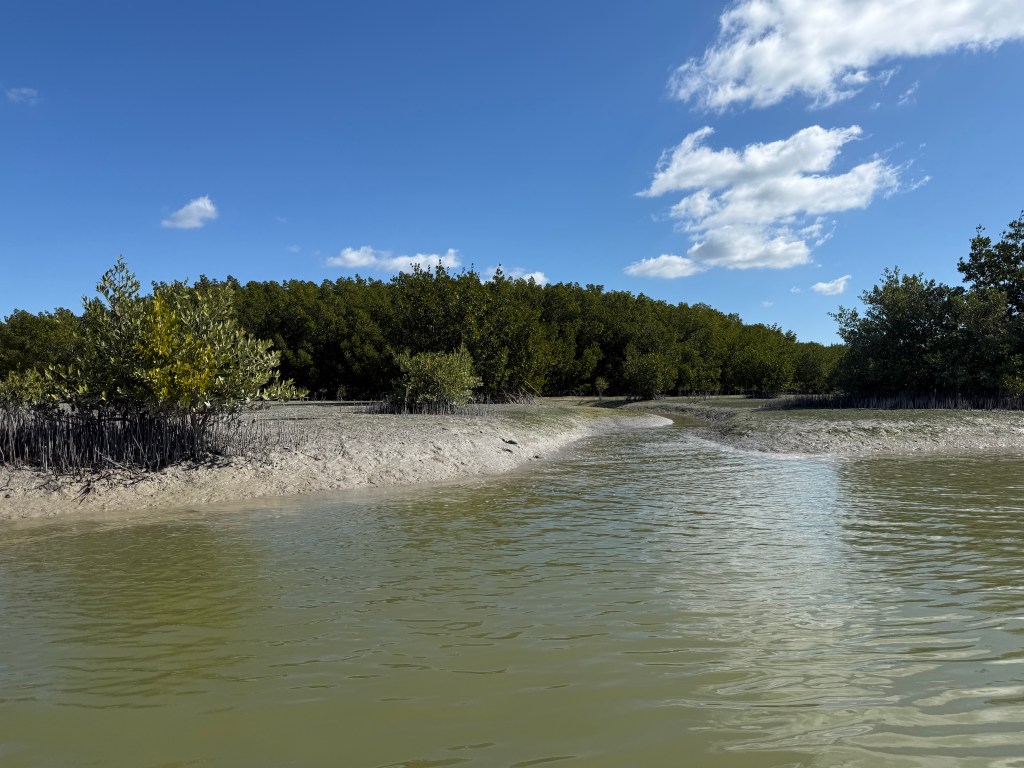
One shallow flat in particular draws me to watch shorebirds and chase game fish.
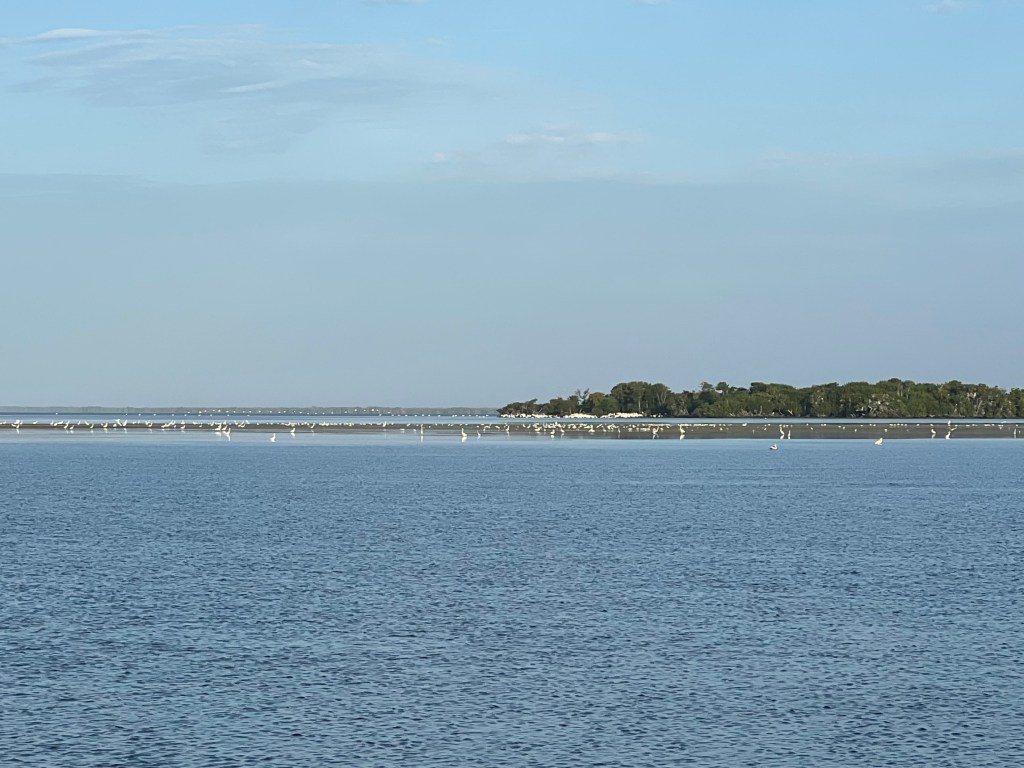
Birds gather on the falling tide. Snook and Redfish forage near that edge.
To get the best experience, you have to get the tides right. Depending on the moon and tide phases, the area can be 16 square miles of water (birds wait in the trees and fish are everywhere), 15 square miles of exposed mud (birds dispersed everywhere and fish are concentrated in the channels with the sharks), or something in between (birds and fish both concentrated on the edge of the tide). If the wind comes up, water might blow onto or off the flat, superseding the tidal prediction.
Several two mile trails lead to the edge of the flat. When my late colleague George Dalrymple took his zoology class down the Snake Bight Trail, one student had to be carried out after she fainted from the sheer horror of the Black Salt Marsh Mosquitoes. I found that pedaling my bicycle down the trail lets me keep ahead of the swarm. Just don’t stop! But the best access is in a shallow-draft boat, a kayak, canoe, or technical poling skiff.
Coming by boat, you have access to more of the flat and can approach the edge of the tide where birds and fish are concentrated. However, it’s easy to get trapped by the falling tide, particularly when distracted by fish or shorebirds, both of which follow the rapidly moving tidal edge. If Poseidon empties the bathtub while you are far from a channel, there’s no walking out. The deep, sucking mud steals your sandals before eating you whole.
People who get stuck sometimes phone the Park dispatch office. The ranger explains:“Yes, we see you out there, but we can’t get to you. Unless it’s an emergency and you want to pay for a helicopter, you are going to sit there until the tide comes back in.” You might spend up to eight hours waiting for the next high tide to free your boat. Hope you brought extra water and a granola bar, and good luck with the lightning.
I have willingly allowed myself get stranded at the bottom of the outgoing tide while watching shorebirds, chasing fish, or watching shorebirds chase fish. I eat lunch then escape when the tide returns to float my boat. The show can be worth the wait.
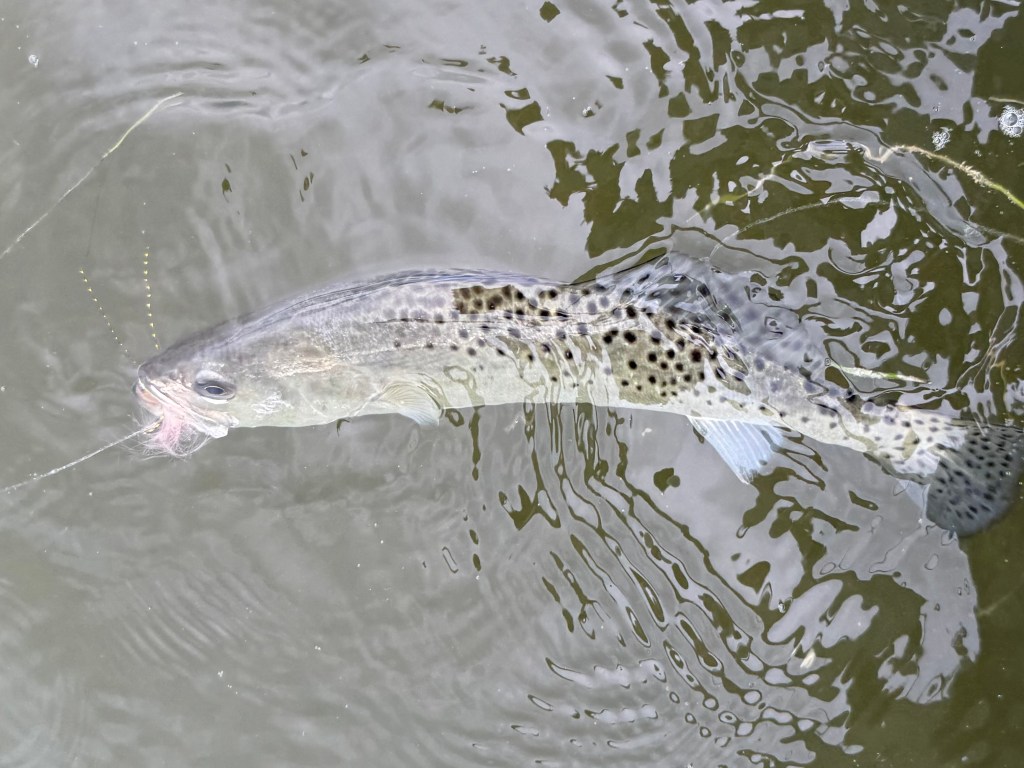
Tricolored HeronBlack-necked StiltSpeckled Seatrout that took my fly.
The low tide can bring spectacular birding as it did last week when baitfish and birds filled the runouts along one of the main channels. The flats were covered with winter waterbirds: White Pelicans, Black Skimmers, all the long-legged waders, Marbled Godwits, Short-billed Dowitchers, Wilson’s Plovers, and assorted “peeps”.
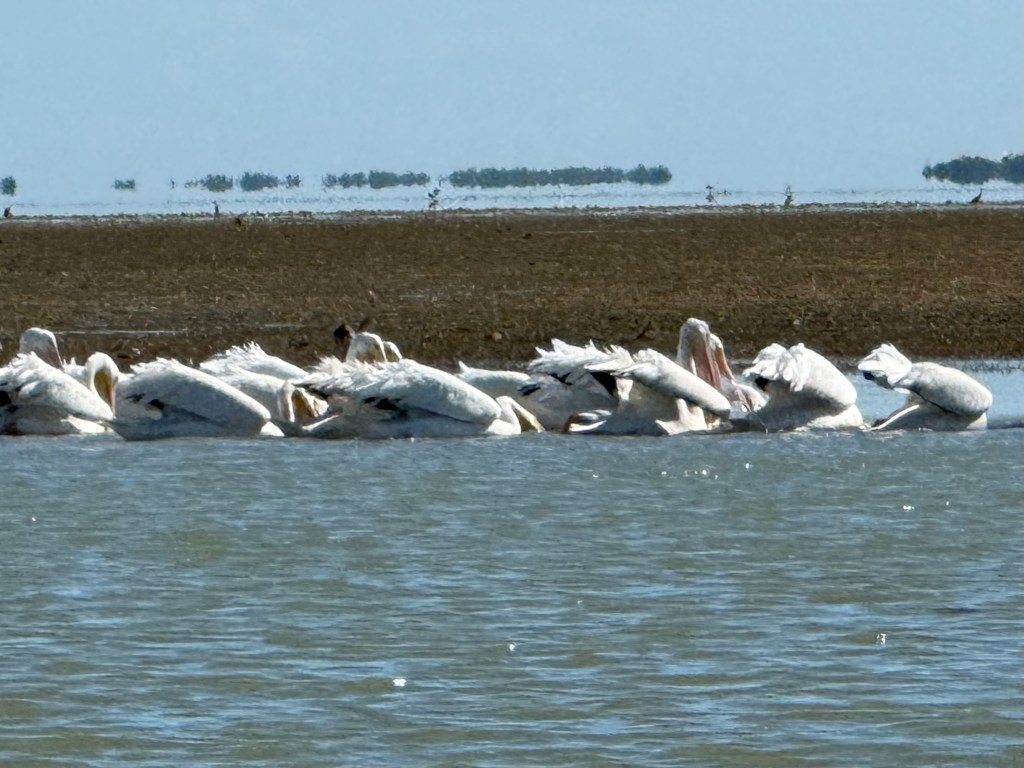
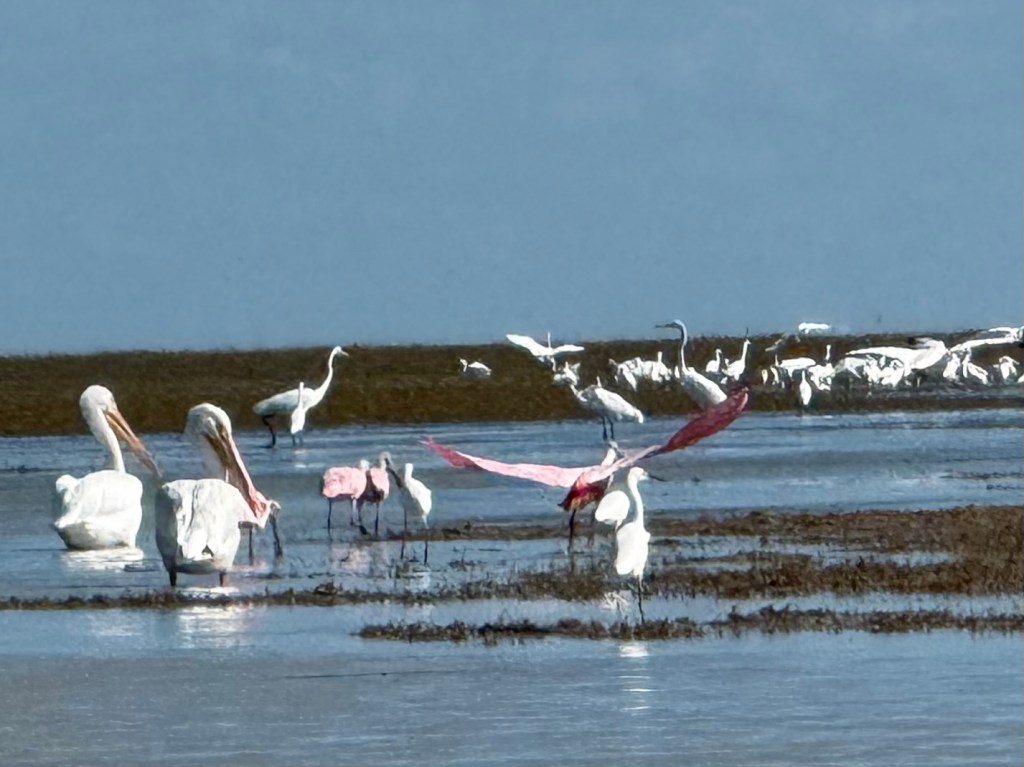
White Pelicans fishing cooperatively for mullet.Black Skimmers leaving the flat as the tide rises.White Pelicans, Great White Herons, Great Egrets, Roseate Spoonbills, Snowy Egrets, all fishing the shallow run-out at dead low tide.
When the high tide pushes birds off the flats, some regroup on the highest shorelines, while others settle into the mangrove trees.
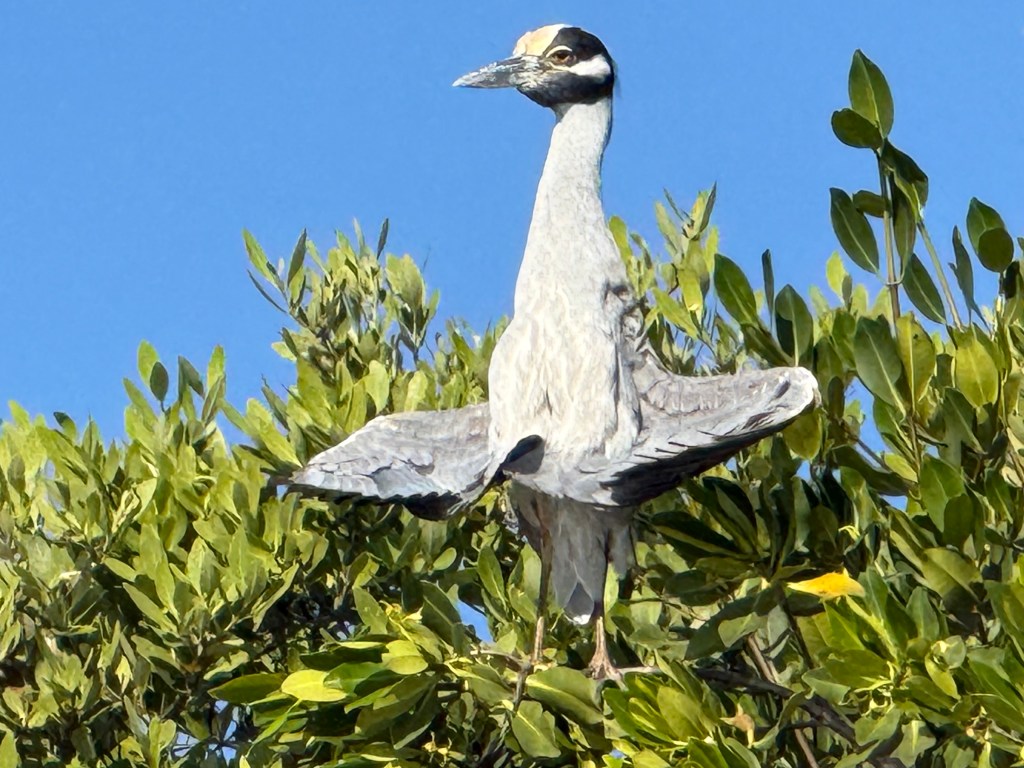
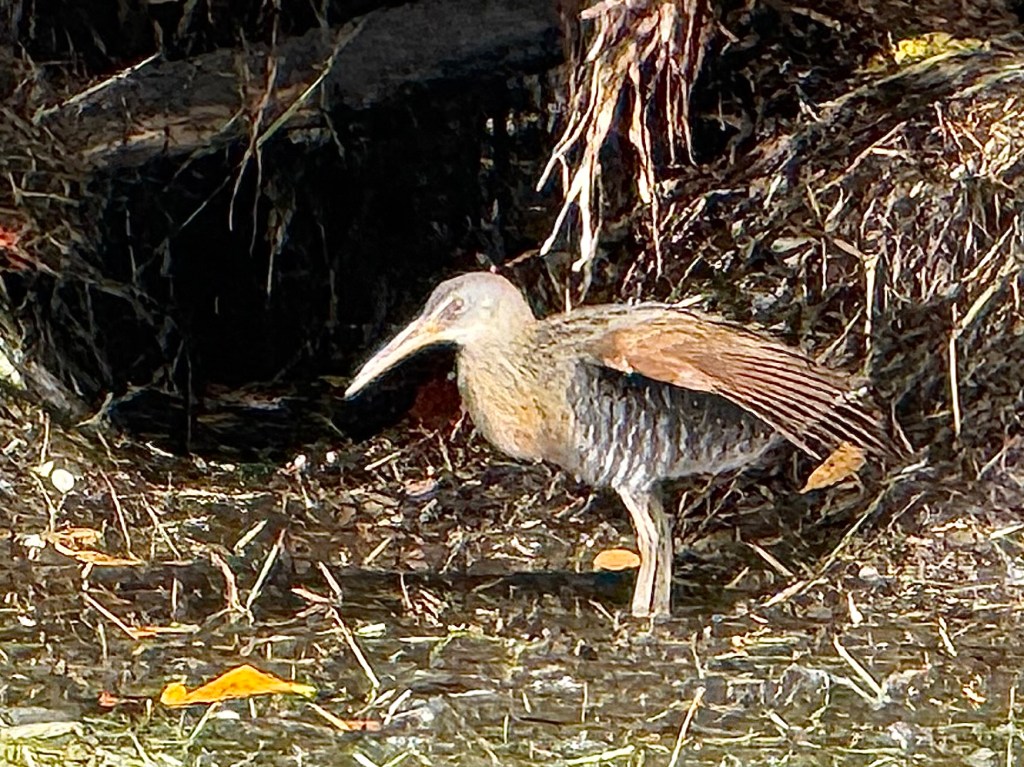
Reddish Egret takes refuge from the high tide on a mangrove island.Yellow-crowned Night heron practices the Angeli Mudra yoga pose.Roseate Spoonbill looks down to assess the water level while waiting for the tide to recede.A Mangrove Clapper Rail skulks through the matted seagrass caught in the mangrove roots.
A couple of days prior, my friend Jay Levine had caught and released 30 Snook on fly in a channel and had zero shark hassles. But when I arrived, the water had rewarmed, the sharks were returning, and the Snook were making themselves scarce. I caught and released a couple of Snook safely but an unseen shark took the third one and I called it quits.
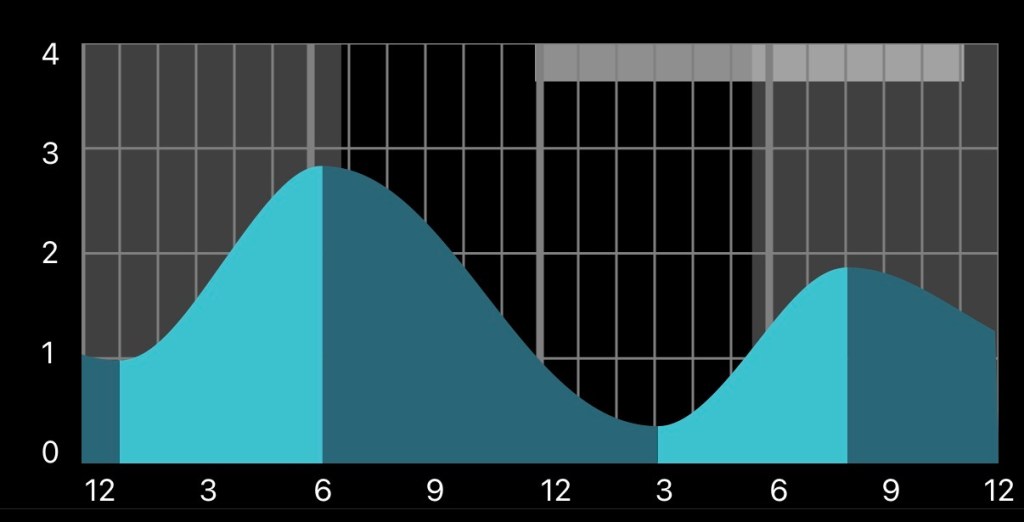
Four days later, my fishing friend Jeremy Nawyn asked me to join him kayak fishing this same flat once again. At first I declined, but then I took a look at the tide chart:
Tide chart for Flamingo on 26 Nov 2025. The black band in the middle is daylight and the gray bar at the top is the moon. The tide on the flat we are fishing is delayed by an hour. It will fall for eight hours, from 7:45 am until 4 pm .
I normally fish this flat by motorized skiff because it’s so exhausting to exit by kayak. If you fish the rising tide (safest) you must paddle back against the fast incoming tidal current to escape, but a long falling tide like this one is a virtual water taxi service. As a lagniappe, the wind would be at our backs coming out. I texted Jeremy that the tide chart had changed my mind. I was in.
Jeremy’s proposal was to head out in the dark before dawn and ride the incoming tide up a narrow unmarked channel on the edge of the flat, then ride the outgoing tide back toward the marina with the wind at our backs. We faced little risk of getting stranded if we stayed in or near the narrow channel, and would not have to fight the tides or winds to escape.
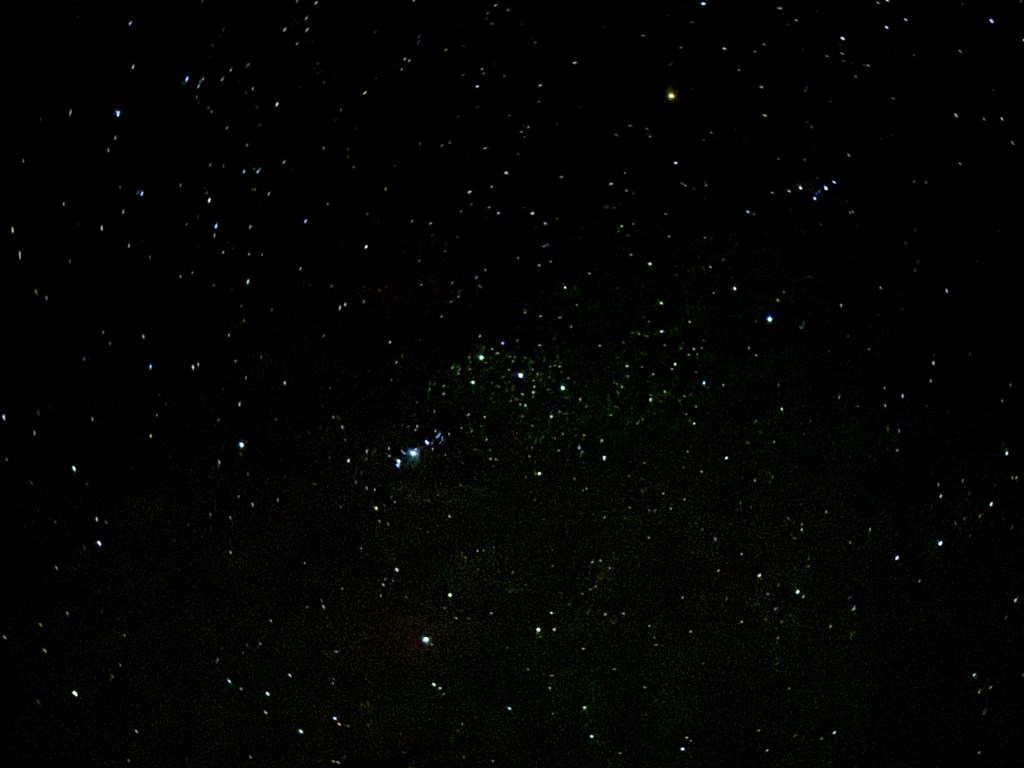
I arrived early to enjoy the starry moonless sky.
Orion.
I rigged my kayak while the resident Barred Owl hooted:“Who cooks for you? Who cooks for you-all?”
Jeremy arrived at 5:30 am with his kayak mostly rigged in the back of his pickup truck. We were on the water by 5:45 am, 70 minutes before sunrise.
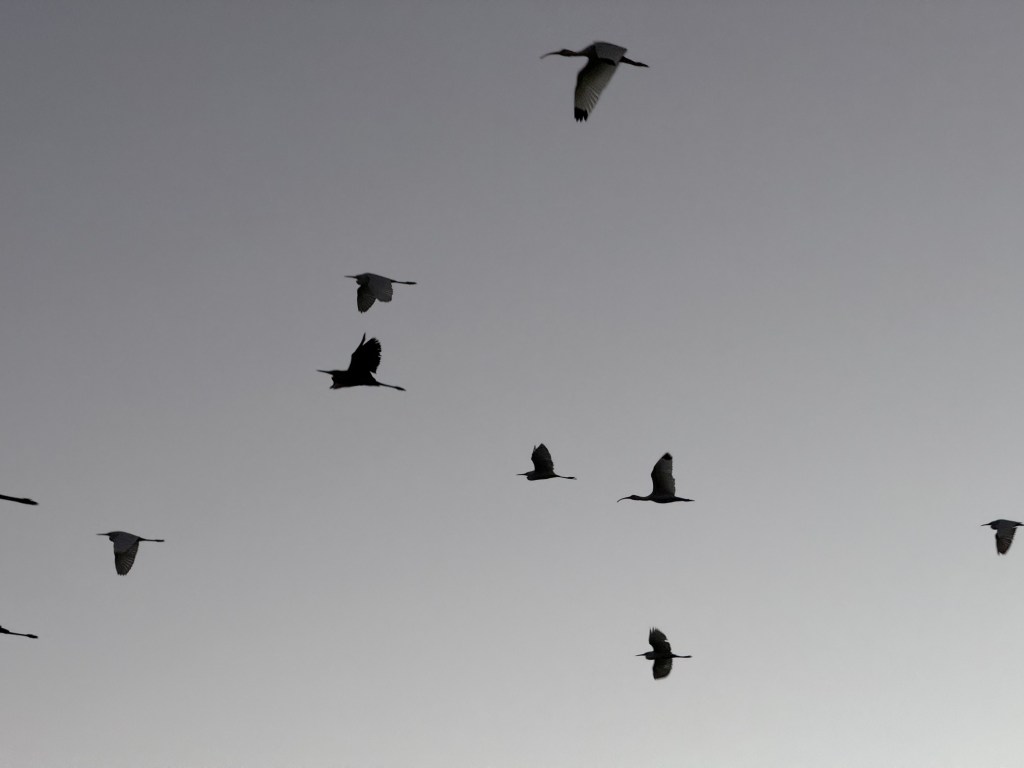
Great Egrets and White Ibis leaving their roosts. White birds look black in the pre-dawn light.Jeremy in the lead. One of his teenage kids sometimes joins us, but not if we’re going out this early.
Our fishing strategy was to paddle the narrow channel and cast toward the mangrove roots on shore where the predatory fish typically forage for crabs and small fish when the tide is up.
I hooked a nice Snook near the mangroves then pedaled my kayak hellbent-for-leather onto the shallow flat, grounding the Hobie’s pedal flippers on the mud before stopping to work the fish to my landing net for a quick measurement and release.
Phil with Snook in shallow water. Photo by Jeremy Nawyn
Grounding the kayak on the flat might seem like an odd thing to do on purpose, but it prevents unseen sharks from popping up from below and grabbing the fish on my line. A Snook or Redfish hides handily in a foot of water, but a Lemon Shark or Bull Shark is conspicuous. If a shark comes for my fish in super-skinny water, I can see its approach, open the reel, and let the fish run. My trick worked this morning with a handsome Snook and a chunky Redfish.
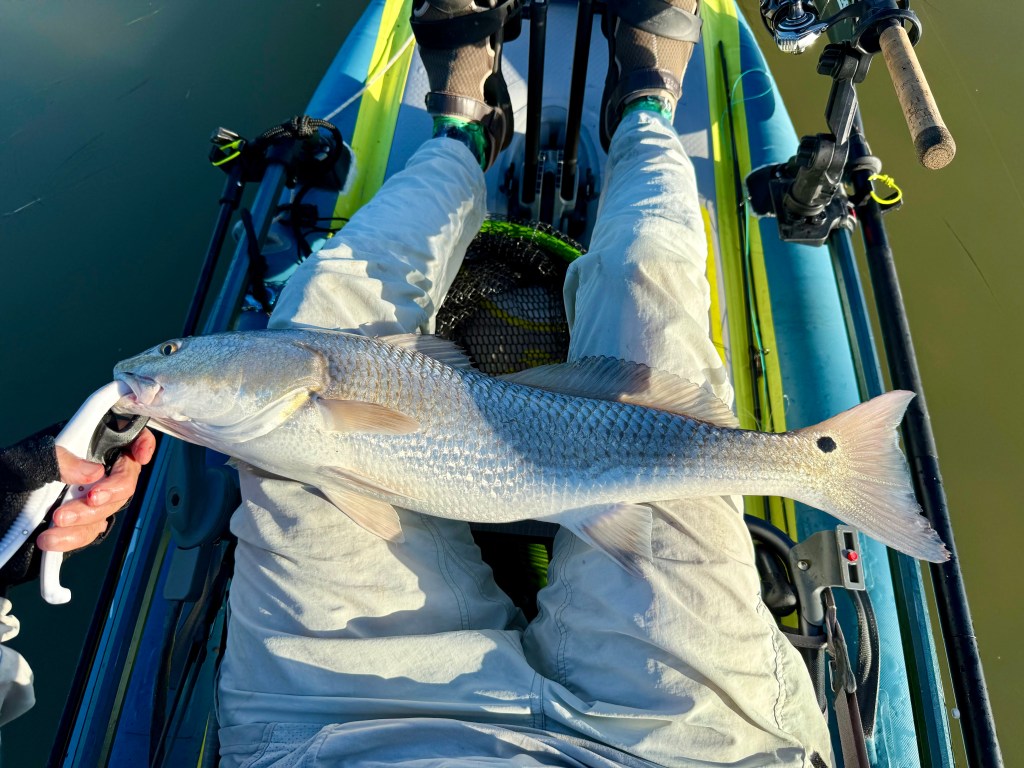
Snook, 24″.Redfish, 24.5″
A Lemon Shark circled my kayak looking for my redfish as I hefted it in my landing net from one side of the kayak to the other.
Pesky Lemon Shark circling the kayak.
Enough already. I pedaled the kayak right at the shark to chase it away.
Typical of this flat, the water was opaque with sediment. One could only make out detail in the top 6”, which made it hard to spot fish. At the farthest extent of the tiny channel, a three-foot tarpon swam under my kayak, which I only saw because the water was just a foot deep… and dropping. Time to turn around.
I stopped in at a favorite cove on the way back, wherein I often find Snook and Tarpon. A four foot Lemon Shark had gotten in ahead of me and was working over the cove, chasing all the fish up the mangrove creek – definitely time to head back. As cool as they are to see up close, I don’t want sharks hanging around my boat jonesing for my fish. Lemon Sharks at Flamingo have bitten the hands of several fishermen in the past couple of years and even dragged one careless lad overboard and into the water (YouTube video).
I paused to watch eight Ospreys circle a mullet school, diving in succession, snatching hapless fish, and landing in the trees on shore to enjoy a sashimi breakfast.
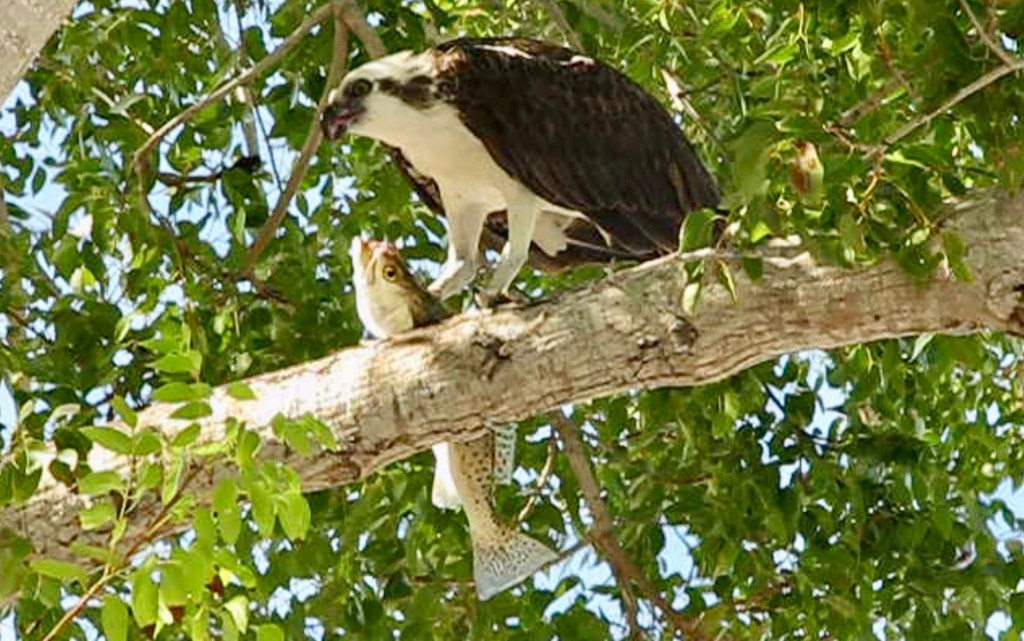
This lucky Osprey caught a yummy seatrout.
Full of fresh fish, the Ospreys set about collecting soft material to line their stick nests. Some carried clumps of dead seagrass in their feet.
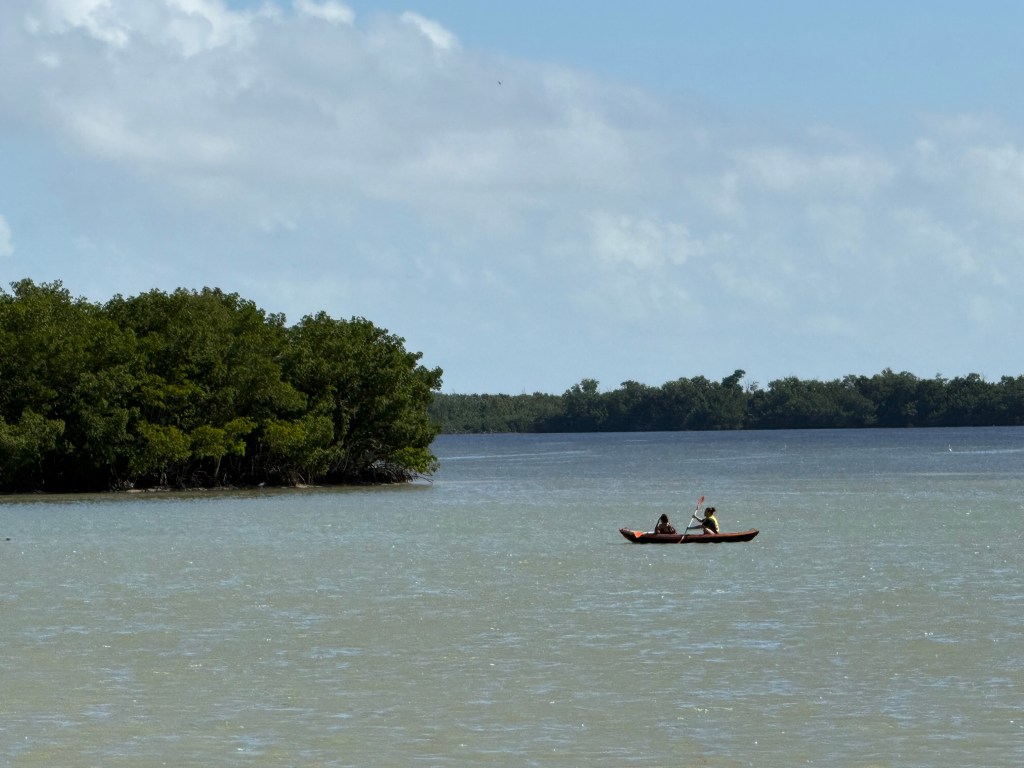
On our way back to the marina, I spotted a young couple in an inflatable kayak paddling the opposite direction, heading toward the heart of the flat. Unless they knew what they were doing, they stood to get stranded in about 20 minutes and stuck there for the next 5 hours. Seeing neither fishing gear nor binoculars, I took them for tourists. I paddled over and asked whether they came here often. “First time” responded the young man in a British accent.
I explained about the tides and the mud, and pointed them toward a channel marker. If they paddled directly to that marker they could spend all day watching birds, sea turtles, and marine mammals from the main channel without getting stranded.
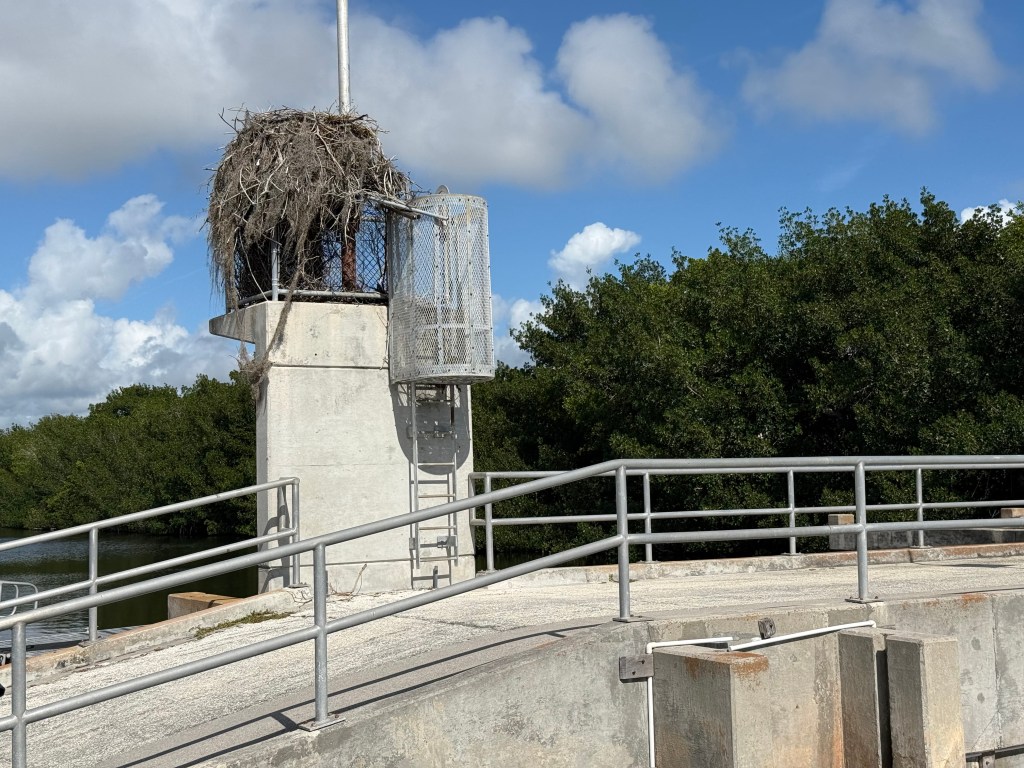
As I packed my gear in the car, I watched another Osprey pair skimming the West Indian Mahogany trees to collect Spanish moss for their bulky nest on the water control lock that separates the Buttonwood Canal from Florida Bay.
Lock Moss Nesters
I ate my lunch while overlooking Florida Bay from the refurbished visitor center. In addition to the wildlife viewing it’s entertaining to watch international visitors enjoying this National Park in their own ways.
Keeping up with Instagram is priority anywhere you go.More my style.
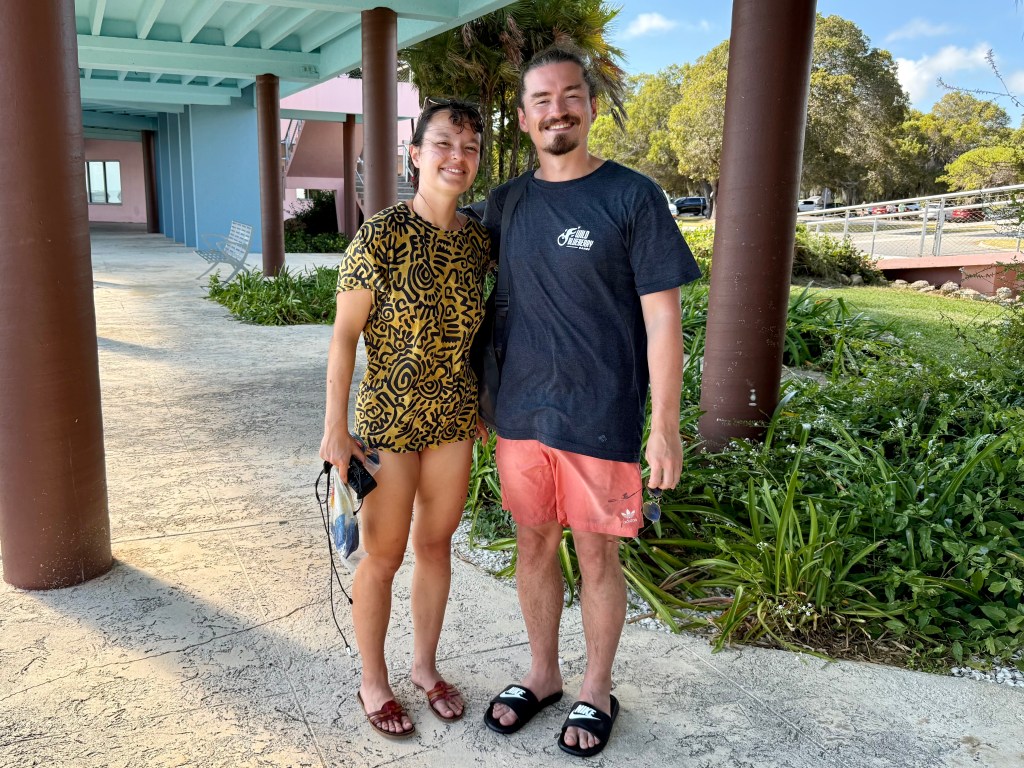
Hey, that’s the same couple in the kayak I saw earlier, now returning from the flats. They pulled their boat ashore and stopped by to say “hi”.
Caroline from Strasbourg and Jason from London.
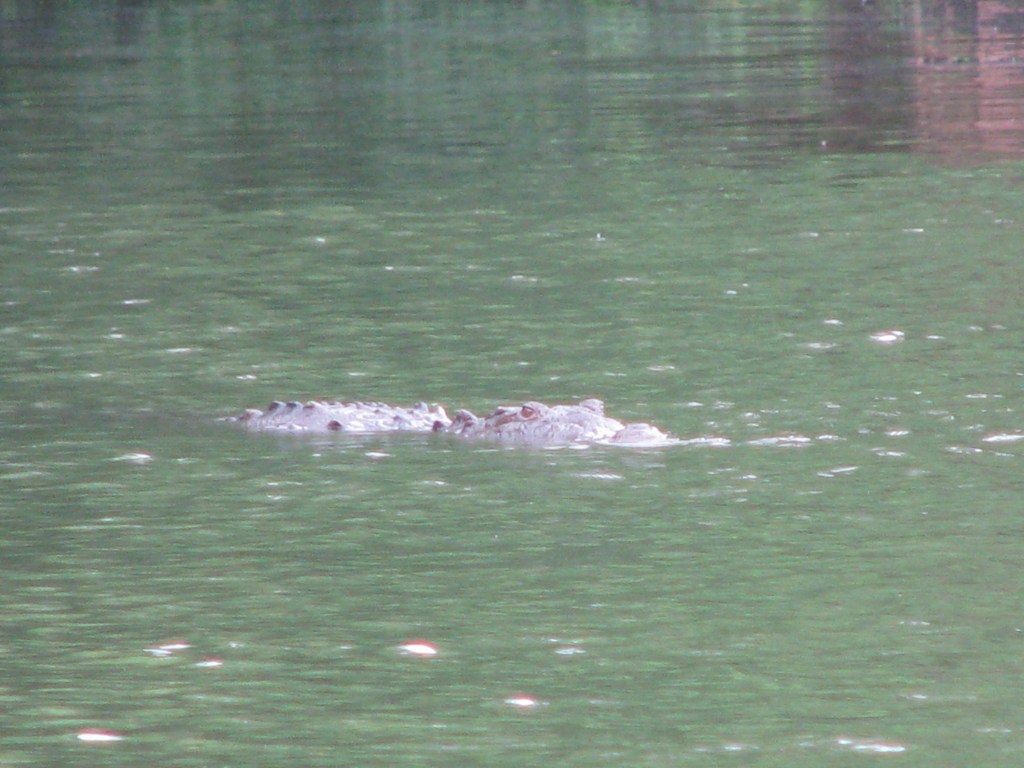
They had decided to head back in after a large American Crocodile surfaced in the channel next to their inflatable kayak.
My photo, not theirs, but you can see why they might have felt unsafe in an inflatable kayak.
Until recently, I’d have told them not to worry about the normally docile American Crocodile, but last summer an experienced fly fisherman told me of a large croc at Flamingo that went airborne in its best attempt to take him off the deck of his skiff.
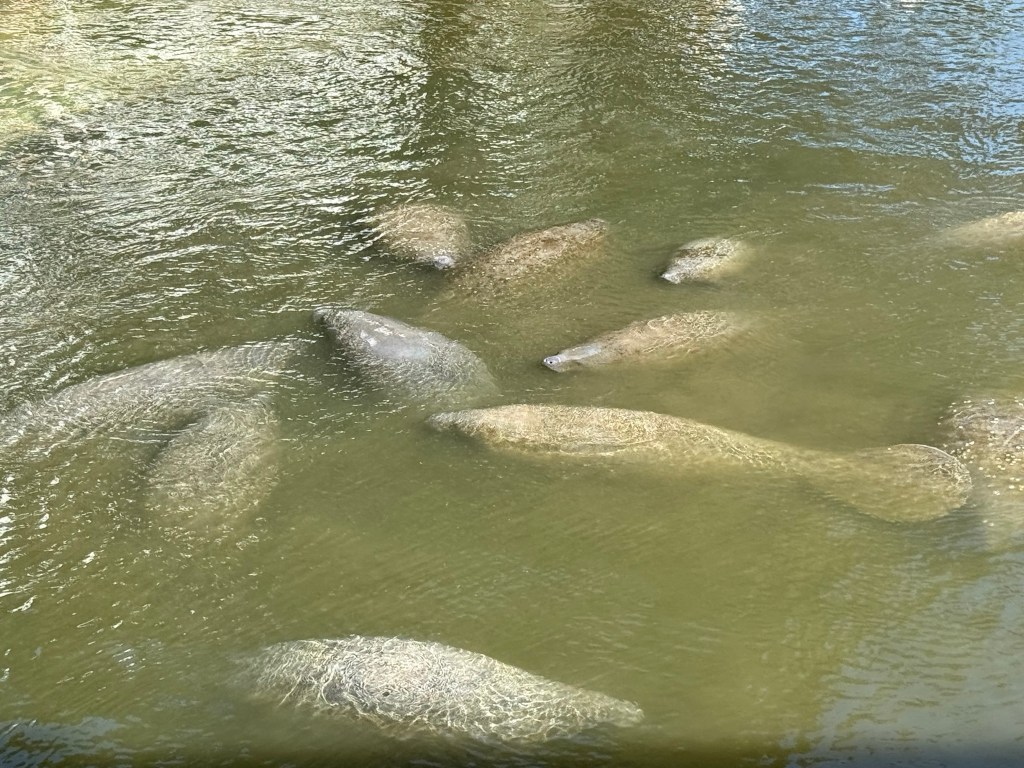
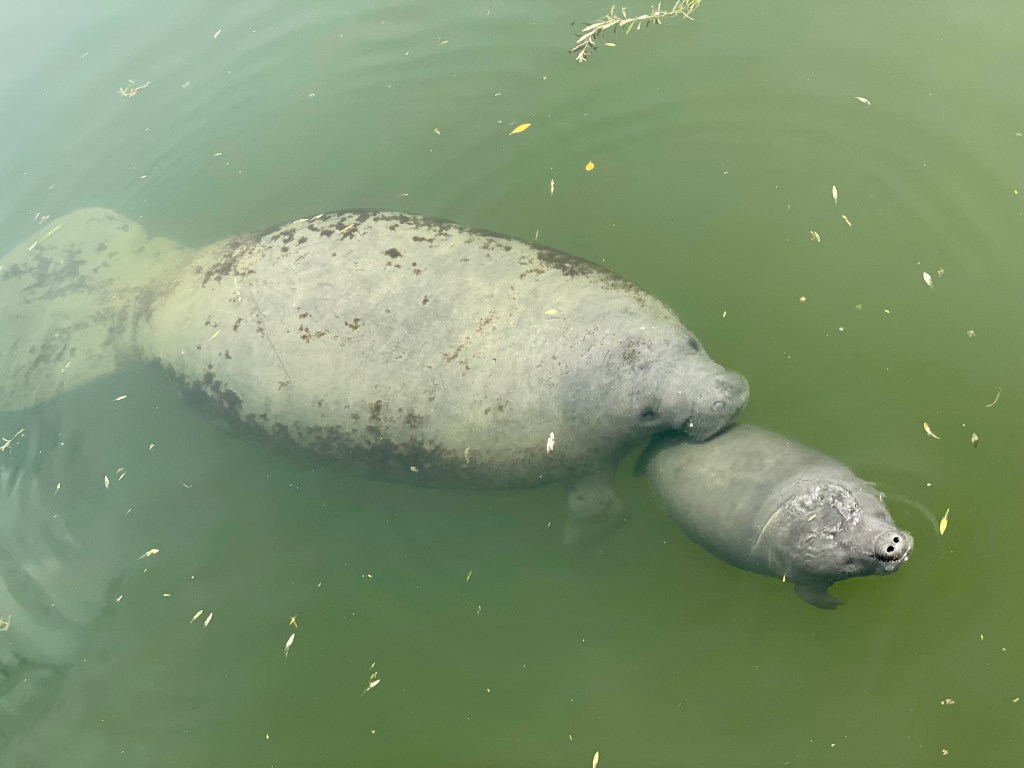
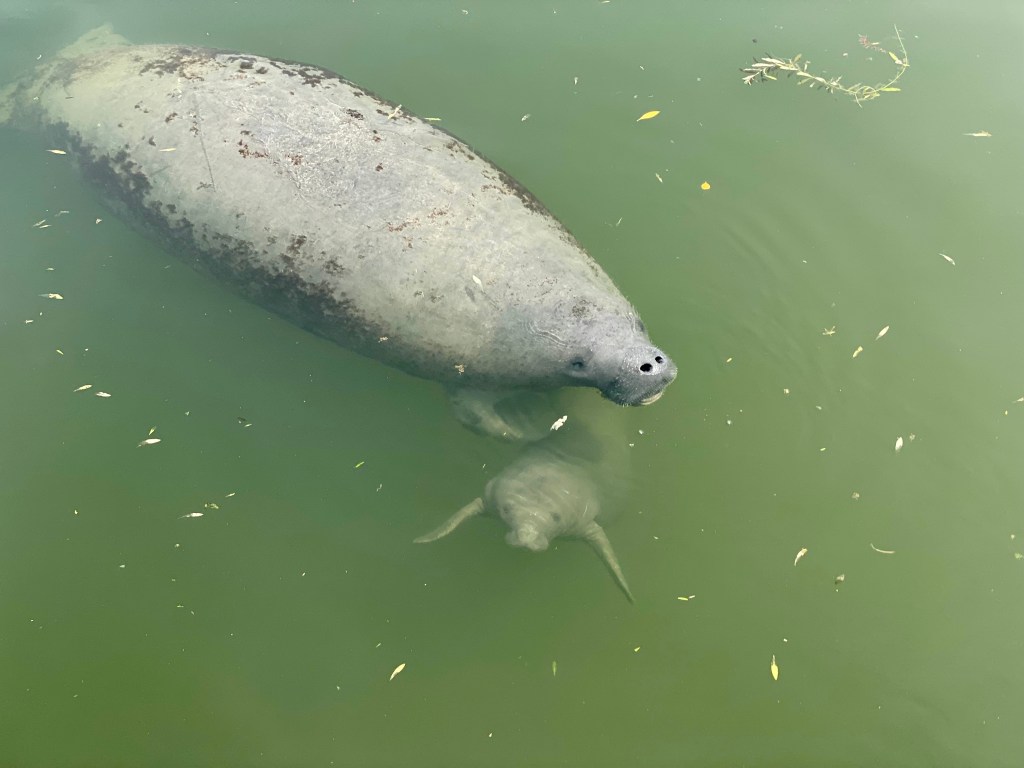
I took Caroline and Jason over to the marina to admire the assembly of mother and baby manatees.
Too cute.
* * *
Pandora’s Flats
A couple of months back, I promised to write an essay about why you shouldn’t fish at Flamingo. The dense mosquito swarms are sufficient reason for normal people to stay away nine months of the year. Risk of stranding on the flats while exposed to sun and lightning should give pause to any sane person. We recently acquired the man-made problem of habituated sharks and crocodiles popping up at random from the opaque water below – recreational fishing boats have trained them well. If you just wanted to fish, you might find an equally productive area with fewer ancillary hazards.
American Crocodile. Note the skinny snoot, Roman nose, and 4th tooth on the bottom that sticks up.
All of these risks have proven insufficient to keep a certain zoologist away. The combination of birds, fish, and scenery will keep me coming back as long as my health and the rising seas allow.
My last few fishing trips onto the flats have been unproductive. The late summer water has been hot and low in oxygen. Maybe the fish are somewhere else, or maybe they’re just laying low. Tomorrow morning I’m venturing back into the mangrove lakes of Mosquito Hell, an area where I always find fish this time of year, assuming the Black Salt Marsh Mosquitoes (BSSMs) don’t drive me out first.
Trip planning
The moon is near full tonight, so the morning fishing activity is likely to be brief. I plan to arrive in the dark to maybe find a snook or two before the sun comes up. Then I’ll peddle-paddle my kayak to an area where the tarpon hang out and snook spend their day hiding in the mangroves. Occasionally, a snook wakes up for a mid-morning snack. If I find the juvenile tarpon rolling, I can see if they’ll play with me. Like snook, tarpon feed actively at night on a full moon, so they may be sated by the time I arrive.
I’m preparing for the BSSMs the night before, putting into play a few improvements over my last trip to Mosquito Hell:
I take my khaki fishing pants, outer shirt, and gloves to the driveway, spray them with DEET, and place them inside a 2-gallon zip-loc bag. I lay out a towel to protect the car seat from the DEET. The rest of my special mosquito gear I place on the passenger seat: for my head, a Tilley hat and insect head net; for my feet, Simm’s neoprene wading gaiters and neoprene dive booties. Mosquitoes are not going to bite through 5 mm of neoprene.
My scheme is to drive to the launch in the dark, and change into my stinky DEET-soaked clothes, then get out of the car to rig and launch my kayak. I will start fishing at 06:00, before the first dawn light. The nearly full moon sets at 05:49 and the sun rises at 07:06, with civil twilight starting at 06:36.
It’s tricky fishing in total darkness, and tricker fly fishing. I only know that a snook is nearby if I hear it blow up the water while chasing mullet. Sometimes the water is silent. Other times I cast too far and hang the fly into a mangrove tree. Then I have to turn on my head lamp to untangle the line and of course the light attracts mosquitoes to my head. But other times I cast the fly near a snook and things get exciting in a much better way. Hope springs eternal.
My alarm is set for 3:50 am. Time for bed.
Fishing report
On the Mosquito Horror Scale (0-10) the morning ranks an 8, “Severe” but not “Extreme”. My mosquito gear system works perfectly. The only mosquitoes that try to bite me are 3 or 4 that go for the pads of my fingers where I have no repellant. That’s not a safe place for a mosquito to bite a human, and they are instantly dispatched with a pat of the finger. With my DEET-soaked outer clothes, mosquitoes don’t even follow me into the car.
No mullet are splashing around the kayak launch area in the dark, so no predatory fish are there either. Too bad – sometimes the fishing is amazing right there. I light out for the far mangrove shore, about a mile’s paddle.
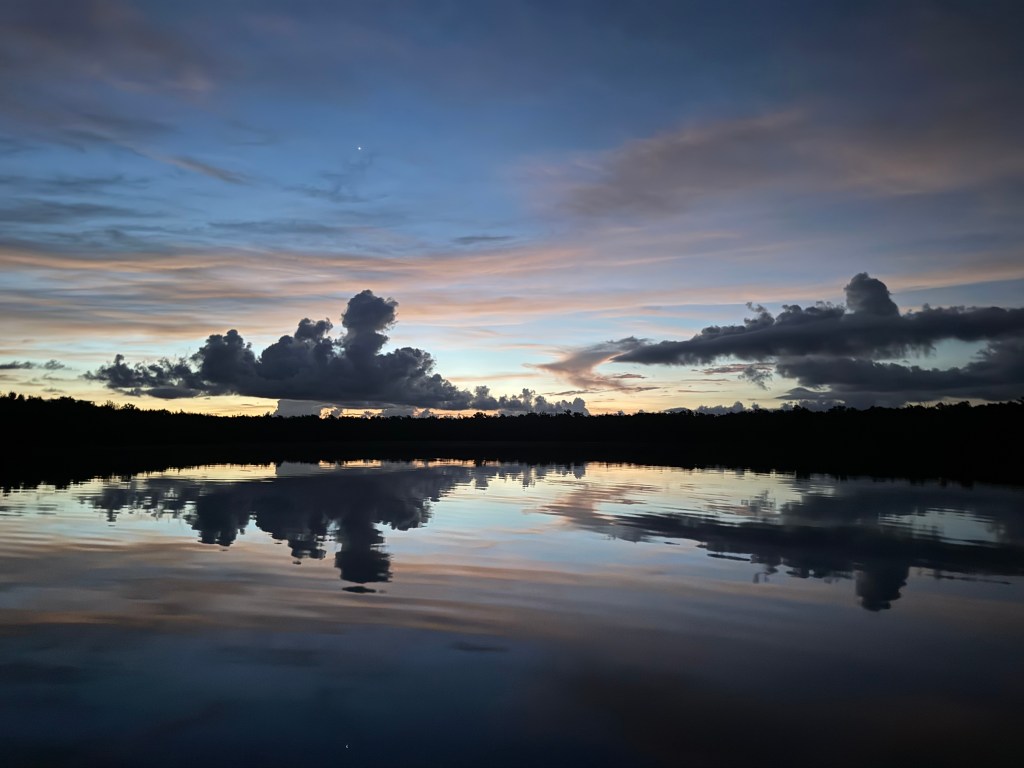
The first traces of dawn light appear, with Venus still visible directly above the tallest thunderhead on the left.
Dawn explodes enroute. Yowza.
I reach the other side eight minutes after sunrise. The water is extremely murky and tannic, like donut shop coffee with a tiny splash of horrid non-dairy creamer. I dip my finger in the water and taste it through the head net: slightly brackish.
To find fish in water this opaque I need a “search bait” that’s dark, for maximum contrast when viewed from below against the sky, but with some sparkle and a lot of vibration to get a fish’s attention. I put away the fly rod and rig my spinning rod with a 4” paddletail in rootbeer & gold with a gold underspin jig – just the ticket.
The paddletail, true to its name, wiggles its tail back and forth, and the underspin leaf twirls up a storm.
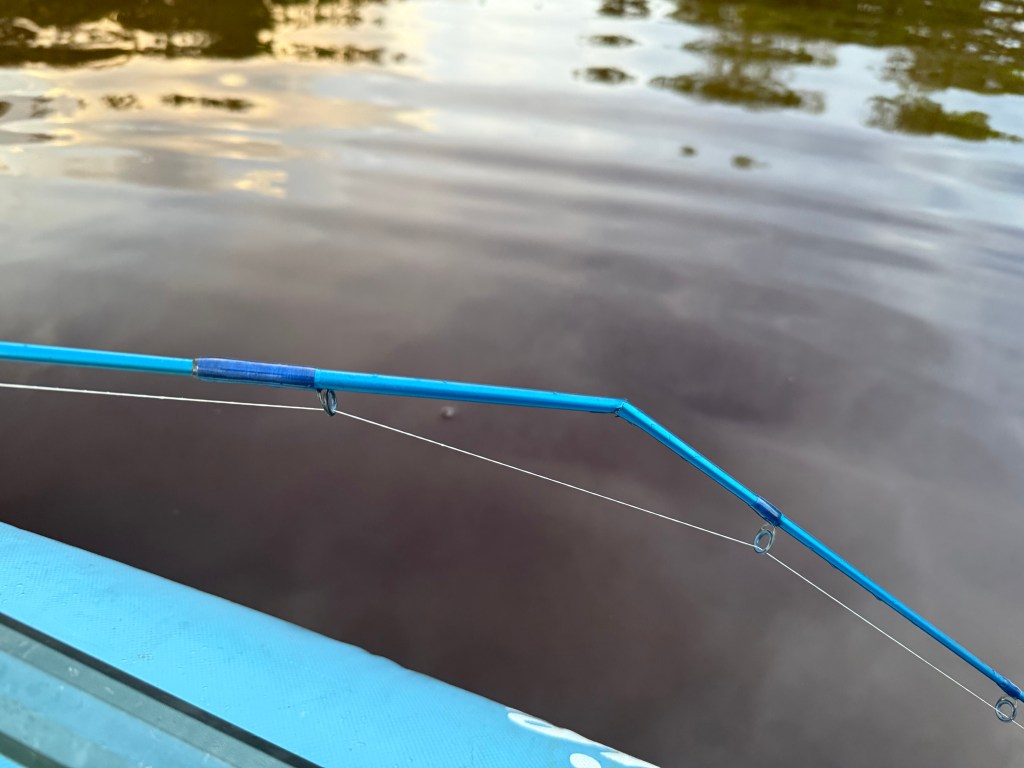
At 7:15, my second cast is slammed by a snook in the 30″ range. It makes one jump, a brief lateral run pulling line off the reel, then runs straight for me as fast as I can take up line. It passing directly under the middle of the kayak, bending the rod hard. The tip section of my three-piece TFO travel rod snaps, creating a brief moment of slack that pops the lure free of the fish’s mouth.
This is the 4th time this spinning rod has broken, every time in exactly the same spot, 5″ above the ferule. Until now, I’ve blamed myself, but thinking on it, each break occurred under a different circumstance and stress geometry and I’ve never broken any other spinning rod. I’d wager the TFO Traveler is weak at the internal edge of a carbon fiber sheet wrap. I will write the company about this problem. I bought two replacement tip sections the last time one broke, so I still have one left, but I need a more reliable multi-piece spinning rod.
Why even bring a travel rod on a local fishing trip? When kayak fishing tight to the mangroves, it helps to have the rods I am not using at the moment disassembled and stowed safely out of the way. That’s a key advantage of multi-piece rods, not to mention the obvious advantage when I travel.
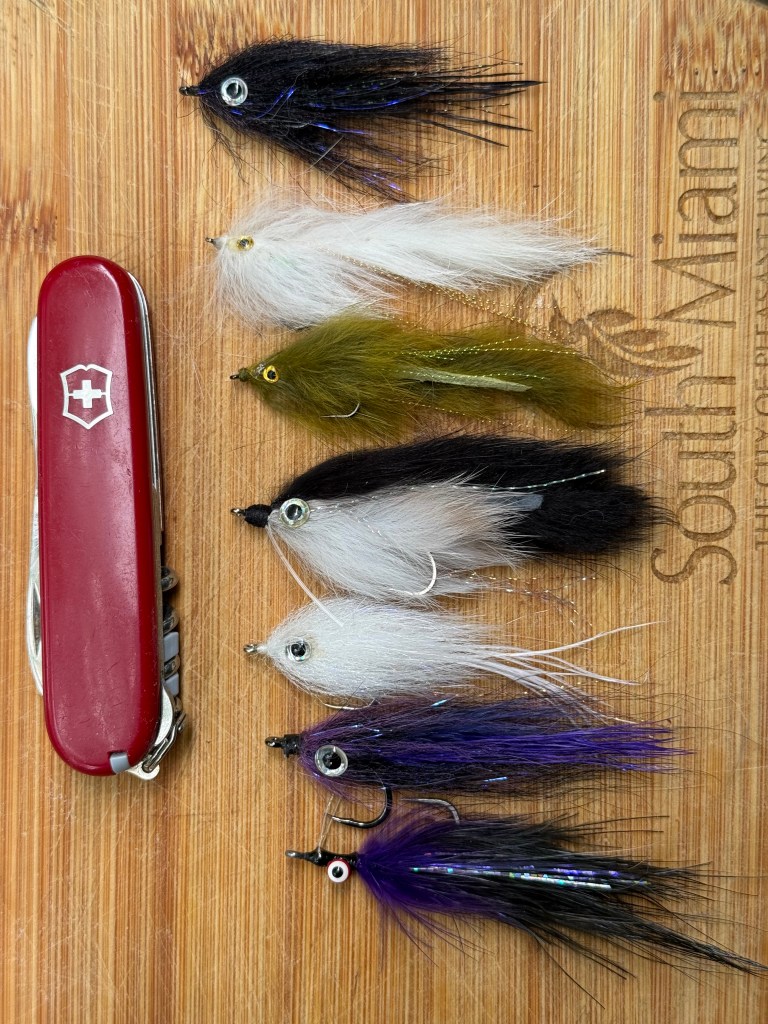
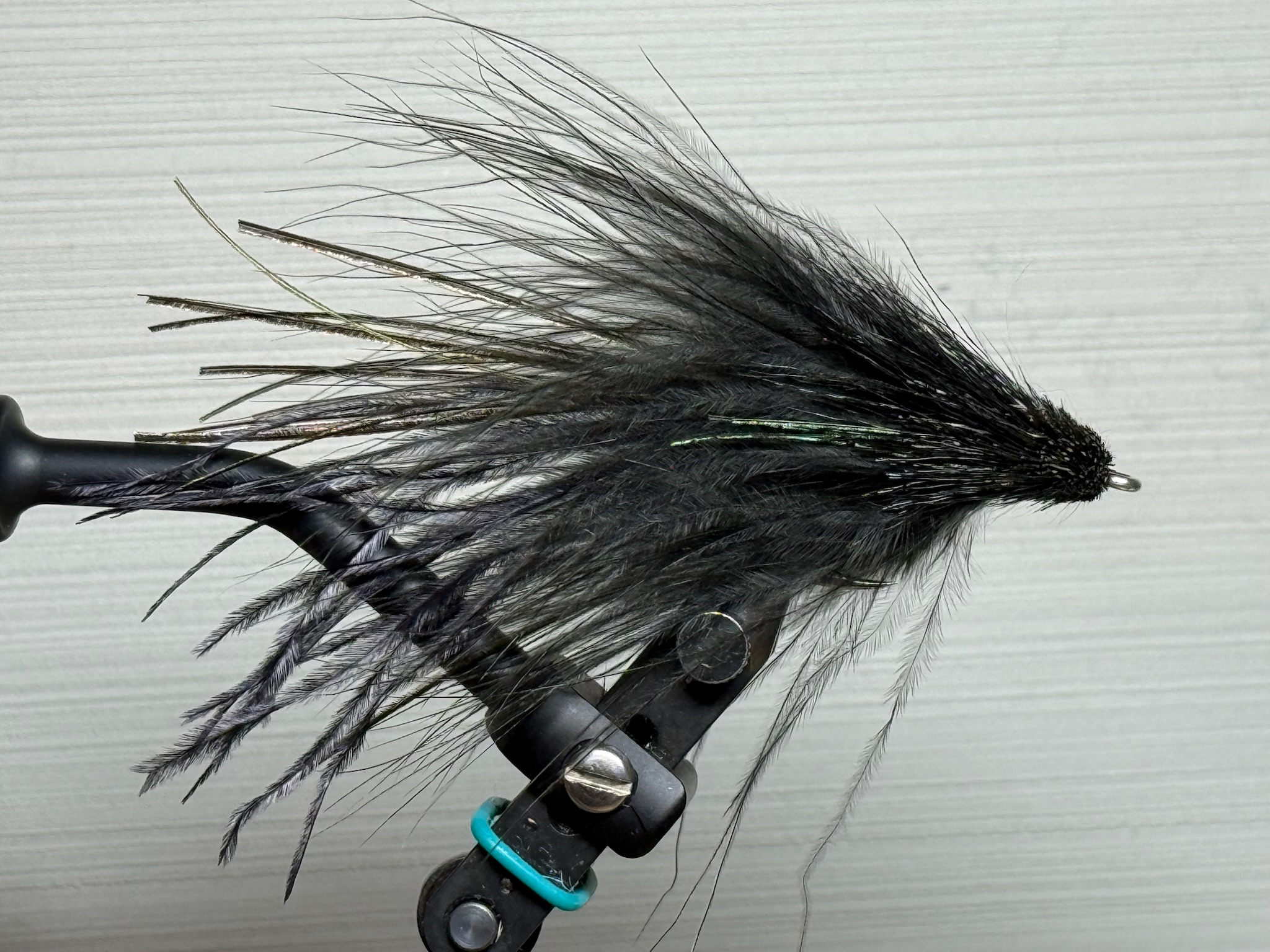
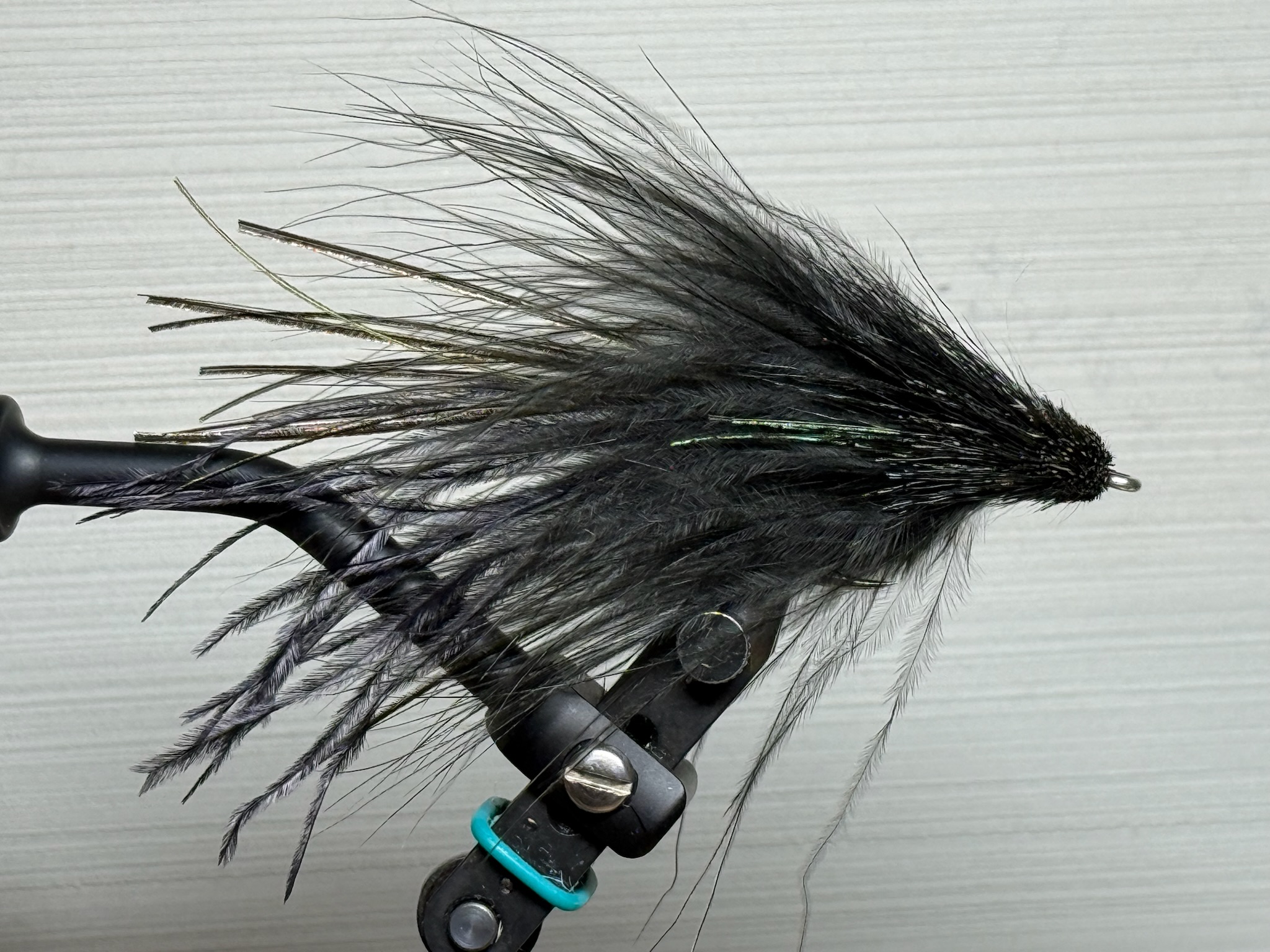
Back to fishing. Having broken the spinning rod, it’s “fly or die”. I re-assemble the 8wt fly rod and choose a black dark-water fly, this one tied from Drew Chicone’s pattern, The Devil’s Daughter. The tail is ostrich and peacock herl, the body is fluffy marabou feathers, and the head is spun deer hair. Peacock herl gives It shimmer and the ostrich and marabou make it swish enticingly in the water.
I start with the fly in the photo and immediately hang it in a mangrove. Impatiently, I shove my kayak into the mangroves to untangle the fly, leader, and line, then tie on another I’d made with a weed guard to keep it from hanging in trees and roots.
Predatory fish that have spent the night foraging under a bright moon generally won’t be hungry again until the afternoon. This morning fits that typical pattern, with fish ending their feeding spree shortly after sunrise, shortly as in 9 minutes. In the next hour, I get rained on briefly (feels good) and catch a couple of small juvenile tarpon on fly (they’re always hungry), while their older cousins roll on the surface for air but won’t eat.
Fishing is over until afternoon but the shoreline holds birds, orchids, and bromeliads. I can see for miles, the mosquitoes have let up, the rain shower has cooled things off, and I have yet to spot another human. It’s has turned into a pretty fine Sunday in the Everglades wilderness, but it’s time to get out. Bigger storm clouds are assembling and I don’t want to be crossing open water in an electric storm.
On the way home I stop by Moreno’s Tortilla shop in Florida City to pick up hot tamales and a pack of corn tortillas. Josephine greets me and knows what I want without my asking. This little hole-in-the-wall makes the best Mexican tamales and you can’t buy all-corn tortillas this good in a supermarket.
On the drive back, I divert 10 miles to check out a canal that friend Jay and I had identified from a YouTube video. In the video, a young kayak fisher from out of town was catching lots of fish while getting bitten on the eyelids and lips by something he called “yellow flies”. As soon as I step out of the car I am engulfed by a swarm of hungry deer flies. Uh oh.
I consider deer flies even worse than mosquitoes because they are active midday when it’s too hot for protective bug clothes, they will find the the tiniest spot of skin on which you did not apply repellant (e.g. lips and eyelids), and their bites really hurt.
Climbing over two metal gates, swat swat swat, I find the kayak put-in, swat swat. From the vague track through the vegetation, swat swat swat, I can tell it’s rarely used. I wonder why not, swat swat.
I mash the deer flies that followed me into the car and photograph one that wasn’t too mangled.
Serious rain slows the drive home but returns a few minutes by washing salt from the kayak and car.
Unpacking my fishing gear, two stow-away mosquitos escape into the house. It’s still summer here in South Florida where if it’s not one nasty biting bug it’s another. I’ll bet the Wisconsin Driftless Area is getting really nice about now.
When I took up fishing again after a 50 year hiatus, my wife Gray was bewildered: “Phil, you’ve spent your whole career being nice to fish. Why do you suddenly want to be mean to them?”
I could say I went fishing for the spectacular sunrises and experience of nature, but Gray would quickly note that I could get up at 3:30 am to be on Florida Bay for the sunrise, spend the morning watching shorebirds, manatees, dolphins, rays, and sharks, and come home to enjoy lunch and a nap, all while leaving the fish in peace.
So hers is a fair question. I studied electric fish and mosquitofish for 35 years at Cornell and FIU. I had a massive fish-rearing facility on the roof of my building where our fish bred because we made them so happy. An undercover plant from PETA worked as a technician in my lab for a few months then left because he couldn’t find any evidence that we were inhumane in our treatment of fish. I definitely don’t want to be mean to fish.
So, yes, my love of fishing embodies a patent contradiction in my values. I truly love all the wild things and trying to catch fish. I especially enjoy chasing fish with a fly rod, widely recognized as the least efficient way to actually catch a fish.
With that bed of nettles as our background, let’s relocate temporarily to the site of the sunrise photo, a seagrass flat in Florida Bay, two miles south of the Flamingo Marina in Everglades National Park. In a future essay, I’ll tell you all the reasons you should NOT fish there, but this day I will share some of its magic.
Here’s the flat surrounding a mangrove key a few minutes after sunrise. This light always enchants me. Look for a moment and you’ll see the water is pink dimpled with dark blue, far prettier to my eye than Christo’s famous pink island wrapping.
The water surface reflects the sky at low sun angles so my iPhone camera can’t see into the water to document for you how the fish are going about their morning activities. That would require a circular polarizer on my iPhone (wait, look it up… PolarPro makes a good one). But I’m up on the poling platform of my skiff this morning wearing polarized sunglasses. You’ll have to trust me when I tell you what fish I’m seeing and what they are doing.
Mullet are flipping and splooshing in the shallows, while egrets line up to try for the small ones. From the key comes the hollow whinny of a Bald Eagle, the raucous clatter of a Mangrove Clapper Rail, and the sweet song of a Yellow Warbler. Against the key lies a deeper channel where I spot a nice redfish but I won’t try for it. A five foot lemon shark cruises the channel, not far behind. Hooking a snook or redfish in any channel at Flamingo is tantamount to feeding a shark. I do not feed sharks or alligators, for similar reasons.
Two juvenile Goliath Groupers, about 18” long, are out in the open on the flat. Young Goliaths normally spend their days holed up in the mangroves, roving the flat at night. But here they are in the light of day.I watch to see what these young groupers will do when they’re caught out in their pj’s with a flats skiff poling towards them. When I get closer, they panic and swim to the nearest clump of red mangroves, sticking their heads in the roots and leaving their mottled brown and black bodies sticking out in the open. With their heads concealed, they can’t see me, so I guess I’m not supposed to see them either, but they look thoroughly silly.
Two young redfish with light gold bodies and blue tails are cruising the shoreline. I pitch a sparkly spoon fly in front of them, then retrieve it. One redfish starts to follow the fly, then changes its mind and wanders back to cruise with its friend. A different fly might have worked better, but which one? Unlike a rising trout that feeds for a while in one spot while the flyfisher tries one fly after another, a flats fish on the move rarely affords a second chance.
The edge of the flat becomes a reverse shower of small jacks taking to the air. Underneath the water, I presume, a school of large jacks roars through the water in hot pursuit. In fifteen seconds, the water is still once again. It’s a fish-eat-fish world on the flats.
I round the corner of the key and the glassy water surface erupts and goes still in alternation. Silver tails appear briefly and disappear. A school of juvenile tarpon is actively feeding on baitfish.
The prey this morning is a school of anxious young mangrove snappers that’s holding in one area. To my happy surprise, the tarpon are cruising back and forth to take multiple shots at the bait school and affording me a parallel opportunity with my fly rod.
I throw a black tarpon fly in front of the advancing tarpon with no success. The same fly worked last week in murky water four miles to the east, but the water here today is clear. Oh, right. Light-colored flies work better in clear water than dark patterns because fish (including baitfish) in clear water change to lighter, more reflective body colors for better camouflage. I knew that. The tarpon will be coming back soon for another pass at the snappers, so I remove the black fly and select a big gray & white snook fly that I tied but never put in front of a fish. If I stretch my imagination, this fly could resemble a young mangrove snapper. It looks very fishy in the water and it’s not black.
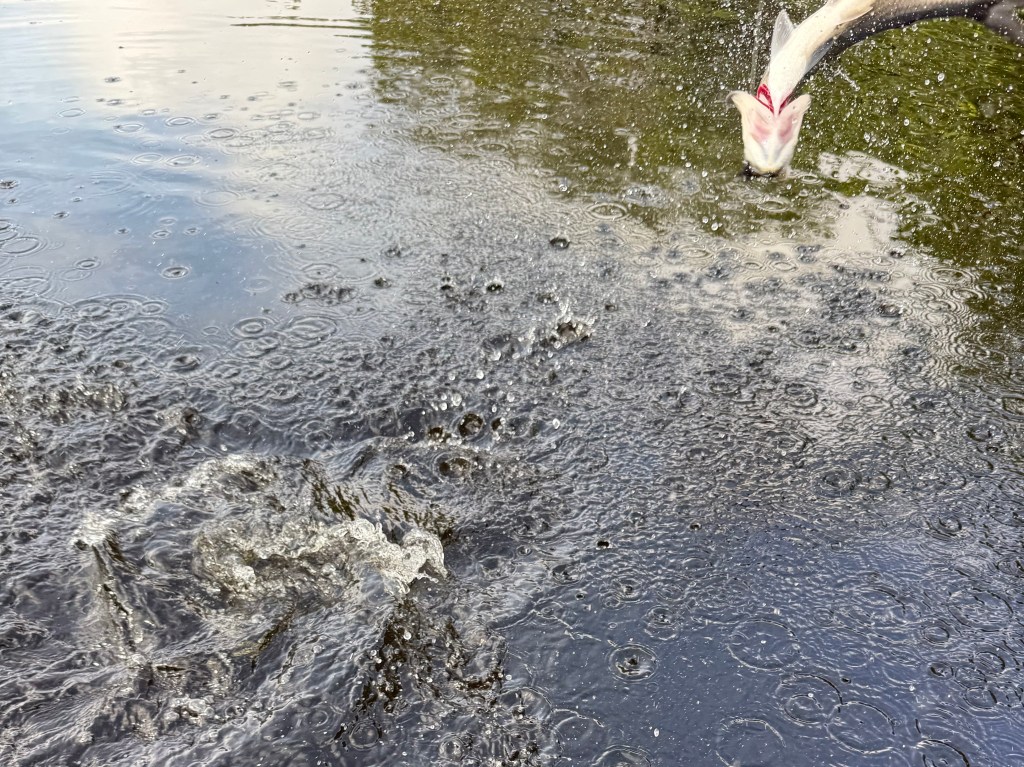
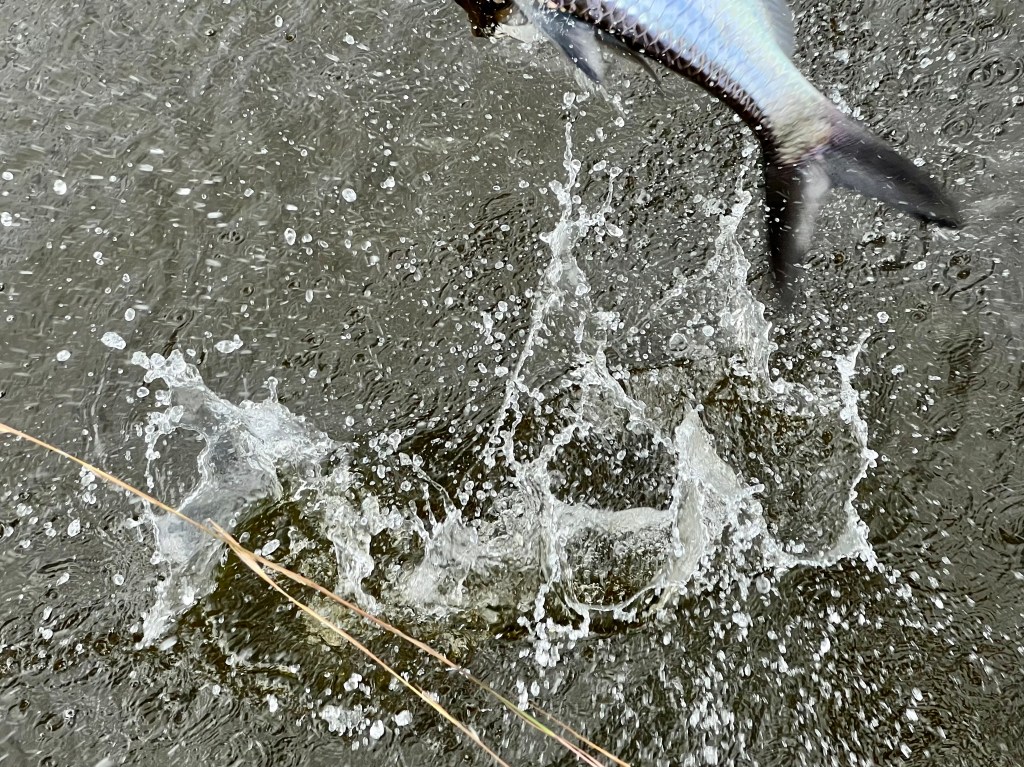
I attach this snook fly to the heavy tarpon-proof bite tippet on my leader, and cast it in front of the tarpon school. To complete the illusion of a small fish finding itself in the wrong place at the wrong time, I make the fly attempt an escape. It works. One of the larger tarpon breaks from the school and grabs the hapless fly. I set the hook, but the tarpon doesn’t seem to care. The lining of a tarpon’s mouth is as tough as Kevlar – I’ve seen a tarpon consume a whole blue crab without chewing. But, feeling the line resistance, the tarpon forcibly yanks some fly line from my left hand and swims back into formation in the school. I restore tension on the line, putting a good arc into the 7-weight fly rod. The tarpon resists for a moment, then jumps clear of the water, snapping its body back and forth in the air and creating the slack needed to neatly toss my fly.
You normally drop the rod tip when a tarpon jumps, precisely to keep it from creating that line slack, but I kept light tension on specifically to help the tarpon escape. More on that in a moment.
Free of the leader’s encumbrance, the young tarpon, roughly 10 pounds’ worth, once again resumes its position in the school as the members continue their search for yummy little mangrove snappers.
* * *
Even though a fish’s face doesn’t change with mood, I swear this tarpon glared with an annoyed expression in its whole body. Perhaps it was in the way it shouldered loose some free line and went back to what it was doing before. It was never so clear that my hard earned fly-fishing skills, such as they are, do indeed annoy the fish.
When a woman sends me a message like this, it stings. Same with a fish it turns out. I didn’t spend 35 years studying fish behavior to no effect.
Increasingly, I compromise, seeking a bite on the fly then a self-release at a distance.
When a fish takes a fly that I tied myself, I delight at having completed the illusion. My heart skips a beat at the sudden appearance of weight and power on the other end of the fly line gripped in my left hand. If I’m lucky, the fish makes a fast initial run, and maybe, if it’s the right species, it makes a couple of spectacular jumps. If it’s a new species for me, I want to see it up close and take a photo to remember it better. But for familiar species I do what I can to help the fish pitch the fly and get on with its fish life, ideally without my having to net and unhook it.
We’ll see how that deal sits with me. And, I suppose, with the fish.
Zeus used his lightning bolt “Keraunos”, a gift from Cyclops, to exercise divine authority over the sky and weather, wielding Keraunos in divine retribution as he saw fit (perhaps inspiration for you-know-who and his black Sharpie, only more final and definitive).
I launched the skiff out of Flamingo before sunrise with the triple intent of (1) trying my new used Spey rod around actual fish, (2) seeing if small dark-colored paddletails, gifts from a friend, might pull a redfish out of the mangroves, and (3) not getting struck by lightning from any among the squadron of thunderheads coursing the flats.
I fished wherever the storm cells were not, motoring away from every encroaching squall to the nearest patch of clear sky.
Results:
The two-handed Spey rod works. I caught four speckled seatrout, some ladyfish, and a catfish on assorted flies while Spey casting from the skiff’s poling platform. Wind is not a serious problem.
Throwing the tiny dark paddletail into the mangrove roots, I hooked a redfish, but it came off as I got it to the boat. That happens. But the tiny paddletail works as intended.
I had to move around a lot, and could not fish where/when I wanted, but the outboard let me dodge the electric storms. One can’t do that in a kayak.
This seatrout ate Tim Borski’s Mackerel Shrimp pattern.
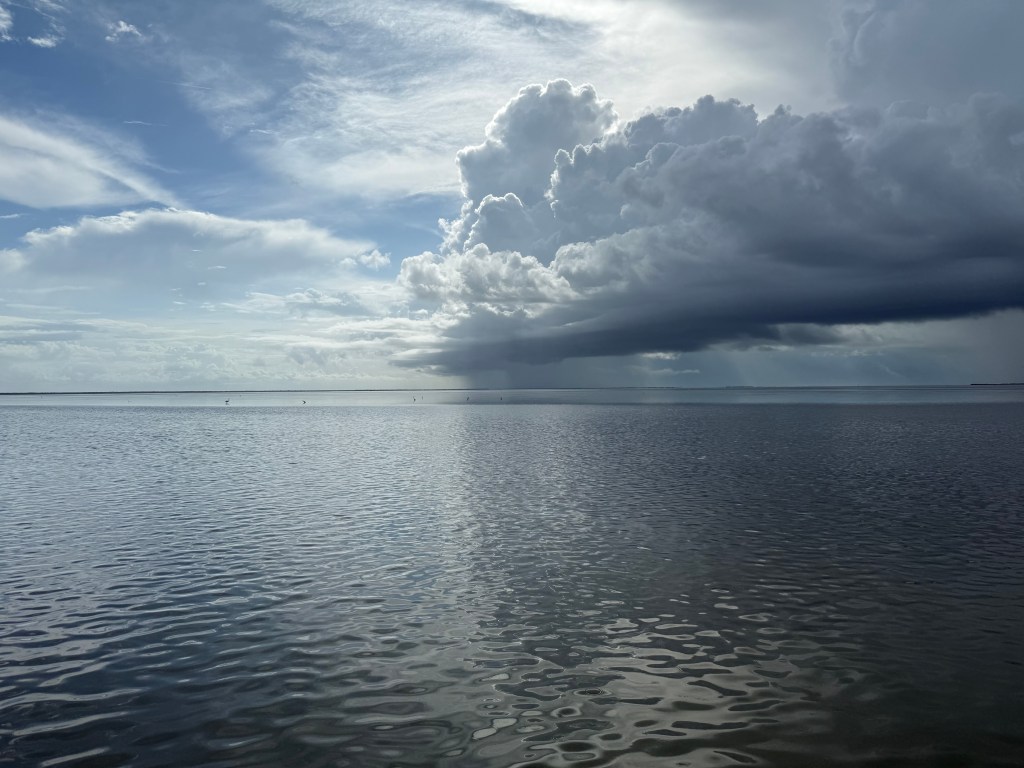
It turned out to be a pretty good day for bird- and fish-watching despite the ominous weather.
I spotted this Mangrove Clapper Rail peering out from its secretive world.
Mangrove Clapper Rail, Snake Bight ENP
Roseate Spoonbills foraged on the adjacent flat. I counted 67 of them. When you find feeding spoonbills, the snook are usually close by, foraging on the same small fish and crustacea.
The wind picked up, but no lightning, and then it rained. Between the wind, rain, and holding the boat steady in the tide coursing the shallow and narrow channel, the elemental chaos was too much for fly casting. With a spinning rod I still managed three snook in the low 20-something-inch range, just what the spoonbills had predicted.
After the rain moved out, I paused to watch a Reddish Egret scampering after a shoal of baitfish. The one in this video I found at Key Biscayne, but it gives you a sense of their hyperactive hunting style.
While I watched the antics of the egret, something to the right of it caught my eye. A snook was working its way below the surface, sneaking toward the same bait school as the egret, but from the other direction. They came closer and closer together until the snook made its move, charging the baitfish and showering the egret with spray. The surprised egret jumped into the air, flapping to land several feet back. Wish I’d gotten a video, but I was too mesmerized by the impending collision to reach for a camera.
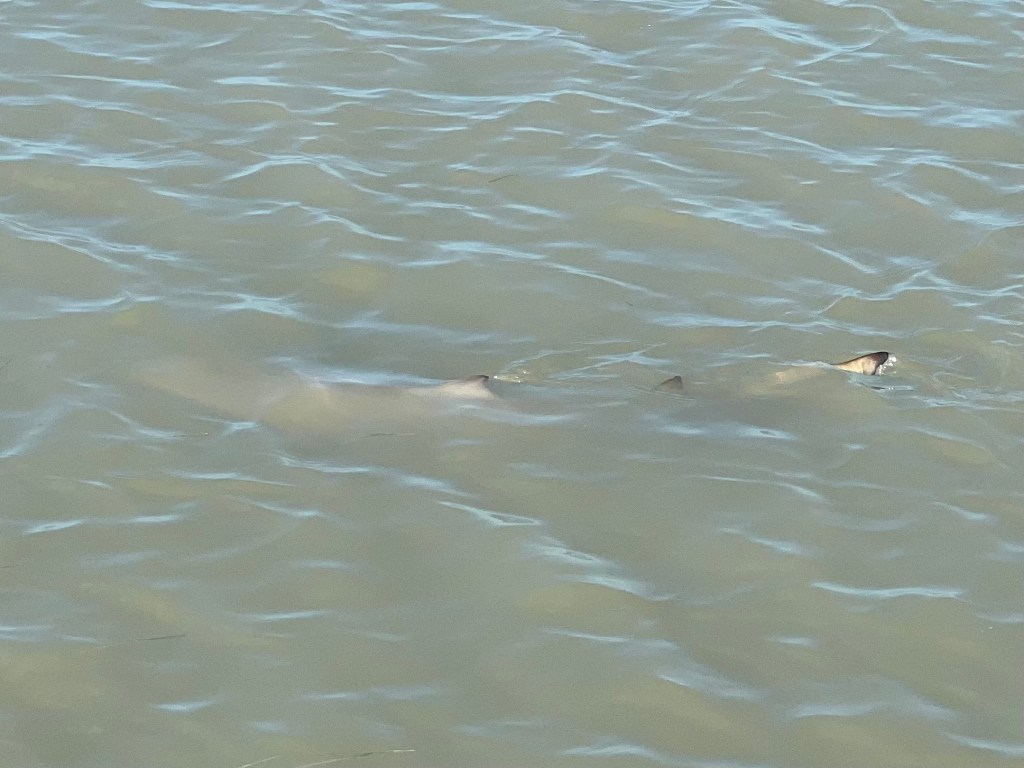
Three bull sharks formed a mullet-hunting party. After the trio dispersed around me, this six-footer came close enough to get a video.
Keep your hands in the boat.
With that many sharks hunting in the water, it’s time to wind it up.
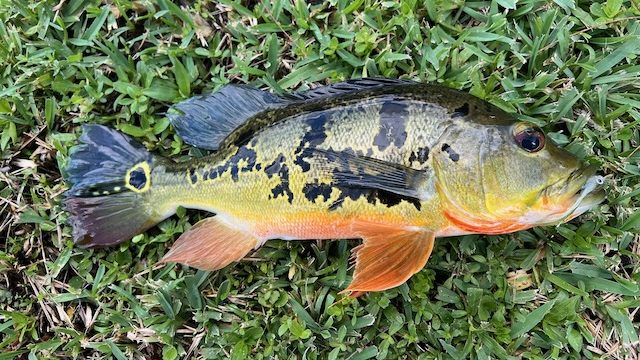
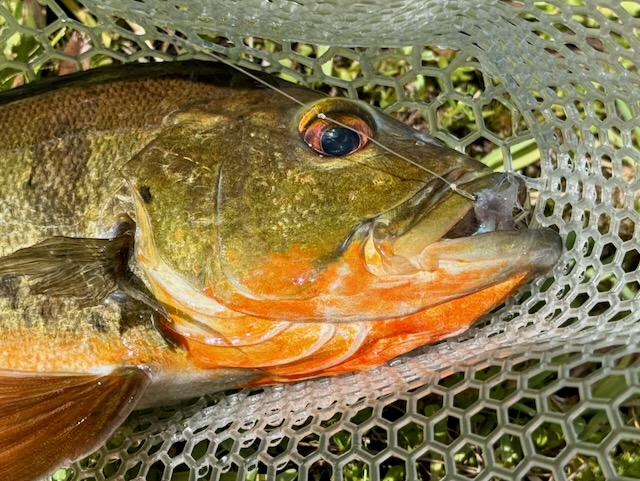
The Butterfly Peacock Bass (Cichla ocellaris), or “pea” for short, is not a bass at all, but rather a cichlid (pronounced “sic-lid”) from the Guianas and Brazil.
In our version of the song “I know an old lady who swallowed a fly” Peacock Bass were introduced to South Florida waters to control the Oscar, an invasive exotic cichlid from Africa. Now we have plenty of both.
The Oscar is a hard fighting fish. Also hard-biting. I learned the hard way not to skinny-dip at night near the Oscar in our pond.
These exotic cichlids are fine game fish: strong, ferocious, and beautiful. Most people fish for them with live bait. Peas are partial to shiners, but I chase them with a 5-weight fly rod.
Like most pressured fish, peas in public waters become educated and discriminating. They’ve seen it all. The farther from a road one ventures into the Everglades, the easier it is to catch them. But late last December, a hard cold snap hit the Everglades waters and killed 98% of the peas. These tropical beauties survived in the warmer urban canals and lakes, but it will take a few years for them to recolonize the Everglades.
Though it’s hard to beat fishing in the Everglades, I had a backup spot for peas at a private suburban lake in a gated community not far my house. Two sets of friends reside there and grant me access. The lake is posted “no fishing”, but folks fish off their backyard docks, and nobody minds me fishing the heavily treed east side, since I release what I catch. One resident told me: “That’s a FLY ROD. You have my utmost respect.” Ooo.
The peas on this lake have gotten steadily fussier, but since I’m the only one tossing flies at them, I probably have no one to blame for their education but myself.
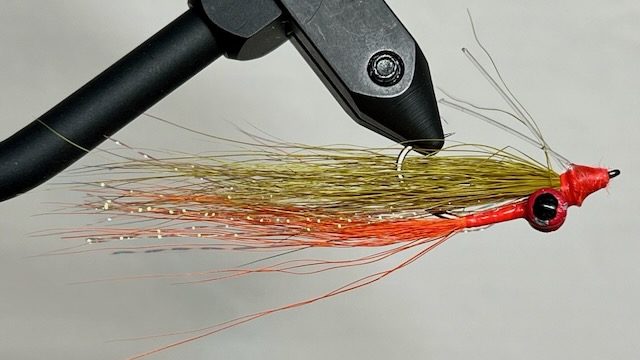
In the beginning, they’d readily devour an olive-over-orange Clouser Deep Minnow, even competing to be the first to grab it.
Cichlid candy, the olive-over-orange Clouser Deep Minnow. Prior to the recent cold snap, you could not throw this fly in an Everglades canal without catching a cichlid fish of one species or another. They’ll recover in time.
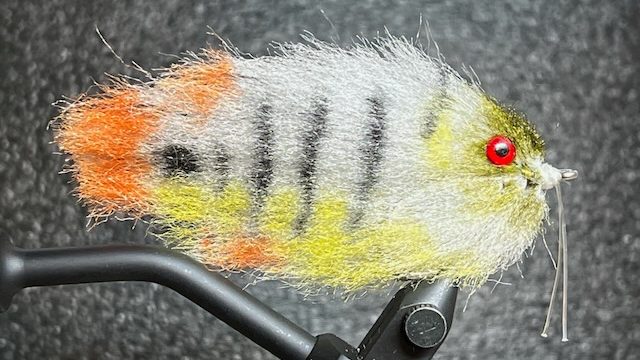
Then the magic wore off. My “can’t fail” fly would get weak follows, but no eats. In frustration, I devised a fly that looked like a baby Mayan Cichlid, one of the pea’s favorite treats. Sometimes on a cold day, a sluggish pea would take that big fly, thinking it a big reward for a small effort. Wrong this time, but generally a winning idea.
Baby Mayan Cichlid fly.
Yes, I pretend to know what fish think. Some fish, some of the time. I studied fish behavior for 35 years, long enough to learn some things about their thought processes, and long enough to be unsure about anything I think they think.
[Ursula Le Guin noted: “Few people know what fish think about injustice, or anything else.” ]
When the peas stopped eating my flies altogether, it was time to pay closer attention to what they WERE eating.
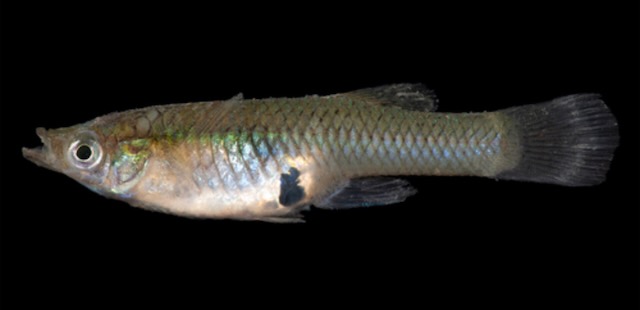
They were stalking and ambushing mosquitofish shoals.
Eastern Mosquitofish (Gambusia holbrooki). A pregnant female.
A famous fly pattern already existed for mosquitofish. Mike Connor invented his Glades Minnow fly to catch snook and juvenile tarpon feeding on mosquitofish in late summer and fall along the Tamiami Trail. But, since every fish in the Everglades eats mosquitofish, it worked on those too.
My tie of Connor’s Glades Minnow
I tried Connor’s Glades Minnow on these peas, and it worked great for about two days, then zip.
How does this happen? There must be something like 400+ mature peas in this lake. If I catch 20, I can see those 20 not eating the same fly again. But why do the other 380 now refuse it as well?
Maybe they learn from their friends. My grad student, Ben Sager, studied observational learning among fish in the lab (mosquitofish, no less) and found that they do learn about safe food sources from their buddies. Other researchers have found similar effects in other fish species.
Alternately, maybe these 380 peas were already “line shy” from a prior encounter with a different fly or a lure fished from a dock, and wouldn’t have eaten this fly or any other tempting object dragged behind a fishing line. Even if one fishes super-transparent lines (e.g., thin fluorocarbon) a fish can use their mechanoreceptor system (neuromasts in the head and the lateral line system that runs the lengths of the body) to feel the water disturbance caused by those lines. One get more eats on thinner lines, but more break-offs too.
Not ready to give up, I spent the next couple of months devising and testing a fly that’s converging on a near perfect mosquitofish mimic. To make it more tempting, I chose a pregnant female mosquitofish as my model (photo above). Mosquitofish are live bearers, like their relatives the guppies and mollies. Pregnant ones are slower and extra nutritious.
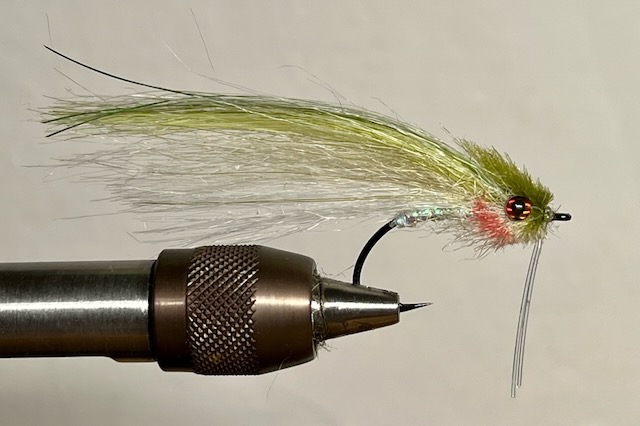
The fly’s construction borrows from the Clouser Deep Minnow and the Glades Minnow, with a few unique features that better match the real thing.
My mosquitofish fly needs a catchy name. Suggestions welcomed.
Once I got the size and details right (small with concealed flash to reproduce the abdominal iridescence), the fly worked brilliantly. It didn’t matter how I fished it. The fly could swim casually, take off in a panic, sit on the bottom, or hang motionless in the water column – a big pea would grab it.
I’d even go back and try other flies for comparison and the peas would ignore those while still eating the mosquitofish fly.
Other fish species liked it too. Everything eats mosquitofish.
Midas Cichlid (Amphilophus citrinellus) endemic to Costa Rica, is naturalized in the waters around Miami. That’s a mosquitofish fly in its mouth.
And then it happened. The peas stopped eating this fly too.
This morning, for example, I probably saw 30 peas, but no pea would even approach the fly unless it swam away from them in apparent fear. Of the first five that took the escaping fly, I caught zero. They were short-striking, a sign of hesitancy. I caught other fish on the same fly with no difficulty: Midas and Mayan Cichlids and a Bluegill Sunfish.
It took two hours to get a couple of big peas to take the fly in full eat mode. By that time I was sweaty, had retrieved flies from underwater snags and overhead branches, had scraped my arm sliding down the slippery layer of casuarina (Australian pine) needles on the bank, had cinched a tight figure-8 knot in my leader, and my last two flies had been chewed to bits. The usual wear & tear.
Another possibility is that the peas aren’t eating mosquitofish right now. The lake is full of baby cichlids, all of which have grown larger than the dinky mosquitofish, so perhaps those are top summer fare. Come winter, mosquitofish may return to the menu. Fingers crossed.
I am planning to uncross my fingers and tie up another batch of mosquitofish flies. Not being one to underestimate the power of education, I can’t help wondering if they have a future.