Eye of the Cormorant

another odd bird who chases fish.

Tag: writing

  • Taxi Tides

    Taxi Tides

    “Time and tide wait for no man.”

    A trip by paddle craft to the coastal marshes and flats can be a breeze or a slog depending on wind and tides. It took me one arduous kayak trip to Rabbit Key and another escaping the Snake Bight flat to become a tide chart addict.

    The wind. Paddling home against a stiff headwind is somewhere between exhausting and impossible. Returning from Sandfly Pass in the Ten Thousand Islands I was stopped in my tracks by a squall that forced me to get out of the boat in the rocky shallows and wade back to the launch, pulling the kayak behind me. My favorite hat blew off and disappeared in the distance.

    Tides are the same, but more predictable. Get the tides right and you get a free ride. Get them wrong, and you fight a river, ferry-crossing back and forth to seek eddies and weaker currents.

    My purchase of a motorized skiff made it possible to move against the elements, to cover long distances, and sometimes to dodge a localized thunderstorm. Very efficient, but I missed the quiet and stealth of the pedal kayak. And the exercise. It’s the difference between a car and a bike: the motor craft is useful, the pedal craft enjoyable.

    When I itch to be on the water, I open the marine weather forecast and the tide chart phone apps, looking for happy windows of winds and tides. Living on a peninsula provides choices. My choice of location and craft is based on the forecasts. If conditions are unfavorable on the east coast, nearby Biscayne Bay or the Keys, how about Flamingo on the southern tip of the peninsula? No? Then check the west coast out of Chokoloskee / Everglades City. If all three look threatening, I may opt for the interior mangrove creeks or central Everglades marshes. If it looks horrible everywhere, I stay home and tie flies while imagining the next outing.

    A TAXI TIDE

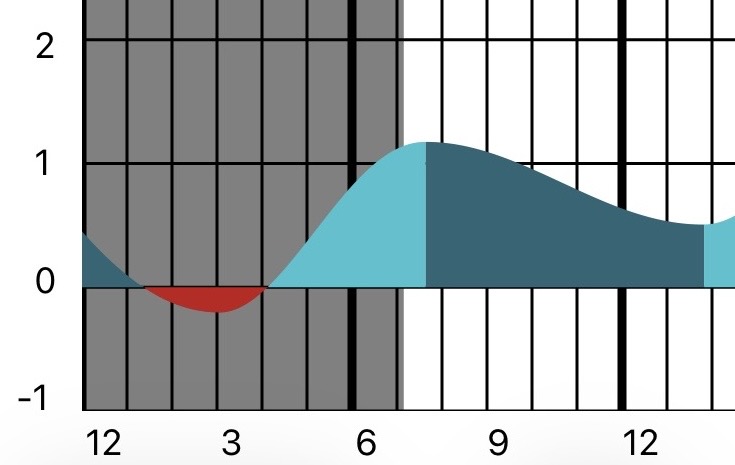
    I normally I take the skiff into Snake Bight in Everglades National Park to escape against the incoming tide, but the tide chart for Tuesday showed the rare, magical tide cycle that’s perfect for kayak exploration. One can ride the incoming tide into Snake Bight before sunrise, fish and bird well into the morning, then ride the outgoing tide back out again.

    Snake Bight’s tides are one hour delayed from the Flamingo tide chart shown here.

    I wake at 3:30 am and check the weather report. The wind looks to remain low through the morning. Rain looks iffy – it’s supposed to rain solid until 6 am, then let up until afternoon. Hopefully the algorithm running on the National Weather Service computer gets it right today.

    Scary-hard rain pounds my drive south to the bottom of the peninsula, then stops to let me set up and launch the kayak in the dark. I can see the odd lightning flash to the south. Gradually the clouds break up and I have a lovely morning waiting for me on the water with 50 minutes to sunrise. 

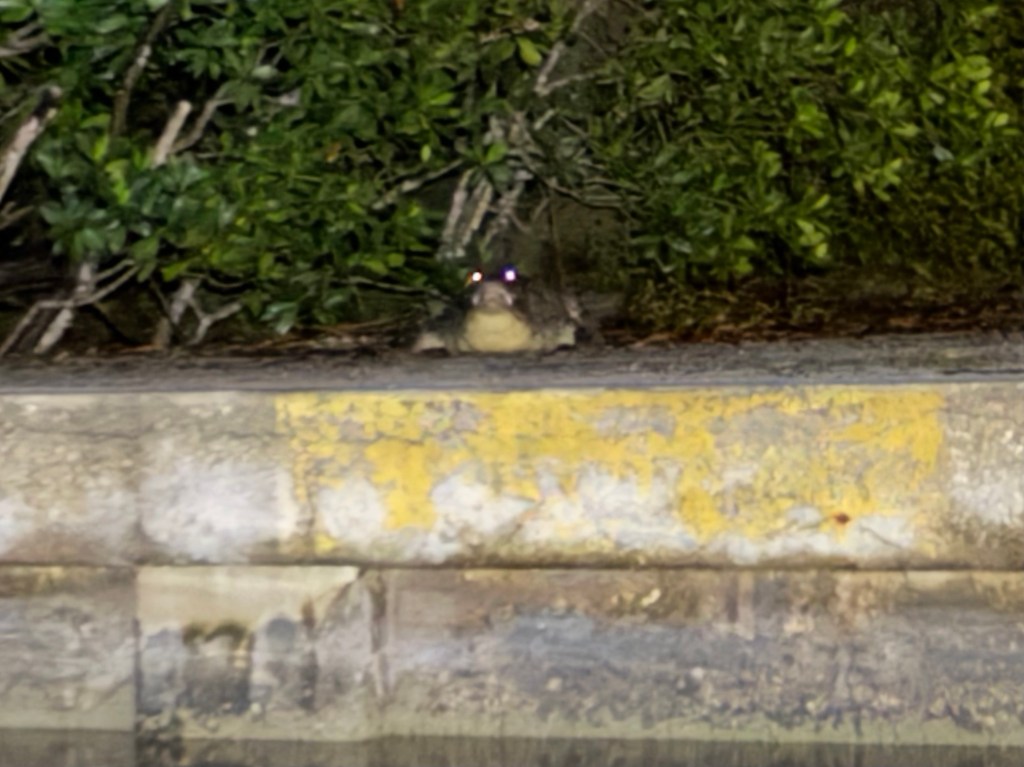
    The half moon is still blocked by clouds and it is DARK. I turn on the pole-mounted kayak light. Its #1 job is to keep me from being run over by powered craft, but as a bonus, it casts a bit of soft light in all directions. Sitting above and behind me, the light doesn’t shine in my eyes. It does, however, shine in the eyes of the crocodiles.

    American Crocodile perched on the marina wall. Amazing what the iPhone’s camera can do with the faintest of light sources.
    Here’s the same croc in motion.

    Several more crocs take umbrage at my passage and splash off in a huff.

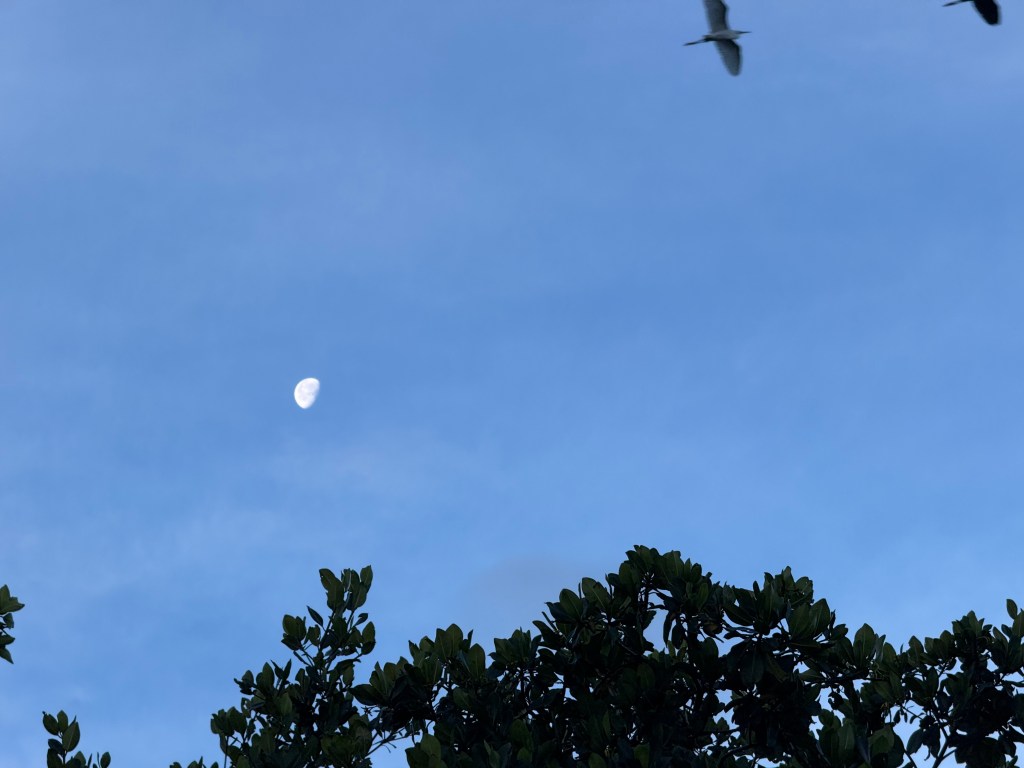
    In time, the clouds melt away, allowing the half moon to illuminate the mangrove shoreline.

    A Spotted Sandpiper perches on a fallen log, bobbing up and down. The end of the log has eyes and large teeth. Eek!

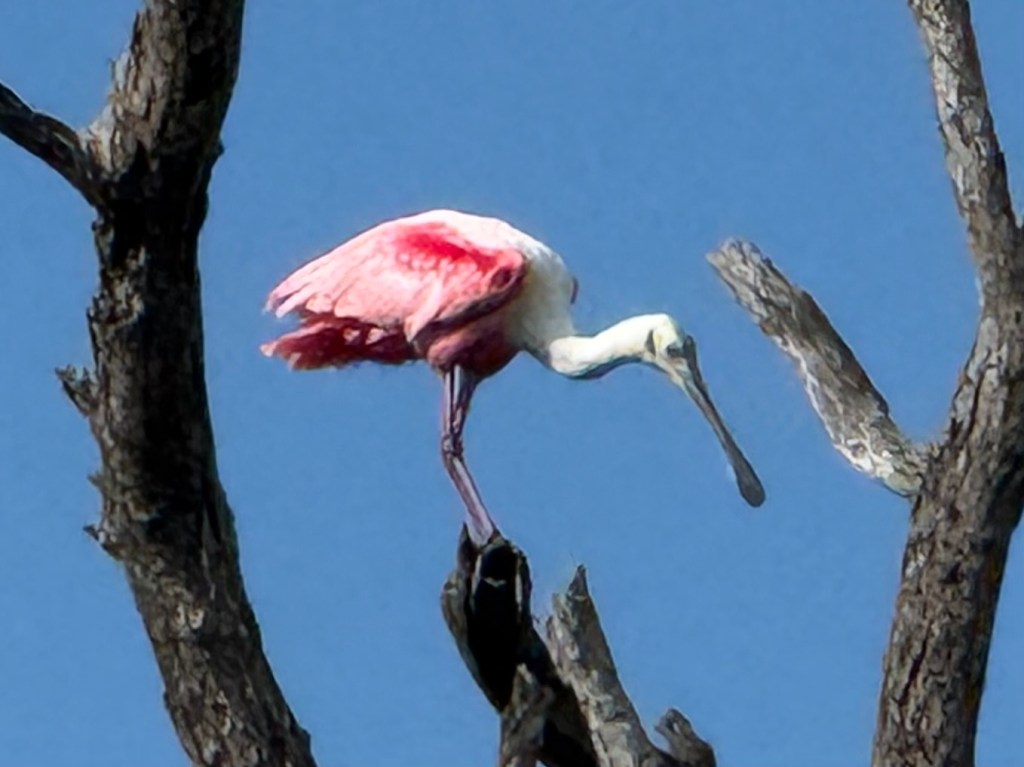
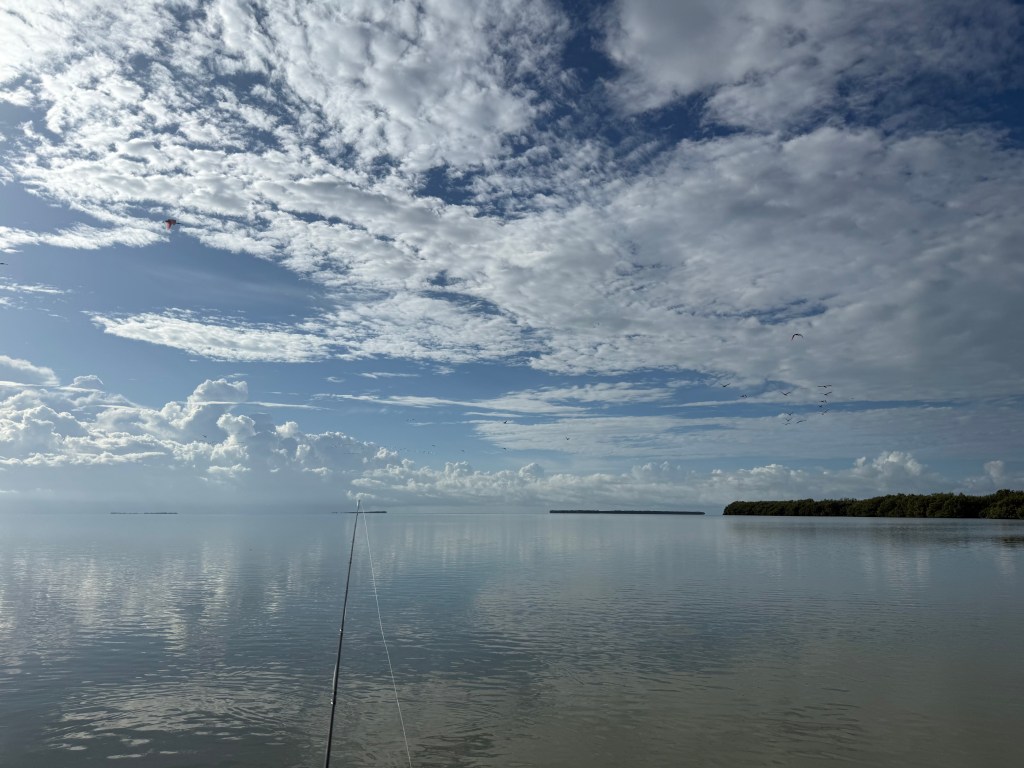
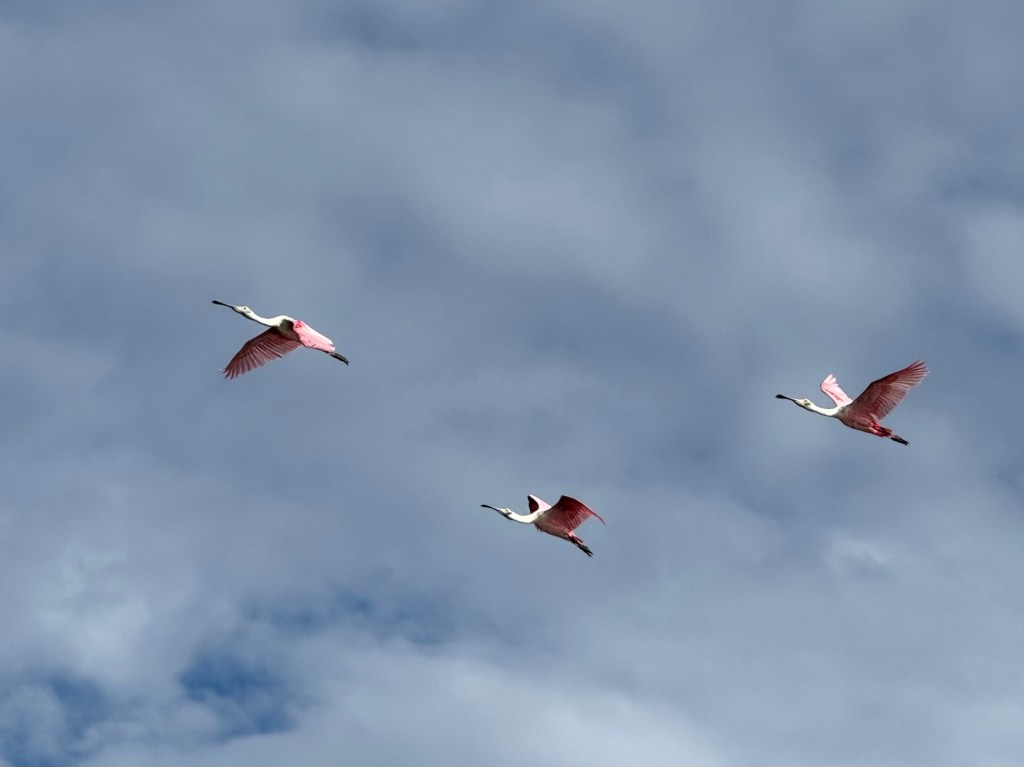
    The sun glows as I round the corner into the Snake Bight flat. The north edge of the flat has a thin line of shocking pink. Though I’m looking for fish, Roseate Spoonbills always steal the show.

    Some spoonbills fly over my kayak enroute to their favorite roost of snags by a mangrove creek.

    I spot another kayaker approaching the cove where the spoonbills are roosting. He pulls out a camera with a giant lens, then paddles in too close, spooking some of the spoonbills. If that’s not bad enough, he starts paddling in even closer – too much.

    If I can use an iPhone to get this photo without spooking the spoonbills, a kayaker with a giant lens doesn’t need to crawl down their throats.

    First rule of not spooking birds is to act like you are interested in something else. Definitely do not aim your kayak directly at them.
    I call out: “That’s close enough!” He stops, turns around, and leaves. Good thing too. In half an hour, a carefully guided kayak tour comes by specifically to see the spoonbills.

    * * *

    FISHING REPORT (stop here if fishing bores you)

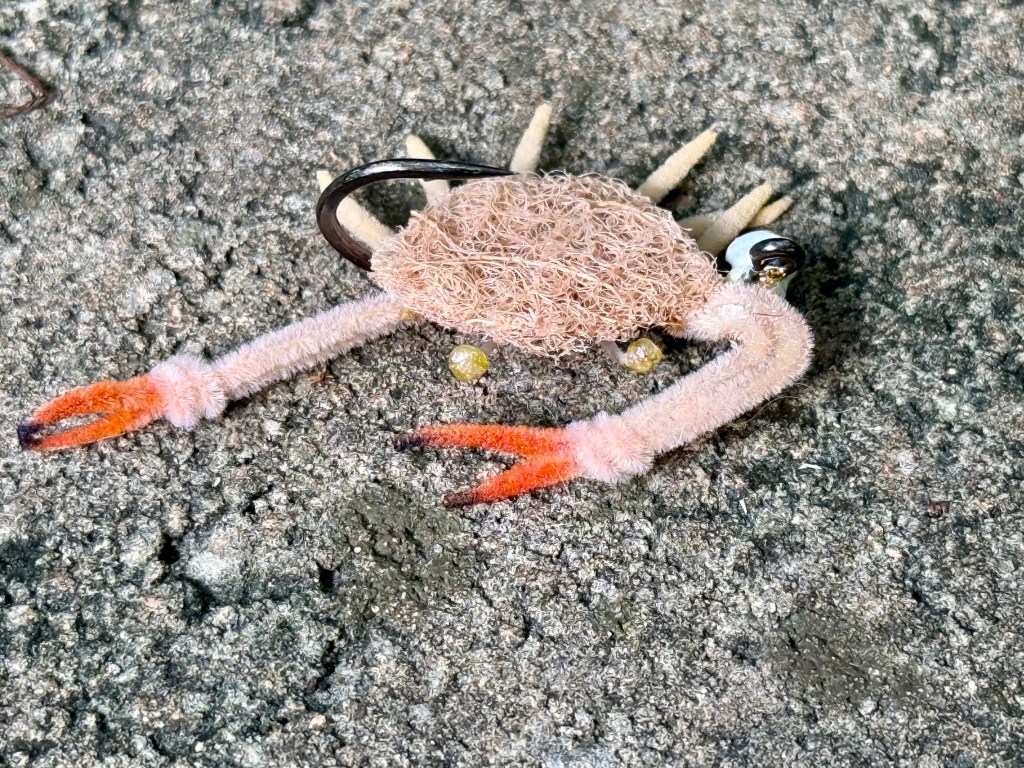
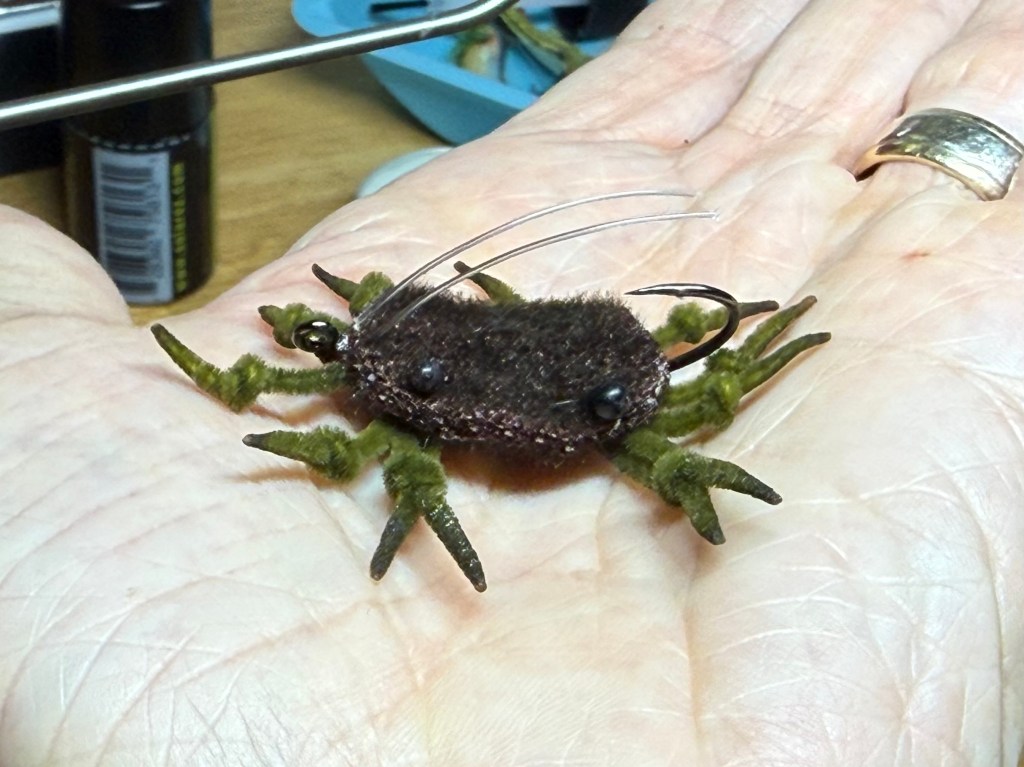
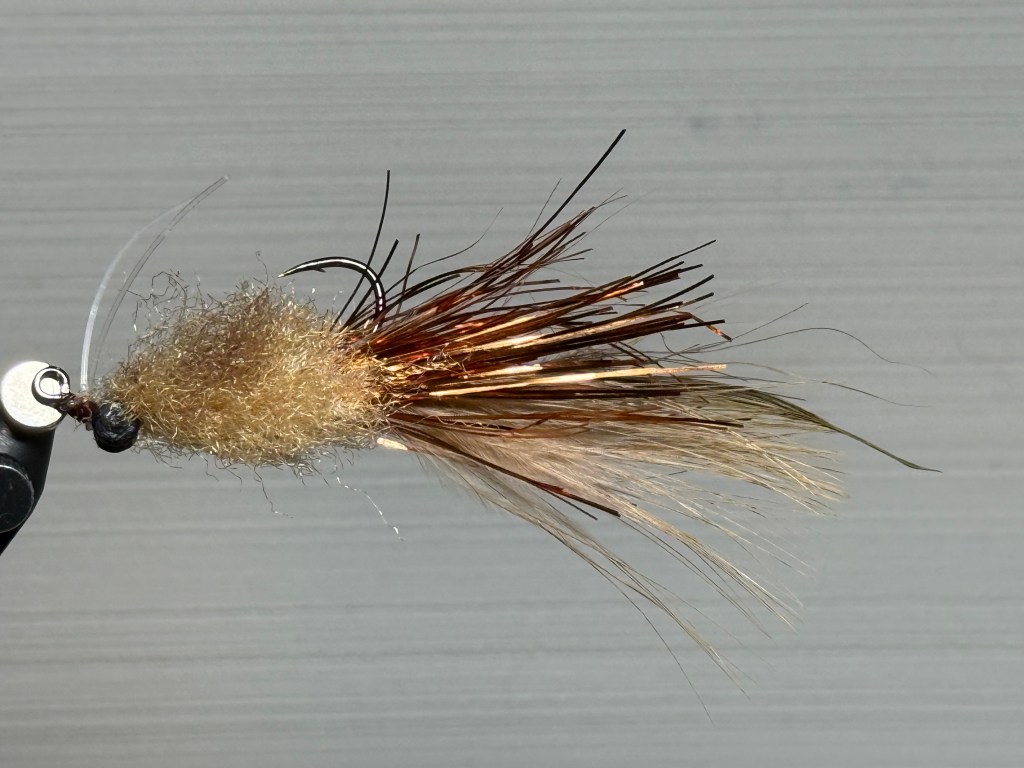
    Last weekend I tied a mangrove crab fly using whatever I had lying around, with a notion to try for redfish feeding in the mangrove roots along the edge of Snake Bight. It came out pretty well.

    Never mind the fish – I think it’s adorable.

    I try it out. Crabby casts fine and stays upright while it sinks, but the legs entangle too much sea grass detritus.  I’ll try it again in the Ten Thousand Islands where there’s less sea grass.

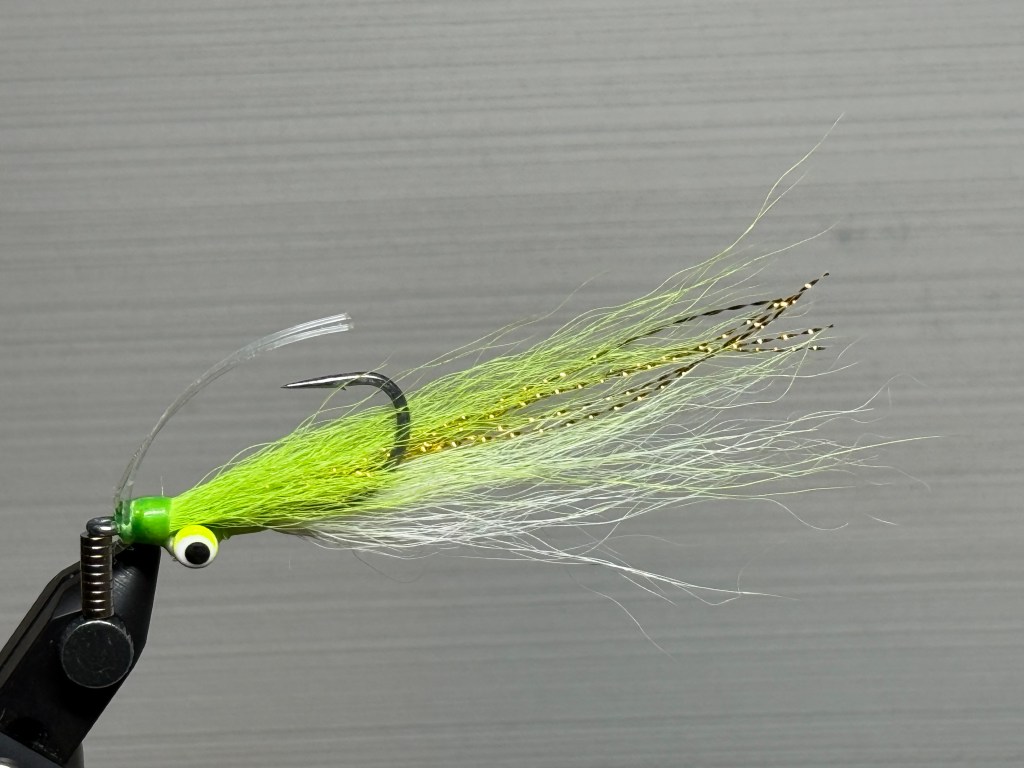
    Instead, the winning fly today is my weedless tie of the classic chartreuse-over-white Clouser Deep Minnow.

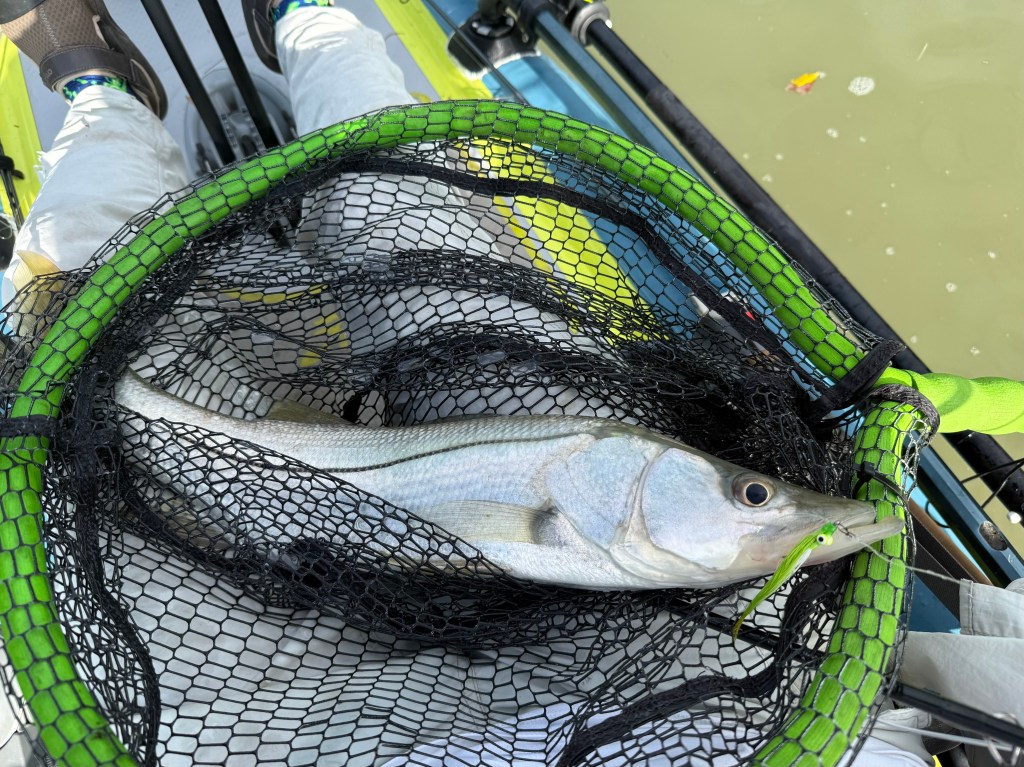
    It catches seven snook 18-22”.

    20″ male snook with Clouser fly.

    Snook in this size range are all males, turning into females when they get bigger, around 26-28”. I wonder if our Florida State legislators know that many of our prize game fish are transexual, “protandrous”, to be exact.

    Somewhere else out there lurk the female snook. Research by FIU professor Jenn Rehage indicates that most of the females are still up-river, fattening up on sunfish and cichlids for the breeding season. This rainy spell should get them moving downriver again.

    I have caught countless redfish on spinning gear but exactly zero on fly. I tied this sparkly fly in the hopes of temping a bite. Don Quixote jousts at yet another windmill.

    Snook are great but I am still hoping to catch at least one redfish today. I swap out the Clouser for a sparkly redfish attractor pattern. Instead of a redfish, it catches my biggest snook of the morning (23″) plus a pretty little sea trout.

    Lunch is leftover tamales from Moreno’s Tortilla Shop, re-heated in the sun. Gentle rain resumes on the drive home, kindly washing the saltwater drips from kayak and car. Fine morning all around.

  • Jewell Stoddard, 1933-2026


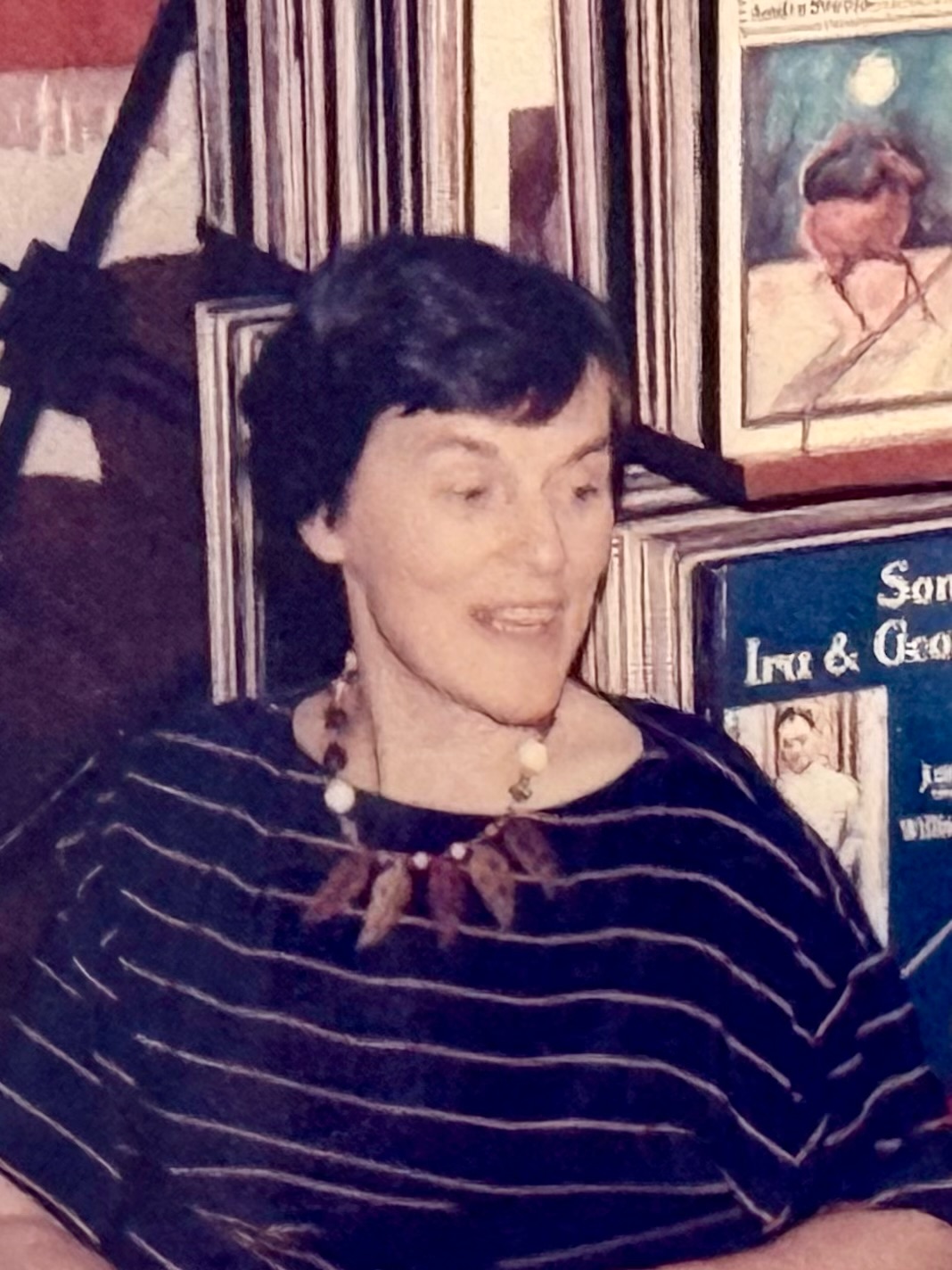
    Bill and Maggie Stone were not trying to be funny when they named their seventh child Jewell. Mostly they called her Judy.

    Jewell grew up in Graniteville, a  mill town in the pinewoods of the South Carolina Piedmont. There she developed her love of the woods, taking walks in the pine hills with her father when he visited his friend, a long-bearded hermit named Shag Jones.

    Jewell’s father Bill Stone ended his career advancement at the town cotton mill by refusing to join the Klan. He instilled in Jewell a deep sense of decency. Bill would stop by the railyard during the Depression and bring people home for dinner. Once, their weekly groceries were stolen from the kitchen, but her dad refused to call the police, saying “Whoever took those groceries needed them more than we did.”

    Thanks to the town librarian, Jewell fell in love with books. To avoid the family’s scorn, she read unseen in her hiding place behind the sofa.

    No women in her family went to college but Jewell’s determination was likewise inspired by the subversive town librarian. Jewell bewildered her family further by insisting on heading north to Washington DC so she could attend a racially integrated college. Teased for her southern accent upon her arrival at American University, Jewell lost it post haste. She graduated with a B.A. in English Literature.

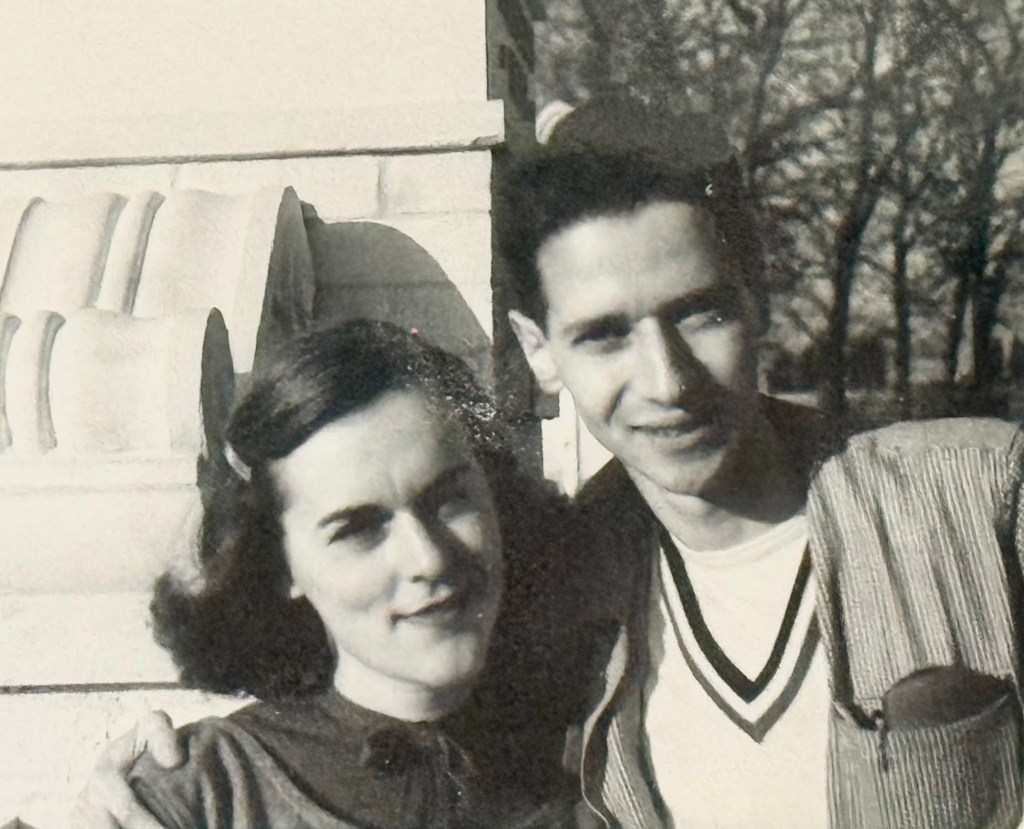
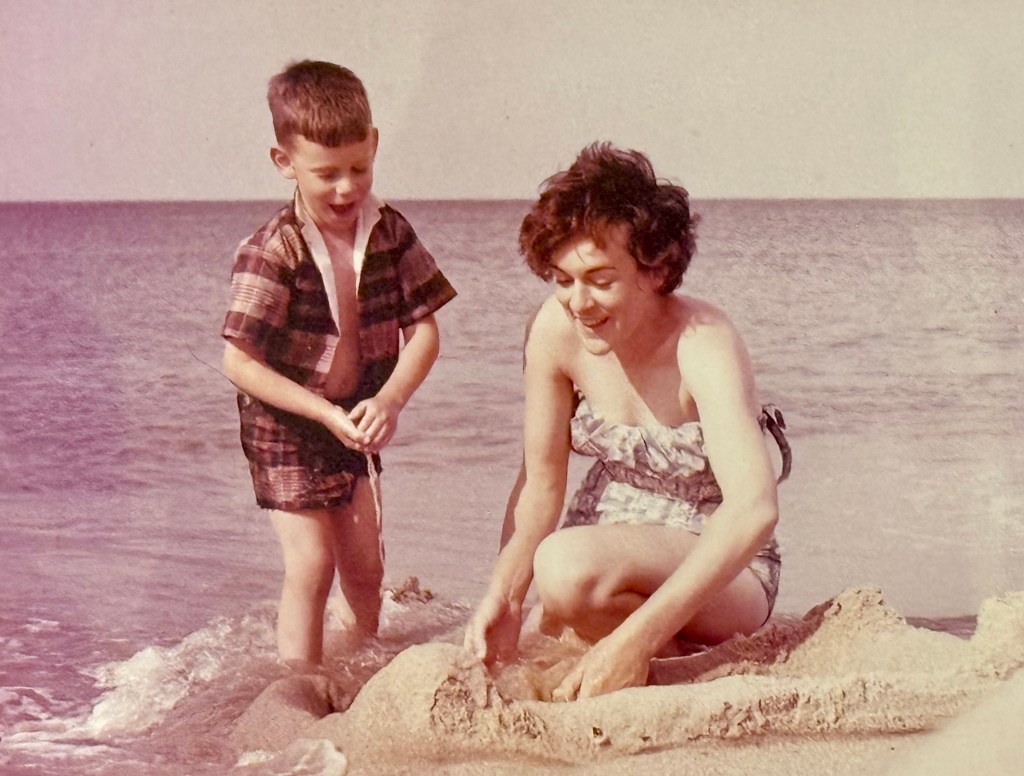
    Jewell married Arthur Kraft, a journalist who covered international trade for MacMillan. Art’s family embraced Jewell, and the Krafts became her new family.

    Jewell Stone & Art Kraft, 1954

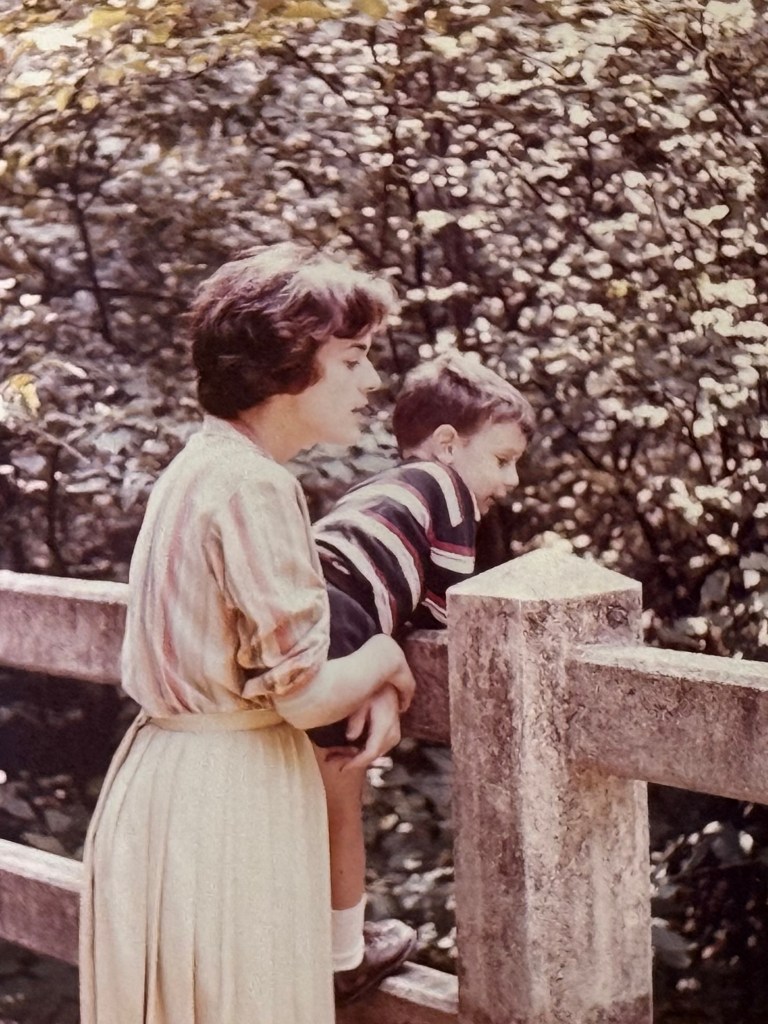
    Arthur died on Christmas Eve 1958, leaving Jewell widowed with a toddler son, Philip. Jewell’s oldest brother Carl reached out to tell her “the family would be willing to take her back”, apparently ready to forgive her triple sins of moving north, getting educated among Blacks, and marrying a Jew. Jewell recounted, “I told him to go fuck himself.”  

    The Krafts remained our core family, looking after Jewell and me during the rough times following Arthur’s death. 

    To support the two of us, Jewell got a job assisting DC Circuit judge David Bazelon with his work on legal rights for the mentally ill. Judge Bazelon urged Jewell to attend law school, but she declined. She took me along to Civil Rights marches in Washington DC and I joined her walking door to door collecting funds to support Democrats running for office.

    My Grandpa Lou, known in the Kraft family as “Pop”, gave Jewell money to buy a car. A VW Beetle would have been an economical choice, but Jewell knew these cars were built with Nazi slave labor during the war, and she would not disrespect Pop with such a purchase. Instead, she bought a small British Ford, a total lemon that often failed to start, a trait that filled our lives with serendipity. 

    One snowy morning in 1961, a nice man who lived in our apartment complex helped Jewell get our little car started. I took to asking Jewell “When are we going to see the nice man again?” 

    In time I learned his name was “Ted Theodore Stoddard”. Sometimes as I peered from the window of our 3rd floor walk-up, eagerly awaiting Jewell’s return from work, she diverted from the direct path to stop by Ted’s flat in the adjacent apartment block for “a drink” – HEY! They fell in love and married on the Ides of March in 1962. The Kraft family embraced Ted as well.

    Ted also turned out to be a good photographer.

    Jewell stopped working to travel overseas with Ted, me in tow. We had a great time exploring Cyprus, Egypt, and Ethiopia. Eight months after our return from Ethiopia, Andrew was born in 1964.

    In 1968, Jewell found a new career teaching third and fourth grades at Green Acres School. Her former student, Professor Manuel Lerdau, describes her as ”… one of those rare grownups who talked with kids as though we were adults, and we responded as if we were. I still remember talking with her, when I was a third grader, about a hagiographic [look it up] biography of Andrew Jackson that I had read. Jewell used it as a chance to point me toward books with different viewpoints. She taught me to think of reading as both an end and a means.”

    In 1977, Jewell and three colleagues from Green Acres started the first children’s bookstore in the U.S., Cheshire Cat Children’s Books, on Connecticut Avenue south of Chevy Chase Circle. Book industry experts told the partners that a bookstore could not succeed selling children’s books alone. The store thrived and became a fixture in Washington DC. While Amy Carter shopped at the store, her Secret Service detail bought books for their own children.

    Jewell befriended all the children’s authors; her favorites included Maurice Sendak, Tomie de Paola, and Allen Say. Jewell told me that when Jimmy Carter came by the store to sign books he could inscribe his name while talking to a customer and without looking down. She once joined Dr. Seuss for breakfast, who thanked his hosts for not serving green eggs and ham. Her shelves at home were filled with signed first editions. 

    Jewell’s children and grandchildren always received the best of children’s books, inscribed by the authors, for holiday gifts or because the author had been by the store with a new book and she thought a particular child would like it.

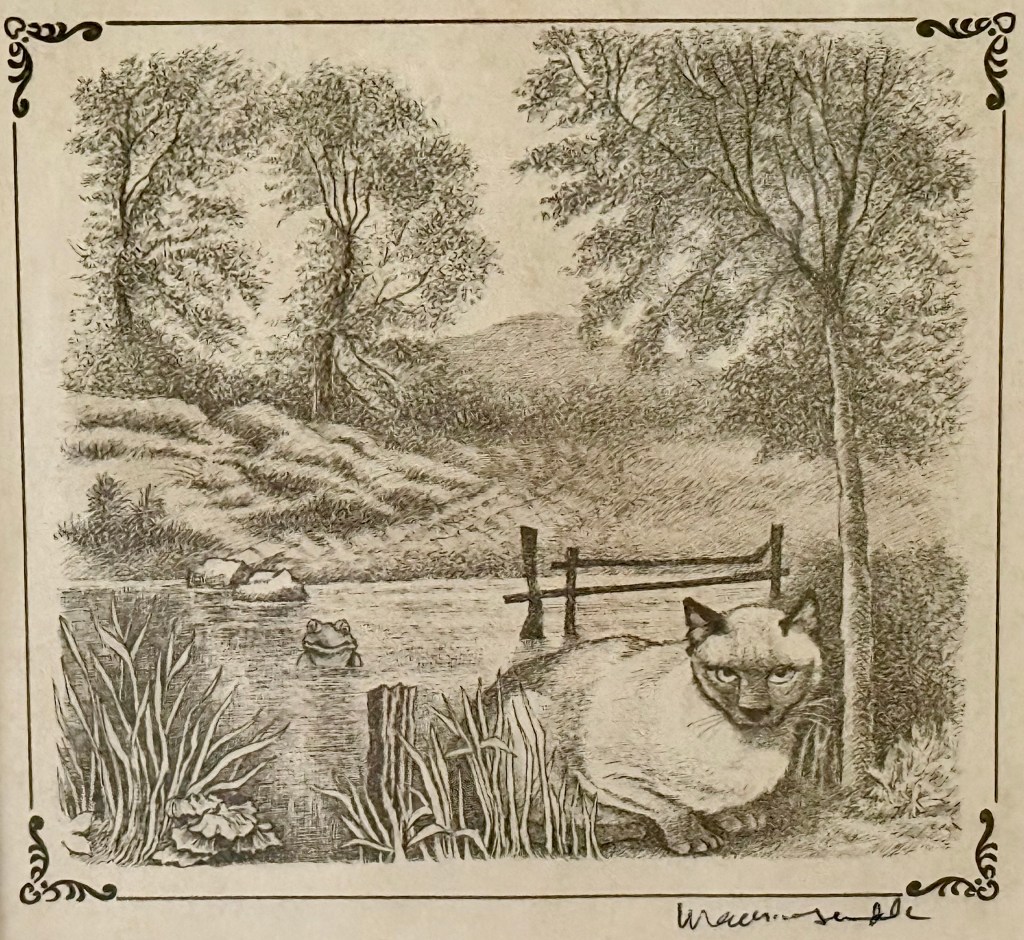
    A gift from Maurice Sendak adorns my wall in South Miami, a favorite plate from his early book, “A Kiss for Little Bear”.

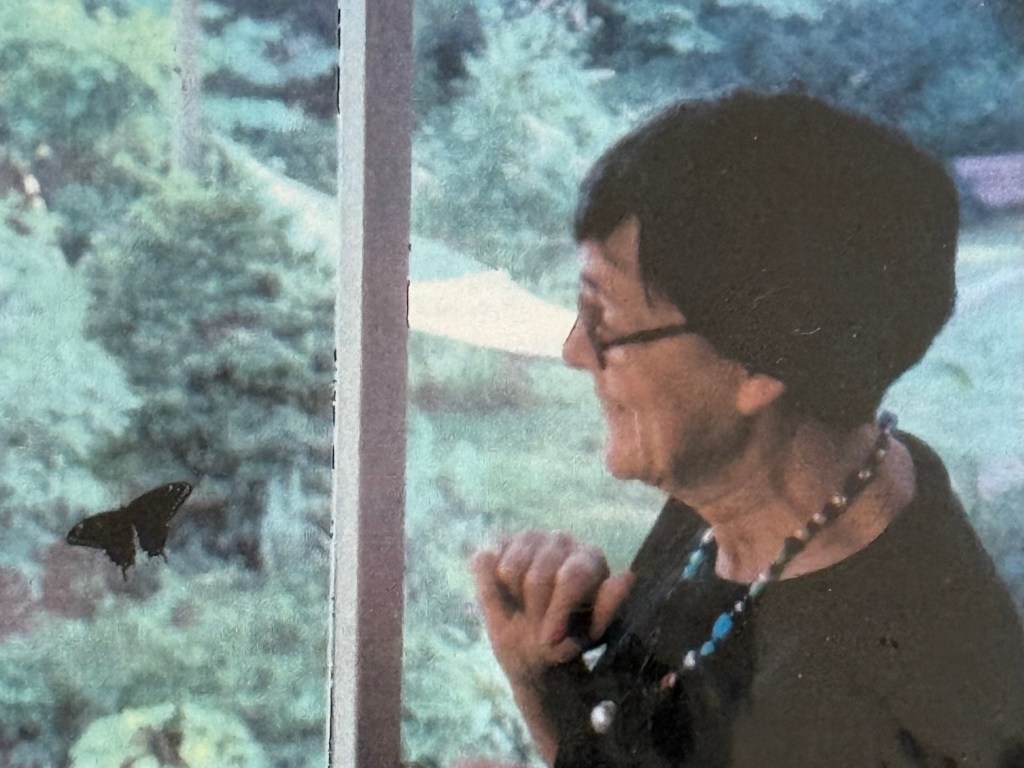
    As an extra attraction for the store, Jewell raised monarch butterflies from the egg – when the caterpillars were ready to pupate she moved them to a tree branch in the front window. In a week, they would emerge as butterflies and be released. A flock of humans gathered on the sidewalk each morning to watch the butterflies emerge. Her butterfly window was featured prominently in the Washington Post.

    Ted has all the good photos of Jewell with the Monarchs. This butterfly is a recently emerged Black Swallowtail that Jewell reared from an egg laid on the parsley in her herb garden.

    Jewell served on all the children’s literature award committees including for the Caldecott and Newbery Medals. A master of digital bookstore management, Jewell carried five digital devices wherever she traveled.

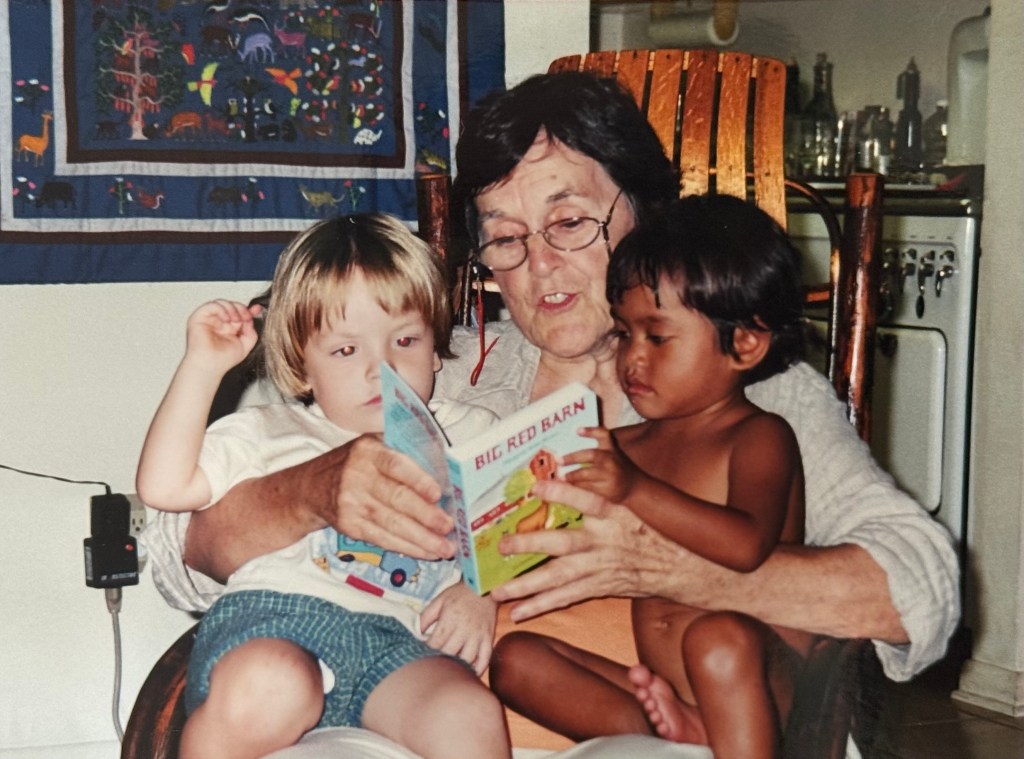
    Jewell reading to her granddaughter Vannak and V’s friend Shawn. At two, Vannak greatly preferred books to clothes. In the lower left you can see the charging cords for some of Jewell’s assorted devices.

    Jewell ran the Cheshire Cat for 22 years before closing up shop and moving her inventory and staff to Politics and Prose (P&P), farther down Connecticut Ave. In her first year in the basement at P&P she sold a million dollars’ worth of children’s books; the owners said “We’ll get you anything you need.” Jewell retired from P&P at the age of 80. 

    In her spare time, Jewell was a gourmet cook, a consummate gardener, and a voracious reader.

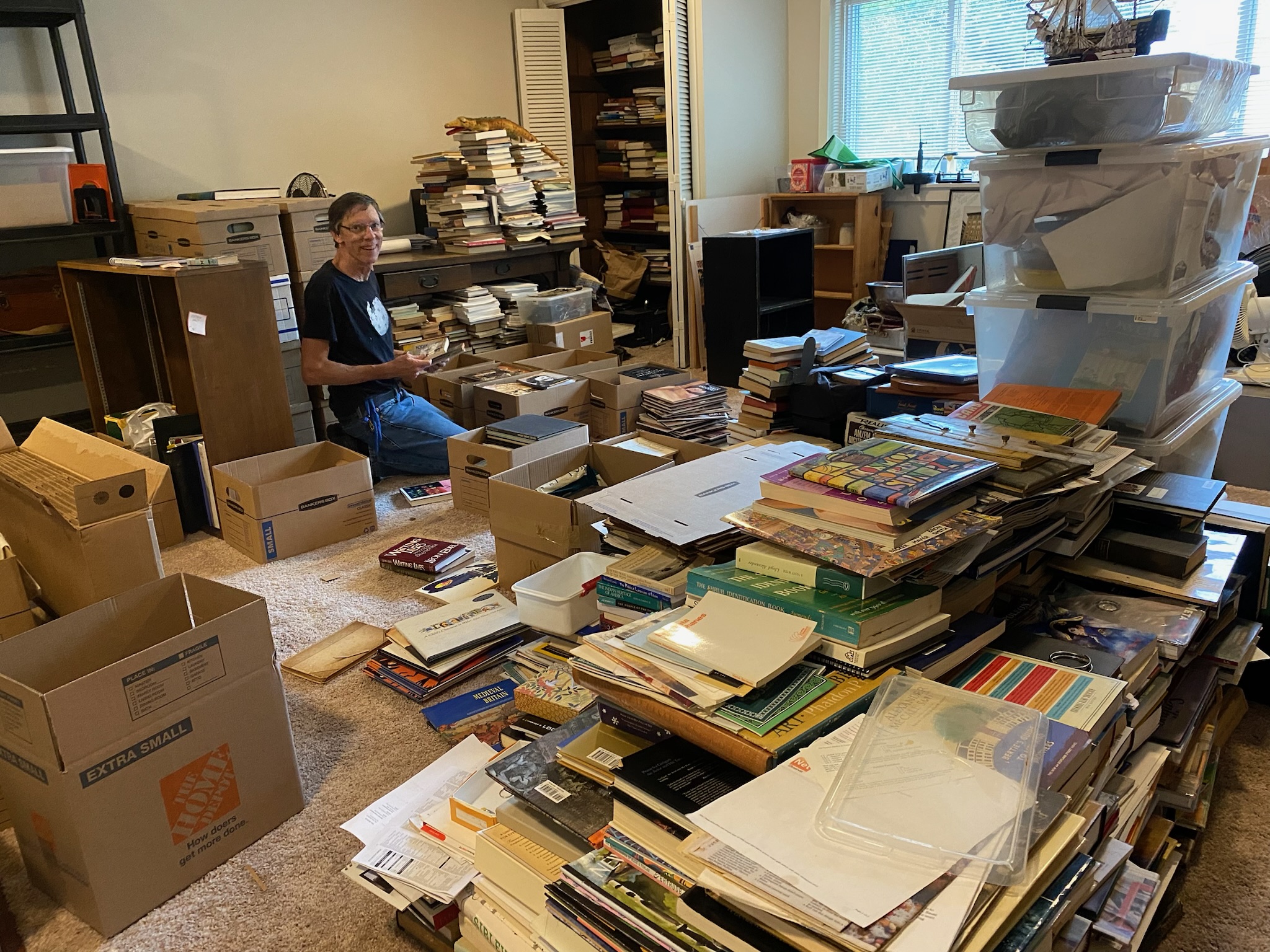
    Here I sort just some of Jewell’s books after their move from Turner Lane to a single storey house in Silver Spring..

    Jewell loved going for walks in Rock Creek Park, Hughes Hollow, Chincoteague, and her native South Carolina pine woods. In her back yard on Turner Lane, she created a wildflower garden of native plants that she salvaged from the immediate path of the Capitol Beltway through Rock Creek Park.

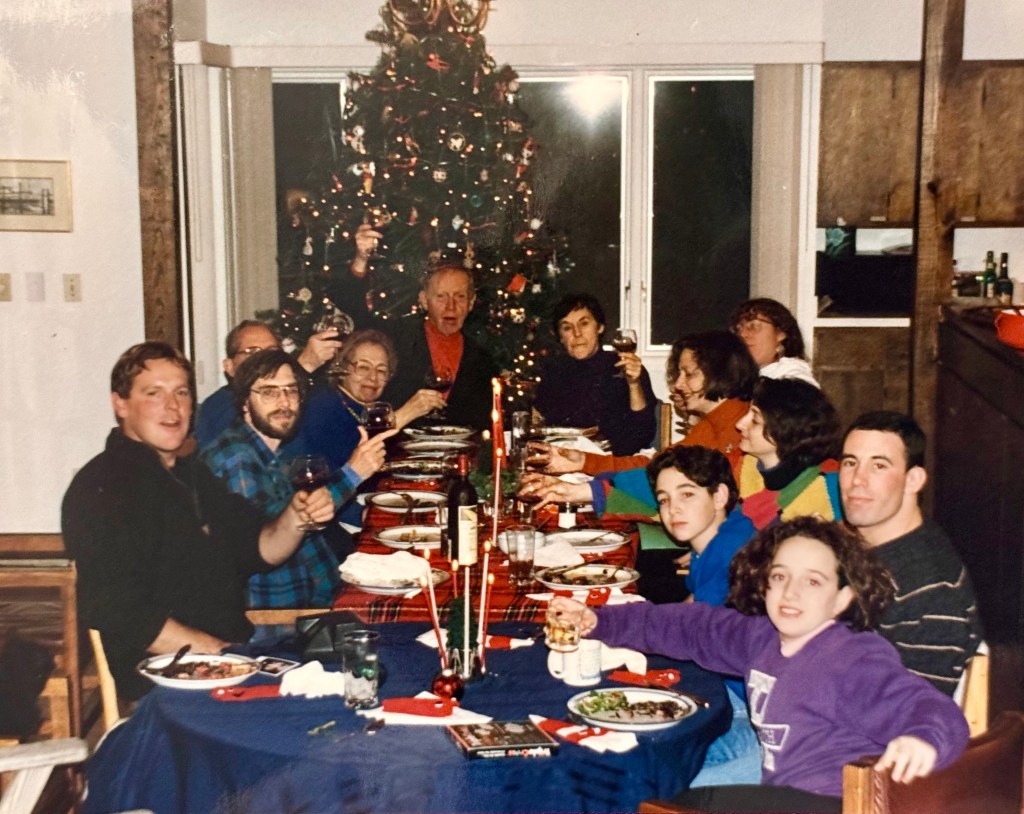
    Sticking around Washington on Christmas Eve was hard for Jewell, so in 1967 she decided we should blow town and escape to Chincoteague Island for the holiday. Within a year, the extended family had joined us. “Chincoteague” evolved into special week of walks, feasts, and revelry, a tradition closing in on six decades.

    Chincoteague Christmas feast, Jewell style.
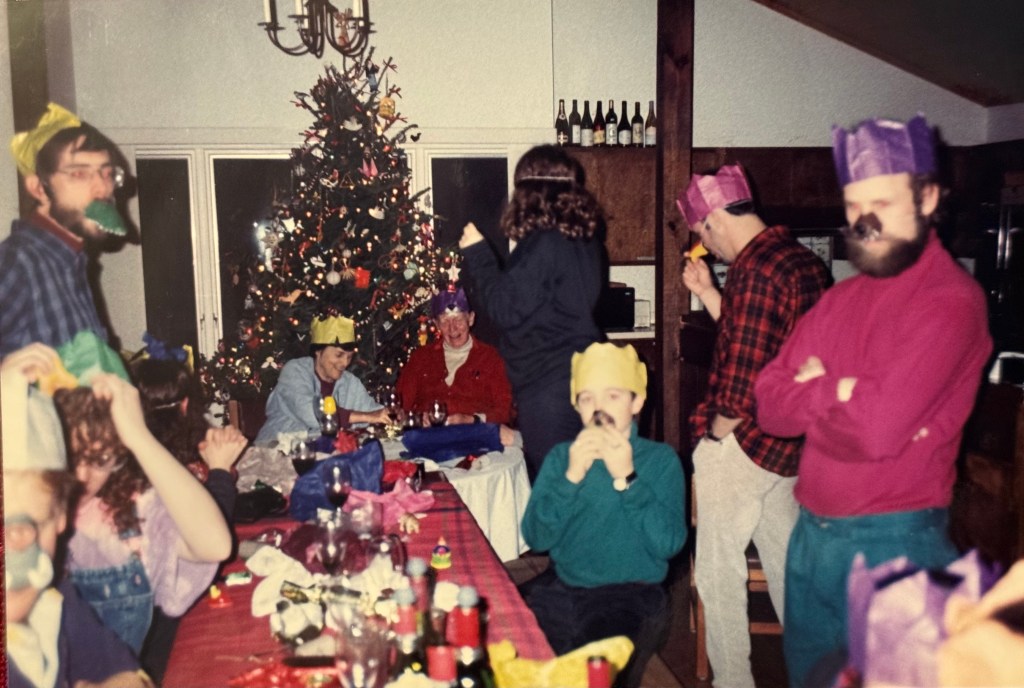
    Jewell also facilitated silliness, providing everyone with tissue paper crowns and rubber animal noses. That’s her in front of the Christmas tree.
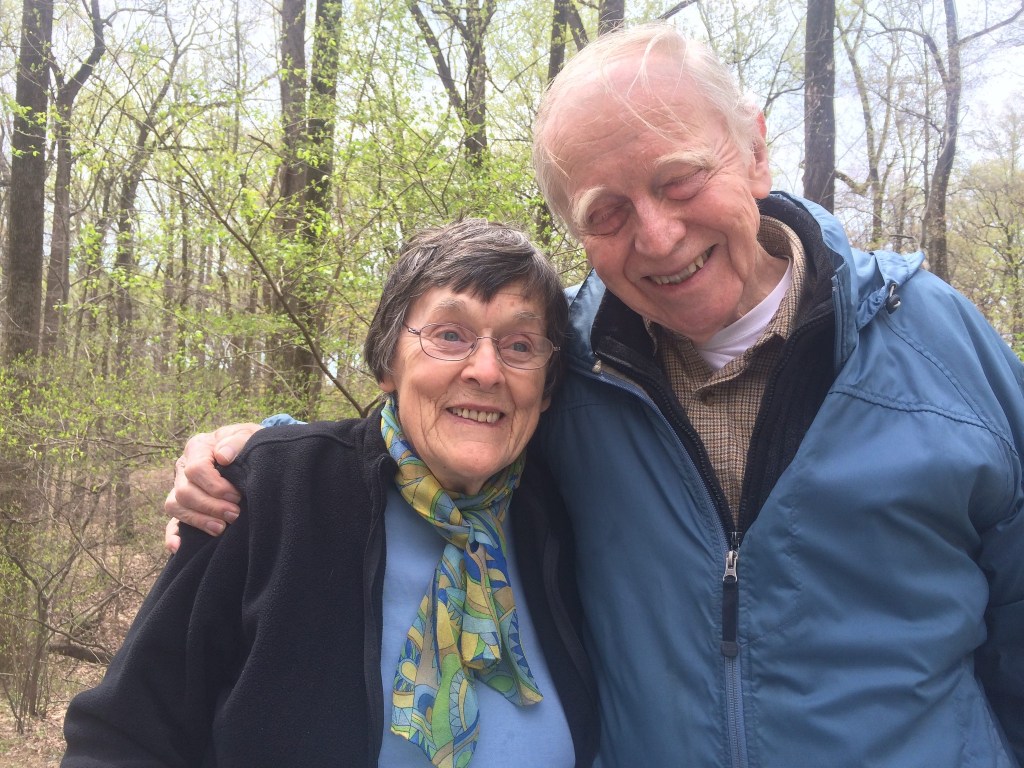
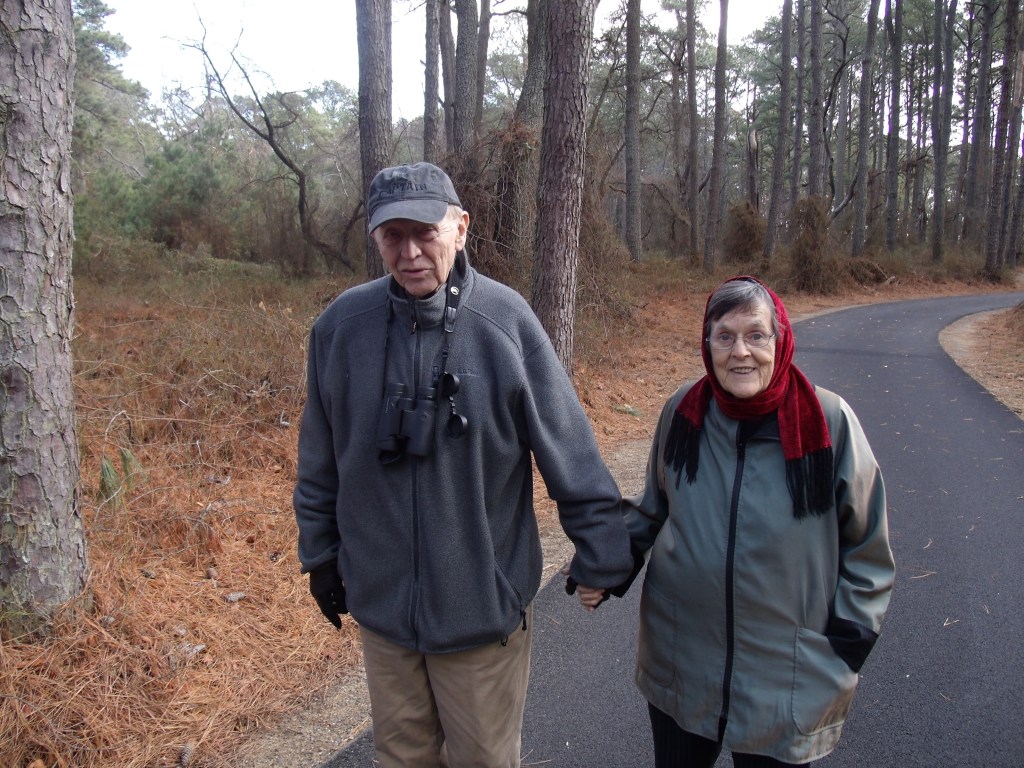
    Ted and Jewell walking at Chincoteage National Wildlife Refuge.

    * * *

    On March 10, 2026, Jewell passed away, surrounded by family in a house in the woods, a setting she described as “the best vacation ever”. She was 92, five days shy of her and Ted’s 64th wedding anniversary.

    Jewell leaves behind her husband Ted (99), her two sons, me and Andrew, and a passel of well-read grandchildren, great nieces, great nephews, and so on.

    Jewell didn’t want a funeral but we figure we can get away with a potluck remembrance lunch for family and close friends. Such is planned for April 12, 2026.

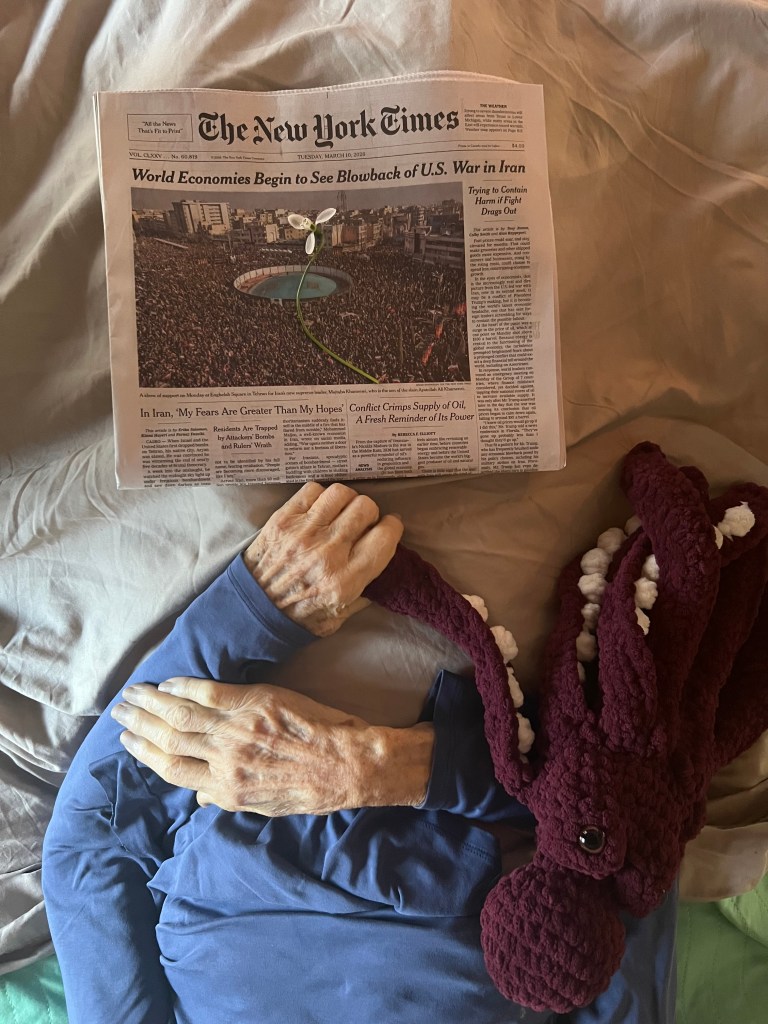
    Jewell with her beloved NY Times and stuffed octopus, 10-Mar-2026

  • Coffee before coffee

    In 1993, Associate Professor Suzanne Koptur wanted to have coffee when she visited her new tea-drinking FIU colleague, so she mail-ordered me a 2-cup Gavalia coffee maker.

    Everything about the coffee maker was adorable and it even came with a couple of ground Gavalia coffees. Drawn to cute gadgets as I am, did not wait for Suzanne’s next visit to try it out. Mixed with half & half and a bit of sugar, the coffee was pretty good, even for a tea-drinker. Before long, I’d nixed the sugar, but a small cup of coffee remained a nice daily complement to my breakfast of toasted English muffin and fruit.

    Thus, in my late 30s, began my one-cup-of-coffee ritual. A second cup in the morning tended to wire me (risk of being obnoxious) and a cup in the afternoon messed with my sleep.

    In my mid 50’s I read about pesticides in tea. Why would anyone knowingly do a hot water pesticide extraction then drink the contaminated hot water? I switched exclusively to organically grown teas. Then it occurred to me (duh) that many growers in poorly-regulated tropical countries apply massive amounts of EPA-banned pesticides to everything they grow, including coffee. Forget Gavalia: not organic, not happening. Whole Foods had a very good organic coffee in their 365 product line, then discontinued it. Sprouts Market has no connection to Jeff Besos, prohibits open carry in their stores, and sells 24 different organic bean varieties. My favorite is their organic fair trade Sumatran dark roast.

    I didn’t adopt another habit as compulsive as my breakfast cup of coffee until my mid 60s when I rekindled my middle school era passion for fishing.

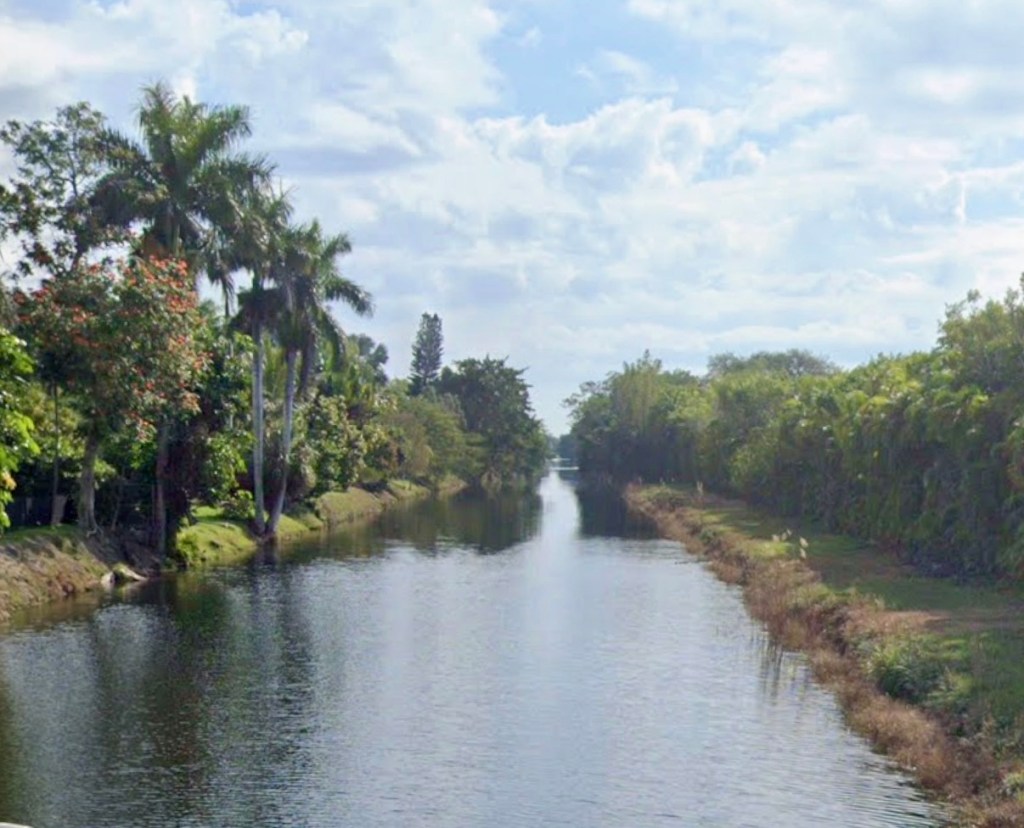
    Sunday morning before sunrise, I’d grab a rod and head over for a quick fishing walk along the north bank of Snapper Creek on the southern edge of South Miami.

    There I’d catch an occasional snook or peacock bass, but I’d also see the morning canal birds: Limpkins hunting apple snails, flocks of Chimney Swifts skimming the water for emergent aquatic insects, the occasional Peregrine Falcon or Short-tailed Hawk.

    That’s when I discovered the “coffee-before-coffee” paradox.

    People’s kitchens and back yards face the canal banks, coffee is diuretic, and there’s no place to pee discretely. I figured, incorrectly, that I could simply postpone my one cup of coffee by an hour and have it with breakfast when I returned. Not so simple. To attain sufficient aim and focus for skip-casting lures under low-hanging tree branches where the snook hang out, I needed a cup of coffee before my cup of coffee.

    Roll forward to the present, my late 60s.

    Professor Emerita Suzanne Koptur remains a good friend but the sweet two-cup Gavalia drip machine she gave me is long dead. Plastic lives forever, so for the past 20 years, its detachable plastic cone has sufficed for single-cup pour-over production.

    As for me, the coffee-before-coffee problem has gotten so much worse. How many times have I caught myself spooning fresh grounds into  my coffee cup or stopped myself from pouring half & half into the filter cone? I don’t even try to fish before my one cup.

    © Philip Stoddard

  • Everglades tarpon fishing, with thanks to Woody Guthrie & Drew Chicone

    As I went walking I saw a sign there,
    And on the sign it said “No Trespassing.”
    But on the other side it didn’t say nothing.
    That side was made for you and me.

    © Woody Guthrie Publications, Inc.
    & TRO-Ludlow Music, Inc. (BMI)

    Contrary to my religious practice, I have been off the water for two long weeks. Bunch of pressing things going on, despite which, my psyche demands TOW (time on water). Rain is predicted for Saturday afternoon but the morning looks good in the western Everglades if I stay south of the fire. The plan unfolds to shirk the day’s assorted social obligations and start the morning fly fishing for juvenile tarpon from my kayak. I’ll play it by ear after that.

    I packed the car the night before, bringing a single 7-weight fly rod, a clear-tip intermediate sink-tip line, and an assortment of proven flies that I tied to entice juvenile tarpon. Going “fly or die”.

    * * *

    FINDING JUVENILE TARPON AFTER A COLD SNAP

    A few days back, a friend reported 100 dead juvenile tarpon in my favorite Everglades tarpon fishing area, casualties of the recent cold event. The spot I chose for today, ~60 miles northwest of there, is a brackish canal network dug 20’ deep to excavate fill to create adjacent dry land for buildings. Some people still think building in the Everglades is a good idea. On the plus side, deep water makes a good thermal refuge for manatees and juvenile tarpon during a winter cold snap. I always find tarpon holed up there in the winter and especially when it’s cold. 
    The general area sees significant fishing pressure, evidenced by snagged fishing lures I pluck from mangrove branches and by the landing net sitting next to a kayak on the shore at a nearby residence. Pressured tarpon are hard to catch, especially on fly, and these particular ones often refuse Mike Connor’s Glades Minnow and Jay Levine’s black micro-bunny, my two best-producing flies for tarpon along  the Tamiami Trail.

    Water access here is controversial. There’s a public boat launch a mile away, but a clear “NO TRESPASSING” sign is posted on a buoy you’d have to pass to get to the canal network. It’s all public water but I assume someone of authority doesn’t want motor boats shattering the peace in the canal area. Some fishermen told me they were issued a $125 fine plus administrative fees when they were caught on the wrong side of that sign by an officer from the Florida Wildlife Commission.

    Florida Statutes Ch 810.011 states that No Trespassing signs must be “…placed conspicuously at all places where entry to the property is normally expected or known to occur.”  

    When I approach the canal system in a kayak from the tidal creek on other side, the only posted sign says not to feed the alligators. By my read of the statute and the signage, a person can lawfully enter by kayak or canoe from this creek (nix the paddleboard – see below). To honor the implied intent, I paddle solo and fish in silence.
    While no sign prohibits entry from the creek, a militia of large alligators guards a shallow area in the creek outflow. It’s such a good spot to snap up a passing fish that only the biggest gators can command a seat at the table. They allowed me to pass hassle-free on prior trips, but I always treat them with respect and get past them quickly lest they think up some excuse to engage.

    * * *

    THE WEE HOURS

    Dream after dream has me looking for a bathroom. At 1:35 am, my conscious brain integrates the repeated hints that I need to get up to pee. Sleep is over. The alarm is set for 3:30 am, but lying awake at 3:05 I give up and start my day. Dress, shave,  sunscreen, pet the cat, coffee, granola, Heather Cox Richardson, pack the cooler, and hit the road to cross the Tamiami Trail in the dark. 

    A dense fog in the Everglades blocks the full moon and lowers my driving speed to 35 mph. Ninety minutes later, I am parked a short walk from the creek mouth. It’s pitch dark. Fifty minutes to sunrise, and twenty to the start of civil twilight.

    * * *

    GATOR GAUNTLET

    Water levels are very low this winter. The gators’ usual ambush spot in the shallow portion of the creek bed is high and dry. Seeing no gator eyes glowing in the beam of my headlamp, I haul my kayak overland in the dark to the rocky exposed creek bed. The eastern sky shows the very first glow of dawn as I launch in the fog.

    Dark water explodes into spray around my kayak. The gators hadn’t gone far. Huge bodies, black and cream, churn in front of me and to either side. So much for silence.

    Waves subside and I can see the glassy water is dotted with dead cichlids killed by the cold, mostly tilapia. I’m sure the gators have been feasting on them. Just past the gators, foot-long mullet begin leaping into the air and crashing onto their sides. Nobody knows why mullet jump, but I’m pretty confident it’s a courtship display. Fifty yards further, a dorsal fin and tail nick the surface. Tarpon can breathe air and come up to the surface for a quick gulp in a behavior known as “rolling”.

    Tarpon are alive and rolling. The morning holds promise.

    * * *

    FLIES 

    In very tannic or murky water, tarpon will bite dark-colored flies, but in clear water they prefer white flies. The water today is clear but somewhat tannic, so it’s anybody’s guess what shade of fly will do best. I start with a black baitfish fly that’s been super-effective for tarpon and snook in dark water.

    I pull some fly line off the reel and make my first cast in front of three rolling tarpon. Nice to have my right arm working again after four months of physical therapy for a torn muscle in my rotator cuff.

    The tarpon ignore this black fly over the next dozen casts. That means they won’t take Jay’s black micro-bunny either. I switch to a white micro-bunny fly. They like that one better, but not enough. They nip and pull its tail, “short-strikes” in fly fishing parlance. I begin counting short strikes.  

    Since they don’t want black or white, how about olive? I try an olive micro-bunny. Nothing. Black & white bunny?  Nope. White baitfish with swishy peacock herl tail? Nope. Black & purple tie of Paul Nocifora’s BMF?  It gets a bunch more short strikes, but no eats. I see them charge the fly, rolling onto their silver sides to rip off bits of the BMF’s purple tail, but they don’t want to eat it, even after I snip off the weed guard. How about a black & purple tie of Chico Fernandez’s Marabou Madness, weighted to get down deeper? Nope.

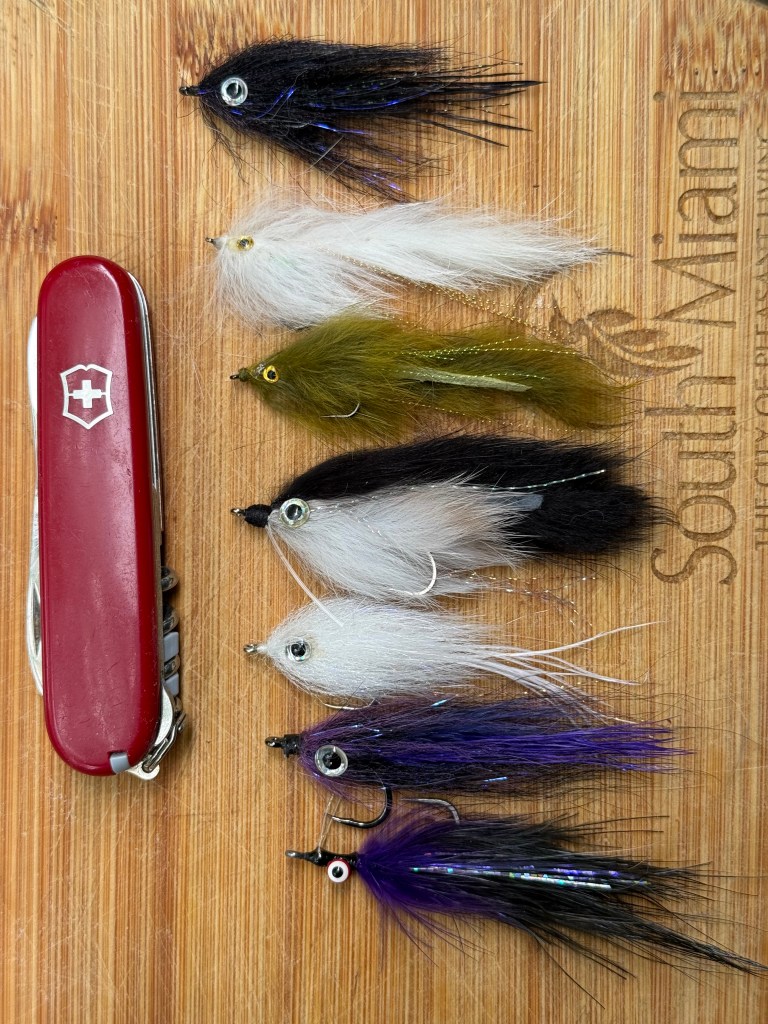
    Seven proven tarpon flies that did not catch tarpon today.

    I have been on the water for the best two hours of the day. I have pitched a hundred casts at rolling tarpon, swapped through seven flies, two of which received 13 short strikes between them but zero eats. Mangroves lining the canals have been more eager than the tarpon, grabbing my flies on the errant backcasts. My newly rehabilitated rotator cuff is starting to complain.

    I suppose it’s possible the tarpon, though plentiful, just won’t bite today.The water feels coolish but not cold, maybe 68°.

    Not catching fish is hardly the worst thing on a spring morning in the western Everglades. A bull manatee is swimming back and forth underneath me, probably curious about my kayak. Chortling songs of Purple Martins grace the air. Mullet sploosh nonstop under the watch of Great Blue Herons waiting in ambush on the odd bit of open shoreline. Anhingas and cormorants dry in the trees overhead as they digest their breakfasts. Alligators rise and sink as I pedal-paddle past.

    * * *

    THE DEVIL’S DAUGHTER

    Master fly designer Drew Chicone of Ft. Myers publishes an email newsletter with detailed instructions for tying his more successful fly designs.

    https://flylordsmag.com/featured-fly-tyer-drew-chicone/

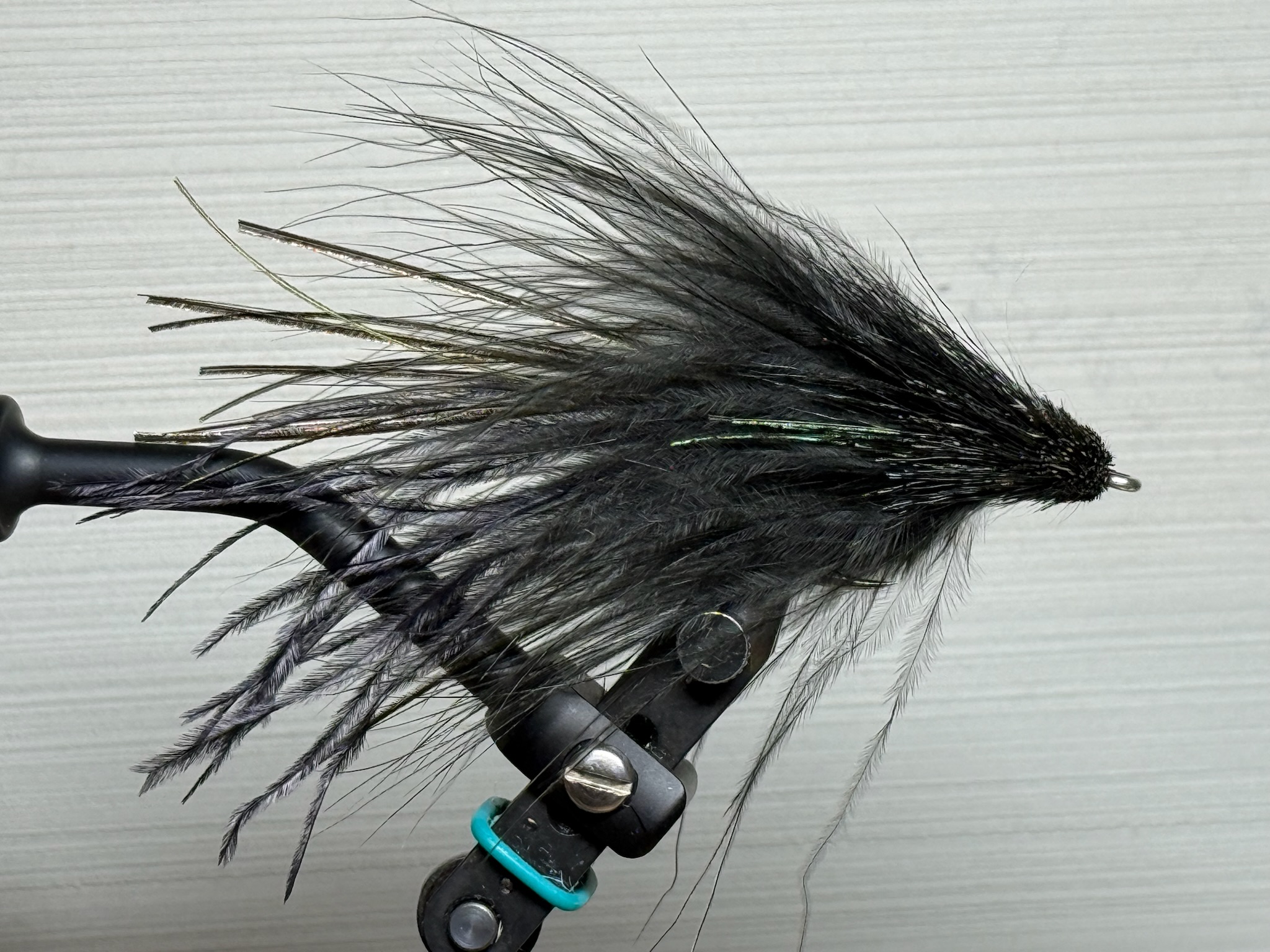
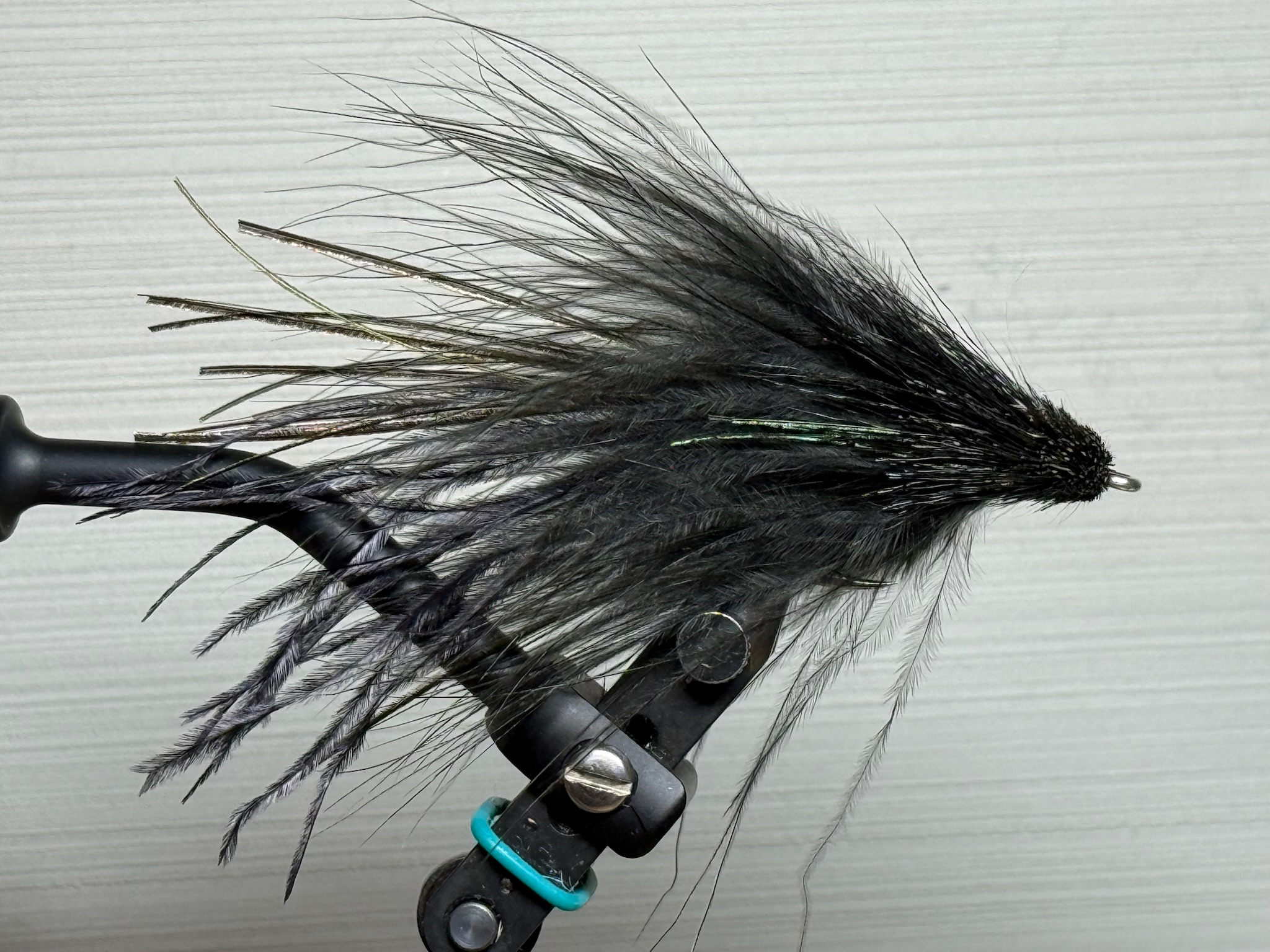
    Drew invented “The Devil’s Daughter”, a big black fly for targeting those overfished snook and juvenile tarpon that have wised to every fly in the box. It’s a complicated tie as saltwater flies go, combining shimmering peacock herl, swishy ostrich herl, and fluffy marabou feathers into a pulsating body, with a head of spun black deer hair and peacock herl that displaces water as the fly moves. The fly is light for its size, lands softly, wets quickly, swishes enticingly, and pushes water to announce its passage. I had tied one and used it only once, but it caught a 40 pound canal tarpon.

    Devil’s Daughter, freshly tied and before being gnawed by a lot of tarpon.

    This fly is in my collection today so I throw it in front of the rolling tarpon and move it through the water, mostly steady with tiny twitches to make it quiver. The fly stops and I give the line a tug…

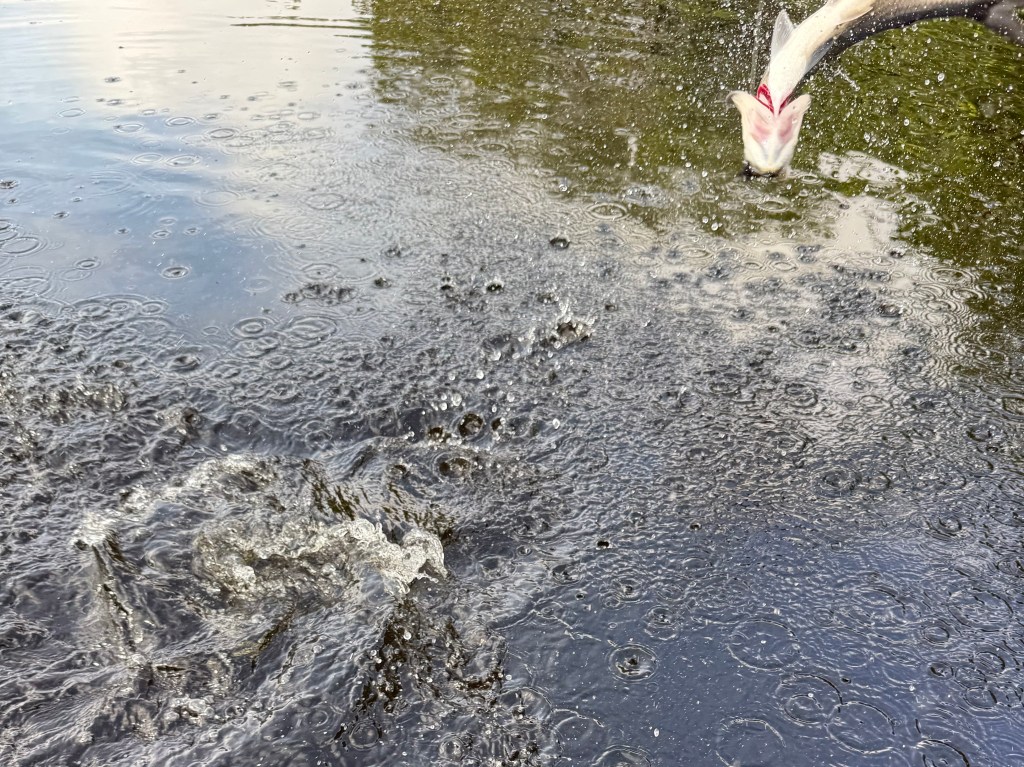
    Line rips out of my hand and screams off the reel. I take back line and a five pound tarpon goes airborne. They always do and it’s always a splendid show of athleticism.

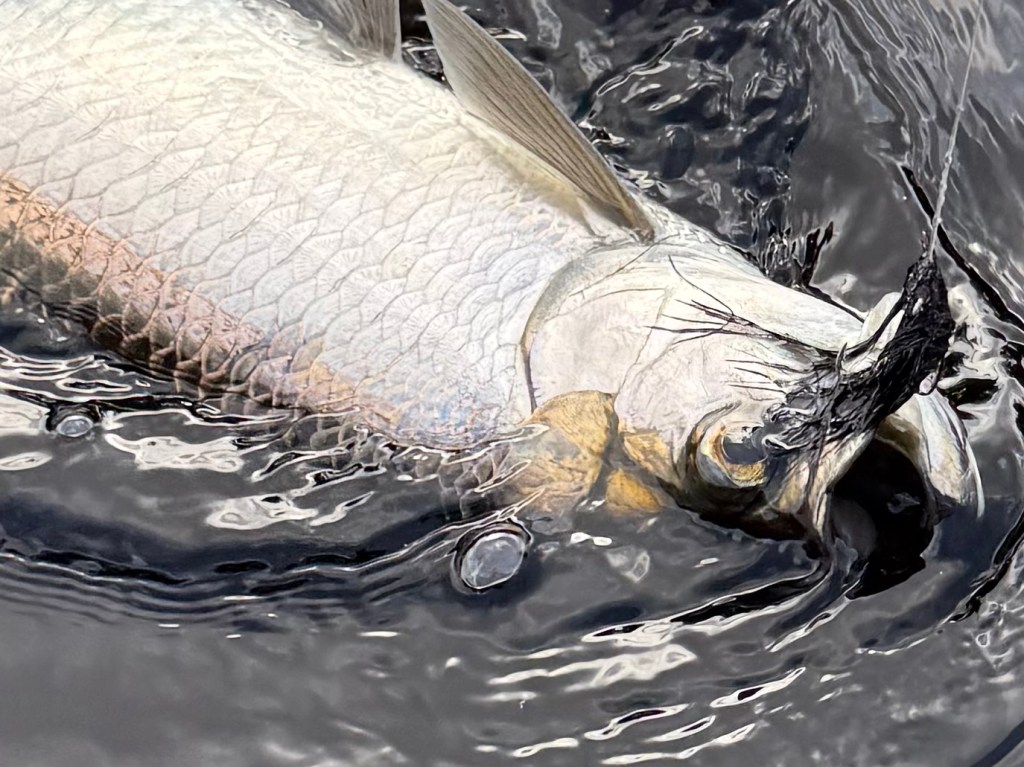
    The pink and lavender iridescence leaves me awestruck.

    Over the next two hours I catch and release eight tarpon ranging from 3 to 10 pounds.  Two manage to toss the fly and six have to be unhooked in the net.

    After being unhooked, this ten pound tarpon chose not to stick around for the photo op.

    Expert wisdom has it that the fly design matters much less than how you move the fly in the water. True enough, but this morning’s fishing success has hinged on one black fly designed by Drew Chicone. Both times I’ve fished it, a third of tarpon contacts resulted in hook-ups: two nips then an eat. Heck of a fly, Drew.

    * * *

    The sky opens up as I pull into our driveway. I could use a nap. 

    One last nod to the enduring spirit of Woody Guthrie.
    Roll on sweet tarpon, roll on.

    © Philip Stoddard

  • Falling Iguana Alert!

    It took a week, but the Arctic blast freezing tootsies across the US finally made its way to Miami on Saturday night, dropping to 34°F by dawn Sunday. 

    Most cold fronts stall before reaching South Florida, so our exotic people and critters are not adapted to temperatures below 50°F.

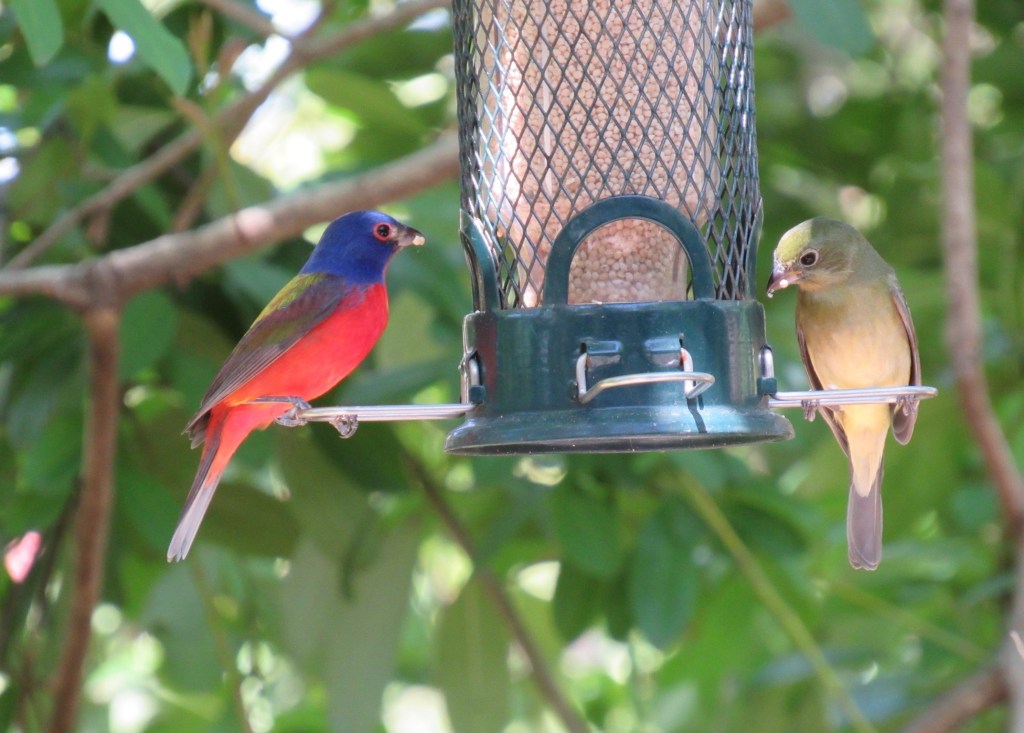
    A chill like this brings Painted Buntings into our bird feeders and moves the manatees out of Biscayne Bay and into the urban canals.

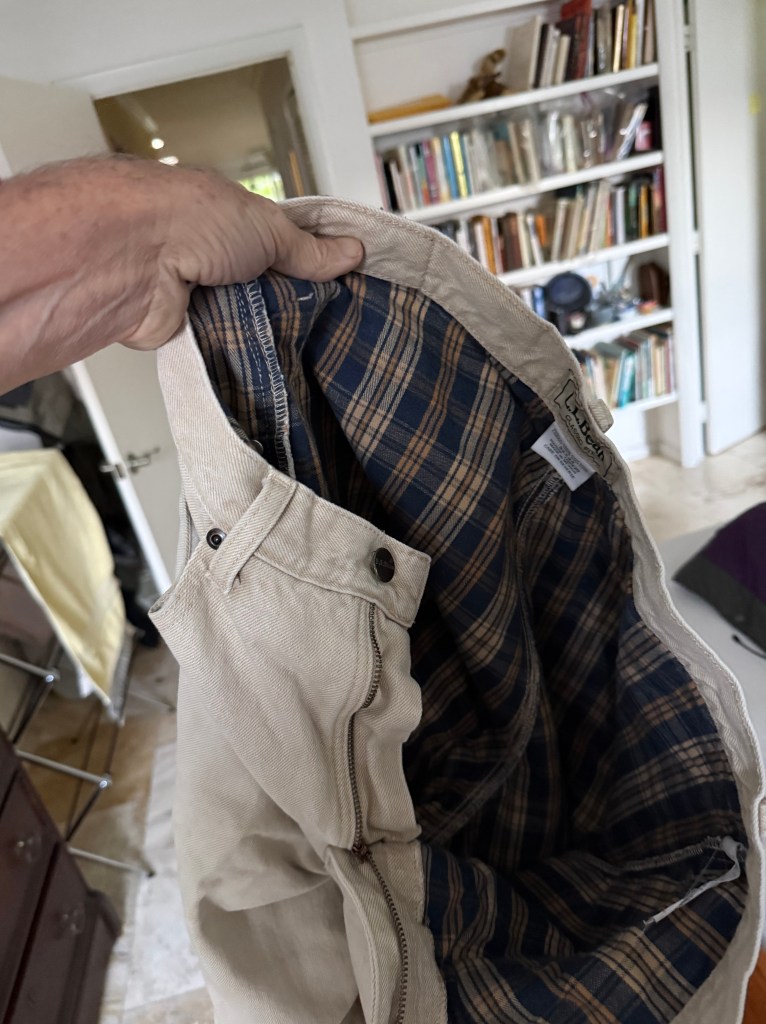
    Displaced northerners walk around shouting “Yes! Yes!” Teenage girls across Miami break out the boots with the fur. I unearth the LL Bean flannel-lined jeans and my 40 year old fleece jacket, recently refurbished by Patagonia at no charge. Everybody else wearing a too-thin jacket mutters profanity beneath their frosty breath.

    LL Bean flannel-lined jeans. Love ’em!

    The long, hard freeze of 2010 clobbered our native bonefish, snook, tarpon, and shark populations. A hard cold snap also kills-off many invasive exotic tropical fish and reptiles, but never gets them all.

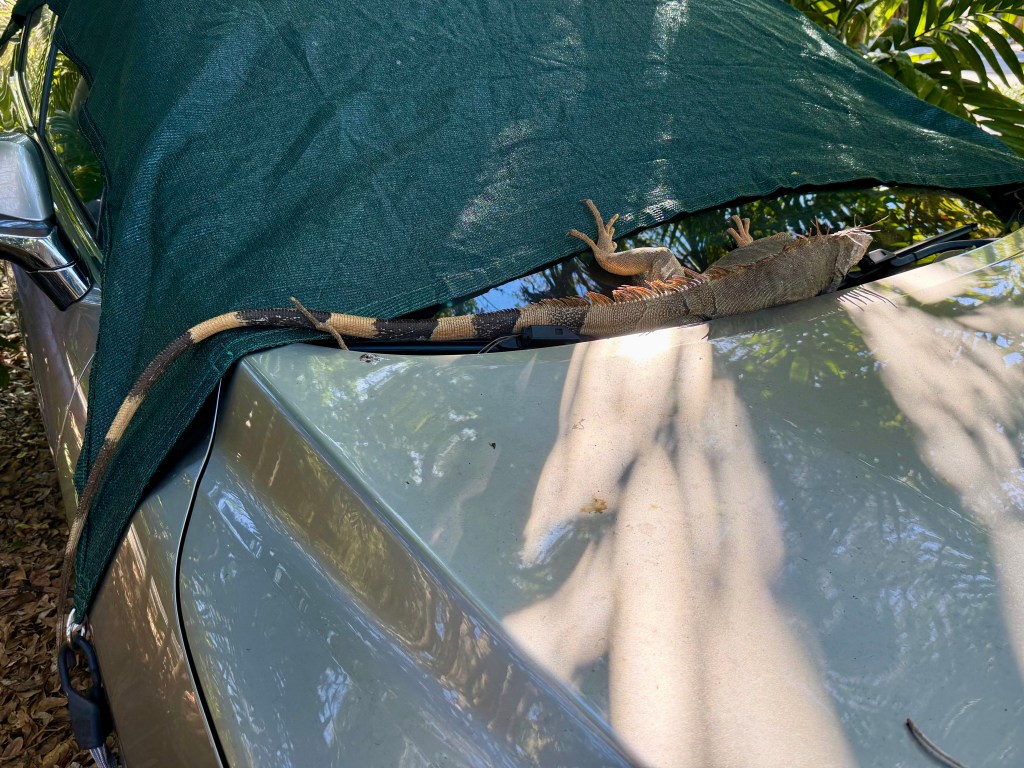
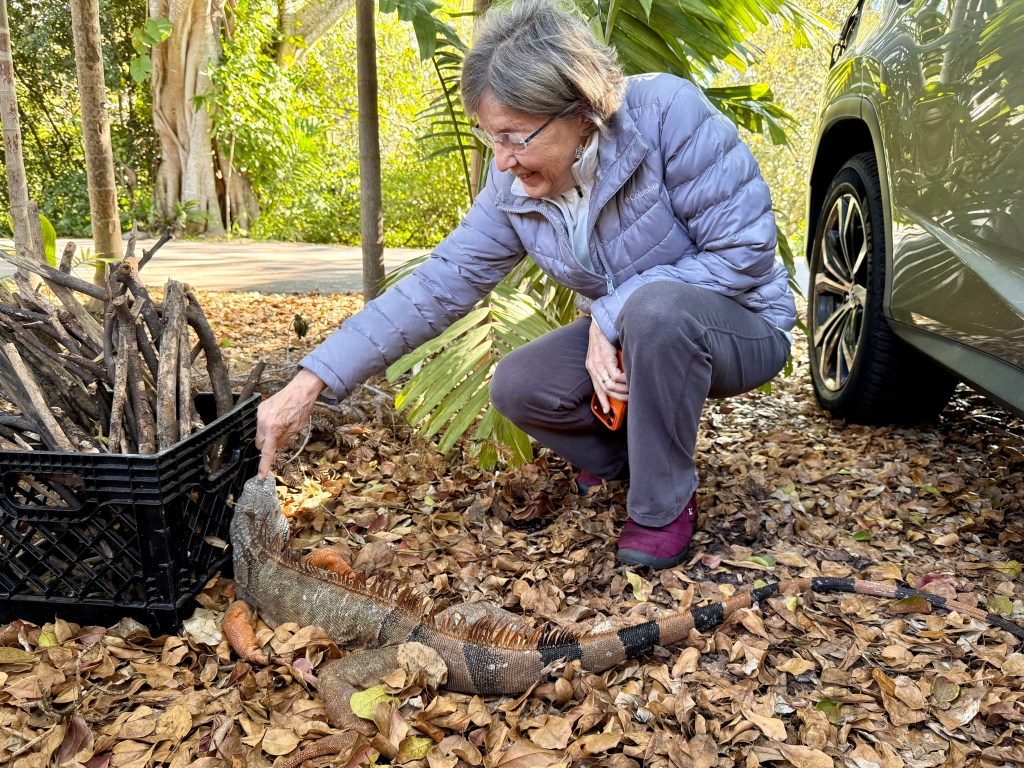
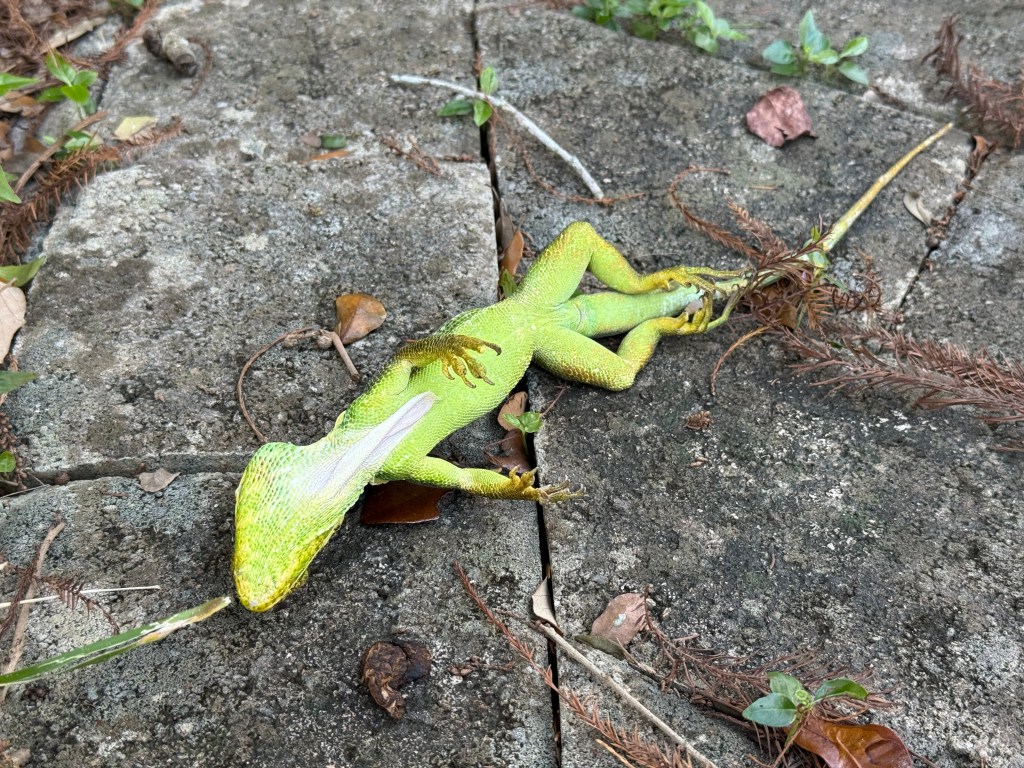
    When the temperature drops below 40°F, local news organizations issue Falling Iguana Alerts. The Falling Iguana Alert is kind of a joke down here, except it’s a real thing. All over our neighborhood, fallen iguanas littered the ground.

    This Iguana fell onto the windshield of a neighbor’s car.
    This one made it all the way to the ground.

    The bigger they come, the harder they fall – neither iguana in the photos survived. Had either of these bad boys landed on someone walking their dog, it could have done some damage.

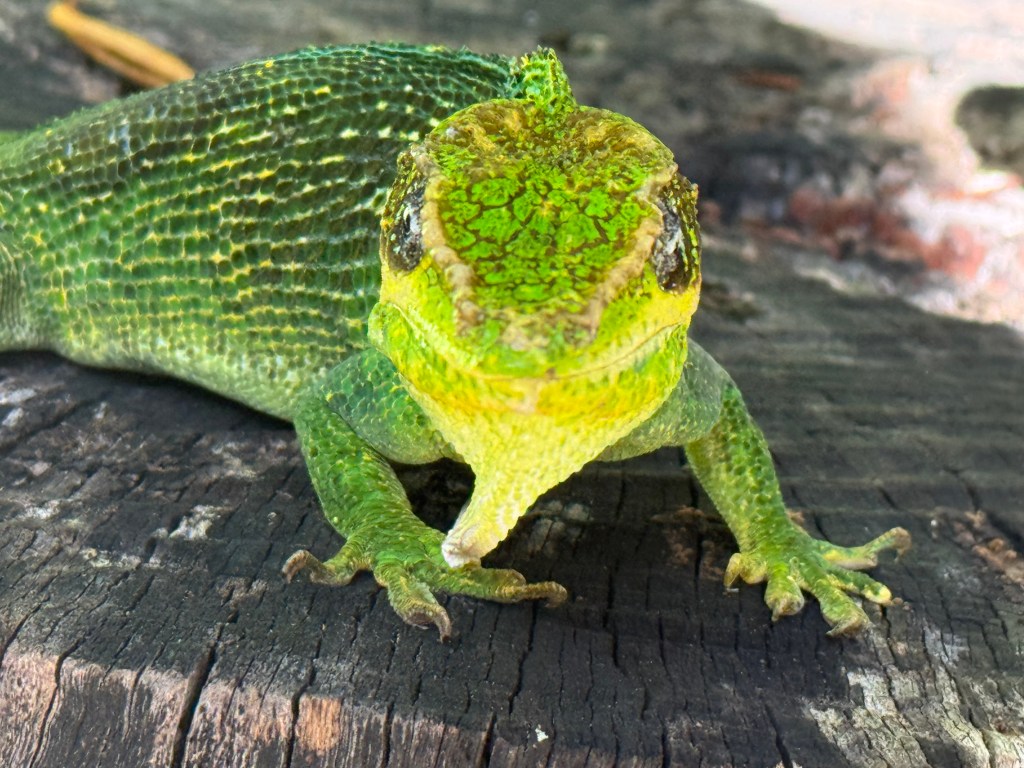
    Don’t be fooled, this frigid Cuban Knight Anole is not dead.

    A Cuban Knight Anole fell onto the patio near our backyard pond. Good-intentioned folks who don’t know better sometimes bring a cold-stunned Knight Anole indoors to warm it up. Remember the velociraptors that chased people around the lab in Jurassic Park?

    I moved Señor Knight Anole to a sunny spot by the front patio and he took care of the rest on his own.
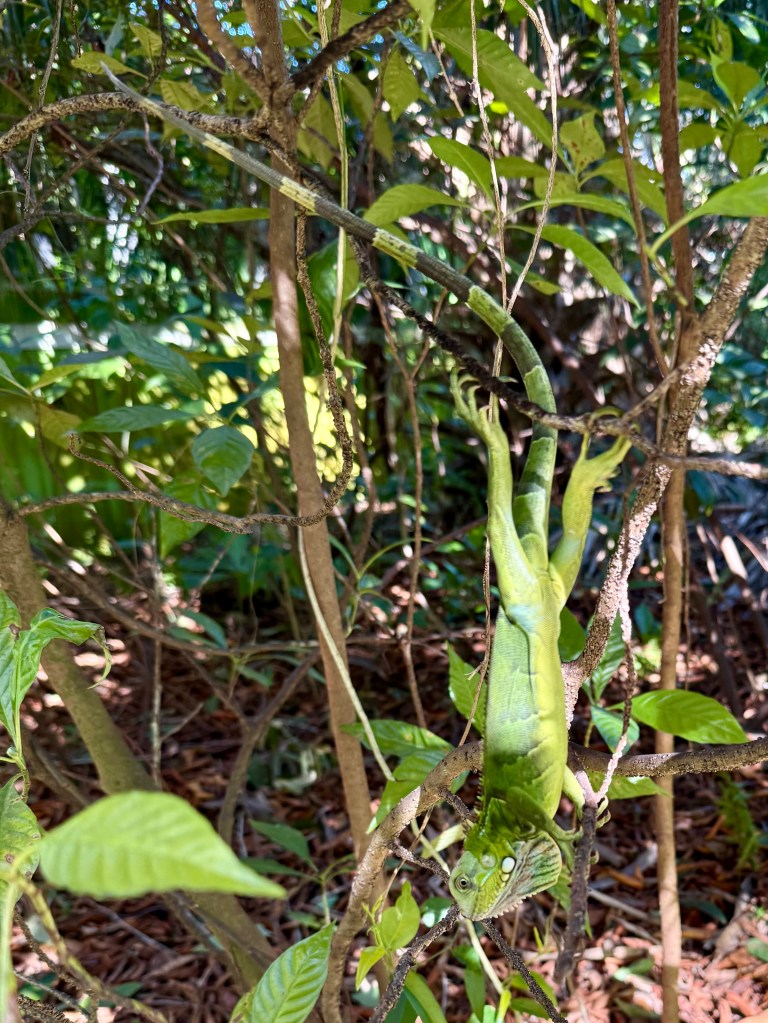
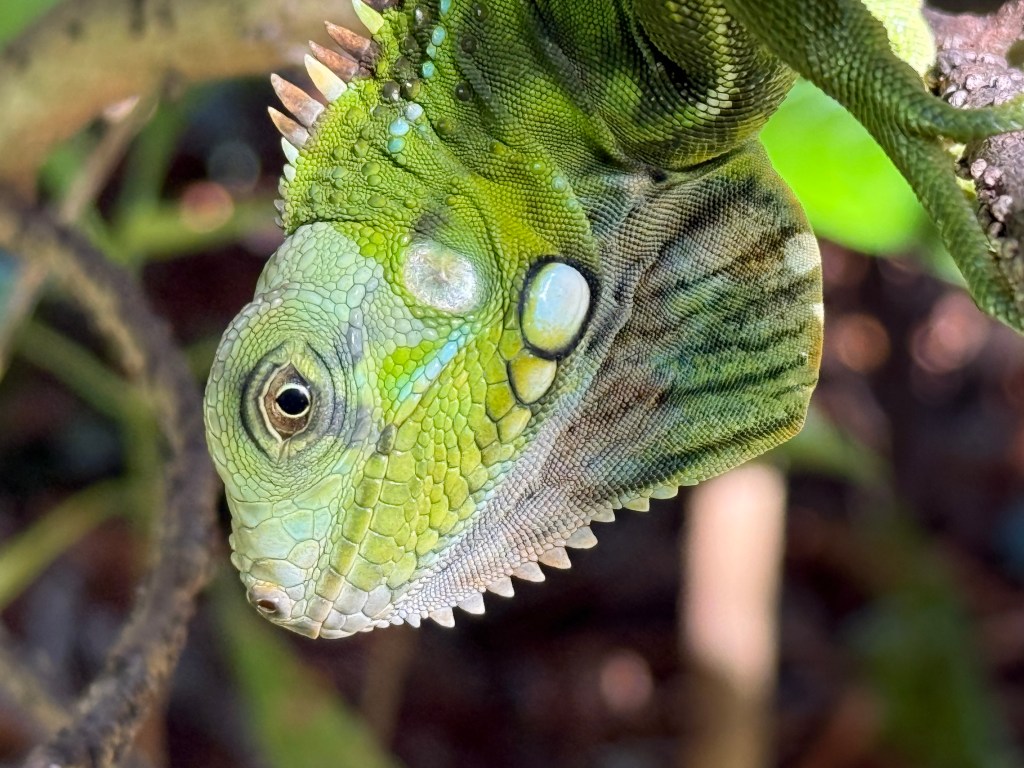
    This little iguana only partially lost its footing and was found hanging upside down in a bush outside our front door.
    Cute little guy, huh?

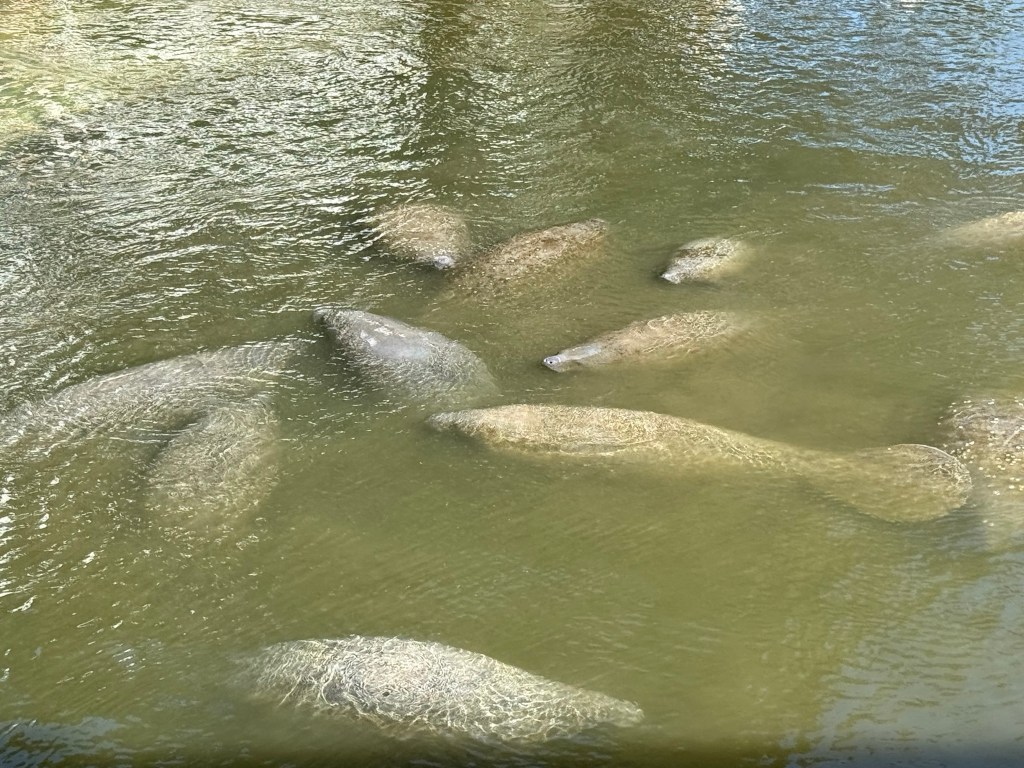
    In the afternoon, Gray and I bundled up and biked over to check on the manatees at a nearby marina on US 1.

    I counted 31 altogether. One big male kept rolling onto his back and waving his flippers in the air.

    Several bulls were quite frisky.

    It’s dropping into the 30s again tonight, perfect weather for snuggling around an outdoor fire.

    Vetoed. Both Gray and our neighbors agree that it’s too cold tonight for an outdoor anything. Sheesh. Somebody I know will be getting flannel-lined jeans for Christmas.

  • Tarpon colors

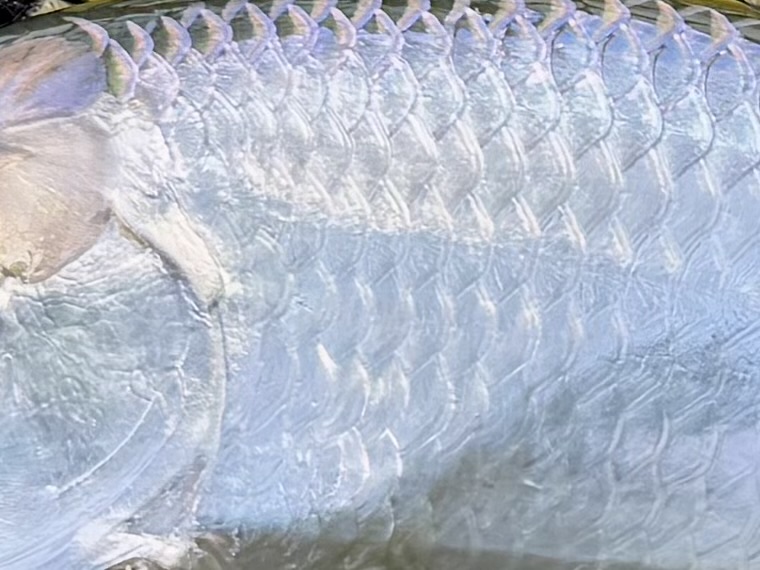
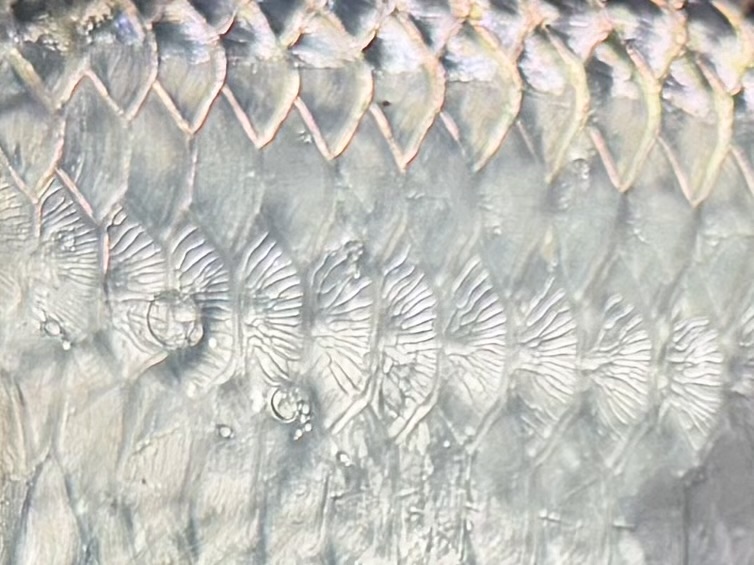
    Fish are often camouflaged, some by color and patterns that resemble their backgrounds, others by reflecting the light around them and thus matching any and every background. Tarpon do the latter with scales that work like mirrors.

    Juvenile tarpon are about my favorite fish to chase on the fly rod. I say “juvenile” because the adults weigh 70 to 200 pounds. I normally avoid disturbing the adults and fly fish instead for smaller juveniles weighing 3 to 20 pounds, reasonably common in the canals and tidal creeks of South Florida.

    Tarpon are smart and strong, and they are spirited jumpers. The mantra among tarpon fishers is “Bow to the King”, meaning when the tarpon jumps, you lower the rod to create slack and prevent it breaking off or throwing the fly.

    Instead, I lightly tension the fly line during a jump to help the tarpon toss the fly without breaking the line. My goal is to fool the tarpon into eating my fly, have it give me a showy jump or two, but spare it the exhaustion of a complete fight and spare me the guilt of exhausting a beautiful fish.

    Yesterday, while kayak-fishing a saltwater canal, three miles from home as the cormorant flies, I spotted a couple of big juvenile tarpon in the 40-60 pound range. I swapped up to a larger fly “the Devil’s Daughter”, a muted black pattern designed by Drew Chicone for catching tarpon that are wise to the fly fisher’s usual sparkly fare.

    Tarpon can breath air, “rolling” on the surface to gulp a bubble before descending into the murky water. Following a roll, I’d cast the fly 6-10 feet in front, let it sink a bit, and retrieve it steadily. Twice I felt “short strikes”, in which an unseen tarpon grabbed only the feathery tail of the fly. A couple of casts later the fly stopped mid-retrieve, like I’d hooked a log. I set the hook and the line began to pull. The fish was in no hurry.

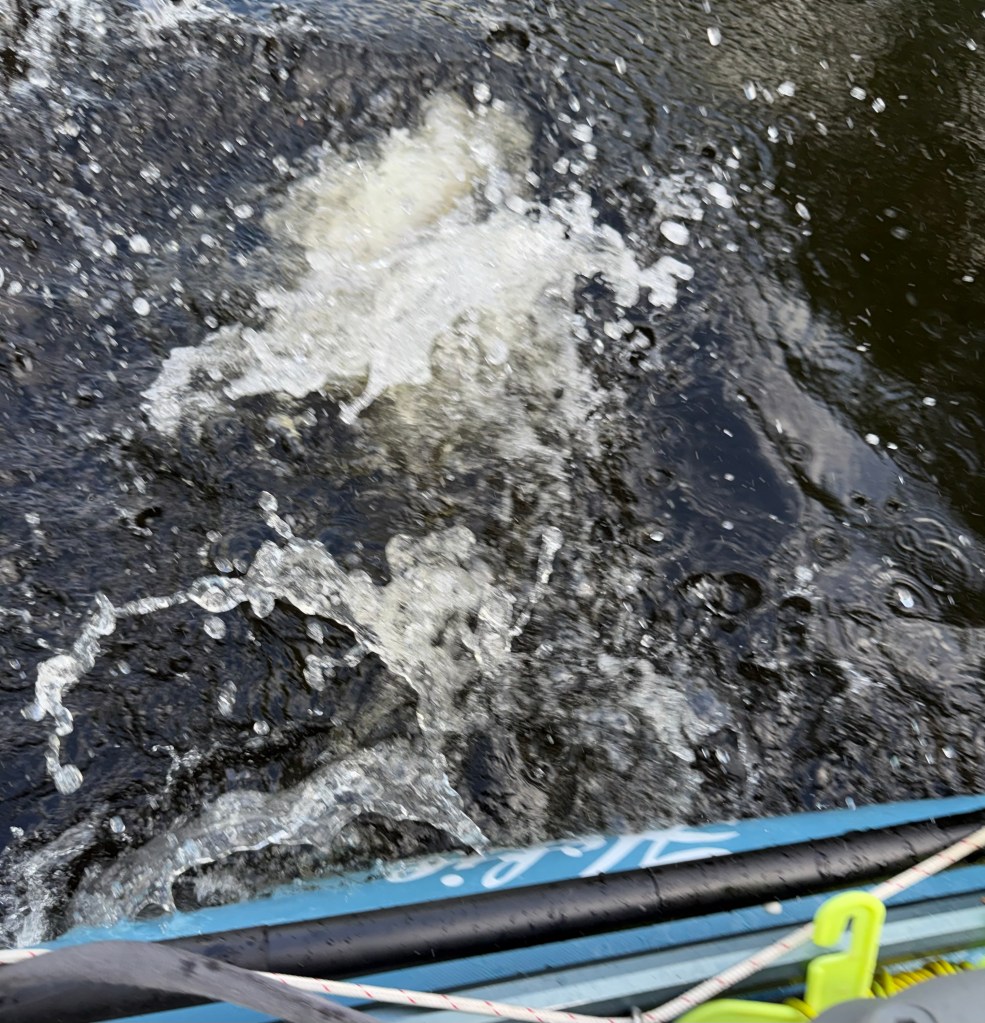
    Smaller tarpon jump immediately. Instead this tarpon went deep and swam away slowly. I took up the slack and kept reeling until my 7wt rod bent double and the leader touched the tip guide of the rod. The tarpon turned and made a dash under the kayak. I flattened the propulsion flippers to keep the line free as I worked it around the bow and the tarpon took off. Once in a while, I’m glad for the smooth drag on my fly reel.

    We had been pulling back and forth on the fly line (intermediate clear tip) for a couple of minutes and the tarpon had enough. It took to the air, arcing its body in a fast reciprocating shake that tossed the fly. I got my fly back and the tarpon continued on its hunt for hapless baitfish. I was ecstatic – that’s about as good as it gets in my book.

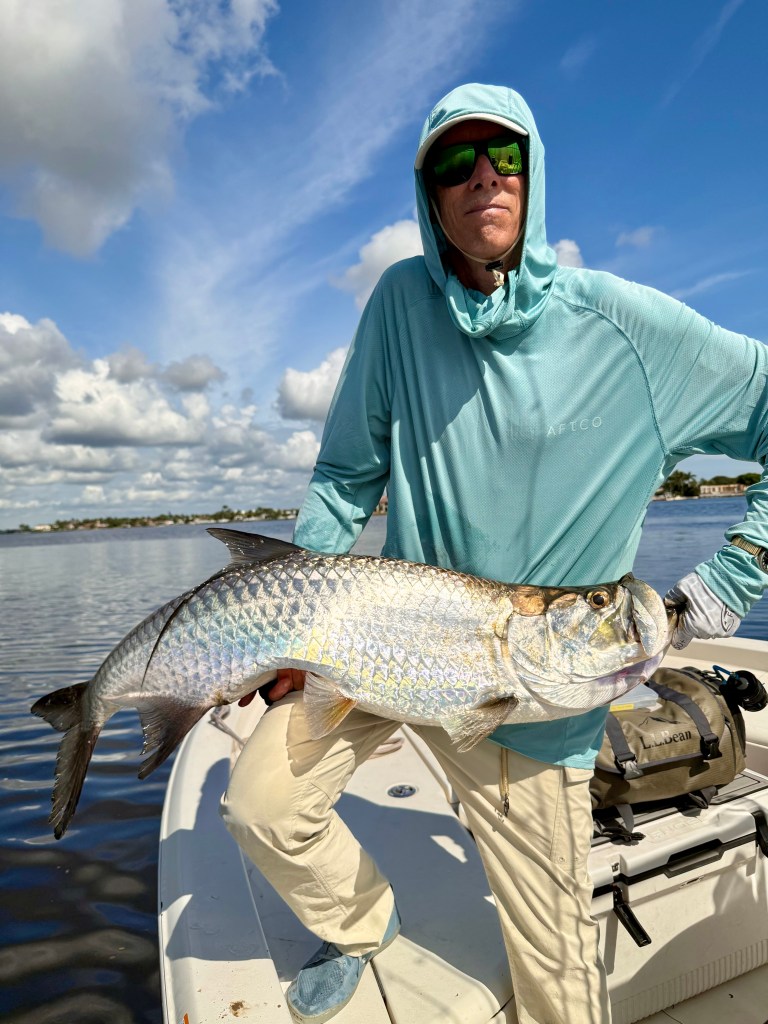
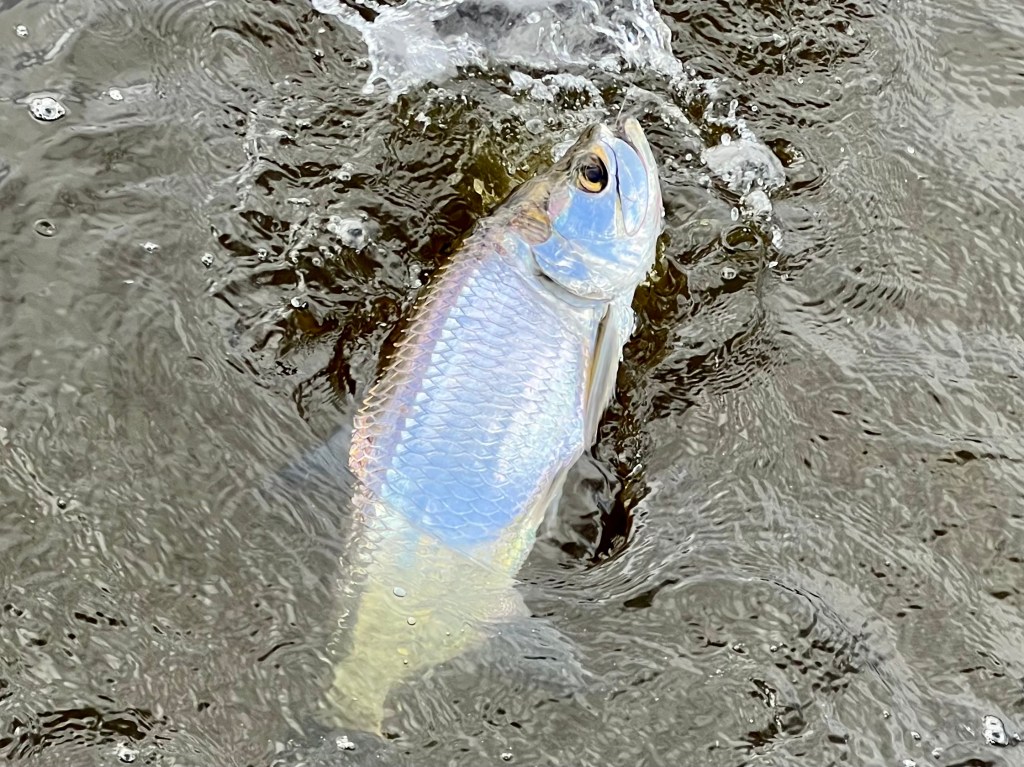
    Sometimes the fly won’t shake loose and I must net the fish to release it. While I have it in the net, I usually take a photo to document the spectacular purples, pinks, blues, and greens reflected by the tarpon’s mirrored scales. Here are some photos from my collection.

    Thank you, tarpon.

  • To decimate 

    … as in “The Burmese python is decimating native wildlife across their invaded range.” Miami Herald, 12-Jun-2025

    Marsh Rabbit photo swiped from Animal Diversity Web. Such cute ears!

    People today use “decimate” synonymously with “devastate” and it bugs me.

    These two words sound similar, but to “decimate” is to reduce by 1/10th, not reduce to 1/10th

    I’d be thrilled if pythons had only decimated Everglades mammal populations.

    Origin – The verb “decimate” dates back to ancient Rome. My high school Latin teacher, Mr. Downum, explained that if a member of the Roman Legion committed a heinous crime, and nobody among the ranks would identify the culprit, all the soldiers were lined up and every tenth one was killed.  Wikipedia provides a similar explanation with more detail and historic record, albeit limited. Decimation didn’t happen a lot after the scary new word got around. The original meaning gave “decimate” the power to change human behavior for the better.

    Here are more examples in which over-educated people are decimating the lexical diversity and power of our language:

    The first time I drove into Tuscaloosa after the storms, I had to pull over on the side of the road to take in the decimation and collect myself.”  Joyce Vance, 17-May-2025

    A Fungus Decimated American Bats. Now Scientists Are Fighting Back”  Headline, The New York Times, 17-Sep-2024

    In 1989, Hurricane Hugo decimated much of the remaining old-growth forest that is vital habitat for endangered red-cockaded woodpeckers, Leuconotopicus borealis.” @grrlscientist, 11-Oct-2024

    It’s everywhere. Even Heather Cox Richardson and Paul Krugman conflate “decimate” and “devastate”, two erudite professors with a mastery of English.

    In a living language, word meanings can change. Still, this one sticks in my craw every time I read it. Seems a shame to lose such a graphic and powerful word to confusion in common parlance.

    * * *

    I’d tell this to the marsh rabbits in the Everglades, if I could find one to tell. Not that a marsh rabbit ever listened to what I had to say. Not even back in the pre-python glory days, when legions of round-eared bunnies lined up ten feet apart along the swale of the Shark Valley tram road every evening. Had they merely been decimated by Burmese pythons, they’d line up today eleven feet apart. Like coral reefs and trees dripping with migrant warblers, or a savored word that’s lost its meaning to misuse, I miss them.

    Grumph, grumph, grumph.

    © Philip Stoddard