
A favorite backyard game in the summer of 2006 was holding my 8-year old daughter aloft in both hands and tossing her headlong into the deep end of the pond. “Do it again, Daddy!”
And I did, over and over, until something went “pop”.
The regional elbow specialist, Dr. Obvious, diagnosed the injury:“You pulled a ligament in your elbow.”
He prescribed the state-of-the-art treatment: “Baby it.”
Forever, it seems.
After taking up saltwater fly fishing in 2022, I discovered that fly casting is an elbow-intensive sport. The heavier the rod and line, the greater the elbow strain.
I settled into elbow-friendly fly rods 7 weight and lighter. But I’ve found that a 7wt setup, situated in the middle of the weight range, has its limits: the 7wt can’t deliver big flies very far or turn a big snook away from the mangroves. Of greater consequence, a 7wt fly line cannot punch far through the coastal winds common on the open flats. Can I only pursue medium-sized fish using smallish flies on calm days?
This year has been extra windy, as documented by the local avocado growers, who complain that wind desiccates the blooms and lowers their yields. I’ve been using the 8wt rod more than my elbow likes.
To fish tarpon with my friend Chris Schneider in the Keys where it’s often windy, I really need an 11 or 12wt setup, but I can cast Chris’s elegant Hardy 11wt tarpon rod twice at most before my elbow calls Uncle.
I’ve been pondering two solutions: left-handed casting (working on it) and two-handed casting. Left-handed casting is good relief, but when my left elbow began taking notes from the fussy right one and demanding equitable treatment, it came time to study up on two-handed casting.
Salmon fishers on the River Spey in Scotland invented the two-handed Spey casting system for throwing big flies on big rivers with long rods and heavy lines. Queen Elizabeth II was said to be a good Spey caster in her day.
Steelhead fishers on the Skagit River north of Seattle evolved their own variant of Spey casting, using shorter shooting heads on their fly lines.
A two-handed cast with a long Spey rod should still load the elbow but minimize the elbow flexion that particularly irritates my injured ligament. In Spey casting, the caster’s dominant hand holds the rod above the reel and remains almost stationary as a fulcrum, while the other lightly hand grips the rod butt, performing a sharp, short, punch and tuck to lever the distant rod tip back then forward. In contrast, a single-handed fly rod cast is 100% forearm action, maximizing both elbow flexion and torsion.
I looked up [Spey + tarpon] on the web. Wading past the page of retail ads, I spotted the podcast Wet Fly Swing featuring an hour-long interview with saltwater Spey casting evangelist John Grasta,. Grasta has adapted the Skagit Spey style to fishing Florida’s mangrove coasts for tarpon. And he lives in Florida within half a day’s drive of my house.
I tracked down John Grasta at the Bass Pro Shop in Orlando, where he runs the store’s expansive fly fishing department.
John is an affable guy who retains his Rochester accent. One could not find a more enthusiastic Spey coach. A couple of weeks ago, I hired John to give me a Spey orientation and casting lesson on one of his days off from work.
I drove 215 miles north from Miami to Orlando, stayed overnight with a University of Central Florida colleague, and met John at his house in Winter Garden, Florida, following him to a park on the shore of Lake Apopka.
Apopka is famous in zoological circles for its male alligators having been feminized by the endocrine disrupting effects of pesticide runoff. Here in Florida, that’s a lifestyle choice, right? But I digress.
John laid out his collection of Spey rods on the bed of his pickup.
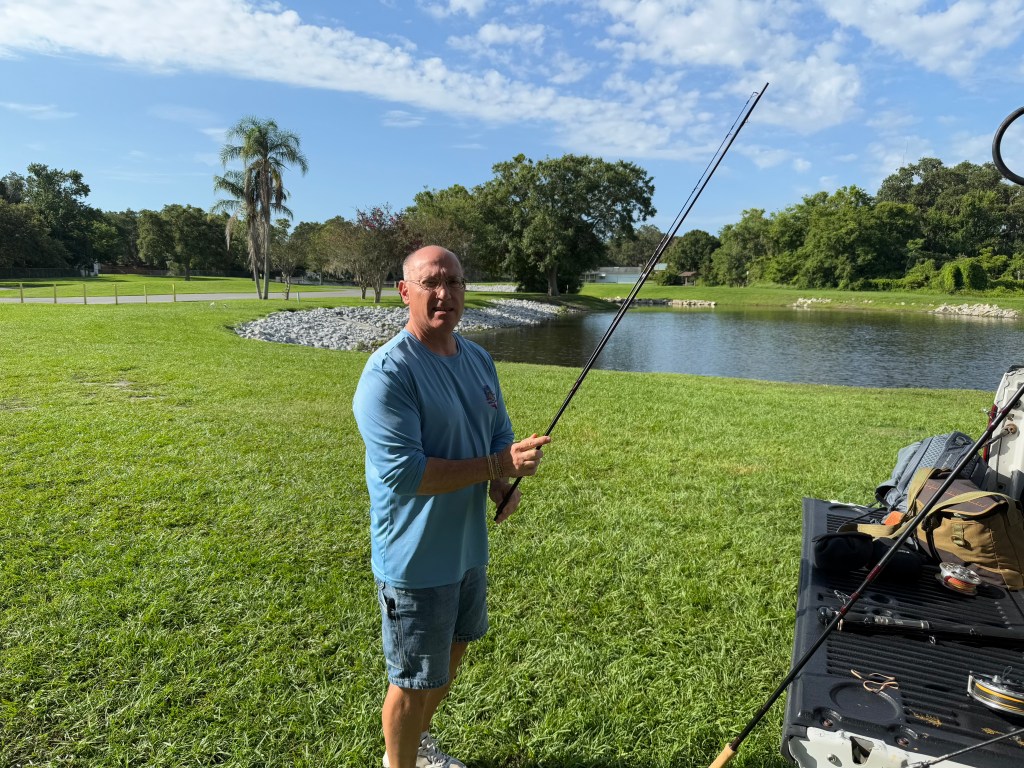
He rigged up a few rods, and spent the next hour explaining innovations in the specialized tackle and narrating the dynamics of the simpler Skagit Spey casts.
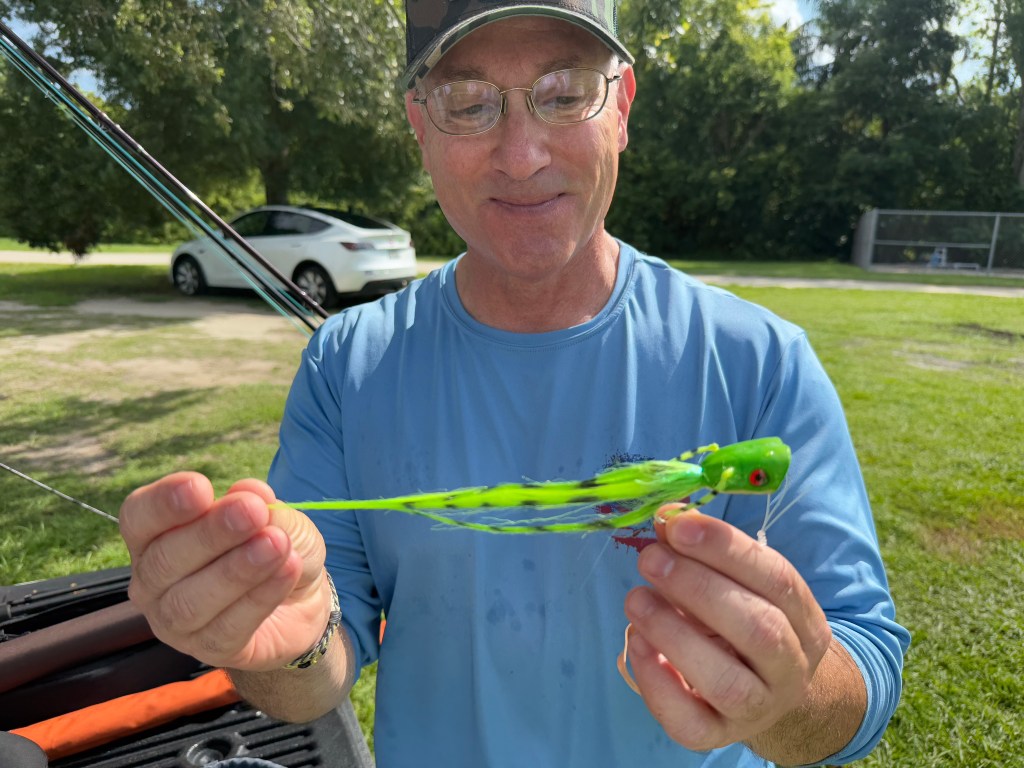
I asked a million questions, taking notes, photos, and videos.
After an hour of explanations and demo casts, John handed me a 15 foot, 10wt rod rigged with a short Skagit shooting head.
Hopes are high, but tempered by the recall of my learning curve with single-handed fly gear. I also remembered the podcast where John explains how many thousands of casts it takes to get competent with a Spey rod. To increase the challenge, a wind is blowing directly at us. Being realistic, I expect my first two dozen or so Spey casts will resemble hurled plates of spaghetti.
I took a breath and exhaled as I made my first cast…
The line shot out 70 feet, dead straight. I couldn’t believe it. That’s my maximum single-handed cast range with no wind.
I tried all the rods and, not surprisingly, my elbow chose the lightest one, a 12 foot, 7wt, fast action Sage Igniter that John had rigged with the equivalent of a 12wt single-handed tarpon line.
After half an hour with the 7wt, I was throwing long casts that cleared all the line. After the last one, I retrieved the thrown line from the lake, laid it out on the grass, and measured it with my calibrated paces: 96 feet +/- 3%. That should do.
* * *
On the long drive home I spotted fourteen Swallow-tailed Kites.
Fishing the flats at Flamingo yesterday, a Swallow-tailed Kite danced in the sky over the mangroves.
More kites swooped low over the trees as I drove home through Everglades Natl. Park.
Last night as Gray and I shared mango slices for desert, we heard a chorus of whistled peeps above us – baby Swallow-tailed Kites! While I got odd glimpses through the trees (video below), Gray scrambled up the step ladder to the roof for a view of the open sky. Five kites circled our neighborhood, the parents with three noisy fledglings.
In July, the Swallow-tailed Kites will leave the Southeast to winter in the tropics. Satellite tracking shows they depart the west coast of Florida and fly SW across the Gulf of Mexico to the Yucatan.
Sensing a theme in the air, I take my recent flurry of kite sightings as an omen for a bright future of feathers making long flights over water.
© Philip Stoddard, 2025
 Eye of the Cormorant
Leave a comment