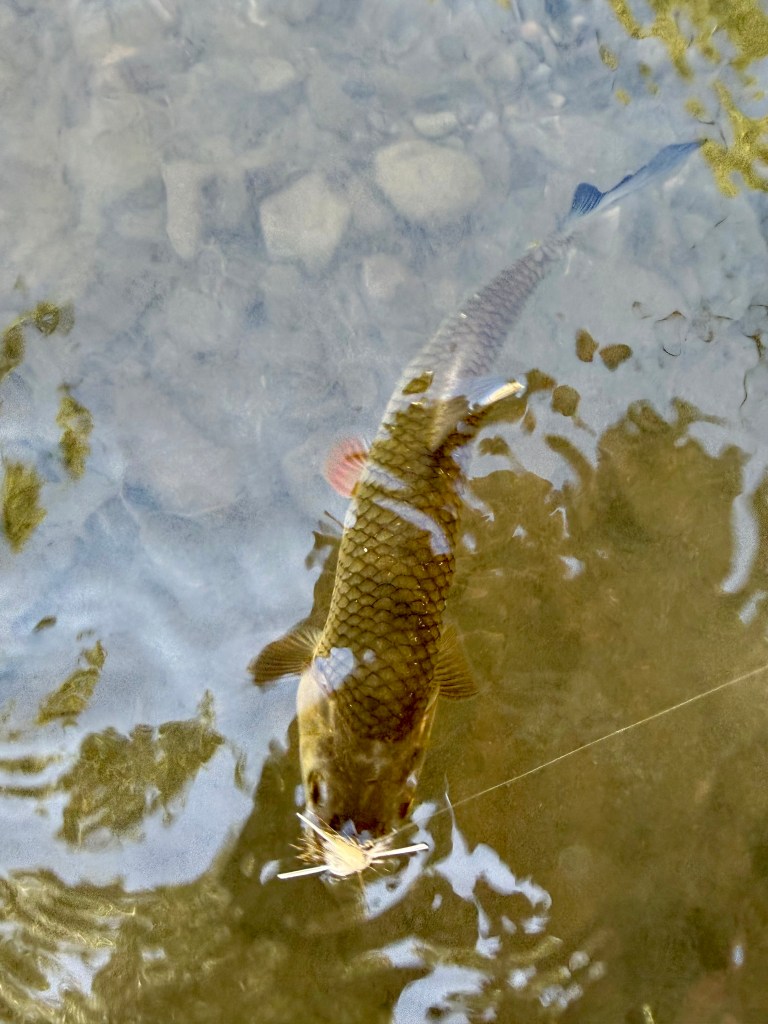
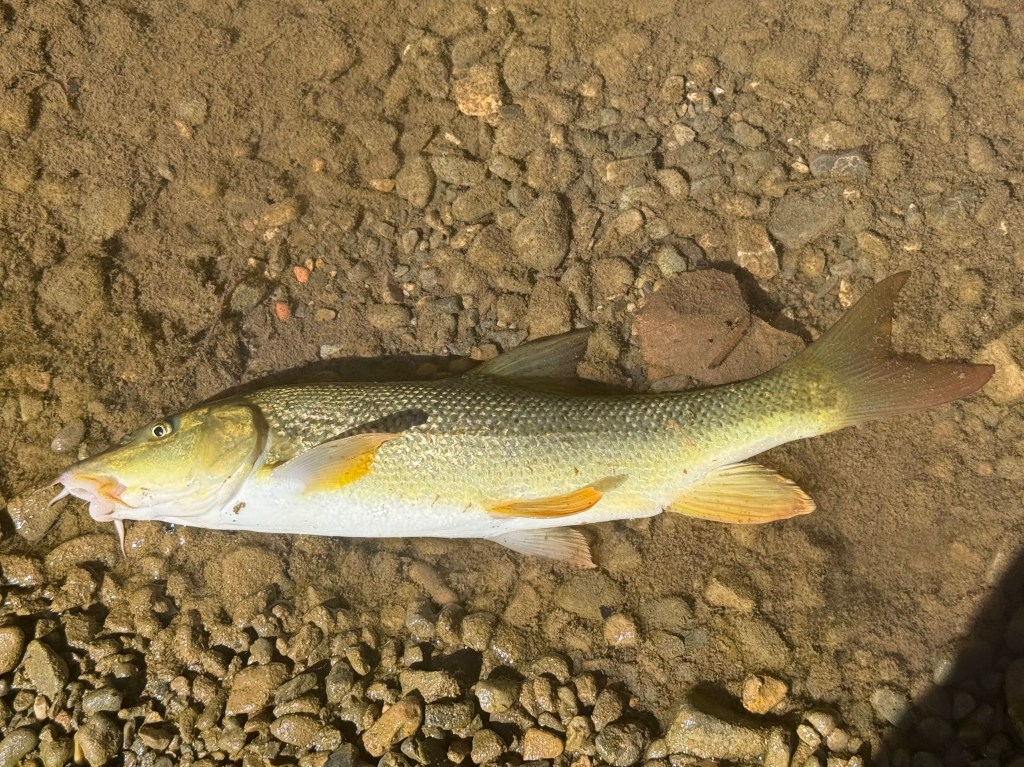
Eye of the Cormorant

another odd bird who chases fish.

Tag: fishing

  • Curse of the Redfish

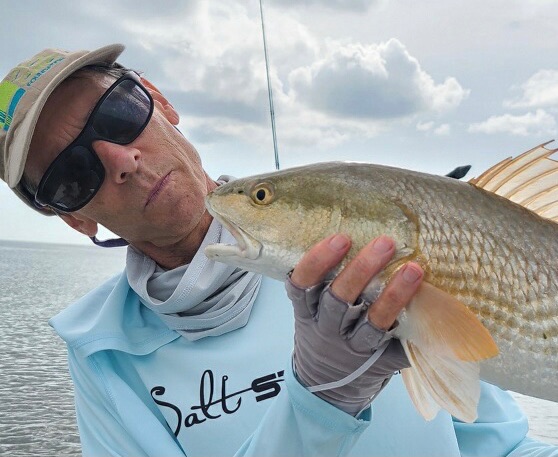
    Since I took up fly fishing four years ago, I have caught 42 species of fish on fly. Conspicuously missing from this assortment is the humble redfish, aka Red Drum, even though redfish frequent the flats and lagoons I fish in Everglades National Park.

    It’s not like I can’t catch redfish at all. I have caught dozens of redfish using spinning gear and soft plastic lures, and several more on natural bait.

    Most times, redfish are easily sight-fished by offering them an imitation baitfish or shrimp. If you make the lure appear from elsewhere, then make it try to hide like a scared shrimp or escape like a panicked or injured baitfish, a redfish can’t resist pouncing on it. Sometimes, when sharks are feeding nearby, I’ve tempted redfish with a lure that has no hook, just for the fun of watching them dive on it like a beagle on a slice of pepperoni.

    If the light is bad for spotting redfish beneath the water’s surface, one can cast a lure towards “nervous water”, whereupon the redfish roiling the water’s surface from below is likely to grab it. Throw a lure up a dark, mangrove-lined creek and the unseen redfish hunting crabs in that creek will probably chase it down. Pitch a lure under the mangrove trees where a redfish is hiding in the cool shade, and the redfish will snatch that lure before it touches the bottom. Once a redfish has hold of your lure, it will tug like a bulldog. I have mistaken a big redfish for a small shark.

    My total failure to catch redfish on a fly is not for lack of trying. I’ve worked at it with obsessive dedication. Day after day I venture forth on the flats before dawn, saying “This will be the day I catch a redfish on fly.” The sun rises, redfish reveal themselves on the flat, but for one odd reason or another, it just doesn’t happen. Here’s a sampling of the redfish I have NOT caught on fly:

    • I was surrounded by 50 redfish, noses in the mud and tails in the air. They completely ignored every single fly I dropped next to them or pulled past their noses in the muddy water. I guess stirred up mud makes it hard to see.
    • Again I was surrounded by redfish feeding on all sides, but each one stayed just out of fly casting range. Was it a redfish conspiracy or do I need to change my deodorant?
    • I arrived early, waited patiently by a particular oyster bar until the moment in the incoming tide when redfish came to feed on the bar. I placed my fly directly in front of that feeding redfish only to have a puffer swim in, grab the fly, chew off the fur, get hooked, and then flap about, scaring off the redfish. The redfish was not seen again at that bar. Ever.
    • I have stalked schools of redfish feeding in the shallows near a bank in a saltwater lagoon, approaching ever so slowly for 20 minutes, then watched them zoom away, spooked by a Little Blue Heron or a tern passing overhead. Redfish can’t be too careful.
    • A redfish swam right past my stationary fly. Didn’t see it. I recast the same fly in front of the same redfish, moved it a tiny bit to get the redfish’s attention, and the redfish spooked like it had seen a ghost. Damned if you do, damned if you don’t.
    • I designed and tied a special sparkly redfish attractor fly, cast it into high-tide redfish haunts under mangrove branches, and caught some nice snook instead. I’d hate to complain about catching snook.
    • I watched a redfish follow my fly for 10 feet then turn away. I think it liked the fly, but then remembered it wasn’t hungry.
    • A redfish bit my fly but did not get hooked. Am I getting warmer?
    • I drove 3 hours each way and stayed overnight with my friend Herman, who took me fishing at all his secret redfish spots around Pine Island. I just saw one redfish, a baby “rat red”, and Herman saw none. We blamed the almost-full moon and the slow daytime tides, but we both knew in our hearts it was the Curse of the Redfish.

    I’m sure that as soon as I catch one redfish on fly, the next one will come quickly, and then they’ll become easy enough that I’ll wonder why they eluded me for so long. When I was a teenager, that’s how it was with birds. I’d knock myself out to spot a new species in the wild, then, after I’d found my first one, they’d pop up like mushrooms everywhere I went.

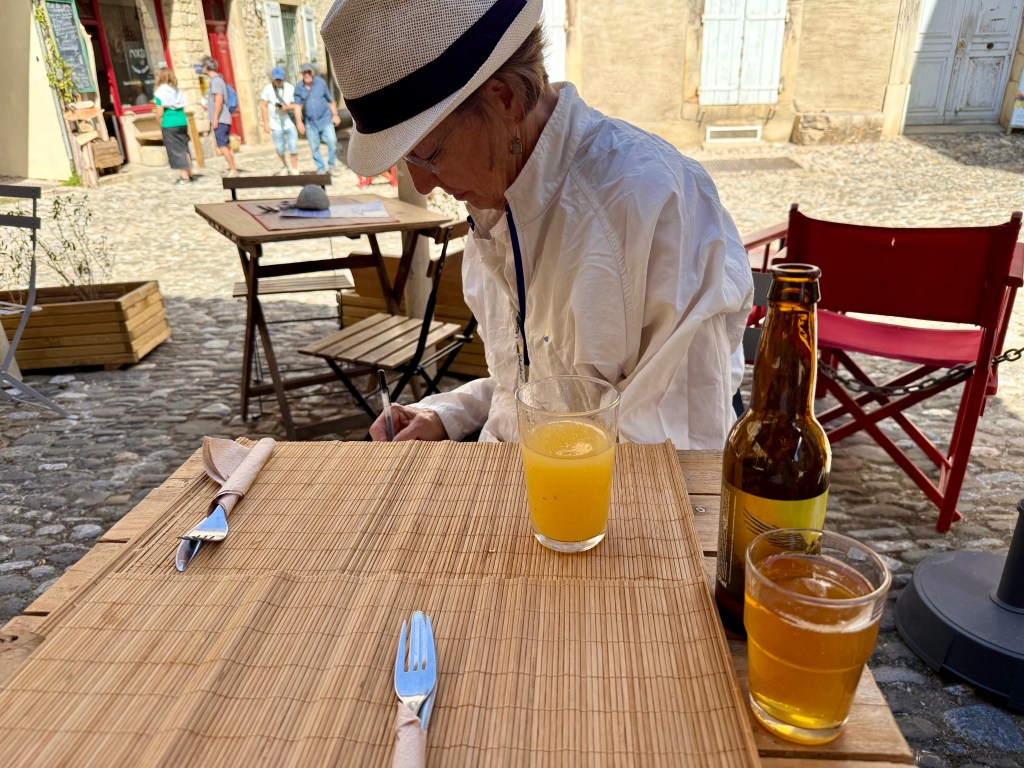
    Gray and I will spend most of September in France, where red wine will make up for lack of redfish. I will resume my quest upon our return to Florida. I have tied a new crab fly that catches every redfish I see in my dreams.

  • Yucatan 4: First Permit on a Spey rod?

    Yucatan 4: First Permit on a Spey rod?

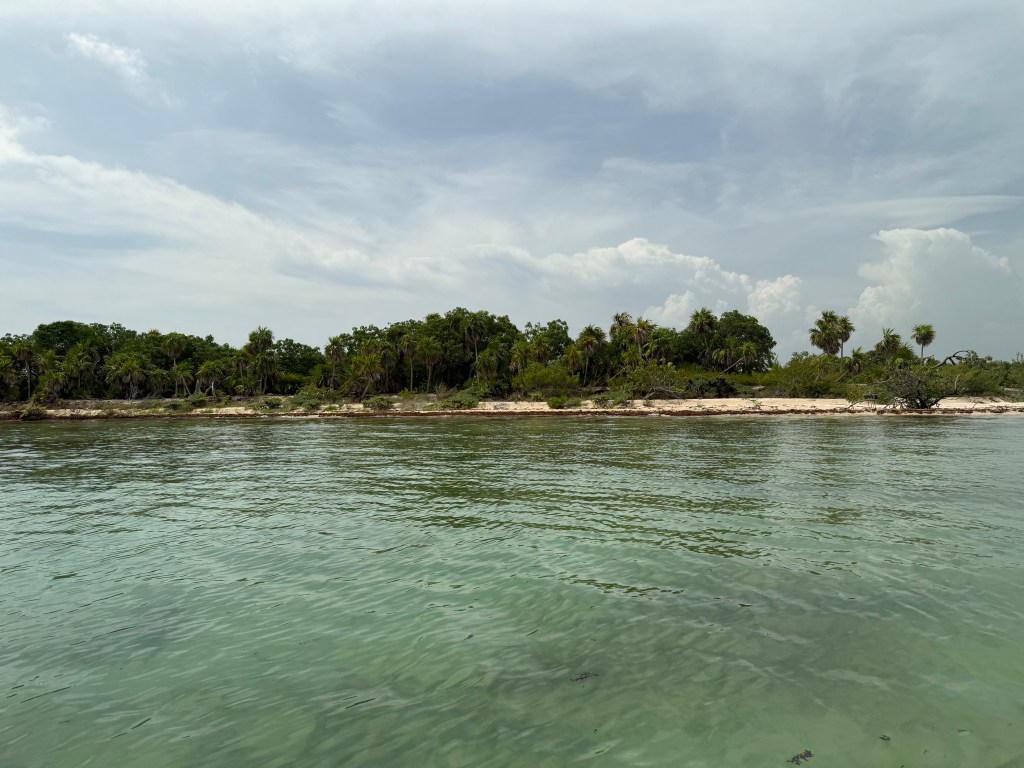
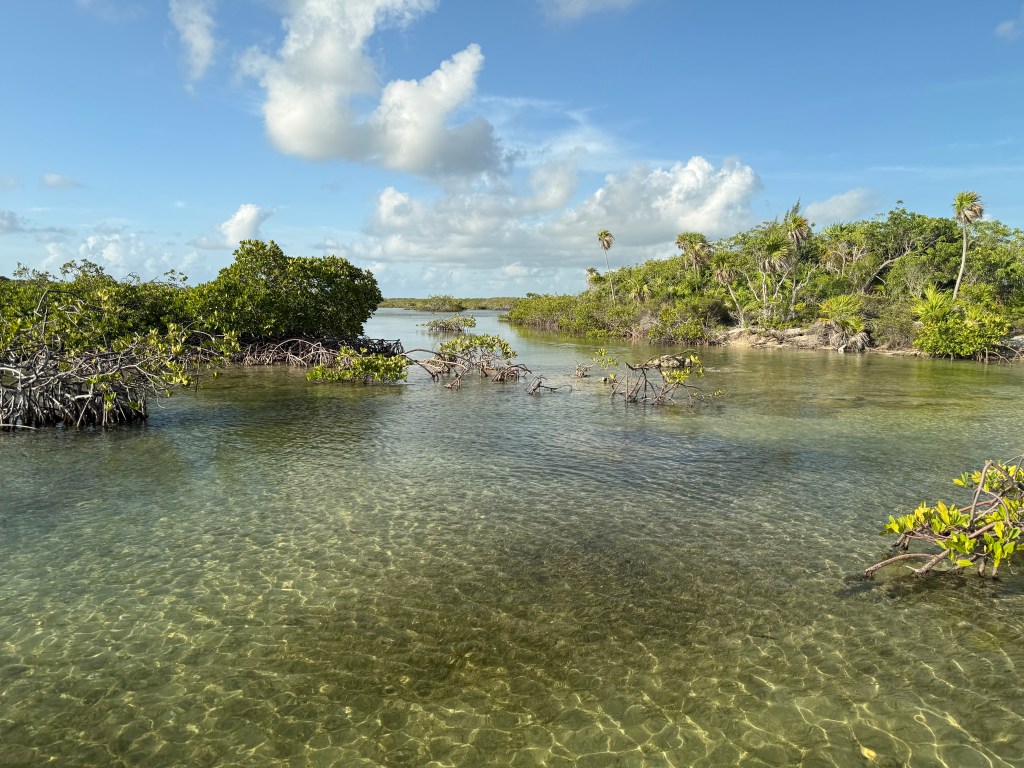
    Fly fishing for Permit on the flats of Espiritu Santo Bay in the Sian Ka’an Biosphere Preserve

    Day 2.

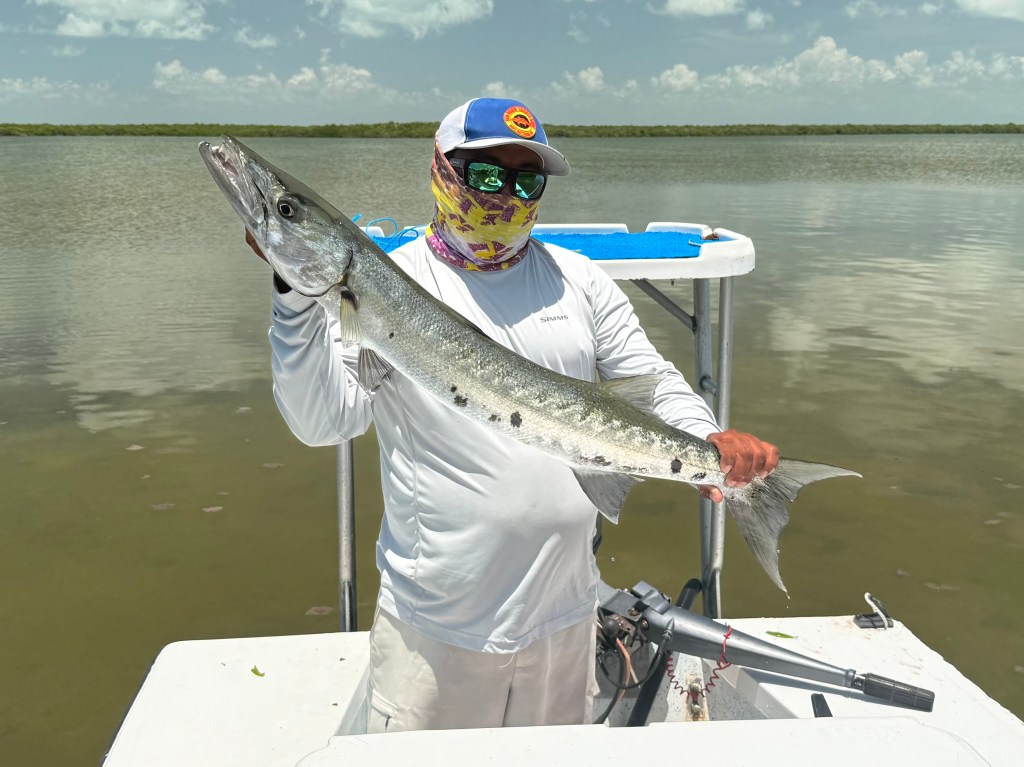
    Today I am sharing a boat with another fisherman. Our morning is spent deep in a network of steamy mangrove creeks and coves where we see lots of juvenile tarpon and six hefty snook. The tarpon do not want to eat flies and the snook stay out of our way in the tight mangrove creeks. I catch one small tarpon and my partner refuses my offer to loan him a fly in the successful pattern. To his immense chagrin, he catches nothing but mangrove branches, usually on his backcast, each snag followed by a barrage of Spanish curses. Just outside the mangroves my partner hooks a hefty barracuda on one of the many tarpon flies that the tarpon had refused. Remarkably, the cuda does not sever the tarpon bite-tippet.

    Guide Chepo with the barracuda.

    Back on the flats again after lunch, it’s my turn to be up front casting. Our guide Chepo takes us to a shallow stretch of green water edged by a beach. Just as we arrive, a school of ~20 Permit rips past us going the other direction. Chepo stows his push pole and fires up the outboard. We roar out a quarter mile from the shore then head back up the beach to get around the Permit school and wait for their approach.

    Poling slowly off the beach we come upon the Permit school tailing in shallow water over a patch reef. Their black tails and dorsal fins extend from the water, swishing back and forth like so many knife blades.

    Chepo suggests that rather than cast from the boat, I should hop out and wade to fish for them. I love wade fishing, but more importantly, a slow-wading human pushes less of a bow wave than a boat. Chepo and I work our way carefully forward and I began casting to the closest Permit. It follows the fly briefly two times but turns back each time.

    As I prepare to cast again, the other fisherman, who will not be named, has worked his way up the beach. I assume he wants to watch, or maybe wait his turn to cast after I hook up. Instead he flanks me and starts casting into the middle of the Permit school. He lines a Permit (i.e., throws his fly line over a fish). That Permit spooks, and the whole school takes off for the middle of the bay. He does not apologize. Even though it was my turn to be on the bow and I was working the school first, he insists he’s allowed to wade fish the same school at the same time. A small black cloud settles in over my head.

    While my boat partner is on the bow, I become aware of the inevitable, creeping dehydration and reach for my water bottle, which has rolled deep behind the seats. While retrieving the bottle, I accidentally scrape it lightly on the hull. Unbeknownst to me, my boat partner is working a group of permit and they turn away from his fly following the audible scrape. I apologize profusely. Despite my annoyance, I did not consciously scrape the hull with the bottle. After chewing me out, my boat partner says, “Well, I guess we’re even.”

    * * *

    DAY 3

    Before getting back on the water here in the Yucatan, I’ll back up a month. Gearing up to fly fish for Permit, I went out every day to an open lake or salt flat near my home to practice casting heavy crab flies in the wind using my moderately fast Sage 9wt fly rod. 

    People usually fly fish for permit using a beefier 10wt fly rod because the heavier line penetrates the wind better. In fact, my friend Juan offered to loan me his ultra-fast 10wt rod for the trip.

    Experience has taught me that my two enemies in a fly rod setup are fast and heavy. Even my moderately fast 9wt setup tends to overload my light bone structure and aggravate old injuries. That’s why I’d built a 8/9wt fly rod around a softer rod blank. My hand, wrist, and elbow get progressively grumpier with every step up in weight. My preferred flats rod is a 7wt – anything heavier is asking for trouble.

    And trouble I got. Two weeks before the trip, I sprained my casting hand through the repetitive motion of a home carpentry project and daily casting practice with the 9wt. Ice reduced the pain, but healing was slow and I had to lay off casting practice to aid the recovery. The day I left for the Yucatan, my hand felt 95% better.

    My wise spouse, who does not fish, nonetheless integrates information well and has a history of dispensing good fly fishing advice. She suggested I bring, as a backup, my two-handed “Spey” rod. Because it doesn’t load the same joints as a one-handed fly rod, if or when my right hand gives out again, I could continue to fish.

    I’d never heard of anyone fishing for Permit with a two-handed rod, so I sought a second opinion from Anthropic’s “Claude” AI chatbot (Sonnet 5 medium LLM):

    “Does anyone fly fish for Permit with a two-handed fly rod (Spey rod)?”

    Claude returned a five paragraph treatise, the gist of which was that Spey rods are designed for distance, not accuracy, and that I’m a sacrilegious twit for considering such a crude instrument in the noble pursuit of Permit. Claude did throw me a small bone in the last paragraph:

    That said, “almost never” isn’t “never” — some experimental or novelty anglers have tried switch rods or short two-handers for permit, mostly out of curiosity rather than because it offers any real advantage. It’s not a recognized or recommended technique in the permit-fishing community.

    Being a scientist, I necessarily qualify as an experimental angler. My two-handed fly rod is 13 feet long, though, not a short two-hander or a switch rod. But what the heck, maybe I’ll be the first person to catch a Permit on a proper Spey rod.

    OK, fat chance. Still, an extra checked item in my baggage would only cost $60 each way – not a bad price for trip insurance given the recent injury to my right hand.

    Sure enough, after my first two days of fishing for fussy Permit with one-handed 9wt rods (“Cast again, same place!”), my right hand is trashed. I have four more days of fishing ahead of me here in the Yucatan. Casting left-handed, I’m quite accurate at close range but I can’t reach the full distance needed to hit every Permit shot the guide calls. So, on DAY 3, out comes the two-hander.

    * * *

    Yesterday’s boat partner has hired a guided boat all to himself for the rest of the week. Good idea. This day I share guide Chepo’s boat with Tim.

    As Claude had explained, the two-handed fly rod won’t let me place a fly as precisely as I can with a single-handed rod, but contrary to Claude’s pronouncements, it excels at every other demand. Without hurting my hand, the two-hander tosses heavy permit flies 60 feet in a wind. Plenty of times a permit ignores a fly, so repeated casts are needed, even with a one-handed rod. When the guide calls out “Cast again, same distance, more left!” the two-handed rod can pick up 40-50 feet of fly line and recast it “more left” 60 or 70 feet with no time-wasting false casts.

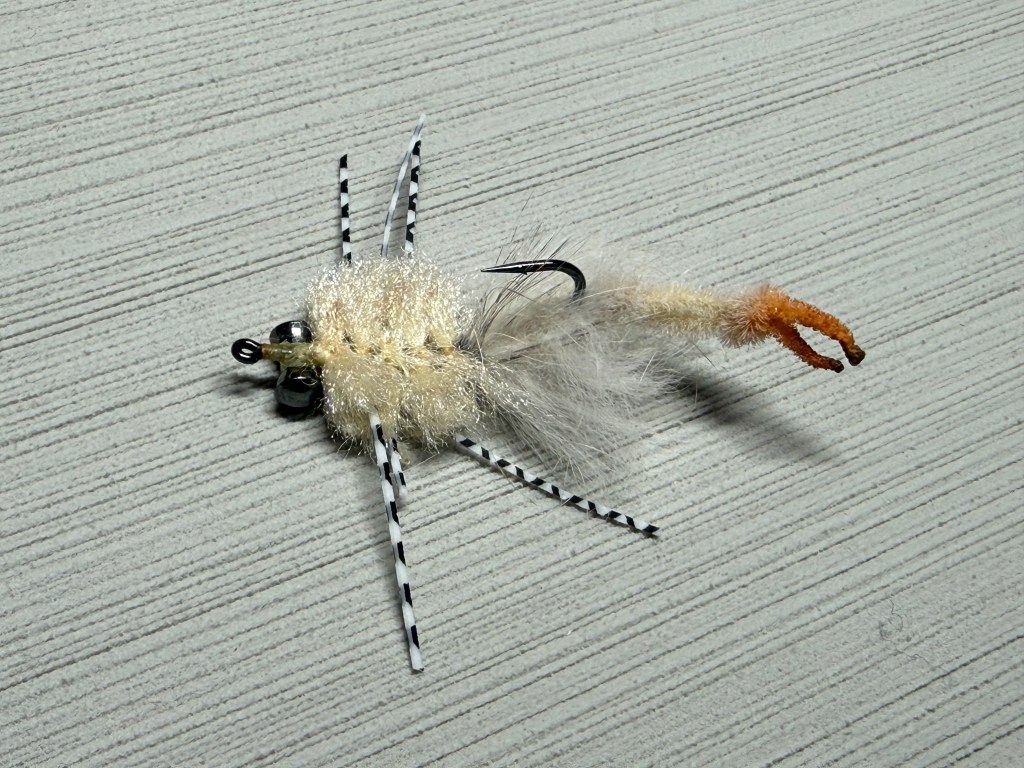
    From my collection of Permit flies, Chepo selects a white tie of Dave Skok’s Strong Arm Merkin. I always fish with the tip of the hook barb depressed. Saltwater fly fishing pioneer, Chico Fernandez, insists that by pressing just the tip of the barb down to make a hump out of the barb, you get the best of both worlds: the hook penetrates better but also comes out when you want it to. That’s helpful when you hook your clothes, or worse, your cheek. If a precious fish breaks off with my fly in its mouth, I want it to shed the hook easily.

    Back at the same spot mid-afternoon, a Permit follows my fly twenty feet before pouncing on it. I set the hook and the Permit takes off. That 20 foot follow has left me with a bit over twenty feet of loose fly line, piled in random curls on the deck behind me. As the fish starts its run, a strong gust blows a loop of that loose line up over my head and around my neck. Gripping the rod in one hand, I flail frantically with the other to get the line off my neck but in an instant it comes tight around the back of my head and the 16 pound tippet snaps. Rats!

    Lesson learned: no matter the excitement of a permit chasing the fly, I must do what it takes to throw the retrieved line back and DOWN so the extra loops land inside the cockpit and not on the deck.

    The break-off aside (beginner’s mistake), the two-handed rod had proven it could hook a permit. Even better, I have not been strangled nor my carotid artery severed by a fly line attached to a powerful fish.

    But I have not spooked the school, so it’s Tim’s turn to try. He and Chepo hop out of the boat to wade, while I stay behind and make a point of not spooking his fish.

    Tim lands a nice one.

    A boy and his fish. I’m in the back, trying again. Photo by Chepo..

    The Permit school is still there, so I climb out and try again. During my first retrieve, a big barracuda slashes through the school, probably in pursuit of Bonefish. The water explodes in a sparkle of silver flashes, Permit and Bonefish bound for deep water. The fishing day is over.

    DAY 4

    My partner today is Chris. I am heeding the lesson of yesterday’s error. After casting from the foredeck in the stiff wind, I bend down or kneel for the retrieve so I can carefully pitch each curl of loose fly line back and down into the cockpit behind me where the wind can’t make mischief of it. I am using a new fly of the same pattern as yesterday, but in cream instead of white.

    Strong Arm Merkin, missing part of a leg, nipped off by a baby Blue Runner.

    Chris gets out to wade fish our magic afternoon spot and casts repeatedly to a Permit, but each time a succession of small Bonefish zoom in to snatch away his fly. After a catching and releasing a bunch of little squirts, he hooks into a decent Bonefish.

    Here Chris wrangles a pesky 4 lb Bonefish that snatched his fly from in front of the Permit.

    It does not please him. Only a missed Permit could turn a nice Bonefish into a disappointment.

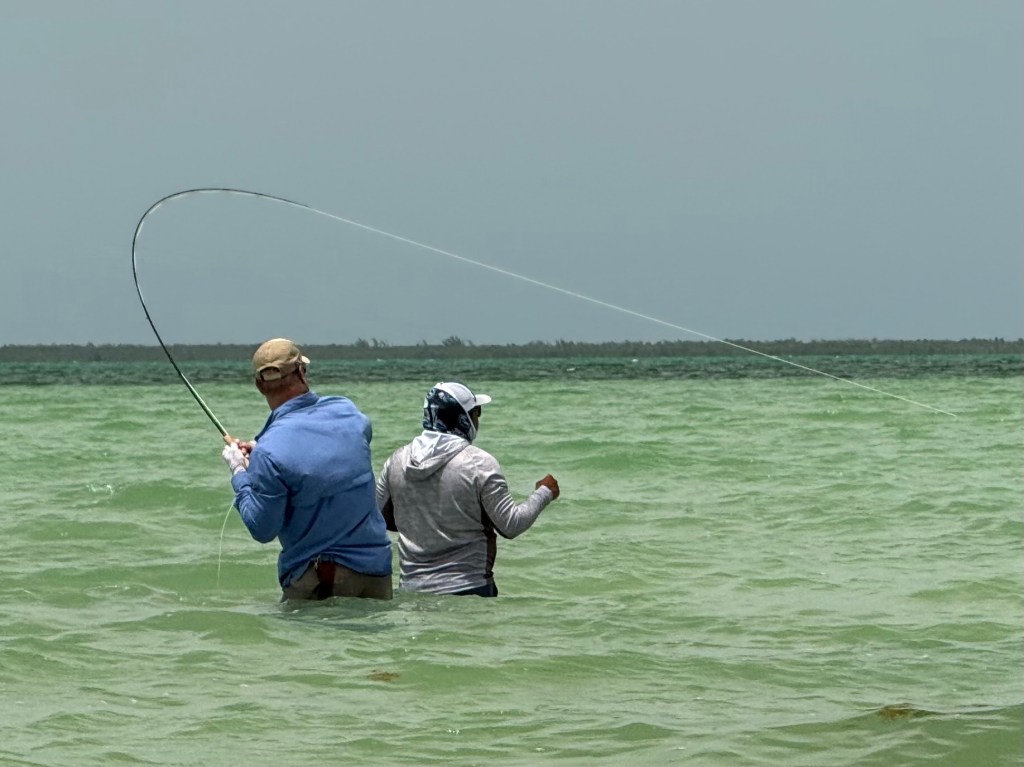
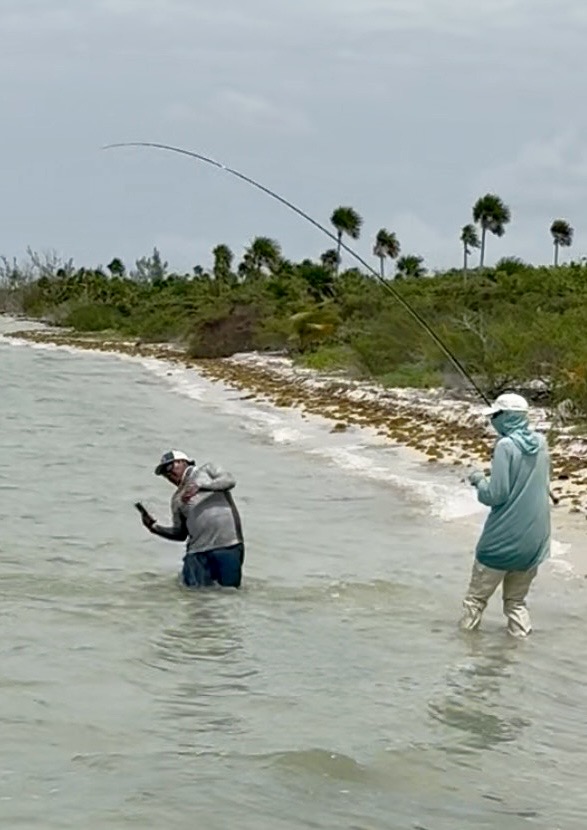
    Using the two-hander, I hook up on another Permit and get it “on the reel”, meaning the line slack safely is taken up and the reel’s drag is engaged. 

    The fish runs down the beach, so I hop from the boat and wade after it to recover some line and make the fish quicker to land when it tires. Chepo wades in behind me while Chris stays with the boat and takes video.

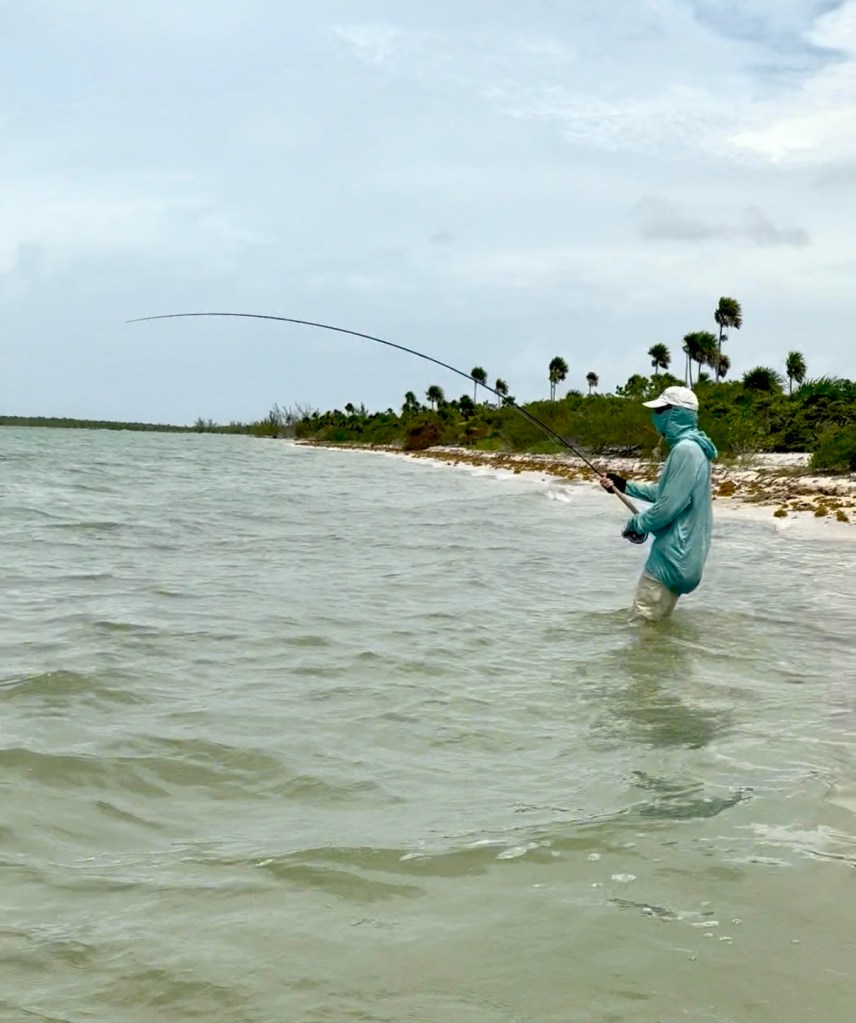
    Permit on the two-hander. Notice how little the two-hander bends compared to a single-handed rod. Photo by Chris Webb.

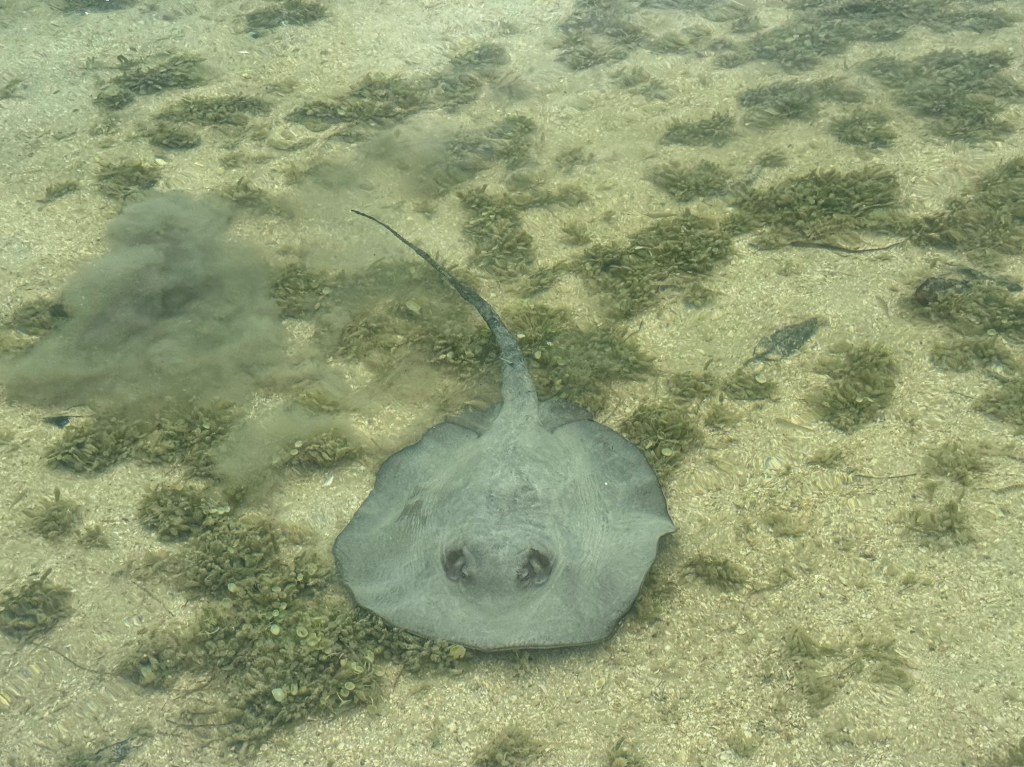
    I mostly keep my eye on the fish but glance down to avoid stepping on a sting rays in the shallows. Shuffling one’s feet is a safe practice but it stirs up the sediments.

    I try not to step on one of these dudes, which are common in the shallows.

    Though I landed my first Permit myself, Chepo wants to land this one, and I let him – he likely knows something I don’t. Holding his cellphone-camera aloft in one hand, Chepo tries twice to grab the permit by its tail with his other hand, but each time the fish bolts back to deep water, forcing Chepo to duck the whizzing fly line. 

    Chepo has good reflexes. A guide doesn’t want to break off his client’s Permit.

    Third time’s a charm and we have the fish to hand.

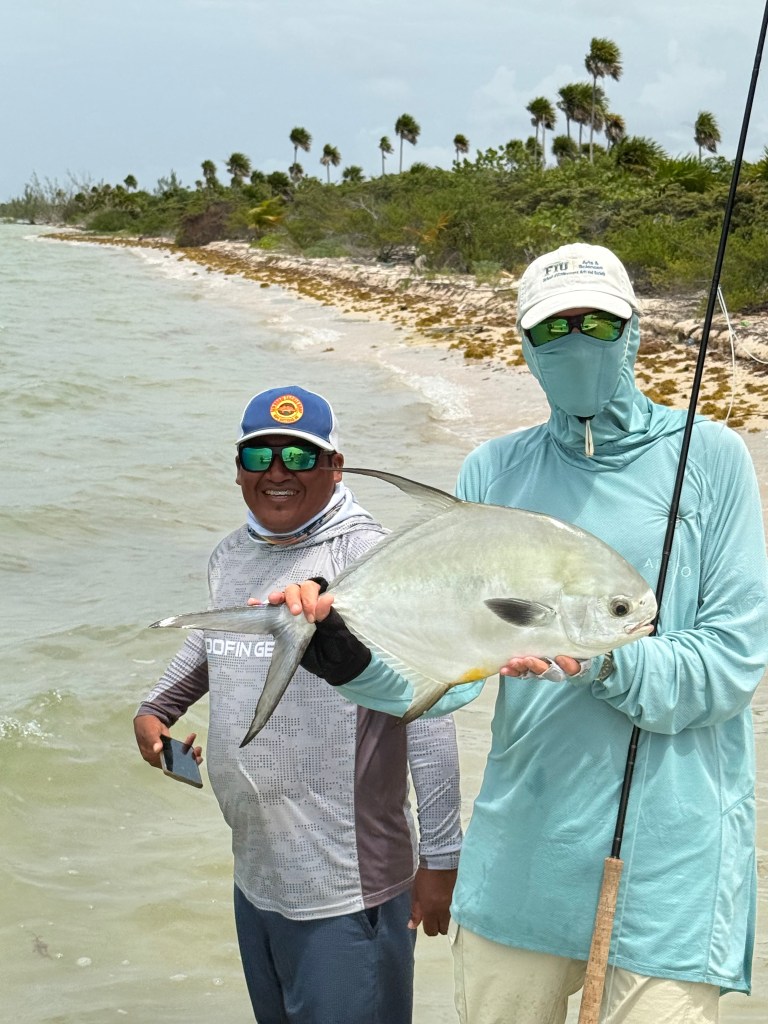
    That’s a proper Permit, not a monster, but solid. When I remove the fly from its mouth, the tippet breaks in my hand.

    This Permit has not only chewed my fly to a pulp, it has shredded the tippet most of the way through, probably by rubbing it against corals. I really don’t know how this fish didn’t break off before we landed it. That risk is probably why Chepo was so eager to grab the Permit as soon as possible.

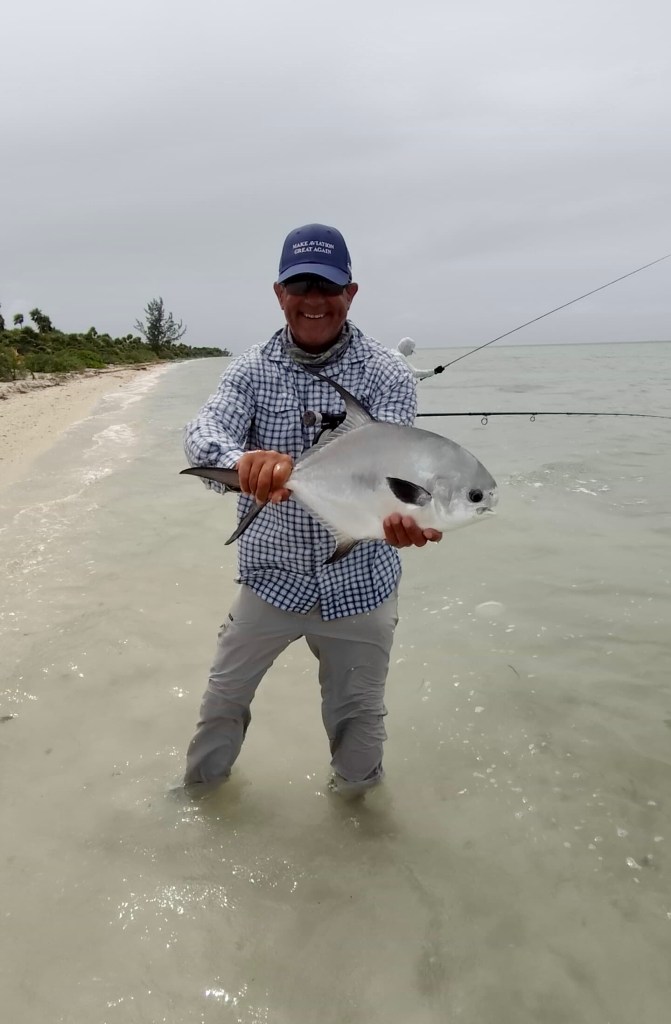
    After quick photos, I release this Permit, perhaps the first caught on a Spey rod. It hurries off to rejoin its school in the green waters of Bahia del Espiritu Santo.

  • Yucatan 3: First Day- “More longer”

    Yucatan 3: First Day- “More longer”

    Breakfast at Playa Blanca Lodge is whatever you want. I had coffee, OJ, fresh tropical fruits, an omelette, and two strips of bacon. We packed our lunches from an equally splendid spread of ceviche, fried fish, leftover roast beef or BBQ ribs, fruits, sandwich fixings, French cheeses, you name it. You want bottles of water, limeade, beer? How many?

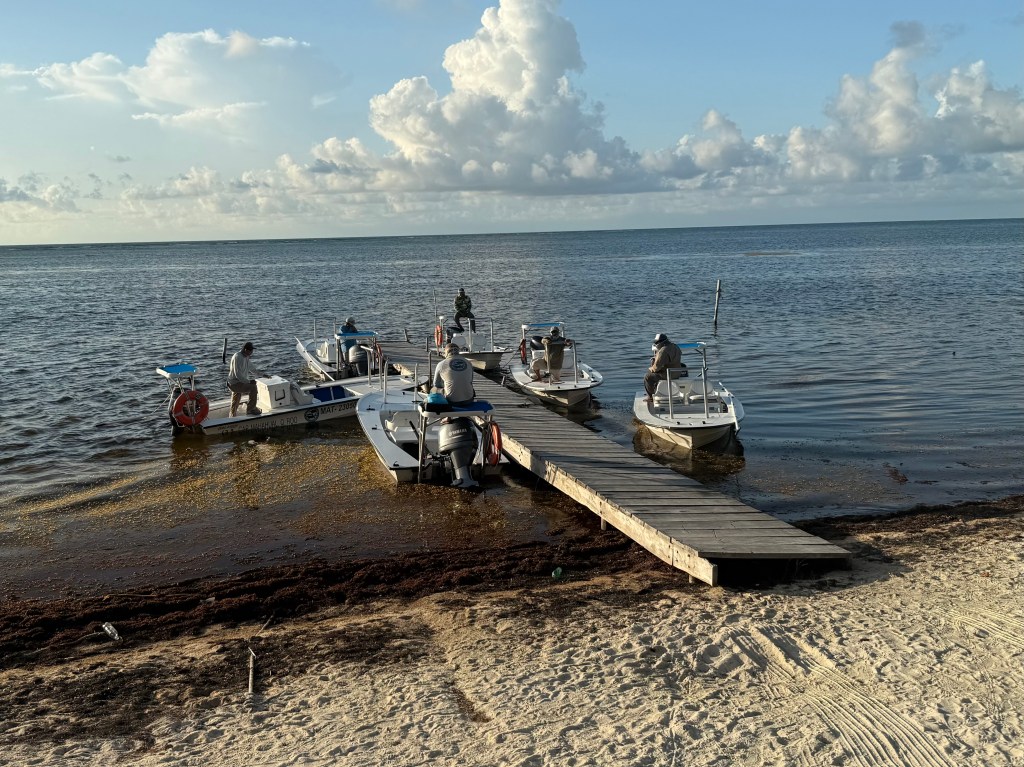
    At 07:10, fly fishing guests assembled at the truck for the 20 minute ride south to the dock. Skiffs departed the dock each day at 07:30 and returned by 16:00.

    The flats of Espiritu Santo Bay (Bahia del Espiritu Santo) are accessed by a fleet of small Dolphin skiffs. The ride south is bouncy in the waves driven by the prevailing SE trade winds, but the small craft are dry and easy for guides to pole. The guides are all local fellows from the Yucatan. My guide the first four days was a short, stocky fellow named Chepo, pronounced “Chay-Poe”. The first day on the water, I had Chepo and his boat to myself.

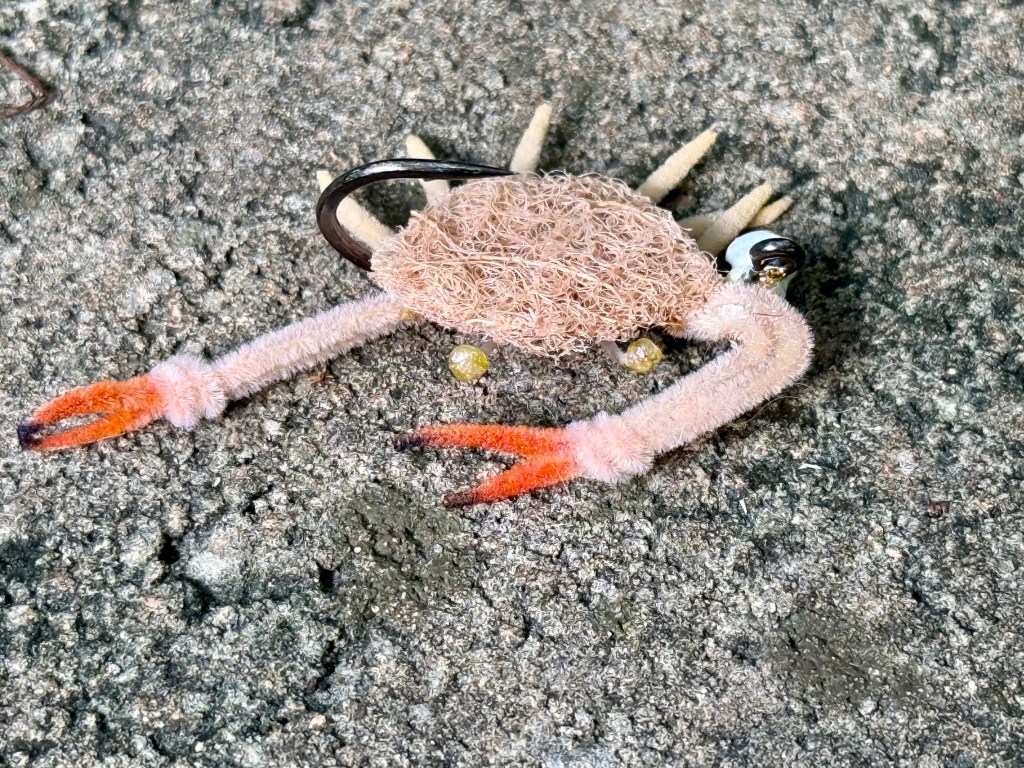
    Chepo looked in my box of permit flies and picked out a crab fly, my favorite by chance, that I’d crafted from a coconut fibre scrubbing pad and some “ultra chenille”.

    Up on the poling platform, Chepo deployed his magic flats vision, spotting fish invisible to me under the shimmering waves.

    In addition to Spanish, Chepo speaks a dialect of fly fishing English, enhanced with his own units of measure:

    “Eleven o’clock, forty feet”  means
    “Cast 45° left of center, sixty feet”.

    “White, white…”  means  
    “Wait, wait…”

    “Cast again! More longer!”  means
    Throw the fly in the same direction, but seventy feet.

    Once I learned to follow Chepo’s directions (“white” took the longest), I began to catch fish.

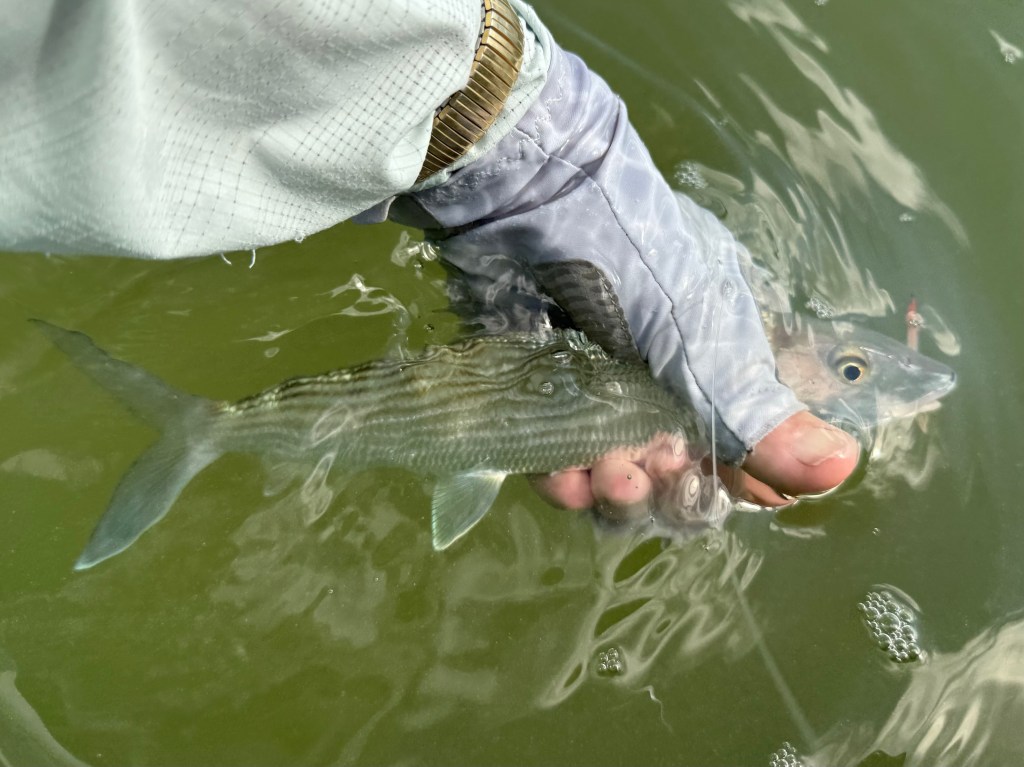
    A baby Bonefish, my smallest ever on fly, somehow managed to stuff most of that crab fly in its mouth.  

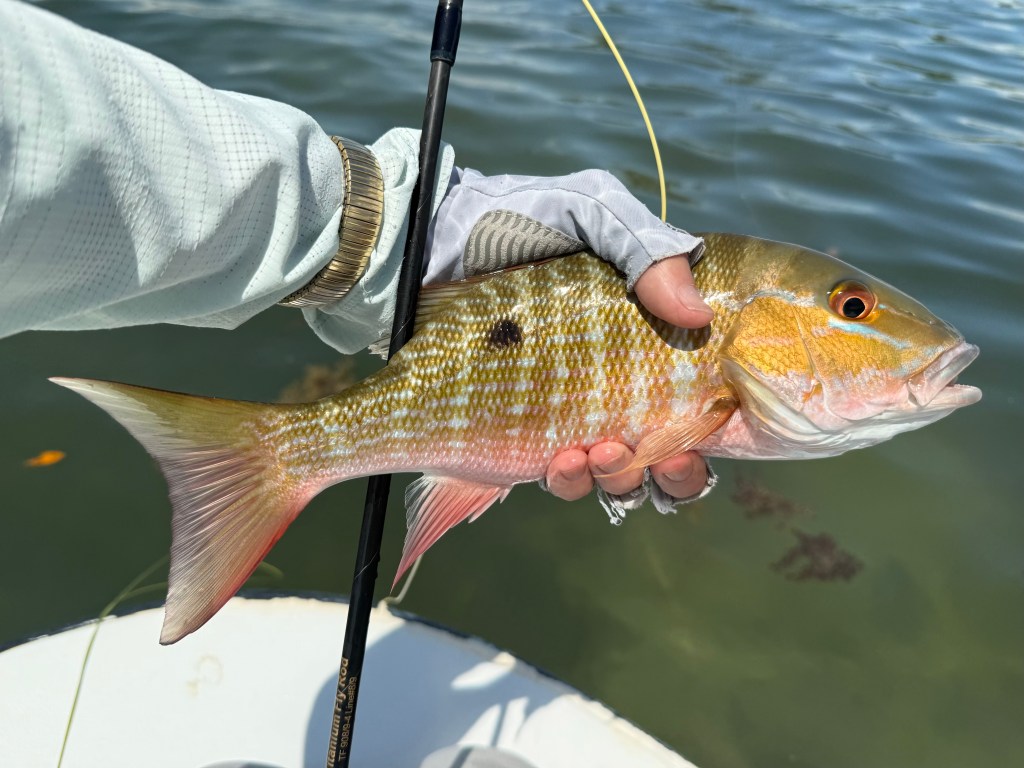
    Some juvenile Mutton Snappers likewise gulped down the crab fly, my first ones on a fly rod.

    An uncounted mess of small Blue Runners and Mangrove Snappers did their best to rip the fly to pieces, yanking loose bits of coconut fiber, and chewing the fuzz off the leading claw so it flopped pitifully.

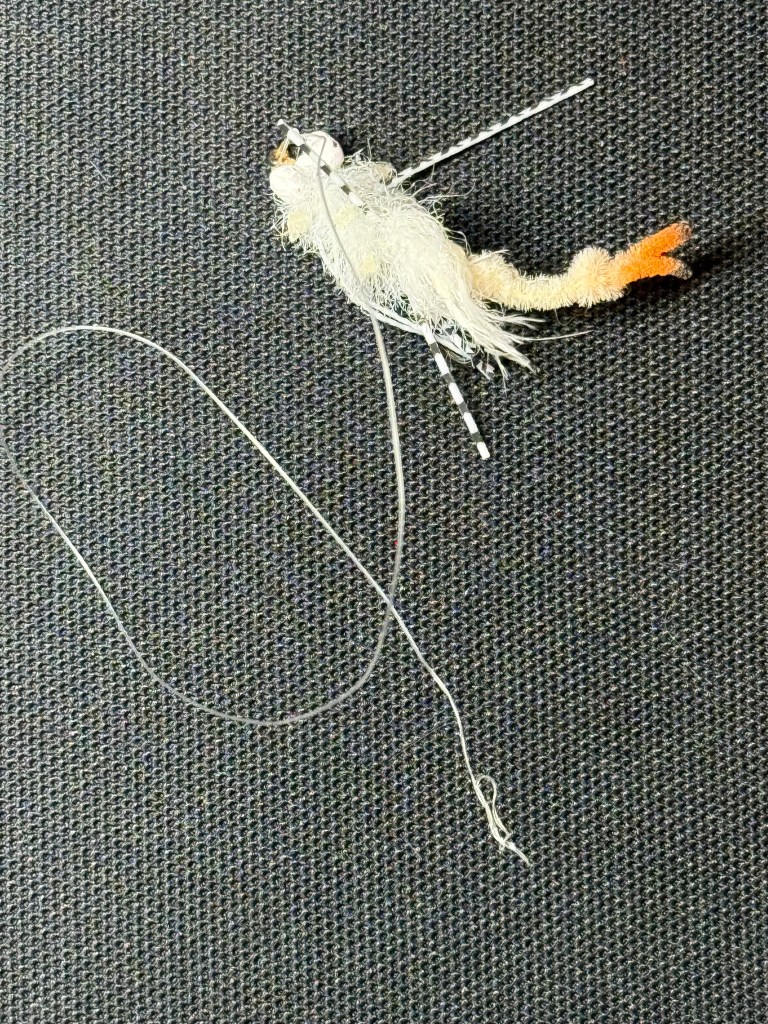
    Finally a permit appeared, using my new rod, I cast what little remained of the fly: a small disk of coconut fiber, two eyes, and a trailing claw.

    “White, white, white…strip…strip…strip…STRIP-STRIP-STRIP!”

    The Permit connected with my bedraggled fly. I cleared the line and the reel drag sang the happy buzzing song that flats fishers so love to hear as the fly line sliced water in two.

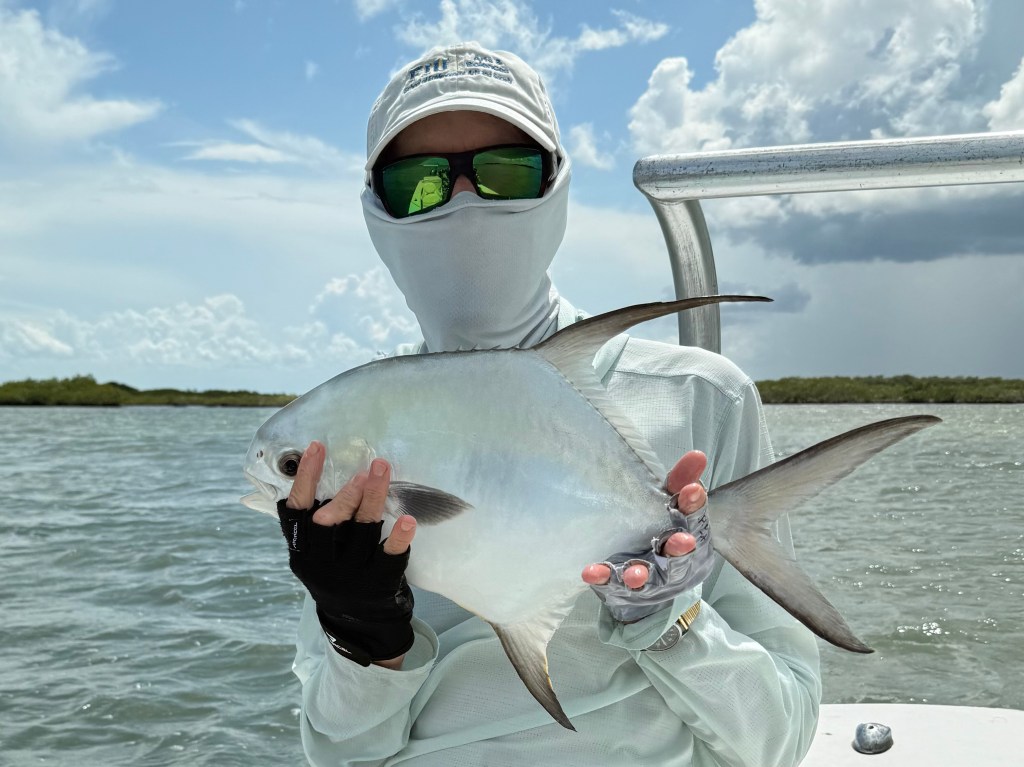
    My first Permit on fly, not huge, but just dandy, on my first day fishing the flats of Bahia del Espiritu Santo, on the tattered remnants of a file that I tied, cast with a rod that I built. What’s better than that?

    Thank you Andy, Juan, and Chepo.

    Two ways to eat a scorpion

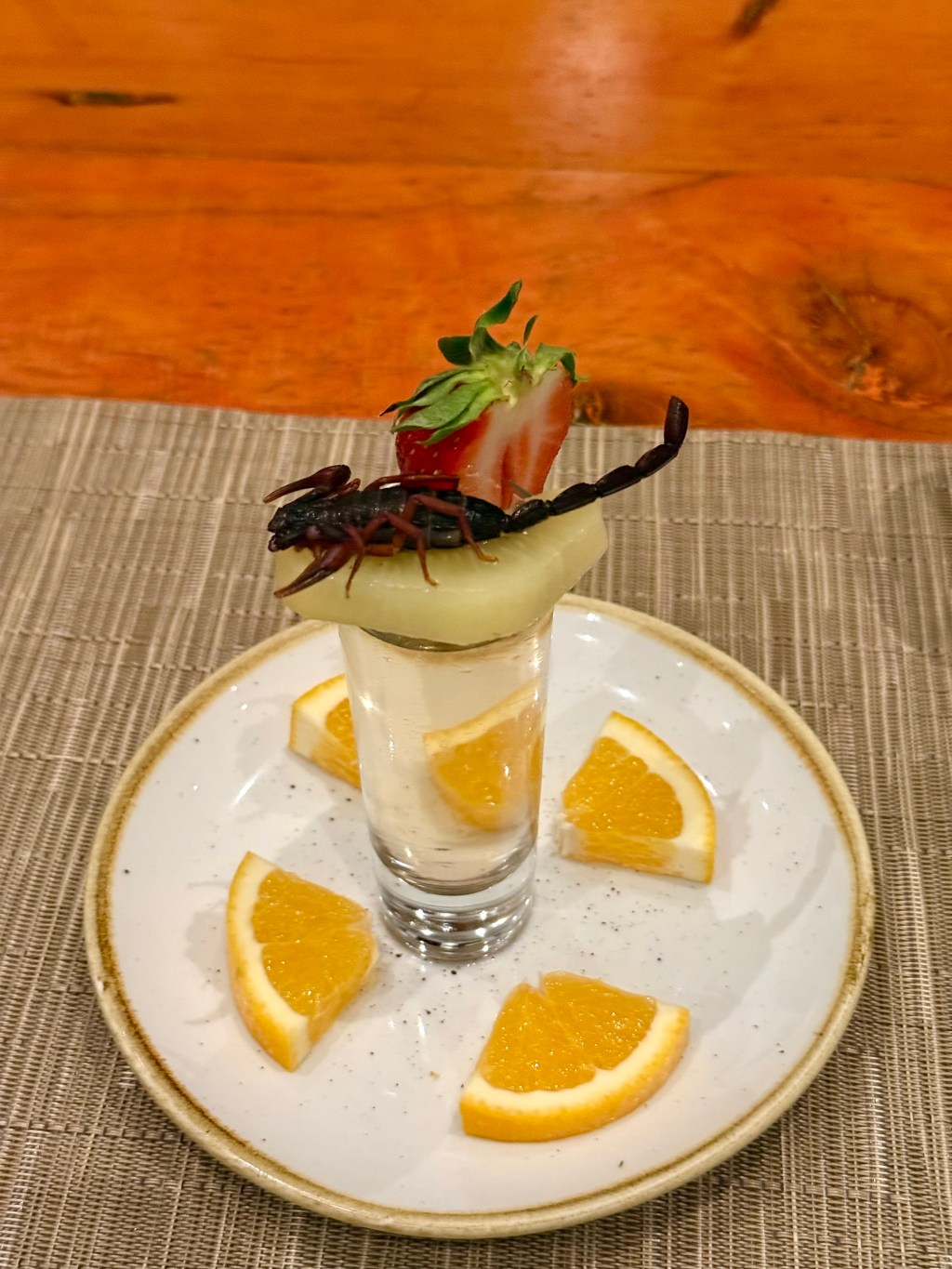
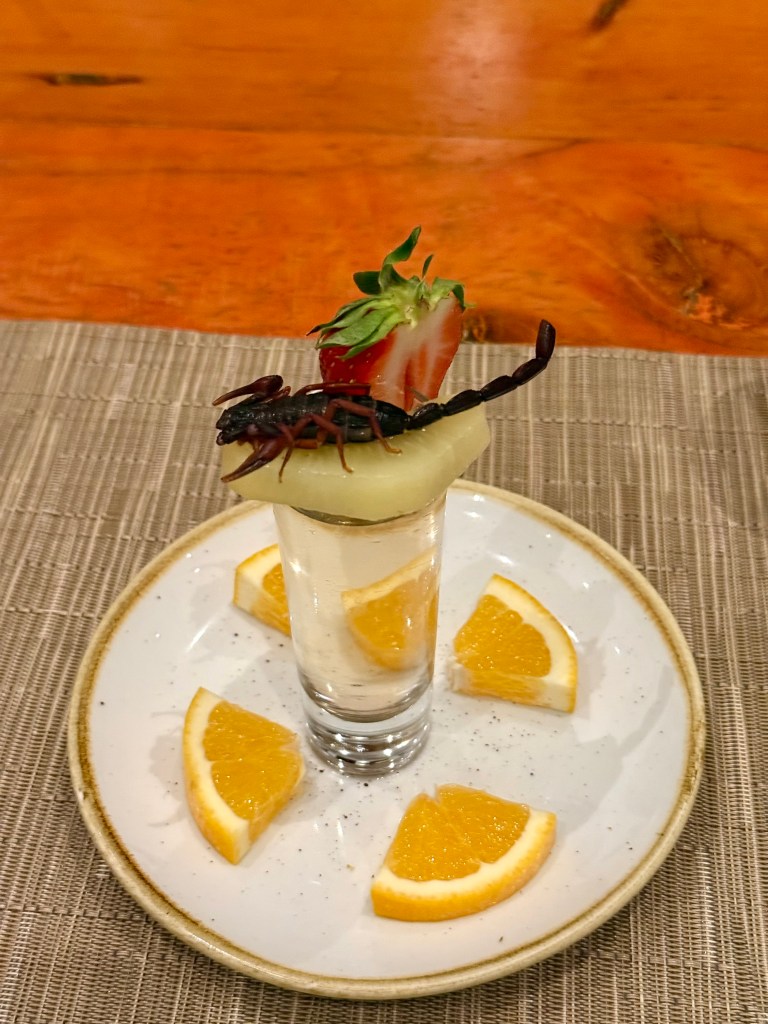
    Playa Blanca Lodge has one sacred tradition: when an angler catches his or her first Permit, he or she must eat a scorpion.

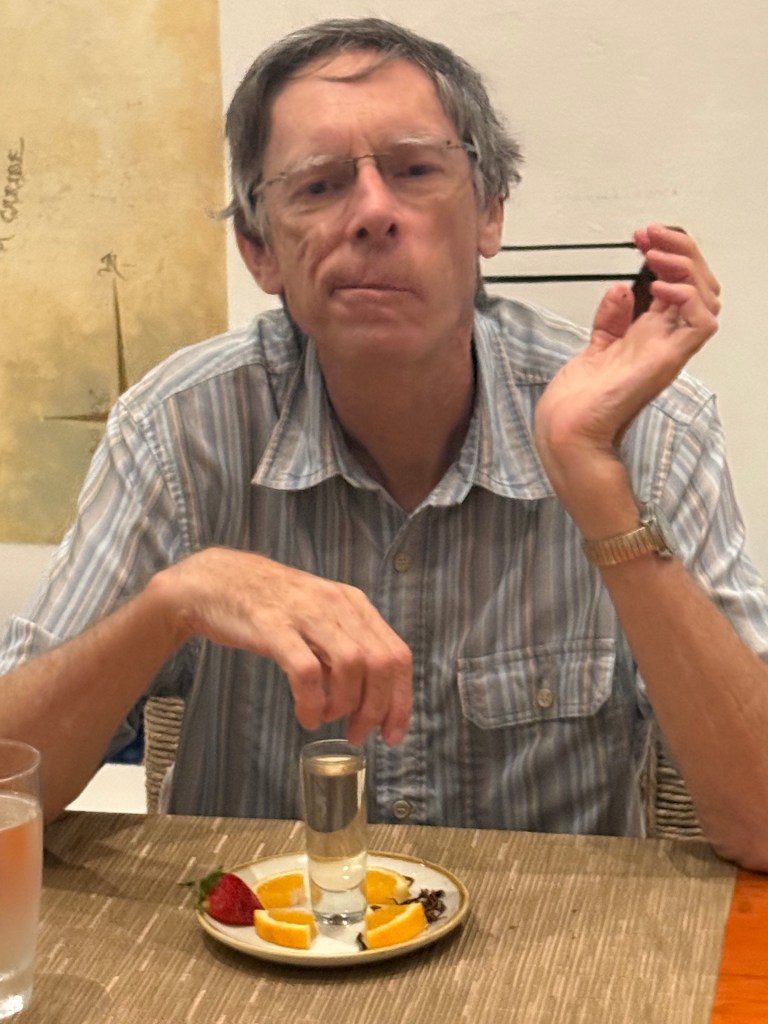
    Accordingly, after dinner that night, young Calvin and I were each served a scorpion, pickled in mescal. 

    Florida Bark Scorpion, Centruroides gracilis

    I recognized my dessert topping as a Florida Bark Scorpion, common in the Florida Keys. For years I kept one in a jar of alcohol on my desk at work. They’re big and scary when they skitter across the floor, and their sting hurts like a wasp if you are unfortunate enough to contact one, but their venom is not lethal. The terminal segment of the tail that holds the venom had already been removed.

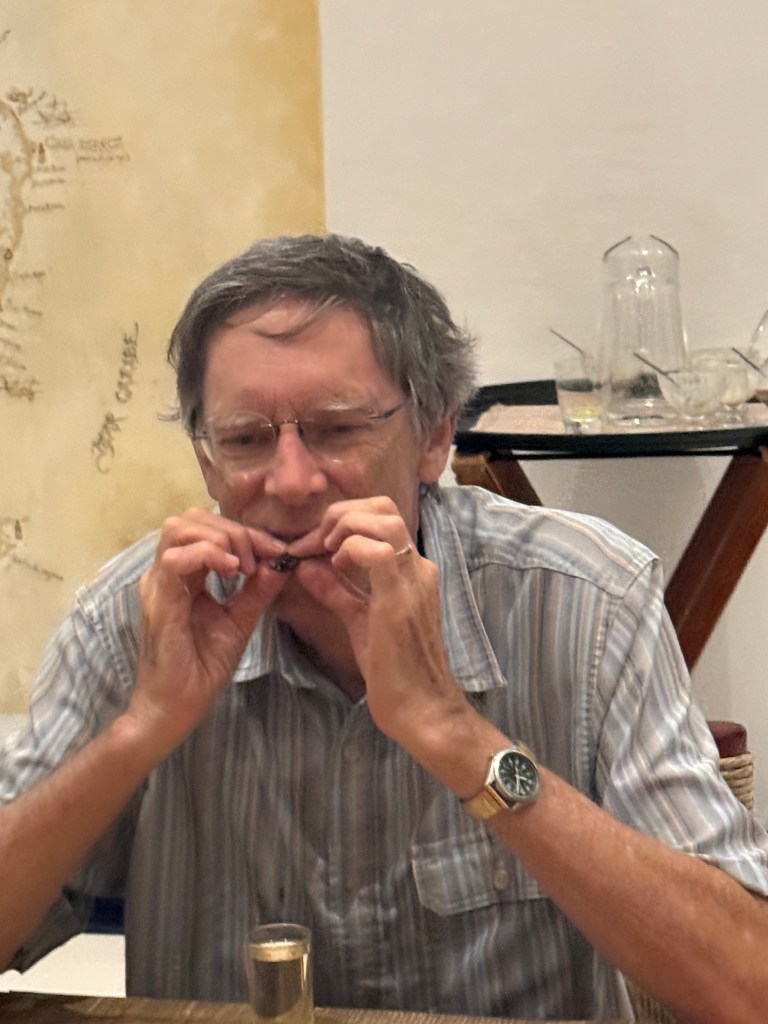
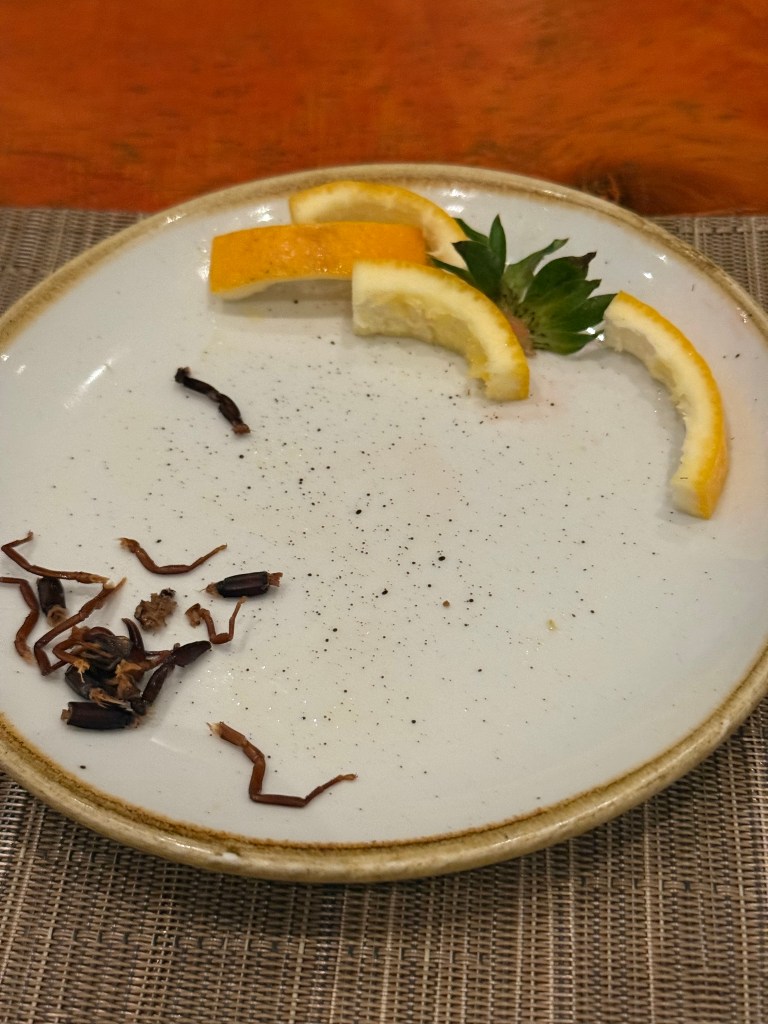
    I took my scorpion apart leg-by-leg, squeezing the meat out of each segment with my teeth like one does with the legs of a fried tarantula, a tasty Cambodian delicacy.

    Glancing back and forth between his own intact scorpion and me, actively nibbling my prize, Calvin looked worried. Finally, he picked up the 8-legged horror and tossed it down the hatch in one gulp, aided by the double shot of tequila.

    The chitin exoskeleton of arthropods is indigestible, so you can guess what happens, or rather, what doesn’t happen, if one swallows said arthropod without chewing. Not wanting my scorpion to reappear as a scorpion, ever, I channeled my inner squirrel monkey and thoughtfully munched it down.

    After its soak in mescal, the scorpion tasted more like mescal than the assorted terrestrial arthropods I’ve eaten on prior tropical adventures. I gave it a rating of meh-minus, but the fruit was good. I’ll happily take a deep-fried tarantula over a mescal-soaked scorpion any day.

  • Yucatan 1: The Butterfly Effect

    Yucatan 1: The Butterfly Effect

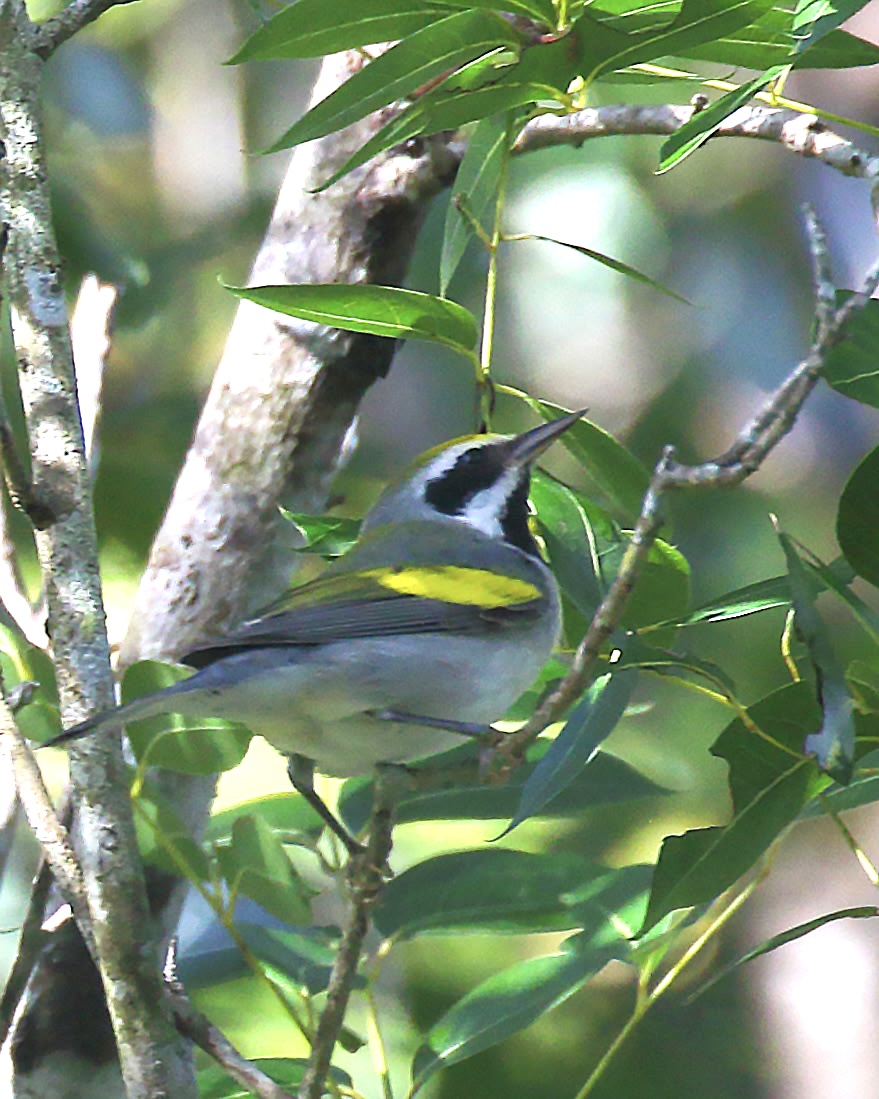
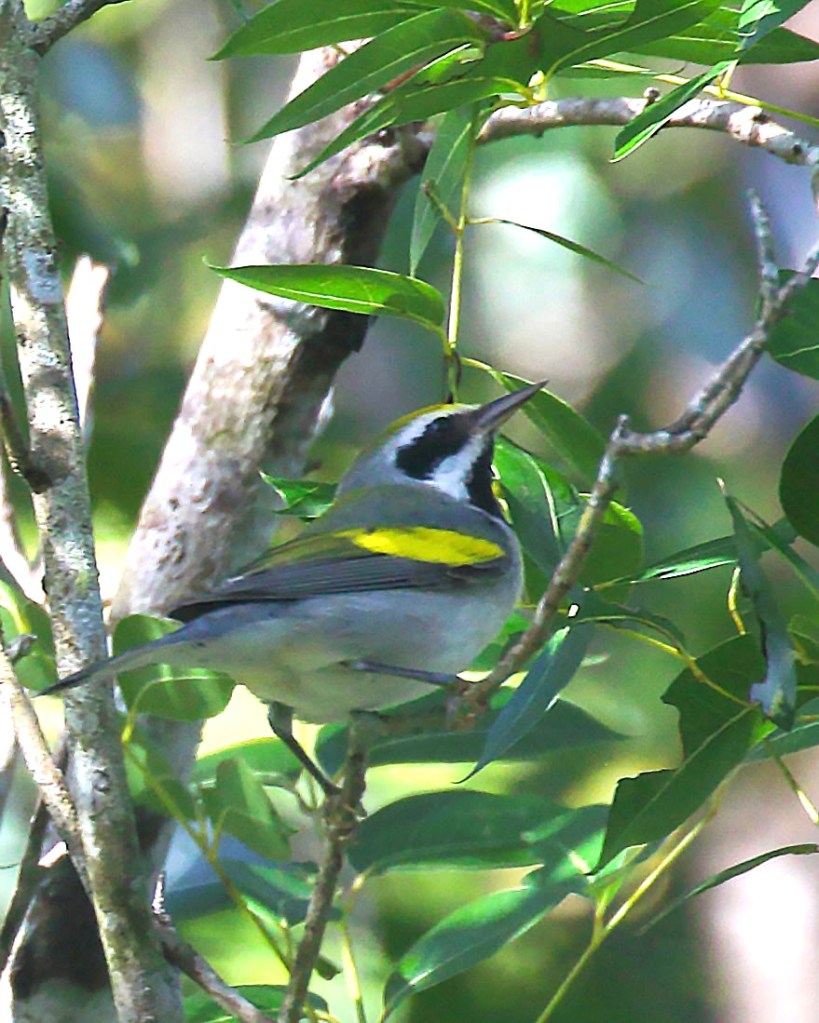
    On the morning of 3 October 2025, I spotted a woman alone in the park across the street from our house. A pair of binoculars hung from her neck and she cradled a camera with a long lens. I always say ‘hi’ to birders in the park. Andrea Diamond, bubbling with excitement, told me she’d just spotted a Golden-winged Warbler, the first rare bird she had discovered on her own.  

    I came to know this elegant songbird during my childhood summers at a wildlife camp in West Virginia, but I had never seen one in Florida. Andrea relocated it quickly and I renewed my acquaintance with an old friend.

    Golden-winged Warbler in All American Park, South Miami. Photo by local birder Himanshu Gupta.

    For the next three days, South Florida’s birders flocked to the park and I became the Golden-winged Warbler Ambassador. Juan Valdez, one of the many birders who came to look for the warbler, also turned out to know the native plants. I learned that he works as an art museum curator and…wait… he fly fishes Biscayne Bay. Clearly my kind of guy.

    Since then I have entertained Juan through The Eye of the Cormorant and he has delighted me with photos and texts when his fly fishing skills produce a particularly splendid result.

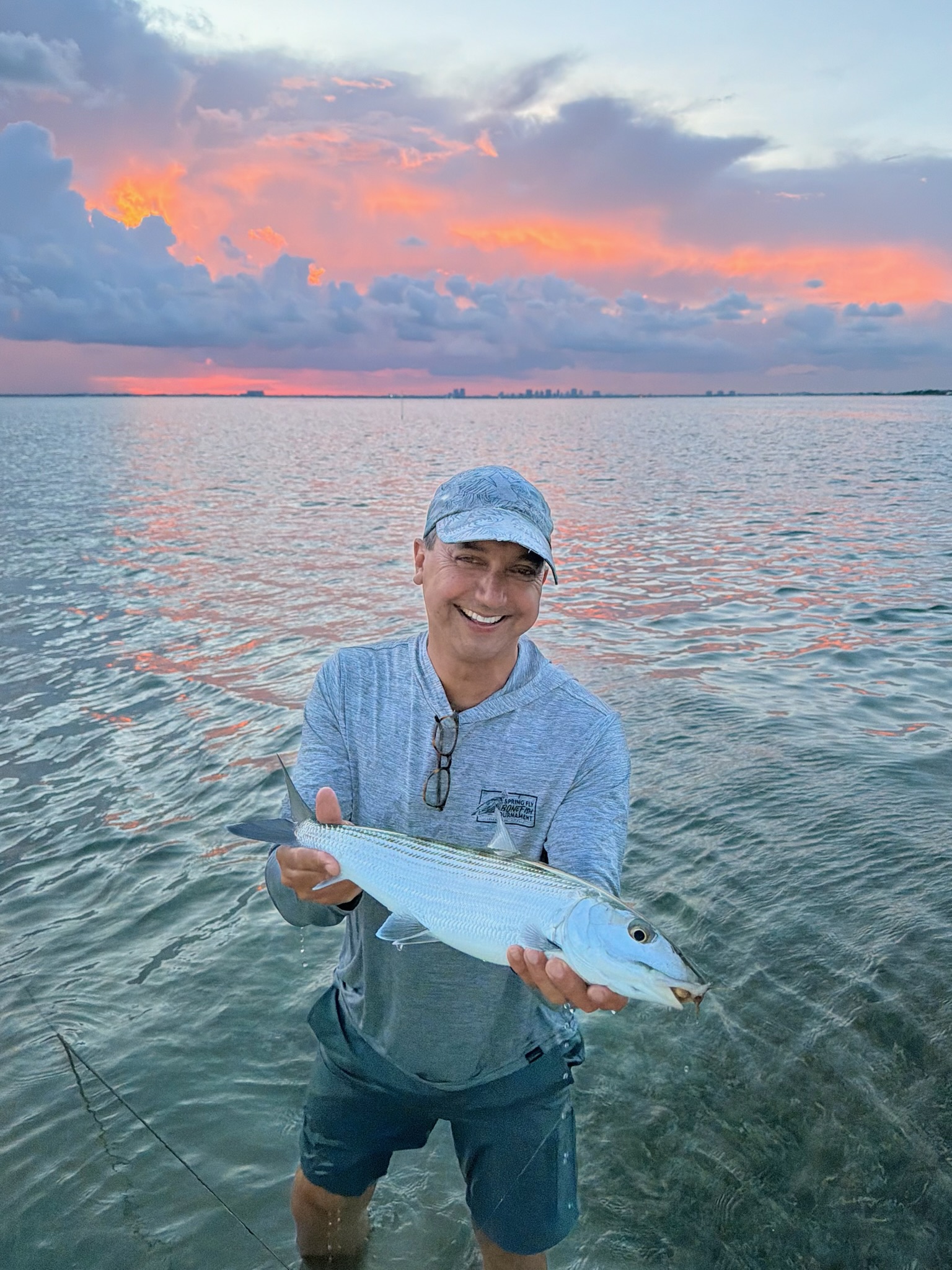
    Juan with a bonefish caught on fly in Biscayne Bay.

    Fast forward to late June of this year. Juan phones me one evening to say that his friend Andy had booked a week at a fancy fly fishing lodge in the Yucatan, but cannot go. Andy offered the trip to Juan, but Juan can’t go either. In the unlikely event that I am free the second week of August the trip is mine.

    Playa Blanca Lodge is the sort  of place I read about online in the outfitter catalogs. I drool longingly over the descriptions, check the cost, then exhale and close the webpage. With this gifted package I just had to get myself from Miami to Cancún, cover one night in a hotel, and tip the lodge staff and fishing guides.

    I am definitely free the second week in August.

    Wow.

    Thanks Andy! Thanks Juan!

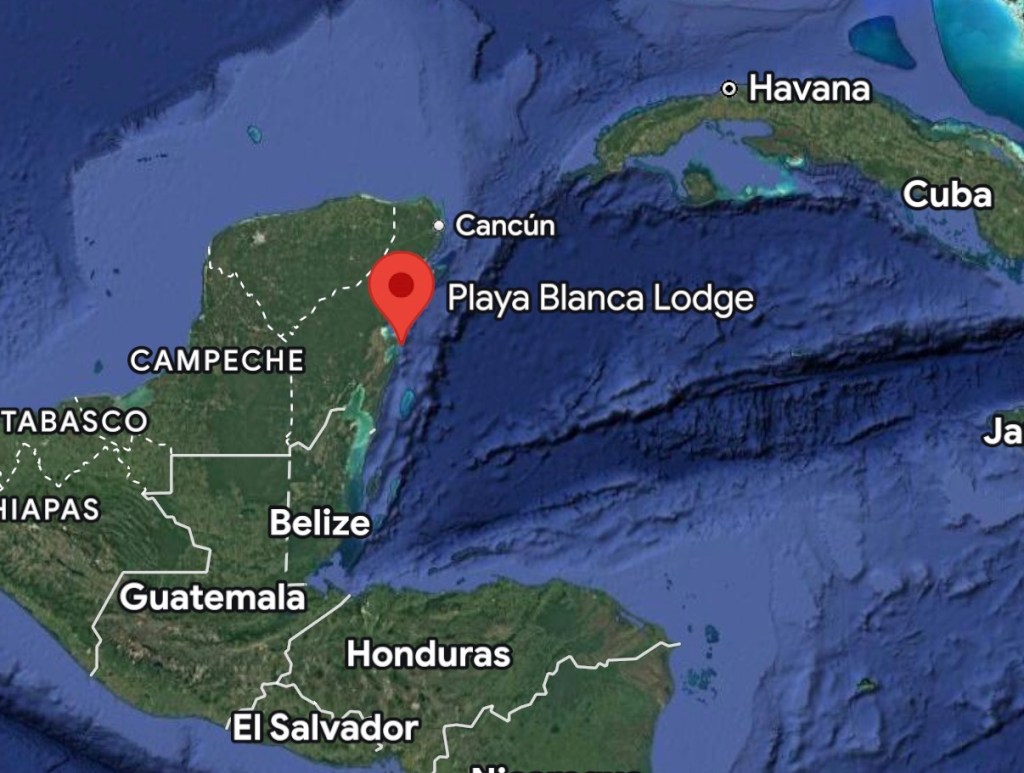
    Playa Blanca Lodge is situated in the Sian Ka’an Biosphere Preserve on the Atlantic coast of the Yucatan Peninsula, located here on Google Maps.

    My family visited Sian Ka’an twelve years ago while on vacation in Tulum. The Biosphere Preserve is a cross between the Everglades and the Lower Florida Keys before people made such a mess of things here in Florida. The Mayans, likewise, tried their best to screw up the hydrology of Sian Ka’an, but equipped only with stone tools and manual labor for chipping canals out of the limestone bedrock, and no artificial fertilizer to aid their agriculture, the harms they wrought were far less extensive than here in Florida.

    The lower reaches of Sian Ka’an Biosphere include Espiritu Santo Bay, home to a healthy population of Permit(Trachinotus falcatus), a game fish in the jack family. Permit are wary, strong, and fast. The Permit is infamous among fly fishers for its capricious behavior, often rejecting a perfectly delivered fly and, on rare occasion, grabbing a fly from a botched cast. Permit fight hard, and have a large repertoire of escape tactics: scraping off a fly on a coral, crushing or straightening a fly’s hook, or grinding through the nylon leader on the floor of the bay.

    A local attorney friend has been trying to catch a Permit for years with no success.

    The most accomplished fisherman in my local fishing club writes: 
    “I have presented over 1000 flies to Permit… caught one (winning a tournament in 1988) and been skunked ever since!!! There is no way I haven’t found to lose a hooked Permit!” 

    Juan recently caught a nice Permit in Biscayne Bay. He is amazing.

    With only four years of fly fishing under my belt, I consider Permit to be out of my league. I’ve seen Permit in Biscayne Bay and the Keys, but I’ve never caught one on fly or even set my mind to trying. Last spring I followed a massive Permit in my kayak for half an hour, but despite my advancing as slowly as possible, the Permit would never let me approach closer than 125 feet.

    My benefactor, Andy, who gave me his trip reservation, sent me a brief note: 

    “Catch a permit for me.” 

    Uh oh.

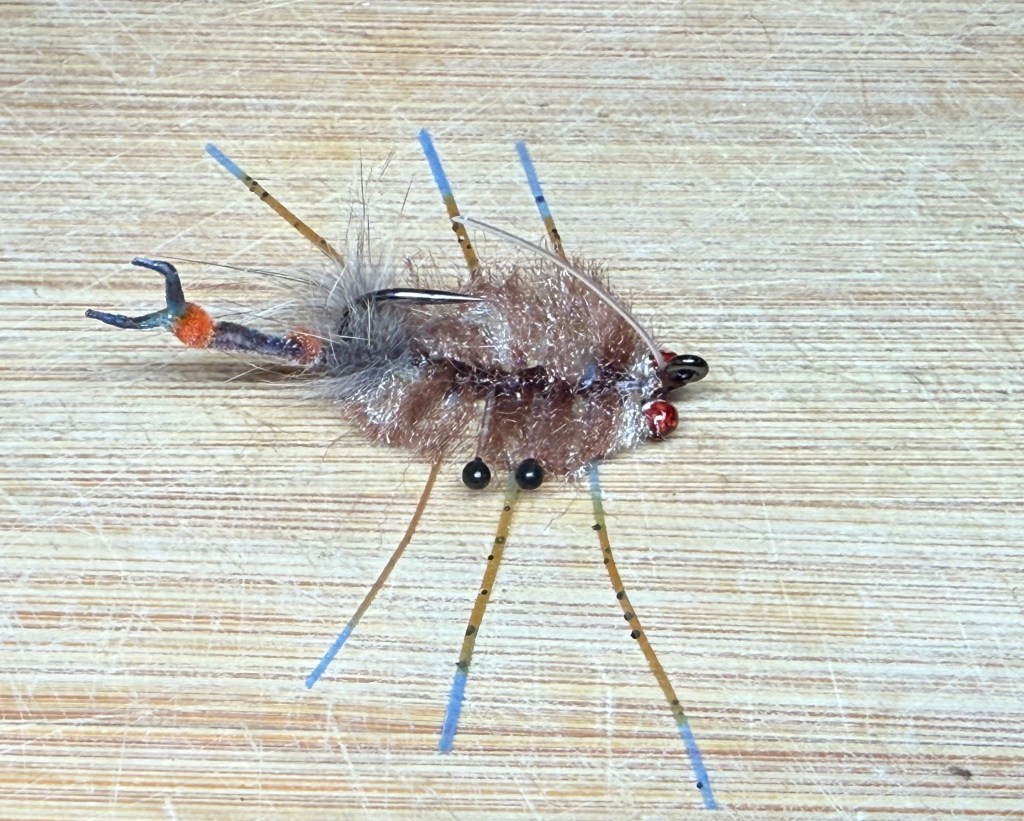
    I ordered materials to tie Permit flies, producing an assortment of weighted crabby and shrimpy things in proven patterns recommended by the trip outfitter.

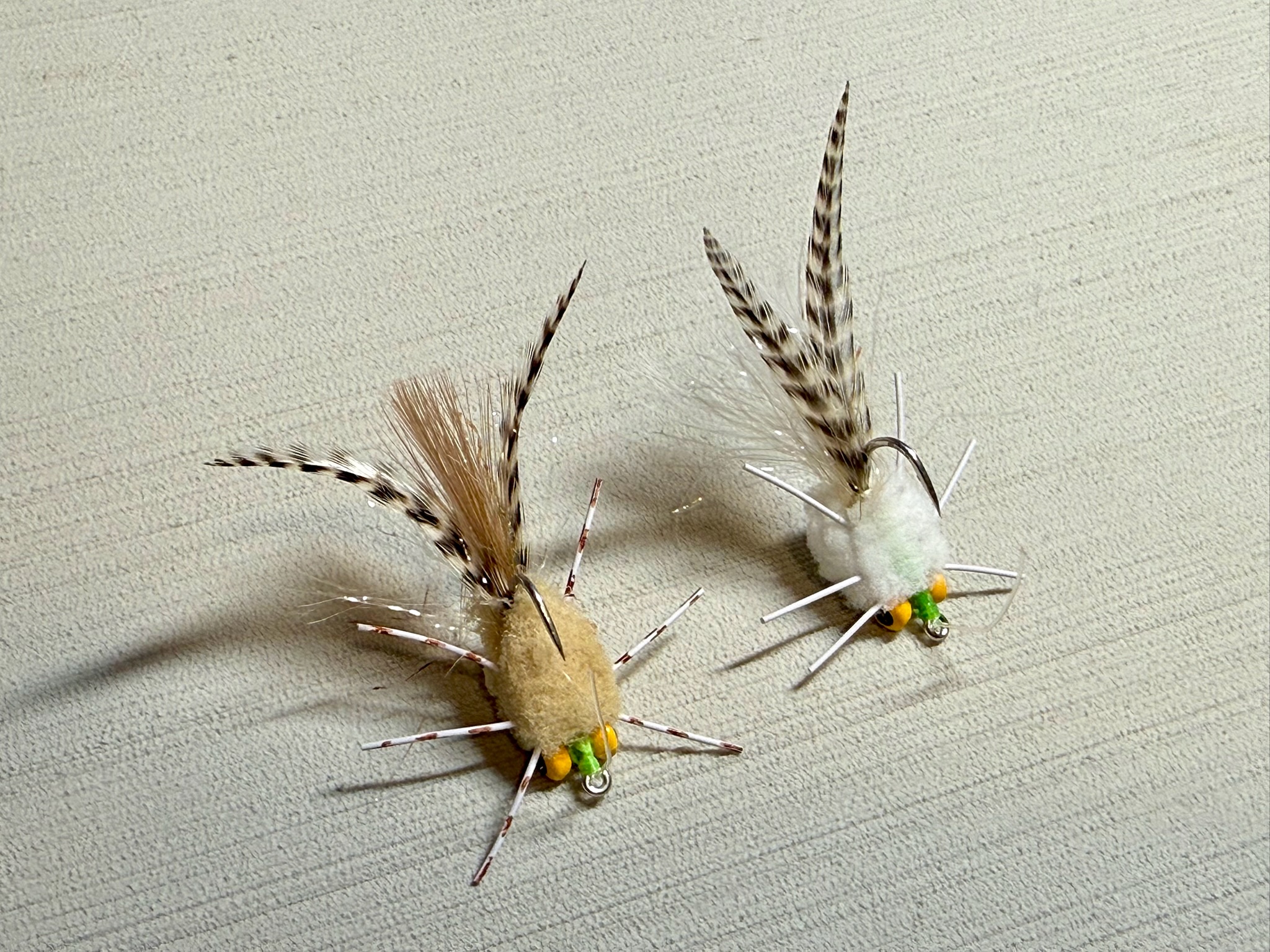
    My ties of the Raghead Crab fly.

    The weighted crab flies that Permit favor are hard to cast, so I would need serious practice.

    In the vain hope of not trashing my right hand by excessively casting my fast-action 9wt fly rod, I sought a rod of similar weight but with a softer action. The company I picked had 8/9wt rod blanks available, but none assembled in the size I wanted. I had never built out a rod blank before, but I figured why would Al Gore invent the internet if not for instructing a novice such as myself?

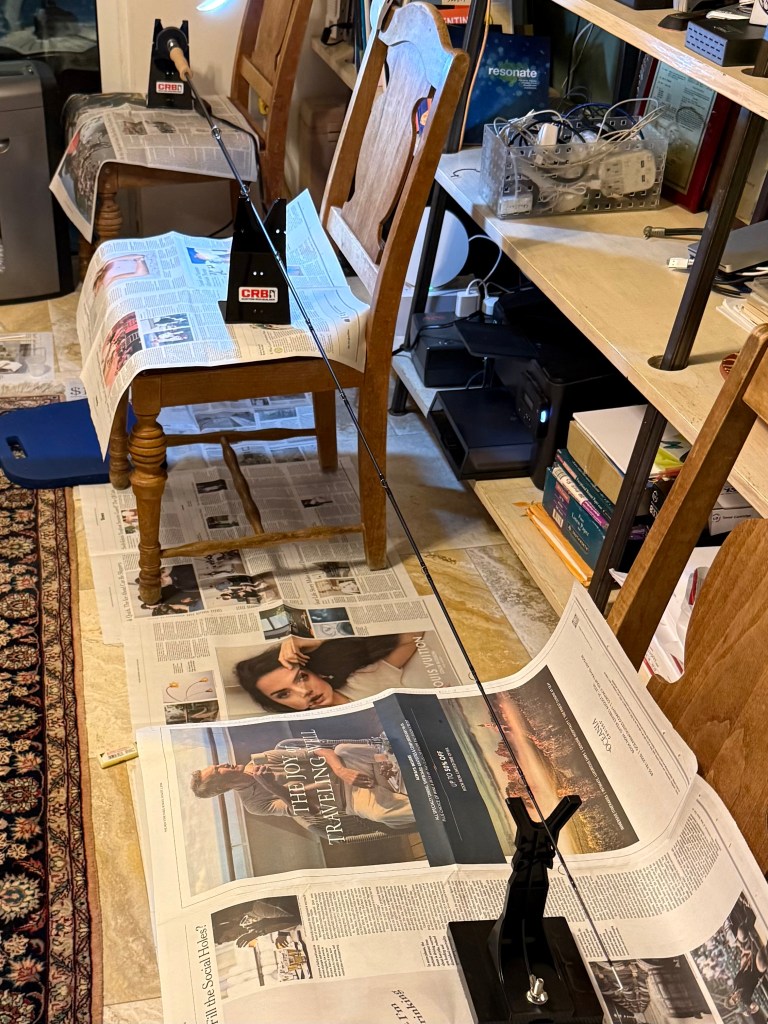
    Here’s the newly built rod, getting its epoxy coating on a rotating machine that prevents drips.

    I left for the airport a few hours after the epoxy dried.

  • Albies on fly

    Four days of icing and rest have rejuvenated my sore forearm, so it’s time to write up the fishing trip responsible for its unhappy condition.   

    In short, I wore out my arm fighting a mess of high energy fish on a fly rod. If you don’t want to read about fly fishing, you can enjoy the pretty photos and get back to swatting mosquitoes.

    * * *

    Last year I learned that a former FIU student of mine from 1994 had become a fishing charter captain. I looked him up and gave him a call. Capt. Mike Haines had relocated his business from Flamingo, where I fish regularly, to Jupiter Florida, two hours north of me, where I never fish. Mike mentioned that he sometimes takes fly fishers out for albies in the summer.   

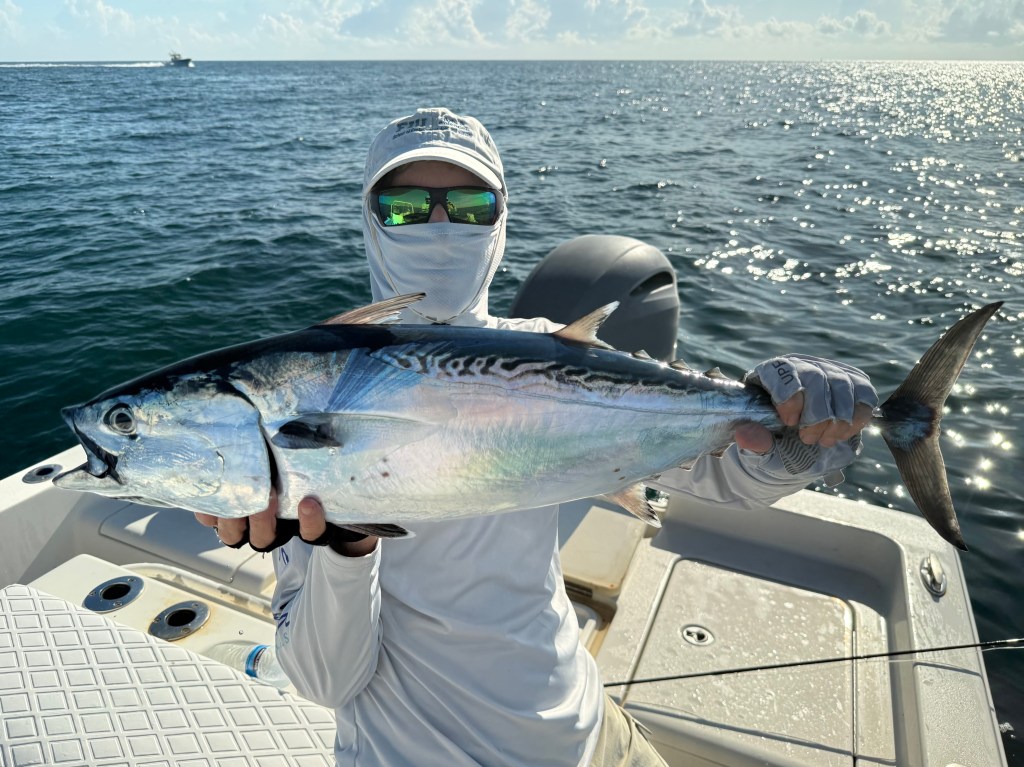
    A small member of the tuna tribe, Euthynnus alletteratus resides in the Atlantic and Mediterranean. In New England their common name is the undignified Little Tunny. Down here in South Florida, these fish are larger, stronger, and are called False Albacore, or “albies” for short (fortunately the name “falsies” was already taken). Some fishers call them “bonito”, which they are not. Whatever you call them, albies are spectacular fish, silver with black and blue vermiculated striping on the back.   

    Albies swim 40 mph in pursuit of their sardine prey or when escaping fast predators such as marlin or mako sharks. They’re famous for wearing out fishermen with their long, powerful runs and their extraordinary stamina.

    Summer mosquitoes have arrived in force in South Everglades, so I welcomed the news when Mike let me know the albies were on the ocean off Jupiter. We settled on a charter for July 1st and I invited my neighbor Rex to join us.

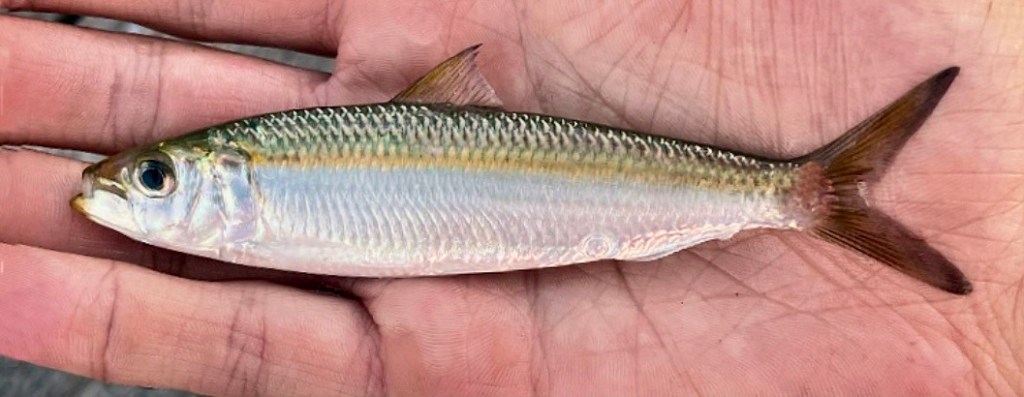
    In the meantime, I read up on albies and consulted knowledgeable friends. In New England, albies feed on tiny baitfish, so small fishy flies are the ticket. Down here in Florida, albies feed on larger prey, Spanish Sardines 3-5” long.

    Spanish Sardine (from the web)

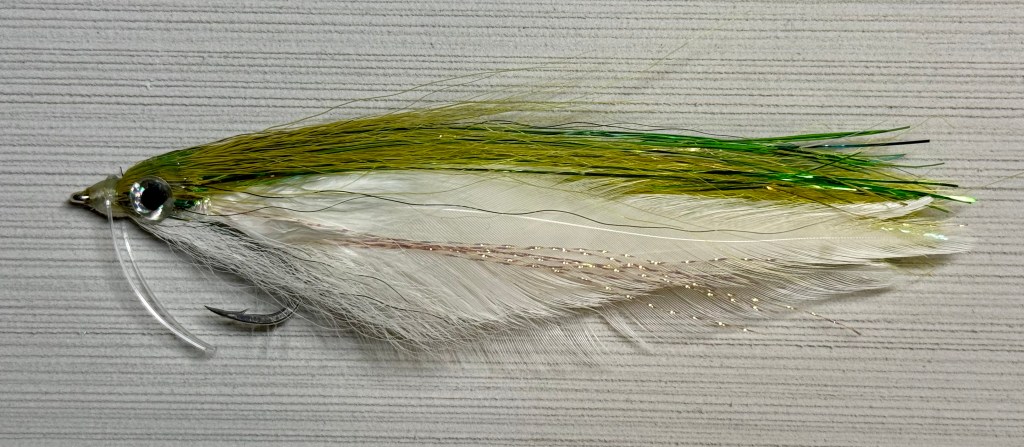
    I tied up some mimics: 3-5” versions of Lefty’s Deceiver in colors that match the Spanish Sardine.

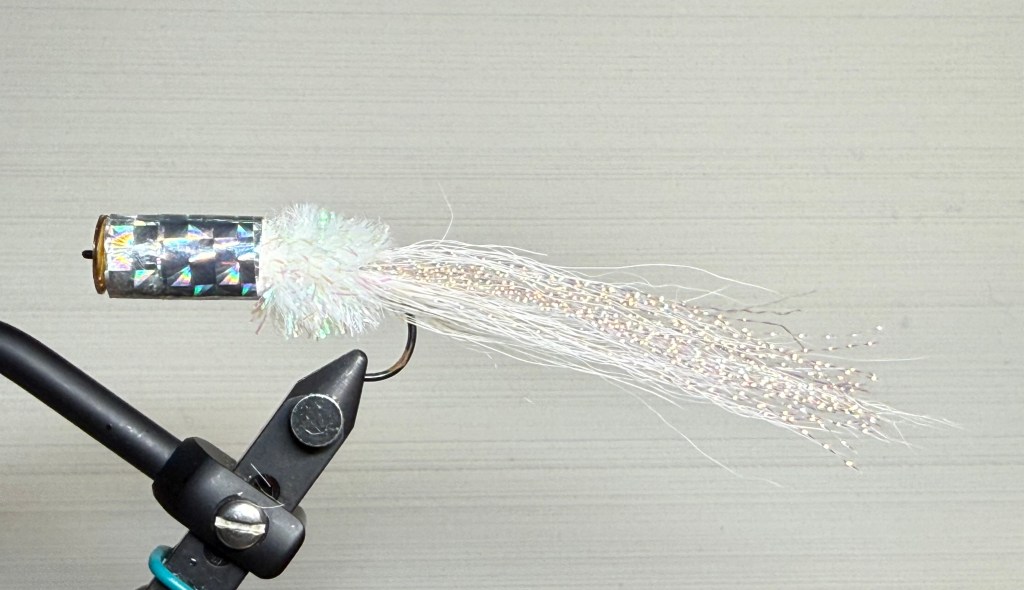
    Sometimes, albies feed on the surface, so I made some sparkly poppers as well.

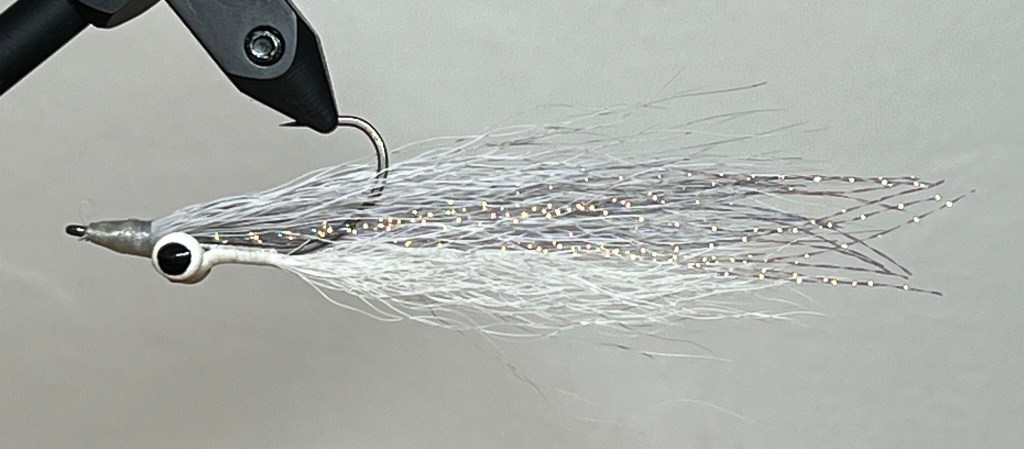
    Local fly fishing friends mentioned getting albies on Clouser Deep Minnows, which I had already tied in gray over white.

    For rods, I packed a conventional 9wt rigged with a floating line as well as my 7wt two-hander (13’ Spey rod) rigged with an intermediate line that sinks slowly. All my advisors recommended a sinking line when fish are feeding below the surface or when floating sargassum seaweed is present. My grumpy right elbow prefers casting the two-handed rod.

    Neighbor Rex knows better than to mess with fly gear – he brought a substantial spinning rod.   

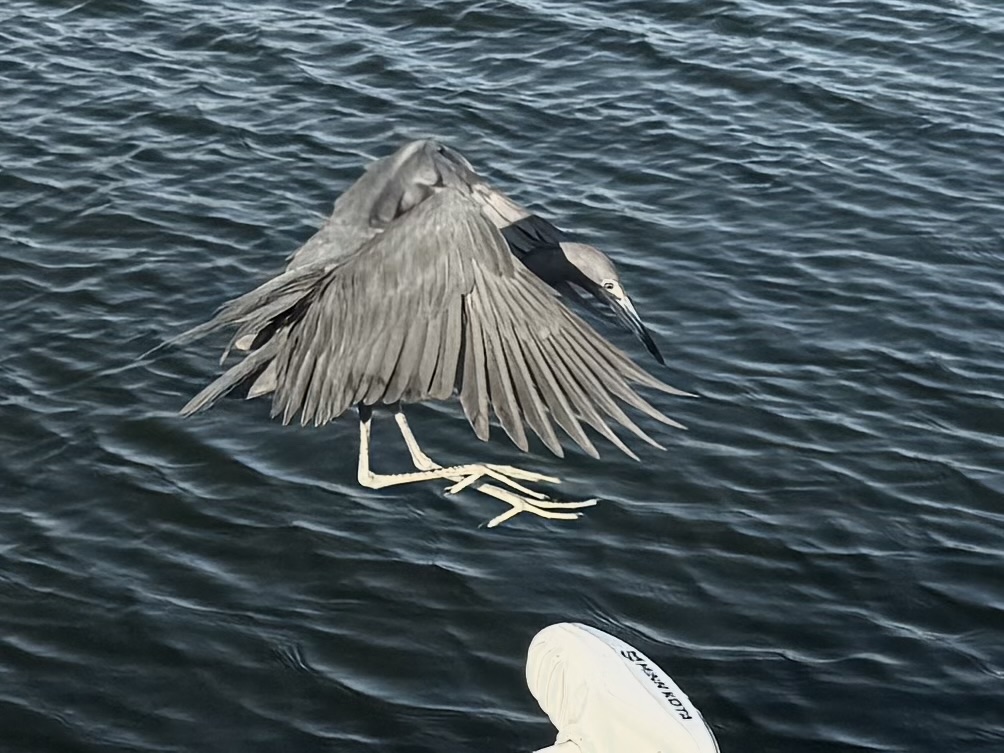
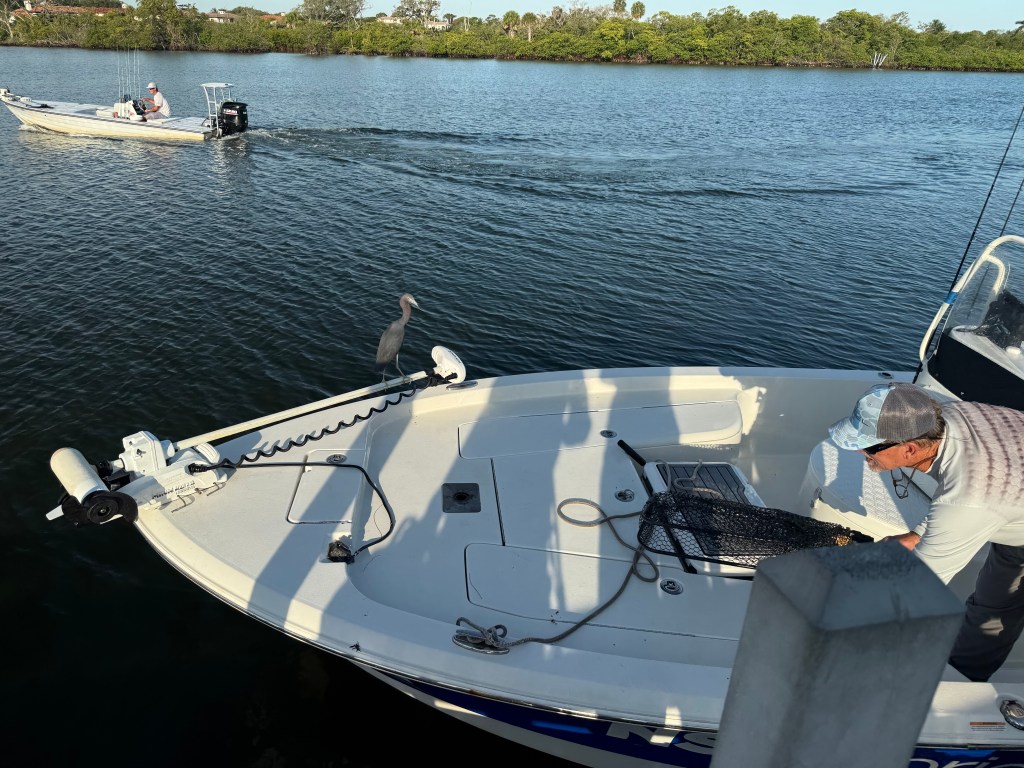
    We caught up with Mike at the dock where he had some small baitfish, pilchards, in the live well of his boat. A Little Blue Heron showed up, hoping Mike had neglected to close the lid.

    Mike cruised us out the inlet to the ocean and selected his spot about half a mile off the shore and spot-locked us in place with the trolling motor. Big fish broke the surface. Maybe albies are everywhere, or perhaps one Captain Mike Haines knows exactly where to look for them.

    Mike suggested I use a smallish white fly that that would match the baitfish in his livewell. Best listen to the pro. I selected the Clouser to fish sub-surface on the two-handed setup.   

    While I was doodling with flies and leaders Mike tossed out half a dozen little pilchards and the water exploded. Rex cast his spinning lure over the fray and hooked up on his first albie of the day. Despite his beefy spinning rod, Rex was outgunned as that albie ran him ragged. Mike loaned him an even bigger rod for the next one.

    My fly was ready, and Mike said to go ahead and cast, despite another albie on Rex’s line still racing around in the ocean. I cast my fly a short distance, let it sink five seconds, and started the retrieve. WHAM! An albie grabbed the fly and roared off, snapping the 16lb tippet. I was not even using the lightest tippet recommended. Mike informed me that, contrary to online tutorials from the New England albie fishers, the big albies in South Florida are not leader-shy, Rather than lightening the drag and risking being spooled, he suggested I scale up to 25 or 30 pound tippet instead. I went to 25 pound and sure enough, another albie roared off with the fly, pulling the remaining fly line off the reel plus a hundred yards of backing with the drag set high.

    Rex and I were “doubled up”, in the lingo of boat-fishing. The two albies wove back and forth helter-skelter while Mike danced about the boat, threading Rex’s spinning rod over or under my 13’ two-handed fly rod as the fish weaves warranted. Rex has a bad knee and sensibly did not engage me in the two albie tango on a small boat.   

    Like some sharks, albies can’t flap their operculi to pump water over their gills, so they respire by opening their mouths as they swim, a process known as ram ventilation. Accordingly, when you release an albie, you hold it by the tail (caudal peduncle) and thrust it head first into the water to give it some speed and push water through the gills.

    Albie caught on gray/white #2 Clouser & 9wt full intermediate line using the 7wt Spey rod.

    After catching and releasing couple of albies on the subsurface setup, I switched to the surface popper on the floating line for the fun of watching fish blow up a fly in plain sight.

    A couple of albies and dozens of blue runners exploded on the popper in rapid succession. We watched them streak through the water and hit the fly in a blast of spray. I could shake most of the blue runners free of the popper, but the albies stuck and roared off.

    After one popper eat by an albie, the fly line looped around my left hand and jammed as the fish made its run and before the loose line had fully cleared the rod guides. Fortunately the tippet broke. Without a breakable tippet in that situation, a fly fisher can lose a finger. Some people fish a straight 60 pound fluorocarbon leader for tarpon and other strong fish, but I have considered it too dangerous. This experience only solidified my decision to stick with breakable tippets. I press the barbs down on my flies so a fish can more easily rid itself of the fly after a break-off.

    I tried one of my beautiful sardine flies, but the fish had no interest in it. Too big for today, I guess. I tied on a heavily chewed Clouser and the fish were back on it in an instant. Oh well, they know what they want to eat… some big fish somewhere will want those sardine flies.

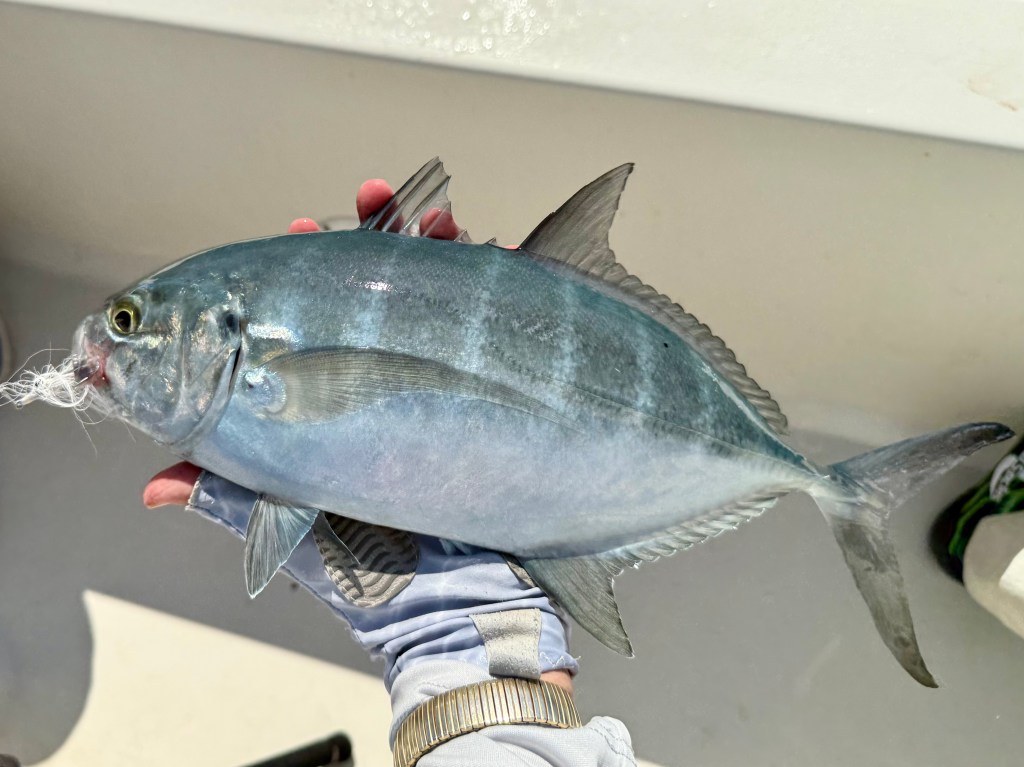
    I’d caught five albies and couldn’t resist tossing the fly another time. A chunky blue runner grabbed it, pulled line off the real, and shot straight down 40 feet. I bent the rod double but it refused to budge.

    The absurdly strong Blue Runner that parked under the boat. Notice how rounded and chunky this little jack species is.

    Getting that runner up to the boat to release it overworked my already tired right forearm. I wound up my line, reluctantly – sigh. It’s hard to leave when great fish are still biting. Rex was smarter and quit after his 4th albie.

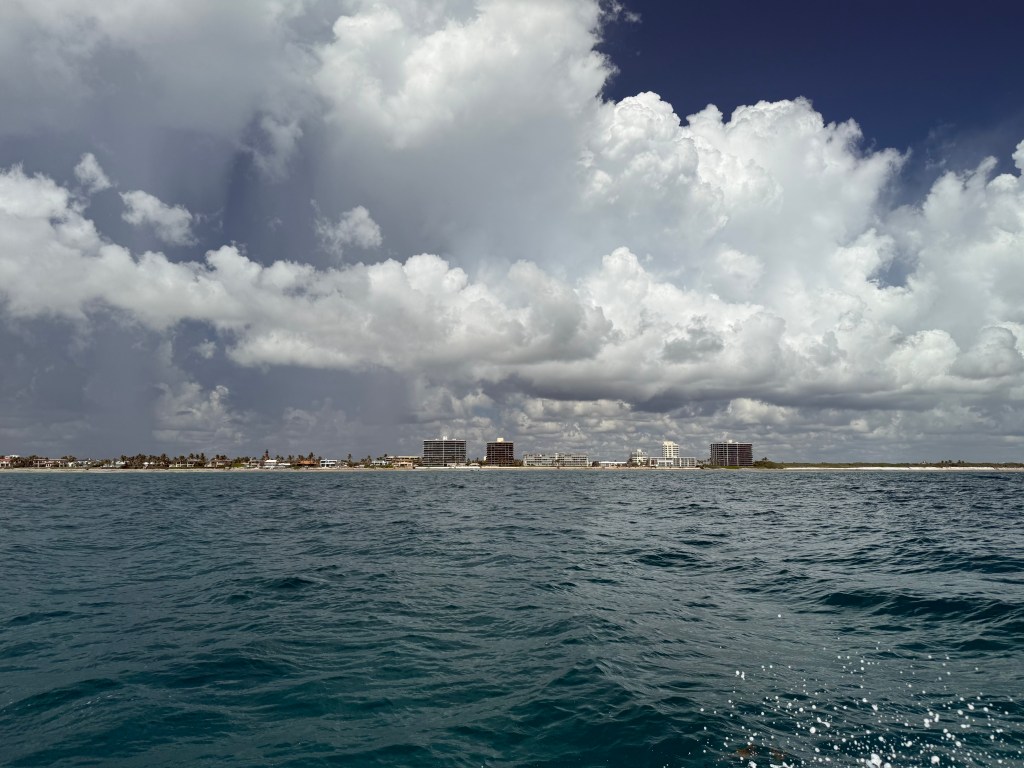
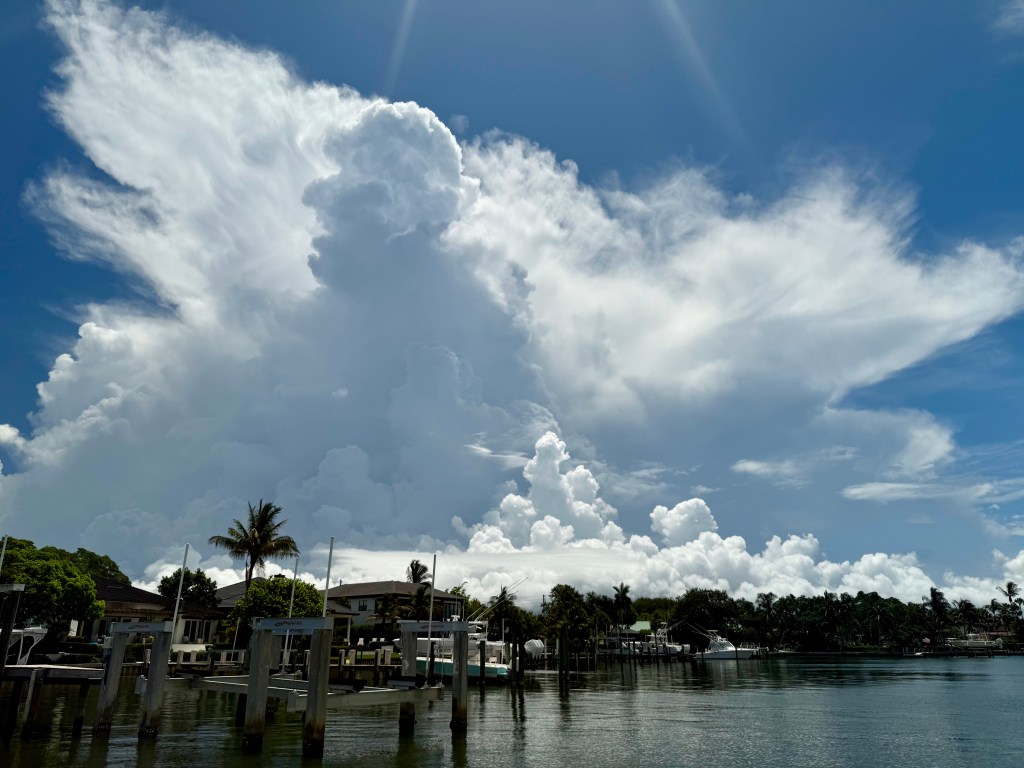
    We came back to the inlet and fished a dock for snook while admiring the storm clouds building.

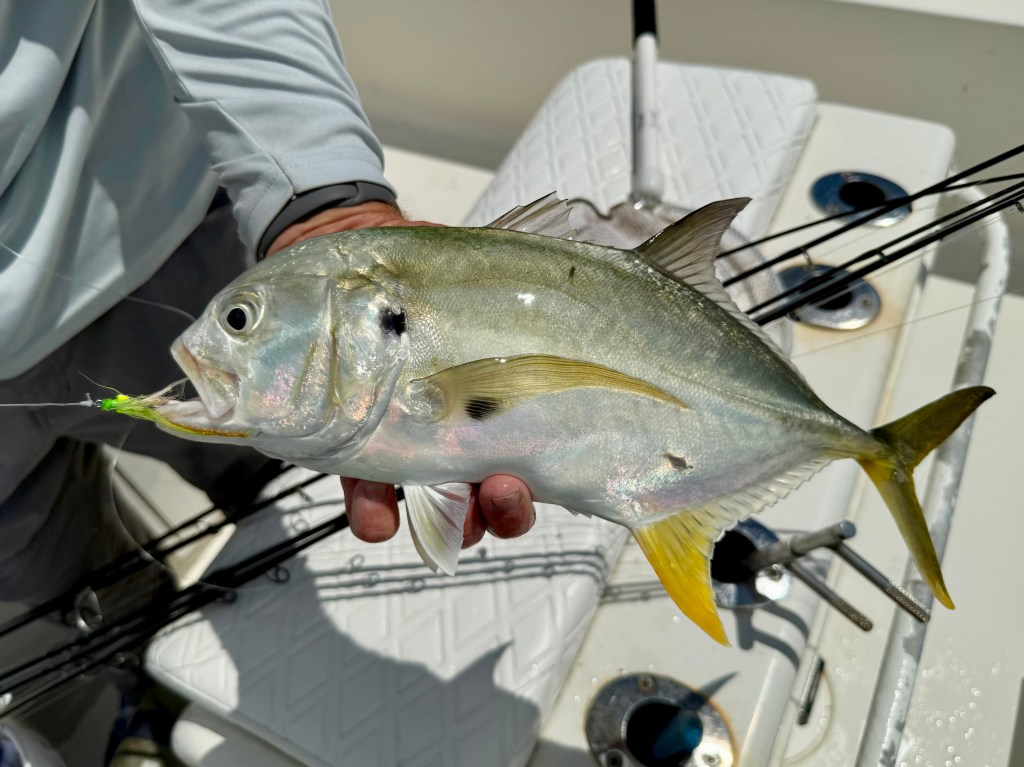
    Rex caught one snook on a pilchard, but they wouldn’t take my fly. Instead, it caught a Jack Crevalle…

    Jack Crevalle with the yellow fins and black spots.

    … plus a small Ladyfish that squirted poop all over me before I could release it. I’ve learned to aim Ladyfish away from me and the boat before they let loose, but this one was too fast. Another reason I carry a change of clothes in the car.

       * * *

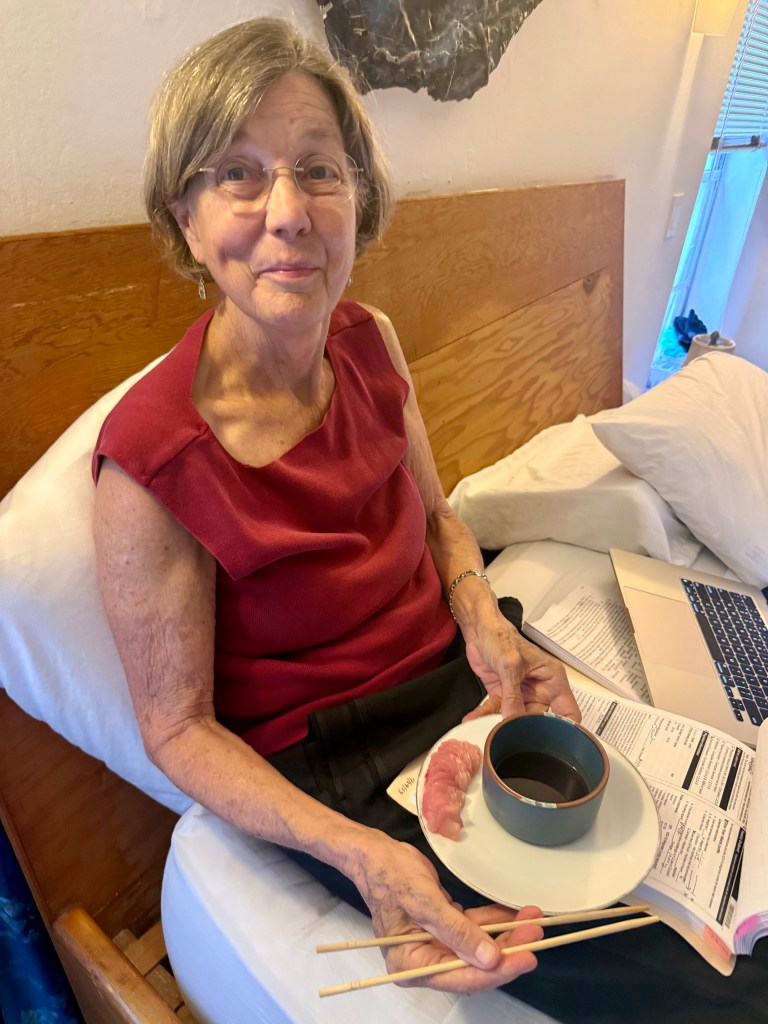
    In contrast to bonefish, our #1 piscine speed demon, taking albies on fly requires more brawn than brain. They are truly gorgeous fish though, and especially thrilling when they hit on the surface. Albies are better kept in the ocean than served at the table, but blue runners are superb eating. I kept a few medium-sized runners, Mike filleted them (thanks Mike!), and I prepared a little sashimi for a snack and a big bowl of ceviche that was our dinner for the next two nights.

    Gray finds Blue Runner sashimi the perfect complement to late afternoon paperwork.

  • Long day

    We’ve all had the odd day in which few things go right but it works out and still counts as a good day. Here’s mine.

    I rise at 3:10 am to fish the Ten Thousand Islands, where Everglades National Park meets the Gulf of Mexico. The weather forecast includes low hourly odds of light rain throughout the day, with 45% cumulative odds overall.

    Predawn boat check at the marina in Chokoloskee reveals the waterproof controller for the trolling motor isn’t working. I carry tools in the boat and the fix proves simple: disassemble, remove and reinsert batteries, reassemble.

    My first destination is Pavilion Key, a 12-mile run to the south through the maze of islands. About halfway there the wind comes up, raising waves that break on the deck of my little skiff. I turn on the bilge pump and head for the closest of approximately 10,000 mangrove keys in the vicinity. Then the sky opens. The rain is warm but I throw on my rain suit so at least my underwear stays dry.

    The mangrove key occupies less than an acre, so I entertain myself fishing back and forth along the lee mangrove edge while I wait out the squall. I know a rainbow is coming. In this wind the fly rod is outgunned, so I slum it and take out the spinning rod (oh, the shame). A small ladyfish pecks at my lure but I find no “serious” fish.

    And so goes fishing throughout the morning, substituting small saltwater catfish on the open flats for the small ladyfish near the mangroves. Whenever I feel the catfish’s telltale quiver as it nibbles the lure’s tail, I yank the lure away. In all, I catch only two of these swimming mucus bombs. In time, the storm moves north, and my clothes dry out in the sun and wind. A faint rainbow appears. I have no complaints.

    Fast forward through the morning to a nameless mangrove creek I’ve been wanting to explore, situated 15 miles south of the launch. Tight creeks like this one are buggy this time of year. Somehow the storm added a cup of saltwater to the ziplock bag holding my mosquito head net. It’s fine – wind is keeping the mosquitoes at bay, mostly.

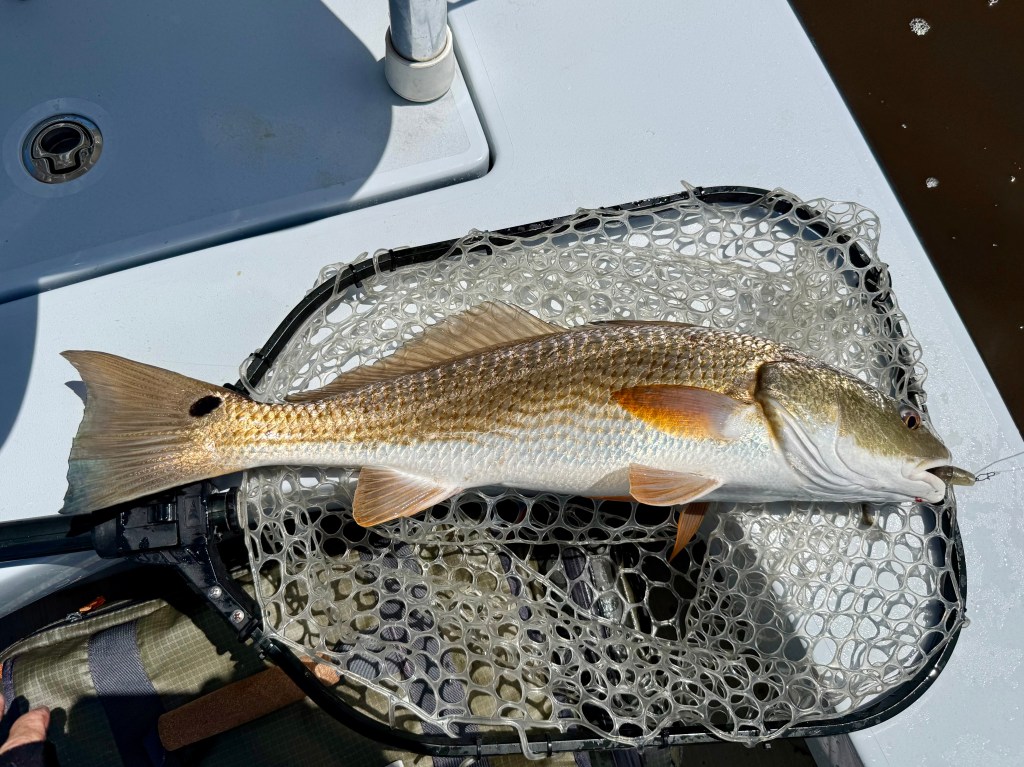
    I get out the push pole and head in at the start of the incoming tide, the wind at my back. I drift up the creek, pausing with the stick anchor to cast in front of the boat. A handsome 22 inch redfish (aka Red Drum) inhales the lure and roars down the creek for open water. A redfish counts as a “serious” fish.

    Proof of concept. I stow the spinning rod and take out a fly rod. Fly casting in a mangrove creek is like doing cartwheels through a yarn store while wearing a Velcro suit. The wind adds a stochastic element to the fly’s trajectory that wipes from the game my last vestige of skill. I pole out against the wind and current and get a proper workout.

    It’s sunny now but wind still riles the open water of the Gulf. I take the long way back, winding through the sheltered bays and rivers of the back country.

    The day has been a tour of the places in Peter Matheissen’s books Killing Mr. Watson and Shadow Country.

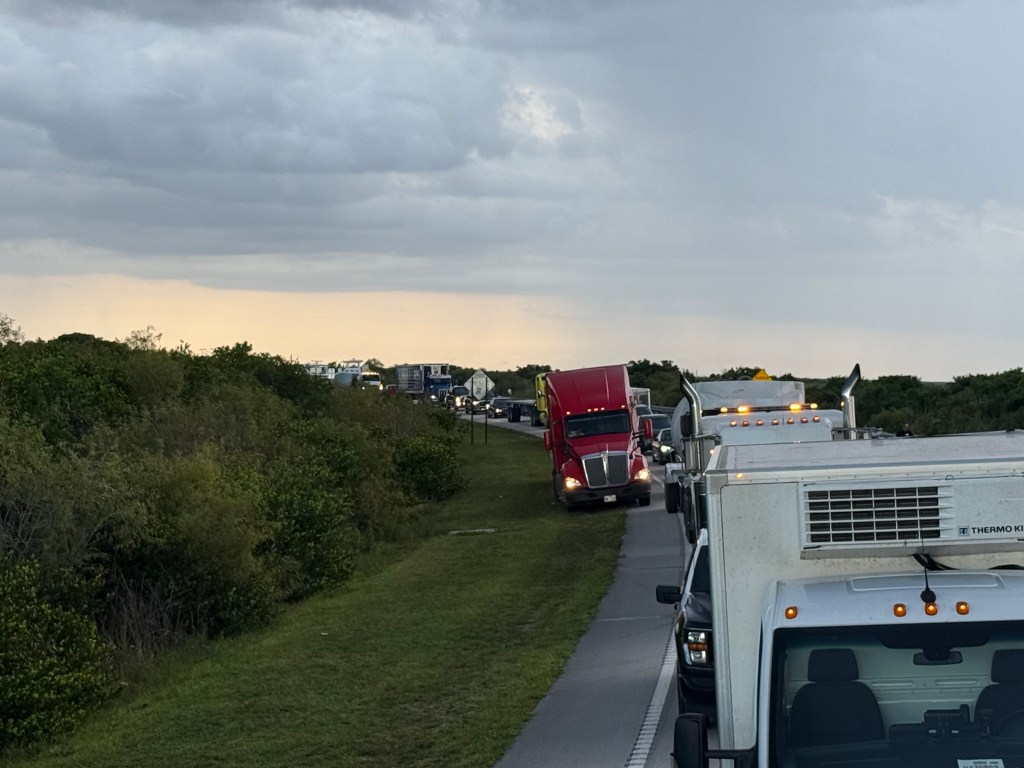
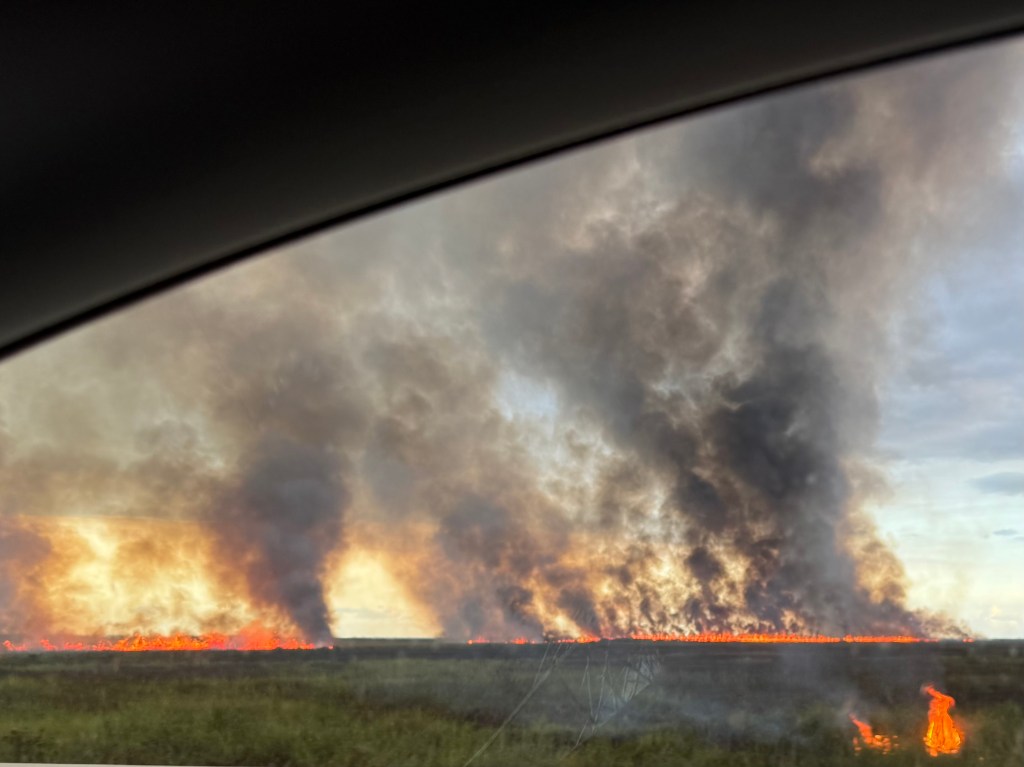
    At 3:30 pm, the Miccosukee Police stop all eastbound traffic on the Tamiami Trail. I am car #11 in a line that will, in time, extend back for miles as wildfires in the east Everglades force closure of road after road.

    A storm forms to the north, but the wind is still pushing from the south and will not direct it over the fire.

    We are parked near the Valuejet Memorial, about 40 minutes from home. I know this area – it’s a good spot for bass. I’m tempted to pull out the fly rod again, but two large alligators get the same idea, so maybe not.

    We are told our wait will be at least six hours. I invite some friendly Everglades mosquitoes into the car to keep me company.

    A mere four hours later the wind changes direction and the police let us through. The fire is impressive.

    I roll in at 8 pm. Expecting a 6+ hour wait, I had consumed an emergency granola bar for dinner, but Gray has a better menu ready for my second dinner. Bless her.

  • If you can’t beat ‘em, eat ‘em

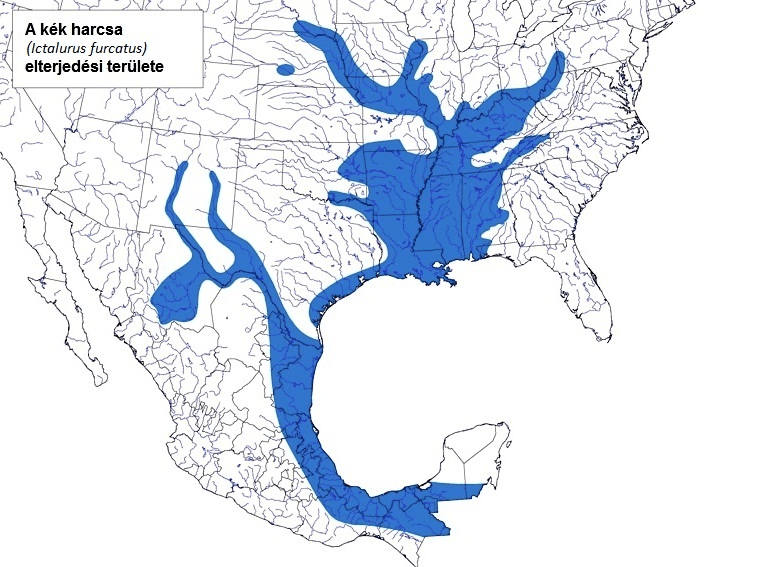
    The Blue Catfish (Ictalurus furcatus), is native to the Mississippi Valley, Gulf Coast, and east coast rivers of Central America:

    In 1974, the Virginia Department of Wildlife Resources introduced Blue Catfish to rivers on the western side of Chesapeake Bay. The DWR biologists assumed these catfish would remain confined to the freshwater systems. Their distribution along most of the Gulf coast should have been a hint that Blue Catfish tolerate salt water – duh. 

    Blue Catfish took no time moving into the saltwater and spreading throughout the Chesapeake. In the Bay they grow to over 50 pounds and devour every blue crab, clam, and menhaden in their path. The only good news is that Blue Catfish are delicious. 

    With fuel prices up, Gray and I took the EV north to visit family and friends, 4577 miles in all.

    I squeezed in a bit of fishing, of course. Visiting Gray’s family on the Eastern Shore of Maryland gives me a chance to fish with Jon Shaw, the husband of Gray’s second cousin. We fished off the family farm dock that extends into the Chester River, a brackish tributary of the Chesapeake Bay. 

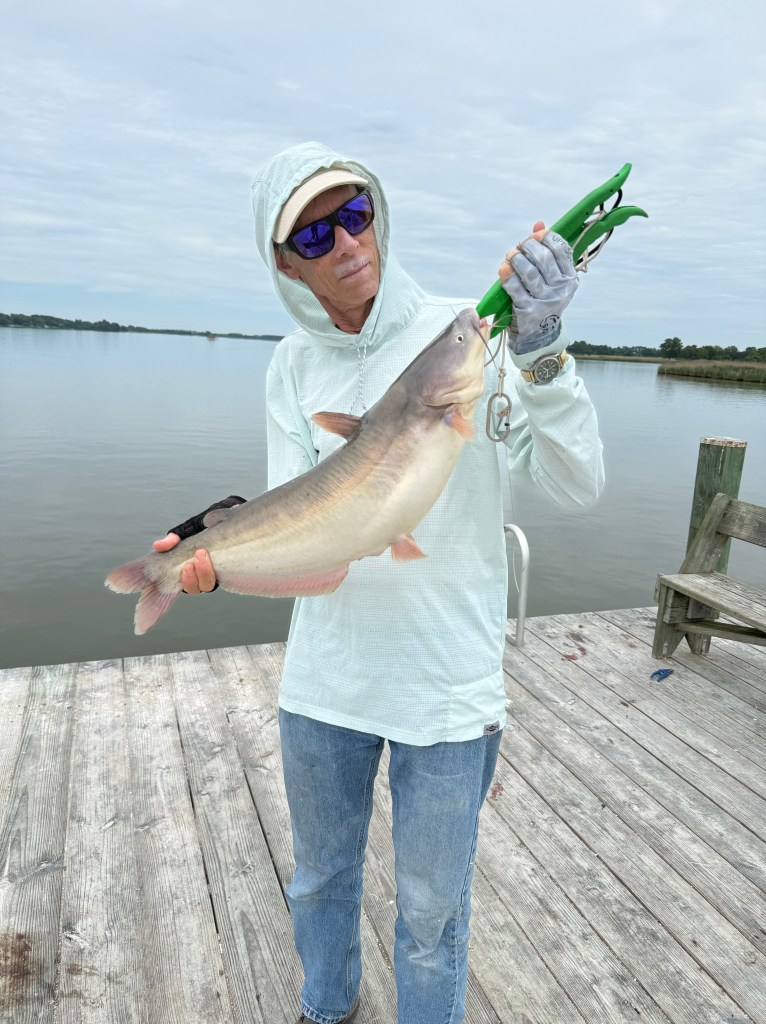
    Jon and I bait-fished for a family dinner, finding 6-12 pound catfish off the end of the dock. Our first afternoon together Jon caught four catfish and I caught zero. Hmm. 

    To catch catfish as well Jon, I realized I’d have to ignore what he says (tie on a heavy leader and a 7/0 or 9/0 circle hook), and do what he does (tie on a light leader and a 3/0 or 5/0 circle hook). The discrepancy between his instructions and his practice should have come as no surprise to me insofar as all fishermen are liars, myself excepted. The second day I rigged my rod like his and did a lot better.

    Catfish overflowed Jon’s dinky cooler, so we filleted some on the spot to make them fit.

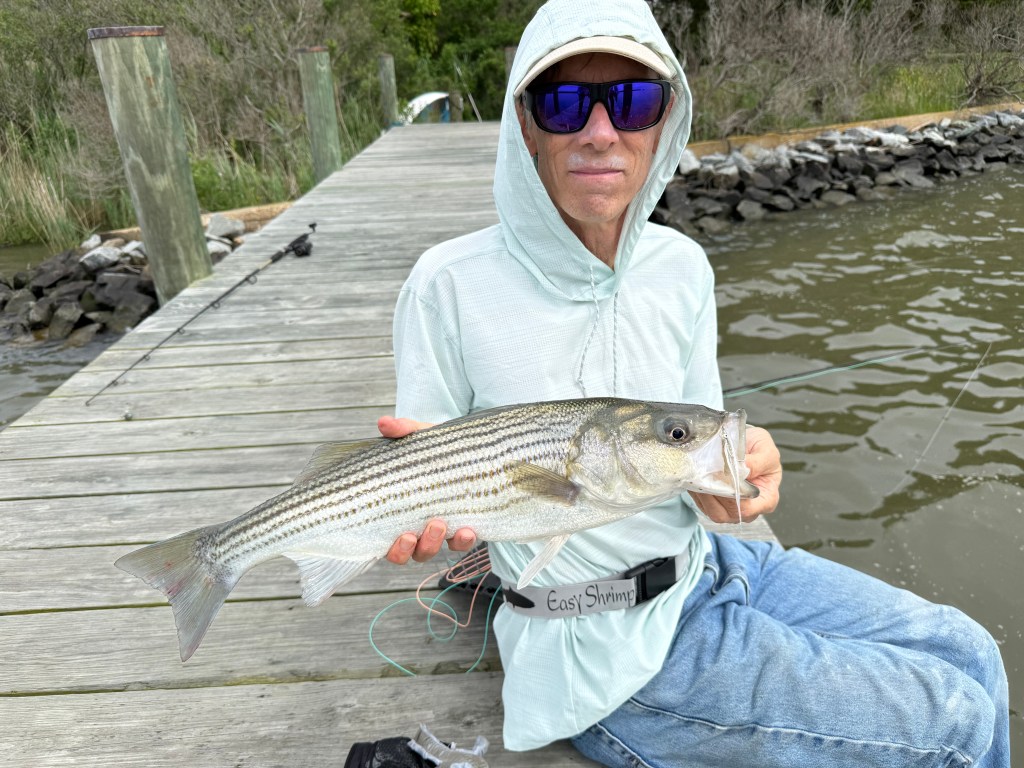
    With enough catfish to feed Gray’ cousins and plenty to freeze, I switched to fly fishing. Sitting on the dock near shore, I tied on a favorite snook fly, the gray over white Clouser Deep Minnow. The water swirled under my feet, so I flipped the fly beyond the swirl- nothing – try again – boom. A perfect dinner-sized Striped Bass, known locally as rockfish. 

    The river was closed for rockfish for six more days of spawning season, so my catch went back in the river to make more of them. 

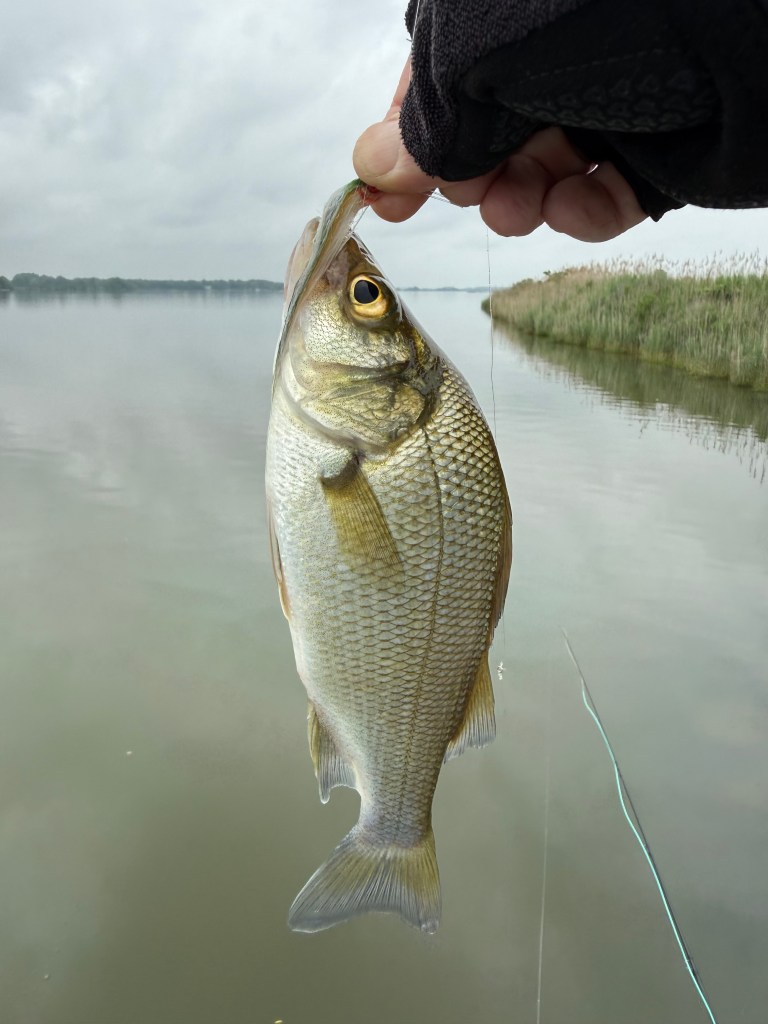
    I caught a few little White Perch on fly. They also went back in the river – too small.

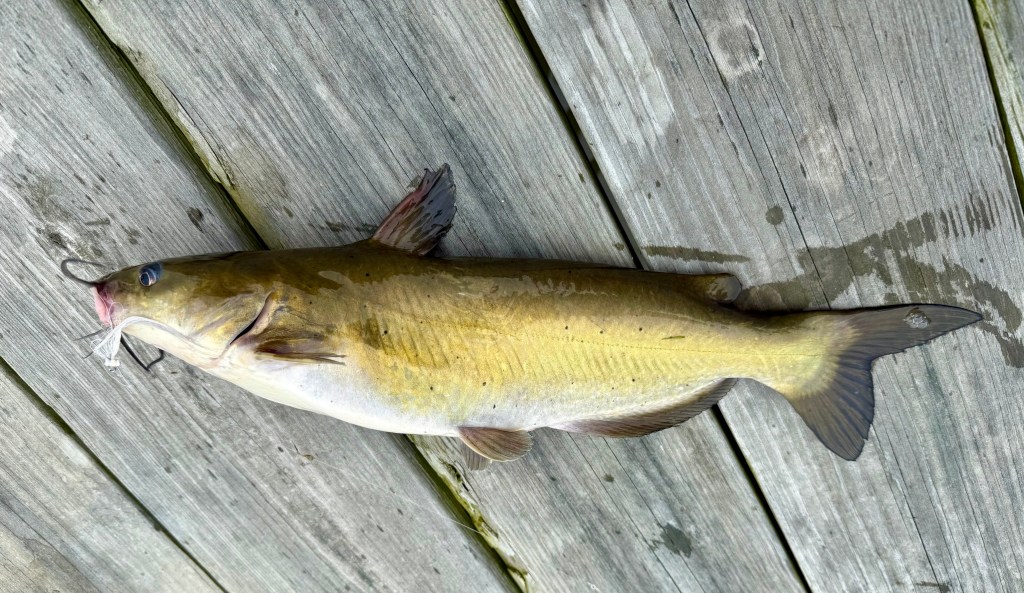
    Another fish took the fly and fought above its weight, attempting the old run-under-the-dock-and-break-your-fly-rod-or-cut-your-line maneuver. When it flashed bronze instead of silver, I realized it was not another rockfish, but rather a Channel Catfish (Ictalurus punctatus). I’d never taken one on fly. It’s a spirited gamefish.

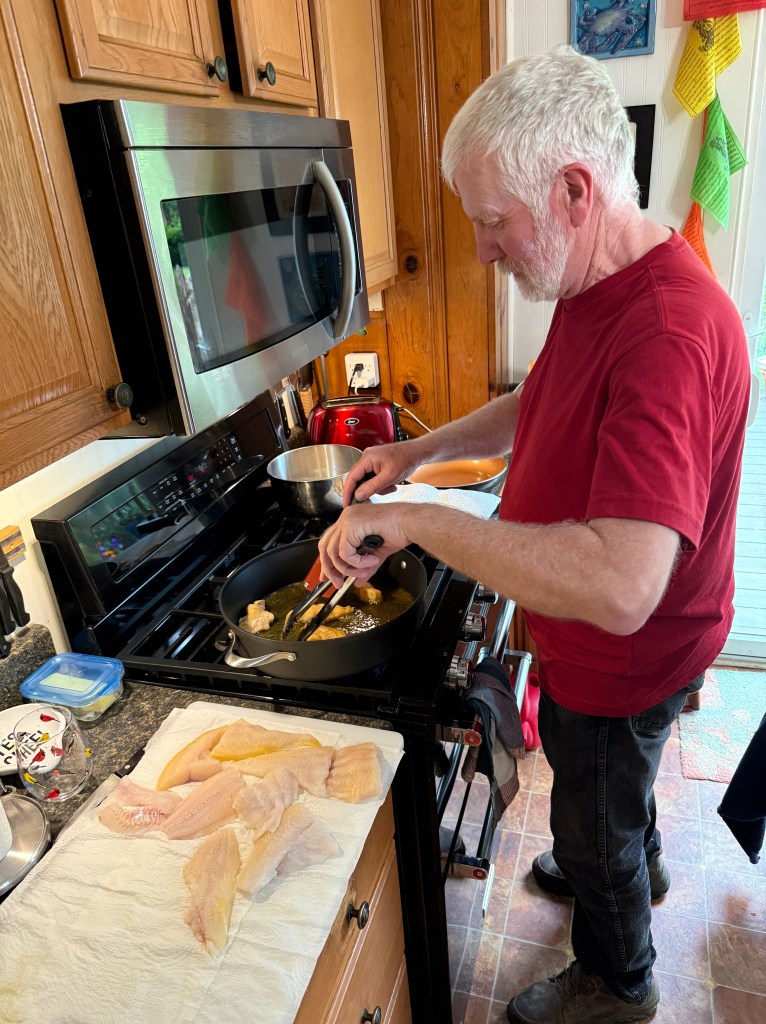
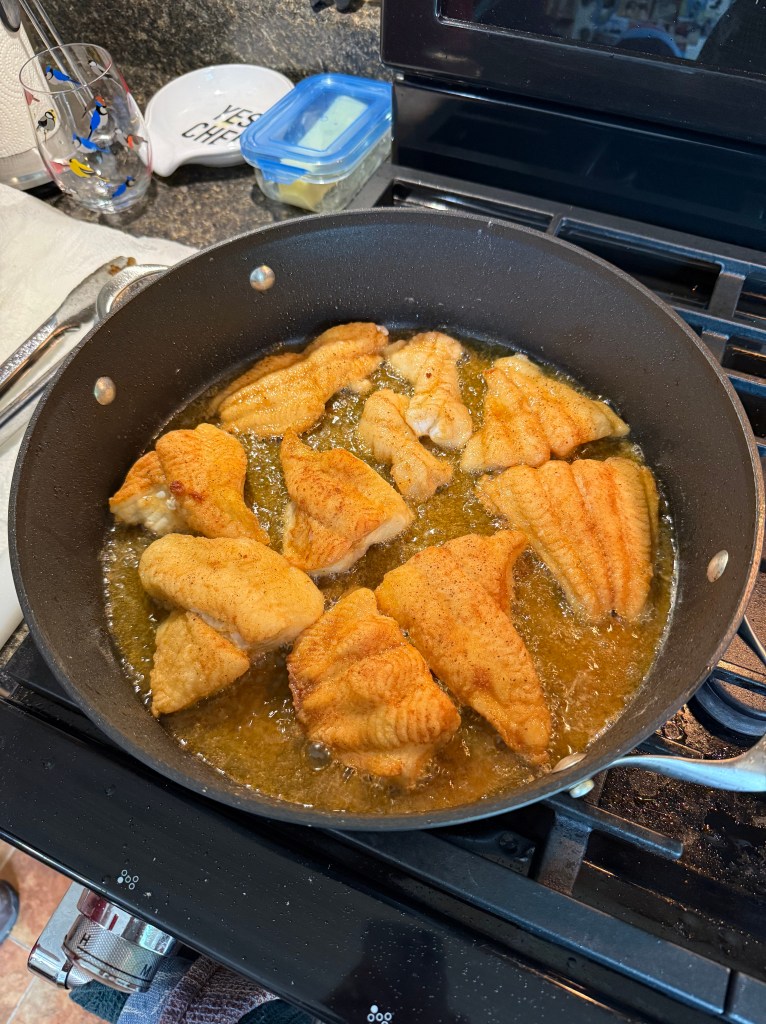
    Back at the barn, Jon and I filleted Blue Catfish. The females were full of eggs and the stomach of one spilled a load of Atlantic Ribbed Mussels (Geukensia demissa). The Blue Catfish is mostly head and stomach, yielding one pound of meat for each four pounds of catch. Jon put the ample carcasses out for his resident Bald Eagles and we all had a fine dinner.

  • Snookered

    May 15, 2026. Low winds are predicted through noon with no rain forecast for the day. Ideal weather to fly fish for snook on the beaches in the SW corner of the Florida peninsula.

    When the tide starts to come in, small bait fish congregate along the shoreline. In May and June, snook move in to hunt these baitfish along the beaches of SW Florida before heading offshore to breed. In turn, Lemon Sharks ply the water a few feet out from beaches to hunt the snook.

    Sea level rise is a real thing here, and snook make the most of it, seeking out the beach stretches with “ghost forests”, woody remnants of drowned mangroves. I presume snook find some protection from hungry sharks and ospreys among the submerged stumps.

    * * *

    Mosquito season has returned to south Everglades. I don a second shirt and my head net in the car before heading outside to ready the skiff for launch. As I step out, a swarm of mosquitoes rushes inside the car to amuse me on the drive home. No kayak today; my destination is 17 miles from the put-in.

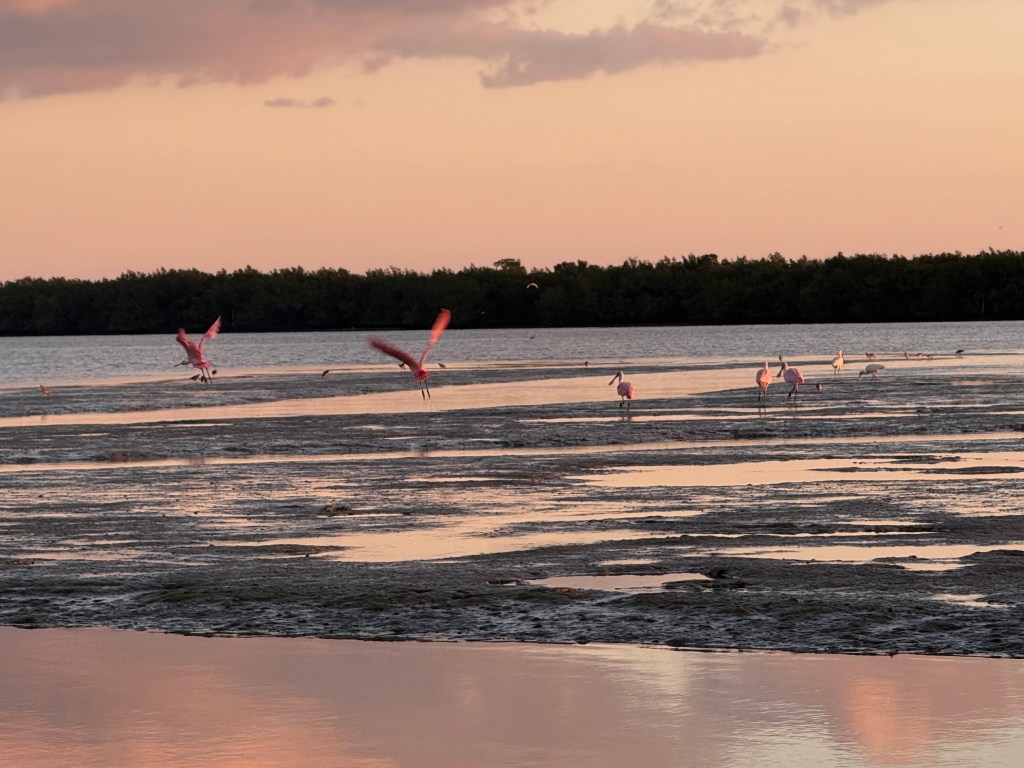
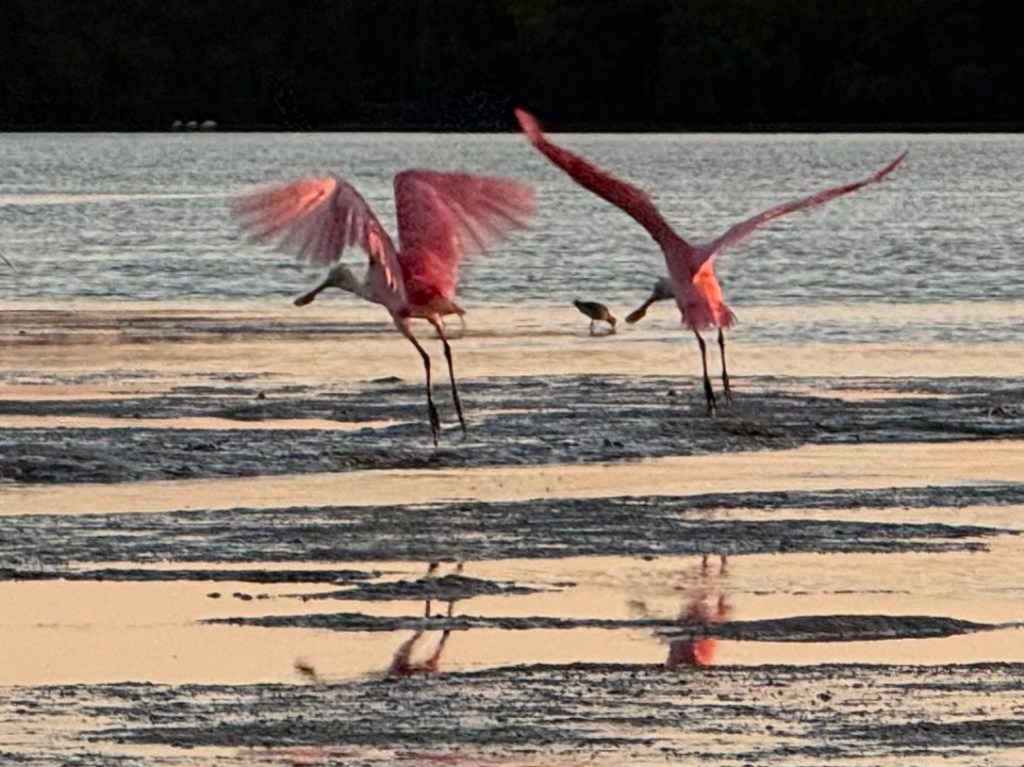
    A Chuck-Will’s-Widow sings nearby as I launch in the dark. Something splashes, but my flashlight detects no crocodile eyes. The sun peeks over the horizon turning the sky and water pink as I take the shortcut through Lake Ingraham. I stop to watch pink birds.

    Roseate Spoonbills on Lake Ingraham at low tide. They’re pink at all times of day.

    The tide is still going out when I arrive, so I check out the shoreline of a nearby tidal river, a spot just outside the strong current where I have found snook stacked up as they wait for the tide to change. Someone else has arrived before me to hunt for snook, with no intention of releasing them:

    Feeding caught or released fish to Lemon Sharks is against my religion, so I move on to the beach. The wind is low, as NOAA predicted it would be, and the tide chart says the tide will turn in an hour. I bide my time watching a Swallow-tailed Kite hunts lizards and dragonflies as it courses back and forth over the low coastal scrub. I never get tired of watching kites.

    I assemble my long, two-handed “Spey” rod, tie on a proven fly, and begin casting to the water’s edge, trying not to hook remnants of the mangrove ghost forest. At 8:30 am a snook grabs the fly and leaps into the air. It lands with a splash and leaps again. A great fish, but commotion like this broadcasts a loud “EAT ME” signal to any nearby sharks. A couple of years ago at this same spot, I broke a fly rod playing “keep away” with a Lemon Shark. I buy used fly rods, but they’re still inordinately expensive, and that particular rod was a treasured gift from my former student Manny. I have devised a plan to avoid a repeat:

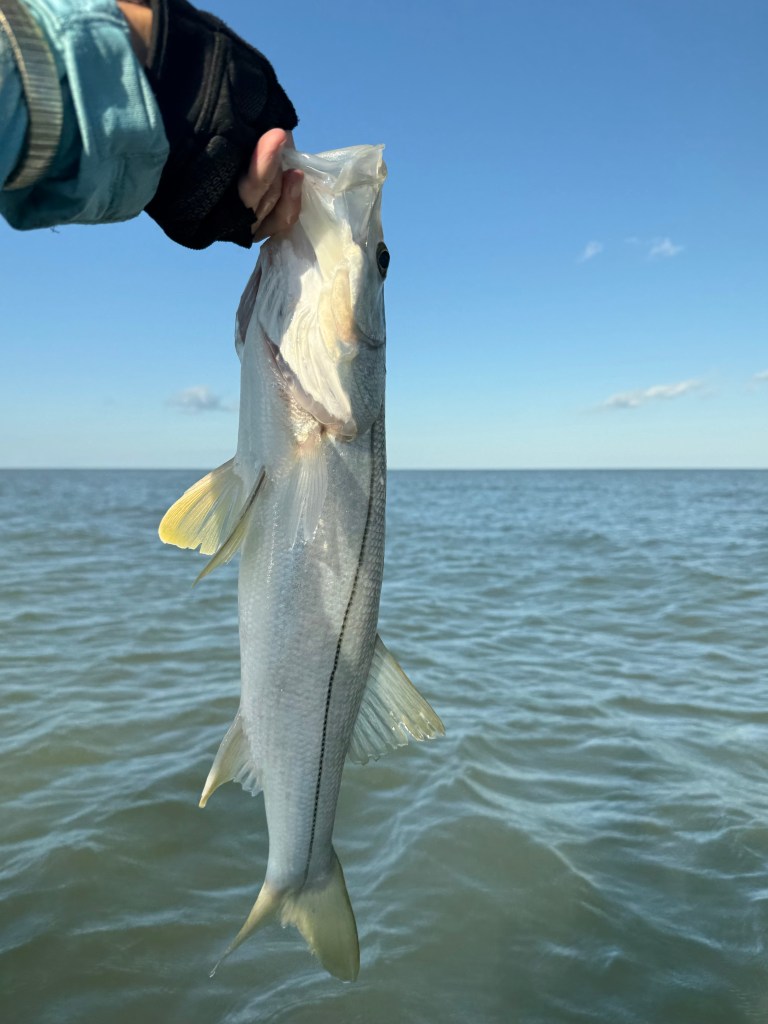
    As soon as the snook hits the fly, I open the drag on the fly reel and let the fish run while I maneuver the skiff away from the beach into deeper water. When I spot-lock the trolling motor, Mr. Snook is still on the line. The ruse works – I play in the snook and net it up with no shark interference.

    With sharks on the prowl, it’s unwise to reach your hand into the water to unhook a fish.

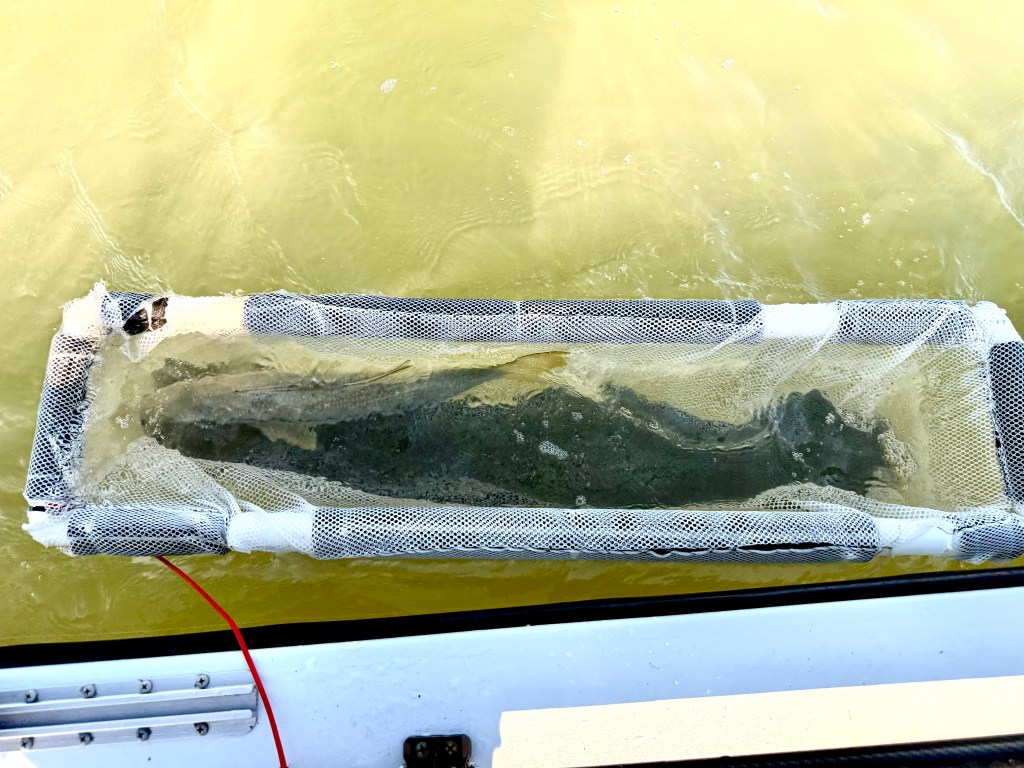
    According to a paper I read, giving caught fish a few minutes to recover before release greatly reduces the likelihood of a shark chasing them down. I unhook the snook and put him into a homemade floating recovery pen where he rests calmly for a few minutes until I release him 75m from shore.

    The snook is the gray fish-shaped thing with fins and a yellow tail on the left side of the floating pen. The long black thing is a strip of shade cloth to keep a shark from seeing the resting fish’s silhouette from below.

    The wind is picking up three hours earlier than predicted and surf is now pounding the shoreline. I fish another hour, bobbing around in the waves, but no more snook are to be found. I disassemble the rod, fold up the floating pen, and make the return run. Retracing my path through Lake Ingraham and Florida Bay I’m happy to find the water is much flatter on the lea of the peninsula than the on the windward Gulf side.

    * * *

    So where are rest of the snook today?

    1. With the strong offshore wind and crashing surf, perhaps the bait fish left the shoreline so the snook went elsewhere.
    2. Rains bring snook down from the rivers to the beaches where they congregate before heading offshore to breed. Perhaps the spring has been so dry the snook are still up-river.
    3. Maybe the recovering Lemon Shark population has reduced the snook numbers – I hope that’s not it.

    Here’s the car’s front bumper when I get home. Even as the beach snook are missing today, Black Salt Marsh Mosquitoes have faithfully resumed their time-honored role as defenders of the south Everglades.

  • Flipper

    Not the TV dolphin, a kayak flipper.

    My kayak fisherman buddy Cesar flipped over in a shallow rill along the edge of Florida Bay. Poor guy had no choice but to thrash around waist deep in shallow water and sticky mud groping for his lost fishing gear. He paddled back to the marina soaked, muddy, and completely humiliated. 

    It’s genuinely hard to flip a rotomolded fishing kayak in flat water. These craft have high primary stability and stick tight to the water’s surface. Nor is Cesar a beginner so I don’t think the flip was his fault. Two related stories suggest possible explanations.

    In September 2015, I took my wife Gray out for a birthday paddle in Biscayne Bay. I was a couple of boat lengths ahead as we passed over a bed of lush turtle grass in two feet of water. Out of nowhere, a wave rose up another two feet above the bay’s glassy surface, racing for the shore-side of my kayak. Some large and unseen creature was coming at me, and fast. For whatever protection it could afford, I lifted my paddle blade and held it firmly between me and whatever was coming at me beneath the wave. The wave jumped out of the bay and exploded over me. In the next instant the kayak and I flew up into the air. As we fell back into the bay, I executed a low-brace to stabilize the kayak. I had reflexively turned my face away from the shower, affording me the view of a bull manatee rocketing out the other side, bound for deeper water. I was completely soaked and gallons of seawater had joined me in the cockpit, but I was upright.

    From her ringside seat, Gray enjoyed the whole show.

    An unseen bull manatee had been grazing underwater near the mangrove shore and panicked when he saw my kayak cutting off his escape route. The exploding water resulted from the hard tail flip he made to shove his body under my kayak in water the same depth as his rotund body.

    Unlike my unfortunate friend, Cesar, I had two advantages that kept me from flipping over. First, I was paddling a touring kayak designed for rough water. Such a kayak has low primary stability and high secondary stability, meaning the hull rocks a bit on flat water but exerts a significant righting force that keeps it upright when tipped between 30 and 60  degrees. Second, I had a well-practiced low brace, the paddle maneuver that prevents a flip by controlling the hull’s rotational angle on the water. The low brace couldn’t prevent a soaking, but did keep me from going over.

    Since then I have watched out for the telltale wave of a kayak-panicked bull manatee in shallow water. Several times I have had to back-paddle hard to let a bull manatee barrel through to safety. Cow manatees are more relaxed around passing kayaks. Being smaller, perhaps they don’t feel so vulnerable in the shallows.

    But I can think of another manatee-related, possibility for how Cesar flipped in flat water.

    In 2022, I purchased a Hobie iTrek 11 for inshore fishing. It’s essentially an inflatable paddleboard with a lawn chair and pedal-operated flippers. An additional inflated tube along each side provides extra primary stability. This thing is not going to flip in anything short of breaking surf. The iTrek is oval in shape and gray underneath, like a manatee. 

    Manatees love the iTrek. Many times I have had to reel in my fishing line when cow manatees come up to snuggle. A few times the bow of the iTrek has risen mysteriously out of the water, elevated on the nose of an amorous bull. It’s disconcerting for sure, but unlike a kayak, the iTrek stays upright while balanced at one end on a manatee’s nose, with no athletic intervention by the paddler. One morning I gave up trying to fish because a bull manatee followed me everywhere I went, nudging the boat from underneath then backing away with a silly grin.

    Hardly the worst reason to miss out on the morning’s fishing, don’t you think? And definitely better than being flipped over like my buddy Cesar.

  • Long Island, The Bahamas

    Long Island, The Bahamas

    When I moved to Miami in 1992, I assumed I’d take frequent trips to The Bahamas – they are so close. Thirty-four years later, I finally made my first trip. We spent an enchanted week on Long Island, 335 miles ESE of Miami. “We” includes my wife Gray and our retired zoologist friends Chris and Marcia from the Keys.

    * * *

    Flights being what they are, we stay over in Nassau before flying to Long Island. We spend the afternoon poking around the downtown, the best part of which is the walk up and down the Queen’s Steps at the end of a former limestone quarry turned tropical garden. 

    The Queen’s Steps, Nassau

    As I sit on a stone wall to take in the view, a black rat (Rattus rattus) pops out from behind a rock, runs across the space in broad daylight, and scrambles onto my left foot. I shake my left foot reflexively and Miss Rat deftly leaps onto my right foot. I snap my right leg straight and propel her back across the narrow quarry, where she scoots back into her hole in the rock face. Rats rule the Queen’s Steps, or fancy they do.

    The next day we take a turboprop to Long Island, passing over infinite turquoise flats visible through the scratched window.

    As per its name, Long Island is long, about 80 miles end-to-end, and narrow, a mile wide in most places. It’s heavily vegetated in dense hurricane-pruned coastal hammock and scrub.

    One road, The Queen’s Highway, runs the length of the island (are you sensing the Bahamian “Queen” theme yet?) Some sections had been paved at one time or another and everybody drives on the left side of the pitted road. We lodge at the north end, in Stella Maris where our digs are a Home Exchange house on a hilltop overlooking the Atlantic.

    Chris is a far more experienced fly fisherman than I, and equally enthusiastic. For two months, Chris and I have been planning to fish for bonefish on fly. We even caught them in our dreams.

    Slipping into bed on our first evening in Long Island, Gray asks me in a warning tone:

    “You’re NOT going to spend the WHOLE time fishing, are you?” 

    “Oh no”, I reassure her. 

    Fishermen never lie; it’s hard to see bonefish at night. For her part, Gray spends every possible moment painting lovely watercolors of everything around her. I don’t complain. Why would I? I am delighted by her painting and seeing her enjoy it so.

    Having forgotten to pack her tube of turquoise, Gray struggles to capture the exact color of the water.

    Marcia borrows my binoculars and watches birds. While tricky to spot in the dense, low thicket that covers the windswept island, you can often hear their songs.
    The Bahamas Mockingbird does not imitate other birds, but it sings its own lovely songs with the same enthusiasm.

    A Bananaquit and a Bahama Mockingbird take baths in the gutter under the eave. Mangrove Cuckoos growl from the vegetation “kuk-kuk-kuk-kuk…”, but are largely invisible – only Marcia manages to spot one.

    I discover thin vines with tiny thorns running along the ground through the scrub. Ouch.

    If you venture off the path, nix the sandals – boots advised.

    The property manager tells us that the recent hurricane last November took a heavy toll on the birds and butterflies. Hopefully they recover soon.
    Food and supplies, such as they are, cost about twice what you’d pay on the mainland. Provisions arrive once a week at the town of Salt Pond, 20 miles south of our place, via the mail boat. The Regatta was held at a different island last week. Sailing being the national sport, lots of locals attend the Regatta, so the mail boat went there instead of Salt Pond. As a result, we find the produce shelves sparser than usual at the local food stores and the ATM empty of cash. The only fish we find for sale are canned tuna, tins of sardines, and frozen salmon. I’ll be darned if I’m going to The Bahamas and eating canned fish or frozen salmon. We innovated with the menu and didn’t starve. I’d brought good coffee and granola from home and a spinning rod that might prove handy for grocery fishing.

    The four of us drive an hour south to Dean’s Blue Hole. At 663 feet deep, it’s the second deepest blue hole on the planet. 

    Dean’s Blue Hole. The white thing in the middle is a platform for divers, secured by four long steel cables.

    The hole’s shallow perimeter is lined with live coral, hosting oodles of tropical fish and the odd sea turtle. Gray and I snorkel around the cool water to soak in the splendor.

     * * *

    FISHING REPORT

    Chris and I wade fish on our own for two days, after which we conclude that the author of the do-it-yourself bonefishing book maybe hadn’t actually fished all the places he recommended. A mangrove creek where, he wrote, one could spend a full day fishing for bonefish would have taken us a full day to free ourselves from the deep, sucking mud. It looks promising on Google Earth, right?

    The most interesting wade-fishing spot we find is the lagoon by the Columbus Monument / Lucayan Memorial at the north tip of the island. This lagoon is ringed by the prettiest flats I’ve seen anywhere.

    Columbus Monument / Lucayan Memorial. Good old Christopher Columbus enslaved the Lucayans but they died. All of them.

    Chris wears his new Simms flats boots, cumbersome affairs that do an excellent job traversing the frighteningly sharp eroded limestone that lines the shore. These boots would be good footwear for birding off-trail, as well. I tippy-toe over the crags in my rubber-soled dive booties. They’re better-suited for sand.

    One slip here and you’d be raw hamburger.

    We see lots of young Green Turtles and Lemon Sharks, a few schools of small mullet, and the odd passing bonefish.

    The next morning we walk the edge of Aderley Bay, also pretty, and filled with critters.

    These sand-colored portunid crabs are everywhere in the shallows of Aderley Bay.

    We catch little snappers and Chris catches a baby Nassau Grouper that grabs his fly before diving into its hiding hole, but we don’t see a bonefish.

    Returning to the lagoon at the Monument/Memorial late morning, a 10 pound bonefish swims up to Chris before he has prepared his line for casting. Oops. I see another bonefish approach. It sees me too and veers back into deep water. That’s it for bonefish today. Wading mile after hopeful mile, Chris and I rub our toes raw inside our neoprene wading socks. [Note to self: acquire snug synthetic liner socks].

    This week the moon is waxing full, allowing the bonefish to stay up all night feeding on sand worms and other invertebrate party snacks. Having a full tummy come morning presumably lets them hang out in deep water and reduce daytime exposure to aerial Osprey attacks. Tide swings are steeper on the new and full moons which move bonefish faster through their circuit between the mangrove creeks and deep water. These faster movements, in turn, shorten our accessible fishing time on the flats. Neither nocturnal feeding nor fast transit over the flats is ideal for finding hungry bonefish by daylight.

    Fortunately, Chris has booked us a day with James “Docky” Smith, owner of Bonafide Bonefishing. The locals tell us that Docky can put us on bonefish under any conditions.

    The following morning, as we wait at the marina for Docky to show up, Chris chats with Docky’s brother “Big Dog”, who is fiddling with something on a large fishing boat. I watch a school of baby tarpon evading a hopeful barracuda and scout the water for snappers as a possible future dinner alternative to dining out.

    A gazillion Baby tarpon. So cute!

    Docky motors up in his flats skiff, a Kevlar Hell’s Bay Professional that poles in 5″ of water.

    In 20 minutes we are on a beautiful flat, completely inaccessible to fishers lacking a shallow-draft flats boat. Docky cuts the motor and asks us to make a few practice casts so he can gauge our skill levels. My humble casting skills have room for improvement. Docky says to slow down my rod and speed up my left hand line haul. I try and it makes the casts longer and easier (thanks, Docky!). I can tell Chris is very excited – I’ve seen him make a hundred casts better than these.

    Docky selects a fly from my collection, Chicone’s Crusher Legs Gotcha, tied with fur from our friend Laura’s Australian Shepherd. Docky directs me to the bow, and begins poling his skiff slowly across the flat in less than a foot of water.

    “They are here, we just have to find them.”

    Docky’s scheme is to intercept bonefish as the falling tide pushes them to deeper water. Wind riffles the water, better for fishing but harder for seeing fish. At least that’s the case for me. Docky has 30 years experience spotting these flats ghosts, and like all good flats guides, easily spots fish twice as far away as a normal human can.

    Docky: “There … 11 o’clock, 80 feet. See them?”
    Me: “No.”
    Docky: “Sixty feet. See them?”
    Me: “No.”
    Docky: “Forty feet. See them?”
    Me: “Yep!”
    Docky: “Start casting!”

    Twenty bonefish are swimming side-by-side straight toward us. I cast where Docky says. The fish don’t like my cast and leave. I need to angle my cast more downward so the fish cannot see the fly line. Try again.

    Docky finds more fish and says “Start casting.” I cast and the fish turn away. When Docky says to start casting, he doesn’t mean for me to cast. He wants me to false cast until he likes the angle of my fly line and the distance of my fly, and then only to let it go when he says to. Ohh-kay. Not what I’m used to, but I’ll follow the master today.

    The next school holds 25 bonefish, including a few large ones. Docky tells me to cast right in front of the middle of the school… wait, now! With a clearer understanding of his directions, I make a satisfactory cast, wait for the fish to get close enough to see the fly, then start the long, slow strips that mimic the behavior of a small shrimp fleeing encroaching bonefish. A dozen fish advance curiously to check out the escaping fly. Each bonefish, in turn, takes a quick look and swims away. Then the biggest one, a nine pounder, breaks out of the school and swims up to the fly. This big bonefish keeps following, following, following, then nope! It turns away too. They all think something is wrong with the fly. I suspect the fur is too long and offer to trim it shorter, but Docky says to pick a different fly entirely. I ask which one? “Doesn’t matter, choose one.”

    I let Chris have the bow and go back into my fly box for something different. I pick the #6 Bone Appétit, with a shorter “wing” of tan rabbit fur. It’s a Crazy Charlie variant that Drew Chicone designed for the white sands of Andros Island. The sand here is white as well. I also switch from my 8 weight setup to my 9 weight, which will handle the wind a little better.

    My tie of the Bone Appétit, a bonefish pattern by Drew Chicone.

    Chris explores the numerous ways to scare bonefish. He shifts his body weight during the cast, rocking the boat maybe an inch, just enough to push out a subtle wave that makes the bonefish anxious. He repositions his sock-clad foot after the cast; somehow the bonefish sense it and depart. He casts his fly to land upwind of a bonefish school but the wind curves the belly of the fly line in front of the fish, scaring them away. Having corrected all his errors, Chris finally hooks up with a nice-sized bonefish that gives him several good runs before randomly tossing the fly. Hard-mouthed fish are good at that. Here’s a photo of the bonefish before it got away.

    It’s not you; this hooked bonefish is invisible to normal humans. Even if you zoom in, all you can see is the nylon leader and disturbed water. Bonefish match and reflect the background color, but they are opaque, so one can track them by their moving shadows if clouds don’t block the sun.

    At the next spot, Docky directs us to hop out and wade. As I walk beside him, Docky instructs me in bonefish behavior. I had a career studying animal behavior, but have only fly fished saltwater gamefish for four years. This lesson alone would be worth the price of the guide day, but it gets better. Docky spots a school of several dozen bonefish. As we get closer we can see them moving slowly away from us, transparent dorsal fins and tails glinting in the sunlight. I am beside myself. Wade fishing is my favorite pursuit. We follow the fish quietly, out of disturbance range. In time, they pause, turn, and come back towards us. I drop the new fly in their path, wait for the fish to get close, and begin the fleeing shrimp retrieve. A four pound bonefish pounces on the fly. I set the hook, and the bonefish takes off, zipping line off the reel.

    I have caught many bonefish on spinning gear, but had just two “eats” on fly, neither of which I landed. This one is my first bonefish on fly brought to hand. I lift it briefly from the water for a quick pic and it’s off to rejoin its friends.

    Close inspection of the photo shows recent injuries from Osprey attacks. No way an Osprey can lift a fish this big from the water, but it tried. Ospreys are the reason bonefish are so skittish, fleeing when anything disturbs the water or casts a shadow.

    This bonefish has multiple injuries from Osprey attacks, a big V-shaped gash on its back and a nick on its tail. Adding insult to injury, it had the bad luck to eat my fly and get dragged in. This fish lives a rough life but thus far has always gotten away.

    Chris hooks up again, more good runs, and the fish breaks off.

    I catch a second bonefish, a little smaller than the first, about 3 pounds. I’d keep this fish in the water to unhook and release it, but oblige Docky who wants a quick photo.

    I’m not happy, or anything, am I? Now quick, back in the water. Bye fish, and thank you.

    Chris gets a third eat and manages to land this one. 

    You’d think this was Chris’ first bonefish. It’s not. They’re that cool to catch.

    On the way back to the marina, Docky stops to have us compare the feel of different fly rods as he gives us some final coaching in flats casting. Chris asks what rod is HIS favorite and Docky pulls out a titanium-wrapped ADG fly rod, cautioning “be careful with my girl.” It casts like a dream, farther and with less effort than Chris’ Orvis Recon or my Sage X.

    Despite the worst possible moon and tides, Docky has put us in front of nine bonefish schools today, ranging from 20 to 200 fish each. I’ve seen more bonefish today than altogether over the past five years in South Florida and I’ve learned as much again about bonefish behavior. We’ve hooked up five times and brought three bonefish to hand. I’ve had a such a fine day that when I back out of the lot at Docky’s fly shop and knock over his shop sign, the humiliation cannot put a dent in my elation. I happily pay a neighborhood carpenter to remount the sign – gotta support the local tradesmen.

    After five days on Long Island we still have not seen fresh fish for sale. With a notion to catch something fresh for dinner, I drive back to a spot where I saw some respectable Mangrove Snappers. I cast some shrimp flies and get no reaction. Nuts to that. I pull out my cheap Okuma travel spinning rod and tie on the irresistible snapper lure, a sparkly 2.5” rubber shrimp made by MonsterUSA. I rigged it with a fly hook, lightly weighted. Tossed where the flies were ignored, a bunch of snappers zoom over to check it out. Some of them are big enough for dinner but none will eat this proven lure. Throwing caution to the wind, I cut off the protective barracuda-proof wire bite tippet and re-tie the shrimp lure directly to the 20 pound monofilament leader. I try again in a slightly different spot but get the same refusals as before. Snappers are notoriously leader shy, so I add to the leader two feet of Rio high strength 1X fluorocarbon tippet. This precious stuff is just one quarter of a millimeter in diameter and tests close to 15 pounds. I move a bit further and try a third time. I see a quick flash of silver and wham! My rod bends double and the drag screams as line peels off the reel. The barely-seen fish, whatever it is, has dashed back through the dock pilings whence it came.

    I assume it’s a big barracuda, but the thin tippet holds. Definitely not a barracuda. Maybe a grouper(?). The 15 pound braided line is stretched taught against the pilings, humming audibly, yet amazingly, does not fray and break. We go back and forth, each of us gaining and losing line until the balance tips in my favor and the fish comes into view. I spy the characteristic black spot and red tail of a Mutton Snapper. With no one to help me land the fish, I grasp the leader in my right hand, lie on my stomach, and nab the fish with my left hand. Sometimes it’s good to be built like a gibbon.

    Mutton Snapper by Gray Read, 8″x12″. If you want this painting, make her an offer.

    The snapper measures 22″. I’d cook it whole, but it won’t fit on the grill. Filleted, it makes a fine dinner for the four of us with two pieces saved out for the property manager and his wife.

     * * *

    Long Island has been a lovely place to visit for a week, enjoyed in the best of company. We’ll happily go back.

     * * *

    Postscript: the bonefish mug

    Four years ago, retired Miami attorney and fly fisherman Joel Rosenthal spotted me returning to the Black Point marina in my kayak. Joel recognized me as the former mayor of South Miami and asked “How did you do today?” Two bonefish and an overslot snook. “Fly or spin?”  Spin.

    Joel asked if I’d like to learn how to fly cast and I jumped at the offer. Since I was 12 years old, I have imagined I would learn fly fishing as a retirement project. With just two years to go before retiring, why not get a head start? Naive question. Like watercolor painting, fly-fishing requires true obsession to develop competence, except the gear costs much, much more. If you are cash-strapped, take up watercolors instead.

    When I could throw a fly line 70 feet, Joel gave me a mug adorned with a drawing of a bonefish, but with the proviso that I could not use the mug until I’d caught a bonefish on fly. Oh, and the bonefish had to be brought to hand – “no photo and it didn’t happen.” I found a big gulf between casting a fly line on the grass and (1) convincing a moving, skittish, and largely invisible bonefish on the flats to eat a fly, (2) seeing it eat so I can quickly set the hook before the fish crushes the fly and spits it out, and (3) getting the hooked bonefish to hand without losing it. This morning the mug finally joins me for breakfast.