
My new dad, Ted Stoddard, was a Naval Intelligence Reserve officer. At the age of 4, I knew the Navy had ships, that ships had lots of ropes, and ropes had to be secured with just the right knots. Since Ted’s work was classified, I determined that he had to know the US Navy’s trove of secret navy knots. Under questioning, he admitted this was true. I set out to learn as many of these knots as I could, but of course they were secret so he couldn’t reveal them.
My favorite bathtub toy was a 3 foot length of India rubber tubing. I’d sit in the tub at bath time and tie a complex knot in the rubber tube then ask: “Is THIS one of the Secret Navy Knots?”
Lt. Commander Stoddard would gravely inspect the knot and answer “No, not that one.” After inspecting half-dozen of my intricate tangles he’d bend down closer to the splash zone and whisper, “Yes, that’s one.”
That was in the 1961, around the time of the Cuban Missile Crisis. Most of the Secret Navy Knots have been declassified since then, but I suspect a few remain secret. I can’t know for sure.
Some knots are named for their inventors. My favorite named knot is the Crazy Alberto knot, invented by Alberto Knie, who is intense, high-spirited, and very funny, but not crazy. Alberto is an unusually astute observer of wild fish, a great fisherman, and a lovely guy. His knot is terrific.
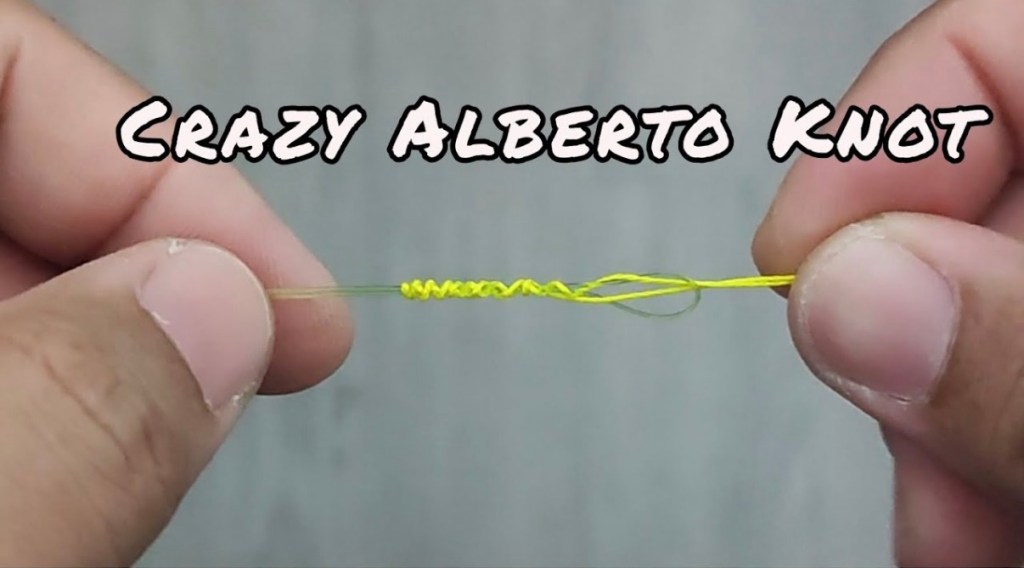

I’m a fan of Alberto and I use his knot to attach the bite tippet in every leader I tie for snook or juvenile tarpon. As of my writing, Alberto is recovering from a massive heart attack – if you are also a fan, you can help him out at https://gofund.me/4b854b908
I’m not in Alberto’s league as a fisherman, but I’m good with knots and I’ve long aspired to have a knot named after me. Of course, I’d have to invent a knot so good that a lot of people would use it, and the knot would have to be so unique that a graphic name like “figure-8 knot” wouldn’t capture it.
I do have a candidate.
On days I want to fly fish but I don’t feel like messing with boats in heavy winds and/or heavy rain, I often grab my 5-weight fly rod and head over to a local lake to fish for Butterfly Peacock Bass (“peas” for short). There, if the sky opens up on me, it’s a short dash to the car and not too far home to change into dry clothes.
Peas aren’t the hardest-pulling fish I catch, but they’re gorgeous and they fight plenty hard, leaping into the air or diving and delivering a series of sharp body snaps. Here’s a big male in action:
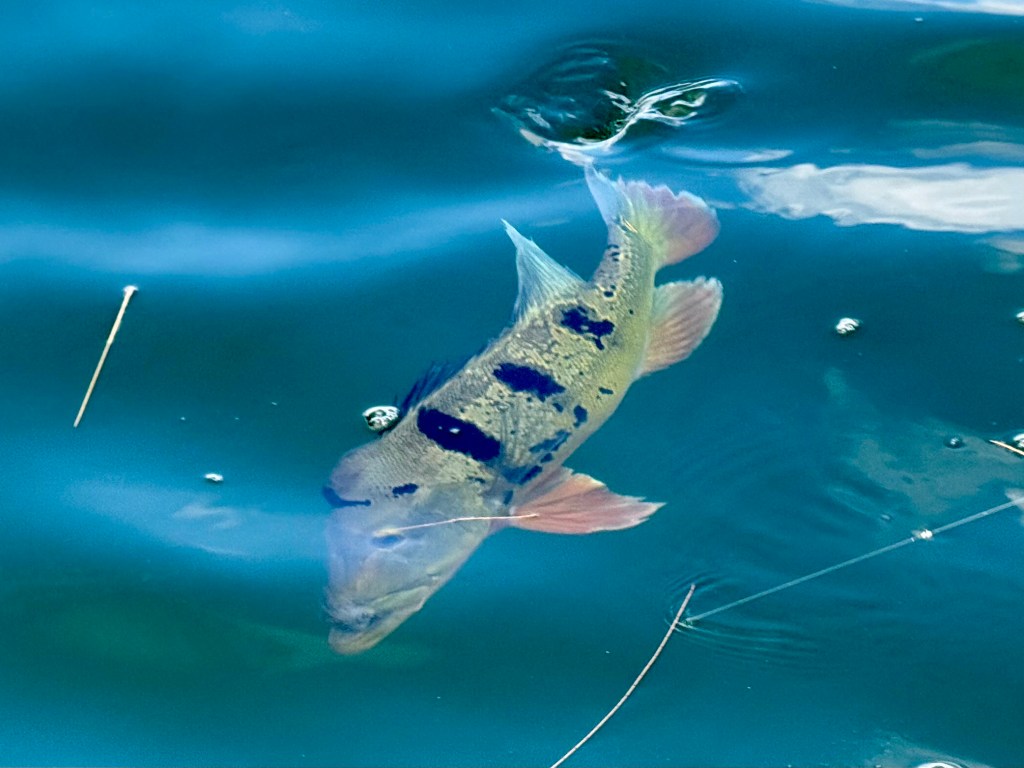
If the line has enough tension, the pea’s body snap can break the monofilament tippet that joins the leader to the fly. The tippet breaks at the weakest point, usually the loop knot that connects the tippet to my streamer fly. The pea’s other trick is to head for the nearest submerged branch tangle where it will break off for sure. It takes a lot of line tension to keep a big pea out of the branch tangles, to which it responds with – yes – sharp body snaps, breaking the line at the loop knot.
The obvious solution is to use sufficiently heavy tippet to resist breaking, but the peas in this lake have become educated and won’t eat a fly if they can spot the tell-tale tippet. When I upsize to thicker, stronger tippets, the peas stop eating my flies. When I downsize to thinner, less visible tippets, I get bites once again but the peas break off at the loop knot. This trade-off has only arisen recently, a byproduct of the fish education that arises from my catch-and-release fly fishing. The peas have learned to watch for my tippets and I’m stuck.
Earlier this week I hooked a not-so-big pea on my special mosquitofish fly, and the pea broke off at the loop knot once again. Dang! I can’t go up in tippet diameter and I’m tying the strongest known loop knot, the Kreh Loop, invented by Lefty Kreh. The Kreh Loop is slightly stronger than another great loop knot, the Duncan Loop, invented by Norman Duncan. I need an even stronger knot.
I sat on the bank for a few minutes and pondered until I hatched an idea for a new loop knot, a cross between the Palomar knot and the Kreh Loop. If I was lucky, this new loop knot would combine the best traits of both, the enhanced strength of the Palomar and the non-slip property of the Kreh Loop.
I tied on my fly with a prototype of the new loop knot. Here’s it is, photographed against my shorts:

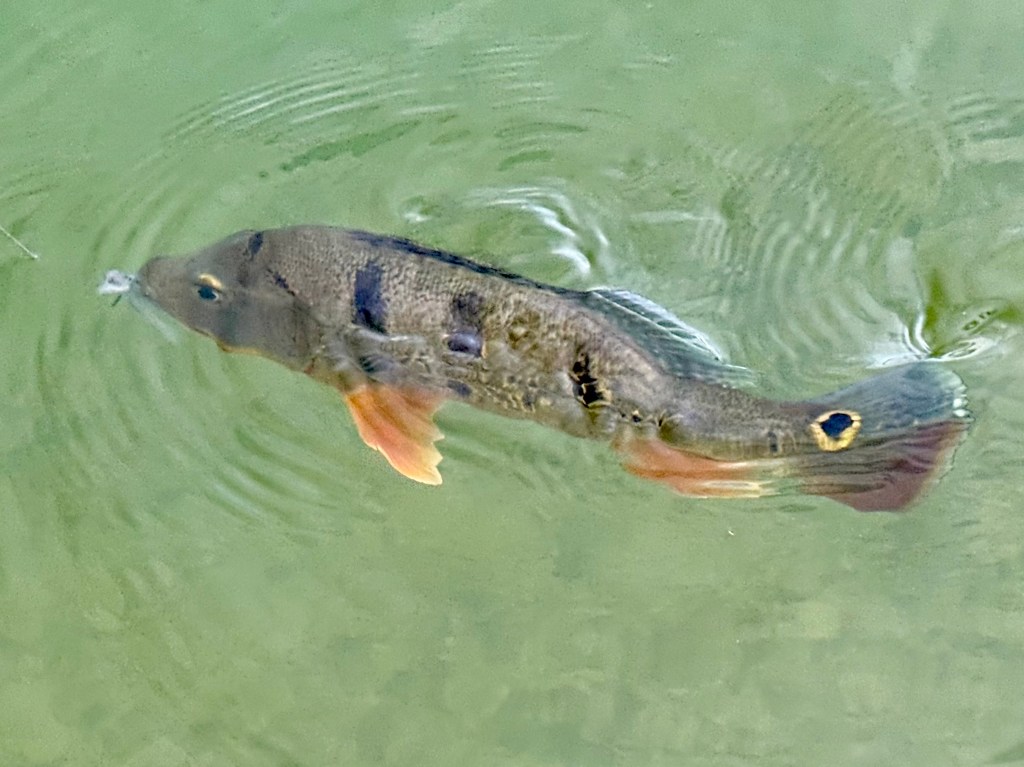
In a few minutes I’d hooked a scrappy, medium-sized peacock bass and the knot held despite the pea’s snapping tugs.
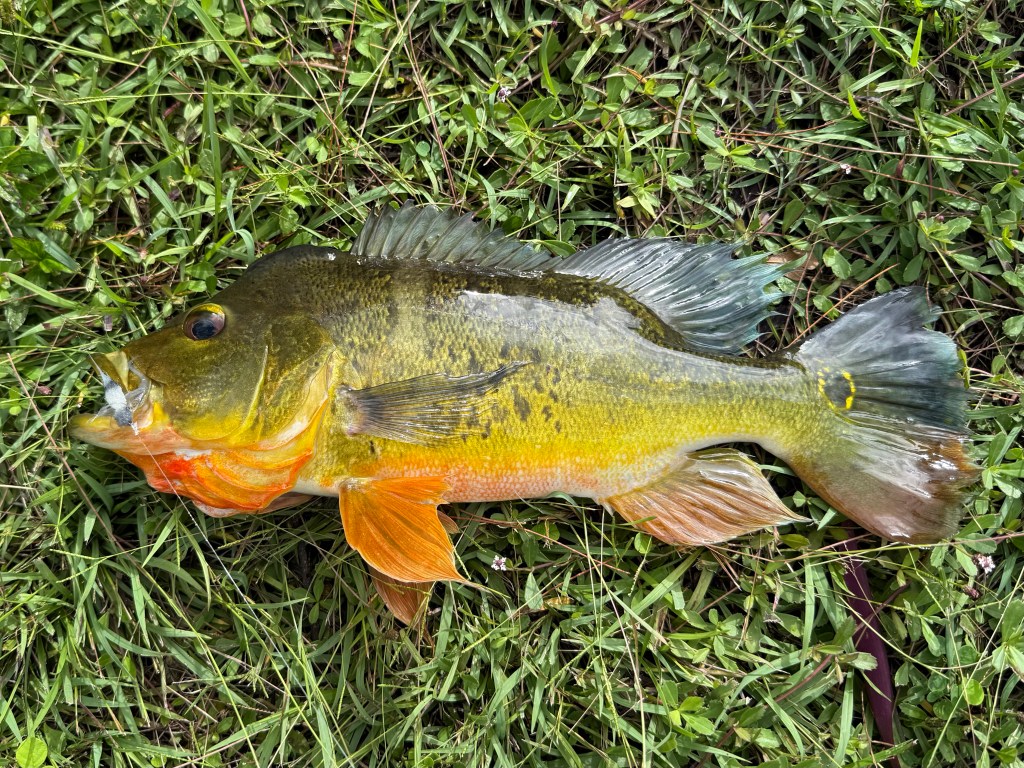
The next fish was a much larger pea that put up a long and vigorous fight, and again the knot held.
Lucky coincidence? As a scientist I can tell you that empirical testing can never rule out coincidence entirely, but with enough tests one can reduce the likelihood of coincidence to a very tiny number. One percent is the standard comfort level for most scientists.
METHODS
First thing when testing knots is to test the line to make sure it performs as expected. I tie one end of the line to a digital archery bow scale with peak hold function ($18 on Amazon). Obviously securing the line to the scale requires a knot, so I use a Bimini Twist, one of the rare “100% knots”, that retains 100% of the original line strength. The other end of the line I keep on the spool. I put on gloves to protect my hands from being cut when the line breaks (learned my lesson there), grip the spool and scale in my two hands and pull slowly and steadily until the line breaks. This is a static line test. Admittedly, the fish breaks the line with faster dynamic loading, conditions under which even the Bimini Twist is no longer a 100% knot, but for now a static load test will do.
My original tippet that was breaking at the knot, Rio Powerflex 1X, is rated at 13 pounds, but my spool was breaking around 10 pounds. Oops. That’s an issue right there and explains part of my break-off problem. Next I tried Rio’s 16 pound fluorocarbon tippet material but it also broke well below its rated strength. Hmm. Does Rio have production problems? If single strand line stays too hot during production it can lose strength.
Next I tried Yo-Zuri Hybrid 12# line, a nylon-fluorocarbon mix. I have discarded spools of Yo-Zuri Hybrid that tested far below their rated strength, but other spools have tested fine. My open 12 pound spool breaks at 14.0 pounds (standard deviation 2.8 pounds), so that’s what I used for my knot testing session.
I tied and broke a dozen Kreh Loop Knots, my standard knot for streamer flies. These I alternated with a dozen of my new loop knots. Why a dozen? With the variance in the strength of this line spool (mean=14, SD=2.8) a sample size of 12 per group gives me a decent chance of finding an effect if an effect exists (i.e., good statistical power). I could do the mathematical power analysis, but I’ve run similar statistical tests for 46 years, long enough to ballpark it.
After each break, I pulled a foot of line off the spool and discarded it to get all fresh line for the next test.
RESULTS
All 12 of the Kreh Loops broke at the knot, and all 12 of my new loop knots broke in the middle of the line.
The odds of getting a result this extreme by chance alone is the same as flipping a fair coin 24 times and calling it correctly in the air all 24 times: one in 16,777,216. A little better than one in 100? My best run of coin flips ever was 11 in a row, the odds of which are one-in-2048. I won’t waste my time trying for a run of 24 unless I achieve a life sentence in a prison with a coin but no library.
Since the new loop knot never broke, I can’t know how strong it actually is. However, the Kreh loop knots broke, on average, at 79% of the line strength with a standard deviation of 2.2 pounds. A two-sample T-test comparing the peak breaking tensions of the two knot types showed that the new loop knot is statistically stronger. The P-value of this statistical test is 0.005, meaning that a pattern this extreme or more extreme would occur by chance in only 5 of 1000 similar knot break-off contests using 12 knots of each type. That’s 1-in-200 odds, twice as good as my 1% criterion.
[31-Oct-2025, Addition since original post: Andy Mill on his recent Mill House podcast stated that the Improved Homer Rhode Loop Knot retains 100% of the line strength. Competitive tarpon fishers swear by this knot. I tied and tested 14 of them, and found the Improved Homer Rhode Loop broke, on average, at 64% of the line strength compared to 79% for the Kreh Loop, and 100% for the my new knot. The standard deviation was 2.1, similar to the Kreh Loop. The Improved Homer Rhode is significantly weaker than either the Kreh Loop or my new knot. Woof woof, it’s a dog.]
DISCUSSION
The two statistical tests are good enough for me to have faith that the difference is real. The fact that in tests of my new knot the line always broke in the middle and never at the knot, means this new loop knot is at least as strong as the line itself, making it the first 100% line-to-hook loop knot. That’s a knot worthy of a name.
Hey, this is exciting!
Oops. Can’t say that. Successful scientists might pop the cork on a bottle of good Champagne to celebrate a major discovery, but it’s considered unprofessional to fully convey our excitement in print. Even Watson & Crick, in their original publication about the structure of DNA forced themselves to remain understated when explaining how a double helix structure could facilitate DNA replication: “It has not escaped our notice….”
This study also helps explain my break-off problem. My original 13 pound-rated tippet was functioning at 10 pounds, and the Kreh Loop was reducing that strength by 21% to ~8 pounds. The standard deviation was 2.2 pounds which means that in over a third of my knots the functional strength is reduced to under 6 pounds static load, and maybe half that under dynamic loading. The peacock bass are having a much lighter task breaking that tippet than the nominal 13 pound strength I might have thought I had going for me. I will switch to the Yo-Zuri Hybrid 12 pound spool for now, and use my new loop knot to tie on the streamer flies.
This new loop knot might be a Secret Navy Knot. If it is, the US Navy’s PR office certainly won’t tell me. After illegally blowing up several boatloads of Venezuelans, some of whom now appear to be fishermen, the US Navy will be too anxious about media shit storms to field a loony call from an American fisherman inquiring about “secret knots”. I might do better calling the Office of Naval Research.
My father Ted will turn 99 next month, having retired long ago at the rank of Captain. I will ask him about this knot for sure.
I’d call the National Institute of Standards and Technology (NIST) to find out if my knot is in their collection of Standard Knots, but they’re closed during the government shutdown, stemming from a dispute as to whether Americans, such as my brother’s family, should be able to afford health insurance, versus rich people getting a big tax break. My wife and I are on Medicare now, but we think all families should have access to affordable health care. We support the goals of those in Congress holding out to restore affordable health care to middle and low income Americans, and to keep community hospitals from closing.
* * *
Returning to the prosaic, I have simplified the new loop knot slightly, to make it easier to tie while retaining its strength. I will explain how to tie this knot in another post, but first it needs a name.
Phil’s Pea Knot?
Forget Me Knot?
Eye Kid You Knot?
Other suggestions? (thinking of you, Rex)
Let me know your preference.


 Eye of the Cormorant
Leave a comment