It’s the spring of 1995 and I’m onboard the R/V Bellows, anchored off the Dry Tortugas. Beside me is my host and senior colleague, Professor L. Scott Quackenbush. Quack is an expert on the endocrinology of marine invertebrates as well as a crack aquaculturist.
Dr. L. Scott Quackenbush
Our elbows propped on the rail, as we admire the sunset over the Gulf of Mexico. Quack is downwind of me enjoying a smoke, a vice that will take him out three years from now.
“Did I ever tell you about the time we tried shrimp-farming at Turkey Point?”
I am all ears. Turkey Point is the site of two nuclear power generators on the shore of Biscayne Bay operated by Florida Power and Light (FPL). When first opened in the early 1970s, the reactors dumped thermally hot water into the bay, scalding everything and causing a massive sea grass kill.
Look ma, no cooling towers!
Instead of building cooling towers like those handling hot water in every other nuclear power plant on Planet Earth, FPL cheaped-out and constructed an expansive trapezoidal array of leaky cooling canals. The cooling canals cover 10 square miles of the Southeast Coastal Everglades.
The canals released giant plumes of hyper-saline water into the porous limestone rock beneath them, which expanded outward underground in all directions, including towards the well field that supplies fresh water to the Florida Keys. Most of the local biologists who are not on FPL’s payroll consider these canals an environmental disaster, which I’ll explain more about some other time. This story is about shrimp.
FPL contracted Dr. Quackenbush to determine if they could raise shrimp in the warm water of Turkey Point’s cooling canals.
Quack told me that they blocked off the ends of a couple of canal branches and he stocked them with shrimp.
The shrimp grew and thrived. But, when he harvested the shrimp, they were radioactive.
Nuclear reactors produce radioiodines, though the radioisotopes that are supposed to be contained in the reactor vessels. Shrimp concentrate iodine.
“We filled in those canals and buried the whole project, and if you ever repeat this story to anyone, I will deny it.”
(FPL contracts are famous for their airtight non-disclosure agreements.)
* * *
Quack passed in 2008, so I figure it’s OK to retell his story today. Make of it what you will – I do have another witness to the telling.
A trip by paddle craft to the coastal marshes and flats can be a breeze or a slog depending on wind and tides. It took me one arduous kayak trip to Rabbit Key and another escaping the Snake Bight flat to become a tide chart addict.
The wind. Paddling home against a stiff headwind is somewhere between exhausting and impossible. Returning from Sandfly Pass in the Ten Thousand Islands I was stopped in my tracks by a squall that forced me to get out of the boat in the rocky shallows and wade back to the launch, pulling the kayak behind me. My favorite hat blew off and disappeared in the distance.
Tides are the same, but more predictable. Get the tides right and you get a free ride. Get them wrong, and you fight a river, ferry-crossing back and forth to seek eddies and weaker currents.
My purchase of a motorized skiff made it possible to move against the elements, to cover long distances, and sometimes to dodge a localized thunderstorm. Very efficient, but I missed the quiet and stealth of the pedal kayak. And the exercise. It’s the difference between a car and a bike: the motor craft is useful, the pedal craft enjoyable.
When I itch to be on the water, I open the marine weather forecast and the tide chart phone apps, looking for happy windows of winds and tides. Living on a peninsula provides choices. My choice of location and craft is based on the forecasts. If conditions are unfavorable on the east coast, nearby Biscayne Bay or the Keys, how about Flamingo on the southern tip of the peninsula? No? Then check the west coast out of Chokoloskee / Everglades City. If all three look threatening, I may opt for the interior mangrove creeks or central Everglades marshes. If it looks horrible everywhere, I stay home and tie flies while imagining the next outing.
A TAXI TIDE
I normally I take the skiff into Snake Bight in Everglades National Park to escape against the incoming tide, but the tide chart for Tuesday showed the rare, magical tide cycle that’s perfect for kayak exploration. One can ride the incoming tide into Snake Bight before sunrise, fish and bird well into the morning, then ride the outgoing tide back out again.
Snake Bight’s tides are one hour delayed from the Flamingo tide chart shown here.
I wake at 3:30 am and check the weather report. The wind looks to remain low through the morning. Rain looks iffy – it’s supposed to rain solid until 6 am, then let up until afternoon. Hopefully the algorithm running on the National Weather Service computer gets it right today.
Scary-hard rain pounds my drive south to the bottom of the peninsula, then stops to let me set up and launch the kayak in the dark. I can see the odd lightning flash to the south. Gradually the clouds break up and I have a lovely morning waiting for me on the water with 50 minutes to sunrise.
The half moon is still blocked by clouds and it is DARK. I turn on the pole-mounted kayak light. Its #1 job is to keep me from being run over by powered craft, but as a bonus, it casts a bit of soft light in all directions. Sitting above and behind me, the light doesn’t shine in my eyes. It does, however, shine in the eyes of the crocodiles.
American Crocodile perched on the marina wall. Amazing what the iPhone’s camera can do with the faintest of light sources.Here’s the same croc in motion.
Several more crocs take umbrage at my passage and splash off in a huff.
In time, the clouds melt away, allowing the half moon to illuminate the mangrove shoreline.
A Spotted Sandpiper perches on a fallen log, bobbing up and down. The end of the log has eyes and large teeth. Eek!
The sun glows as I round the corner into the Snake Bight flat. The north edge of the flat has a thin line of shocking pink. Though I’m looking for fish, Roseate Spoonbills always steal the show.
Some spoonbills fly over my kayak enroute to their favorite roost of snags by a mangrove creek.
I spot another kayaker approaching the cove where the spoonbills are roosting. He pulls out a camera with a giant lens, then paddles in too close, spooking some of the spoonbills. If that’s not bad enough, he starts paddling in even closer – too much.
If I can use an iPhone to get this photo without spooking the spoonbills, a kayaker with a giant lens doesn’t need to crawl down their throats.
First rule of not spooking birds is to act like you are interested in something else. Definitely do not aim your kayak directly at them. I call out: “That’s close enough!” He stops, turns around, and leaves. Good thing too. In half an hour, a carefully guided kayak tour comes by specifically to see the spoonbills.
* * *
FISHING REPORT (stop here if fishing bores you)
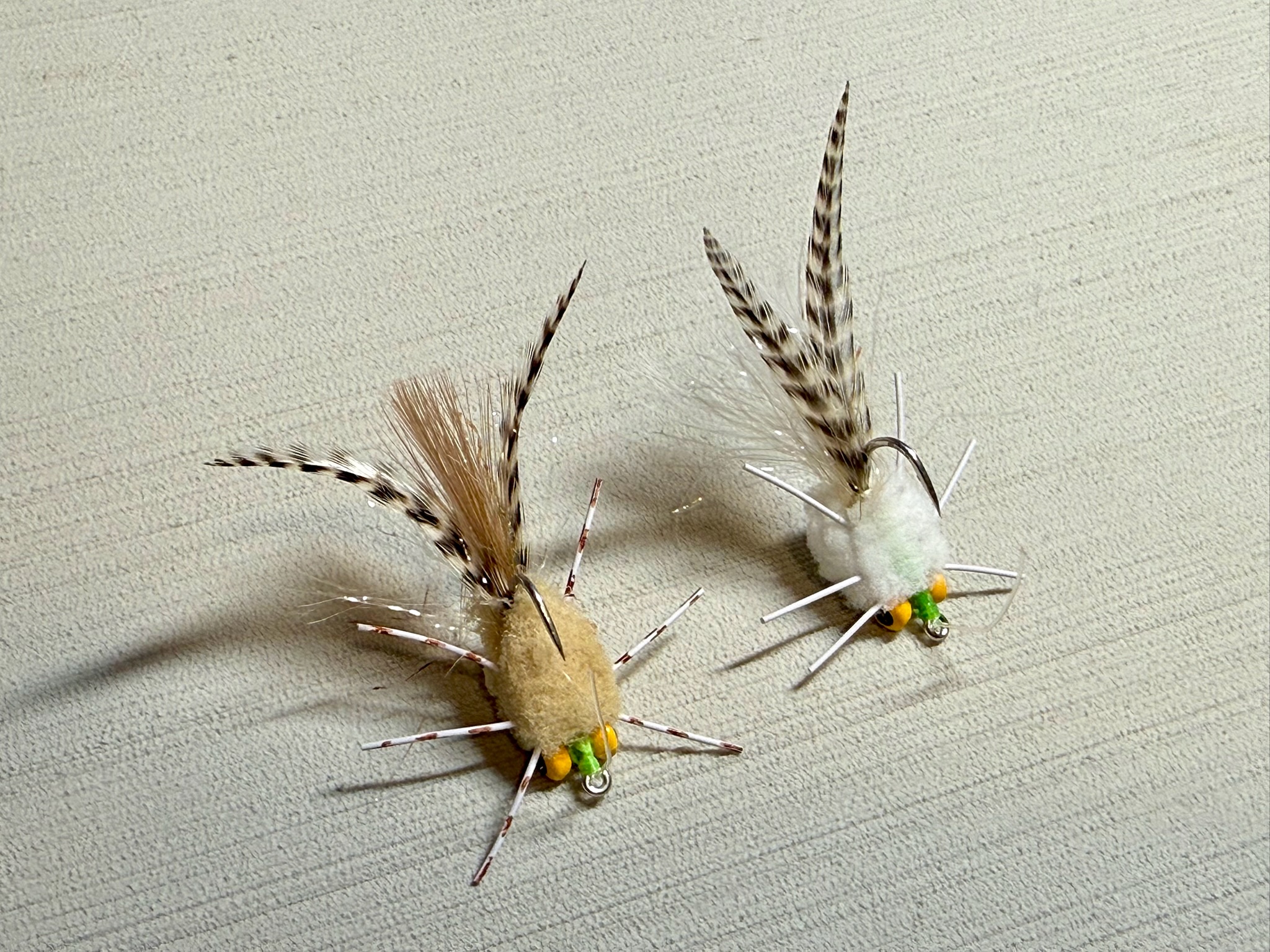
Last weekend I tied a mangrove crab fly using whatever I had lying around, with a notion to try for redfish feeding in the mangrove roots along the edge of Snake Bight. It came out pretty well.
Never mind the fish – I think it’s adorable.
I try it out. Crabby casts fine and stays upright while it sinks, but the legs entangle too much sea grass detritus. I’ll try it again in the Ten Thousand Islands where there’s less sea grass.
Instead, the winning fly today is my weedless tie of the classic chartreuse-over-white Clouser Deep Minnow.
It catches seven snook 18-22”.
20″ male snook with Clouser fly.
Snook in this size range are all males, turning into females when they get bigger, around 26-28”. I wonder if our Florida State legislators know that many of our prize game fish are transexual, “protandrous”, to be exact.
Somewhere else out there lurk the female snook. Research by FIU professor Jenn Rehage indicates that most of the females are still up-river, fattening up on sunfish and cichlids for the breeding season. This rainy spell should get them moving downriver again.
I have caught countless redfish on spinning gear but exactly zero on fly. I tied this sparkly fly in the hopes of temping a bite. Don Quixote jousts at yet another windmill.
Snook are great but I am still hoping to catch at least one redfish today. I swap out the Clouser for a sparkly redfish attractor pattern. Instead of a redfish, it catches my biggest snook of the morning (23″) plus a pretty little sea trout.
Lunch is leftover tamales from Moreno’s Tortilla Shop, re-heated in the sun. Gentle rain resumes on the drive home, kindly washing the saltwater drips from kayak and car. Fine morning all around.
In a motel breakfast room in Jacksonville last week, a woman learned I was from Miami and told me: “I don’t like Miami. I visited once and it didn’t seem like a nice place.”
So right she is.
In Miami…
…the Sun gets in your eyes.
* * *
You might encounter a stranger wandering in your yard,
while wild reptiles invade your home,
and grotesquely large bugs walk on you.
* * *
The water is too warm for trout fishing…
… but the sideshow can be too distracting to fish at all.
* * *
It rains on the weekend,
yet you can’t grow a decent apple.
* * *
Flocks of noisy birds disturb the peace,
it’s not safe to drink the water,
and you have to watch your step.
* * *
The Guardian 11-July-2014 / Talking Points Memo 12-July-2024
People in Miami can be so rude.
* * *
Proud Boys leader Enrique Tario.
Convicted felons wander the streets, disguised as clowns.
In 1993, Associate Professor Suzanne Koptur wanted to have coffee when she visited her new tea-drinking FIU colleague, so she mail-ordered me a 2-cup Gavalia coffee maker.
Everything about the coffee maker was adorable and it even came with a couple of ground Gavalia coffees. Drawn to cute gadgets as I am, did not wait for Suzanne’s next visit to try it out. Mixed with half & half and a bit of sugar, the coffee was pretty good, even for a tea-drinker. Before long, I’d nixed the sugar, but a small cup of coffee remained a nice daily complement to my breakfast of toasted English muffin and fruit.
Thus, in my late 30s, began my one-cup-of-coffee ritual. A second cup in the morning tended to wire me (risk of being obnoxious) and a cup in the afternoon messed with my sleep.
In my mid 50’s I read about pesticides in tea. Why would anyone knowingly do a hot water pesticide extraction then drink the contaminated hot water? I switched exclusively to organically grown teas. Then it occurred to me (duh) that many growers in poorly-regulated tropical countries apply massive amounts of EPA-banned pesticides to everything they grow, including coffee. Forget Gavalia: not organic, not happening. Whole Foods had a very good organic coffee in their 365 product line, then discontinued it. Sprouts Market has no connection to Jeff Besos, prohibits open carry in their stores, and sells 24 different organic bean varieties. My favorite is their organic fair trade Sumatran dark roast.
I didn’t adopt another habit as compulsive as my breakfast cup of coffee until my mid 60s when I rekindled my middle school era passion for fishing.
Sunday morning before sunrise, I’d grab a rod and head over for a quick fishing walk along the north bank of Snapper Creek on the southern edge of South Miami.
There I’d catch an occasional snook or peacock bass, but I’d also see the morning canal birds: Limpkins hunting apple snails, flocks of Chimney Swifts skimming the water for emergent aquatic insects, the occasional Peregrine Falcon or Short-tailed Hawk.
That’s when I discovered the “coffee-before-coffee” paradox.
People’s kitchens and back yards face the canal banks, coffee is diuretic, and there’s no place to pee discretely. I figured, incorrectly, that I could simply postpone my one cup of coffee by an hour and have it with breakfast when I returned. Not so simple. To attain sufficient aim and focus for skip-casting lures under low-hanging tree branches where the snook hang out, I needed a cup of coffee before my cup of coffee.
Roll forward to the present, my late 60s.
Professor Emerita Suzanne Koptur remains a good friend but the sweet two-cup Gavalia drip machine she gave me is long dead. Plastic lives forever, so for the past 20 years, its detachable plastic cone has sufficed for single-cup pour-over production.
As for me, the coffee-before-coffee problem has gotten so much worse. How many times have I caught myself spooning fresh grounds into my coffee cup or stopped myself from pouring half & half into the filter cone? I don’t even try to fish before my one cup.
It took a week, but the Arctic blast freezing tootsies across the US finally made its way to Miami on Saturday night, dropping to 34°F by dawn Sunday.
Most cold fronts stall before reaching South Florida, so our exotic people and critters are not adapted to temperatures below 50°F.
A chill like this brings Painted Buntings into our bird feeders and moves the manatees out of Biscayne Bay and into the urban canals.
Displaced northerners walk around shouting “Yes! Yes!” Teenage girls across Miami break out the boots with the fur. I unearth the LL Bean flannel-lined jeans and my 40 year old fleece jacket, recently refurbished by Patagonia at no charge. Everybody else wearing a too-thin jacket mutters profanity beneath their frosty breath.
LL Bean flannel-lined jeans. Love ’em!
The long, hard freeze of 2010 clobbered our native bonefish, snook, tarpon, and shark populations. A hard cold snap also kills-off many invasive exotic tropical fish and reptiles, but never gets them all.
When the temperature drops below 40°F, local news organizations issue Falling Iguana Alerts. The Falling Iguana Alert is kind of a joke down here, except it’s a real thing. All over our neighborhood, fallen iguanas littered the ground.
This Iguana fell onto the windshield of a neighbor’s car.This one made it all the way to the ground.
The bigger they come, the harder they fall – neither iguana in the photos survived. Had either of these bad boys landed on someone walking their dog, it could have done some damage.
Don’t be fooled, this frigid Cuban Knight Anole is not dead.
A Cuban Knight Anole fell onto the patio near our backyard pond. Good-intentioned folks who don’t know better sometimes bring a cold-stunned Knight Anole indoors to warm it up. Remember the velociraptors that chased people around the lab in Jurassic Park?
I moved Señor Knight Anole to a sunny spot by the front patio and he took care of the rest on his own.This little iguana only partially lost its footing and was found hanging upside down in a bush outside our front door.Cute little guy, huh?
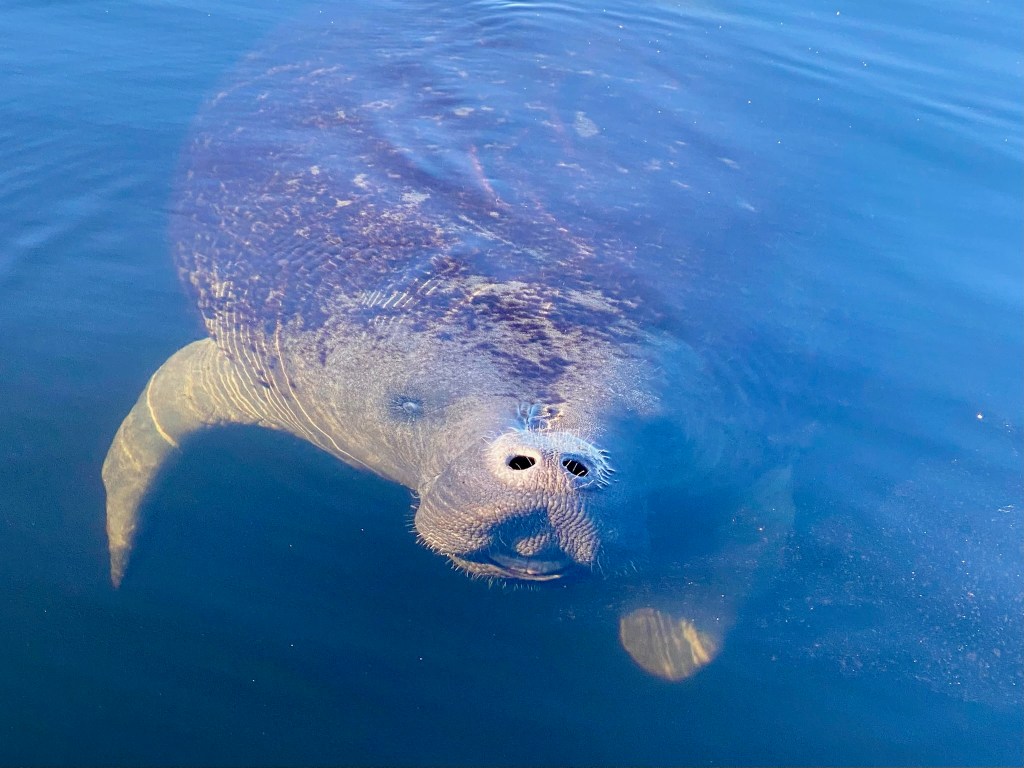
In the afternoon, Gray and I bundled up and biked over to check on the manatees at a nearby marina on US 1.
I counted 31 altogether. One big male kept rolling onto his back and waving his flippers in the air.
Several bulls were quite frisky.
It’s dropping into the 30s again tonight, perfect weather for snuggling around an outdoor fire.
Vetoed. Both Gray and our neighbors agree that it’s too cold tonight for an outdoor anything. Sheesh. Somebody I know will be getting flannel-lined jeans for Christmas.
Carter was both my favorite president and my favorite former president.
James Earl Carter, Jr., 1924-2024, 39th President of the United States
Carter had served in the US Navy as a nuclear submarine officer and engineer. He not only knew how to operate nuclear subs, he knew how to repair them and their complex electronics.
During his initial security briefing after being elected president, Carter greatly impressed the briefing staff with the insights in his questions and his ability to absorb and integrate complex information. My father told me that the Naval intelligence community considered Carter the smartest politician they had ever briefed.
President Carter emphasized human rights as a guiding principle in American foreign policy. Critics said we should be more instrumental in our policy, but Carter’s stubborn implementation of his Christian values made me proud to be an American.
Only when Carter was four decades out of office did it dawn on me how much inspiration I had drawn from his exemplary public service.
President Carter installed solar panels on the White House. As a teenager at the time, that REALLY impressed me. I dreamed that someday I would be able to do the same.
You can also explore my solar blog, SomiSolar.com where I explain solar home economics and how to run a house with solar + batteries when the grid is down.
Jimmy and Roselyn Carter were big supporters of affordable housing and worked closely with Habitat for Humanity for many years after leaving the White House.
One frequently saw photos of them helping to build and refurbish houses for low income families.
Inspired by the Carters’ commitment to affordable housing, I agreed to serve an extra, 5th term as mayor of South Miami so I could lock in the zoning approval and funding for two major affordable housing projects, both of which were completed after I left office. Here’s one of them:
SOMI Parc, South Miami
After leaving office Carter championed democracy and protected election integrity throughout the world.
I am writing this remembrance in a quiet moment as I volunteer as a poll observer, something I have done for the past two decades.
For my non-Miami resident friends, 305 is our area code and thus greater Miami is often referred to as “The 305”. This year, two friends and I started an organization,We the People of 305, to coordinate events supporting democracy in greater Miami.You can check out our Pro-Democracy Events Calendar at wtp305.org/events. We will make our software available if you or someone you know wants to host your own local events calendar.
During his presidency, the Carters would slip out the back door at Camp David to evade the press, whereupon the Secret Service would whisk them up to the clear mountain streams of central Pennsylvania where they would unwind by fly fishing for trout.
As Carter was leaving office, a reporter asked the President what he would do next. Carter replied: “I’m going to become a really good fly fisherman.”
Powering artificial intelligence might involve constructing a fleet of new nuclear reactors, yet natural intelligence runs handily on organic farm waste, such as tofu and kale.
If powering Nvidia chips to make fake videos is that important, nuclear power is still the most expensive way to add power to the electric grid, while renewables, wind and solar/battery, are the cheapest.
The push to build more old-style nuclear reactors suggests that AI and data companies have made so much money from their stratospheric stock valuations that they and everyone around them are willing to waste it.
Seems like a sign, and I am hardly alone in thinking so. Here, I believe, is a hint to how this mystery might resolve.
Remember Michael Burry and Scion Asset Management from the film “The Big Short”? Scion is betting big on an AI stock decline, allocating 80% of its $1.1 billion portfolio to put options against the AI companies Nvidia (NVDA) and Palantir (PLTR).
Why stop at shorting NVDA & PLTR? When was the last time any utility company failed to lose money building nuclear power?
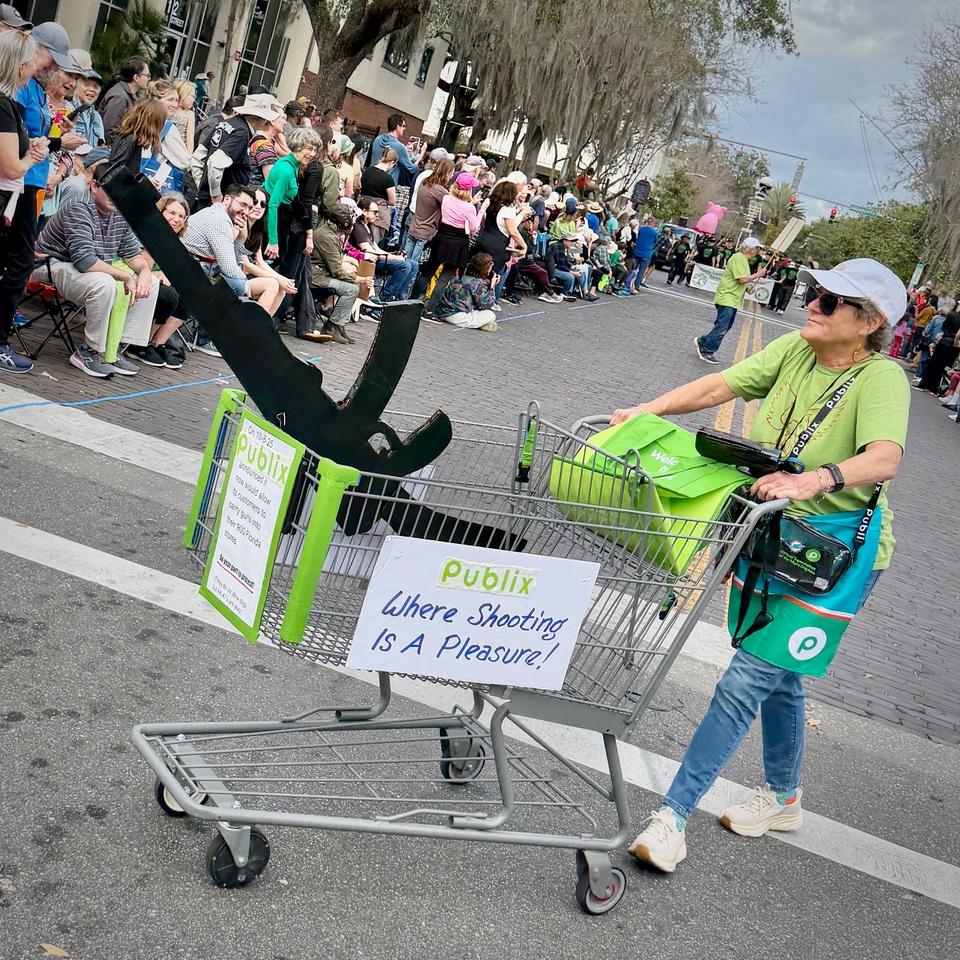
Open carry of firearms became legal in Florida on 25 Sept, 2025, though private property owners can still prohibit firearms on their premises. To the horror of many, the Florida grocery chain Publix responded by changing their own policy to allow customers to bring loaded firearms into their 900 stores.
How should folks like us respond?
A boycott seems appropriate, and we do have choices. Most Florida grocers DO NOT allow their customers to display weapons in their stores. Here are the ones I’ve found, in alphabetical order who do not: Aldi’s, Milam’s, Sprouts Market,Trader Joe’s, Whole Foods, and Winn-Dixie.
Fresh Market does the same as Publix. Walmart prefers you not bring a weapon into the store, but does not outright prohibit open carry.
If you boycott Publix over this policy, please amplify your power by letting them know:
The problem for my family is that we pretty much already boycott Publix over their dark money campaign to prevent single-use plastic bag regulation in Florida and their refusal to support the Immolakee farm workers with a penny-a-pound bonus for tomatoes.
As an alternative to the open carry boycott, what if we give Publix what they seem to be asking for? Open carry.
Engaging in open carry in Publix, to the extent allowed by their own policy and Florida law, would do far more damage to the Publix brand than by shaking our fists and shopping at Sprouts.
Go for it.
Acquire an assault rifle, such as an AR15.
Insert an empty ammunition clip, release the safety and dry fire once at the ground to make sure the rifle doesn’t have a cartridge in the chamber.
Dress in black (trick or treat!).
Strap the rifle across your chest.
Stroll the produce isles at your nearest Publix.
For my family, that would be the sparkly new Publix that replaced the theater on US1 in Coral Gables. Knowing the Coral Gables clientele, I’m confident that a man in black strolling the produce isle with an AR15 would empty the place in a heartbeat. For a woman doing the same it would take several heartbeats – maybe snarl every few moments: “Publix – where shopping is a pleasure”.
My stomach isn’t strong enough (yet) to purchase an assault rifle, much less carry one, even for such a noble cause. When it comes to any type of firearm, the only civilian use I entertain is deer hunting (for conservation purposes, of course). There I draw the line at single-shot hunting rifles and I prefer to borrow cousin Jon’s crossbow. Oh yeah, and shotguns are useful for shooting down those pesky quadcopter drones.
Still, I continue to entertain the AR15-at-Publix fantasy and hope someone with serious cojones is inspired to pull it off.
Today I am volunteering as a poll-watcher in the City of Miami elections. Early voting is in progress.
I’m stationed at a polling site in a community center in the north end of Miami on the edge of the area known as Little Haiti. The conversation among the elections staff alternates sentence-by-sentence between English and Haitian Creole, both with the same Caribbean cadence and accent.
The Elections Clerk at this polling site is delightful, a nutritionist by trade and a proud alumna of FIU. She shares with me her recipe for the sauce she applies to snappers before she fries them.
This morning, the large TV in the hall of the community center is playing Fox News, highly political and inappropriate for a polling site.
The young elections worker sitting nearby would prefer to see the football game, however the TV controls are in a locked-off area so the Clerk cannot change the channel or even turn off the TV. While she ponders the problem, I trot to my car and return with my TV-B-Gone, an electronic device the size of a matchbook that turns off any television.
The TV-B-Gone contains a microchip that cycles through all the TV “off” codes. Aim its infrared LED at a TV, press the button, and wait… it never fails. The IR beam will also bounce off reflective surfaces and light-colored walls, so you can use it surreptitiously.
One click, a brief pause, and the offending TV goes dark.
Are you wondering why Phil carries a TV-B-Gone in the glove compartment of his car?
I deploy the device in restaurants where TVs are interfering with the table conversation, or, on rare occasion when the devil gets into me, to create havoc in a sports bar. Never during a FIFA soccer match, though. The Argentinian fans are so spirited they might break something… or someone.
The Elections Clerk wants to buy her own TV-B-Gone ($15 on eBay) and maybe a cell phone jammer as well to use on her husband’s phone.