Eye of the Cormorant

another odd bird who chases fish.

Tag: conservation

  • Radio Shrimp

    It’s the spring of 1995 and I’m onboard the R/V Bellows, anchored off the Dry Tortugas. Beside me is my host and senior colleague, Professor L. Scott Quackenbush. Quack is an expert on the endocrinology of marine invertebrates as well as a crack aquaculturist.

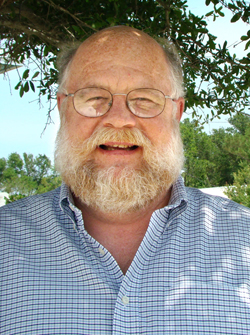
    Dr. L. Scott Quackenbush

    Our elbows propped on the rail, as we admire the sunset over the Gulf of Mexico. Quack is downwind of me enjoying a smoke, a vice that will take him out three years from now.

    “Did I ever tell you about the time we tried shrimp-farming at Turkey Point?”

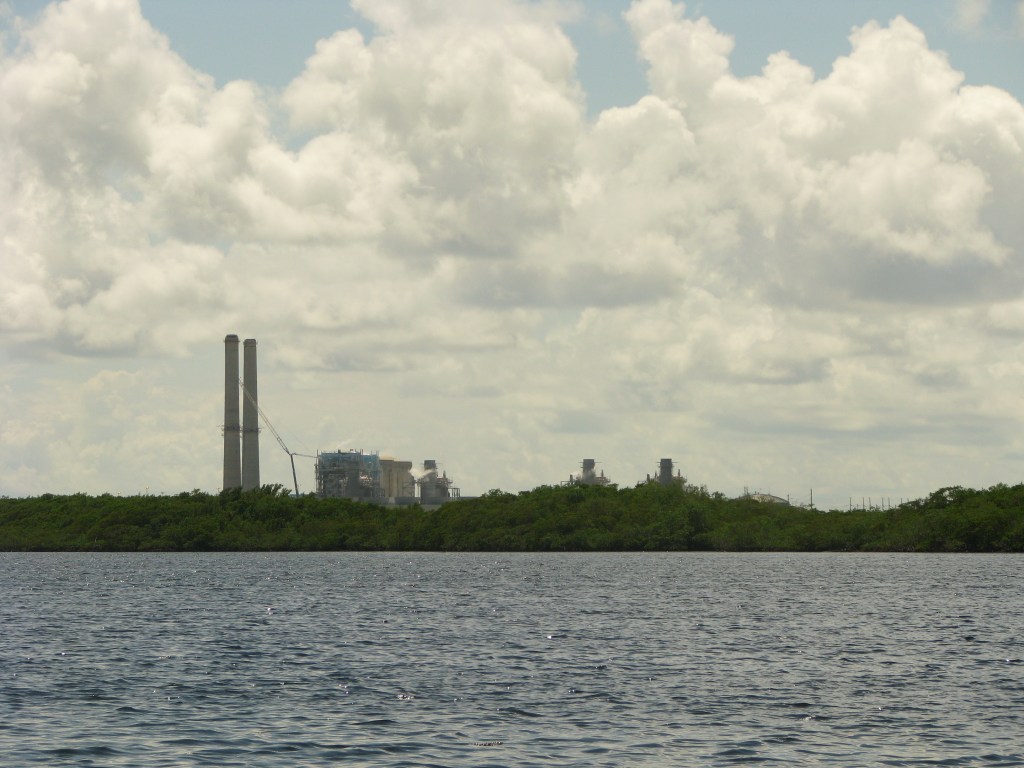
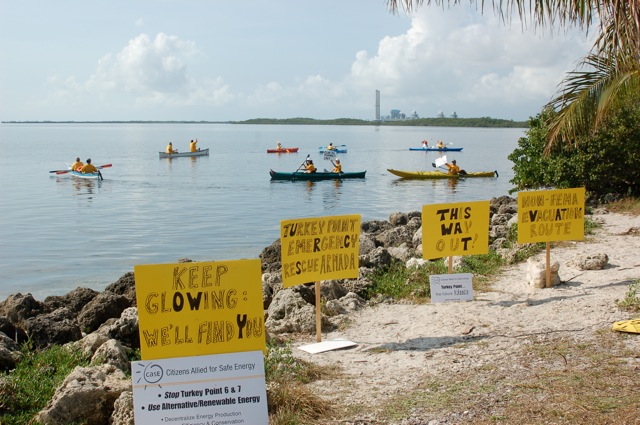
    I am all ears. Turkey Point is the site of two nuclear power generators on the shore of Biscayne Bay operated by Florida Power and Light (FPL). When first opened in the early 1970s, the reactors dumped thermally hot water into the bay, scalding everything and causing a massive sea grass kill. 

    Look ma, no cooling towers!

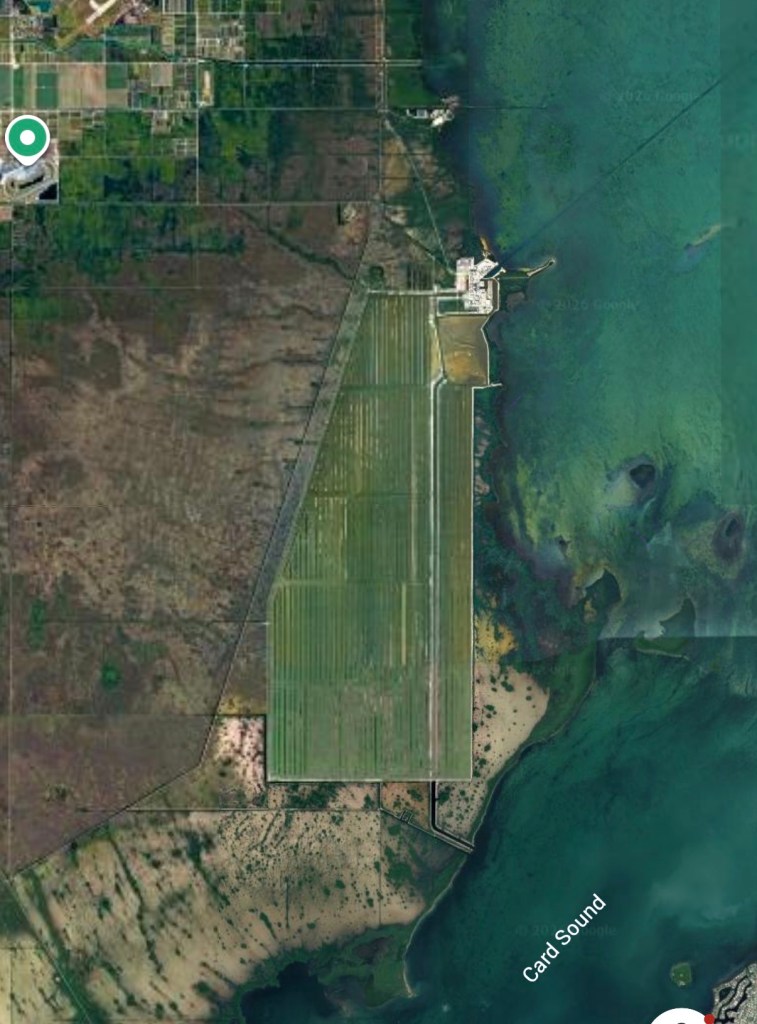
    Instead of building cooling towers like those handling hot water in every other nuclear power plant on Planet Earth, FPL cheaped-out and constructed an expansive trapezoidal array of leaky cooling canals. The cooling canals cover 10 square miles of the Southeast Coastal Everglades.

    The canals released giant plumes of hyper-saline water into the porous limestone rock beneath them, which expanded outward underground in all directions, including towards the well field that supplies fresh water to the Florida Keys. Most of the local biologists who are not on FPL’s payroll consider these canals an environmental disaster, which I’ll explain more about some other time. This story is about shrimp.

    FPL contracted Dr. Quackenbush to determine if they could raise shrimp in the warm water of Turkey Point’s cooling canals. 

    Quack told me that they blocked off the ends of a couple of canal branches and he stocked them with shrimp.

    The shrimp grew and thrived. But, when he harvested the shrimp, they were radioactive. 
    Nuclear reactors produce radioiodines, though the radioisotopes that are supposed to be contained in the reactor vessels. Shrimp concentrate iodine.

    “We filled in those canals and buried the whole project, and if you ever repeat this story to anyone, I will deny it.”

    (FPL contracts are famous for their airtight non-disclosure agreements.)

    * * *

    Quack passed in 2008, so I figure it’s OK to retell his story today. Make of it what you will – I do have another witness to the telling.

  • Taxi Tides

    Taxi Tides

    “Time and tide wait for no man.”

    A trip by paddle craft to the coastal marshes and flats can be a breeze or a slog depending on wind and tides. It took me one arduous kayak trip to Rabbit Key and another escaping the Snake Bight flat to become a tide chart addict.

    The wind. Paddling home against a stiff headwind is somewhere between exhausting and impossible. Returning from Sandfly Pass in the Ten Thousand Islands I was stopped in my tracks by a squall that forced me to get out of the boat in the rocky shallows and wade back to the launch, pulling the kayak behind me. My favorite hat blew off and disappeared in the distance.
    Tides are the same, but more predictable. Get the tides right and you get a free ride. Get them wrong, and you fight a river, ferry-crossing back and forth to seek eddies and weaker currents.

    My purchase of a motorized skiff made it possible to move against the elements, to cover long distances, and sometimes to dodge a localized thunderstorm. Very efficient, but I missed the quiet and stealth of the pedal kayak. And the exercise. It’s the difference between a car and a bike: the motor craft is useful, the pedal craft enjoyable.

    When I itch to be on the water, I open the marine weather forecast and the tide chart phone apps, looking for happy windows of winds and tides. Living on a peninsula provides choices. My choice of location and craft is based on the forecasts. If conditions are unfavorable on the east coast, nearby Biscayne Bay or the Keys, how about Flamingo on the southern tip of the peninsula? No? Then check the west coast out of Chokoloskee / Everglades City. If all three look threatening, I may opt for the interior mangrove creeks or central Everglades marshes. If it looks horrible everywhere, I stay home and tie flies while imagining the next outing.

    A TAXI TIDE

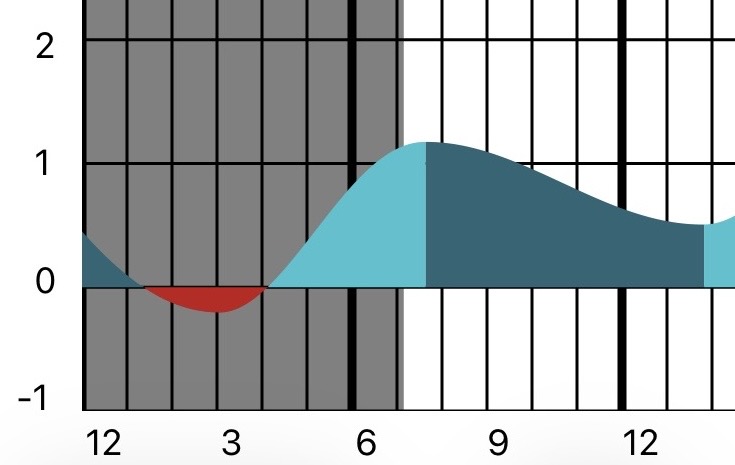
    I normally I take the skiff into Snake Bight in Everglades National Park to escape against the incoming tide, but the tide chart for Tuesday showed the rare, magical tide cycle that’s perfect for kayak exploration. One can ride the incoming tide into Snake Bight before sunrise, fish and bird well into the morning, then ride the outgoing tide back out again.

    Snake Bight’s tides are one hour delayed from the Flamingo tide chart shown here.

    I wake at 3:30 am and check the weather report. The wind looks to remain low through the morning. Rain looks iffy – it’s supposed to rain solid until 6 am, then let up until afternoon. Hopefully the algorithm running on the National Weather Service computer gets it right today.

    Scary-hard rain pounds my drive south to the bottom of the peninsula, then stops to let me set up and launch the kayak in the dark. I can see the odd lightning flash to the south. Gradually the clouds break up and I have a lovely morning waiting for me on the water with 50 minutes to sunrise. 

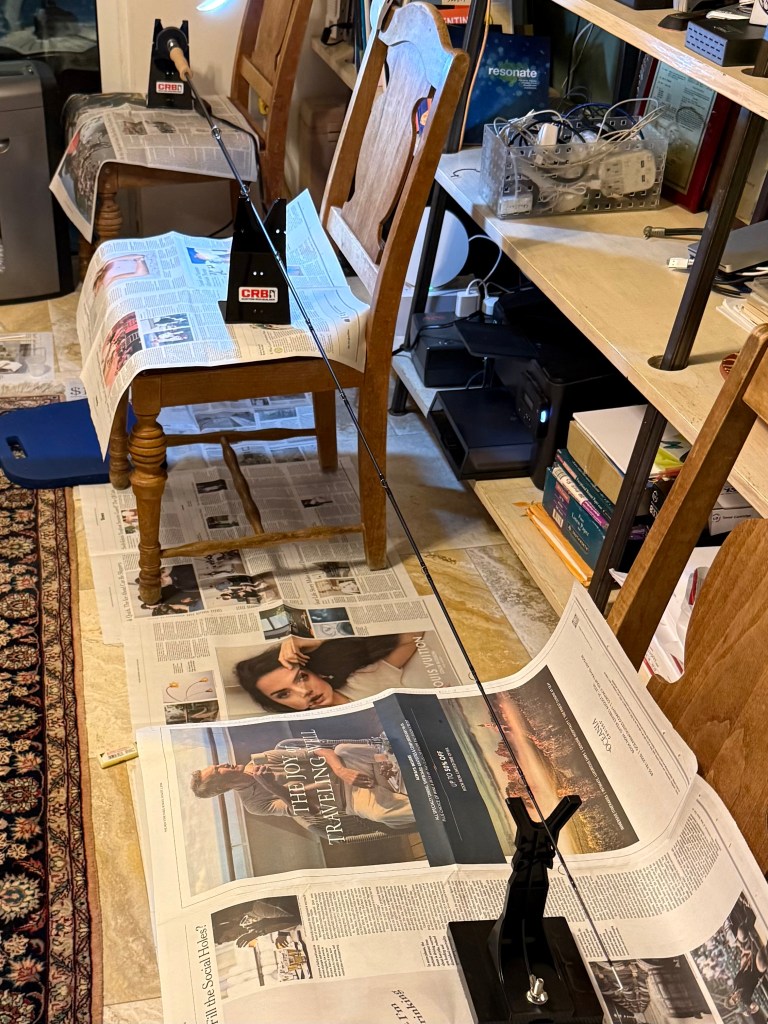
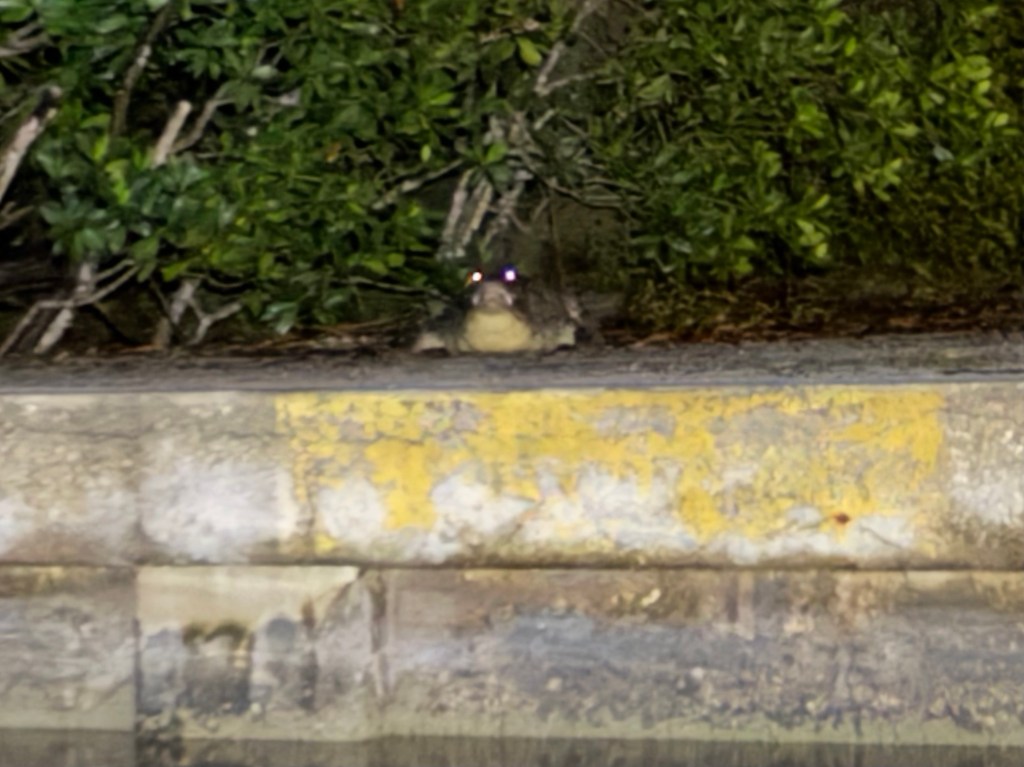
    The half moon is still blocked by clouds and it is DARK. I turn on the pole-mounted kayak light. Its #1 job is to keep me from being run over by powered craft, but as a bonus, it casts a bit of soft light in all directions. Sitting above and behind me, the light doesn’t shine in my eyes. It does, however, shine in the eyes of the crocodiles.

    American Crocodile perched on the marina wall. Amazing what the iPhone’s camera can do with the faintest of light sources.
    Here’s the same croc in motion.

    Several more crocs take umbrage at my passage and splash off in a huff.

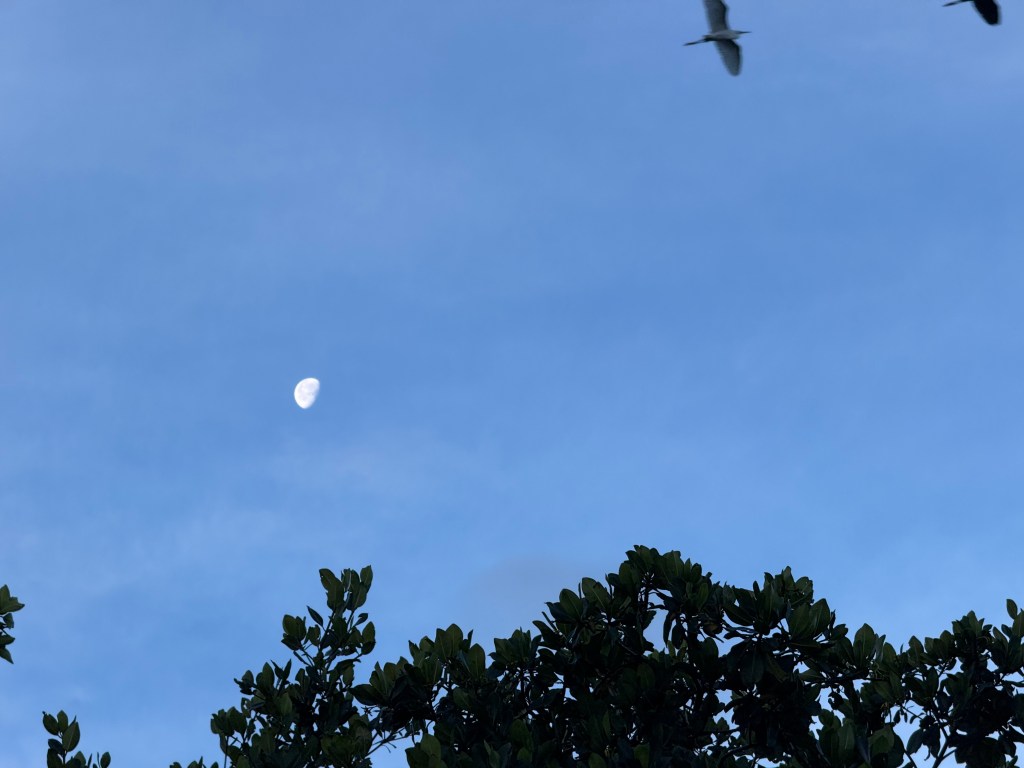
    In time, the clouds melt away, allowing the half moon to illuminate the mangrove shoreline.

    A Spotted Sandpiper perches on a fallen log, bobbing up and down. The end of the log has eyes and large teeth. Eek!

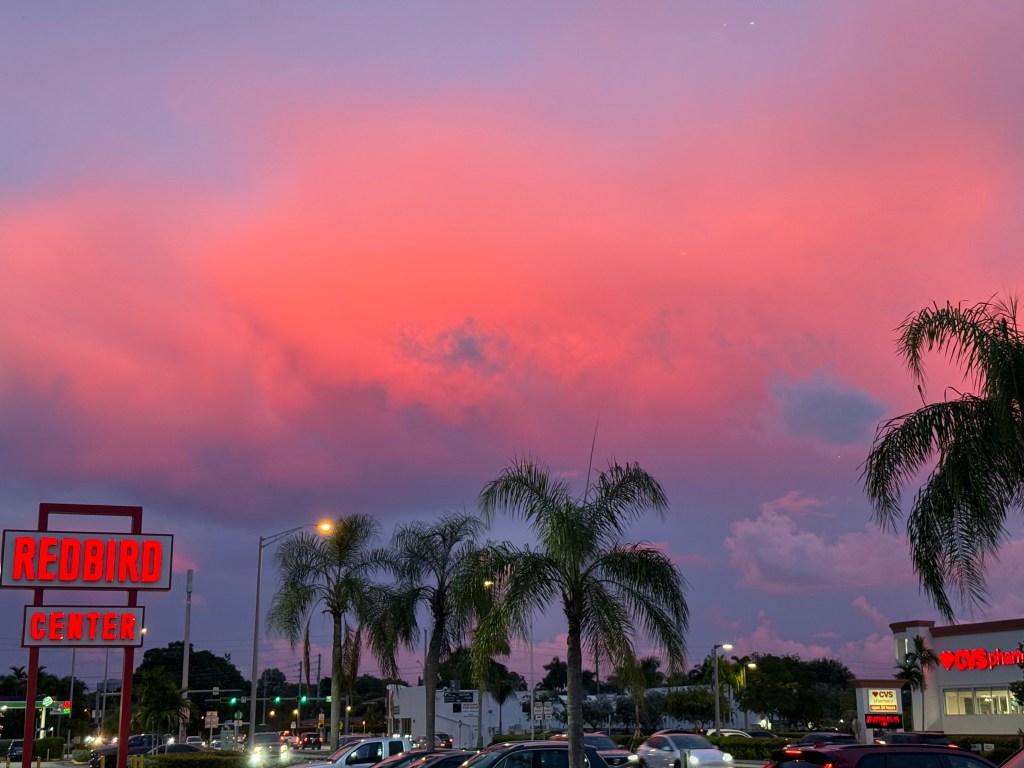
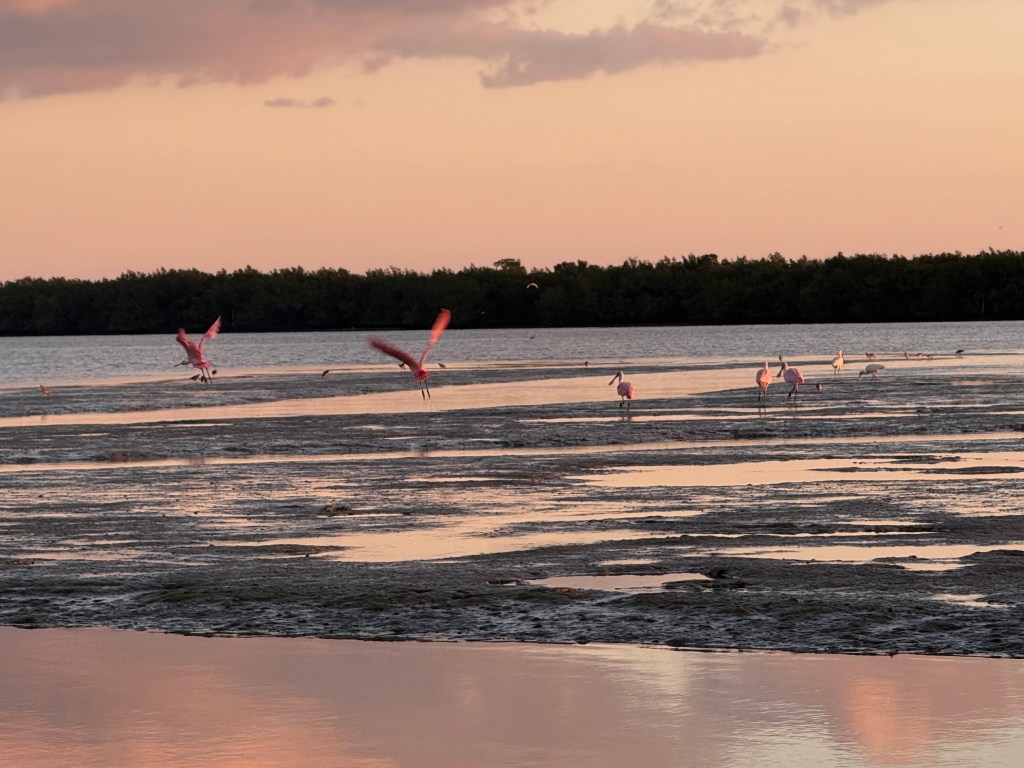
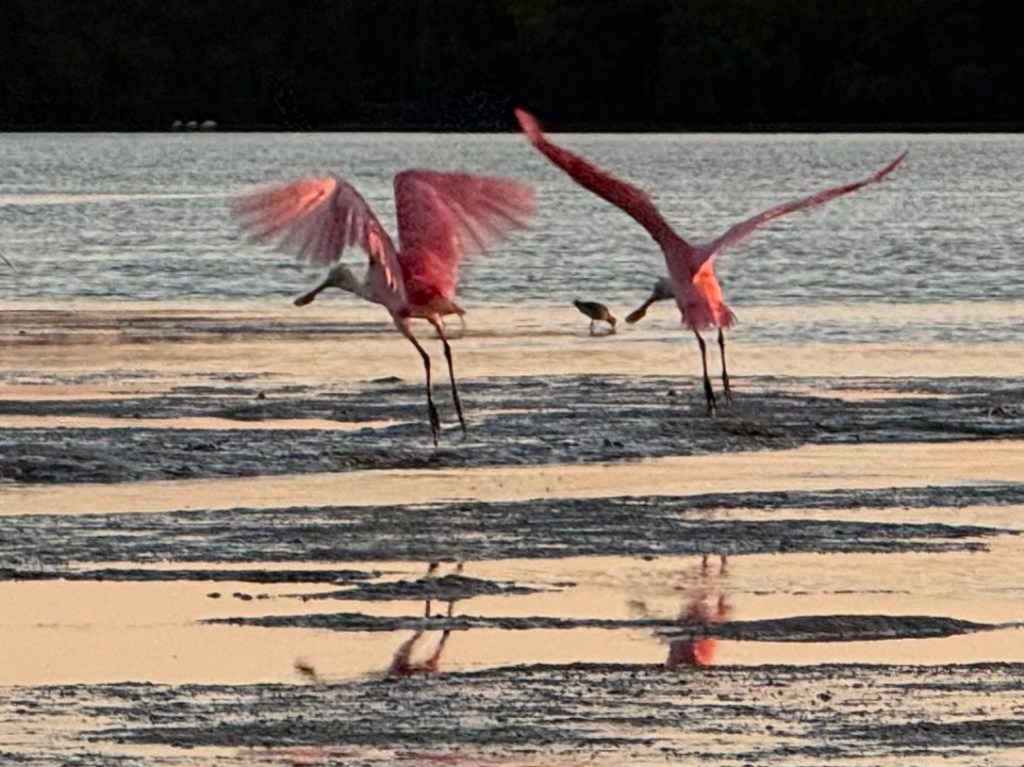
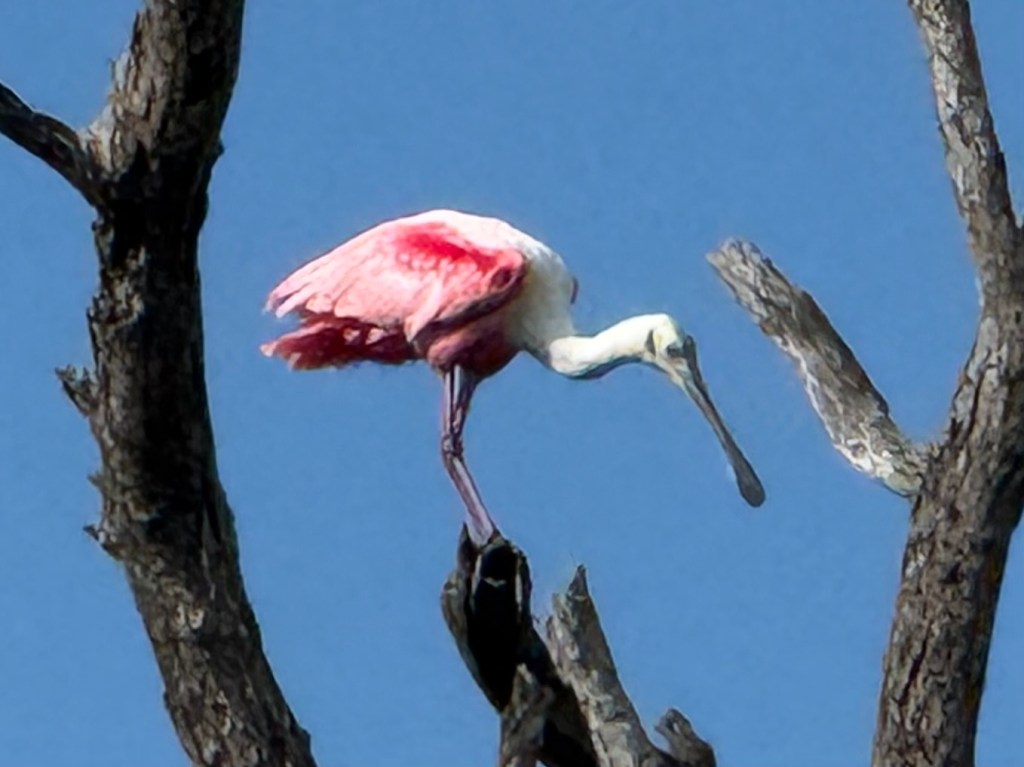
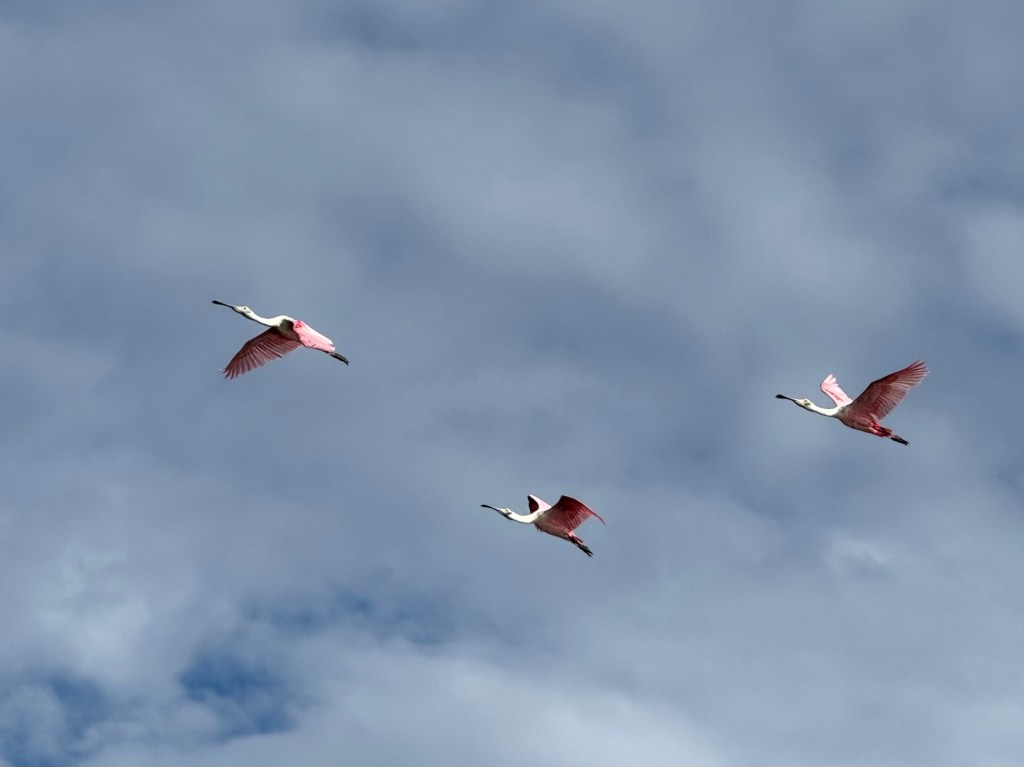
    The sun glows as I round the corner into the Snake Bight flat. The north edge of the flat has a thin line of shocking pink. Though I’m looking for fish, Roseate Spoonbills always steal the show.

    Some spoonbills fly over my kayak enroute to their favorite roost of snags by a mangrove creek.

    I spot another kayaker approaching the cove where the spoonbills are roosting. He pulls out a camera with a giant lens, then paddles in too close, spooking some of the spoonbills. If that’s not bad enough, he starts paddling in even closer – too much.

    If I can use an iPhone to get this photo without spooking the spoonbills, a kayaker with a giant lens doesn’t need to crawl down their throats.

    First rule of not spooking birds is to act like you are interested in something else. Definitely do not aim your kayak directly at them.
    I call out: “That’s close enough!” He stops, turns around, and leaves. Good thing too. In half an hour, a carefully guided kayak tour comes by specifically to see the spoonbills.

    * * *

    FISHING REPORT (stop here if fishing bores you)

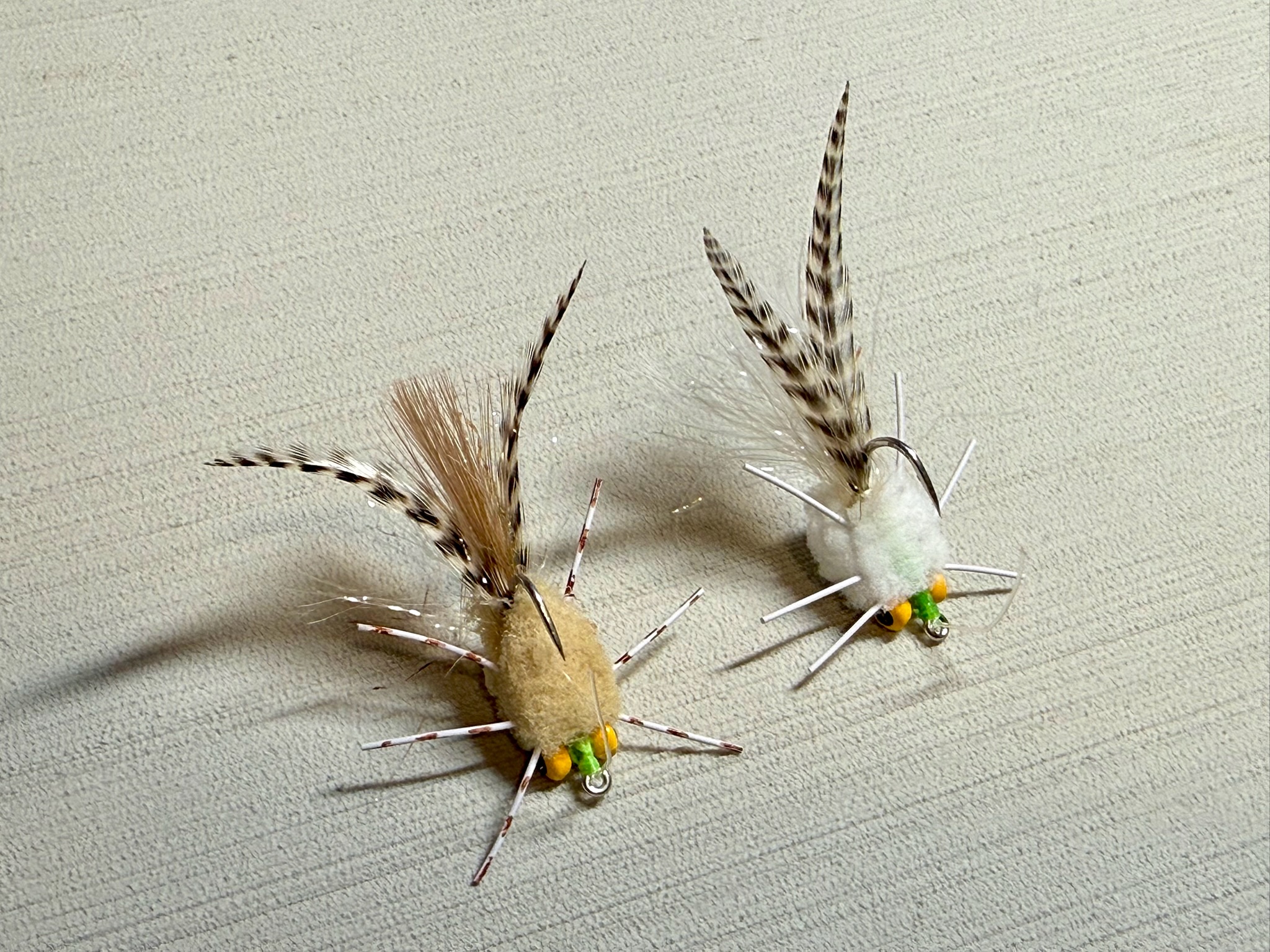
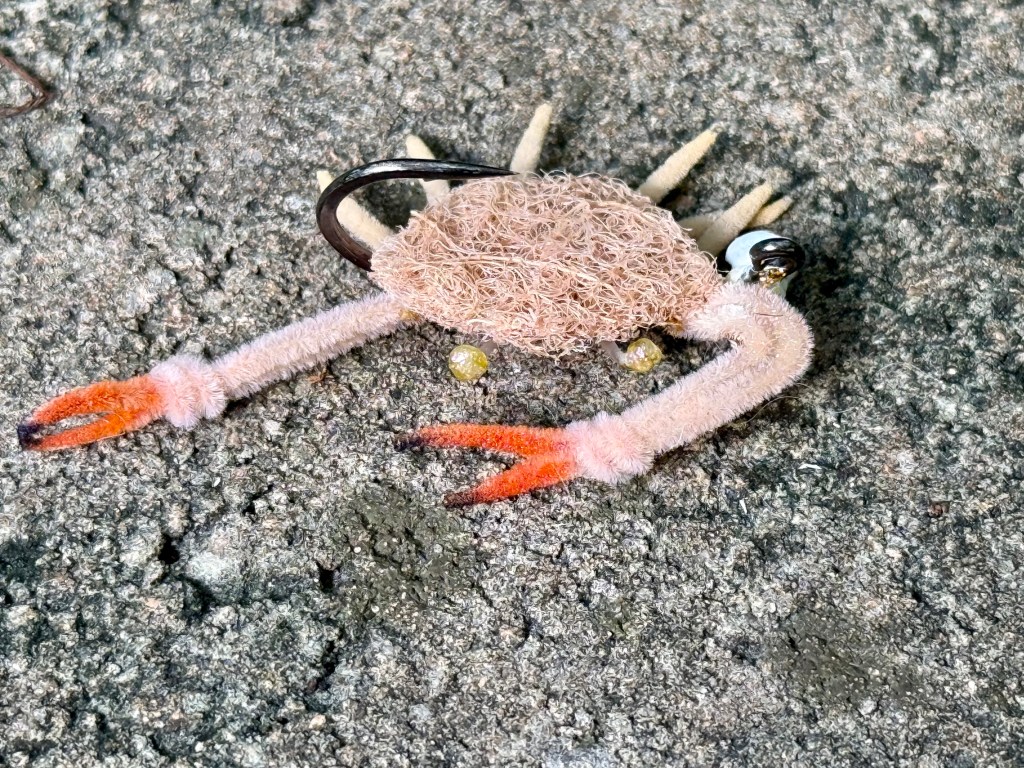
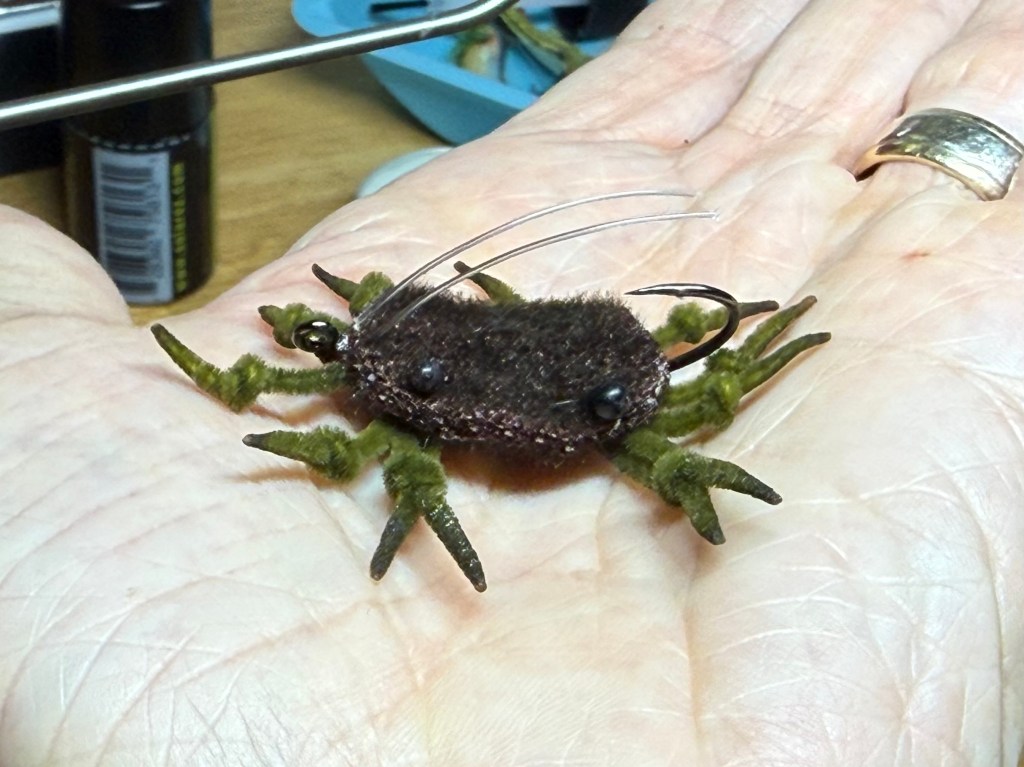
    Last weekend I tied a mangrove crab fly using whatever I had lying around, with a notion to try for redfish feeding in the mangrove roots along the edge of Snake Bight. It came out pretty well.

    Never mind the fish – I think it’s adorable.

    I try it out. Crabby casts fine and stays upright while it sinks, but the legs entangle too much sea grass detritus.  I’ll try it again in the Ten Thousand Islands where there’s less sea grass.

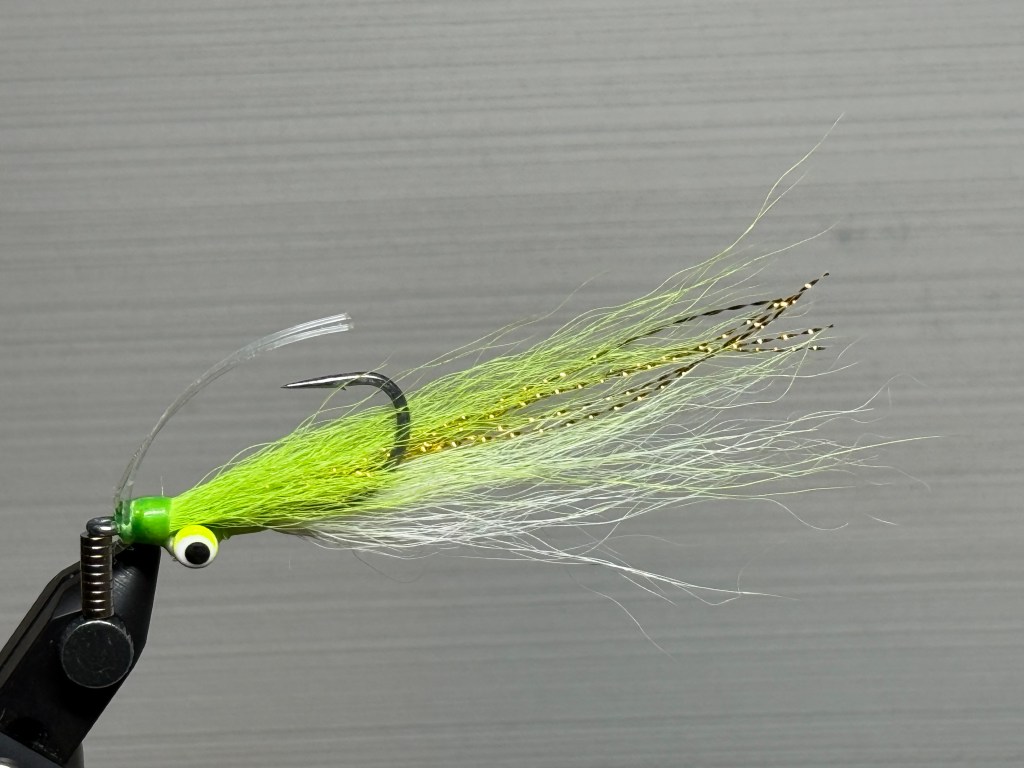
    Instead, the winning fly today is my weedless tie of the classic chartreuse-over-white Clouser Deep Minnow.

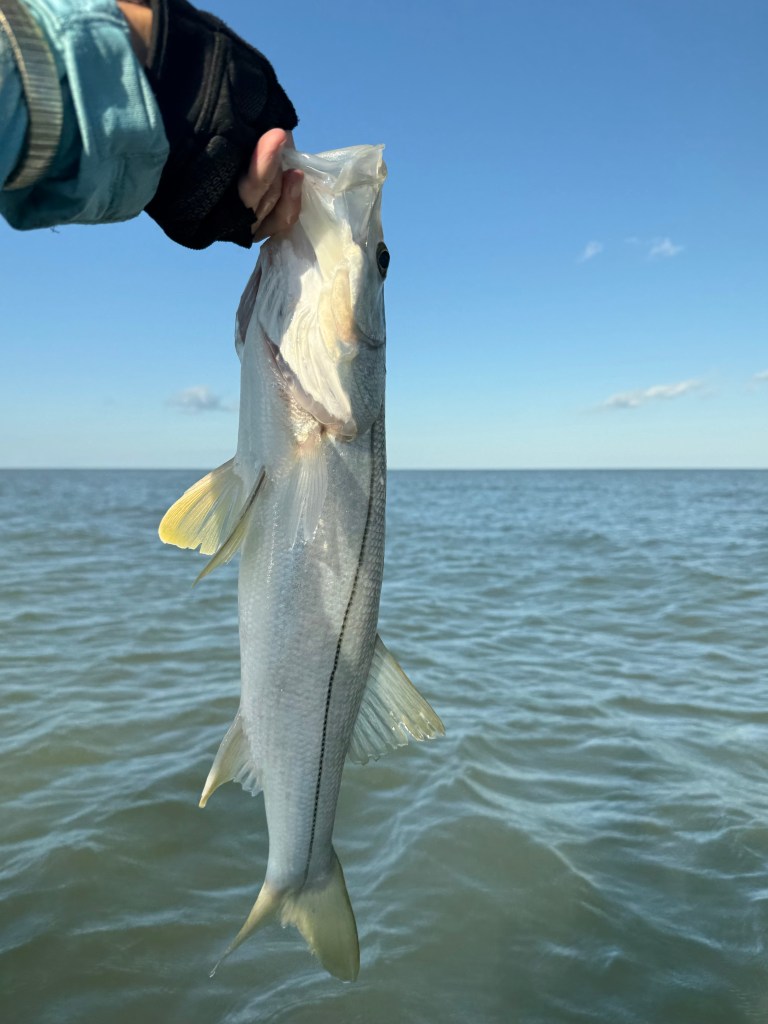
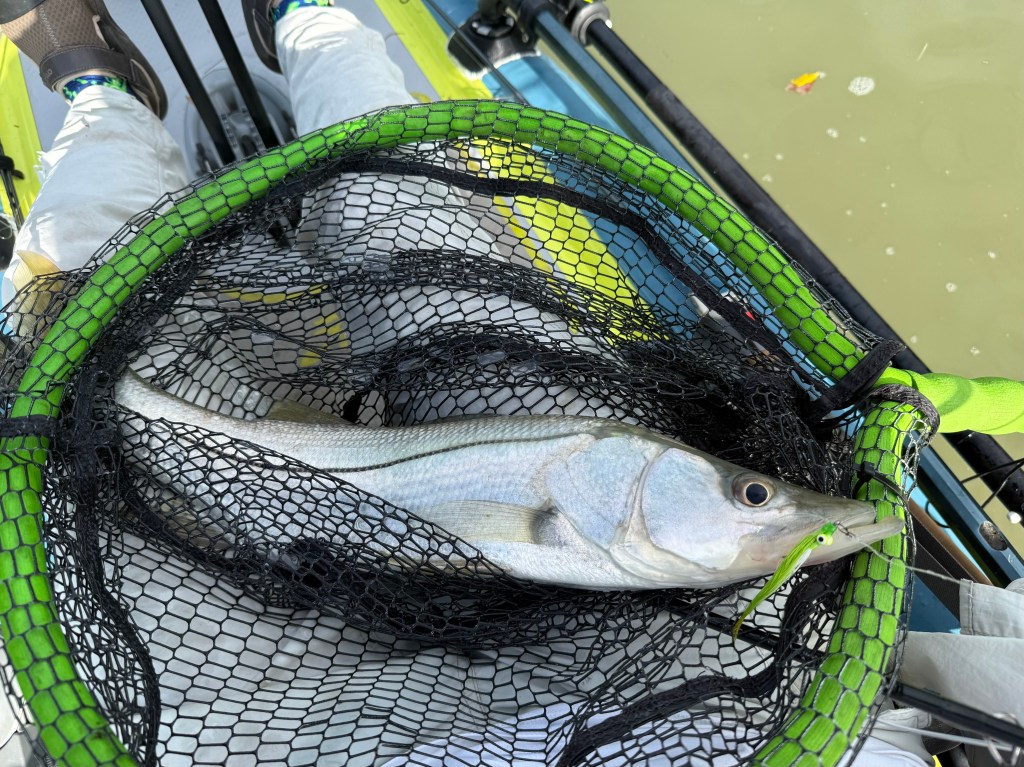
    It catches seven snook 18-22”.

    20″ male snook with Clouser fly.

    Snook in this size range are all males, turning into females when they get bigger, around 26-28”. I wonder if our Florida State legislators know that many of our prize game fish are transexual, “protandrous”, to be exact.

    Somewhere else out there lurk the female snook. Research by FIU professor Jenn Rehage indicates that most of the females are still up-river, fattening up on sunfish and cichlids for the breeding season. This rainy spell should get them moving downriver again.

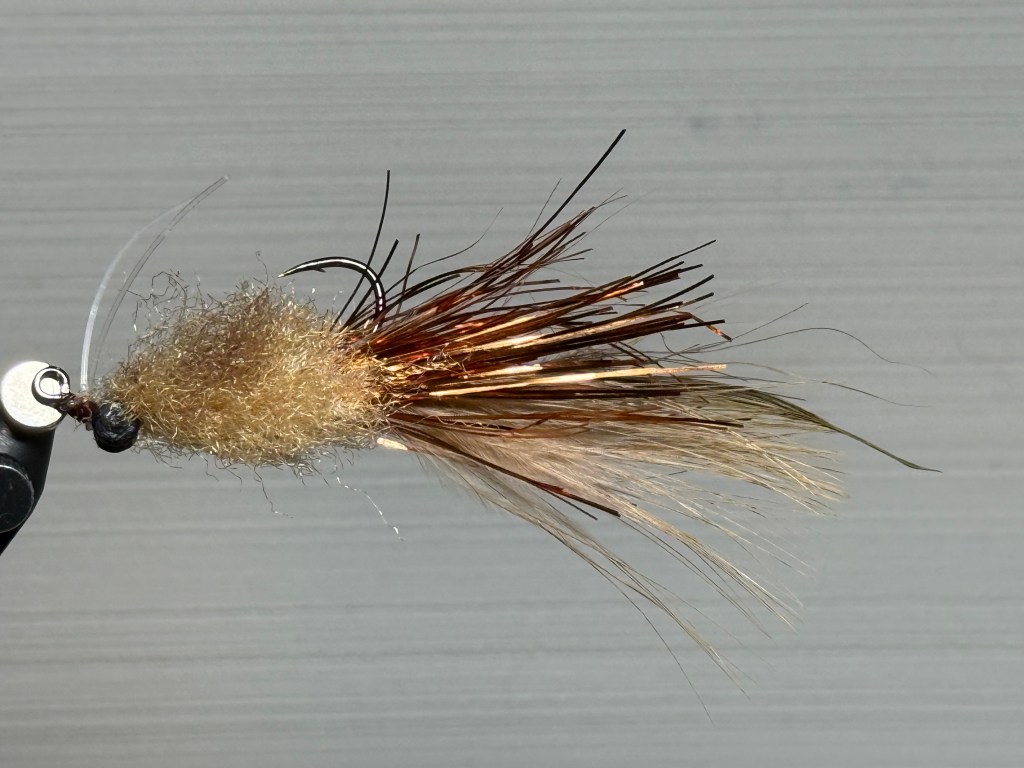
    I have caught countless redfish on spinning gear but exactly zero on fly. I tied this sparkly fly in the hopes of temping a bite. Don Quixote jousts at yet another windmill.

    Snook are great but I am still hoping to catch at least one redfish today. I swap out the Clouser for a sparkly redfish attractor pattern. Instead of a redfish, it catches my biggest snook of the morning (23″) plus a pretty little sea trout.

    Lunch is leftover tamales from Moreno’s Tortilla Shop, re-heated in the sun. Gentle rain resumes on the drive home, kindly washing the saltwater drips from kayak and car. Fine morning all around.

  • Annoying the fish

    When I took up fishing again after a 50 year hiatus, my wife Gray was bewildered: “Phil, you’ve spent your whole career being nice to fish. Why do you suddenly want to be mean to them?”

    I could say I went fishing for the spectacular sunrises and experience of nature, but Gray would quickly note that I could get up at 3:30 am to be on Florida Bay for the sunrise, spend the morning watching shorebirds, manatees, dolphins, rays, and sharks, and come home to enjoy lunch and a nap, all while leaving the fish in peace.

    So hers is a fair question. I studied electric fish and mosquitofish for 35 years at Cornell and FIU. I had a massive fish-rearing facility on the roof of my building where our fish bred because we made them so happy. An undercover plant from PETA worked as a technician in my lab for a few months then left because he couldn’t find any evidence that we were inhumane in our treatment of fish. I definitely don’t want to be mean to fish.

    So, yes, my love of fishing embodies a patent contradiction in my values. I truly love all the wild things and trying to catch fish. I especially enjoy chasing fish with a fly rod, widely recognized as the least efficient way to actually catch a fish.

    With that bed of nettles as our background, let’s relocate temporarily to the site of the sunrise photo, a seagrass flat in Florida Bay, two miles south of the Flamingo Marina in Everglades National Park. In a future essay, I’ll tell you all the reasons you should NOT fish there, but this day I will share some of its magic.

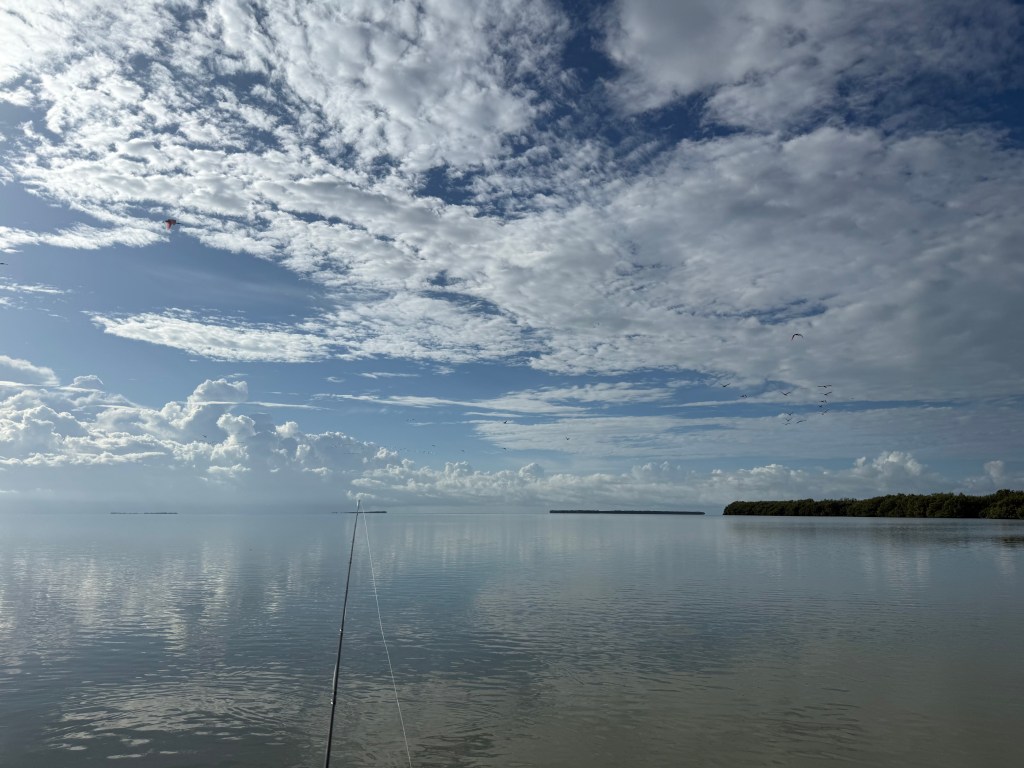
    Here’s the flat surrounding a mangrove key a few minutes after sunrise. This light always enchants me. Look for a moment and you’ll see the water is pink dimpled with dark blue, far prettier to my eye than Christo’s famous pink island wrapping.

    The water surface reflects the sky at low sun angles so my iPhone camera can’t see into the water to document for you how the fish are going about their morning activities. That would require a circular polarizer on my iPhone (wait, look it up… PolarPro makes a good one). But I’m up on the poling platform of my skiff this morning wearing polarized sunglasses. You’ll have to trust me when I tell you what fish I’m seeing and what they are doing.

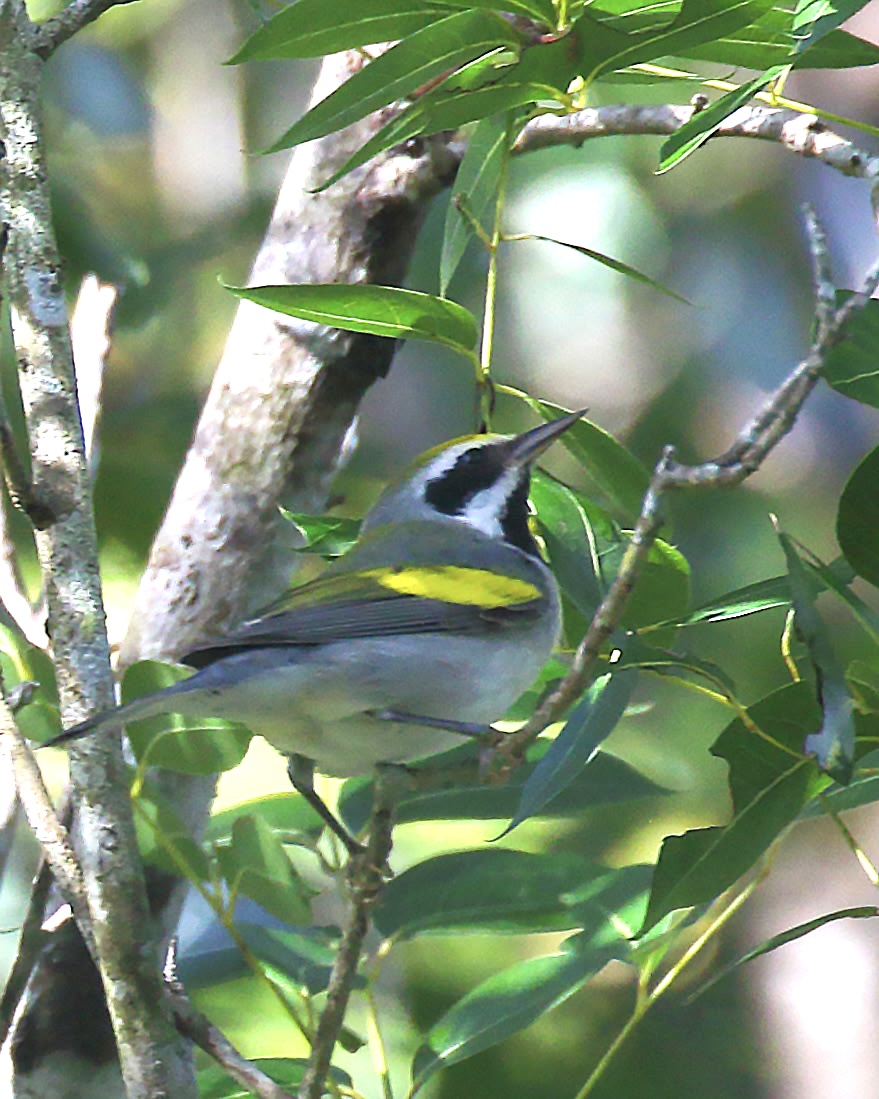
    Mullet are flipping and splooshing in the shallows, while egrets line up to try for the small ones. From the key comes the hollow whinny of a Bald Eagle, the raucous clatter of a Mangrove Clapper Rail, and the sweet song of a Yellow Warbler. Against the key lies a deeper channel where I spot a nice redfish but I won’t try for it. A five foot lemon shark cruises the channel, not far behind. Hooking a snook or redfish in any channel at Flamingo is tantamount to feeding a shark. I do not feed sharks or alligators, for similar reasons.

    Two juvenile Goliath Groupers, about 18” long, are out in the open on the flat. Young Goliaths normally spend their days holed up in the mangroves, roving the flat at night. But here they are in the light of day.I watch to see what these young groupers will do when they’re caught out in their pj’s with a flats skiff poling towards them. When I get closer, they panic and swim to the nearest clump of red mangroves, sticking their heads in the roots and leaving their mottled brown and black bodies sticking out in the open. With their heads concealed, they can’t see me, so I guess I’m not supposed to see them either, but they look thoroughly silly.

    Two young redfish with light gold bodies and blue tails are cruising the shoreline. I pitch a sparkly spoon fly in front of them, then retrieve it. One redfish starts to follow the fly, then changes its mind and wanders back to cruise with its friend. A different fly might have worked better, but which one? Unlike a rising trout that feeds for a while in one spot while the flyfisher tries one fly after another, a flats fish on the move rarely affords a second chance.

    The edge of the flat becomes a reverse shower of small jacks taking to the air. Underneath the water, I presume, a school of large jacks roars through the water in hot pursuit. In fifteen seconds, the water is still once again. It’s a fish-eat-fish world on the flats.

    I round the corner of the key and the glassy water surface erupts and goes still in alternation. Silver tails appear briefly and disappear. A school of juvenile tarpon is actively feeding on baitfish.

    The prey this morning is a school of anxious young mangrove snappers that’s holding in one area. To my happy surprise, the tarpon are cruising back and forth to take multiple shots at the bait school and affording me a parallel opportunity with my fly rod.

    I throw a black tarpon fly in front of the advancing tarpon with no success. The same fly worked last week in murky water four miles to the east, but the water here today is clear. Oh, right. Light-colored flies work better in clear water than dark patterns because fish (including baitfish) in clear water change to lighter, more reflective body colors for better camouflage. I knew that. The tarpon will be coming back soon for another pass at the snappers, so I remove the black fly and select a big gray & white snook fly that I tied but never put in front of a fish. If I stretch my imagination, this fly  could resemble a young mangrove snapper. It looks very fishy in the water and it’s not black.

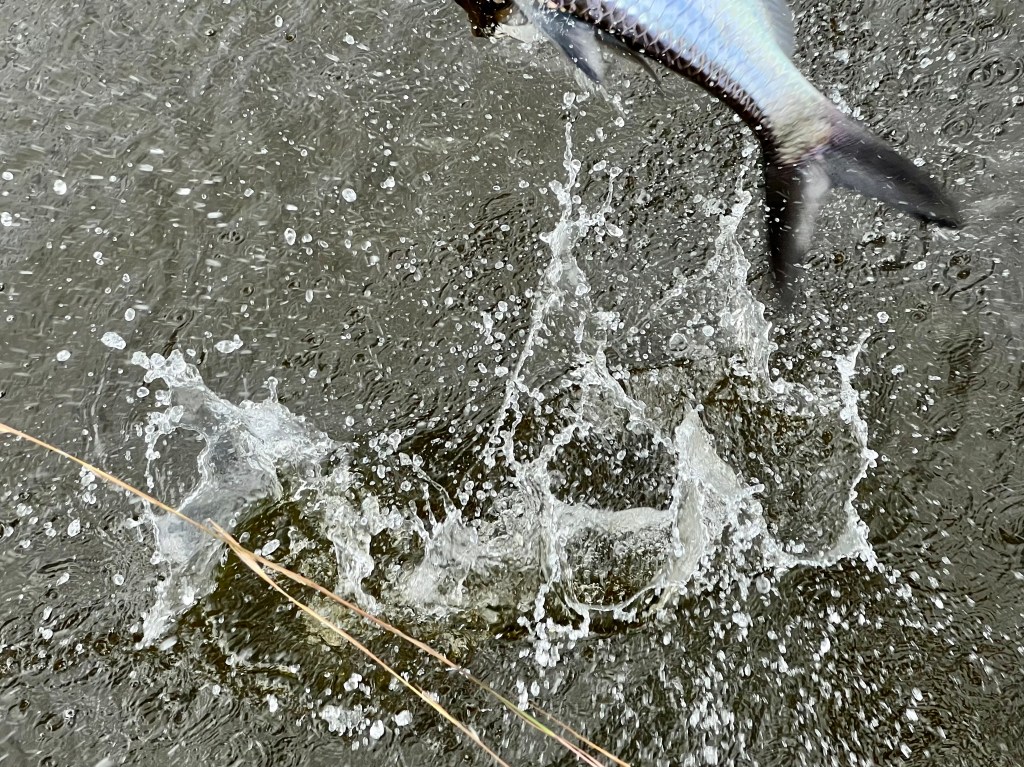
    I attach this snook fly to the heavy tarpon-proof bite tippet on my leader, and cast it in front of the tarpon school. To complete the illusion of a small fish finding itself in the wrong place at the wrong time, I make the fly attempt an escape. It works. One of the larger tarpon breaks from the school and grabs the hapless fly. I set the hook, but the tarpon doesn’t seem to care. The lining of a tarpon’s mouth is as tough as Kevlar – I’ve seen a tarpon consume a whole blue crab without chewing. But, feeling the line resistance, the tarpon forcibly yanks some fly line from my left hand and swims back into formation in the school. I restore tension on the line, putting a good arc into the 7-weight fly rod. The tarpon resists for a moment, then jumps clear of the water, snapping its body back and forth in the air and creating the slack needed to neatly toss my fly.

    You normally drop the rod tip when a tarpon jumps, precisely to keep it from creating that line slack, but I kept light tension on specifically to help the tarpon escape. More on that in a moment.

    Free of the leader’s encumbrance, the young tarpon, roughly 10 pounds’ worth, once again resumes its position in the school as the members continue their search for yummy little mangrove snappers.

    * * *

    Even though a fish’s face doesn’t change with mood, I swear this tarpon glared with an annoyed expression in its whole body. Perhaps it was in the way it shouldered loose some free line and went back to what it was doing before. It was never so clear that my hard earned fly-fishing skills, such as they are, do indeed annoy the fish.

    When a woman sends me a message like this, it stings. Same with a fish it turns out. I didn’t spend 35 years studying fish behavior to no effect.

    Increasingly, I compromise, seeking a bite on the fly then a self-release at a distance.

    When a fish takes a fly that I tied myself, I delight at having completed the illusion. My heart skips a beat at the sudden appearance of weight and power on the other end of the fly line gripped in my left hand. If I’m lucky, the fish makes a fast initial run, and maybe, if it’s the right species, it makes a couple of spectacular jumps. If it’s a new species for me, I want to see it up close and take a photo to remember it better. But for familiar species I do what I can to help the fish pitch the fly and get on with its fish life, ideally without my having to net and unhook it.  

    We’ll see how that deal sits with me. And, I suppose, with the fish.

    © Philip Stoddard

  • DeSantis Gulag: Protest #2 at Alligator Alcatraz

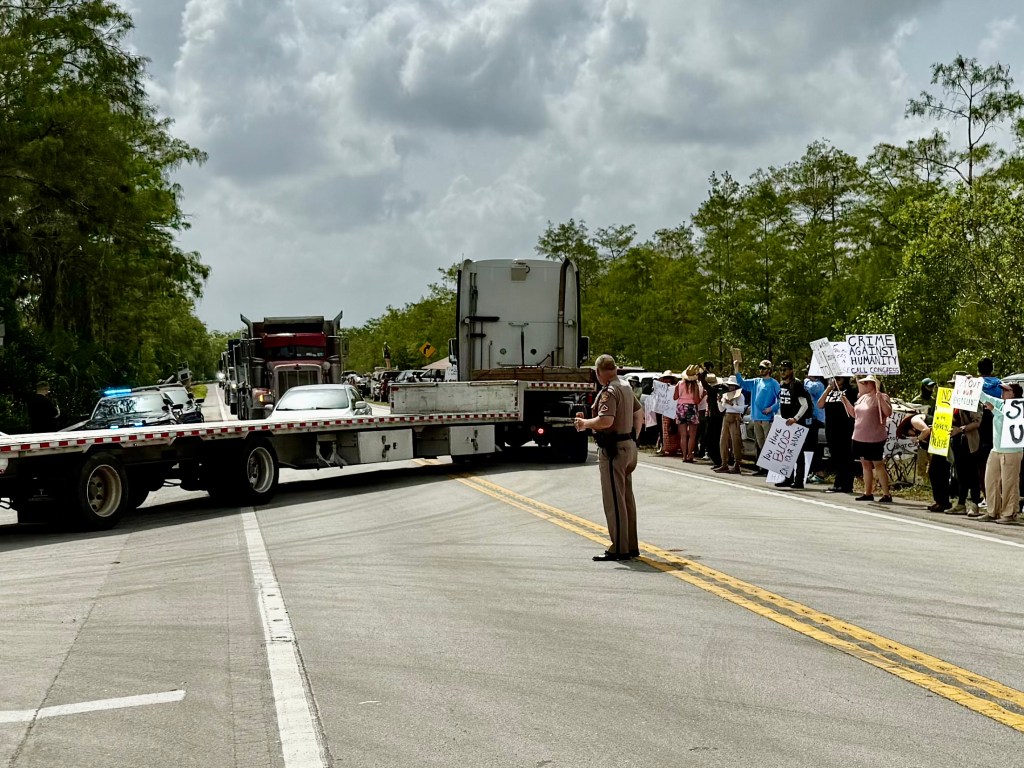
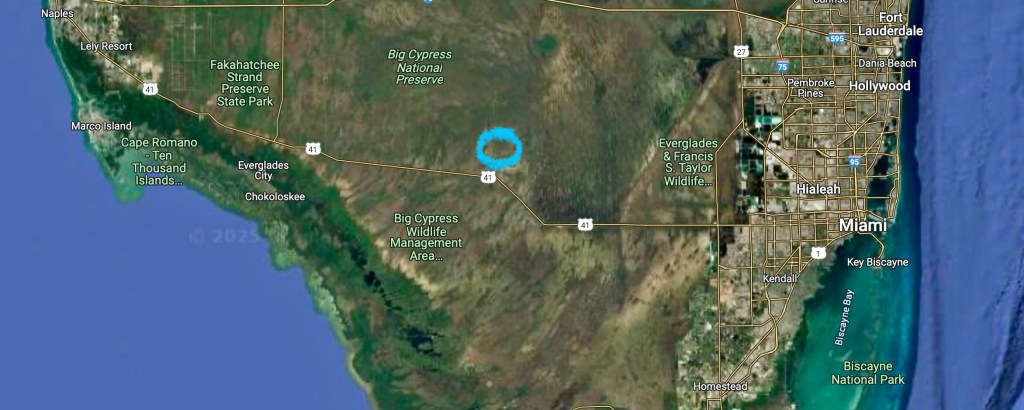
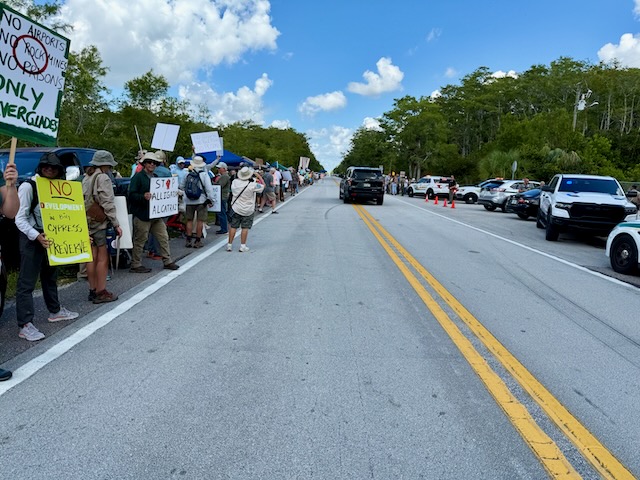
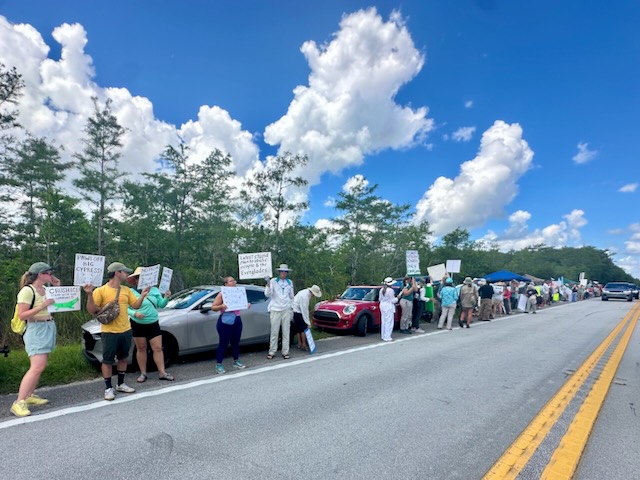
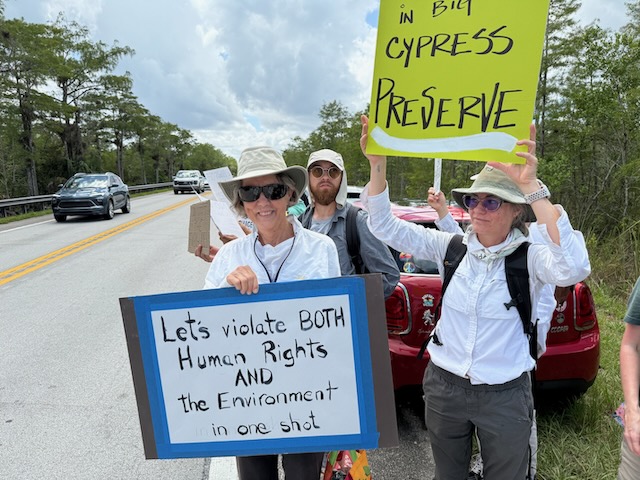
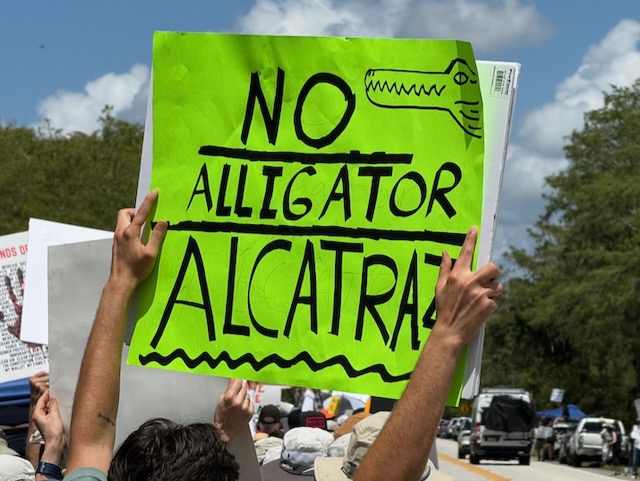
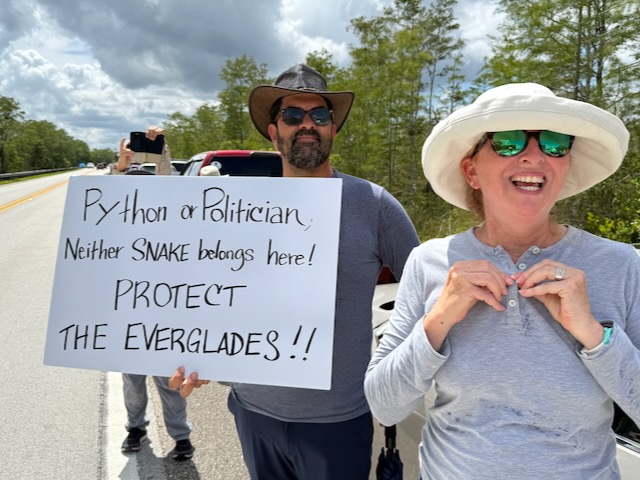
    Construction has begun on Alligator Alcatraz, the 1000 person immigration prison that Florida Governor Ron DeSantis is building in the heart of a sensitive wetland. Once again, 400 concerned Floridians made the trek out to the center of the Big Cypress National Preserve to stand and protest for 4 hours under the midday sun.

    On the drive out to the second protest on Saturday morning we passed 8 concrete mixing trucks returning from the site and dozens of tractor-trailer rigs lined up to deliver construction materials.

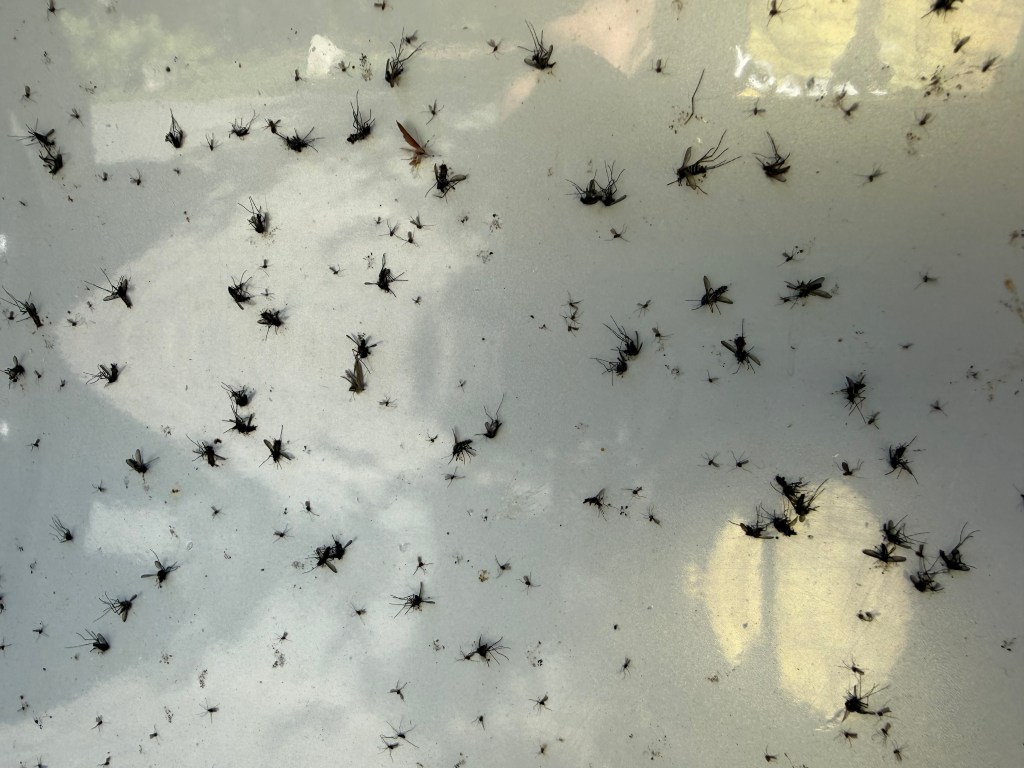
    In winter, the center of Big Cypress National Preserve is a nature lover’s paradise, but in summer you reach a terminal sweat in the unrelenting heat and saturating humidity. Mosquitoes are big and fierce. The nearest small town is Everglades City, 40 miles away. This site has the makings of a Siberian style gulag, described by Alexandr Solzhenynitzyn in The Gulag Archipelago.

    Environmental activist Betty Osceola of the Miccosukee Tribe led the crowd of peaceful protesters.  We could hear the drum beats in the distance as the Miccosukees themselves protested to a higher authority.

    Friends of the Everglades and the Center for Biological Diversity have filed for an injunction pending the full environmental review required by federal law, and ignored by Gov. DeSantis.  DeSantis plows ahead, ignoring the law, his trademark modus operandi.

    DeSantis has seized the land under his 2023 emergency declaration, but the only emergencies we’re seeing here in South Florida are unnecessary ICE raids in our communities and unnecessary prison construction in a cherished and protected wetland.

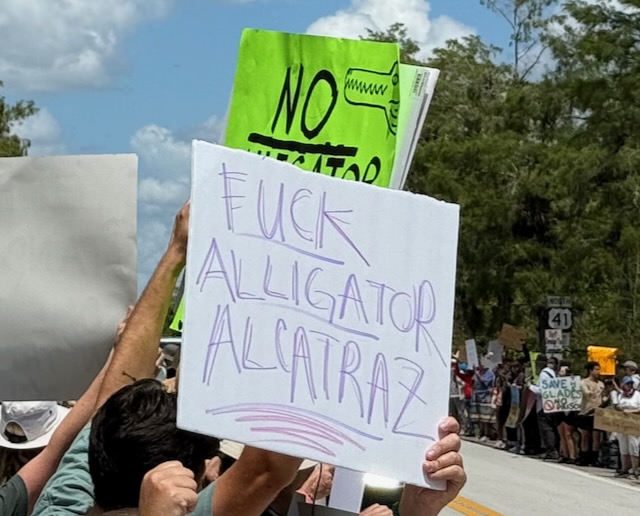
  • “F*ck Alligator Alcatraz”

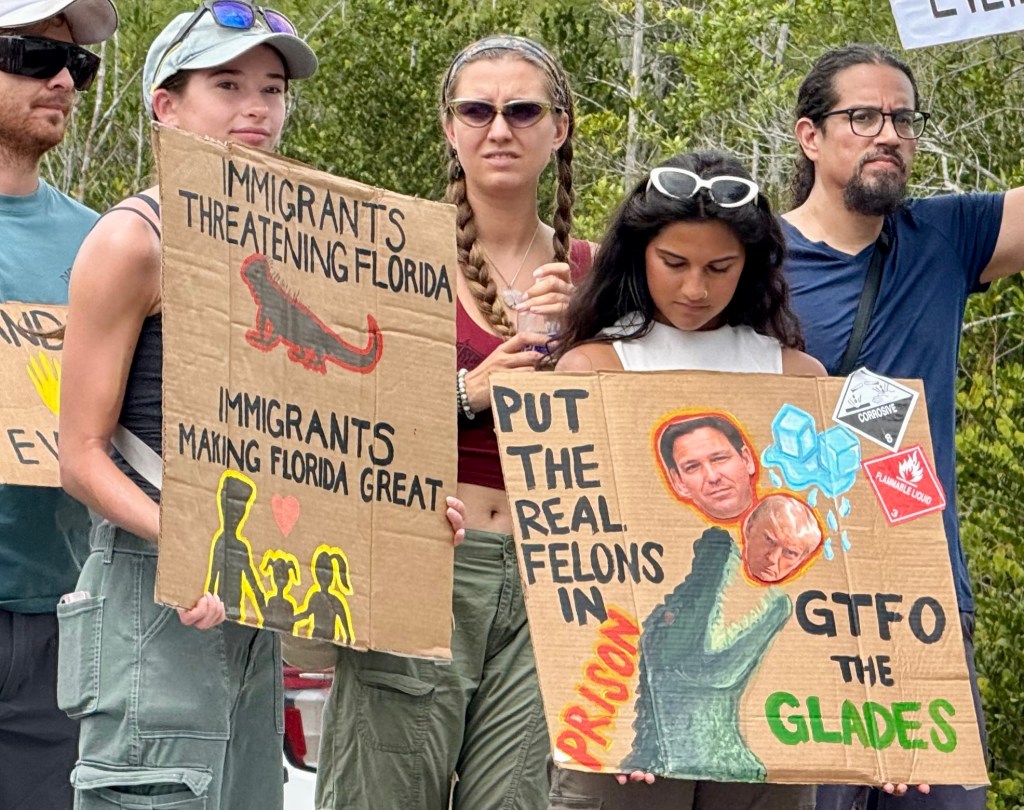
    So read one young woman’s sign this morning, 40 miles west of Miami on the Tamiami Trail, in the heart of the Big Cypress National Preserve.

    Florida Attorney General James Uthmeier’s latest brainstorm is to build an ICE prison in the middle of the Big Cypress National Preserve, a plan he dubs “Alligator Alcatraz”.

    James Uthmeier came to notoriety as the brains behind the diversion of $10 million in public Medicare funds into Gov. DeSantis’ dark money campaign against the Florida ballot initiative to legalize marijuana.

    This would be the same A.G. Uthmeier who is now held in civil contempt for advising Florida law enforcement agencies they should ignore a federal judge’s order limiting enforcement of a Florida statute creating a state immigration policy.

    Hundreds of people showed up this morning to protest Alligator Alcatraz. The line of parked cars was 1/4 mile long on one side of the road and I didn’t measure the line on the other side. Virtually all the cars driving through gave us positive toots on the horn and thumbs up. Zero disapproval.

    Click any photo to see it full size.

    Uthmeier is promoting this site for an immigration prison because, according to him, it wouldn’t need a perimeter fence since nobody can escape through the Everglades. What a moron. Does any intelligent person think that immigrants who escaped gangs by walking through the tropical forests of the Panama’s Darien Gap will be stopped by the inviting waters of a South Florida cypress swamp? My wife and I take children and geezers on swamp walks through the Big Cypress.

    If any immigrants did escape, Miccosukees and Seminoles living nearby would likely take them in. These First Nation folks have a long history of hiding fugitives from the U.S. Government in the swamps of South Florida. The proud Miccosukee Tribe never signed a treaty with the U.S. Government.

    No, the real reason for a 1000 bed ICE prison at Mile 48 on the Tamiami Trail is the Dade-Collier Transition Airport. So easy to lock people up out of sight then fly them out of the country in the middle of the night.

    This land is jointly owned by Miami-Dade and Collier Counties. Will our County Mayor and Commission fight to prevent the state from snatching it for an immigration prison?

    The young woman got it right: “Fuck Alligator Alcatraz”.
    Silence is complicity.

    © Philip Stoddard, 2025