Eye of the Cormorant

another odd bird who chases fish.

Tag: Everglades

  • Snookered

    May 15, 2026. Low winds are predicted through noon with no rain forecast for the day. Ideal weather to fly fish for snook on the beaches in the SW corner of the Florida peninsula.

    When the tide starts to come in, small bait fish congregate along the shoreline. In May and June, snook move in to hunt these baitfish along the beaches of SW Florida before heading offshore to breed. In turn, Lemon Sharks ply the water a few feet out from beaches to hunt the snook.

    Sea level rise is a real thing here, and snook make the most of it, seeking out the beach stretches with “ghost forests”, woody remnants of drowned mangroves. I presume snook find some protection from hungry sharks and ospreys among the submerged stumps.

    * * *

    Mosquito season has returned to south Everglades. I don a second shirt and my head net in the car before heading outside to ready the skiff for launch. As I step out, a swarm of mosquitoes rushes inside the car to amuse me on the drive home. No kayak today; my destination is 17 miles from the put-in.

    A Chuck-Will’s-Widow sings nearby as I launch in the dark. Something splashes, but my flashlight detects no crocodile eyes. The sun peeks over the horizon turning the sky and water pink as I take the shortcut through Lake Ingraham. I stop to watch pink birds.
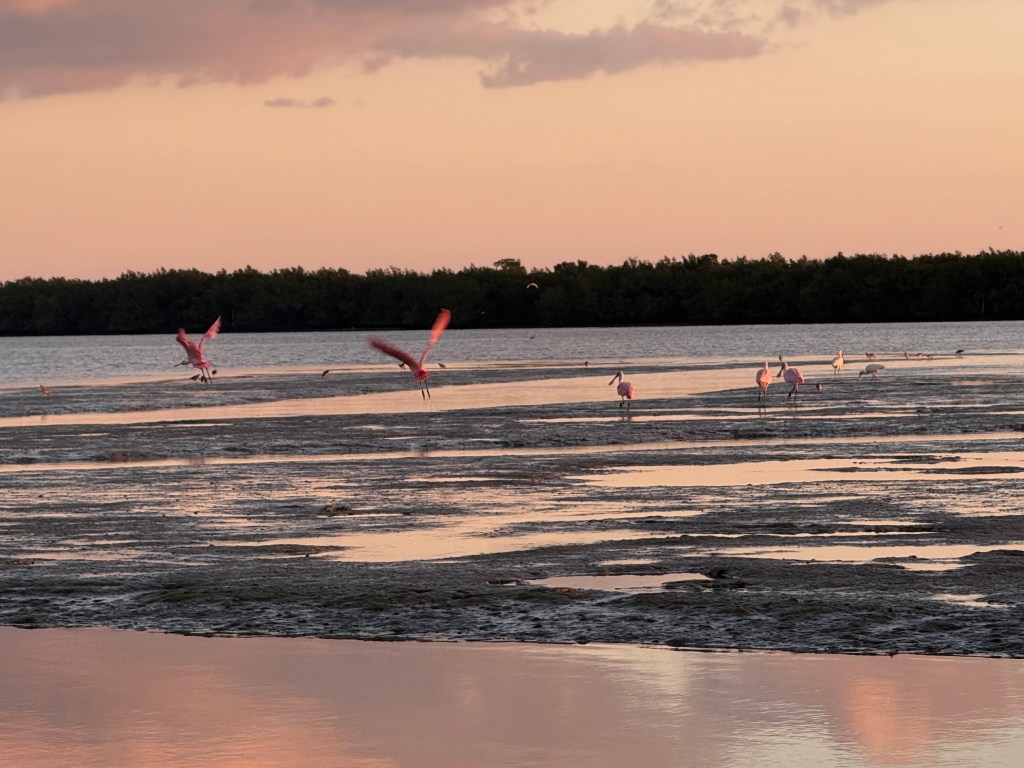
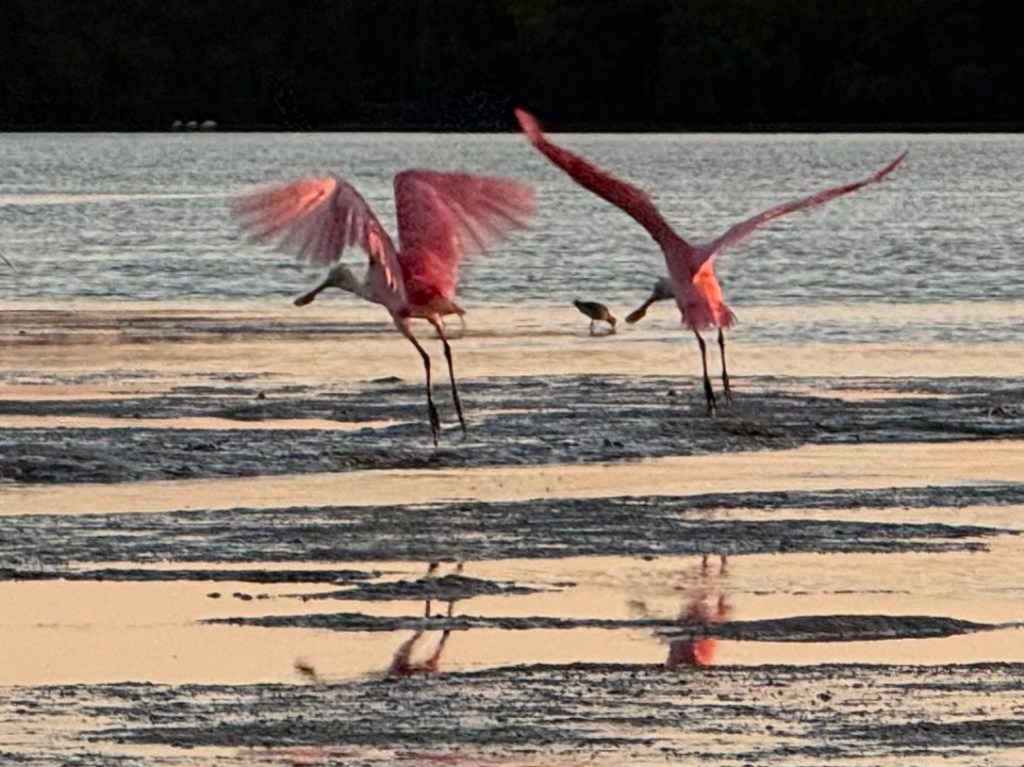
    Roseate Spoonbills on Lake Ingraham at low tide. They’re pink at all times of day.

    The tide is still going out when I arrive, so I check out the shoreline of a nearby tidal river, a spot just outside the strong current where I have found snook stacked up as they wait for the tide to change. Someone else has arrived before me to hunt for snook, with no intention of releasing them:

    Feeding caught or released fish to Lemon Sharks is against my religion, so I move on to the beach. The wind is low, as NOAA predicted it would be, and the tide chart says the tide will turn in an hour. I bide my time watching a Swallow-tailed Kite hunts lizards and dragonflies as it courses back and forth over the low coastal scrub. I never get tired of watching kites.

    I assemble my long, two-handed “Spey” rod, tie on a proven fly, and begin casting to the water’s edge, trying not to hook remnants of the mangrove ghost forest. At 8:30 am a snook grabs the fly and leaps into the air. It lands with a splash and leaps again. A great fish, but commotion like this broadcasts a loud “EAT ME” signal to any nearby sharks. A couple of years ago at this same spot, I broke a fly rod playing “keep away” with a Lemon Shark. I buy used fly rods, but they’re still inordinately expensive, and that particular rod was a treasured gift from my former student Manny. I have devised a plan to avoid a repeat:

    As soon as the snook hits the fly, I open the drag on the fly reel and let the fish run while I maneuver the skiff away from the beach into deeper water. When I spot-lock the trolling motor, Mr. Snook is still on the line. The ruse works – I play in the snook and net it up with no shark interference.
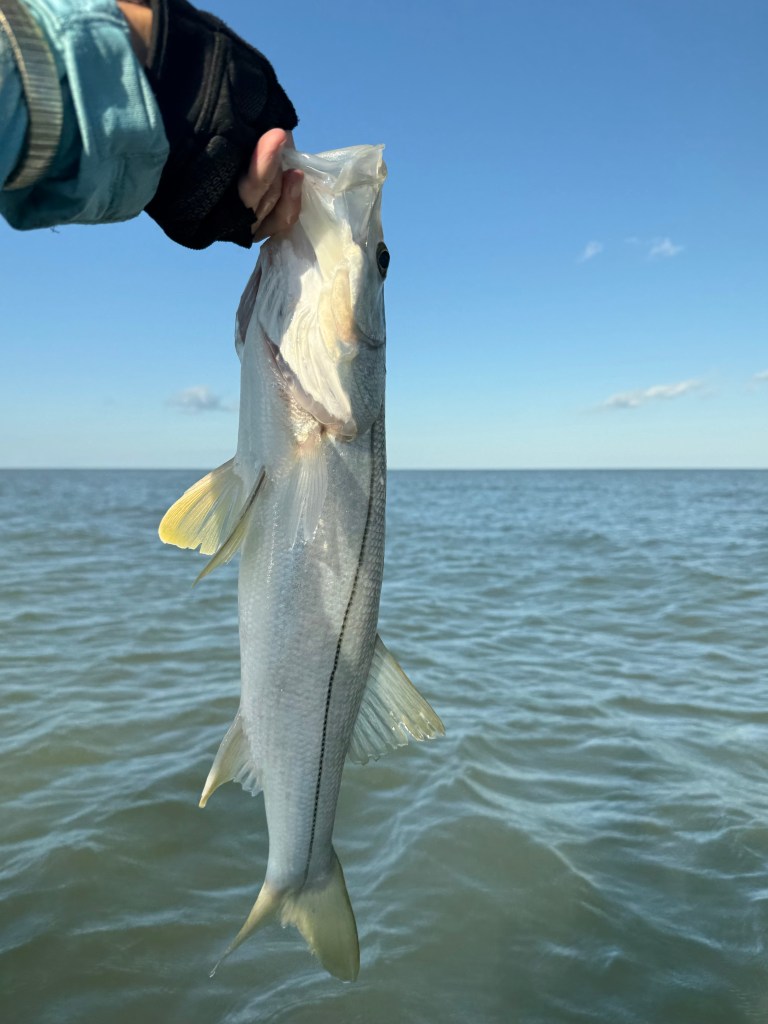
    With sharks on the prowl, it’s unwise to reach your hand into the water to unhook a fish.

    According to a paper I read, giving caught fish a few minutes to recover before release greatly reduces the likelihood of a shark chasing them down. I unhook the snook and put him into a homemade floating recovery pen where he rests calmly for a few minutes until I release him 75m from shore.
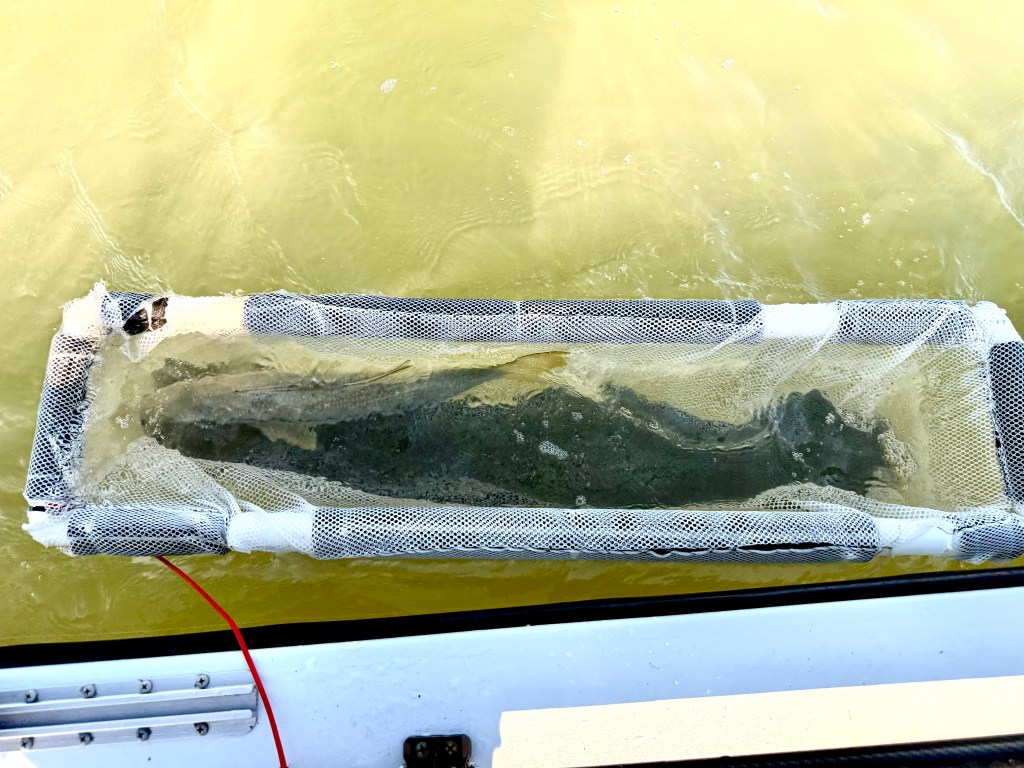
    The snook is the gray fish-shaped thing with fins and a yellow tail on the left side of the floating pen. The long black thing is a strip of shade cloth to keep a shark from seeing the resting fish’s silhouette from below.

    The wind is picking up three hours earlier than predicted and surf is now pounding the shoreline. I fish another hour, bobbing around in the waves, but no more snook are to be found. I disassemble the rod, fold up the floating pen, and make the return run. Retracing my path through Lake Ingraham and Florida Bay I’m happy to find the water is much flatter on the lea of the peninsula than the on the windward Gulf side.

    * * *

    So where are rest of the snook today?

    1. With the strong offshore wind and crashing surf, perhaps the bait fish left the shoreline so the snook went elsewhere.
    2. Rains bring snook down from the rivers to the beaches where they congregate before heading offshore to breed. Perhaps the spring has been so dry the snook are still up-river.
    3. Maybe the recovering Lemon Shark population has reduced the snook numbers – I hope that’s not it.
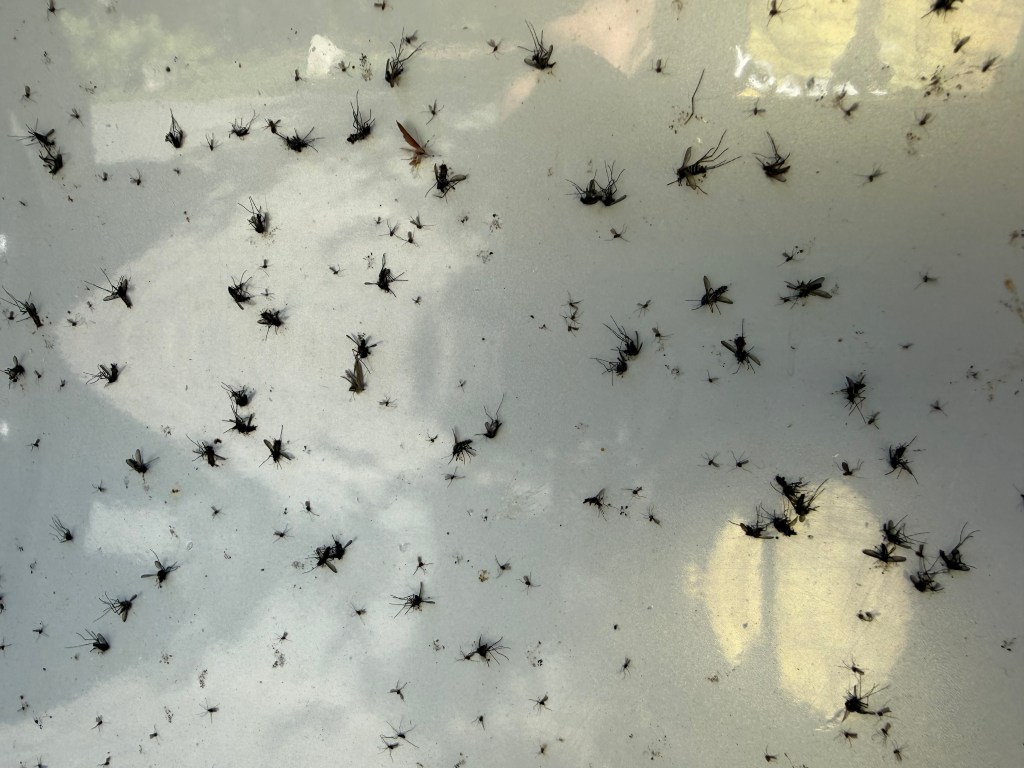
    Here’s the car’s front bumper when I get home. Even as the beach snook are missing today, Black Salt Marsh Mosquitoes have faithfully resumed their time-honored role as defenders of the south Everglades.
  • Flipper

    Not the TV dolphin, a kayak flipper.

    My kayak fisherman buddy Cesar flipped over in a shallow rill along the edge of Florida Bay. Poor guy had no choice but to thrash around waist deep in shallow water and sticky mud groping for his lost fishing gear. He paddled back to the marina soaked, muddy, and completely humiliated. 

    It’s genuinely hard to flip a rotomolded fishing kayak in flat water. These craft have high primary stability and stick tight to the water’s surface. Nor is Cesar a beginner so I don’t think the flip was his fault. Two related stories suggest possible explanations.

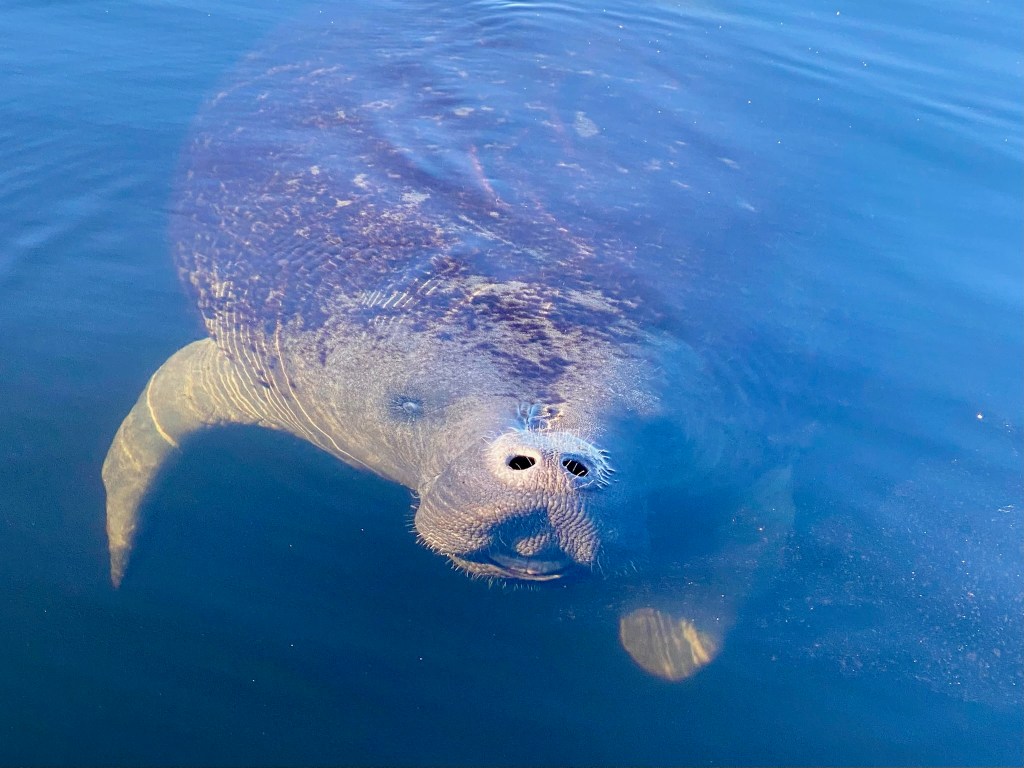
    In September 2015, I took my wife Gray out for a birthday paddle in Biscayne Bay. I was a couple of boat lengths ahead as we passed over a bed of lush turtle grass in two feet of water. Out of nowhere, a wave rose up another two feet above the bay’s glassy surface, racing for the shore-side of my kayak. Some large and unseen creature was coming at me, and fast. For whatever protection it could afford, I lifted my paddle blade and held it firmly between me and whatever was coming at me beneath the wave. The wave jumped out of the bay and exploded over me. In the next instant the kayak and I flew up into the air. As we fell back into the bay, I executed a low-brace to stabilize the kayak. I had reflexively turned my face away from the shower, affording me the view of a bull manatee rocketing out the other side, bound for deeper water. I was completely soaked and gallons of seawater had joined me in the cockpit, but I was upright.

    From her ringside seat, Gray enjoyed the whole show.

    An unseen bull manatee had been grazing underwater near the mangrove shore and panicked when he saw my kayak cutting off his escape route. The exploding water resulted from the hard tail flip he made to shove his body under my kayak in water the same depth as his rotund body.

    Unlike my unfortunate friend, Cesar, I had two advantages that kept me from flipping over. First, I was paddling a touring kayak designed for rough water. Such a kayak has low primary stability and high secondary stability, meaning the hull rocks a bit on flat water but exerts a significant righting force that keeps it upright when tipped between 30 and 60  degrees. Second, I had a well-practiced low brace, the paddle maneuver that prevents a flip by controlling the hull’s rotational angle on the water. The low brace couldn’t prevent a soaking, but did keep me from going over.

    Since then I have watched out for the telltale wave of a kayak-panicked bull manatee in shallow water. Several times I have had to back-paddle hard to let a bull manatee barrel through to safety. Cow manatees are more relaxed around passing kayaks. Being smaller, perhaps they don’t feel so vulnerable in the shallows.

    But I can think of another manatee-related, possibility for how Cesar flipped in flat water.

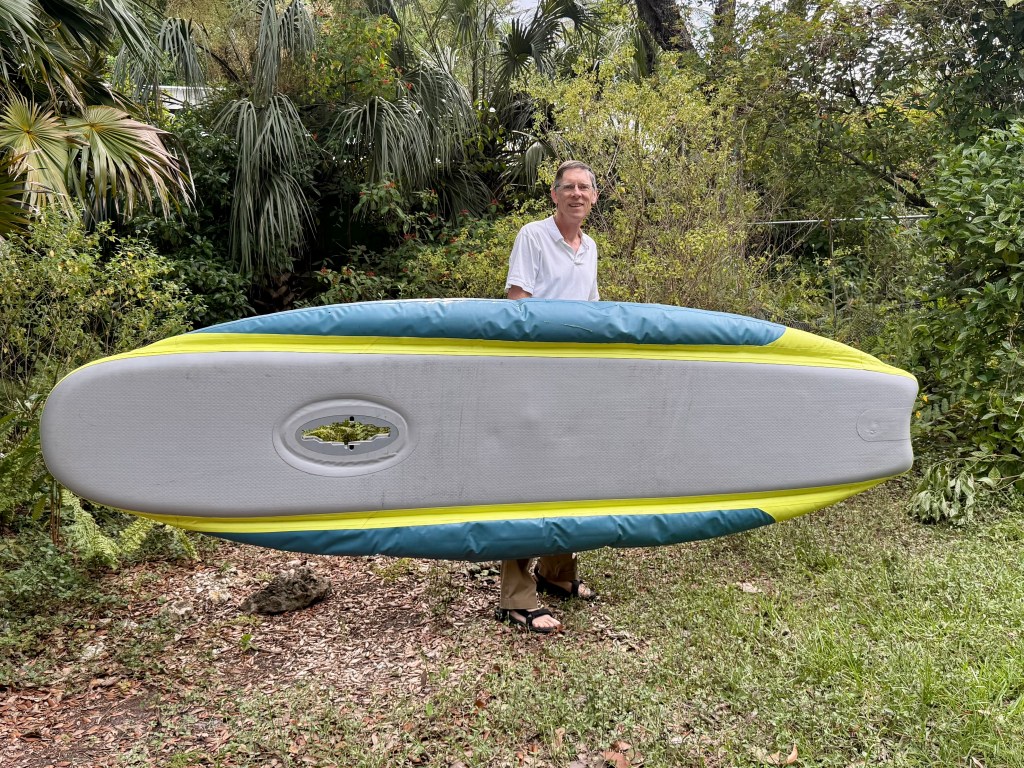
    In 2022, I purchased a Hobie iTrek 11 for inshore fishing. It’s essentially an inflatable paddleboard with a lawn chair and pedal-operated flippers. An additional inflated tube along each side provides extra primary stability. This thing is not going to flip in anything short of breaking surf. The iTrek is oval in shape and gray underneath, like a manatee. 

    Manatees love the iTrek. Many times I have had to reel in my fishing line when cow manatees come up to snuggle. A few times the bow of the iTrek has risen mysteriously out of the water, elevated on the nose of an amorous bull. It’s disconcerting for sure, but unlike a kayak, the iTrek stays upright while balanced at one end on a manatee’s nose, with no athletic intervention by the paddler. One morning I gave up trying to fish because a bull manatee followed me everywhere I went, nudging the boat from underneath then backing away with a silly grin.

    Hardly the worst reason to miss out on the morning’s fishing, don’t you think? And definitely better than being flipped over like my buddy Cesar.

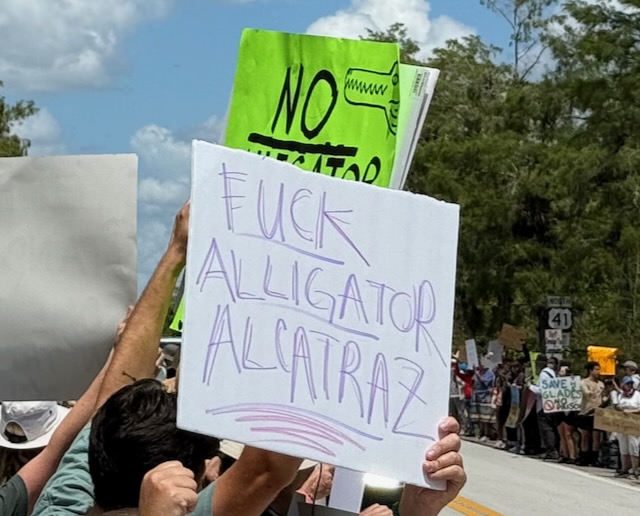
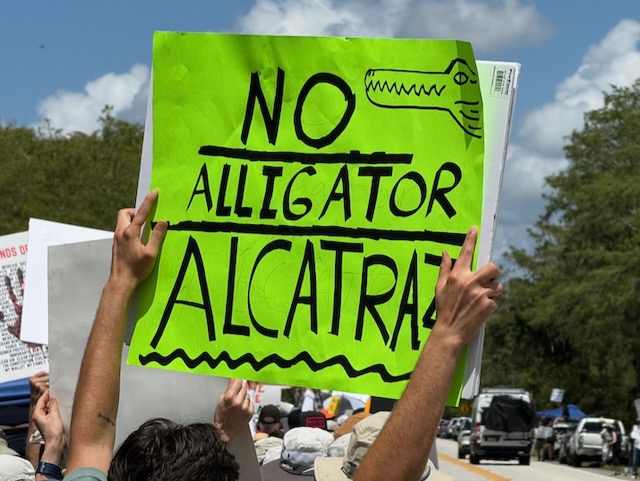
  • “F*ck Alligator Alcatraz”

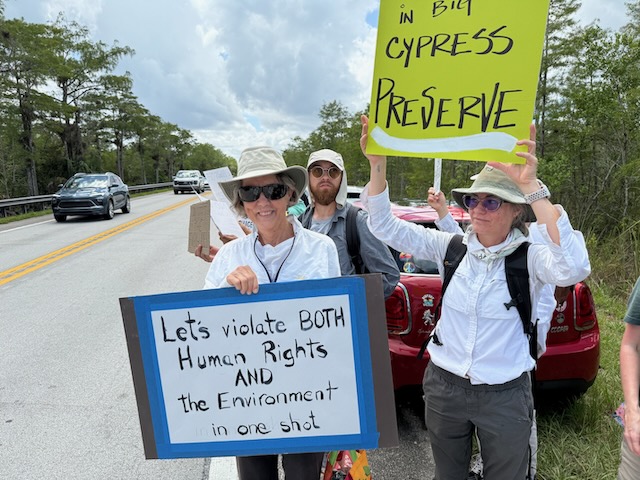
    So read one young woman’s sign this morning, 40 miles west of Miami on the Tamiami Trail, in the heart of the Big Cypress National Preserve.

    Florida Attorney General James Uthmeier’s latest brainstorm is to build an ICE prison in the middle of the Big Cypress National Preserve, a plan he dubs “Alligator Alcatraz”.

    James Uthmeier came to notoriety as the brains behind the diversion of $10 million in public Medicare funds into Gov. DeSantis’ dark money campaign against the Florida ballot initiative to legalize marijuana.

    This would be the same A.G. Uthmeier who is now held in civil contempt for advising Florida law enforcement agencies they should ignore a federal judge’s order limiting enforcement of a Florida statute creating a state immigration policy.

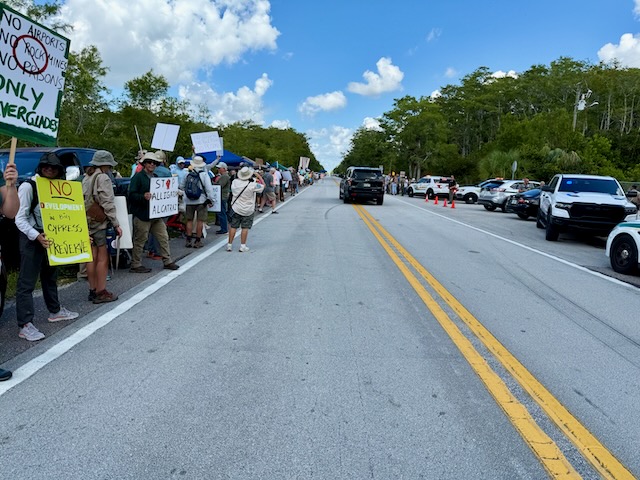
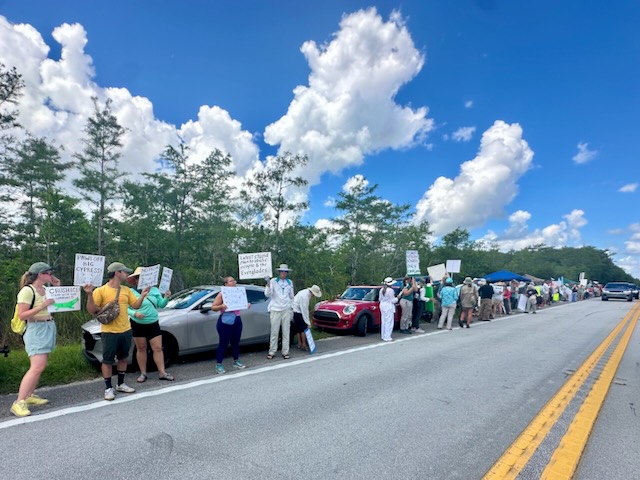
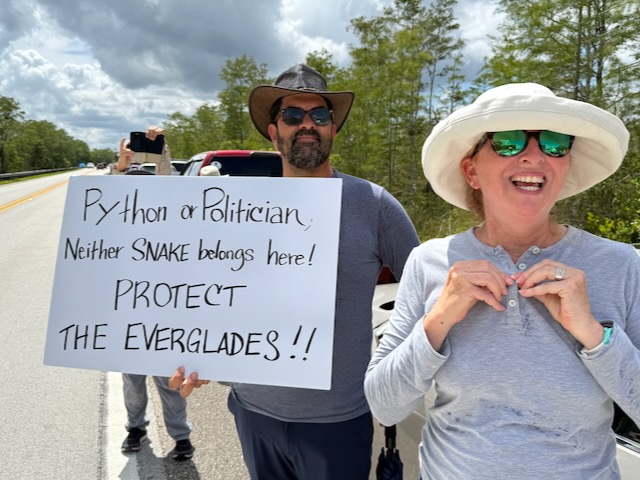
    Hundreds of people showed up this morning to protest Alligator Alcatraz. The line of parked cars was 1/4 mile long on one side of the road and I didn’t measure the line on the other side. Virtually all the cars driving through gave us positive toots on the horn and thumbs up. Zero disapproval.

    Click any photo to see it full size.

    Uthmeier is promoting this site for an immigration prison because, according to him, it wouldn’t need a perimeter fence since nobody can escape through the Everglades. What a moron. Does any intelligent person think that immigrants who escaped gangs by walking through the tropical forests of the Panama’s Darien Gap will be stopped by the inviting waters of a South Florida cypress swamp? My wife and I take children and geezers on swamp walks through the Big Cypress.

    If any immigrants did escape, Miccosukees and Seminoles living nearby would likely take them in. These First Nation folks have a long history of hiding fugitives from the U.S. Government in the swamps of South Florida. The proud Miccosukee Tribe never signed a treaty with the U.S. Government.

    No, the real reason for a 1000 bed ICE prison at Mile 48 on the Tamiami Trail is the Dade-Collier Transition Airport. So easy to lock people up out of sight then fly them out of the country in the middle of the night.

    This land is jointly owned by Miami-Dade and Collier Counties. Will our County Mayor and Commission fight to prevent the state from snatching it for an immigration prison?

    The young woman got it right: “Fuck Alligator Alcatraz”.
    Silence is complicity.

    © Philip Stoddard, 2025