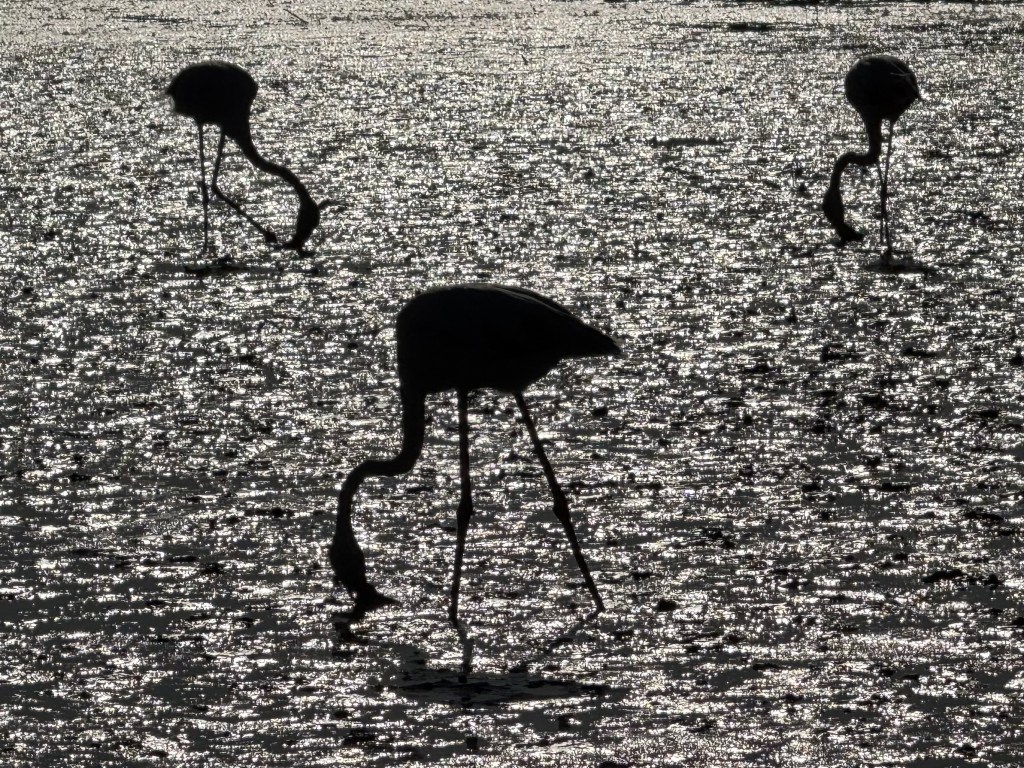
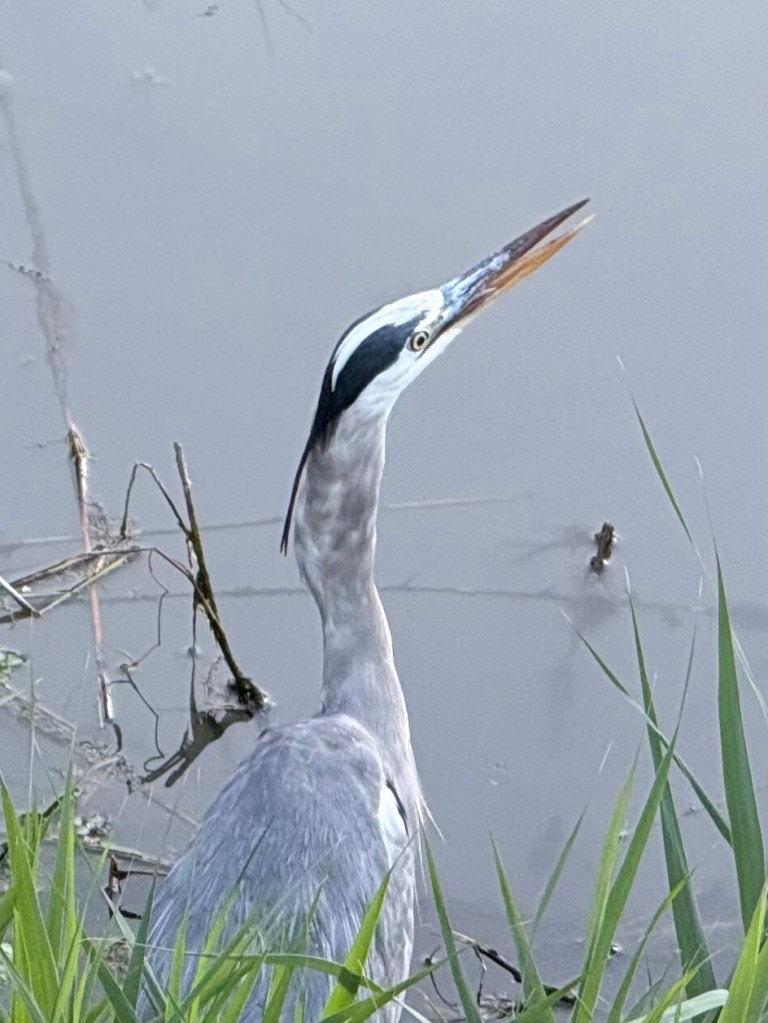
The Camargue is the floodplain delta of the Rhône, situated between the city of Arles, where we are staying, and the Mediterranean Sea. The terrain is flat and marshy, checkered with rice fields, brackish pools, small canals, salt ponds, and tidal estuaries. On the advice of my cousin Judy, we rented a car to visit the Camargue.
DAY 1
Our first afternoon with wheels we headed down the west side of the Camargue to the Parc Ornithologique.
Enroute, we picked up a sweet young couple who were hitch-hiking, and drove them a bit beyond our turn-off to a better spot where they could find their next ride.
The Parc Ornithologique is much like Chincoteague National Wildlife Refuge on Assateague Island, Virginia, but better in important ways. Impoundments are well-maintained and are teaming with water birds. The maze of trails is for walking only. Observation benches and blinds are situated close to the birds.
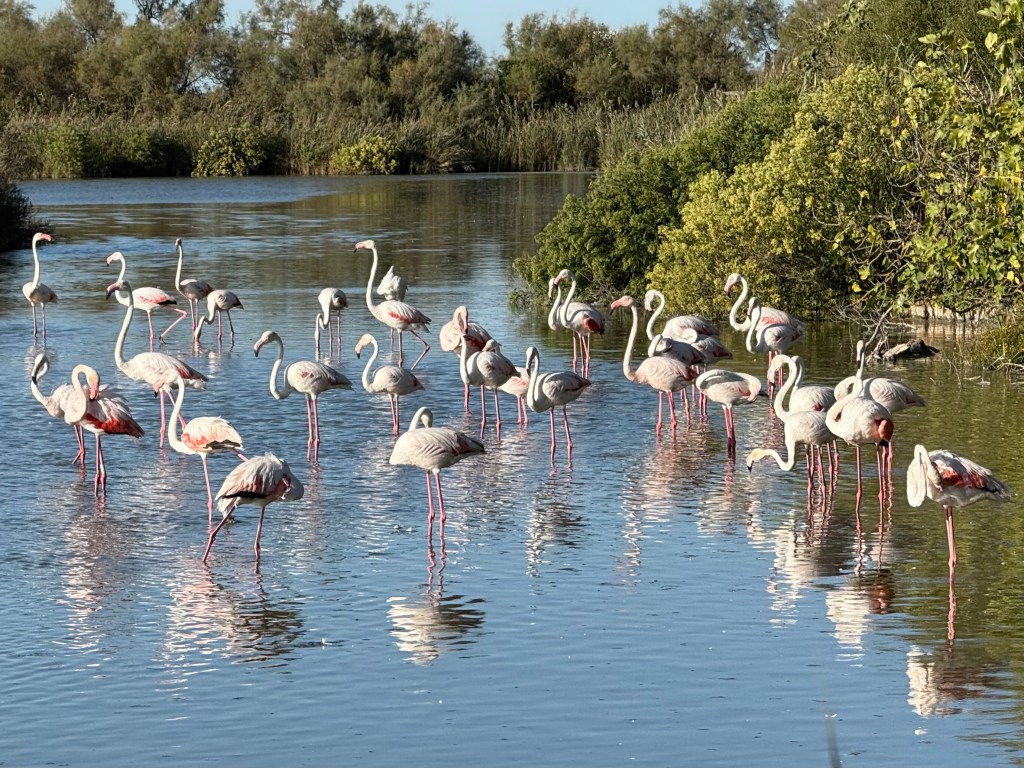
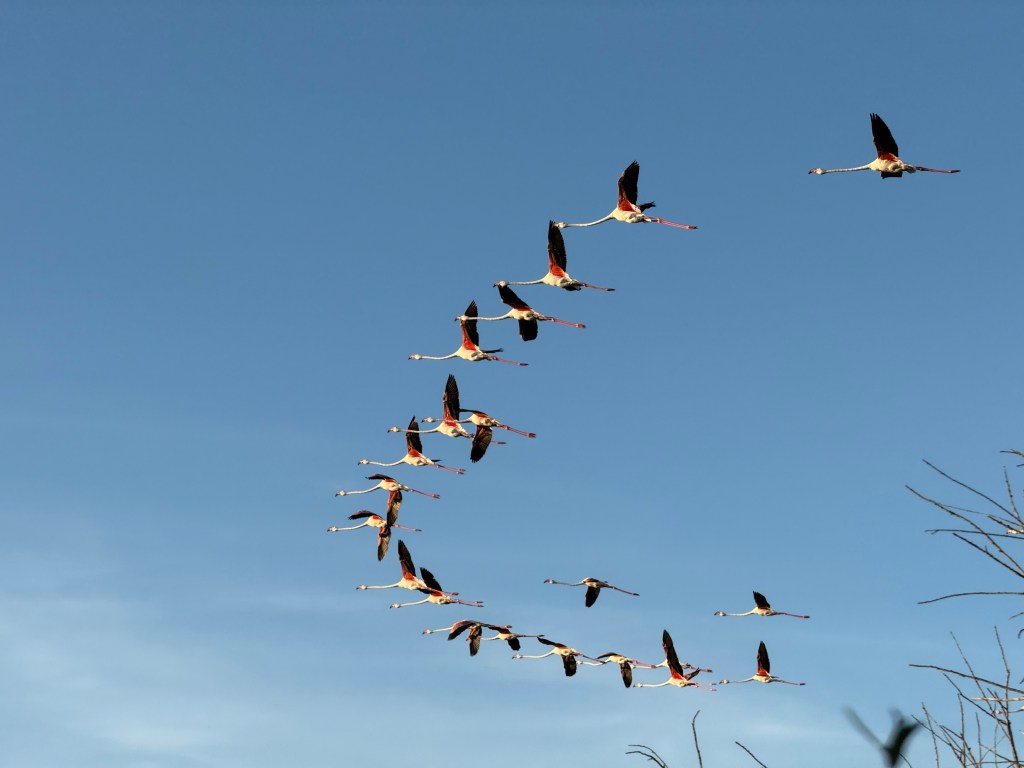
Greater Flamingos are everywhere.
The multilingual signage is informative, even for an old pro like me. For instance, banding results show the flamingoes roam the Mediterranean, but particular individuals return to this park year after year.
I learned that Cetti’s Warbler is one of the few polygynous passerines. My bird book told me that Cetti’s Warbler sings from concealed spots, moving quickly from spot-to-spot. My Merlin phone app played me the song. Ah ha!
I had been hearing the beautiful liquid song of Cetti’s Warblers everywhere and getting only the odd peak at its sources (nondescript brown-backed jobs with a faint white eye-line) hiding in the dense vegetation. Cetti’s Warbler, and the handsome European Dipper I encountered while trout fishing, were my new birds for the trip.
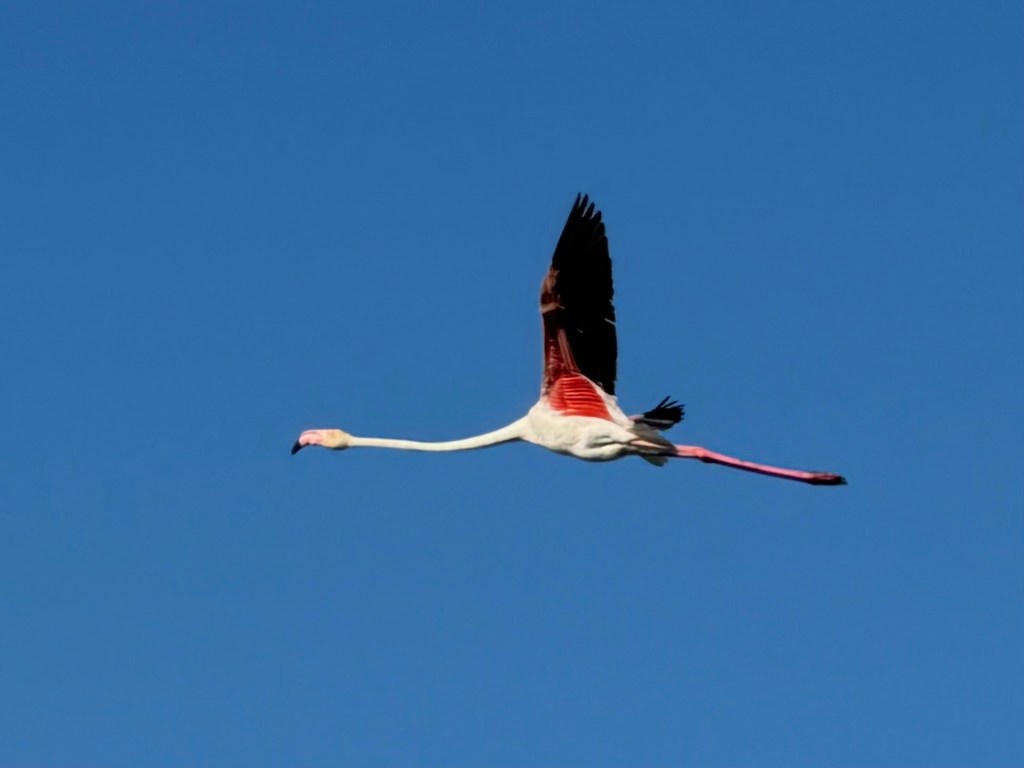
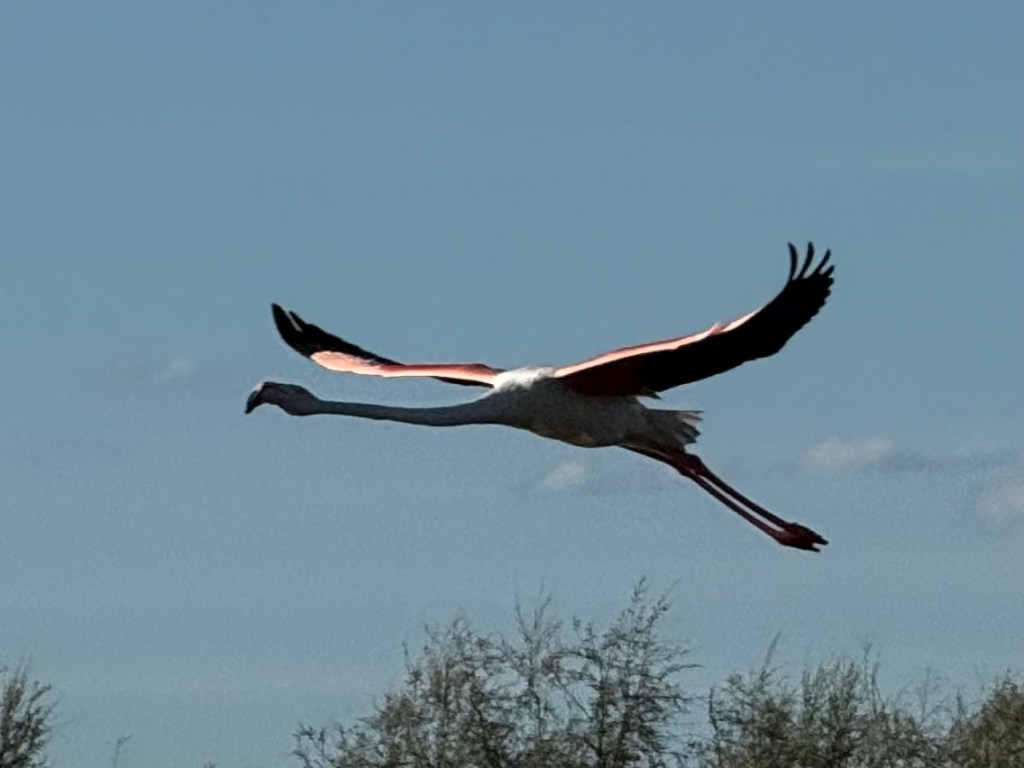
In contrast to the solid orange-pink of the American Flamingos, the Greater Flamingos are pinkish white, with their crimson wing coverts and axillaries visible mainly in flight.
Photo by Gray Read
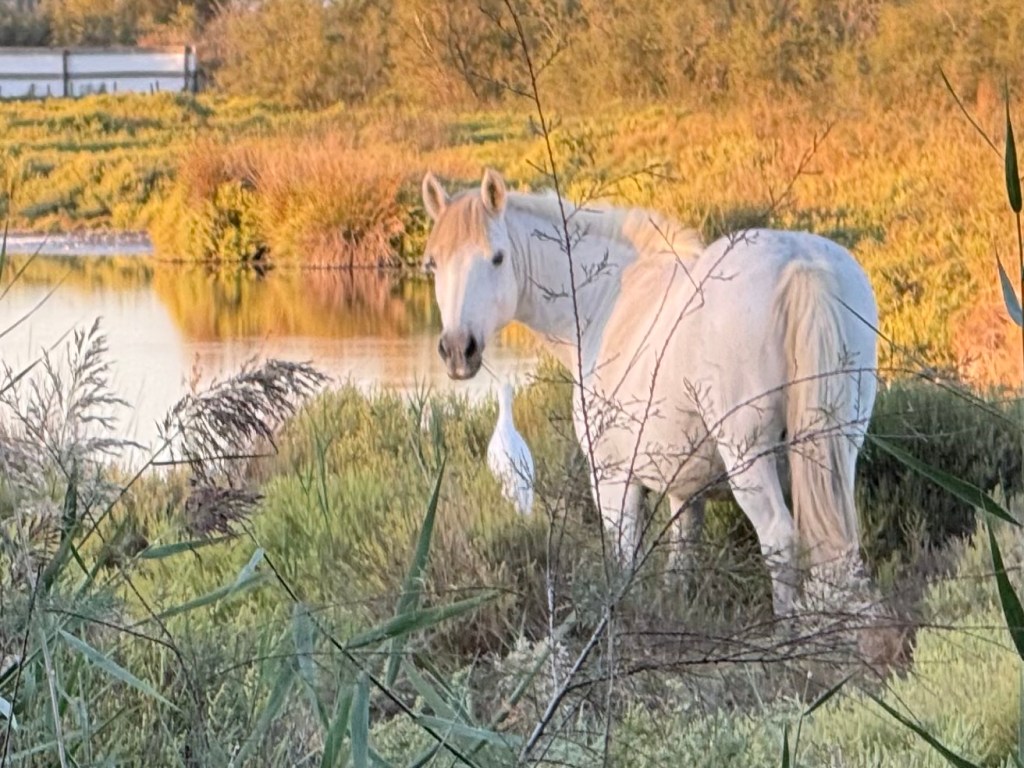
Hearing whinnies from across the thick reed beds, we finally saw the sources. As on Assateague Island, wild horses roam the marshy terrain of Camargue, accompanied by faithful Cattle Egrets, which sometimes rode on their backs.
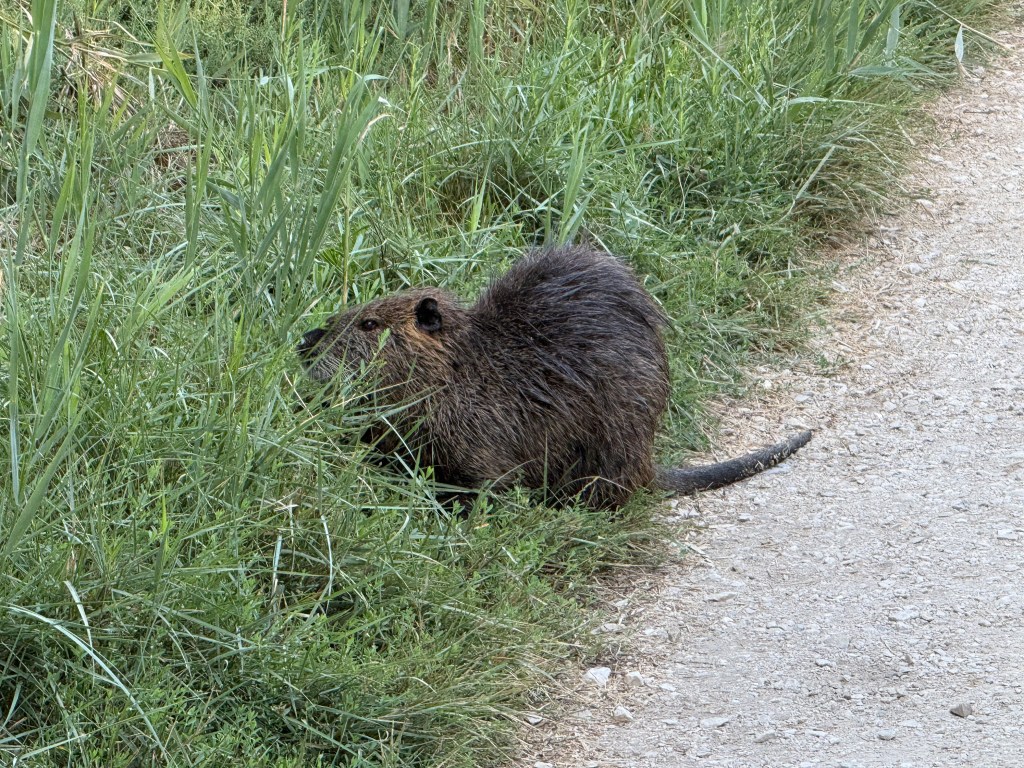
Nutria, introduced from South America, don’t seem to be doing so much damage to embankments as they did in the southeastern US.
Park staff told us we could remain after the park closed for the evening, letting ourselves out via the revolving gate. It’s been very dry of late – we saw just one mosquito and one no-see-um – so we stayed until dusk, watching the day birds put themselves away for the night.
As night herons emerged against a pink and purpling sky, we enjoyed a picnic supper of Brillat-Savarin cheese and guacamole on gluten-free toast accompanied by fresh plums and figs. Pas mal.
DAY 2
Having parked the car overnight near our apartment in Arles for half a Euro, we spent the next morning exploring the east side of the Camargue.
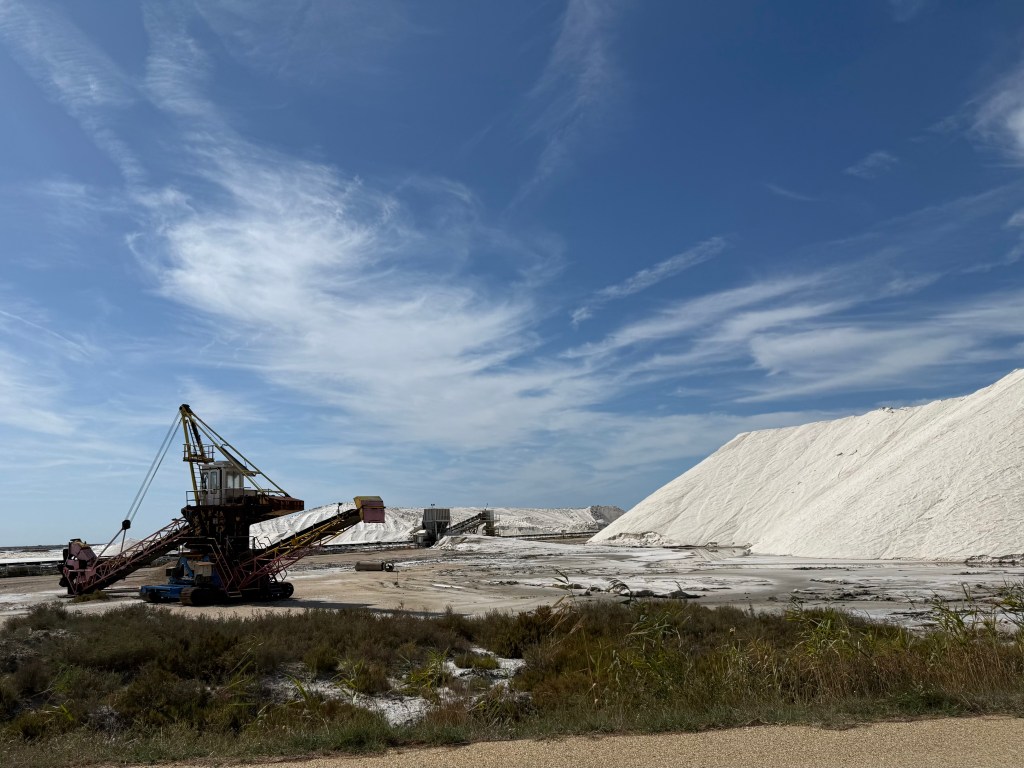
We drove into the Reserve Nationale Camargue where sea salt has been evaporated and harvested from salt ponds at least since Roman times. Now it’s done with big machines instead of slaves.
Sel de Camargue is found in all the local salt shakers. It’s good on fried potatoes and would go well with rice, if you could find rice.
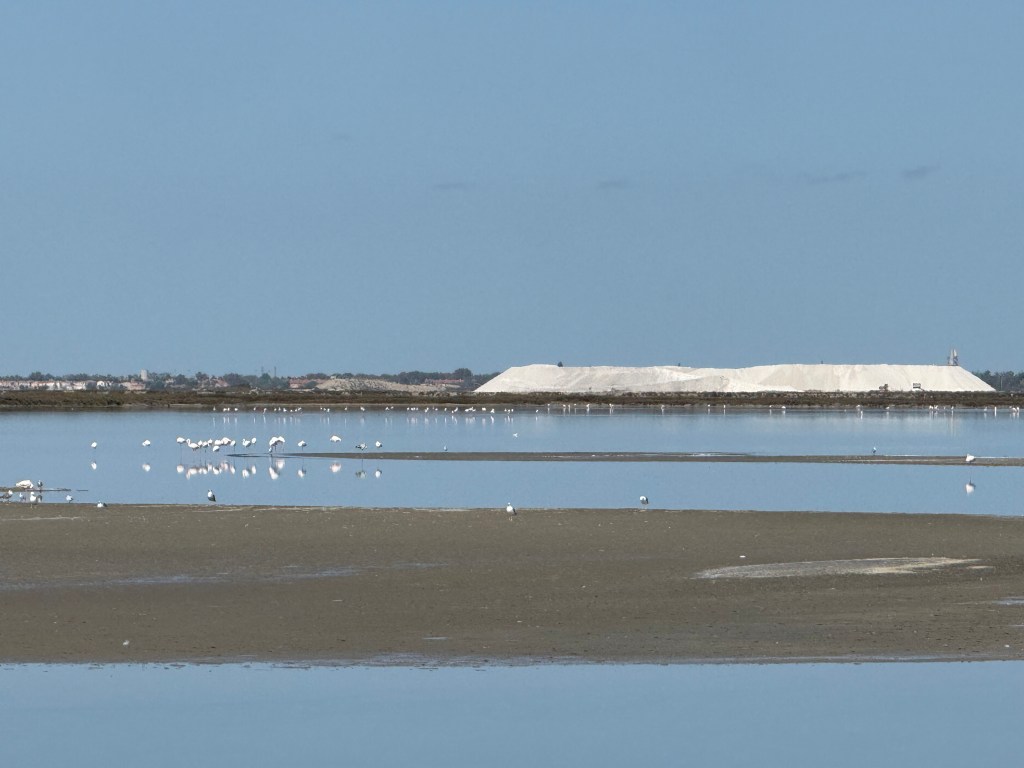
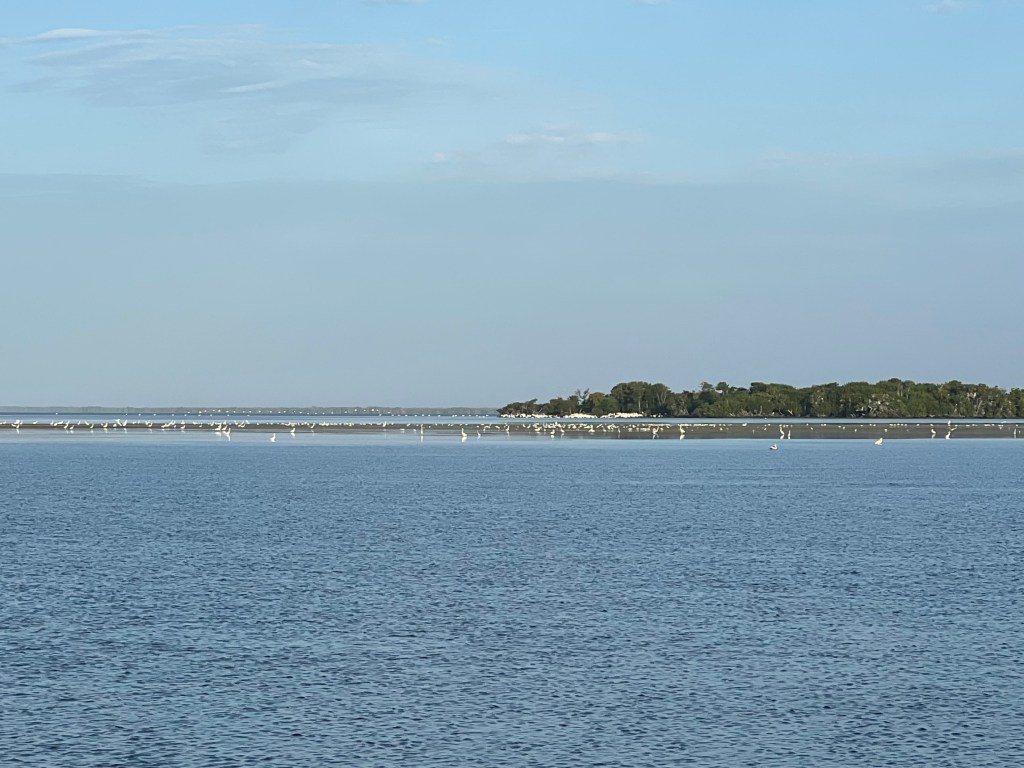
White dots in front of the salt mesa are flamingoes.
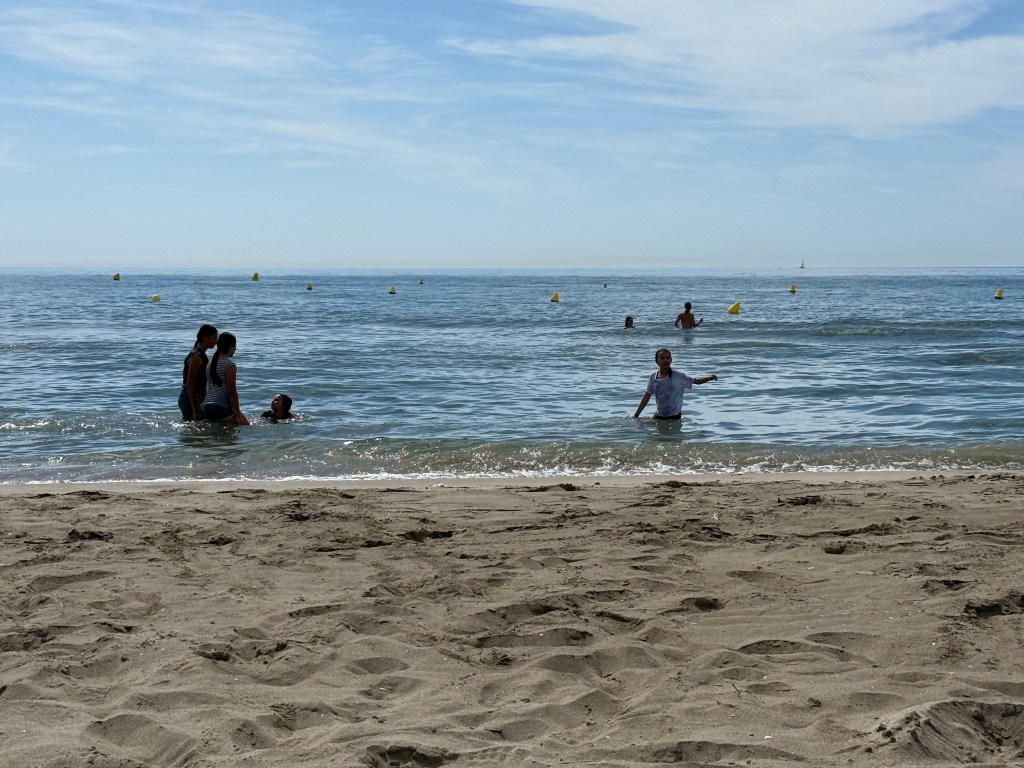
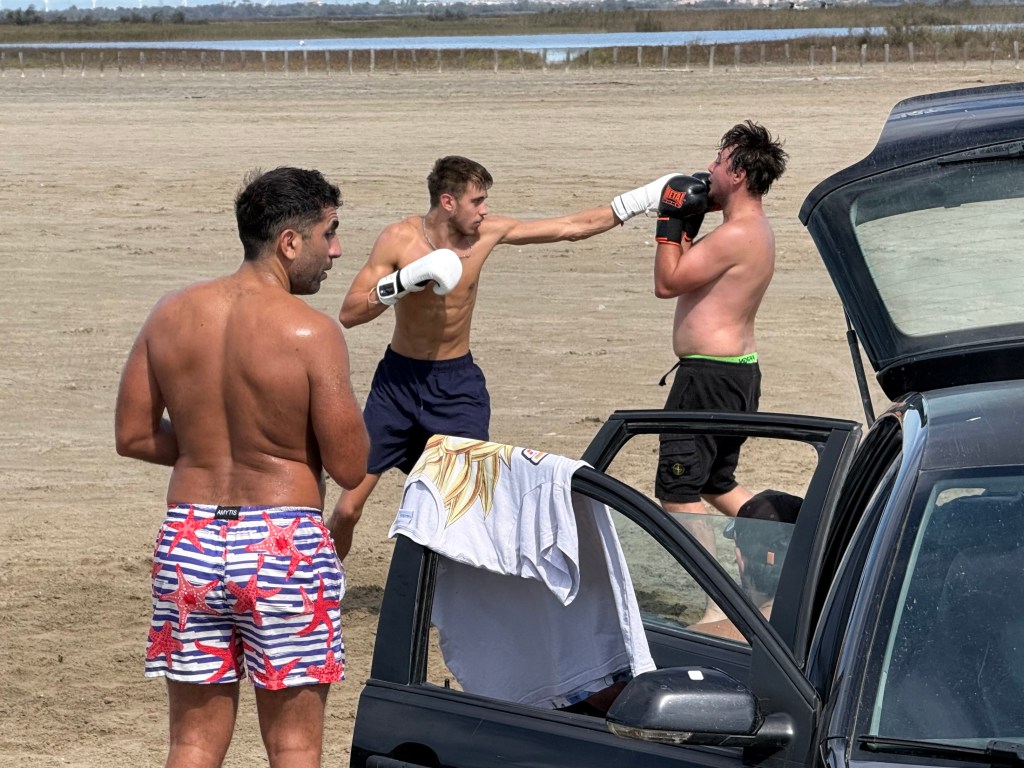
We finally made it to the Mediterranean, where gleeful children splashed in the warm water and sweaty young Frenchmen enjoyed the manly art of hitting each other in the face.
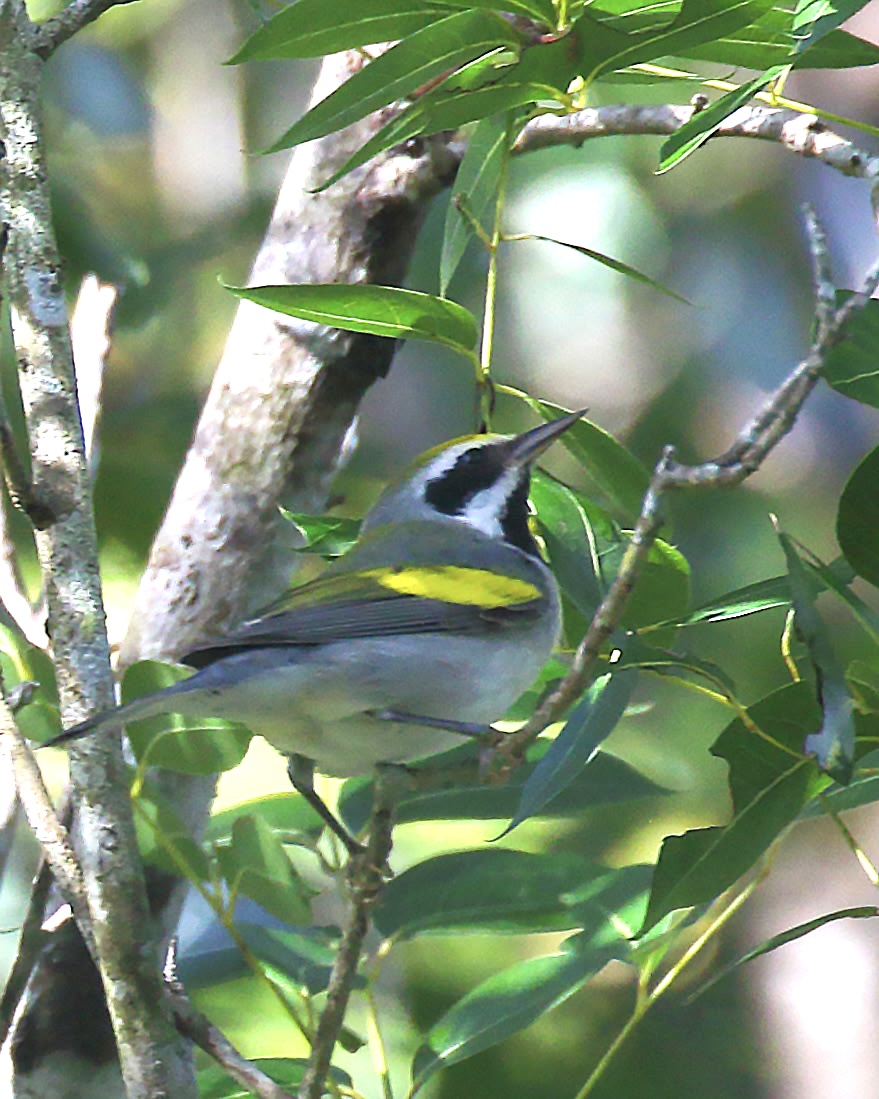
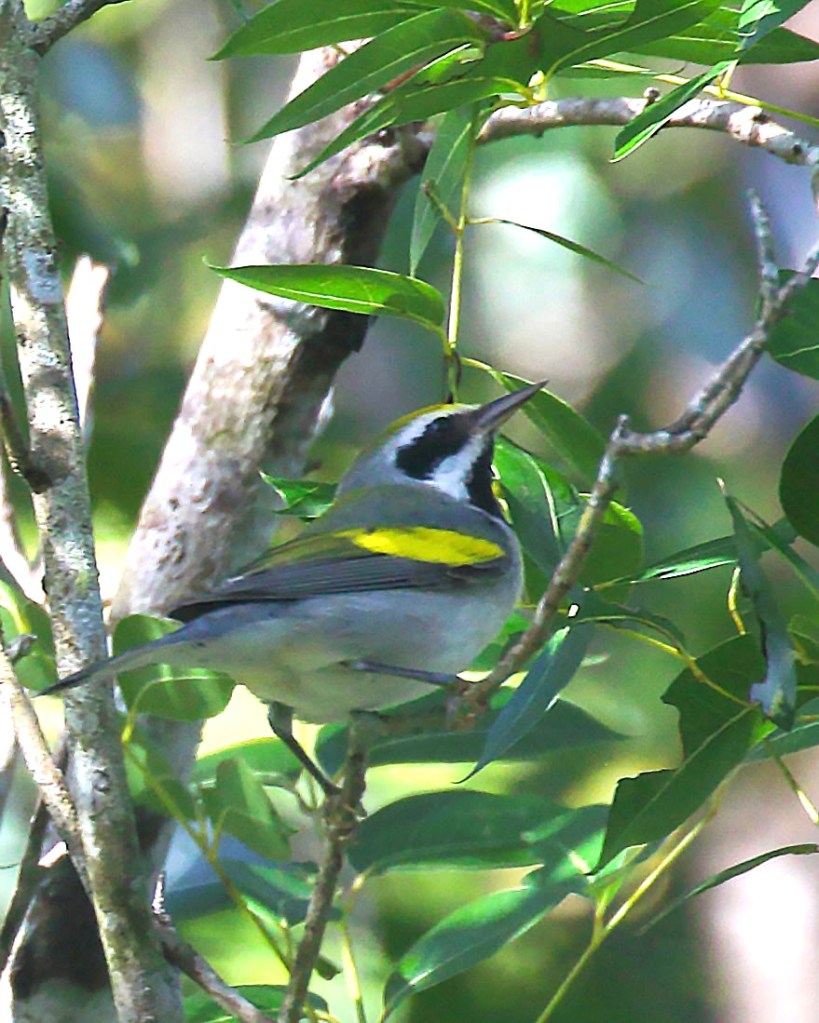
On the morning of 3 October 2025, I spotted a woman alone in the park across the street from our house. A pair of binoculars hung from her neck and she cradled a camera with a long lens. I always say ‘hi’ to birders in the park. Andrea Diamond, bubbling with excitement, told me she’d just spotted a Golden-winged Warbler, the first rare bird she had discovered on her own.
I came to know this elegant songbird during my childhood summers at a wildlife camp in West Virginia, but I had never seen one in Florida. Andrea relocated it quickly and I renewed my acquaintance with an old friend.
Golden-winged Warbler in All American Park, South Miami. Photo by local birder Himanshu Gupta.
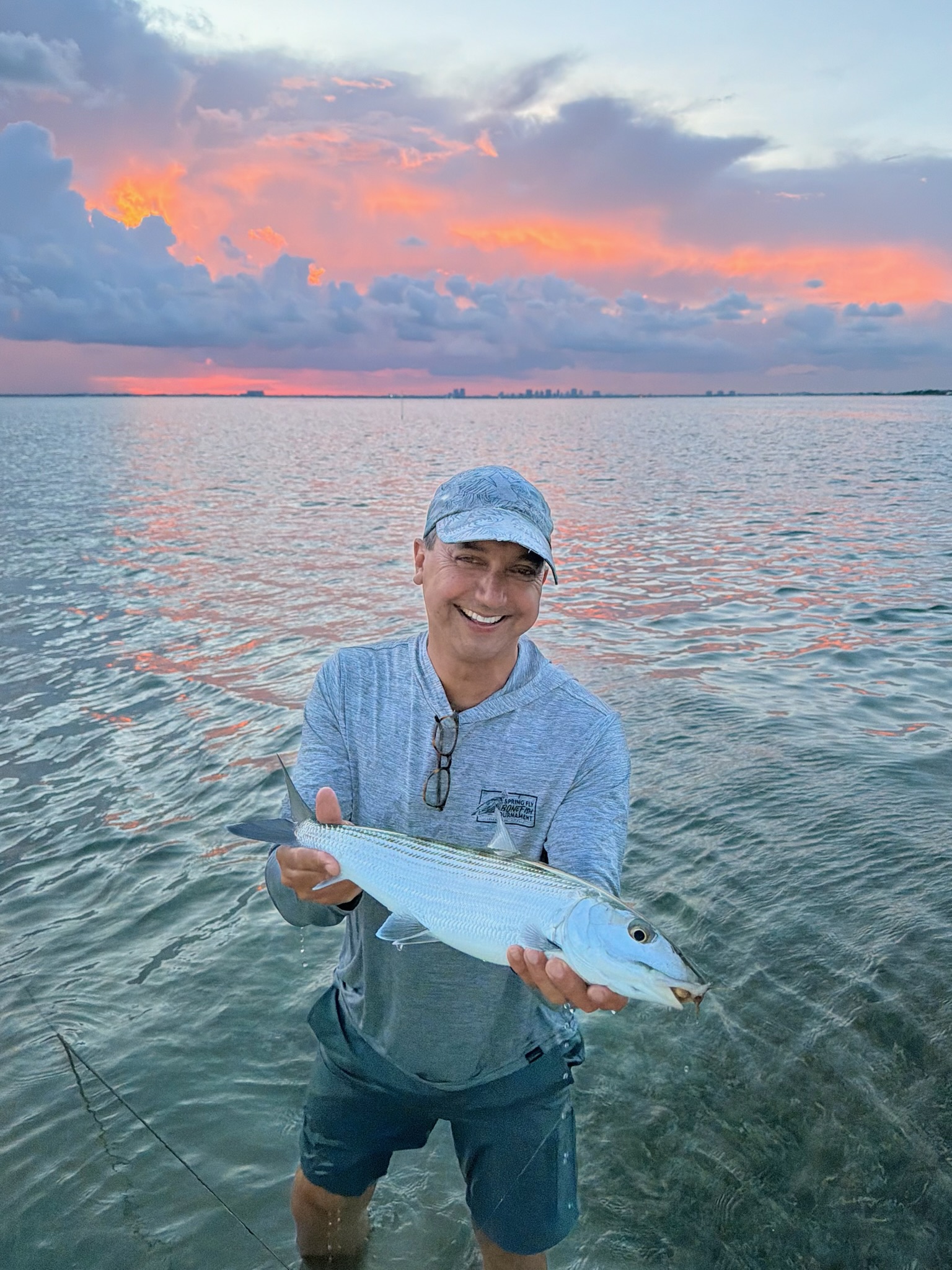
For the next three days, South Florida’s birders flocked to the park and I became the Golden-winged Warbler Ambassador. Juan Valdez, one of the many birders who came to look for the warbler, also turned out to know the native plants. I learned that he works as an art museum curator and…wait… he fly fishes Biscayne Bay. Clearly my kind of guy.
Since then I have entertained Juan through The Eye of the Cormorant and he has delighted me with photos and texts when his fly fishing skills produce a particularly splendid result.
Juan with a bonefish caught on fly in Biscayne Bay.
Fast forward to late June of this year. Juan phones me one evening to say that his friend Andy had booked a week at a fancy fly fishing lodge in the Yucatan, but cannot go. Andy offered the trip to Juan, but Juan can’t go either. In the unlikely event that I am free the second week of August the trip is mine.
Playa Blanca Lodge is the sort of place I read about online in the outfitter catalogs. I drool longingly over the descriptions, check the cost, then exhale and close the webpage. With this gifted package I just had to get myself from Miami to Cancún, cover one night in a hotel, and tip the lodge staff and fishing guides.
I am definitely free the second week in August.
Wow.
Thanks Andy! Thanks Juan!
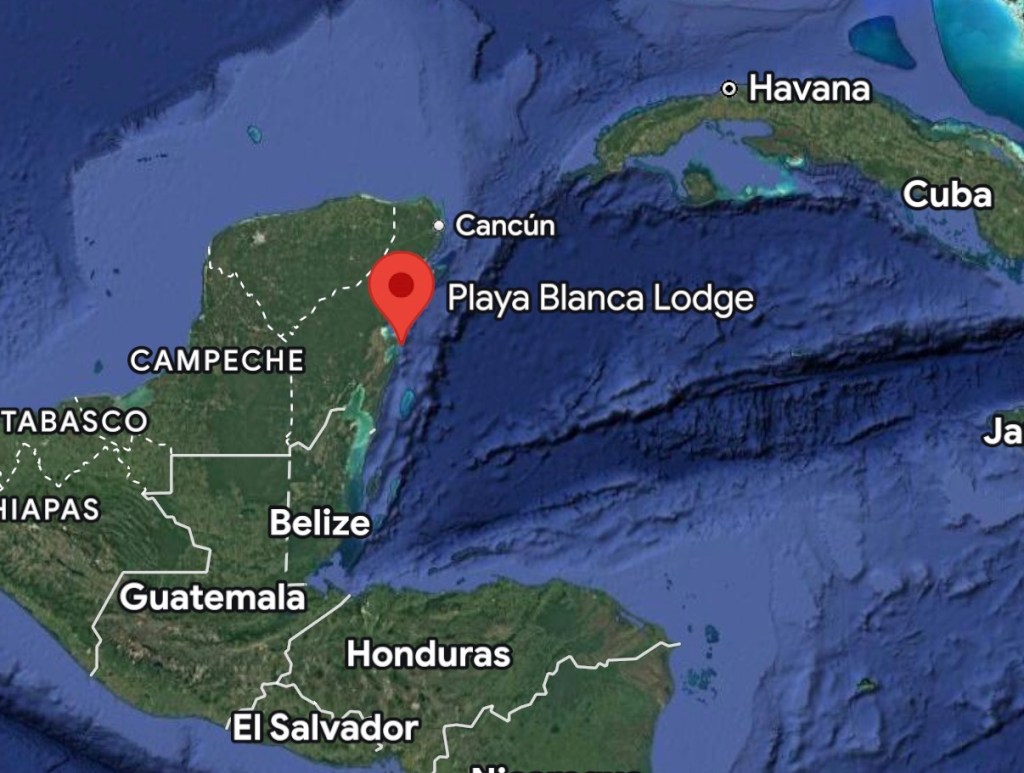
Playa Blanca Lodge is situated in the Sian Ka’an Biosphere Preserve on the Atlantic coast of the Yucatan Peninsula, located here on Google Maps.
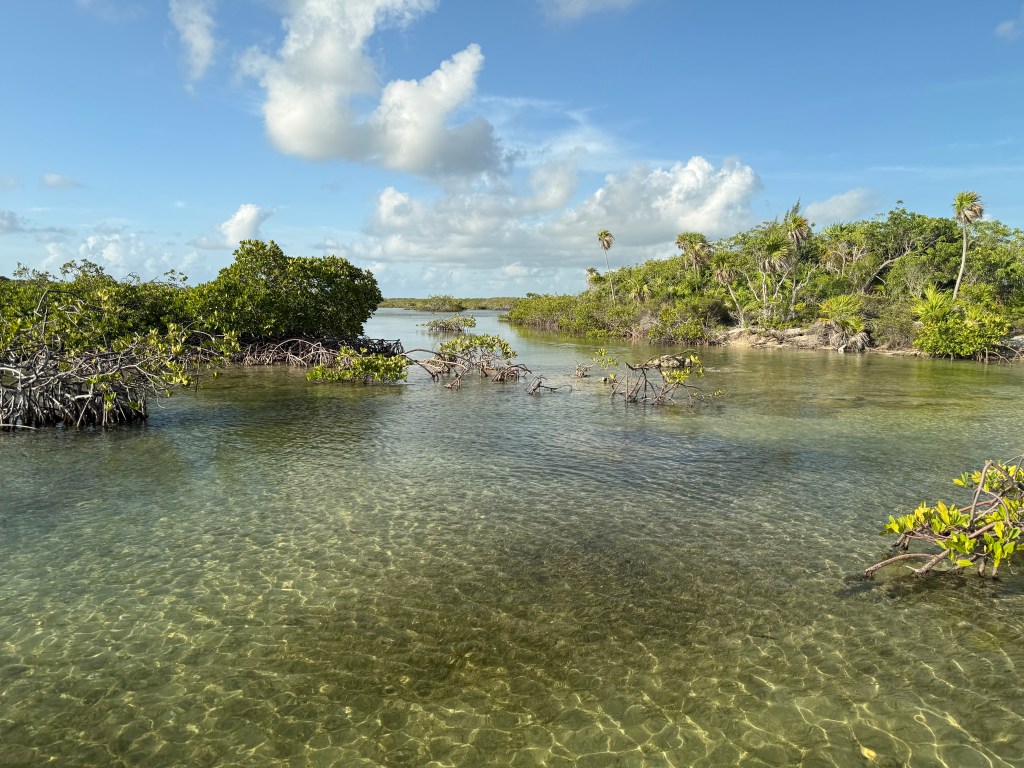
My family visited Sian Ka’an twelve years ago while on vacation in Tulum. The Biosphere Preserve is a cross between the Everglades and the Lower Florida Keys before people made such a mess of things here in Florida. The Mayans, likewise, tried their best to screw up the hydrology of Sian Ka’an, but equipped only with stone tools and manual labor for chipping canals out of the limestone bedrock, and no artificial fertilizer to aid their agriculture, the harms they wrought were far less extensive than here in Florida.
The lower reaches of Sian Ka’an Biosphere include Espiritu Santo Bay, home to a healthy population of Permit(Trachinotus falcatus), a game fish in the jack family. Permit are wary, strong, and fast. The Permit is infamous among fly fishers for its capricious behavior, often rejecting a perfectly delivered fly and, on rare occasion, grabbing a fly from a botched cast. Permit fight hard, and have a large repertoire of escape tactics: scraping off a fly on a coral, crushing or straightening a fly’s hook, or grinding through the nylon leader on the floor of the bay.
A local attorney friend has been trying to catch a Permit for years with no success.
The most accomplished fisherman in my local fishing club writes: “I have presented over 1000 flies to Permit… caught one (winning a tournament in 1988) and been skunked ever since!!! There is no way I haven’t found to lose a hooked Permit!”
Juan recently caught a nice Permit in Biscayne Bay. He is amazing.
With only four years of fly fishing under my belt, I consider Permit to be out of my league. I’ve seen Permit in Biscayne Bay and the Keys, but I’ve never caught one on fly or even set my mind to trying. Last spring I followed a massive Permit in my kayak for half an hour, but despite my advancing as slowly as possible, the Permit would never let me approach closer than 125 feet.
My benefactor, Andy, who gave me his trip reservation, sent me a brief note:
“Catch a permit for me.”
Uh oh.
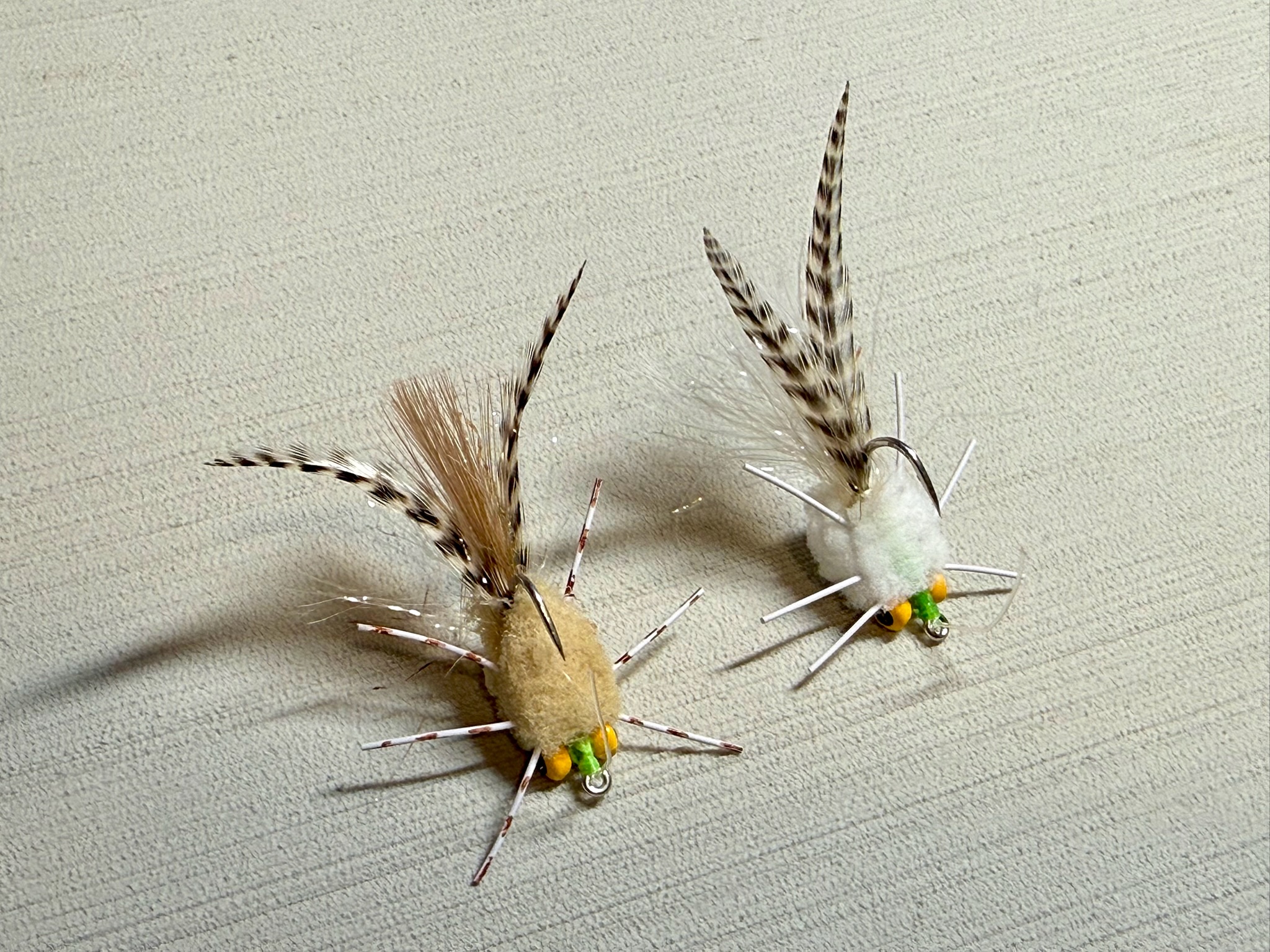
I ordered materials to tie Permit flies, producing an assortment of weighted crabby and shrimpy things in proven patterns recommended by the trip outfitter.
My ties of the Raghead Crab fly.
The weighted crab flies that Permit favor are hard to cast, so I would need serious practice.
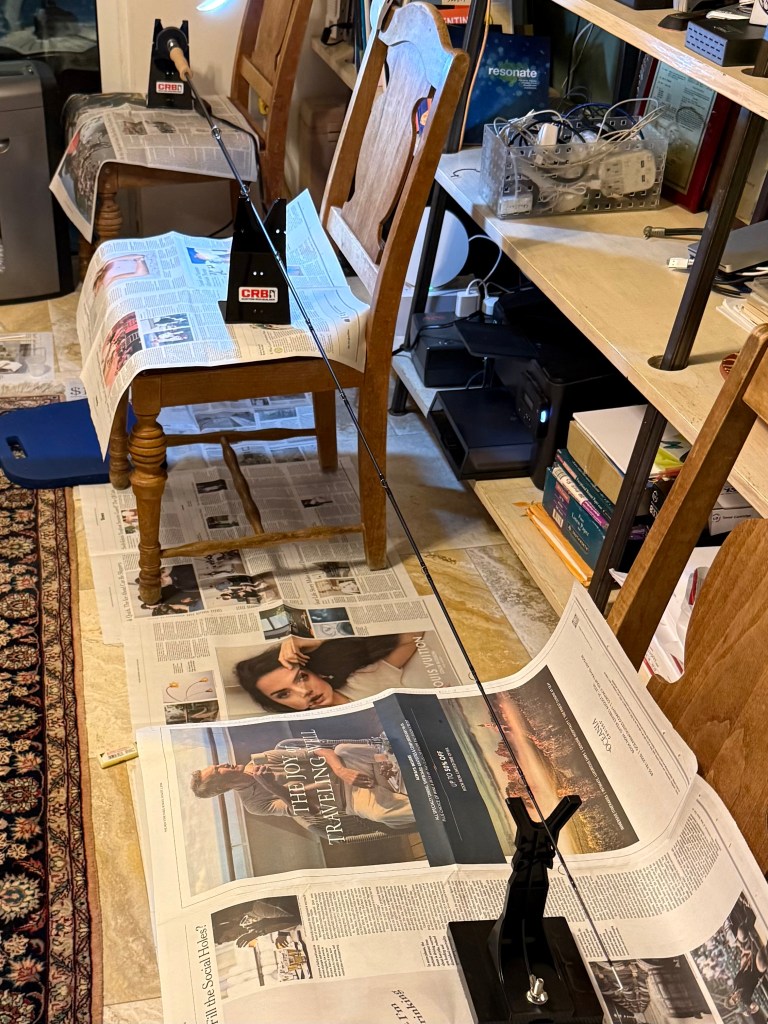
In the vain hope of not trashing my right hand by excessively casting my fast-action 9wt fly rod, I sought a rod of similar weight but with a softer action. The company I picked had 8/9wt rod blanks available, but none assembled in the size I wanted. I had never built out a rod blank before, but I figured why would Al Gore invent the internet if not for instructing a novice such as myself?
Here’s the newly built rod, getting its epoxy coating on a rotating machine that prevents drips.
I left for the airport a few hours after the epoxy dried.
I seem to have sprained my hand, so no fishing report this week. I am taking this setback as a chance to see more of summer’s offerings in our wooded yard in South Miami.
In between icing my hand and tying flies for an impending fly fishing trip to the Sian Ka’an Biosphere in the Yucatan, I have snapped opportune pics of some critters in the yard. An iPhone in the pocket favors providence.
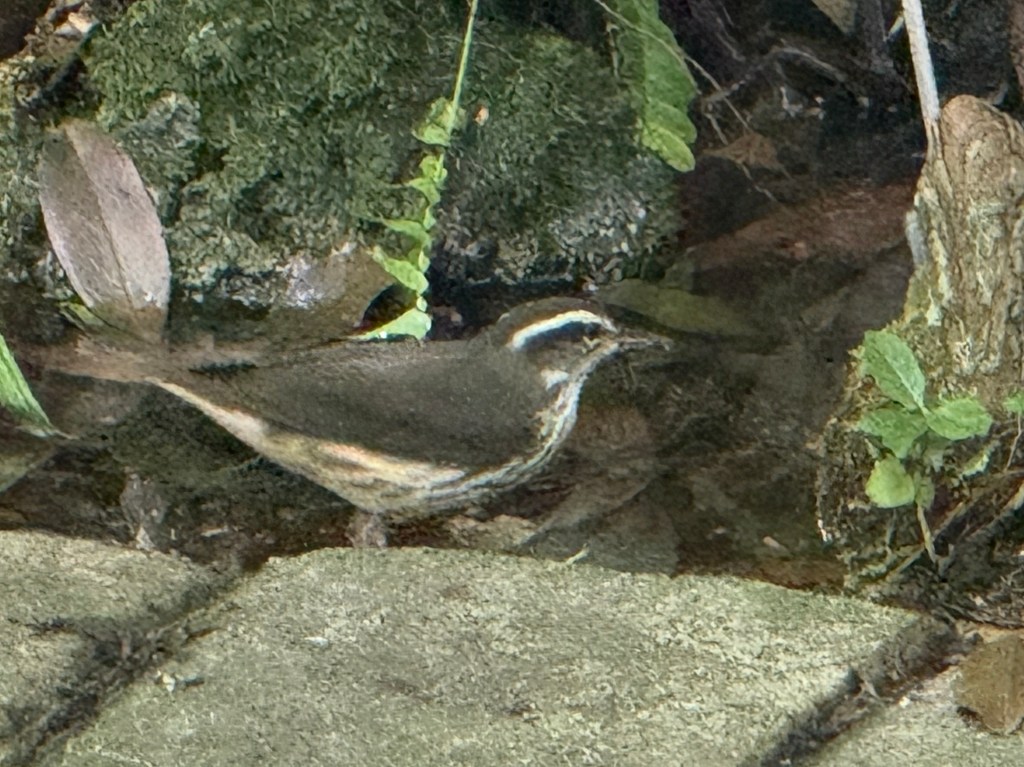
Louisiana Waterthrush (Parkesia moticilla)
The first fall migrant warbler in our yard is always a Louisiana Waterthrush, on their way south from breeding grounds along the Appalachians’ streams. The first waterthrush of this fall’s migration appeared during breakfast today, 30 July, alerting me with its characteristically loud and bright “chip” call. It landed on a small table by the grill, then flitted down to the water’s edge to hunt for bugs, too distant for a photo. I got this grainy shot (shade + high digital magnification) later in the morning through the glass door next to my desk. Waterthrushes constantly bob their back-ends up and down, which appears here as blur.
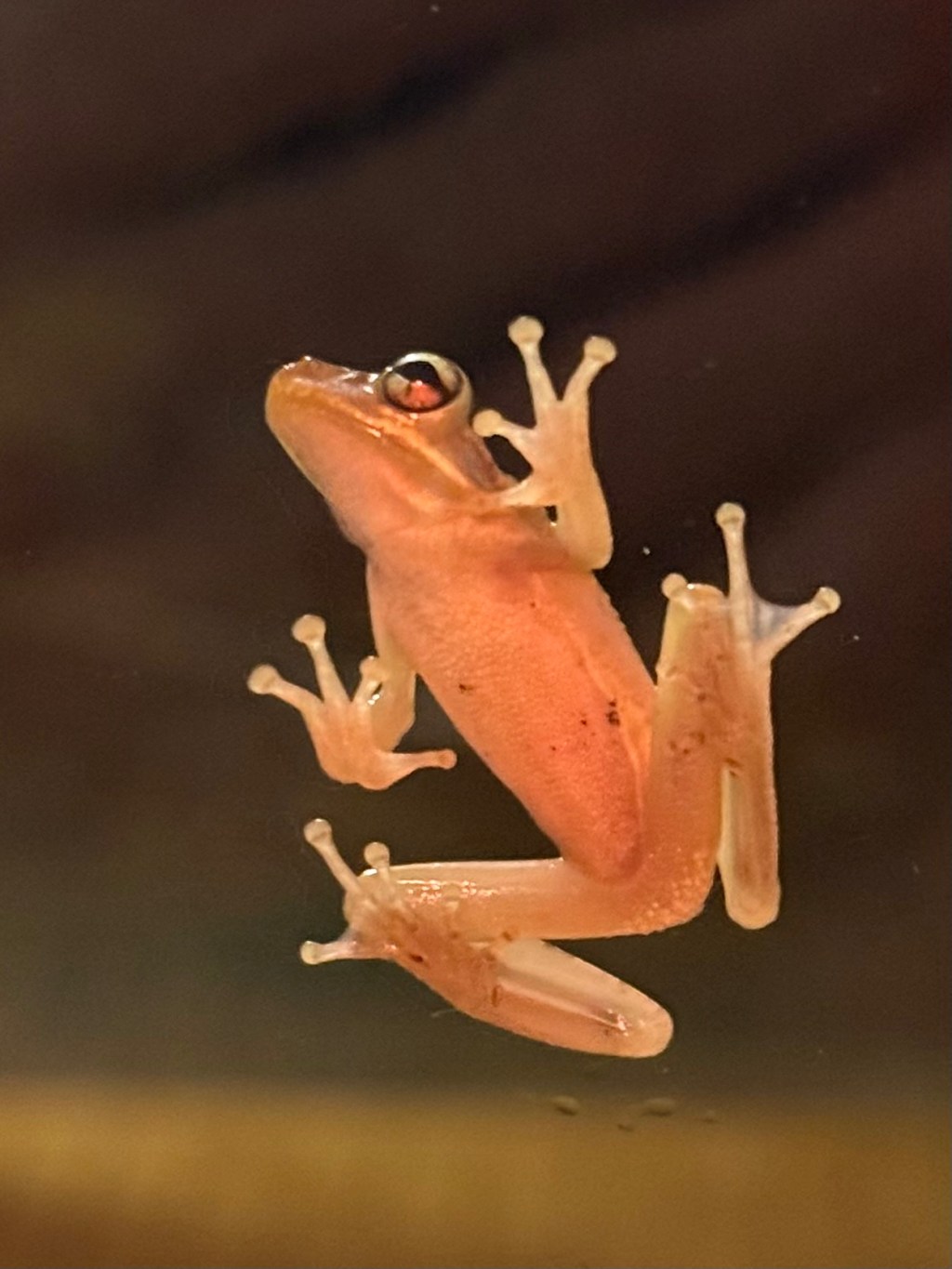
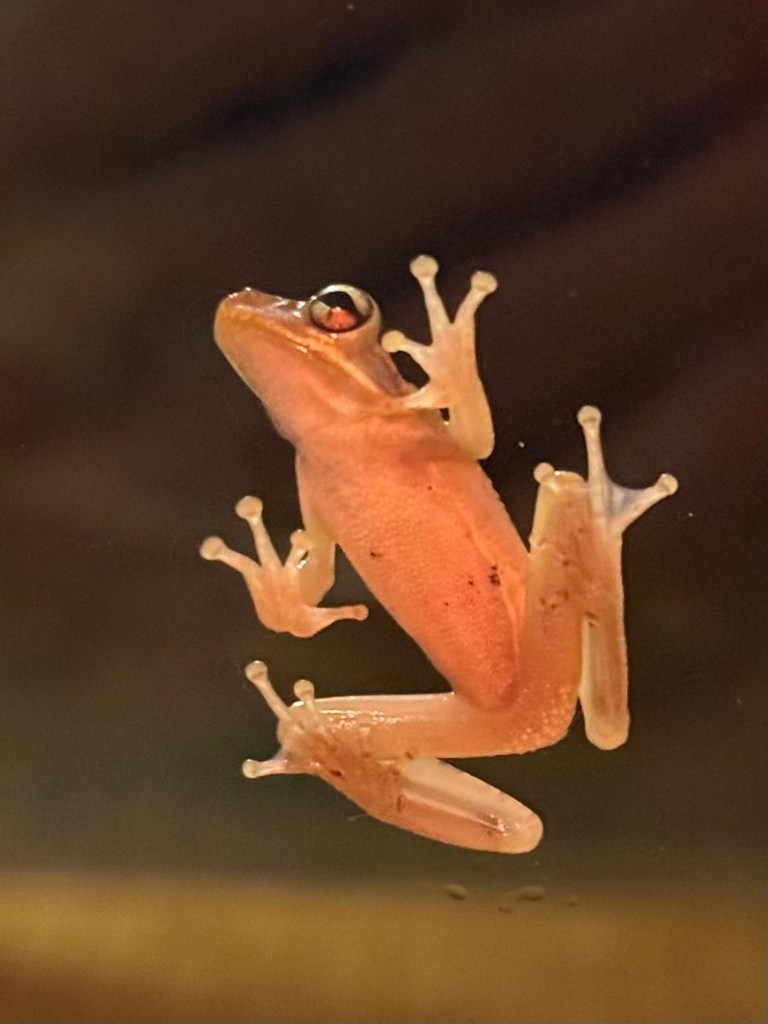
Cuban Tree Frog (Osteopilus septentrionalis).
A Cuban Tree Frog was spoinking around on the glass in our front door one evening, allowing this photo, taken from inside the house. These big tree frogs ate all the native tree frogs in the suburbs, so they’re all we’ve got.
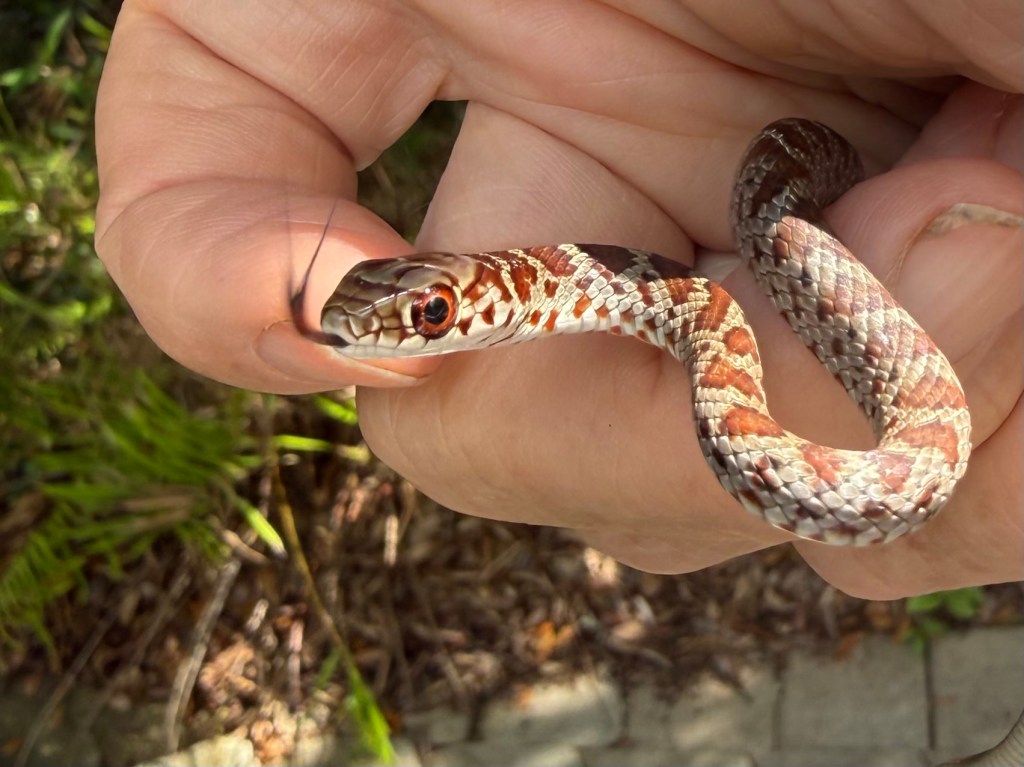
A baby Florida Racer aka Southern Black Racer (Coluber constrictor priapus).
I found this sweetie on the front porch hunting bugs and baby lizards. Wikipedia accurately describes its behavior: “Members of this species generally do not tolerate handling – even after months in captivity – and typically strike and flail wildly every time they are handled, often defecating a foul-smelling musk, a common defense against predators in snakes.” She chewed on my finger and made a stink, but since neither defense had any deterrent effect, she settled down enough to let me snap a photo, left-handed.
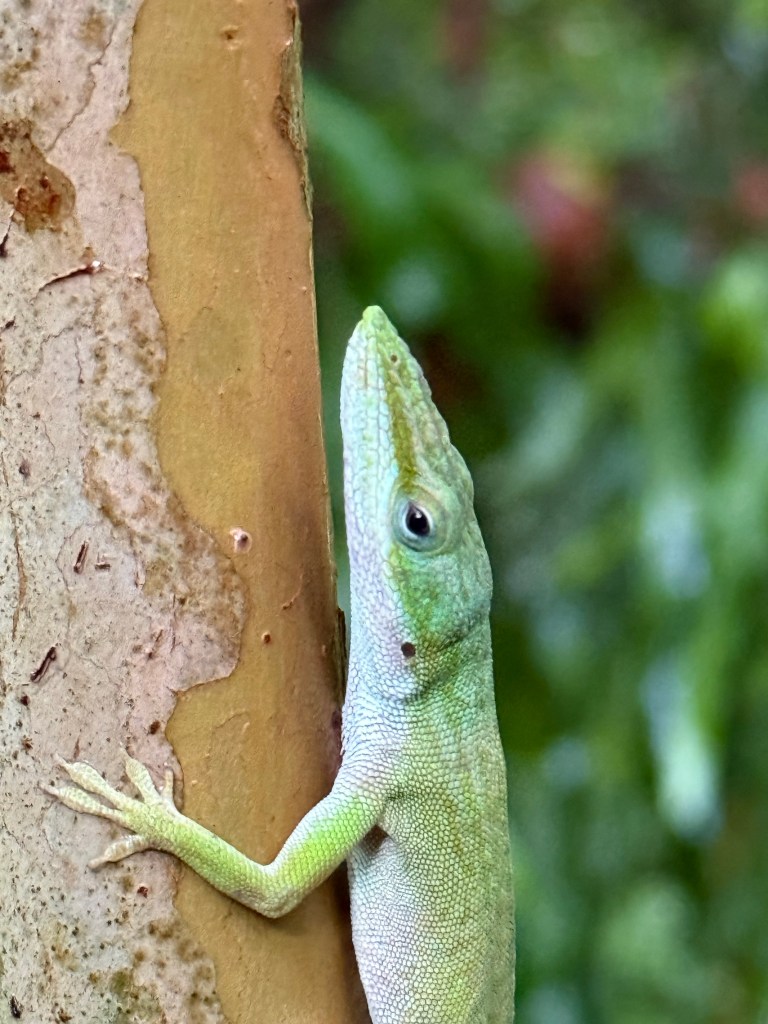
Green Anole (Anolis carolinensis x porcatus)
Green Anoles change color between green and brown. The Green Anoles in Miami are all hybrids between the Carolina Anole and its ancestor, the Cuban Green Anole. It coexists with the other invasive exotic anoles by holding a unique niche in the trees, often high up.
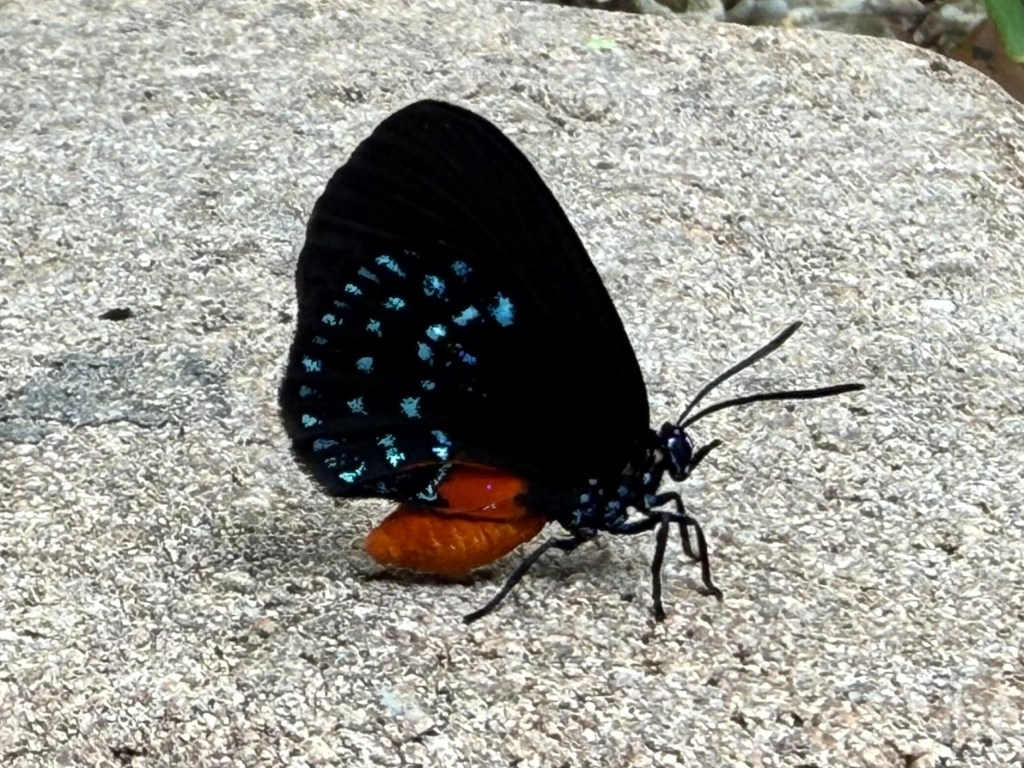
Atala Butterfly (Eumaeus atala).
Thought to be extinct, Atalas were saved by local naturalist Roger Hammer, who stumbled onto an unexpected pocket of survivors. Roger surreptitiously introduced their larvae into the cycad collection at Fairchild Tropical Botanic Garden, to the consternation of Fairchild’s Curator of Cycads. Atalas recovered and now lay eggs on the native cycad species, the Coontie, growing in our front yard. The larvae chew our lush Coonties to a tangle of brown stems while producing a cloud of small, colorful butterflies. The Coontie stores reserves in a big, starchy root and grows back.
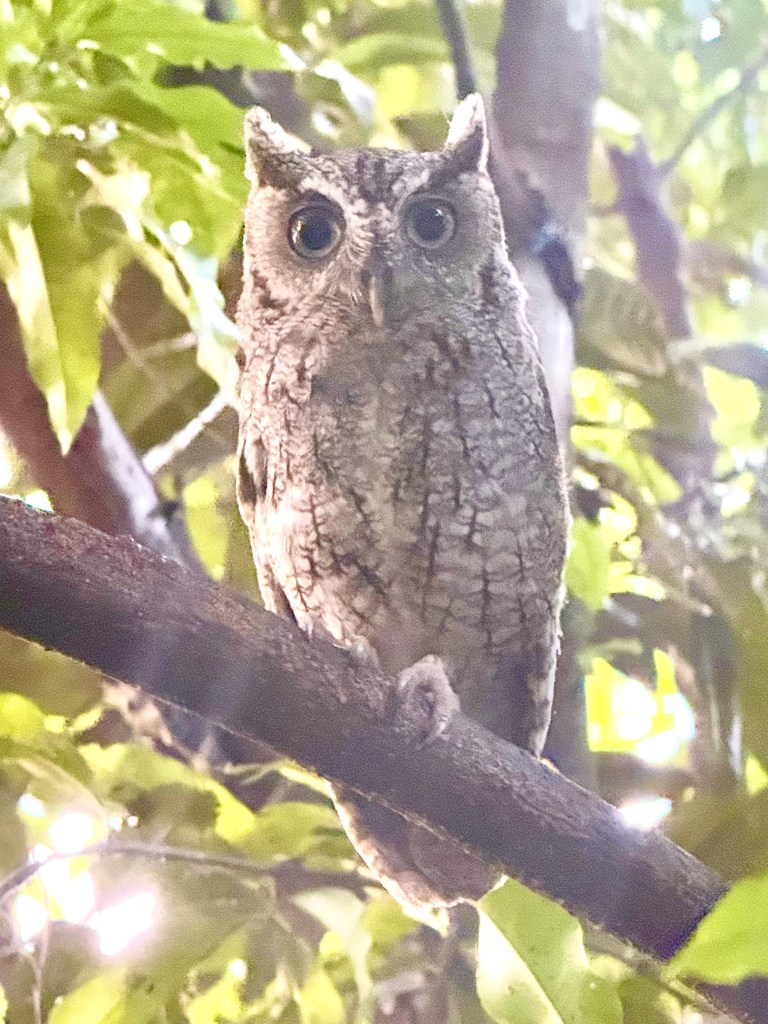
Eastern Screech Owl (Megascops asio).
Mr. Screech Owl revealed his location by singing in the late afternoon when I ventured behind a tree to, um, water the plants. The lighting was all wrong, but it kind of worked anyway – such is the chance encounter.
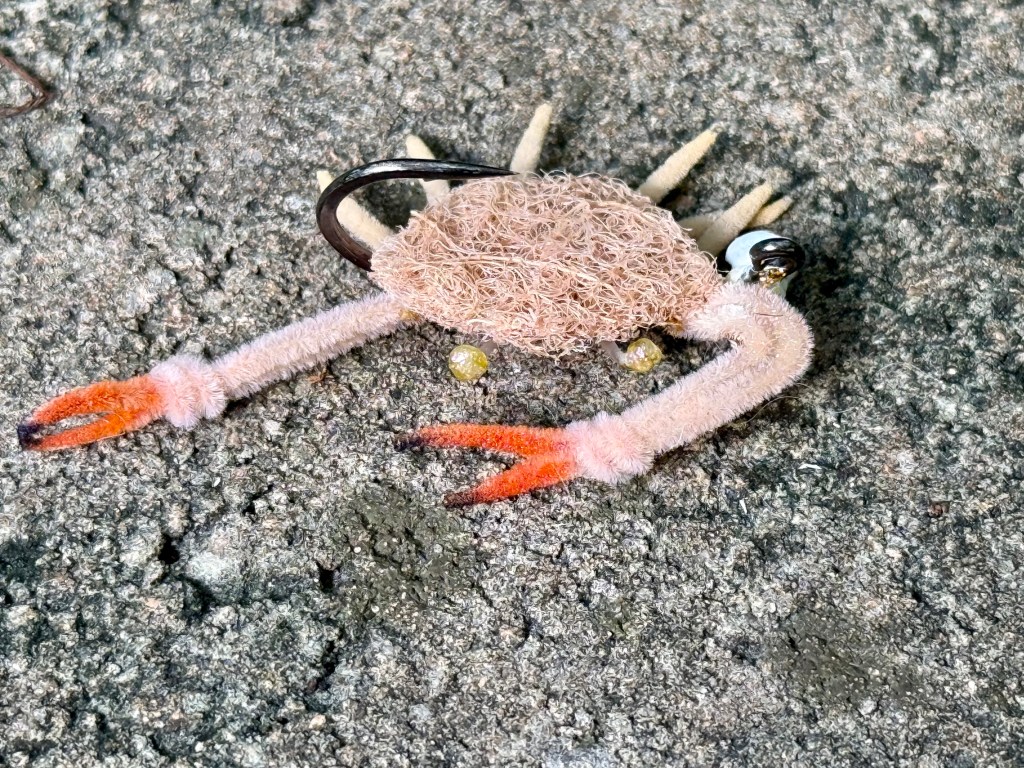
Crab Fly
I’ve been tying a variety of crabby-looking flies in the hopes of fooling a Permit, a big tropical fish that eats crabs but which is notoriously wary, persnickety, and difficult to catch on fly. This fly is a mix of patterns that I adapted from various tyers. The body is cut from a coconut fiber kitchen scrub pad, the legs & claws I made from a fuzzy cord called “ultra chenille”, and the eyes I made from nylon monofilament and sparkly nail polish.
I’ve been grappling with a multi-way conflict: (1) trying shake the “forever cold” while (2) healing a torn rotator cuff muscle (supraspinatus) in my fly casting arm, and (3) enjoying every nice day I can on the water with a fly rod and binoculars. At least I don’t have to grade papers.
A cold front reached South Florida, knocking down the mosquitoes and moving sharks away from the shallows. The Everglades mangrove flats beckoned me southwards.
Entrance to the flats.
One shallow flat in particular draws me to watch shorebirds and chase game fish.
Birds gather on the falling tide. Snook and Redfish forage near that edge.
To get the best experience, you have to get the tides right. Depending on the moon and tide phases, the area can be 16 square miles of water (birds wait in the trees and fish are everywhere), 15 square miles of exposed mud (birds dispersed everywhere and fish are concentrated in the channels with the sharks), or something in between (birds and fish both concentrated on the edge of the tide). If the wind comes up, water might blow onto or off the flat, superseding the tidal prediction.
Several two mile trails lead to the edge of the flat. When my late colleague George Dalrymple took his zoology class down the Snake Bight Trail, one student had to be carried out after she fainted from the sheer horror of the Black Salt Marsh Mosquitoes. I found that pedaling my bicycle down the trail lets me keep ahead of the swarm. Just don’t stop! But the best access is in a shallow-draft boat, a kayak, canoe, or technical poling skiff.
Coming by boat, you have access to more of the flat and can approach the edge of the tide where birds and fish are concentrated. However, it’s easy to get trapped by the falling tide, particularly when distracted by fish or shorebirds, both of which follow the rapidly moving tidal edge. If Poseidon empties the bathtub while you are far from a channel, there’s no walking out. The deep, sucking mud steals your sandals before eating you whole.
People who get stuck sometimes phone the Park dispatch office. The ranger explains:“Yes, we see you out there, but we can’t get to you. Unless it’s an emergency and you want to pay for a helicopter, you are going to sit there until the tide comes back in.” You might spend up to eight hours waiting for the next high tide to free your boat. Hope you brought extra water and a granola bar, and good luck with the lightning.
I have willingly allowed myself get stranded at the bottom of the outgoing tide while watching shorebirds, chasing fish, or watching shorebirds chase fish. I eat lunch then escape when the tide returns to float my boat. The show can be worth the wait.
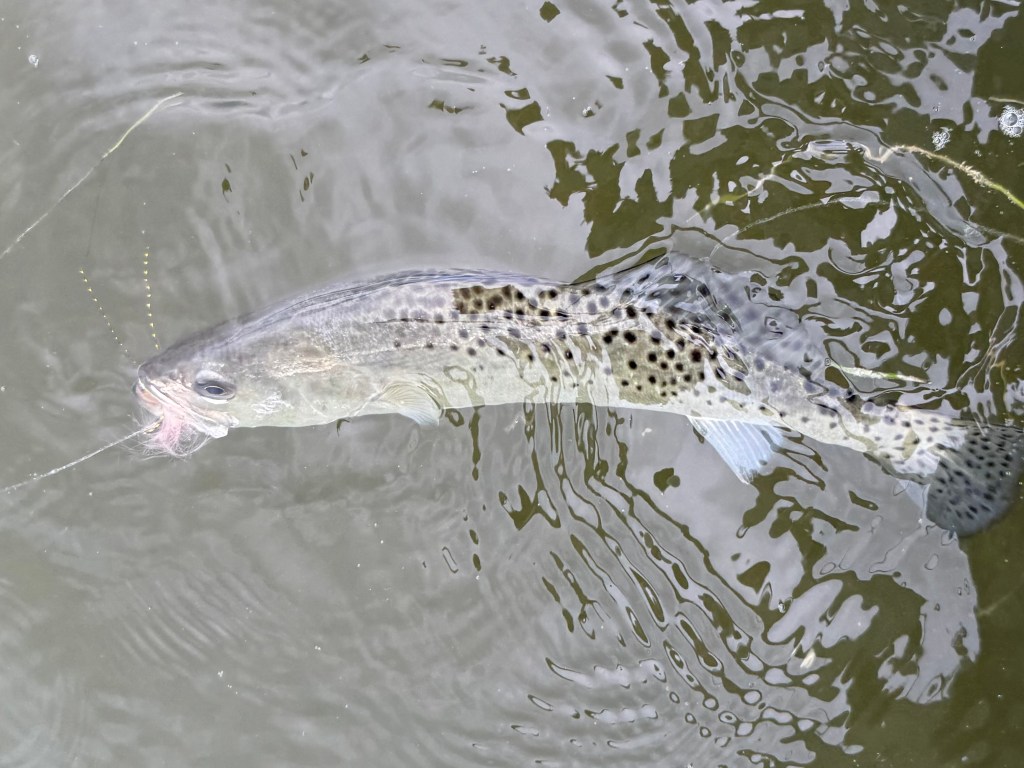
Tricolored HeronBlack-necked StiltSpeckled Seatrout that took my fly.
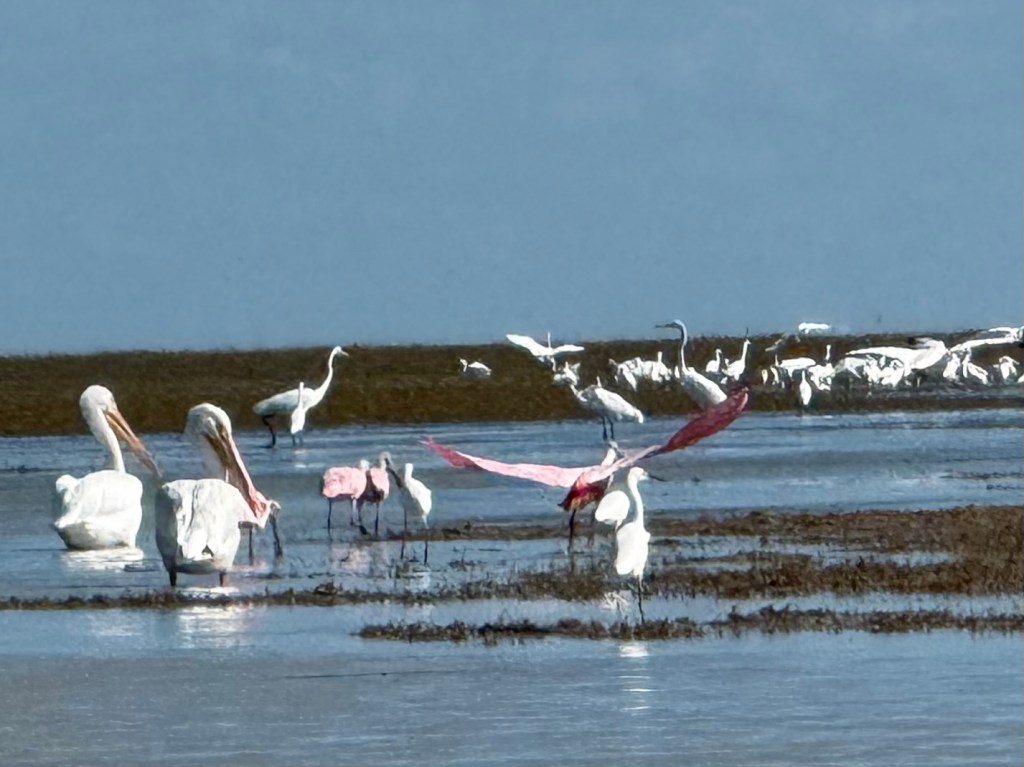
The low tide can bring spectacular birding as it did last week when baitfish and birds filled the runouts along one of the main channels. The flats were covered with winter waterbirds: White Pelicans, Black Skimmers, all the long-legged waders, Marbled Godwits, Short-billed Dowitchers, Wilson’s Plovers, and assorted “peeps”.
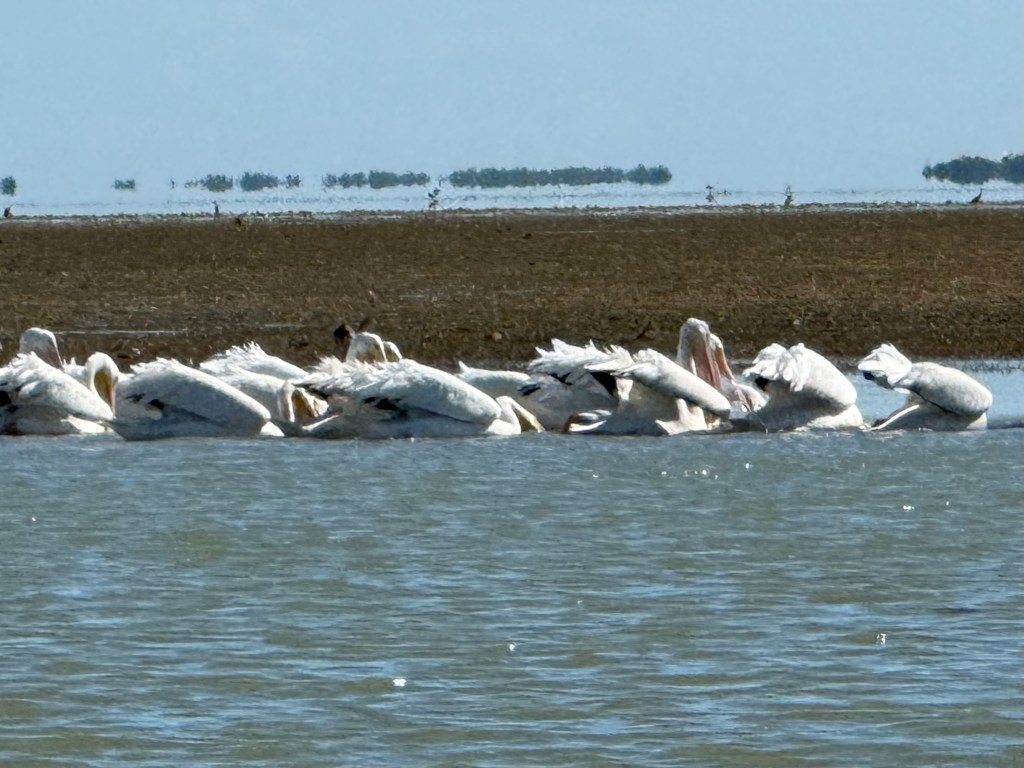
White Pelicans fishing cooperatively for mullet.Black Skimmers leaving the flat as the tide rises.White Pelicans, Great White Herons, Great Egrets, Roseate Spoonbills, Snowy Egrets, all fishing the shallow run-out at dead low tide.
When the high tide pushes birds off the flats, some regroup on the highest shorelines, while others settle into the mangrove trees.
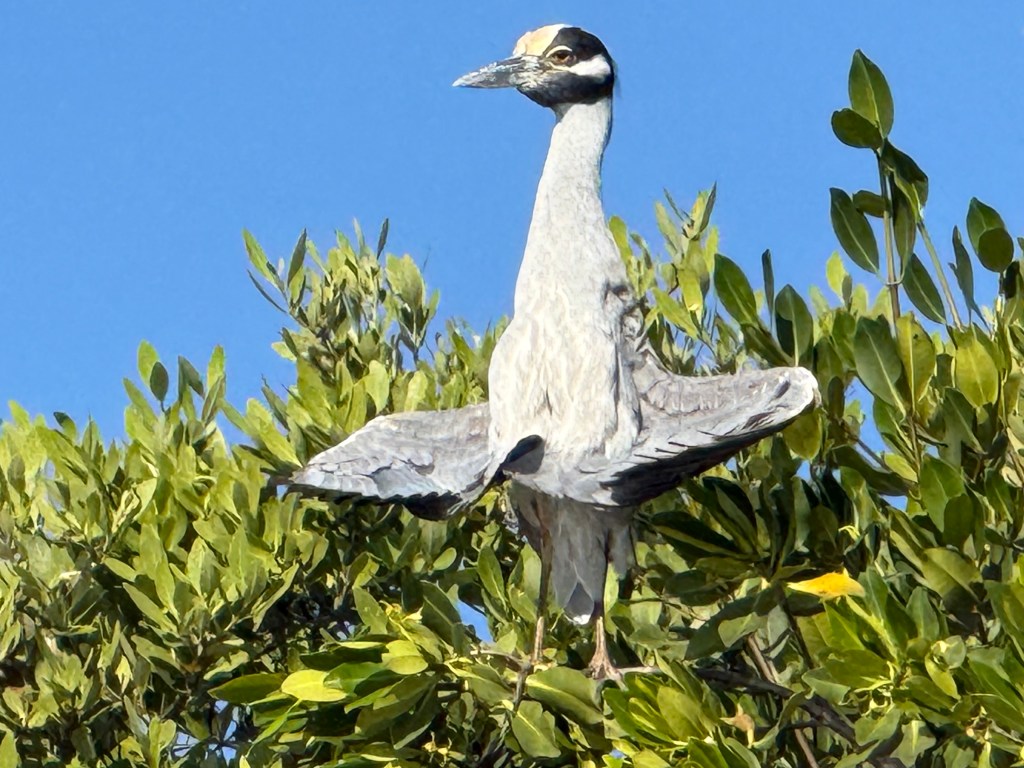
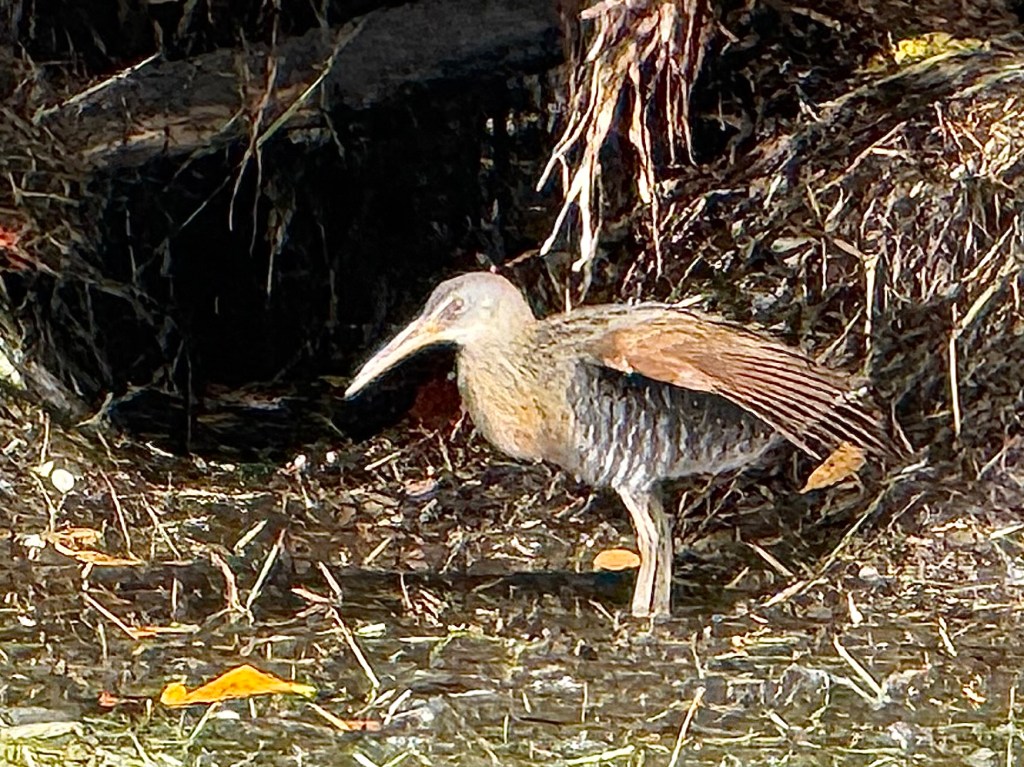
Reddish Egret takes refuge from the high tide on a mangrove island.Yellow-crowned Night heron practices the Angeli Mudra yoga pose.Roseate Spoonbill looks down to assess the water level while waiting for the tide to recede.A Mangrove Clapper Rail skulks through the matted seagrass caught in the mangrove roots.
A couple of days prior, my friend Jay Levine had caught and released 30 Snook on fly in a channel and had zero shark hassles. But when I arrived, the water had rewarmed, the sharks were returning, and the Snook were making themselves scarce. I caught and released a couple of Snook safely but an unseen shark took the third one and I called it quits.
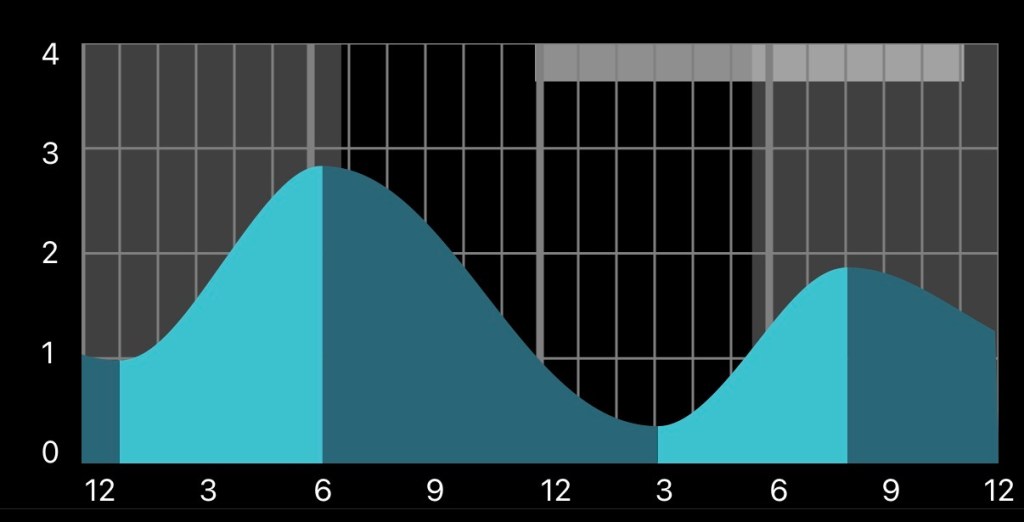
Four days later, my fishing friend Jeremy Nawyn asked me to join him kayak fishing this same flat once again. At first I declined, but then I took a look at the tide chart:
Tide chart for Flamingo on 26 Nov 2025. The black band in the middle is daylight and the gray bar at the top is the moon. The tide on the flat we are fishing is delayed by an hour. It will fall for eight hours, from 7:45 am until 4 pm .
I normally fish this flat by motorized skiff because it’s so exhausting to exit by kayak. If you fish the rising tide (safest) you must paddle back against the fast incoming tidal current to escape, but a long falling tide like this one is a virtual water taxi service. As a lagniappe, the wind would be at our backs coming out. I texted Jeremy that the tide chart had changed my mind. I was in.
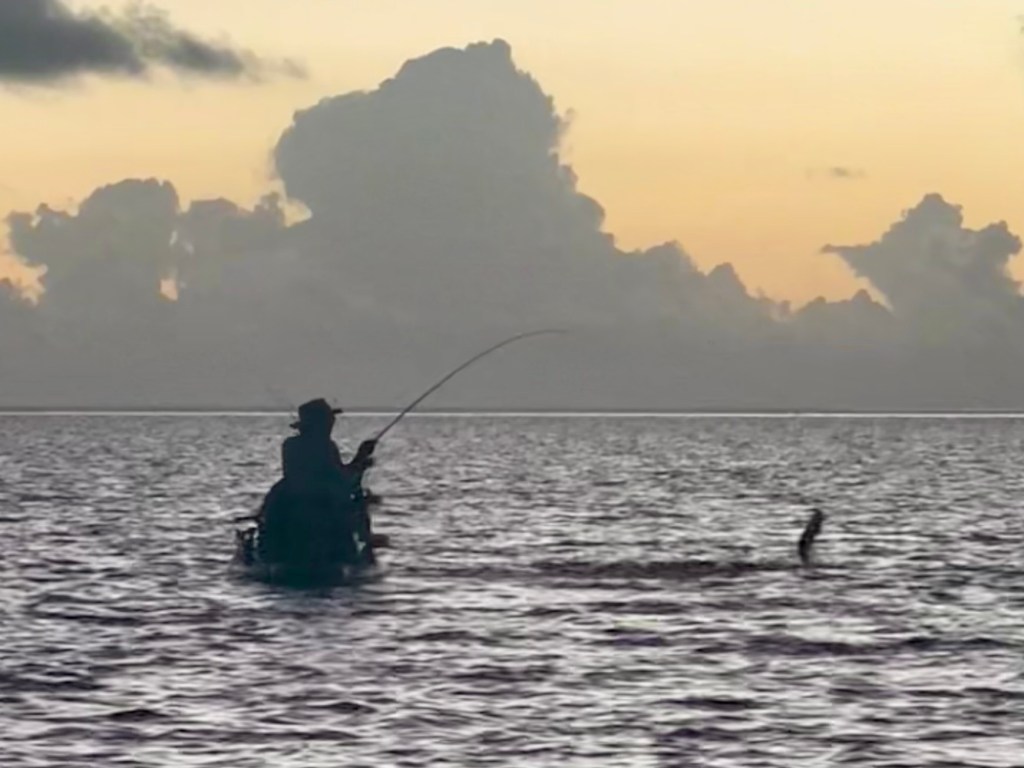
Jeremy’s proposal was to head out in the dark before dawn and ride the incoming tide up a narrow unmarked channel on the edge of the flat, then ride the outgoing tide back toward the marina with the wind at our backs. We faced little risk of getting stranded if we stayed in or near the narrow channel, and would not have to fight the tides or winds to escape.
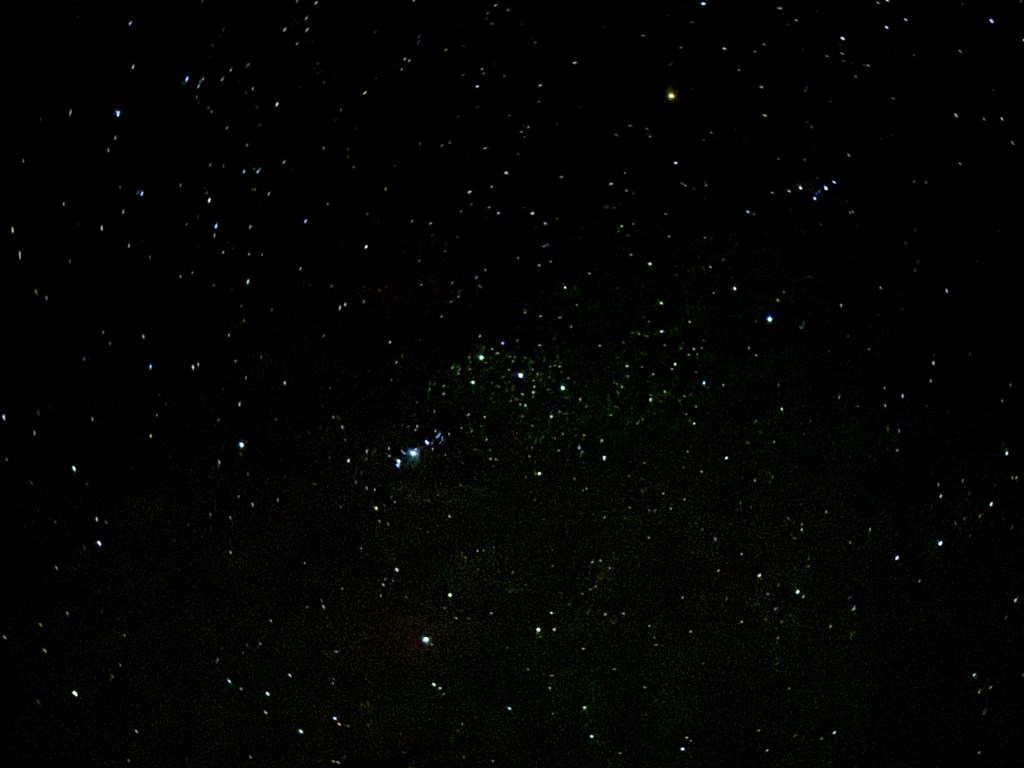
I arrived early to enjoy the starry moonless sky.
Orion.
I rigged my kayak while the resident Barred Owl hooted:“Who cooks for you? Who cooks for you-all?”
Jeremy arrived at 5:30 am with his kayak mostly rigged in the back of his pickup truck. We were on the water by 5:45 am, 70 minutes before sunrise.
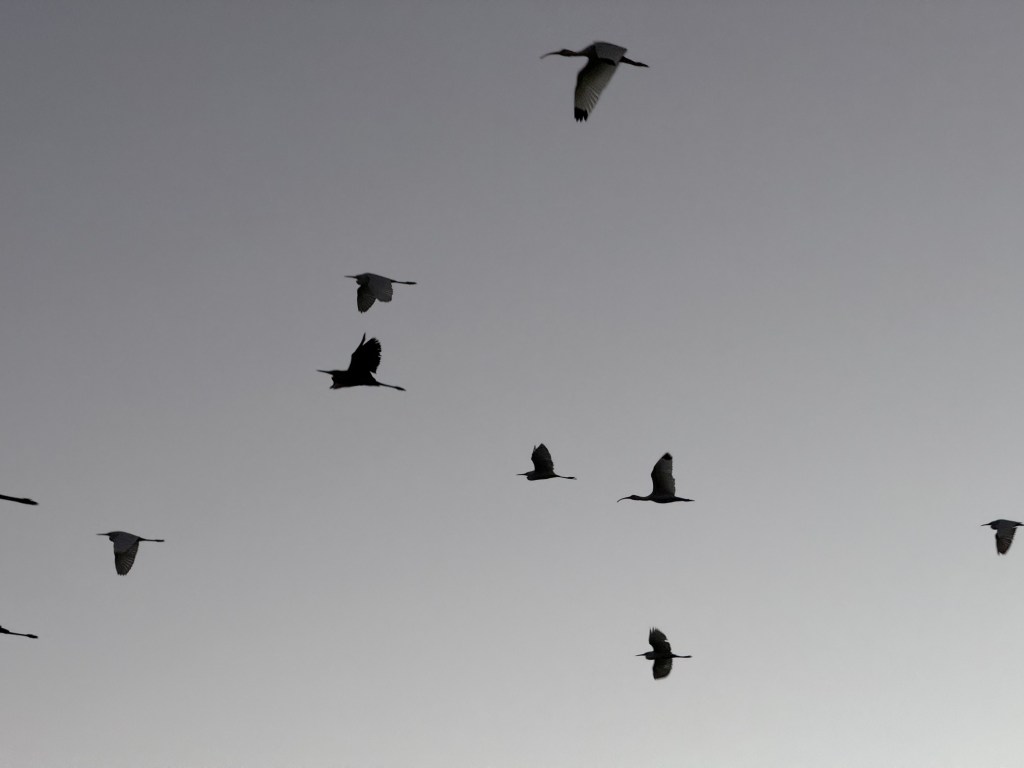
Great Egrets and White Ibis leaving their roosts. White birds look black in the pre-dawn light.Jeremy in the lead. One of his teenage kids sometimes joins us, but not if we’re going out this early.
Our fishing strategy was to paddle the narrow channel and cast toward the mangrove roots on shore where the predatory fish typically forage for crabs and small fish when the tide is up.
I hooked a nice Snook near the mangroves then pedaled my kayak hellbent-for-leather onto the shallow flat, grounding the Hobie’s pedal flippers on the mud before stopping to work the fish to my landing net for a quick measurement and release.
Phil with Snook in shallow water. Photo by Jeremy Nawyn
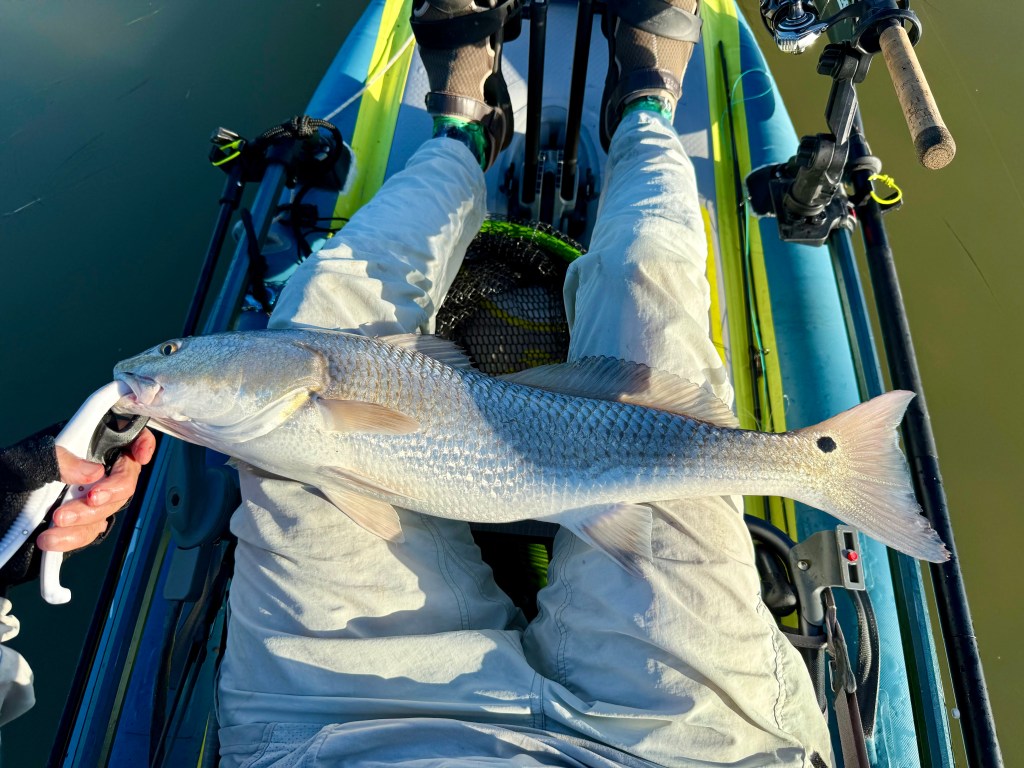
Grounding the kayak on the flat might seem like an odd thing to do on purpose, but it prevents unseen sharks from popping up from below and grabbing the fish on my line. A Snook or Redfish hides handily in a foot of water, but a Lemon Shark or Bull Shark is conspicuous. If a shark comes for my fish in super-skinny water, I can see its approach, open the reel, and let the fish run. My trick worked this morning with a handsome Snook and a chunky Redfish.
Snook, 24″.Redfish, 24.5″
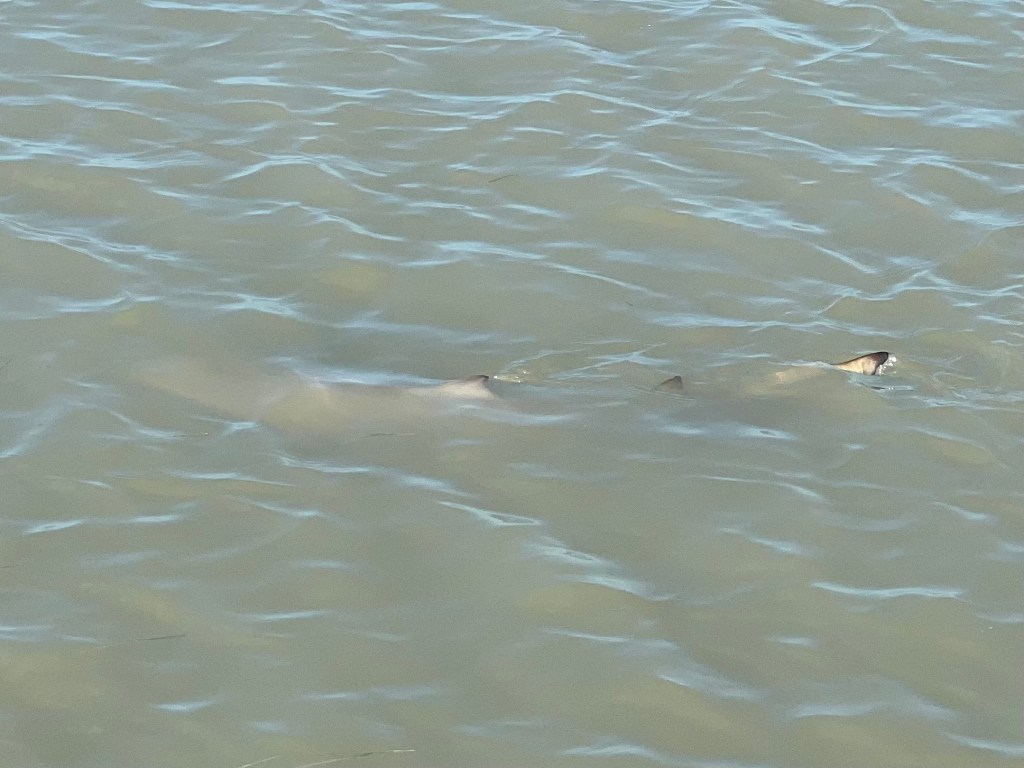
A Lemon Shark circled my kayak looking for my redfish as I hefted it in my landing net from one side of the kayak to the other.
Pesky Lemon Shark circling the kayak.
Enough already. I pedaled the kayak right at the shark to chase it away.
Typical of this flat, the water was opaque with sediment. One could only make out detail in the top 6”, which made it hard to spot fish. At the farthest extent of the tiny channel, a three-foot tarpon swam under my kayak, which I only saw because the water was just a foot deep… and dropping. Time to turn around.
I stopped in at a favorite cove on the way back, wherein I often find Snook and Tarpon. A four foot Lemon Shark had gotten in ahead of me and was working over the cove, chasing all the fish up the mangrove creek – definitely time to head back. As cool as they are to see up close, I don’t want sharks hanging around my boat jonesing for my fish. Lemon Sharks at Flamingo have bitten the hands of several fishermen in the past couple of years and even dragged one careless lad overboard and into the water (YouTube video).
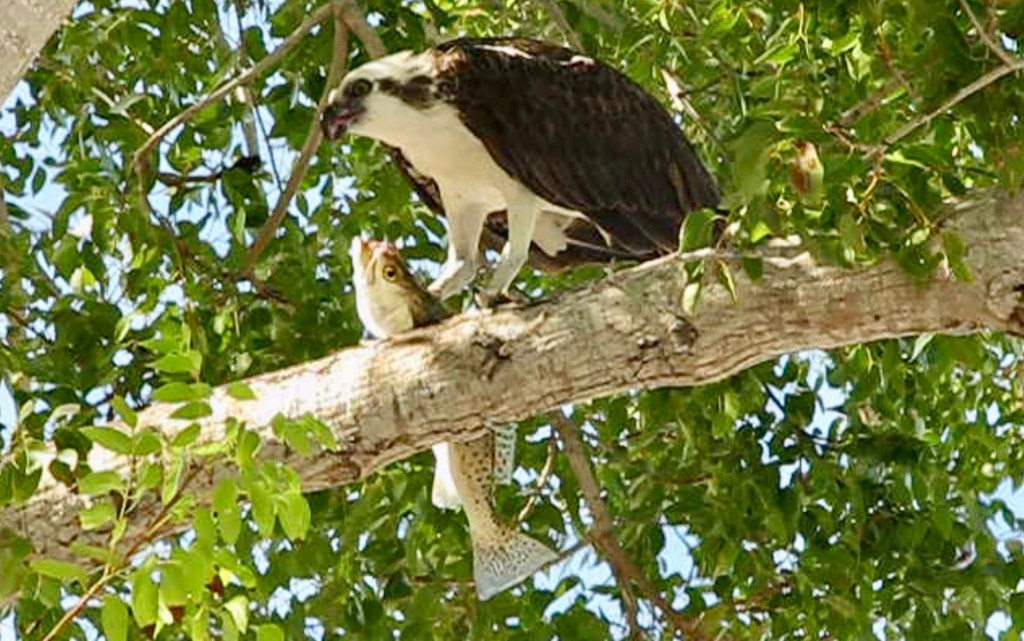
I paused to watch eight Ospreys circle a mullet school, diving in succession, snatching hapless fish, and landing in the trees on shore to enjoy a sashimi breakfast.
This lucky Osprey caught a yummy seatrout.
Full of fresh fish, the Ospreys set about collecting soft material to line their stick nests. Some carried clumps of dead seagrass in their feet.
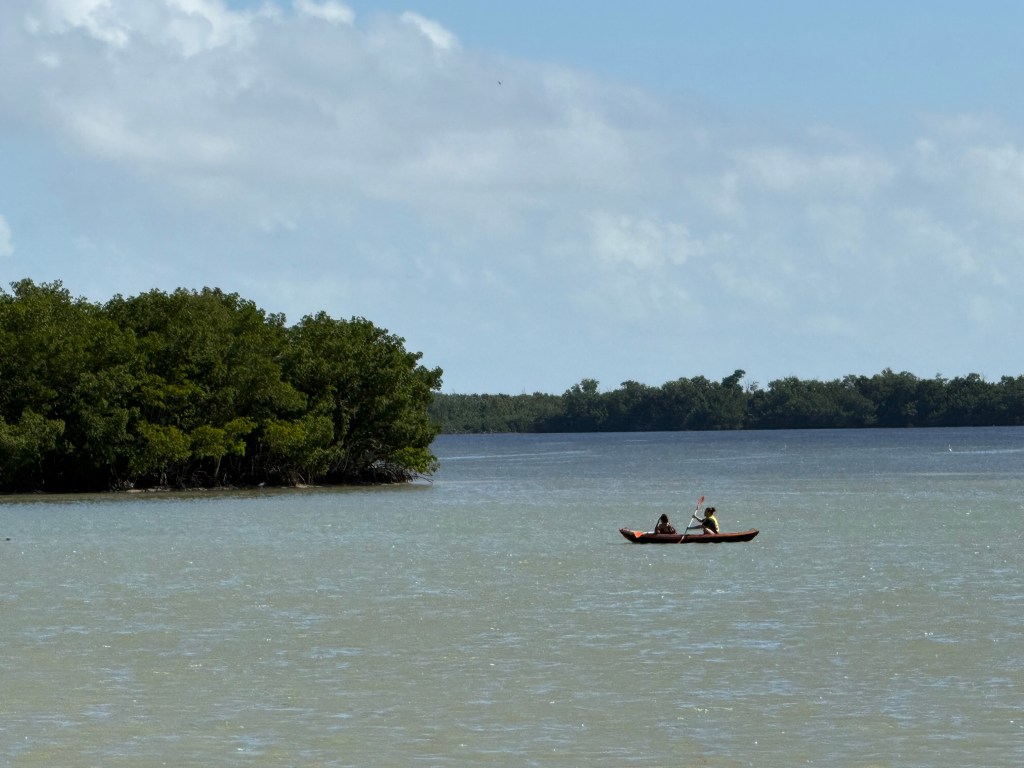
On our way back to the marina, I spotted a young couple in an inflatable kayak paddling the opposite direction, heading toward the heart of the flat. Unless they knew what they were doing, they stood to get stranded in about 20 minutes and stuck there for the next 5 hours. Seeing neither fishing gear nor binoculars, I took them for tourists. I paddled over and asked whether they came here often. “First time” responded the young man in a British accent.
I explained about the tides and the mud, and pointed them toward a channel marker. If they paddled directly to that marker they could spend all day watching birds, sea turtles, and marine mammals from the main channel without getting stranded.
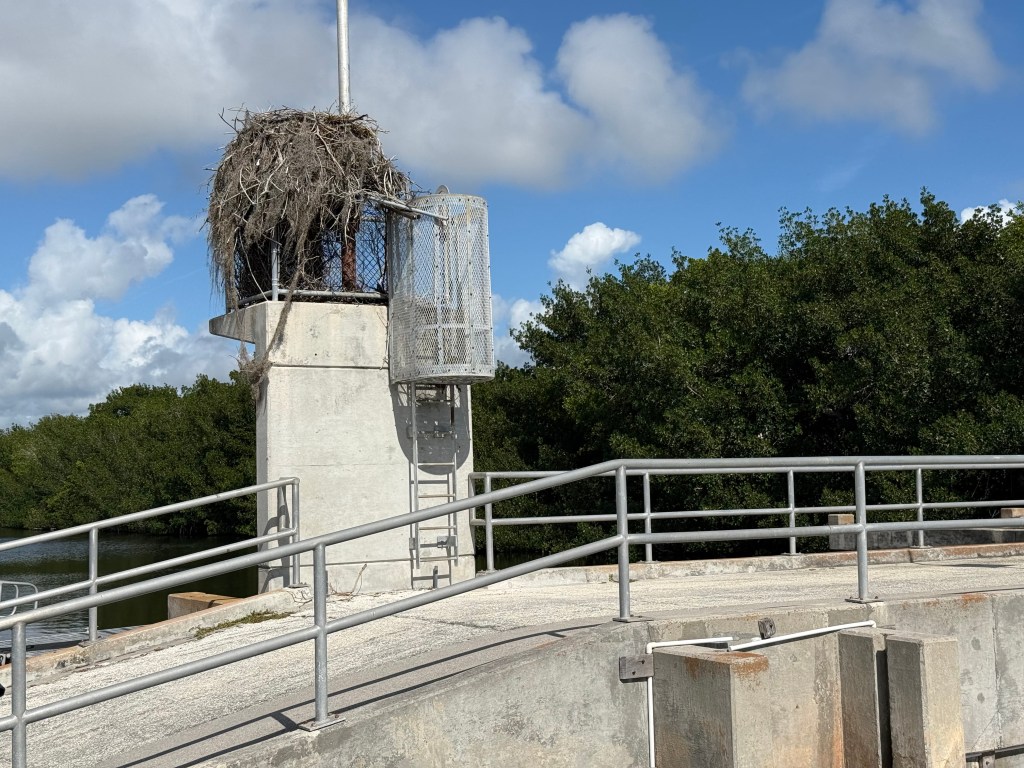
As I packed my gear in the car, I watched another Osprey pair skimming the West Indian Mahogany trees to collect Spanish moss for their bulky nest on the water control lock that separates the Buttonwood Canal from Florida Bay.
Lock Moss Nesters
I ate my lunch while overlooking Florida Bay from the refurbished visitor center. In addition to the wildlife viewing it’s entertaining to watch international visitors enjoying this National Park in their own ways.
Keeping up with Instagram is priority anywhere you go.More my style.
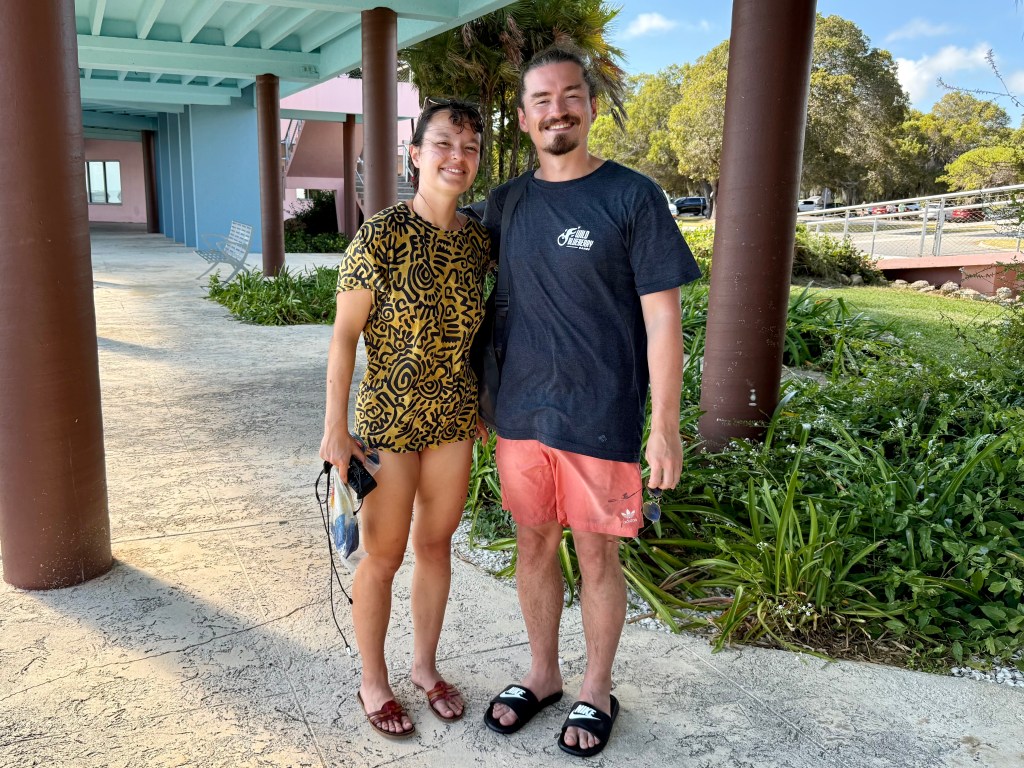
Hey, that’s the same couple in the kayak I saw earlier, now returning from the flats. They pulled their boat ashore and stopped by to say “hi”.
Caroline from Strasbourg and Jason from London.
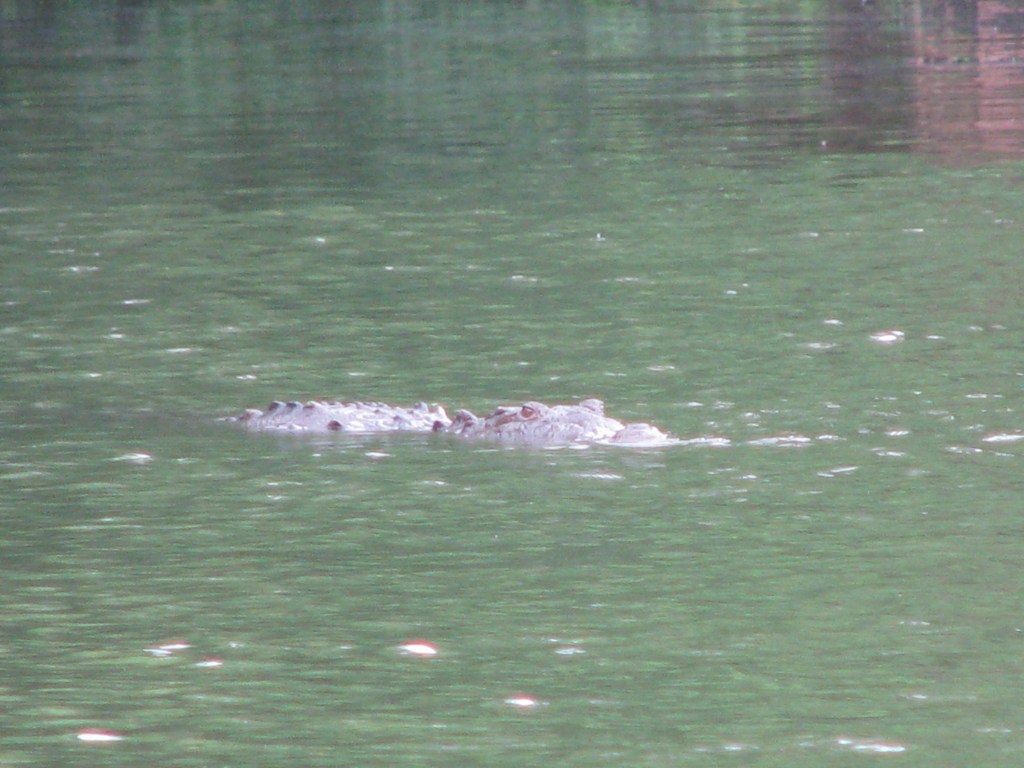
They had decided to head back in after a large American Crocodile surfaced in the channel next to their inflatable kayak.
My photo, not theirs, but you can see why they might have felt unsafe in an inflatable kayak.
Until recently, I’d have told them not to worry about the normally docile American Crocodile, but last summer an experienced fly fisherman told me of a large croc at Flamingo that went airborne in its best attempt to take him off the deck of his skiff.
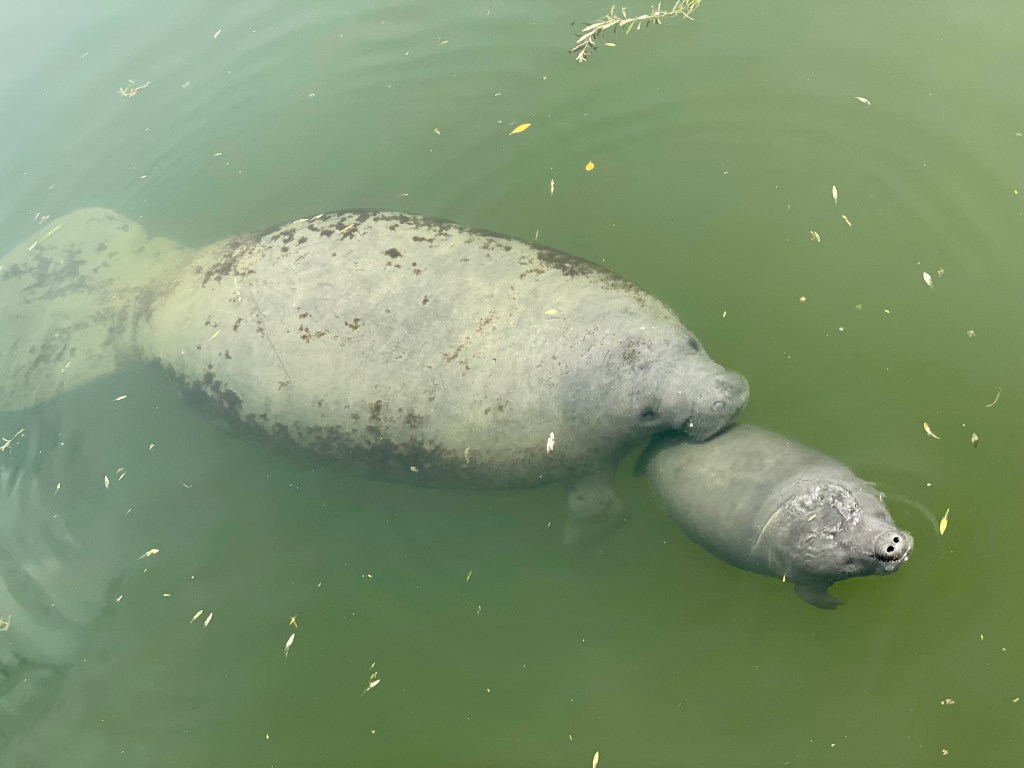
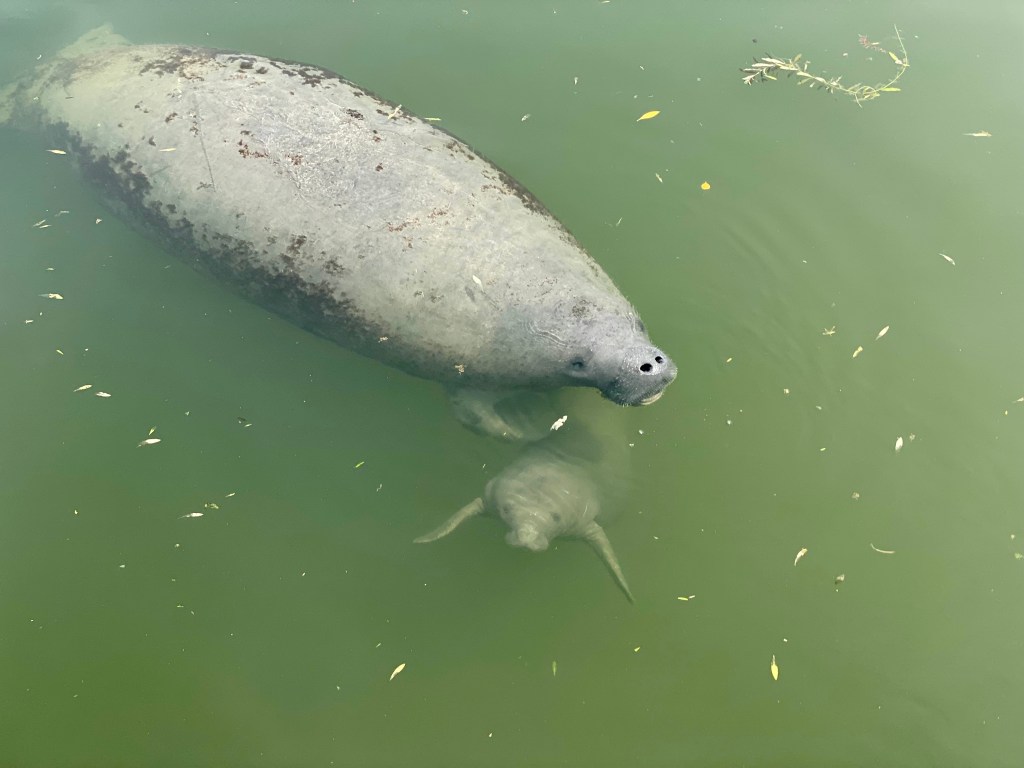
I took Caroline and Jason over to the marina to admire the assembly of mother and baby manatees.
Too cute.
* * *
Pandora’s Flats
A couple of months back, I promised to write an essay about why you shouldn’t fish at Flamingo. The dense mosquito swarms are sufficient reason for normal people to stay away nine months of the year. Risk of stranding on the flats while exposed to sun and lightning should give pause to any sane person. We recently acquired the man-made problem of habituated sharks and crocodiles popping up at random from the opaque water below – recreational fishing boats have trained them well. If you just wanted to fish, you might find an equally productive area with fewer ancillary hazards.
American Crocodile. Note the skinny snoot, Roman nose, and 4th tooth on the bottom that sticks up.
All of these risks have proven insufficient to keep a certain zoologist away. The combination of birds, fish, and scenery will keep me coming back as long as my health and the rising seas allow.