Gray and I drove the EV north from Miami to check in on my parents in Northern Virginia, ages 98 & 91. We made a vacation of it, returning to a rental cottage on the South Fork of the Shenandoah, near the town of Shenandoah VA. The river teams with Smallmouth Bass and there’s paintable scenery everywhere you look.

The river by the cottage was easily wadable when we stayed here two years ago. It was so much fun I stood around in the cold water in my nylon pants until hypothermia set in. I never appreciated a hot tub so much.
This year I’d brought my new waders and wading boots. Arriving in the afternoon, I walk down the steep steps to the river and discover the small floating dock, despite being chained to a big sycamore, had washed away in a flood.
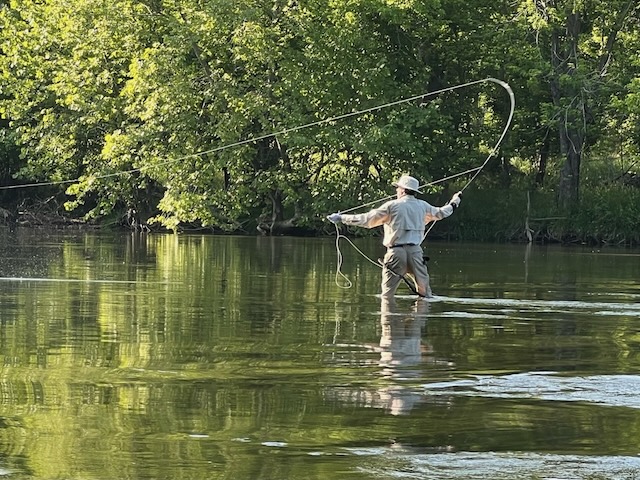
As the sun falls behind the mountain to the west, the hour when the fishing was best two years ago, I don my gear and wade out. The river is a good 2’ higher than before, with a faster current to match. I can wade with care and two hiking staffs, but the prospect of wading all the way across, as I did readily two years ago (photo above), is intimidating. Further, fly casting in that strong a current, while my boot cleats cling tentatively to submerged rock ledges of different heights and angles, is nothing like the relaxing Zen-ish experience I remembered from before.

“There he stands, draped in more equipment than a telephone lineman, trying to outwit an organism with a brain no bigger than a breadcrumb, and getting licked in the process.” Paul O’Neil
On the plus side, the waders keep me dry and warm. Fortunately the house comes with three simple kayaks, and I had chartered a guide with a drift boat for tomorrow, so I don’t push my skill or luck tonight.
Day 1. Drift boat fishing with John Waller
We spend the day floating the river with guide John Waller in his spiffy inflatable raft. Summer has started in Miami, so Gray and I, acclimated to the heat as we are, arrive at the boat ramp bedecked in multiple synthetic layers, while John arrives in a pair of shorts and a light, long-sleeved shirt.
I stand in the bow, Gray sits in the back with her sketchbook, and John mans the oars in the middle, giving me welcome advice on where to cast and how to retrieve.
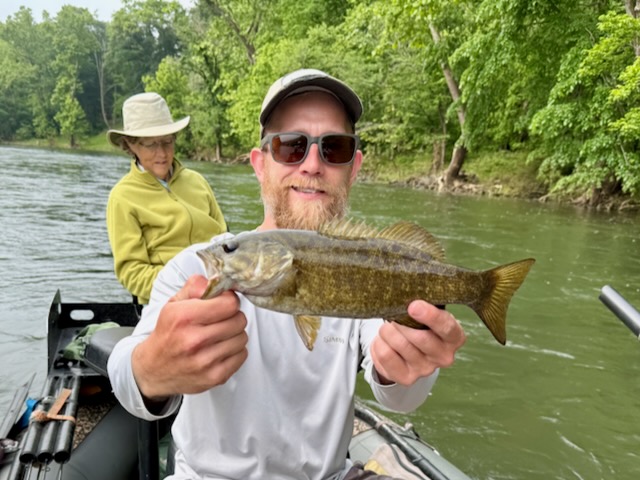
Most of the day I happily cast a topwater frog fly (Umpqua Swimming Frog, 1/0) against the shoreline on John’s lovely Thomas & Thomas 8wt rod, strung with a 2x overweighted line (SA Titan Long). To my delight, I don’t make a complete fool of myself. My experience casting flies under mangroves for snook comes in handy pitching the frog fly under sycamore bows for smallies.

We also mess around with poppers (let it drift, not much popping), streamers (2 hard strips, and a pause), and floating a wooly bugger under an indicator (cast, mend, wait). These setups catch fish, but without question the topwater frog is the most fun. As with dry fly fishing for trout, it’s a hoot seeing Smallmouth Bass rise to the big deer hair frog fly. I especially enjoy watching one that comes up, stares at the fly, then changes its mind… three times in succession.
Around 3 pm, after seven hours of throwing that heavy fly line, my casting hand gives out, so I switch to the other hand. John looks at me and muses: “You waited all day to tell me you can cast left-handed.”
In all, I catch 20 Smallmouth Bass (3 big ones) and three Largemouth Bass (all small). John says that Largemouth are becoming much more common. Warmer times.

Another plus, l learn how to fish the river, or imagine I do.
Forty-five minutes after we get off the water, the weather explodes. Sheets of rain and gale force winds blow down the river. A tornado forms 20 miles north near Luray. Lucky timing for us.

Day 2. more wind

Today is also windy, gusting to 33 mph. Plus my brother Andrew came by to visit. Not a great day for fly fishing, much less from a kayak. Instead we fly Andrew’s stunt kite from a nearby field, fittingly situated on Kite Corner Road.
Pretty cool kite, beyond my capability to handle, but Andrew has it mostly figured out. Check out the video:

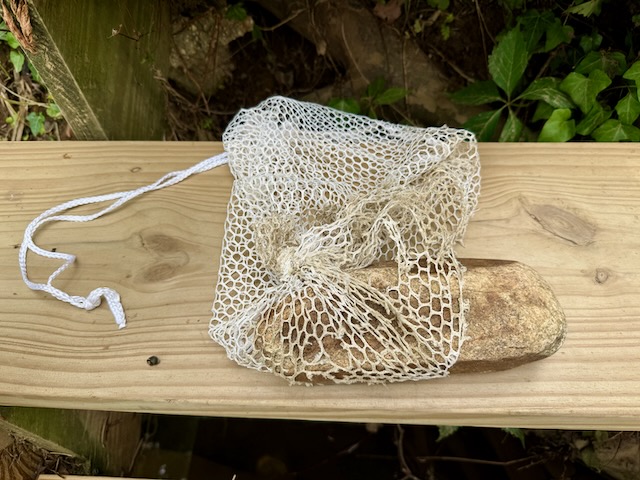
Before sundown, I rig one of the kayaks at our rental with parachute cord and carabiners, lower it down the steep steps, and tie it in the river for tomorrow. I fashion a kayak anchor by putting smooth river stones in a nylon mesh bag that I’d brought along for that purpose. I’ll take the kayak out in the morning and see how I do on my own.
Day 3. Kayak fishing
The air temperature was 49° F when I rose this morning. After seeing my brother off, I put on multiple layers and head out in the kayak to fish the section of river around our rental cabin. Across the river, Wild Turkeys gobble as several deer eye me suspiciously from the bank.
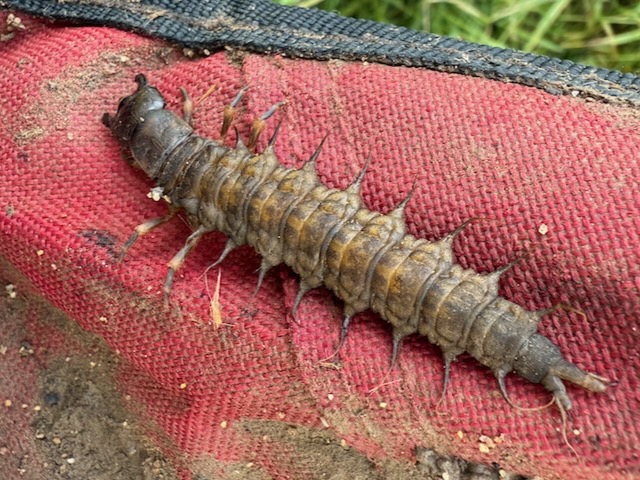
My homemade kayak anchor (v1.0) works OK, but slips a bit in the current. I find more smooth stones on a bar and added them to the bag (v1.1). I also find a folding stool concealing a big hellgramite (Dobsonfly nymph) in between the muddy folds. It crawls into the river, taking its chances with bass unknown over the large creature that I am.
I cast the swimming frog fly under and around every sycamore tree that overhands the river, but cannot get a bite. Ditto for the indicator/wooly bugger rig that John Waller showed me two days ago. This section of river by the house is shallower and faster than the places upstream and downstream where these methods caught fish: the topwater froggy drew bites in slack eddies and the wooly bugger dangling deep under the indicator (a light float) caught fish lurking in deeper holes.
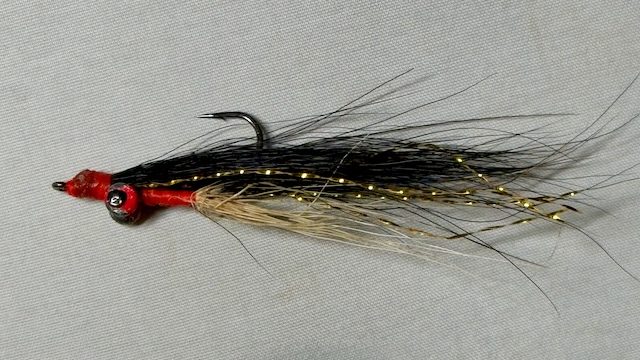
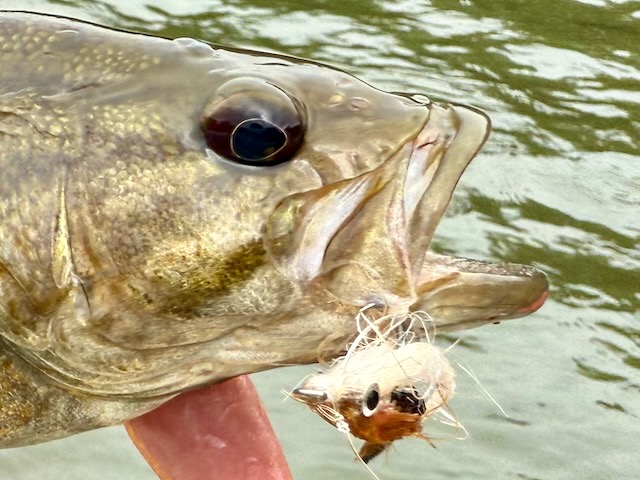
In frustration, I tie on the old faithful black & ginger #6 Clouser Deep Minnow with red eyes and gold flash. That was the fly I used two years ago to catch dozens of small bass in the river. Doink! It hooks up on the first cast. Small fish, but one fish is infinitely better than zero. John Clouser invented this fly for fishing Smallmouth Bass before discovering that it catches everything.
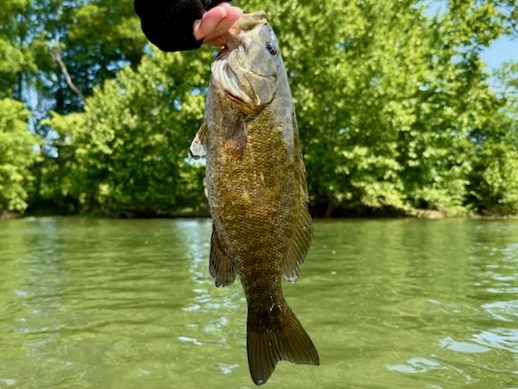
Smallies strike the Clouser 30 feet from shore, retrieved from down current with little strips (strip-strip-pause). The third fish, a big one, comes partway out of the water to take the fly, fighting longer and harder than the one I was holding in the photo above. I switch hands when my right wrist tires, then switch back when my left wrist tires – what a great fish! I’d heard that among North American fish species Smallmouth Bass are the strongest fighters for their weight. Now I believe it. When the fish is close enough to see some flashes in the water, I reach for my landing net and – OH NO – slack line. The fish got off! Rats!
If I’m not fishing for dinner I don’t need to lift a hooked fish from the water to be content, but I do want a good look at it before it takes off. Location noted. I will be back.
Anchor v1.1 worked great this morning until the mesh wore out from dragging along the rocky river bottom, allowing the stones to escape.
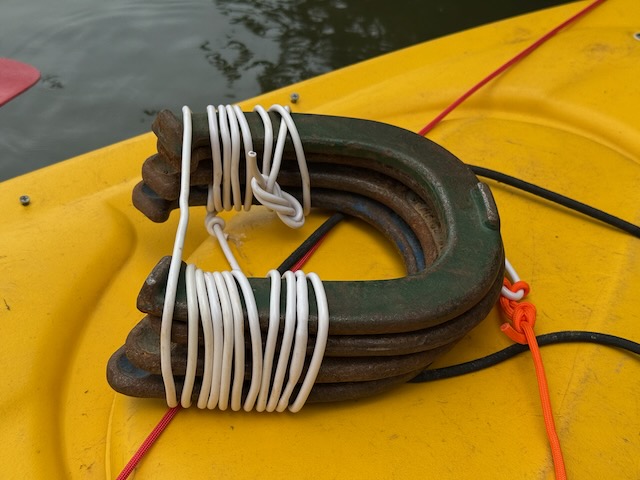
Time for lunch. The owner of the house stops by to survey the storm damage we’d reported to her. She kindly unlocks the shed and invites me to scrounge for anything I could use to McGyver up another anchor. Digging around I find a stack of iron horse shoes, the kind you throw, and some plastic coated wire cable to bind them up. Kayak anchor v2.0.
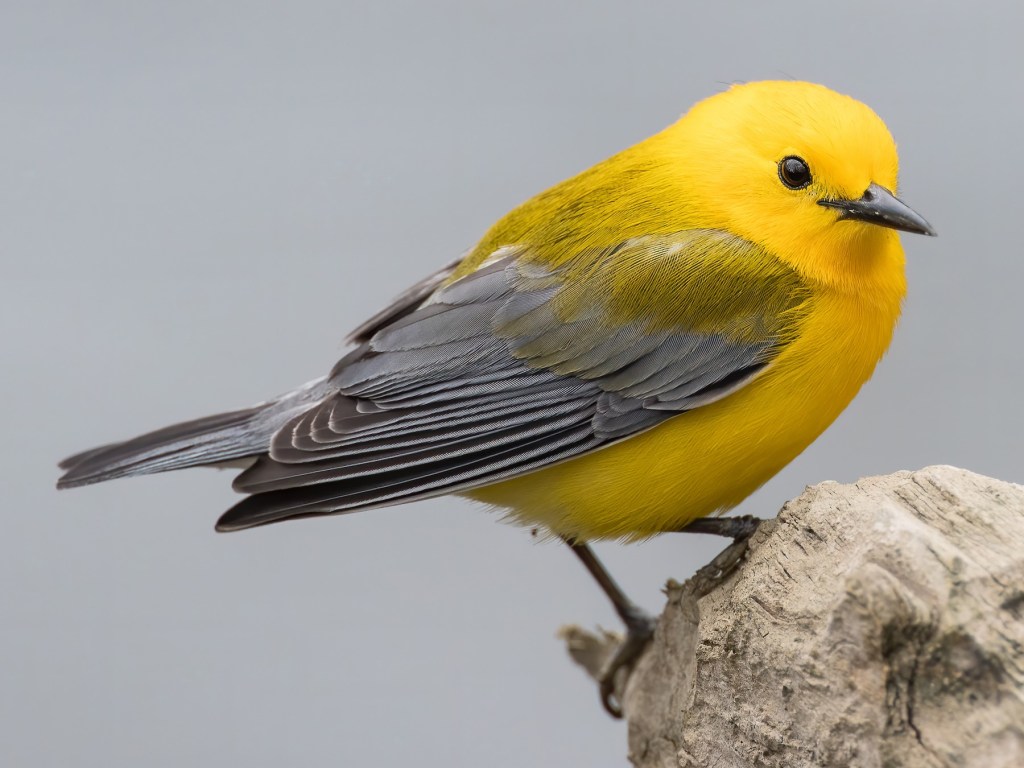
Birding break: I hear a male Prothonotary Warbler singing from a tree near the porch. He cooperates as Gray and I get good views through the binoculars. Quite the looker, described by eBird thus:
“Shockingly bright warbler of swamps and wet forest. Adult males have gorgeous yellow head and body with greenish back and blue-gray wings.”
I attach the horseshoe anchor to the kayak, photograph a Black-nosed Dace (minnow-type fish) in the shallows, and spy on the tame young woodchucks living under the porch.
Two fishermen in a guided drift boat come by, working the shorelines below the house. We exchange the typically terse fishermen’s infochat: “a good morning, slow afternoon, subsurface streamers working best.”
I will have to try casting my untested Black-nosed Dace subsurface streamer patterns against the shoreline.
Late afternoon bird-fish report. Tree Swallows have a nest with babies in a sycamore snag and Baltimore Orioles have a nest in the living part. A Warbling Vireo sings nonstop, but I haven’t found his nest. My first cast of the Clouser catches a fish. A young Bald Eagle flies over in the middle of my next cast. I “Clouser” the kayak while gawking at the eagle instead of minding my backcast. A few more small bass, then a medium-sized one hooked so tight I destroy the fly taking it out with the hemostat.
I needed an excuse to try out my new Black-nosed Dace imitations.
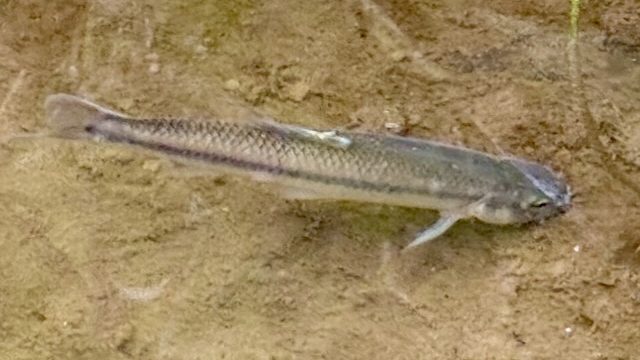
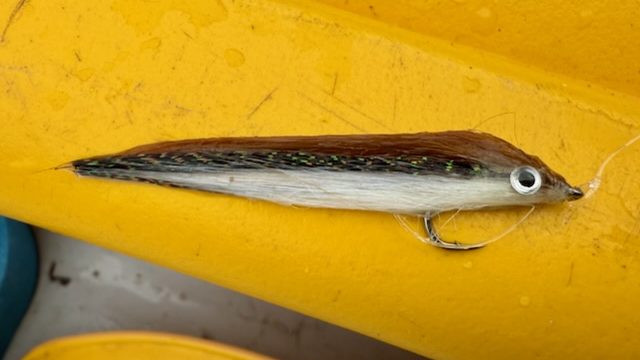
No action on the shoreline but out in the middle, above the rapid line, my dace fly gets a hit every cast. Adding a stinger hook will catch the short-strikers.
After dinner I go back out for the evening rise. Right on schedule the air over the river fills with big brown mayflies, but no fish rise to eat them as they had two years prior. Bobby, a neighbor spin fishing from his deck, tells me that in normal years smallmouth rise to mayflies at dusk, but this year the river is up 2-3’ from the rains and fish habits had changed.
I cover the same sections that had been productive before dinner but cannot get a take. Hurrying back in at 8 pm to join Gray for cold watermelon in the hot tub, I pause to cast at the shoreline and hook up four times. Huh. Maybe river fish move around as much as flats fish do.

Day 4. Working it.
I catch that big smallmouth again, or at least one of similar size in the same spot, on the same fly, at the same time of day, and which puts up the same interminable fight. This time Fishy stays hooked until released.
All day, I only kayak-fish the 1/3 mile section of river in front of the cabin between the class 1 rapid upstream and the class 2 rapid downstream. The upstream rapid was a mere riffle two years ago through which I’d easily pulled the kayak on foot.
I ponder running the lower rapid and think better of it. I am an experienced kayaker, skilled in low braces and competent to roll. I also know that no matter how adroit one is with a paddle, attempting to get over rocky drops in a large-hatched kayak, with no flotation bags or sealed hatches, no spray skirt, no helmet, a heavy unsecured anchor, a floating backpack loosely fastened to the deck, an expensive fly rod between the knees, and no one to assist if something goes wrong, is the epitome of a bad idea. Possibly the anchor gets loose and jams between two rocks, my kayak goes taught against the anchor line and turns crosswise to the current. Secured by the anchor line, the kayak does its very best to tip into the current, filling the open hatch with water and rolling it. Very hard not to break the fly rod. Worst case, I tangle in the paddle leash and/or hit my head on a rock and drown. John Geirach’s friend Archie “A.K.” Best put it this way:
“I enjoy fishing too much to risk my life at it.
Death can really cut into your fishing time.”
An inflatable raft is the way to go.
The day’s final fish count when I quit at supper time is 34 smallies and one Pumpkinseed Sunfish, all caught in the safe span between the rough waters. (I counted the fish I caught in homage to my friend Jay Levine, who always counts his fish.)

Day 5. Downstream
Before we leave for home, I really want to catch another fish on the swimming frog topwater fly that John Waller gave me. I snuffle some more around the shed and find a couple of ratchet tie-down straps. The kayak thus secured on the car’s roof rack, I drive downstream 1.5 miles, bypassing a couple of sets of rapids, to the Grove Hill Boat Ramp (“Boat ramp” might be an Appalachian euphemism for a mudslick bulldozed out of the riverbank). My intent is to look for slack eddies where fish might feel sufficiently rested to attempt a frog.
I spend an hour fishing an eddy shelf 2-4’ deep and 150 yards long. There I catch seven ambitious Pumpkinseed Sunfish and miss a dozen more strike attempts in which the sunfishes fail at stuffing that big fly into their tiny mouths. I don’t see or catch a single Smallmouth – so different from the area near the cabin. I feel like there’s a lesson for me somewhere, but mainly I come away appreciating John Waller’s inflatable drift boat and his proficient oarsmanship.

The next day we drive out, by way of Luray Cavern, which I’d been wanting to see for the past 58 years. Well worth the wait.

© Philip Stoddard
 Eye of the Cormorant
Leave a comment