How can a fisher tell if one lure is better than another?
Say I am fishing and not getting a bite. I see a juvenile tarpon roll and throw a black fly in front of the expanding rings on the surface. I do it four times to four circles. Nothing.
That’s never happened to me, because I change up after three rejections, but say it did.
How do I know whether lack of a bite is because:
(a) I have on the wrong lure or fly,
(b) there’s something wrong with my presentation,
(c) the fish aren’t biting,
(d) or, if I am blind-casting, that the fish are simply elsewhere?
I postulate the problem is (a), tarpon don’t want black flies today, so I clip off my black fly and tie on a white fly.
Next cast, BOOM, I hook up.
I make another cast and hook up again. Ah ha! I’ve found it!
White flies are the ticket. Pretty clever, huh?
Maybe.
Are white flies effective just here and now?
Whenever / wherever the conditions are just like this?
Every day, but just at this place?
Did the tarpon bite finally turn on (right time or tide)?
Or did a couple of naïve tarpon just happen by?
It’s hard to tell.
John Gierach (1988) noted that some fly fishers on The Henry’s Fork of Idaho switch flies regularly, cycling through all their mayfly imitation types (spinners, duns, emergers, and nymphs) until they connect with a feeding trout. Others cast their dry fly spinner imitation to multiple trout until they find the one that’s eating spinners (mayflies that have landed on the water after they finished breeding). Gierach described it as a question of how you want to spend your time on the river: looking down while tying minuscule flies onto a thin leader with tiny knots, or looking at a pretty river and fly casting.
But my point is that it’s hard for us fishers to know what we know.
Worse, a nerd like me sets out to enjoy himself on a beautiful day in nature and stumbles headlong into the tar pit of epistemology, the branch of philosophy that explores the nature, origin, and limits of human knowledge.
Back home, seeking enlightenment, I watch an online video where some fishing pro sets out to see which of two lures works best, perhaps two artificial shrimp, the new pink variety (lure A) or the old original shrimp-colored variety (lure B). He throws the two lures in alternate bouts of five on two identical fishing setups. Being scientific here.
Our pro gets a couple of bites on the original (B) but FOUR bites on the new pink one (A), including a really nice fish. The pink lure outperformed original color by a factor of two.
But the difference in effectiveness of the pink lure found in that video might not have been real. I don’t mean anyone faked the results, I mean that I know, in the back of my head, that a higher catch rate on one of two lures that day might not have been caused by the superior color, but by chance, like a run in a string of coin flips or rolls of the dice. Brings to mind Abelson’s 1st Law: “Chance is Lumpy“ (Abelson 1991).
Here’s the question that our pro ought to have asked before posting the video: “What is the likelihood of getting a result that extreme (i.e., twice as good) or more extreme (better than twice as good) by chance alone?”
To figure it out, I could do some probability math or write a quick computer simulation to estimate the odds of getting at least a two-to-one success ratio for six fish caught by two identical lures, just by chance.
I opt for the simulation because I enjoy programming. I have my computer do six virtual coin flips:
[heads = lure A catches the fish]
[tails = lure B catches the fish].
And, to make it accurate, I’ll repeat the test an astronomical number of times and take the average (computers are fast). Here are the results for Lure A:

What do we have here… First, I see a bell curve, as expected.
Lure A catches zero fish 2% of the time, one fish 9% of the time, two fish 23% of the time, half the fish (three) 32% of the time, and so on, eventually catching all six fish 2% of the time. A graph for lure B, not shown, would be the left-right mirror image: when Lure A catches zero fish, Lure B catches all six, and so on.
How impressed should we be that the pink lure (A) did twice as well as the gray one (B)? In my simulations it caught four of six fish 23% of the time, five of six 9% of the time, and all six fish 2% of the time.
23% + 9% + 2% = 34%
So roughly a third of the time, by chance alone, the new lure A will perform at least twice as well as the old lure B. Likewise, lure B will perform twice as well as lure A another third of the time. So 2/3 of the time we can expect one of the two lures to outfish the other by at least two-to-one. Just one third of the time they’ll perform similarly.
Four percent (2% + 2%) of the time, one fishing trip in 25, one lure or the other will totally clean up, catching all six fish while the other delivers a resounding skunk (see Vantesall et al. 1991, “Removing Skunk Odor”, citation below).
I might have just wasted my money on that new lure color.
But suppose that instead of spending just $7 on a pack of the new pink lures, my brother and I are making an important commercial decision, “Should we invest serious money in developing this new lure color for the marketplace?”
In theory, I suggest, we have to decide whether we’re willing to be wrong, given the high odds that there’s no real difference in effectiveness.
But then my brother reminds me that commercial success of a new lure depends on hooking fishermen rather than fish. It doesn’t matter if the new lure is actually better. As long as it looks great and works roughly as well the old one, our customers will be happy.
Plus, everybody with more experience than me knows that pink works for Redfish.
A few years ago, one of my favorite tackle vendors proudly touted their new pink lure as being especially attractive to Redfish. They even gave it a name to indicate its effectiveness “FRED: Fooling Redfish Everywhere Daily”. I want to fool Redfish too, so I clicked the link and ordered the new pink ones. Here they are, the old shrimpy one, and the new pink one:

The wise folks at my local tackle shop likewise swear by pink for Redfish: pink Rapala X Rap lures (bought one) and pink flies (tied some).
Then I discovered that the Redfish visual system doesn’t extend to the red end of the color spectrum. Redfish don’t have a cone receptor in their retina that’s stimulated by wavelengths longer than orange (Horodysky et al. 2008). Anything red, lacking a sensitive receptor, appears as black to them. Pink, a diluted red, appears as gray. That means Redfish cannot distinguish my pretty pink lures and flies from the shrimpy old gray ones. DOINK!
But humans see the difference, so merchants sells a lot of pink lures.
I don’t feel too bad, though. I justify my resources devoted to pink shrimp lures & flies because my beloved Bonefish, unlike Redfish, Snook, and Speckled Seatrout, actually do see red, so pink stands out to Bonefish in the waters I fish on the west side of Biscayne Bay. Here, with an N=1, is definitive proof that pink gets it done.


What are the chances a shrimpy-colored or silver one would have caught that same fish? I want to think that pink did the trick, my gut tells me about 99%, but I really have no way of knowing.
Side note: I prefer to throw flies at Bonefish because it makes the difficult into the borderline impossible, but these photos were taken when I was forced to use my spinning rod after snagging and breaking the tip of my fly rod on a “No Fishing” sign.
On a recent visit to Virginia, Smallmouth Bass guide John Waller mused to me how local fly fishers swear by the Shenandoah Blue Popper, despite all the research showing that Black Bass (including the Smallmouth) don’t see wavelengths as short as blue.
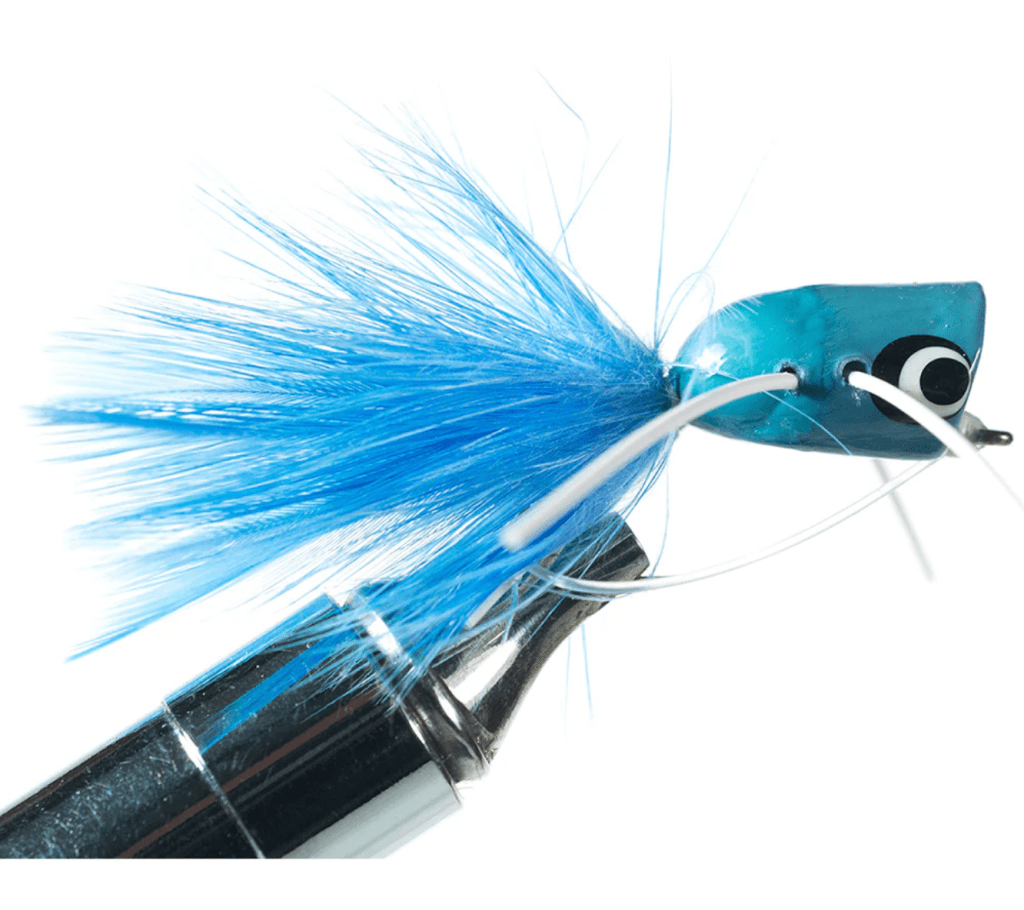
This pretty blue popper looks gray to the bass. Apparently they’re just fine with neutral gray while bass fishers themselves strongly prefer blue.
If it’s hard to figure out what a fish will eat, it’s sometimes easier to figure out what they won’t eat. For instance, when fish are heavily pressured, they learn to avoid familiar things bearing hooks. Changing color can help. And pressured fish get spookier to presentation: lures and flies with less splash do better on wary fish. Natural selection.
Then there’s my friend, Andy Hong, who catches redfish on sautéed broccoli. For real. He’s posted the recipe.
In short, I have not yet seen the justification for all the cool lures and flies in my possession. At most, three shades of each lure or fly would probably set me up for life: light for clear water, dark for nighttime or tannic water, and medium-shaded for when the fish get wise to black and white. And maybe last night’s broccoli if I’m getting skunked.
Here’s my takeaway: If you find it more fun to mess with the new lures and flies go for it. If you want to stick with your old lures and flies, go ahead – the guys who outfish me regularly do so on their old favorites for a whole lot of reasons having nothing to do with lure selection.
Crawling from the tar pit, I realize that I am still only pretending I know what I’m doing.
Tight lines, friends.
© Philip Stoddard
Literature Cited
Abelson, Robert P. (1995) Statistics as Principled Argument. Psychology Press, New York. https://api.pageplace.de/preview/DT0400.9781135694425_A24427578/preview-9781135694425_A24427578.pdf
Gierach, John (1988) “Big Empty River” in: The View from Rat Lake. Pruett Publishing Co., Boulder, CO
Horodysky, A. Z., Brill, R. W., Warrant, E. J., Musick, J. A. and Latour, R. J. (2008). Comparative visual function in five sciaenid fishes inhabiting Chesapeake Bay. Journal of Experimental Biology 211,3601-3612. https://doi.org/10.1242/jeb.023358
Vantasell SM, Hygnstrom SE, Ferraro DM (2011) Removing Skunk Odor. NebGuide, Univ Nebraska, Lincoln Extension, Institute of Agriculture and Natural Resources. edu/publication/g2100/2011/pdf/view/g2100-2011.pdf

 Eye of the Cormorant
Leave a reply to hooknfly Cancel reply