Peas porridge hot. Peas porridge cold...
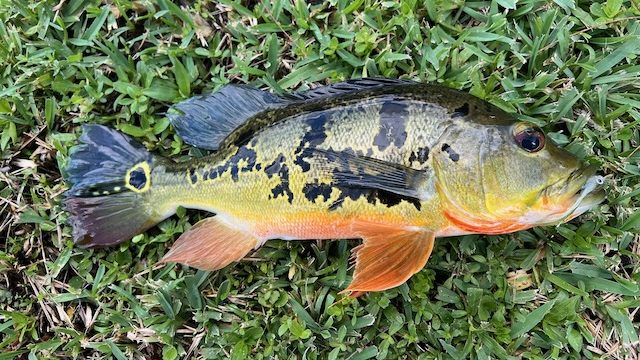
The Butterfly Peacock Bass (Cichla ocellaris), or “pea” for short, is not a bass at all, but rather a cichlid (pronounced “sic-lid”) from the Guianas and Brazil.
In our version of the song “I know an old lady who swallowed a fly” Peacock Bass were introduced to South Florida waters to control the Oscar, an invasive exotic cichlid from Africa. Now we have plenty of both.

These exotic cichlids are fine game fish: strong, ferocious, and beautiful. Most people fish for them with live bait. Peas are partial to shiners, but I chase them with a 5-weight fly rod.
Like most pressured fish, peas in public waters become educated and discriminating. They’ve seen it all. The farther from a road one ventures into the Everglades, the easier it is to catch them. But late last December, a hard cold snap hit the Everglades waters and killed 98% of the peas. These tropical beauties survived in the warmer urban canals and lakes, but it will take a few years for them to recolonize the Everglades.
Though it’s hard to beat fishing in the Everglades, I had a backup spot for peas at a private suburban lake in a gated community not far my house. Two sets of friends reside there and grant me access. The lake is posted “no fishing”, but folks fish off their backyard docks, and nobody minds me fishing the heavily treed east side, since I release what I catch. One resident told me: “That’s a FLY ROD. You have my utmost respect.” Ooo.

The peas on this lake have gotten steadily fussier, but since I’m the only one tossing flies at them, I probably have no one to blame for their education but myself.
In the beginning, they’d readily devour an olive-over-orange Clouser Deep Minnow, even competing to be the first to grab it.
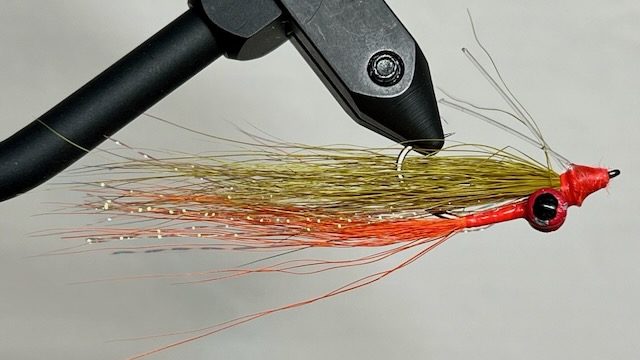
Then the magic wore off. My “can’t fail” fly would get weak follows, but no eats. In frustration, I devised a fly that looked like a baby Mayan Cichlid, one of the pea’s favorite treats. Sometimes on a cold day, a sluggish pea would take that big fly, thinking it a big reward for a small effort. Wrong this time, but generally a winning idea.
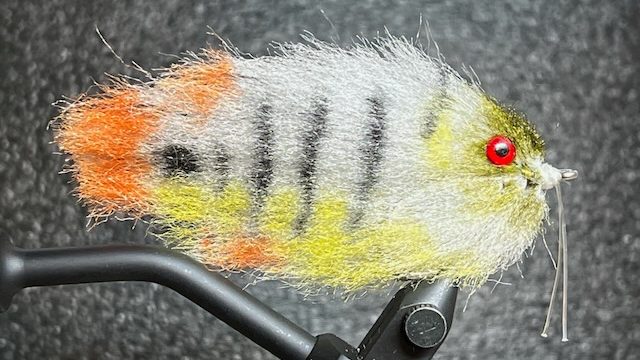
Yes, I pretend to know what fish think. Some fish, some of the time. I studied fish behavior for 35 years, long enough to learn some things about their thought processes, and long enough to be unsure about anything I think they think.
[Ursula Le Guin noted: “Few people know what fish think about injustice, or anything else.” ]
When the peas stopped eating my flies altogether, it was time to pay closer attention to what they WERE eating.
They were stalking and ambushing mosquitofish shoals.
A famous fly pattern already existed for mosquitofish. Mike Connor invented his Glades Minnow fly to catch snook and juvenile tarpon feeding on mosquitofish in late summer and fall along the Tamiami Trail. But, since every fish in the Everglades eats mosquitofish, it worked on those too.
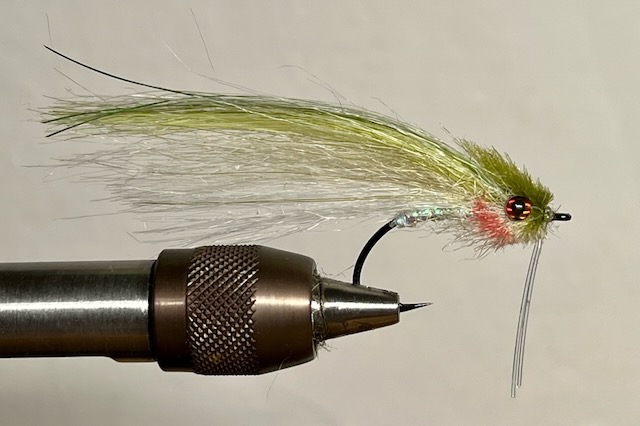
I tried Connor’s Glades Minnow on these peas, and it worked great for about two days, then zip.
How does this happen? There must be something like 400+ mature peas in this lake. If I catch 20, I can see those 20 not eating the same fly again. But why do the other 380 now refuse it as well?
Maybe they learn from their friends. My grad student, Ben Sager, studied observational learning among fish in the lab (mosquitofish, no less) and found that they do learn about safe food sources from their buddies. Other researchers have found similar effects in other fish species.
Alternately, maybe these 380 peas were already “line shy” from a prior encounter with a different fly or a lure fished from a dock, and wouldn’t have eaten this fly or any other tempting object dragged behind a fishing line. Even if one fishes super-transparent lines (e.g., thin fluorocarbon) a fish can use their mechanoreceptor system (neuromasts in the head and the lateral line system that runs the lengths of the body) to feel the water disturbance caused by those lines. One get more eats on thinner lines, but more break-offs too.
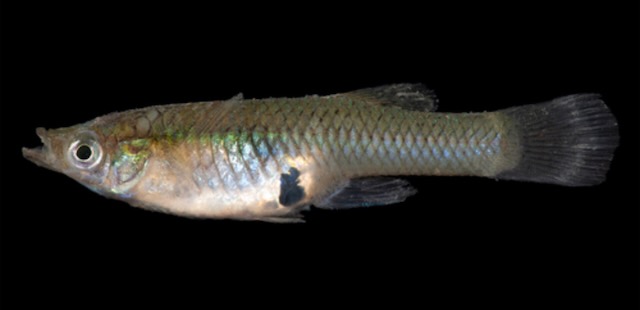
Not ready to give up, I spent the next couple of months devising and testing a fly that’s converging on a near perfect mosquitofish mimic. To make it more tempting, I chose a pregnant female mosquitofish as my model (photo above). Mosquitofish are live bearers, like their relatives the guppies and mollies. Pregnant ones are slower and extra nutritious.
The fly’s construction borrows from the Clouser Deep Minnow and the Glades Minnow, with a few unique features that better match the real thing.

Once I got the size and details right (small with concealed flash to reproduce the abdominal iridescence), the fly worked brilliantly. It didn’t matter how I fished it. The fly could swim casually, take off in a panic, sit on the bottom, or hang motionless in the water column – a big pea would grab it.
I’d even go back and try other flies for comparison and the peas would ignore those while still eating the mosquitofish fly.
Other fish species liked it too. Everything eats mosquitofish.

And then it happened. The peas stopped eating this fly too.
This morning, for example, I probably saw 30 peas, but no pea would even approach the fly unless it swam away from them in apparent fear. Of the first five that took the escaping fly, I caught zero. They were short-striking, a sign of hesitancy. I caught other fish on the same fly with no difficulty: Midas and Mayan Cichlids and a Bluegill Sunfish.
It took two hours to get a couple of big peas to take the fly in full eat mode. By that time I was sweaty, had retrieved flies from underwater snags and overhead branches, had scraped my arm sliding down the slippery layer of casuarina (Australian pine) needles on the bank, had cinched a tight figure-8 knot in my leader, and my last two flies had been chewed to bits. The usual wear & tear.
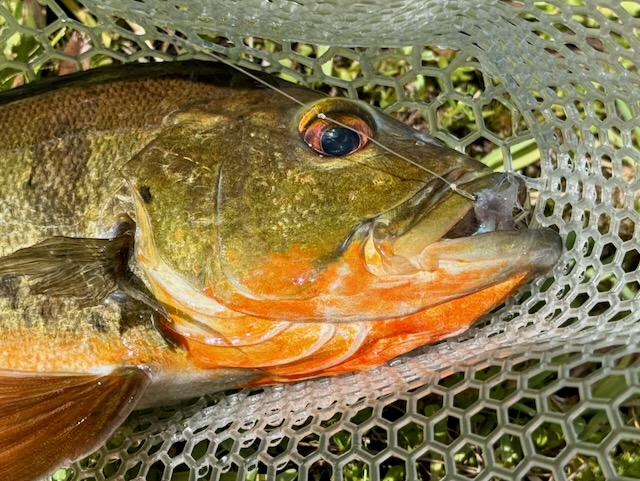
Another possibility is that the peas aren’t eating mosquitofish right now. The lake is full of baby cichlids, all of which have grown larger than the dinky mosquitofish, so perhaps those are top summer fare. Come winter, mosquitofish may return to the menu. Fingers crossed.
I am planning to uncross my fingers and tie up another batch of mosquitofish flies. Not being one to underestimate the power of education, I can’t help wondering if they have a future.
© Philip Stoddard, 2025


 Eye of the Cormorant
Leave a comment