
As a rule, backcountry alligators avoid people, while those dwelling in human-infested waters learn that associating with humans can provide an easy meal.
Feeding alligators is a very bad idea, though alligators in this second group believe that feeding alligators is a very good idea. They hold that the highest calling of human newcomers to the swamps is to catch big fish and feed them to deserving alligators. These alligators can be bold, aggressive, and very dangerous. If you toss a rock at one to scare it off, it assumes you are throwing food and comes closer.
I fly fish tarpon in the tidal creeks and ponds along the Tamiami Trail, Florida Route 40 (“The Trail”), about 70 miles west of Miami.
Last year, two human-adapted alligators ran me out of a productive pair of ponds. The smaller gator, an 8-footer, even came out of the water and chased me overland in a bid to snatch the tarpon I’d caught and had intended to release unharmed. Sprinting from a gator with a 10 pound tarpon in your arms is an effective cardio workout. I always think back on that morning when people tell me “I want to take up fly fishing – it looks so relaxing”.
The ponds along the Trail do hold a lot of fish, but I cannot manage a big fish and fend off a bold alligator at the same time. I needed a way to convince the gators to leave me alone before I would fish there again. I needed a partner. A brave partner with experience in the ways of alligators.
I met Gabriel Ross through an online fishing club. In time I learned that Gabriel knows a lot about freshwater fishing in South Florida. He fishes the Trail regularly and has both a sunny disposition and a high tolerance for mosquitoes. Importantly, Gabriel is not unhinged by alligators, which he has fished around all his life. Just the fellow I’d wanted to meet.
On our first fishing trip together, I brought along two special items. The first was a new net with a long handle and silicone mesh, ideal for lifting big fish clear of the water quickly and gently. I don’t want to fall in the drink with a hungry and excited alligator moving in, and I don’t want to let a precious gamefish bounce around on the ground. Nothing annoys me like seeing video on YouTube featuring some proud, clueless asshole letting a tarpon flop around in the rocky dirt or on the pavement while he gropes around trying to unhook it. The second item was the 18’ carbon fiber push pole from my skiff, already proven useful for poking nosy sharks on the flats. Eighteen feet seemed like a good minimum distance to maintain between myself and a hungry alligator. I’d replaced the push pole’s sharp metal point with a flat-tipped cone 3D-printed of polyurethane, so a hard poke from the pointy end would not make a hole in the recipient.
Gabriel and I met up at dawn at the appointed pond on the Tamiami Trail. As Gabriel set up his minnow trap, an alligator began to move out of the mangroves. More and more of it. It was massive, 9’+, and it was coming towards us.
At 18 feet and closing I made my move. Holding the push pole aloft with a firm grip on the broad shoe end, I let the other end fall two feet through the air onto the alligator’s head with an audible clunk.
A gator this big is never challenged. He wheeled around and snapped at the push pole. I whipped the pole upwards in time to save it, and again dropped it on the alligator’s head – BONK!
The gator wasn’t scared, he was pissed. He turned to face me, opened his mouth, and hissed. My next two strikes were a couple of sharp, well-placed pokes in the nose. Inspection of an alligator’s skull shows the nose is bony, not soft like a shark’s. Still, you’d think it would make an impression to have an 18’ pole thrust directly onto the tip of one’s nose, reinforced or not.

The alligator went underwater, but did not flee. Two sharp nudges in the ribs finally convinced him he was not going to be left alone, much less fed a snook or a tarpon, and he reluctantly departed.
Cool as a cucumber, Gabriel never batted an eye throughout the commotion, quietly tending his minnow trap and bait bucket and re-rigging his spinning rod for bait-fishing. Only when he stood up did Gabriel mention that he carries a handgun to fire into the ground if a gator comes too close. Gators, he explained, are frightened off by the noise. Me too. Glad he told me before he had need to use it.
With the big guy gone, the pond’s usual resident gator, a 6-footer, came out of the mangroves and swam up to us.

It only took three pokes to send her to a far corner of the pond, where she found something else to eat (num num num). She stayed far away from the two-legged maniac with the push pole and from Gabriel’s minnow trap. Minnow traps are a favorite snack food of alligators.
Oddly, the tarpon that are always common in the ponds north of the Trail were largely absent. I gave up pitching flies for missing tarpon, and got my first lesson in bait-fishing freshwater snook on the Trail.
Bait
The African Jewelfish (Hemichromis bimaculatus), also known as the Jewel Cichlid, is an invasive exotic from the pet trade. My former doctoral student, Vanessa Trujillo, studied Jewelfish in the Everglades. Vanessa found that African Jewelfish beat up the small native fish species during the spring drydown, which they can do because they’re tough and mean. Jewelfish outbreed native fish in rainy summer floods because they have biparental care that ensures better survival of their offspring.

African Jewelfish are abundant in these ponds, so snook are already cued into looking for them. Because jewelfish are tough, they hold up well as bait until a snook eats them. Gabriel finds jewelfish easy to catch in a minnow trap baited with stale, week-old brioche. Bien sure.
Gabe recommended connecting the jewelfish’s lower lip to a 4/0 circle hook. Circle hooks have the point concealed inside the hook gap, so when a predator fish swallows the bait (bye-bye jewelfish), the hook does not lodge in the predator’s stomach, but slips free until it encounters the jaw, yielding a clean hookset. An additional trick I learned from Chico Fernandez’s book on bonefish is to press down the very tip of the hook barb rather than pressing the whole barb flat or leaving the barb intact. The goal is to leave the barb shaped as a bit of a hump; it hooks up more reliably this way and makes it possible to remove the hook without tearing anything.
Time to fish
Gabriel tossed his Jewelfish bait into the pond and quickly connected with a hefty snook. Gabe barely kept her out of the mangroves but finally got her in range of my spiffy new net.
Mrs. Snook measured out to 28.5”. She would be the biggest of the day. I took a quick photo then Gabe put her back in the water across the road so our alligator friends wouldn’t grab her before she regained full orientation and composure. It’s a short swim from there back to the pond.
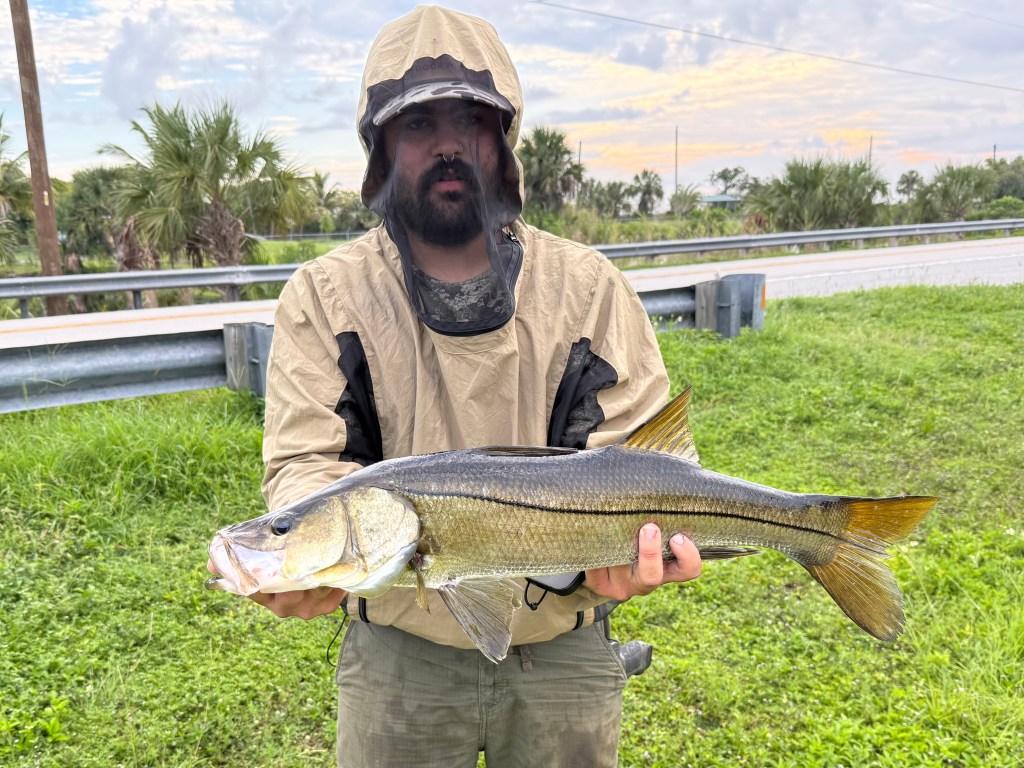
Snook are protandrous, meaning they start life as males and change to become female, transitioning when they reach 25-27 inches or so. Every badass snook is a trans female.
I caught a couple of snooklets in the pond in quick succession before catching a Florida Soft-shelled Turtle. Ugh. Gabe caught a big Florida Gar. Lots of teeth and smelly slime – double ugh. The slime left in my net attracted fire ants. One got inside my shirt and stung me. I hate fire ants – triple ugh.
We could hear snook under the bridge making audible pops as it or they snatched small fish from near the surface. Gabriel lay on his stomach and pitched jewelfish into the slim gap under the bridge.
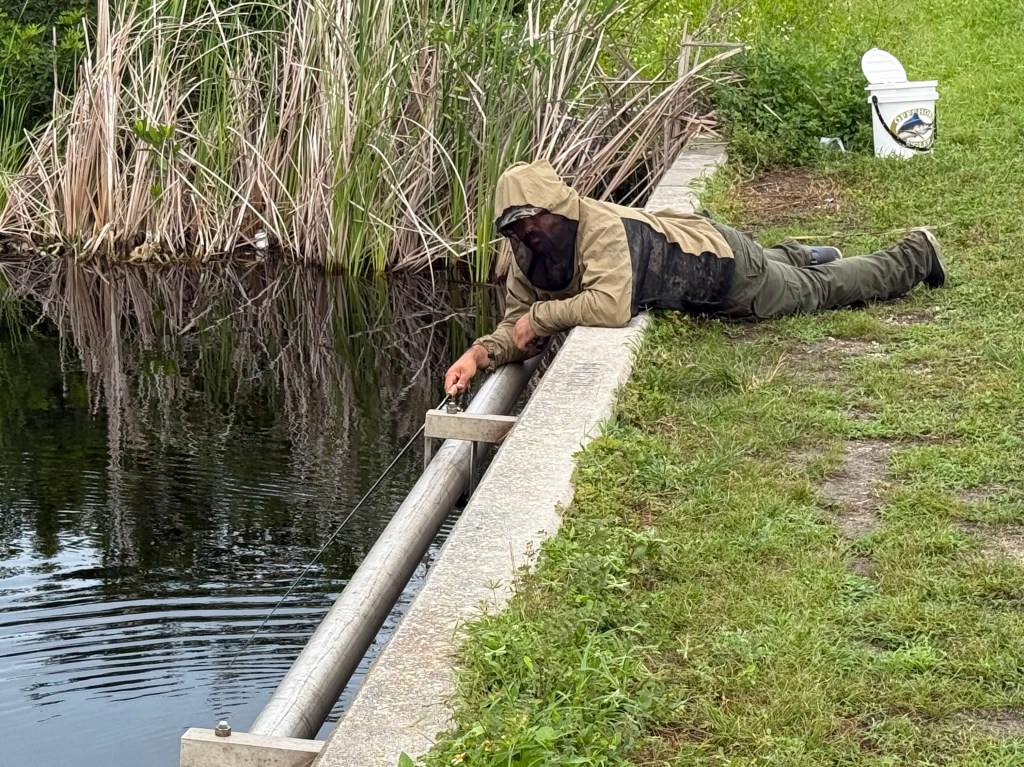
We caught several more snook that way.
In time the mosquitoes let up enough that we could take off the armor.
At 10 am, a wall of white appeared in the East. We had just enough time to dive into our cars before the rain squall hit. As is typical in the Everglades, the rain passed in half an hour, cooling the moist air and leaving enough cloud cover to darken the sky a bit. Perfect conditions for Black Salt Marsh Mosquitoes to come back out.
We fished a few more creeks along the Trail. I’d never caught a fish at my favorite kayak put-in spot, but it always looked promising. Turns out the bridge there was stacked with snook eager to nosh on jewelfish.

At another spot Gabriel knew about, I finally caught a sparkly young tarpon that took a jewelfish snack.

I also caught a blue crab. Everything eats jewelfish.
A second rain squall further improved conditions for mosquitoes.
We returned to our starting point. There, without warning, the water erupted in an explosion of snook. A mob of them had roared out from under the bridge all at once and raided a school of jewelfish or mollies – I couldn’t identify the prey in the mix of froth and silver.
I don’t think I’ve done justice to the summer mosquito experience in the tidal mangrove swamps lining the western end of Tamiami Trail. As challenging as the alligators are to fish around, the summer mosquitoes in the mangrove ponds and creeks are just as bad, but in their own way. Alligators are finite while mosquitoes are infinite.
Beyond sheer annoyance, the Black Salt Marsh Mosquito is a known carrier of Eastern Equine Encephalitis (EEE) and Venezuelan Equine Encephalitis (VEE). I lost a colleague to mosquito-borne encephalitis my first year at FIU. Because of the potential for contracting a lethal virus it’s best to minimize the number of bites one gets. Gabriel and I wore semi-breathable mosquito suits dosed with the repellant picaridin, a plant-derived product that doesn’t dissolve synthetic fabrics, fishing gear, or car seats. The bug suits work, but South Florida summers are hot enough as it is without adding a second layer to further restrict air circulation.
I’d like to wear a GoPro camera to capture some of the action, but a camera mounted on my hat doesn’t work under a bug net and a chest strap mount would create constriction points in my clothes for mosquitoes to bite though.
Am I trying to convince you to stay away from my fishing spots? Yes, but I’m not exaggerating about the contents of Pandora’s box you encounter on the Trail 9-10 months out of the year.
I enjoyed fishing with Gabriel because he’s good company and is supercool around alligators. He liked fishing with me because I could handle the mosquitoes. It’s too beautiful out there to spend your day with someone who complains about nature.

© Philip Stoddard


 Eye of the Cormorant
Leave a reply to Michael Beecher Cancel reply